近日,项目中有一个耗时较长的Job存在CPU占用过高的问题,经排查发现,主要时间消耗在往MyBatis中批量插入数据。mapper configuration是用foreach循环做的,差不多是这样。(由于项目保密,以下代码均为自己手写的demo代码)
<insert id="batchInsert" parameterType="java.util.List">
    insert into USER (id, name) values
    <foreach collection="list" item="model" index="index" separator=",">
        (#{model.id}, #{model.name})
    </foreach>
</insert>
这个方法提升批量插入速度的原理是,将传统的:
INSERT INTO `table1` (`field1`, `field2`) VALUES ("data1", "data2");
INSERT INTO `table1` (`field1`, `field2`) VALUES ("data1", "data2");
INSERT INTO `table1` (`field1`, `field2`) VALUES ("data1", "data2");
INSERT INTO `table1` (`field1`, `field2`) VALUES ("data1", "data2");
INSERT INTO `table1` (`field1`, `field2`) VALUES ("data1", "data2");
转化为:
INSERT INTO `table1` (`field1`, `field2`)
VALUES ("data1", "data2"),
("data1", "data2"),
("data1", "data2"),
("data1", "data2"),
("data1", "data2");
在MySql Docs中也提到过这个trick,如果要优化插入速度时,可以将许多小型操作组合到一个大型操作中。理想情况下,这样可以在单个连接中一次性发送许多新行的数据,并将所有索引更新和一致性检查延迟到最后才进行。
乍看上去这个foreach没有问题,但是经过项目实践发现,当表的列数较多(20+),以及一次性插入的行数较多(5000+)时,整个插入的耗时十分漫长,达到了14分钟,这是不能忍的。在资料中也提到了一句话:
Of course don't combine ALL of them, if the amount is HUGE. Say you have 1000 rows you need to insert, then don't do it one at a time. You shouldn't equally try to have all 1000 rows in a single query. Instead break it into smaller sizes.
它强调,当插入数量很多时,不能一次性全放在一条语句里。可是为什么不能放在同一条语句里呢?这条语句为什么会耗时这么久呢?
我查阅了资料发现:
Insert inside Mybatis foreach is not batch, this is a single (could become giant) SQL statement and that brings drawbacks:
Iteration over the collection must not be done in the mybatis XML. Just execute a simple Insertstatement in a Java Foreach loop. The most important thing is the session Executor type.
SqlSession session = sessionFactory.openSession(ExecutorType.BATCH);
for (Model model : list) {
    session.insert("insertStatement", model);
}
session.flushStatements();
Unlike default ExecutorType.SIMPLE, the statement will be prepared once and executed for each record to insert.
从资料中可知,默认执行器类型为Simple,会为每个语句创建一个新的预处理语句,也就是创建一个PreparedStatement对象。在我们的项目中,会不停地使用批量插入这个方法,而因为MyBatis对于含有<foreach>的语句,无法采用缓存,那么在每次调用方法时,都会重新解析sql语句。
Internally, it still generates the same single insert statement with many placeholders as the JDBC code above.
MyBatis has an ability to cache PreparedStatement, but this statement cannot be cached because it contains
<foreach />element and the statement varies depending on the parameters. As a result, MyBatis has to 1) evaluate the foreach part and 2) parse the statement string to build parameter mapping [1] on every execution of this statement.And these steps are relatively costly process when the statement string is big and contains many placeholders.
[1] simply put, it is a mapping between placeholders and the parameters.
从上述资料可知,耗时就耗在,由于我foreach后有5000+个values,所以这个PreparedStatement特别长,包含了很多占位符,对于占位符和参数的映射尤其耗时。并且,查阅相关资料可知,values的增长与所需的解析时间,是呈指数型增长的。
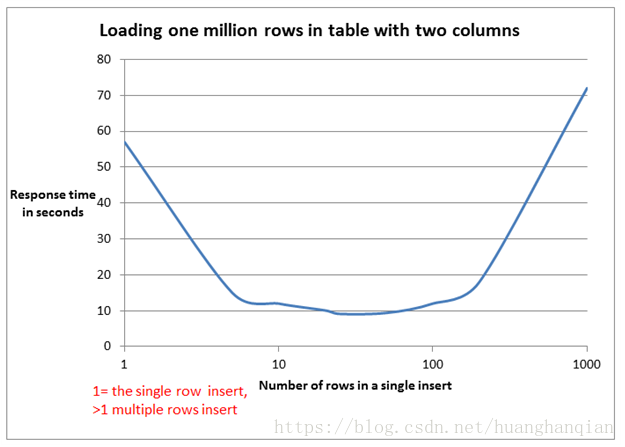
所以,如果非要使用 foreach 的方式来进行批量插入的话,可以考虑减少一条 insert 语句中 values 的个数,最好能达到上面曲线的最底部的值,使速度最快。一般按经验来说,一次性插20~50行数量是比较合适的,时间消耗也能接受。
重点来了。上面讲的是,如果非要用<foreach>的方式来插入,可以提升性能的方式。而实际上,MyBatis文档中写批量插入的时候,是推荐使用另外一种方法。(可以看 http://www.mybatis.org/mybatis-dynamic-sql/docs/insert.html 中 Batch Insert Support 标题里的内容)
SqlSession session = sqlSessionFactory.openSession(ExecutorType.BATCH);
try {
    SimpleTableMapper mapper = session.getMapper(SimpleTableMapper.class);
    List<SimpleTableRecord> records = getRecordsToInsert(); // not shown

    BatchInsert<SimpleTableRecord> batchInsert = insert(records)
            .into(simpleTable)
            .map(id).toProperty("id")
            .map(firstName).toProperty("firstName")
            .map(lastName).toProperty("lastName")
            .map(birthDate).toProperty("birthDate")
            .map(employed).toProperty("employed")
            .map(occupation).toProperty("occupation")
            .build()
            .render(RenderingStrategy.MYBATIS3);

    batchInsert.insertStatements().stream().forEach(mapper::insert);

    session.commit();
} finally {
    session.close();
}
即基本思想是将 MyBatis session 的 executor type 设为 Batch ,然后多次执行插入语句。就类似于JDBC的下面语句一样。
Connection connection = DriverManager.getConnection("jdbc:mysql://127.0.0.1:3306/mydb?useUnicode=true&characterEncoding=UTF-8&useServerPrepStmts=false&rewriteBatchedStatements=true","root","root");
connection.setAutoCommit(false);
PreparedStatement ps = connection.prepareStatement(
        "insert into tb_user (name) values(?)");
for (int i = 0; i < stuNum; i++) {
    ps.setString(1,name);
    ps.addBatch();
}
ps.executeBatch();
connection.commit();
connection.close();
经过试验,使用了 ExecutorType.BATCH 的插入方式,性能显著提升,不到 2s 便能全部插入完成。
总结一下,如果MyBatis需要进行批量插入,推荐使用 ExecutorType.BATCH 的插入方式,如果非要使用 <foreach>的插入的话,需要将每次插入的记录控制在 20~50 左右。
参考资料
原文链接:https://blog.csdn.net/huanghanqian/article/details/83177178
版权声明:本文为CSDN博主「huanghanqian」的原创文章,遵循CC 4.0 BY-SA版权协议,转载请附上原文出处链接及本声明。
近期热文推荐:
1.1,000+ 道 Java面试题及答案整理(2022最新版)
4.别再写满屏的爆爆爆炸类了,试试装饰器模式,这才是优雅的方式!!
觉得不错,别忘了随手点赞+转发哦!
我看到其他人也遇到过类似的问题,但没有一个解决方案对我有用。0.3.14gem与其他gem文件一起存在。我已经完全按照此处指示完成了所有操作:https://github.com/brianmario/mysql2.我仍然得到以下信息。我不知道为什么安装程序指示它找不到include目录,因为我已经检查过它存在。thread.h文件存在,但不在ruby目录中。相反,它在这里:C:\RailsInstaller\DevKit\lib\perl5\5.8\msys\CORE\我正在运行Windows7并尝试在Aptana3中构建我的Rails项目。我的Ruby是1.9.3。$gemin
我试图在Ubuntu14.04中使用Curl安装RVM。我运行了以下命令:\curl-sSLhttps://get.rvm.io|bash-sstable出现如下错误:curl:(7)Failedtoconnecttoget.rvm.ioport80:Networkisunreachable非常感谢解决此问题的任何帮助。谢谢 最佳答案 在执行curl之前尝试这个:echoipv4>>~/.curlrc 关于ruby-在Ubuntu14.04中使用Curl安装RVM时出错,我们在Stack
我使用RVM安装Ruby-2.1.5并再次运行bundle。现在pggem不会安装,我得到这个错误:geminstallpg-v'0.17.1'----with-pg-config=/Applications/Postgres.app/Contents/Versions/9.3/bin/pg_configBuildingnativeextensionswith:'--with-pg-config=/Applications/Postgres.app/Contents/Versions/9.3/bin/pg_config'Thiscouldtakeawhile...ERROR:Error
安装Rails时,一切都很好,但后来,我写道:rails-v和输出:/home/toshiba/.rvm/rubies/ruby-2.2.1/lib/ruby/site_ruby/2.2.0/rubygems/core_ext/kernel_require.rb:54:in`require':cannotloadsuchfile--rails/cli(LoadError)from/home/toshiba/.rvm/rubies/ruby-2.2.1/lib/ruby/site_ruby/2.2.0/rubygems/core_ext/kernel_require.rb:54:in`r
我想使用Ruby检查数千对文件中的每对文件是否包含相同的信息。有人能指出我正确的方向吗? 最佳答案 require'fileutils'FileUtils.compare_file('file1','file2')当且仅当文件file1和file2相同时返回true。 关于ruby-如何批量检查文件内容是否相同,我们在StackOverflow上找到一个类似的问题: https://stackoverflow.com/questions/33769865/
三分钟集成Tap防沉迷SDK(Unity版)一、SDK介绍基于国家对上线所有游戏必须增加防沉迷功能的政策下,TapTap推出防沉迷SDK,供游戏开发者进行接入;允许未成年用户在周五、六、日以及法定节假日晚上8:00-9:00进行游戏,防沉谜时间段进入游戏会弹窗进行提示!开发环境要求:Unity2019.4或更高版本iOS10或更高版本Android5.0(APIlevel21)或更高版本🔗Unity集成Demo参考链接🔗UnityTapSDK功能体验APK下载链接二、集成前准备1.创建应用进入开发者后台,按照提示开始创建应用;2.开通服务在使用TDS实名认证和防沉迷服务之前,需要在上面创建的应
起初:那不是错误区域的问题。在irb和数据库中,一切都很好。当我想在我的View中显示日期(created_at、updated_at和所有由我自己在每个模型中定义的日期)时,就会出现问题。我试图在application.rb中设置时区并从初始化程序中删除时间格式,但这并没有解决我的问题。Annotategem生成的架构信息:#created_at:datetime#updated_at:datetime#publish_at:datetime来自irb:1.9.2-p290:004>Time.zone=>(GMT+00:00)UTC1.9.2-p290:005>Time.zone.n
运行bundle安装时,我收到以下消息:Rubygems2.0.14isnotthreadsafe,soyourgemswillbeinstalledoneatatime.UpgradetoRubygems2.1.0orhighertoenableparallelgeminstallation.这很奇怪,因为在我的RubyGems环境中它说我的RubyGems版本是:2.4.5.1(见下文)~/w/Rafftopia❯❯❯gemenvRubyGemsEnvironment:-RUBYGEMSVERSION:2.4.5.1-RUBYVERSION:2.2.5(2016-04-26patc
假设你有这个结构:classHouse请注意,Tv的用户是故意不可访问的。所以你有一个三层嵌套的表单,允许你在一个页面上输入房子、房间和电视。这是Controller的创建方法:defcreate@house=House.new(params[:house])if@house.save#...standardstuffelse#...standardstuffendend问题:您究竟如何为每台电视填充user_id(它应该来自current_user.id)?什么是好的做法?这是我在其中看到的catch22。将user_ids直接填充到params散列中(它们嵌套得很深)保存将失败,因
这是什么。我首先做了:rvmgetstablervminstallruby-2.2.2没有交易。它向我展示了以下内容:$rvminstallruby-2.2.2Searchingforbinaryrubies,thismighttakesometime.Nobinaryrubiesavailablefor:ubuntu/14.04/i386/ruby-2.2.2.Continuingwithcompilation.Pleaseread'rvmhelpmount'togetmoreinformationonbinaryrubies.Checkingrequirementsforubunt
