由于工程项目中需要对视频中的person进行关键点检测,我测试各个算法后,并没有采用比较应用化成熟的Openpose,决定采用检测精度更高的HRnet系列。但是由于官方给的算法只能测试数据集,需要自己根据算法模型编写实例化代码。
本文根据SimDR工程实现视频关键点检测。SimDR根据HRnet改进而来,整个工程既包括HRnet又包括改进后的算法,使用起来较为方便,而且本文仅在cpu上就可以跑通整个工程。
python的环境主要就是按照工程中SimDR与yolov5的requirement.txt安装即可。总之缺啥装啥。
git clone https://github.com/leeyegy/SimDR.git  #克隆姿态估计工程
cd SimDR
git clone -b v5.0 https://github.com/ultralytics/yolov5.git #在姿态估计工程中添加yolov5算法
添加yolov5x.pt(见评论区网盘)到‘ SimDR/yolov5/weights/ ’文件夹下。
在yolov5文件夹下新建YOLOv5.py,复制以下内容到文件中。注意:根据大家的反馈,不同的电脑,导入yolov5相关包时会不同的方式,代码中我是from yolov5.xxx import xxx,但是有些可以不用前面的yolov5,大家自行尝试哈。一般出现No module xxx 都是有关yolov5 的包导入出错哈。
import argparse
import time
from pathlib import Path
import numpy as np
import cv2
import torch
import torch.backends.cudnn as cudnn
from numpy import random
import sys
import os

from yolov5.models.experimental import attempt_load
from yolov5.utils.datasets import LoadStreams, LoadImages
from yolov5.utils.general import check_img_size, check_requirements, check_imshow, non_max_suppression, apply_classifier, \
    scale_coords, xyxy2xywh, strip_optimizer, set_logging, increment_path
from yolov5.utils.plots import plot_one_box
from yolov5.utils.torch_utils import select_device, load_classifier, time_synchronized
from  yolov5.utils.datasets import letterbox


class Yolov5():
    def __init__(self, weights=None, opt=None, device=None):
        """

        @param weights:
        @param save_txt:
        @param opt:
        @param device:
        """
        self.weights = weights
        self.device = device
        # save_dir = Path(increment_path(Path(opt.project) / opt.name, exist_ok=opt.exist_ok))  # increment run
        # save_dir.mkdir(parents=True, exist_ok=True)  # make dir
        self.img_size = 640
        self.model = attempt_load(weights, map_location=self.device)
        self.stride = int(self.model.stride.max())
        self.names = self.model.module.names if hasattr(self.model, 'module') else self.model.names
        self.colors = [[random.randint(0, 255) for _ in range(3)] for _ in self.names]
        self.opt = opt

    def detect(self,img0):
        """

        @param img0: 输入图片  shape=[h,w,3]
        @return:
        """
        person_boxes = np.ones((6))
        img = letterbox(img0, self.img_size, stride=self.stride)[0]

        # Convert
        img = img[:, :, ::-1].transpose(2, 0, 1)  # BGR to RGB, to 3x416x416
        img = np.ascontiguousarray(img)
        img = torch.from_numpy(img).to(self.device)
        img = img.float()  # uint8 to fp16/32
        img /= 255.0  # 0 - 255 to 0.0 - 1.0
        if img.ndimension() == 3:
            img = img.unsqueeze(0)
        pred = self.model(img, augment=self.opt.augment)[0]
        # Apply NMS
        pred = non_max_suppression(pred, self.opt.conf_thres, self.opt.iou_thres, classes=self.opt.classes, agnostic=self.opt.agnostic_nms)
        for i, det in enumerate(pred):
            if len(det):
                # Rescale boxes from img_size to im0 size
                det[:, :4] = scale_coords(img.shape[2:], det[:, :4], img0.shape).round()
                boxes = reversed(det)
                boxes = boxes.cpu().numpy() #2022.04.06修改,在GPU上跑boxes无法直接转numpy数据
                #for i , box in enumerate(np.array(boxes)):
                for i , box in enumerate(boxes):
                    if int(box[-1]) == 0 and box[-2]>=0.7:
                        person_boxes=np.vstack((person_boxes , box))

        #                 label = f'{self.names[int(box[-1])]} {box[-2]:.2f}'
        #                 print(label)
        #                 plot_one_box(box, img0, label=label, color=self.colors[int(box[-1])], line_thickness=3)
        # cv2.imwrite('result1.jpg',img0)
        # print(s)
        # print(person_boxes,np.ndim(person_boxes))
        if np.ndim(person_boxes)>=2 :
            person_boxes_result = person_boxes[1:]
            boxes_result = person_boxes[1:,:4]
        else:
            person_boxes_result = []
            boxes_result = []
        return person_boxes_result,boxes_result

def yolov5test(opt,path = ''):
    detector = Yolov5(weights='weights/yolov5x.pt',opt=opt,device=torch.device('cpu'))
    img0 = cv2.imread(path)
    personboxes ,boxes= detector.detect(img0)
    for i,(x1,y1,x2,y2) in enumerate(boxes):
        print(x1,y1,x2,y2)
    print(personboxes,'\n',boxes)
if __name__ == '__main__':
    parser = argparse.ArgumentParser()
    parser.add_argument('--conf-thres', type=float, default=0.25, help='object confidence threshold')
    parser.add_argument('--iou-thres', type=float, default=0.45, help='IOU threshold for NMS')
    parser.add_argument('--classes', nargs='+', type=int, help='filter by class: --class 0, or --class 0 2 3')
    parser.add_argument('--agnostic-nms', action='store_true', help='class-agnostic NMS')
    parser.add_argument('--augment', action='store_true', help='augmented inference')
    parser.add_argument('--update', action='store_true', help='update all model')
    parser.add_argument('--project', default='runs/detect', help='save results to project/name')
    parser.add_argument('--name', default='exp', help='save results to project/name')
    parser.add_argument('--exist-ok', action='store_true', help='existing project/name ok, do not increment')
    opt = parser.parse_args()
    print(opt)
    # check_requirements(exclude=('pycocotools', 'thop'))

    with torch.no_grad():

        yolov5test(opt,'data/images/zidane.jpg')
本文代码是在pycharm中运行,yolov5工程的加入导致有些文件夹名称相同,pycharm会搞混,可能会出现某些包找不到。这里需要先运行一下YOLOv5.py脚本,根据报错改一下import的内容。举个例子,./SimDR/yolov5/models/experimental.py 文件中会出现图片中的问题

改成如下即可,其他的文件改法相同。


yolov5 v5.0工程中没有SPPF模块,此时我们需要在./SimDR/yolov5/models/common.py文件末尾加入以下代码。
import warnings

class SPPF(nn.Module):
    # Spatial Pyramid Pooling - Fast (SPPF) layer for YOLOv5 by Glenn Jocher
    def __init__(self, c1, c2, k=5):  # equivalent to SPP(k=(5, 9, 13))
        super().__init__()
        c_ = c1 // 2  # hidden channels
        self.cv1 = Conv(c1, c_, 1, 1)
        self.cv2 = Conv(c_ * 4, c2, 1, 1)
        self.m = nn.MaxPool2d(kernel_size=k, stride=1, padding=k // 2)

    def forward(self, x):
        x = self.cv1(x)
        with warnings.catch_warnings():
            warnings.simplefilter('ignore')  # suppress torch 1.9.0 max_pool2d() warning
            y1 = self.m(x)
            y2 = self.m(y1)
return self.cv2(torch.cat([x, y1, y2, self.m(y2)], 1))在SimDR文件夹下新建weight/hrnet文件夹,添加pose_hrnet_w48_384x288.pth等文件(见评论区网盘)
SimDR/experiments/文件夹下是coco与mpii数据集的配置文件,本文以coco为例。
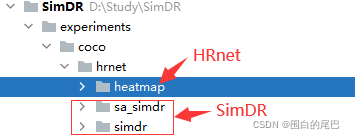
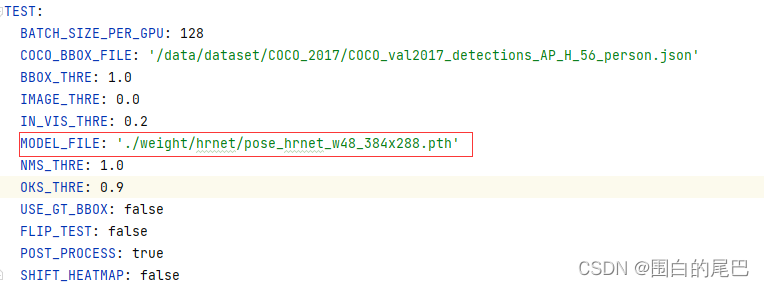
接下来,修改./SimDR/experiments/coco/hrnet/heatmap/w48_384x288_adam_lr1e-3.yaml文件中的TEST部分的MODEL_FILE路径,如图所示。(SimDR算法的配置文件同理改动。)
在’ SimDR/ ‘文件夹下新建Point_detect.py ,复制以下内容到文件中。
注意:代码第12行的路径要改成自己yolov5工程的路径,有这条代码才能正常运行。
【2022.04.16更新:根据评论区的建议,为关键点增加置信度值,这个值我是根据模型输出经过softmax后取最大值(关键点坐标就是这个最大值的索引),仅供参考。根据这个置信度可以解决半身照也会绘制全部点的问题。】
import cv2
import numpy as np
import torch
from torchvision.transforms import transforms
import torch.nn.functional as F
from lib.config import cfg
from yolov5.YOLOv5 import Yolov5
from lib.utils.transforms import flip_back_simdr,transform_preds,get_affine_transform
from lib import models
import argparse
import sys
sys.path.insert(0, 'D:\\Study\\Pose Estimation\\SimDR\\yolov5')
class Points():
def __init__(self,
model_name='sa-simdr',
resolution=(384,288),
opt=None,
yolo_weights_path="./yolov5/weights/yolov5x.pt",
):
"""
Initializes a new SimpleHRNet object.
HRNet (and YOLOv3) are initialized on the torch.device("device") and
its (their) pre-trained weights will be loaded from disk.
Args:
c (int): number of channels (when using HRNet model) or resnet size (when using PoseResNet model).
nof_joints (int): number of joints.
checkpoint_path (str): path to an official hrnet checkpoint or a checkpoint obtained with `train_coco.py`.
model_name (str): model name (HRNet or PoseResNet).
Valid names for HRNet are: `HRNet`, `hrnet`
Valid names for PoseResNet are: `PoseResNet`, `poseresnet`, `ResNet`, `resnet`
Default: "HRNet"
resolution (tuple): hrnet input resolution - format: (height, width).
Default: (384, 288)
interpolation (int): opencv interpolation algorithm.
Default: cv2.INTER_CUBIC
multiperson (bool): if True, multiperson detection will be enabled.
This requires the use of a people detector (like YOLOv3).
Default: True
return_heatmaps (bool): if True, heatmaps will be returned along with poses by self.predict.
Default: False
return_bounding_boxes (bool): if True, bounding boxes will be returned along with poses by self.predict.
Default: False
max_batch_size (int): maximum batch size used in hrnet inference.
Useless without multiperson=True.
Default: 16
yolo_model_def (str): path to yolo model definition file.
Default: "./model/detectors/yolo/config/yolov3.cfg"
yolo_class_path (str): path to yolo class definition file.
Default: "./model/detectors/yolo/data/coco.names"
yolo_weights_path (str): path to yolo pretrained weights file.
Default: "./model/detectors/yolo/weights/yolov3.weights.cfg"
device (:class:`torch.device`): the hrnet (and yolo) inference will be run on this device.
Default: torch.device("cpu")
"""
self.model_name = model_name
self.resolution = resolution # in the form (height, width) as in the original implementation
self.aspect_ratio = resolution[1]/resolution[0]
self.yolo_weights_path = yolo_weights_path
self.flip_pairs = [[1, 2], [3, 4], [5, 6], [7, 8],
[9, 10], [11, 12], [13, 14], [15, 16]]
self.device = torch.device(opt.device)
cfg.defrost()
if model_name in ('sa-simdr','sasimdr','sa_simdr'):
if resolution ==(384,288):
cfg.merge_from_file('./experiments/coco/hrnet/sa_simdr/w48_384x288_adam_lr1e-3_split1_5_sigma4.yaml')
elif resolution == (256,192):
cfg.merge_from_file('./experiments/coco/hrnet/sa_simdr/w48_256x192_adam_lr1e-3_split2_sigma4.yaml')
else:
raise ValueError('Wrong cfg file')
elif model_name in ('simdr'):
if resolution == (256, 192):
cfg.merge_from_file('./experiments/coco/hrnet/simdr/nmt_w48_256x192_adam_lr1e-3.yaml')
else:
raise ValueError('Wrong cfg file')
elif model_name in ('hrnet','HRnet','Hrnet'):
if resolution == (384,288):
cfg.merge_from_file('./experiments/coco/hrnet/heatmap/w48_384x288_adam_lr1e-3.yaml')
elif resolution == (256,192):
cfg.merge_from_file('./experiments/coco/hrnet/heatmap/w48_256x192_adam_lr1e-3.yaml')
else:
raise ValueError('Wrong cfg file')
else:
raise ValueError('Wrong model name.')
cfg.freeze()
self.model = eval('models.' + cfg.MODEL.NAME + '.get_pose_net')(
cfg, is_train=False)
print('=> loading model from {}'.format(cfg.TEST.MODEL_FILE))
checkpoint_path = cfg.TEST.MODEL_FILE
checkpoint = torch.load(checkpoint_path, map_location=self.device)
if 'model' in checkpoint:
self.model.load_state_dict(checkpoint['model'])
else:
self.model.load_state_dict(checkpoint)
if 'cuda' in str(self.device):
print("device: 'cuda' - ", end="")
if 'cuda' == str(self.device):
# if device is set to 'cuda', all available GPUs will be used
print("%d GPU(s) will be used" % torch.cuda.device_count())
device_ids = None
else:
# if device is set to 'cuda:IDS', only that/those device(s) will be used
print("GPU(s) '%s' will be used" % str(self.device))
device_ids = [int(x) for x in str(self.device)[5:].split(',')]
elif 'cpu' == str(self.device):
print("device: 'cpu'")
else:
raise ValueError('Wrong device name.')
self.model = self.model.to(self.device)
self.model.eval()
self.detector = Yolov5(
weights=yolo_weights_path,
opt=opt ,
device=self.device)
self.transform = transforms.Compose([
transforms.ToPILImage(),
transforms.Resize((self.resolution[0], self.resolution[1])), # (height, width)
transforms.ToTensor(),
transforms.Normalize(mean=[0.485, 0.456, 0.406], std=[0.229, 0.224, 0.225]),
])
def _box2cs(self, box):
x, y, w, h = box[:4]
return self._xywh2cs(x, y, w, h)
def _xywh2cs(self, x, y, w, h):
center = np.zeros((2), dtype=np.float32)
center[0] = x + w * 0.5
center[1] = y + h * 0.5
if w > self.aspect_ratio * h:
h = w * 1.0 / self.aspect_ratio
elif w < self.aspect_ratio * h:
w = h * self.aspect_ratio
scale = np.array(
[w * 1.0 / 200, h * 1.0 / 200],
dtype=np.float32)
if center[0] != -1:
scale = scale * 1.25
return center, scale
def predict(self, image):
"""
Predicts the human pose on a single image or a stack of n images.
Args:
image (:class:`np.ndarray`):
the image(s) on which the human pose will be estimated.
image is expected to be in the opencv format.
image can be:
- a single image with shape=(height, width, BGR color channel)
- a stack of n images with shape=(n, height, width, BGR color channel)
Returns:
:class:`np.ndarray` or list:
a numpy array containing human joints for each (detected) person.
Format:
if image is a single image:
shape=(# of people, # of joints (nof_joints), 3); dtype=(np.float32).
if image is a stack of n images:
list of n np.ndarrays with
shape=(# of people, # of joints (nof_joints), 3); dtype=(np.float32).
Each joint has 3 values: (y position, x position, joint confidence).
If self.return_heatmaps, the class returns a list with (heatmaps, human joints)
If self.return_bounding_boxes, the class returns a list with (bounding boxes, human joints)
If self.return_heatmaps and self.return_bounding_boxes, the class returns a list with
(heatmaps, bounding boxes, human joints)
"""
if len(image.shape) == 3:
return self._predict_single(image)
else:
raise ValueError('Wrong image format.')
def sa_simdr_pts(self,img,detection,images,boxes):
c, s = [], []
if detection is not None:
for i, (x1, y1, x2, y2) in enumerate(detection):
x1 = int(round(x1.item()))
x2 = int(round(x2.item()))
y1 = int(round(y1.item()))
y2 = int(round(y2.item()))
boxes[i] = [x1, y1, x2, y2]
w, h = x2 - x1, y2 - y1
xx1 = np.max((0, x1))
yy1 = np.max((0, y1))
xx2 = np.min((img.shape[1] - 1, x1 + np.max((0, w - 1))))
yy2 = np.min((img.shape[0] - 1, y1 + np.max((0, h - 1))))
box = [xx1, yy1, xx2 - xx1, yy2 - yy1]
center, scale = self._box2cs(box)
c.append(center)
s.append(scale)
trans = get_affine_transform(center, scale, 0, np.array(cfg.MODEL.IMAGE_SIZE))
input = cv2.warpAffine(
img,
trans,
(int(self.resolution[1]), int(self.resolution[0])),
flags=cv2.INTER_LINEAR)
images[i] = self.transform(input)
if images.shape[0] > 0:
images = images.to(self.device)
with torch.no_grad():
output_x, output_y = self.model(images)
if cfg.TEST.FLIP_TEST:
input_flipped = images.flip(3)
output_x_flipped_, output_y_flipped_ = self.model(input_flipped)
output_x_flipped = flip_back_simdr(output_x_flipped_.cpu().numpy(),
self.flip_pairs, type='x')
output_y_flipped = flip_back_simdr(output_y_flipped_.cpu().numpy(),
self.flip_pairs, type='y')
output_x_flipped = torch.from_numpy(output_x_flipped.copy()).to(self.device)
output_y_flipped = torch.from_numpy(output_y_flipped.copy()).to(self.device)
# feature is not aligned, shift flipped heatmap for higher accuracy
if cfg.TEST.SHIFT_HEATMAP:
output_x_flipped[:, :, 0:-1] = \
output_x_flipped.clone()[:, :, 1:]
output_x = F.softmax((output_x + output_x_flipped) * 0.5, dim=2)
output_y = F.softmax((output_y + output_y_flipped) * 0.5, dim=2)
else:
output_x = F.softmax(output_x, dim=2)
output_y = F.softmax(output_y, dim=2)
max_val_x, preds_x = output_x.max(2, keepdim=True)
max_val_y, preds_y = output_y.max(2, keepdim=True)
mask = max_val_x > max_val_y
max_val_x[mask] = max_val_y[mask]
maxvals = max_val_x * 10.0
output = torch.ones([images.size(0), preds_x.size(1), 3])
output[:, :, 0] = torch.squeeze(torch.true_divide(preds_x, cfg.MODEL.SIMDR_SPLIT_RATIO))
output[:, :, 1] = torch.squeeze(torch.true_divide(preds_y, cfg.MODEL.SIMDR_SPLIT_RATIO))
# output[:, :, 2] = maxvals.squeeze(2)
output = output.cpu().numpy()
preds = output.copy()
for i in range(output.shape[0]):
preds[i] = transform_preds(
output[i], c[i], s[i], [cfg.MODEL.IMAGE_SIZE[0], cfg.MODEL.IMAGE_SIZE[1]]
)
preds[:, :, 2] = maxvals.squeeze(2)
else:
preds = np.empty((0, 0, 3), dtype=np.float32)
return preds
def simdr_pts(self,img,detection,images,boxes):
c, s = [], []
if detection is not None:
for i, (x1, y1, x2, y2) in enumerate(detection):
x1 = int(round(x1.item()))
x2 = int(round(x2.item()))
y1 = int(round(y1.item()))
y2 = int(round(y2.item()))
boxes[i] = [x1, y1, x2, y2]
w, h = x2 - x1, y2 - y1
xx1 = np.max((0, x1))
yy1 = np.max((0, y1))
xx2 = np.min((img.shape[1] - 1, x1 + np.max((0, w - 1))))
yy2 = np.min((img.shape[0] - 1, y1 + np.max((0, h - 1))))
box = [xx1, yy1, xx2 - xx1, yy2 - yy1]
center, scale = self._box2cs(box)
c.append(center)
s.append(scale)
trans = get_affine_transform(center, scale, 0, np.array(cfg.MODEL.IMAGE_SIZE))
input = cv2.warpAffine(
img,
trans,
(int(self.resolution[1]), int(self.resolution[0])),
flags=cv2.INTER_LINEAR)
images[i] = self.transform(input)
if images.shape[0] > 0:
images = images.to(self.device)
with torch.no_grad():
output_x, output_y = self.model(images)
if cfg.TEST.FLIP_TEST:
input_flipped = images.flip(3)
output_x_flipped_, output_y_flipped_ = self.model(input_flipped)
output_x_flipped = flip_back_simdr(output_x_flipped_.cpu().numpy(),
self.flip_pairs, type='x')
output_y_flipped = flip_back_simdr(output_y_flipped_.cpu().numpy(),
self.flip_pairs, type='y')
output_x_flipped = torch.from_numpy(output_x_flipped.copy()).to(self.device)
output_y_flipped = torch.from_numpy(output_y_flipped.copy()).to(self.device)
# feature is not aligned, shift flipped heatmap for higher accuracy
if cfg.TEST.SHIFT_HEATMAP:
output_x_flipped[:, :, 0:-1] = \
output_x_flipped.clone()[:, :, 1:]
output_x = (F.softmax(output_x, dim=2) + F.softmax(output_x_flipped, dim=2)) * 0.5
output_y = (F.softmax(output_y, dim=2) + F.softmax(output_y_flipped, dim=2)) * 0.5
else:
output_x = F.softmax(output_x, dim=2)
output_y = F.softmax(output_y, dim=2)
max_val_x, preds_x = output_x.max(2, keepdim=True)
max_val_y, preds_y = output_y.max(2, keepdim=True)
mask = max_val_x > max_val_y
max_val_x[mask] = max_val_y[mask]
maxvals = max_val_x * 10.0
output = torch.ones([images.size(0), preds_x.size(1), 3])
output[:, :, 0] = torch.squeeze(torch.true_divide(preds_x, cfg.MODEL.SIMDR_SPLIT_RATIO))
output[:, :, 1] = torch.squeeze(torch.true_divide(preds_y, cfg.MODEL.SIMDR_SPLIT_RATIO))
output = output.cpu().numpy()
preds = output.copy()
for i in range(output.shape[0]):
preds[i] = transform_preds(
output[i], c[i], s[i], [cfg.MODEL.IMAGE_SIZE[0], cfg.MODEL.IMAGE_SIZE[1]]
)
preds[:, :, 2] = maxvals.squeeze(2)
else:
preds = np.empty((0, 0, 3), dtype=np.float32)
return preds
def hrnet_pts(self,img,detection,images,boxes):
if detection is not None:
for i, (x1, y1, x2, y2) in enumerate(detection):
x1 = int(round(x1.item()))
x2 = int(round(x2.item()))
y1 = int(round(y1.item()))
y2 = int(round(y2.item()))
# Adapt detections to match HRNet input aspect ratio (as suggested by xtyDoge in issue #14)
correction_factor = self.resolution[0] / self.resolution[1] * (x2 - x1) / (y2 - y1)
if correction_factor > 1:
# increase y side
center = y1 + (y2 - y1) // 2
length = int(round((y2 - y1) * correction_factor))
y1 = max(0, center - length // 2)
y2 = min(img.shape[0], center + length // 2)
elif correction_factor < 1:
# increase x side
center = x1 + (x2 - x1) // 2
length = int(round((x2 - x1) * 1 / correction_factor))
x1 = max(0, center - length // 2)
x2 = min(img.shape[1], center + length // 2)
boxes[i] = [x1, y1, x2, y2]
images[i] = self.transform(img[y1:y2, x1:x2, ::-1])
if images.shape[0] > 0:
images = images.to(self.device)
with torch.no_grad():
out = self.model(images)
out = out.detach().cpu().numpy()
pts = np.empty((out.shape[0], out.shape[1], 3), dtype=np.float32)
# For each human, for each joint: y, x, confidence
for i, human in enumerate(out):
for j, joint in enumerate(human):
pt = np.unravel_index(np.argmax(joint), (self.resolution[0] // 4, self.resolution[1] // 4))
# 0: pt_x / (height // 4) * (bb_y2 - bb_y1) + bb_y1
# 1: pt_y / (width // 4) * (bb_x2 - bb_x1) + bb_x1
# 2: confidences
pts[i, j, 0] = pt[1] * 1. / (self.resolution[1] // 4) * (boxes[i][2] - boxes[i][0]) + boxes[i][0]
pts[i, j, 1] = pt[0] * 1. / (self.resolution[0] // 4) * (boxes[i][3] - boxes[i][1]) + boxes[i][1]
pts[i, j, 2] = joint[pt]
else:
pts = np.empty((0, 0, 3), dtype=np.float32)
return pts
def _predict_single(self, image):
_,detections = self.detector.detect(image)
nof_people = len(detections) if detections is not None else 0
boxes = np.empty((nof_people, 4), dtype=np.int32)
images = torch.empty((nof_people, 3, self.resolution[0], self.resolution[1])) # (height, width)
if self.model_name in ('sa-simdr','sasimdr'):
pts=self.sa_simdr_pts(image,detections,images,boxes)
elif self.model_name in ('hrnet','HRnet','hrnet'):
pts = self.hrnet_pts(image, detections, images, boxes)
elif self.model_name in ('simdr'):
pts = self.simdr_pts(image, detections, images, boxes)
return pts
# c,s=[],[]
# if detections is not None:
# for i, (x1, y1, x2, y2) in enumerate(detections):
# x1 = int(round(x1.item()))
# x2 = int(round(x2.item()))
# y1 = int(round(y1.item()))
# y2 = int(round(y2.item()))
# boxes[i] = [x1,y1,x2,y2]
# w ,h= x2-x1,y2-y1
# xx1 = np.max((0, x1))
# yy1 = np.max((0, y1))
# xx2 = np.min((image.shape[1] - 1, x1 + np.max((0, w - 1))))
# yy2 = np.min((image.shape[0] - 1, y1 + np.max((0, h - 1))))
# box = [xx1, yy1, xx2-xx1, yy2-yy1]
# center,scale = self._box2cs(box)
# c.append(center)
# s.append(scale)
#
# trans = get_affine_transform(center, scale, 0, np.array(cfg.MODEL.IMAGE_SIZE))
# input = cv2.warpAffine(
# image,
# trans,
# (int(self.resolution[1]), int(self.resolution[0])),
# flags=cv2.INTER_LINEAR)
# images[i] = self.transform(input)
# if images.shape[0] > 0:
# images = images.to(self.device)
# with torch.no_grad():
# output_x,output_y = self.model(images)
# if cfg.TEST.FLIP_TEST:
# input_flipped = images.flip(3)
# output_x_flipped_, output_y_flipped_ = self.model(input_flipped)
# output_x_flipped = flip_back_simdr(output_x_flipped_.cpu().numpy(),
# self.flip_pairs, type='x')
# output_y_flipped = flip_back_simdr(output_y_flipped_.cpu().numpy(),
# self.flip_pairs, type='y')
# output_x_flipped = torch.from_numpy(output_x_flipped.copy()).to(self.device)
# output_y_flipped = torch.from_numpy(output_y_flipped.copy()).to(self.device)
#
# # feature is not aligned, shift flipped heatmap for higher accuracy
# if cfg.TEST.SHIFT_HEATMAP:
# output_x_flipped[:, :, 0:-1] = \
# output_x_flipped.clone()[:, :, 1:]
# output_x = F.softmax((output_x + output_x_flipped) * 0.5, dim=2)
# output_y = F.softmax((output_y + output_y_flipped) * 0.5, dim=2)
# else:
# output_x = F.softmax(output_x, dim=2)
# output_y = F.softmax(output_y, dim=2)
# max_val_x, preds_x = output_x.max(2, keepdim=True)
# max_val_y, preds_y = output_y.max(2, keepdim=True)
#
# mask = max_val_x > max_val_y
# max_val_x[mask] = max_val_y[mask]
# maxvals = max_val_x.cpu().numpy()
#
# output = torch.ones([images.size(0), preds_x.size(1), 2])
# output[:, :, 0] = torch.squeeze(torch.true_divide(preds_x, cfg.MODEL.SIMDR_SPLIT_RATIO))
# output[:, :, 1] = torch.squeeze(torch.true_divide(preds_y, cfg.MODEL.SIMDR_SPLIT_RATIO))
#
# output = output.cpu().numpy()
# preds = output.copy()
# for i in range(output.shape[0]):
# preds[i] = transform_preds(
# output[i], c[i], s[i], [cfg.MODEL.IMAGE_SIZE[0], cfg.MODEL.IMAGE_SIZE[1]]
# )
# else:
# preds = np.empty((0, 0, 2), dtype=np.float32)
# return preds
# parser = argparse.ArgumentParser()
# parser.add_argument('--conf-thres', type=float, default=0.25, help='object confidence threshold')
# parser.add_argument('--iou-thres', type=float, default=0.45, help='IOU threshold for NMS')
# parser.add_argument('--classes', nargs='+', type=int, help='filter by class: --class 0, or --class 0 2 3')
# parser.add_argument('--agnostic-nms', action='store_true', help='class-agnostic NMS')
# parser.add_argument('--augment', action='store_true', help='augmented inference')
# parser.add_argument('--update', action='store_true', help='update all model')
# parser.add_argument('--project', default='runs/detect', help='save results to project/name')
# parser.add_argument('--name', default='exp', help='save results to project/name')
# parser.add_argument('--exist-ok', action='store_true', help='existing project/name ok, do not increment')
# opt = parser.parse_args()
# model = Points(model_name='hrnet',opt=opt)
# img0 = cv2.imread('./data/test1.jpg')
# pts = model.predict(img0)
# print(pts.shape)
# for point in pts[0]:
# image = cv2.circle(img0, (int(point[0]), int(point[1])), 3, [255,0,255], -1 , lineType= cv2.LINE_AA)
# cv2.imwrite('./data/test11_result.jpg',image)根据以上步骤,我们已经得到了关键点的坐标值,接下来需要在图片中描绘出来,以便展示检测结果。
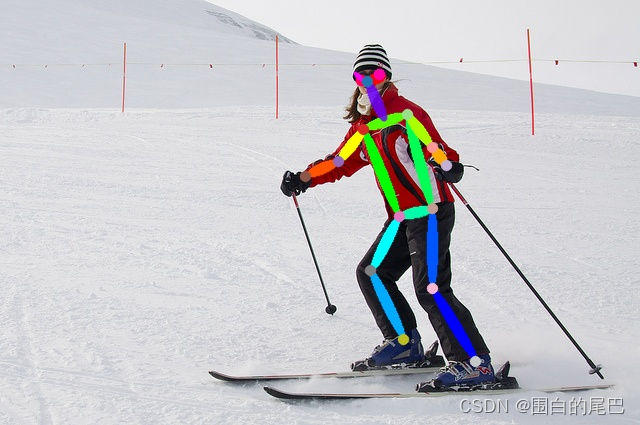
首先在’ ./SimDR/lib/utils/ ‘文件夹下新建visualization.py文件,将以下内容复制到文件中。骨架绘制代码结合了simple-hrnet与Openpose工程。
【2022.04.16更新:由于之前的绘制代码被我魔改过,现在恢复成所有点与骨骼都绘制的模样,但是总觉得好丑,没有openpose那种美观,如果有人绘制出比较美观的骨架,希望能分享一下哈,共同进步!】
import cv2
import matplotlib.pyplot as plt
import numpy as np
import torch
import torchvision
import ffmpeg
import random
import math
import copy
def plot_one_box(x, img, color=None, label=None, line_thickness=3):
    # Plots one bounding box on image img
    tl = line_thickness or round(0.002 * (img.shape[0] + img.shape[1]) / 2) + 1  # line/font thickness
    color = color or [random.randint(0, 255) for _ in range(3)]
    c1, c2 = (int(x[0]), int(x[1])), (int(x[2]), int(x[3]))
    cv2.rectangle(img, c1, c2, color, thickness=tl, lineType=cv2.LINE_AA)
    if label:
        tf = max(tl - 1, 1)  # font thickness
        t_size = cv2.getTextSize(label, 0, fontScale=tl / 3, thickness=tf)[0]
        c2 = c1[0] + t_size[0], c1[1] - t_size[1] - 3
        cv2.rectangle(img, c1, c2, color, -1, cv2.LINE_AA)  # filled
        cv2.putText(img, label, (c1[0], c1[1] - 2), 0, tl / 3, [225, 255, 255], thickness=tf, lineType=cv2.LINE_AA)
    return img

def joints_dict():
    joints = {
        "coco": {
            "keypoints": {
                0: "nose",
                1: "left_eye",
                2: "right_eye",
                3: "left_ear",
                4: "right_ear",
                5: "left_shoulder",
                6: "right_shoulder",
                7: "left_elbow",
                8: "right_elbow",
                9: "left_wrist",
                10: "right_wrist",
                11: "left_hip",
                12: "right_hip",
                13: "left_knee",
                14: "right_knee",
                15: "left_ankle",
                16: "right_ankle"
            },
            "skeleton": [
                # # [16, 14], [14, 12], [17, 15], [15, 13], [12, 13], [6, 12], [7, 13], [6, 7], [6, 8],
                # # [7, 9], [8, 10], [9, 11], [2, 3], [1, 2], [1, 3], [2, 4], [3, 5], [4, 6], [5, 7]
                # [15, 13], [13, 11], [16, 14], [14, 12], [11, 12], [5, 11], [6, 12], [5, 6], [5, 7],
                # [6, 8], [7, 9], [8, 10], [1, 2], [0, 1], [0, 2], [1, 3], [2, 4], [3, 5], [4, 6]
                [15, 13], [13, 11], [16, 14], [14, 12], [11, 12], [5, 11], [6, 12], [5, 6], [5, 7],
                [6, 8], [7, 9], [8, 10], [1, 2], [0, 1], [0, 2], [1, 3], [2, 4],  # [3, 5], [4, 6]
                [0, 5], [0, 6]
                # [15, 13], [13, 11], [16, 14], [14, 12], [11, 12], [5, 11], [6, 12], [5, 6], [5, 7],
                # [6, 8], [7, 9], [8, 10],  [0, 3], [0, 4], [1, 3], [2, 4],  # [3, 5], [4, 6]
                # [0, 5], [0, 6]
            ]
        },
        "mpii": {
            "keypoints": {
                0: "right_ankle",
                1: "right_knee",
                2: "right_hip",
                3: "left_hip",
                4: "left_knee",
                5: "left_ankle",
                6: "pelvis",
                7: "thorax",
                8: "upper_neck",
                9: "head top",
                10: "right_wrist",
                11: "right_elbow",
                12: "right_shoulder",
                13: "left_shoulder",
                14: "left_elbow",
                15: "left_wrist"
            },
            "skeleton": [
                # [5, 4], [4, 3], [0, 1], [1, 2], [3, 2], [13, 3], [12, 2], [13, 12], [13, 14],
                # [12, 11], [14, 15], [11, 10], # [2, 3], [1, 2], [1, 3], [2, 4], [3, 5], [4, 6], [5, 7]
                [5, 4], [4, 3], [0, 1], [1, 2], [3, 2], [3, 6], [2, 6], [6, 7], [7, 8], [8, 9],
                [13, 7], [12, 7], [13, 14], [12, 11], [14, 15], [11, 10],
            ]
        },
    }
    return joints


def draw_points(image, points, color_palette='tab20', palette_samples=16, confidence_threshold=0.1,color=None):
    """
    Draws `points` on `image`.

    Args:
        image: image in opencv format
        points: list of points to be drawn.
            Shape: (nof_points, 3)
            Format: each point should contain (y, x, confidence)
        color_palette: name of a matplotlib color palette
            Default: 'tab20'
        palette_samples: number of different colors sampled from the `color_palette`
            Default: 16
        confidence_threshold: only points with a confidence higher than this threshold will be drawn. Range: [0, 1]
            Default: 0.1

    Returns:
        A new image with overlaid points

    """

    circle_size = max(2, int(np.sqrt(np.max(np.max(points, axis=0) - np.min(points, axis=0)) // 16)))
    for i, pt in enumerate(points):

        if pt[2] >= confidence_threshold:
            image = cv2.circle(image, (int(pt[0]), int(pt[1])), circle_size, color[i] ,-1, lineType= cv2.LINE_AA)

    return image


def draw_skeleton(image, points, skeleton, color_palette='Set2', palette_samples=8, person_index=0,
                  confidence_threshold=0.1,sk_color=None):
    """
    Draws a `skeleton` on `image`.

    Args:
        image: image in opencv format
        points: list of points to be drawn.
            Shape: (nof_points, 3)
            Format: each point should contain (y, x, confidence)
        skeleton: list of joints to be drawn
            Shape: (nof_joints, 2)
            Format: each joint should contain (point_a, point_b) where `point_a` and `point_b` are an index in `points`
        color_palette: name of a matplotlib color palette
            Default: 'Set2'
        palette_samples: number of different colors sampled from the `color_palette`
            Default: 8
        person_index: index of the person in `image`
            Default: 0
        confidence_threshold: only points with a confidence higher than this threshold will be drawn. Range: [0, 1]
            Default: 0.1

    Returns:
        A new image with overlaid joints

    """
    canvas = copy.deepcopy(image)
    cur_canvas = canvas.copy()
    for i, joint in enumerate(skeleton):

        pt1, pt2 = points[joint]

        if pt1[2] >= confidence_threshold and pt2[2]>= confidence_threshold :
            length = ((pt1[0] - pt2[0]) ** 2 + (pt1[1] - pt2[1]) ** 2) ** 0.5
            angle = math.degrees(math.atan2(pt1[1] - pt2[1],pt1[0] - pt2[0]))
            polygon = cv2.ellipse2Poly((int(np.mean((pt1[0],pt2[0]))), int(np.mean((pt1[1],pt2[1])))), (int(length / 2), 2), int(angle), 0, 360, 1)
            cv2.fillConvexPoly(cur_canvas, polygon, sk_color[i],lineType=cv2.LINE_AA)
            # cv2.fillConvexPoly(cur_canvas, polygon, sk_color,lineType=cv2.LINE_AA)
            canvas = cv2.addWeighted(canvas, 0.4, cur_canvas, 0.6, 0)

    return canvas


def draw_points_and_skeleton(image, points, skeleton, points_color_palette='tab20', points_palette_samples=16,
                             skeleton_color_palette='Set2', skeleton_palette_samples=8, person_index=0,
                             confidence_threshold=0.1,color=None,sk_color=None):
    """
    Draws `points` and `skeleton` on `image`.

    Args:
        image: image in opencv format
        points: list of points to be drawn.
            Shape: (nof_points, 3)
            Format: each point should contain (y, x, confidence)
        skeleton: list of joints to be drawn
            Shape: (nof_joints, 2)
            Format: each joint should contain (point_a, point_b) where `point_a` and `point_b` are an index in `points`
        points_color_palette: name of a matplotlib color palette
            Default: 'tab20'
        points_palette_samples: number of different colors sampled from the `color_palette`
            Default: 16
        skeleton_color_palette: name of a matplotlib color palette
            Default: 'Set2'
        skeleton_palette_samples: number of different colors sampled from the `color_palette`
            Default: 8
        person_index: index of the person in `image`
            Default: 0
        confidence_threshold: only points with a confidence higher than this threshold will be drawn. Range: [0, 1]
            Default: 0.1

    Returns:
        A new image with overlaid joints

    """
    colors1 = [[255, 0, 0], [255, 85, 0], [255, 170, 0], [255, 255, 0], [170, 255, 0], [85, 255, 0], [0, 255, 0],
               [0, 255, 85], [0, 255, 170], [0, 255, 255], [0, 170, 255], [0, 85, 255], [0, 0, 255], [85, 0, 255],
               [170, 0, 255], [255, 0, 255], [255, 0, 170], [255, 0, 85], [255, 0, 85]]
    image = draw_skeleton(image, points, skeleton, color_palette=skeleton_color_palette,
                          palette_samples=skeleton_palette_samples, person_index=person_index,
                          confidence_threshold=confidence_threshold,sk_color=colors1)
    image = draw_points(image, points, color_palette=points_color_palette, palette_samples=points_palette_samples,
                        confidence_threshold=confidence_threshold,color=colors1)
    return image


def save_images(images, target, joint_target, output, joint_output, joint_visibility, summary_writer=None, step=0,
                prefix=''):
    """
    Creates a grid of images with gt joints and a grid with predicted joints.
    This is a basic function for debugging purposes only.

    If summary_writer is not None, the grid will be written in that SummaryWriter with name "{prefix}_images" and
    "{prefix}_predictions".

    Args:
        images (torch.Tensor): a tensor of images with shape (batch x channels x height x width).
        target (torch.Tensor): a tensor of gt heatmaps with shape (batch x channels x height x width).
        joint_target (torch.Tensor): a tensor of gt joints with shape (batch x joints x 2).
        output (torch.Tensor): a tensor of predicted heatmaps with shape (batch x channels x height x width).
        joint_output (torch.Tensor): a tensor of predicted joints with shape (batch x joints x 2).
        joint_visibility (torch.Tensor): a tensor of joint visibility with shape (batch x joints).
        summary_writer (tb.SummaryWriter): a SummaryWriter where write the grids.
            Default: None
        step (int): summary_writer step.
            Default: 0
        prefix (str): summary_writer name prefix.
            Default: ""

    Returns:
        A pair of images which are built from torchvision.utils.make_grid
    """
    # Input images with gt
    images_ok = images.detach().clone()
    images_ok[:, 0].mul_(0.229).add_(0.485)
    images_ok[:, 1].mul_(0.224).add_(0.456)
    images_ok[:, 2].mul_(0.225).add_(0.406)
    for i in range(images.shape[0]):
        joints = joint_target[i] * 4.
        joints_vis = joint_visibility[i]

        for joint, joint_vis in zip(joints, joints_vis):
            if joint_vis[0]:
                a = int(joint[1].item())
                b = int(joint[0].item())
                # images_ok[i][:, a-1:a+1, b-1:b+1] = torch.tensor([1, 0, 0])
                images_ok[i][0, a - 1:a + 1, b - 1:b + 1] = 1
                images_ok[i][1:, a - 1:a + 1, b - 1:b + 1] = 0
    grid_gt = torchvision.utils.make_grid(images_ok, nrow=int(images_ok.shape[0] ** 0.5), padding=2, normalize=False)
    if summary_writer is not None:
        summary_writer.add_image(prefix + 'images', grid_gt, global_step=step)

    # Input images with prediction
    images_ok = images.detach().clone()
    images_ok[:, 0].mul_(0.229).add_(0.485)
    images_ok[:, 1].mul_(0.224).add_(0.456)
    images_ok[:, 2].mul_(0.225).add_(0.406)
    for i in range(images.shape[0]):
        joints = joint_output[i] * 4.
        joints_vis = joint_visibility[i]

        for joint, joint_vis in zip(joints, joints_vis):
            if joint_vis[0]:
                a = int(joint[1].item())
                b = int(joint[0].item())
                # images_ok[i][:, a-1:a+1, b-1:b+1] = torch.tensor([1, 0, 0])
                images_ok[i][0, a - 1:a + 1, b - 1:b + 1] = 1
                images_ok[i][1:, a - 1:a + 1, b - 1:b + 1] = 0
    grid_pred = torchvision.utils.make_grid(images_ok, nrow=int(images_ok.shape[0] ** 0.5), padding=2, normalize=False)
    if summary_writer is not None:
        summary_writer.add_image(prefix + 'predictions', grid_pred, global_step=step)

    # Heatmaps
    # ToDo
    # for h in range(0,17):
    #     heatmap = torchvision.utils.make_grid(output[h].detach(), nrow=int(np.sqrt(output.shape[0])),
    #                                            padding=2, normalize=True, range=(0, 1))
    #     summary_writer.add_image('train_heatmap_%d' % h, heatmap, global_step=step + epoch*len_dl_train)

    return grid_gt, grid_pred


def check_video_rotation(filename):
    # thanks to
    # https://stackoverflow.com/questions/53097092/frame-from-video-is-upside-down-after-extracting/55747773#55747773

    # this returns meta-data of the video file in form of a dictionary
    meta_dict = ffmpeg.probe(filename)

    # from the dictionary, meta_dict['streams'][0]['tags']['rotate'] is the key
    # we are looking for
    rotation_code = None
    try:
        if int(meta_dict['streams'][0]['tags']['rotate']) == 90:
            rotation_code = cv2.ROTATE_90_CLOCKWISE
        elif int(meta_dict['streams'][0]['tags']['rotate']) == 180:
            rotation_code = cv2.ROTATE_180
        elif int(meta_dict['streams'][0]['tags']['rotate']) == 270:
            rotation_code = cv2.ROTATE_90_COUNTERCLOCKWISE
        else:
            raise ValueError
    except KeyError:
        pass

    return rotation_code
在SimDR文件夹下新建main.py ,复制以下代码到文件中,修改parser参数source的默认值,运行代码。
import argparse
import time
import os
import cv2 as cv
import numpy as np
from pathlib import Path
from Point_detect import Points
from lib.utils.visualization import draw_points_and_skeleton,joints_dict

def image_detect(opt):
    skeleton = joints_dict()['coco']['skeleton']
    hrnet_model = Points(model_name='hrnet', opt=opt,resolution=(384,288))  #resolution = (384,288)  or (256,192)
    # simdr_model = Points(model_name='simdr', opt=opt,resolution=(256,192))  #resolution = (256,192)
    # sa_simdr_model = Points(model_name='sa-simdr', opt=opt,resolution=(384,288))  #resolution = (384,288)  or (256,192)

    img0 = cv.imread(opt.source)
    frame = img0.copy()
   #predict
    pred = hrnet_model.predict(img0)
    # pred = simdr_model.predict(frame)
    # pred = sa_simdr_model.predict(frame)
   #vis
    for i, pt in enumerate(pred):
        frame = draw_points_and_skeleton(frame, pt, skeleton)

    #save
    cv.imwrite('test_result.jpg', frame)


def video_detect(opt):
    hrnet_model = Points(model_name='hrnet', opt=opt, resolution=(384, 288))  # resolution = (384,288)  or (256,192)
    # simdr_model = Points(model_name='simdr', opt=opt,resolution=(256,192))  #resolution = (256,192)
    # sa_simdr_model = Points(model_name='sa-simdr', opt=opt,resolution=(384,288))  #resolution = (384,288)  or (256,192)
    skeleton = joints_dict()['coco']['skeleton']

    cap = cv.VideoCapture(opt.source)
    if opt.save_video:
        fourcc = cv.VideoWriter_fourcc(*'MJPG')
        out = cv.VideoWriter('data/runs/{}_out.avi'.format(os.path.basename(opt.source).split('.')[0]), fourcc, 24, (int(cap.get(3)), int(cap.get(4))))
    while cap.isOpened():
        ret, frame = cap.read()
        if not ret:
            break
        pred = hrnet_model.predict(frame)
        # pred = simdr_model.predict(frame)
        # pred = sa_simdr_model.predict(frame)
        for pt in pred:
            frame = draw_points_and_skeleton(frame,pt,skeleton)
        if opt.show:
            cv.imshow('result', frame)
        if opt.save_video:
            out.write(frame)
        if cv.waitKey(1) == 27:
            break
    out.release()
    cap.release()
    cv.destroyAllWindows()
# video_detect(0)
if __name__ == '__main__':
    parser = argparse.ArgumentParser()
    parser.add_argument('--source', type=str, default='./data/images/test1.jpg', help='source')  # file/folder, 0 for webcam
    parser.add_argument('--detect_weight', type=str, default="./yolov5/weights/yolov5x.pt", help='e.g "./yolov5/weights/yolov5x.pt"')
    parser.add_argument('--save_video', action='store_true', default=False,help='save results to *.avi')
    parser.add_argument('--show', action='store_true', default=True, help='save results to *.avi')
    parser.add_argument('--device', default='cpu', help='cuda device, i.e. 0 or 0,1,2,3 or cpu')
    parser.add_argument('--conf-thres', type=float, default=0.25, help='object confidence threshold')
    parser.add_argument('--iou-thres', type=float, default=0.45, help='IOU threshold for NMS')
    parser.add_argument('--classes', nargs='+', type=int, help='filter by class: --class 0, or --class 0 2 3')
    parser.add_argument('--agnostic-nms', action='store_true', help='class-agnostic NMS')
    parser.add_argument('--augment', action='store_true', help='augmented inference')

    opt = parser.parse_args()
    image_detect(opt)

全文较长,主要都是些代码,整个工程从跑数据集到实际检测需要对代码工程有一定的理解,整个项目不难,主要考验类的构造。如果需要整个工程可以私聊我。由于我也是刚入门的萌新,所以代码格式写法或者理论看法有很多错误,欢迎指正,共同进步,如果有帮助欢迎点赞评论,万分感谢。
2、https://github.com/ultralytics/yolov5
3、GitHub - GreenTeaHua/simple-HRNet: Multi-person Human Pose Estimation with HRNet in Pytorch
总的来说,我对ruby还比较陌生,我正在为我正在创建的对象编写一些rspec测试用例。许多测试用例都非常基础,我只是想确保正确填充和返回值。我想知道是否有办法使用循环结构来执行此操作。不必为我要测试的每个方法都设置一个assertEquals。例如:describeitem,"TestingtheItem"doit"willhaveanullvaluetostart"doitem=Item.new#HereIcoulddotheitem.name.shouldbe_nil#thenIcoulddoitem.category.shouldbe_nilendend但我想要一些方法来使用
我试图在一个项目中使用rake,如果我把所有东西都放到Rakefile中,它会很大并且很难读取/找到东西,所以我试着将每个命名空间放在lib/rake中它自己的文件中,我添加了这个到我的rake文件的顶部:Dir['#{File.dirname(__FILE__)}/lib/rake/*.rake'].map{|f|requiref}它加载文件没问题,但没有任务。我现在只有一个.rake文件作为测试,名为“servers.rake”,它看起来像这样:namespace:serverdotask:testdoputs"test"endend所以当我运行rakeserver:testid时
作为我的Rails应用程序的一部分,我编写了一个小导入程序,它从我们的LDAP系统中吸取数据并将其塞入一个用户表中。不幸的是,与LDAP相关的代码在遍历我们的32K用户时泄漏了大量内存,我一直无法弄清楚如何解决这个问题。这个问题似乎在某种程度上与LDAP库有关,因为当我删除对LDAP内容的调用时,内存使用情况会很好地稳定下来。此外,不断增加的对象是Net::BER::BerIdentifiedString和Net::BER::BerIdentifiedArray,它们都是LDAP库的一部分。当我运行导入时,内存使用量最终达到超过1GB的峰值。如果问题存在,我需要找到一些方法来更正我的代
Rails2.3可以选择随时使用RouteSet#add_configuration_file添加更多路由。是否可以在Rails3项目中做同样的事情? 最佳答案 在config/application.rb中:config.paths.config.routes在Rails3.2(也可能是Rails3.1)中,使用:config.paths["config/routes"] 关于ruby-on-rails-Rails3中的多个路由文件,我们在StackOverflow上找到一个类似的问题
我需要从一个View访问多个模型。以前,我的links_controller仅用于提供以不同方式排序的链接资源。现在我想包括一个部分(我假设)显示按分数排序的顶级用户(@users=User.all.sort_by(&:score))我知道我可以将此代码插入每个链接操作并从View访问它,但这似乎不是“ruby方式”,我将需要在不久的将来访问更多模型。这可能会变得很脏,是否有针对这种情况的任何技术?注意事项:我认为我的应用程序正朝着单一格式和动态页面内容的方向发展,本质上是一个典型的网络应用程序。我知道before_filter但考虑到我希望应用程序进入的方向,这似乎很麻烦。最终从任何
我在我的项目中添加了一个系统来重置用户密码并通过电子邮件将密码发送给他,以防他忘记密码。昨天它运行良好(当我实现它时)。当我今天尝试启动服务器时,出现以下错误。=>BootingWEBrick=>Rails3.2.1applicationstartingindevelopmentonhttp://0.0.0.0:3000=>Callwith-dtodetach=>Ctrl-CtoshutdownserverExiting/Users/vinayshenoy/.rvm/gems/ruby-1.9.3-p0/gems/actionmailer-3.2.1/lib/action_mailer
刚入门rails,开始慢慢理解。有人可以解释或给我一些关于在application_controller中编码的好处或时间和原因的想法吗?有哪些用例。您如何为Rails应用程序使用应用程序Controller?我不想在那里放太多代码,因为据我了解,每个请求都会调用此Controller。这是真的? 最佳答案 ApplicationController实际上是您应用程序中的每个其他Controller都将从中继承的类(尽管这不是强制性的)。我同意不要用太多代码弄乱它并保持干净整洁的态度,尽管在某些情况下ApplicationContr
我想向我的Controller传递一个参数,它是一个简单的复选框,但我不知道如何在模型的form_for中引入它,这是我的观点:{:id=>'go_finance'}do|f|%>Transferirde:para:Entrada:"input",:placeholder=>"Quantofoiganho?"%>Saída:"output",:placeholder=>"Quantofoigasto?"%>Nota:我想做一个额外的复选框,但我该怎么做,模型中没有一个对象,而是一个要检查的对象,以便在Controller中创建一个ifelse,如果没有检查,请帮助我,非常感谢,谢谢
我注意到像bundler这样的项目在每个specfile中执行requirespec_helper我还注意到rspec使用选项--require,它允许您在引导rspec时要求一个文件。您还可以将其添加到.rspec文件中,因此只要您运行不带参数的rspec就会添加它。使用上述方法有什么缺点可以解释为什么像bundler这样的项目选择在每个规范文件中都需要spec_helper吗? 最佳答案 我不在Bundler上工作,所以我不能直接谈论他们的做法。并非所有项目都checkin.rspec文件。原因是这个文件,通常按照当前的惯例,只
我正在使用active_admin,我在Rails3应用程序的应用程序中有一个目录管理,其中包含模型和页面的声明。时不时地我也有一个类,当那个类有一个常量时,就像这样:classFooBAR="bar"end然后,我在每个必须在我的Rails应用程序中重新加载一些代码的请求中收到此警告:/Users/pupeno/helloworld/app/admin/billing.rb:12:warning:alreadyinitializedconstantBAR知道发生了什么以及如何避免这些警告吗? 最佳答案 在纯Ruby中:classA
