试想一下我们一般怎么统一处理异常呢,答:切面。但抛开切面不讲,如果对每一个controller方法抛出的异常做专门处理,那么着实太费劲了,有没有更好的方法呢?当然有,就是本篇文章接下来要介绍的springmvc的异常处理机制,用到了ControllerAdvice和ExceptionHandler注解,有点切面的感觉哈哈。
首先从springmvc的异常处理解析器开始讲,当执行完controller方法后,不管有没有异常产生都会调用DispatcherServlet#doDispatch()方法中的processDispatchResult(processedRequest, response, mappedHandler, mv, dispatchException); 方法,接着会判断是否有异常,若无异常则走正常流程,若有异常则需要进行处理 mv = processHandlerException(request, response, handler, exception); 再接着就是遍历spring已经注册的异常处理解析器直到有处理器返回mav
private void processDispatchResult(HttpServletRequest request, HttpServletResponse response,
			@Nullable HandlerExecutionChain mappedHandler, @Nullable ModelAndView mv,
			@Nullable Exception exception) throws Exception {

		if (exception != null) {
			if (exception instanceof ModelAndViewDefiningException) {
				logger.debug("ModelAndViewDefiningException encountered", exception);
				mv = ((ModelAndViewDefiningException) exception).getModelAndView();
			}
			else {
				Object handler = (mappedHandler != null ? mappedHandler.getHandler() : null);
				// 执行处理器产生的异常处理
				mv = processHandlerException(request, response, handler, exception);
				// 是否有异常视图返回
				errorView = (mv != null);
			}
		}

		// Did the handler return a view to render? 处理程序是否返回要渲染的视图
		if (mv != null && !mv.wasCleared()) {
			// 渲染视图
			render(mv, request, response);
			if (errorView) {
				WebUtils.clearErrorRequestAttributes(request);
			}
		}
		else {
			if (logger.isDebugEnabled()) {
				logger.debug("Null ModelAndView returned to DispatcherServlet with name '" + getServletName() +
						"': assuming HandlerAdapter completed request handling");
			}
		}
	}
@Nullable
protected ModelAndView processHandlerException(HttpServletRequest request, HttpServletResponse response,
@Nullable Object handler, Exception ex) throws Exception {
// Check registered HandlerExceptionResolvers...
ModelAndView exMv = null;
if (this.handlerExceptionResolvers != null) {
for (HandlerExceptionResolver handlerExceptionResolver : this.handlerExceptionResolvers) {
exMv = handlerExceptionResolver.resolveException(request, response, handler, ex);
if (exMv != null) {
break;
}
}
}
if (exMv != null) {
// 无视图view
if (exMv.isEmpty()) {
request.setAttribute(EXCEPTION_ATTRIBUTE, ex);
return null;
}
// We might still need view name translation for a plain error model...
if (!exMv.hasView()) {
String defaultViewName = getDefaultViewName(request);
if (defaultViewName != null) {
exMv.setViewName(defaultViewName);
}
}
WebUtils.exposeErrorRequestAttributes(request, ex, getServletName());
return exMv;
}
throw ex;
}
其中最重要也是最常使用的一个处理器就是ExceptionHandlerExceptionResolver,下面将着重介绍它,先来看看这个类的继承结构图,实现了InitializingBean接口,在这个bean创建完成之前会调用生命周期初始化方法afterPropertiesSet(),这里面包含了对@ControllerAdvice注解的解析,初始化完后的信息供后续解析异常使用。
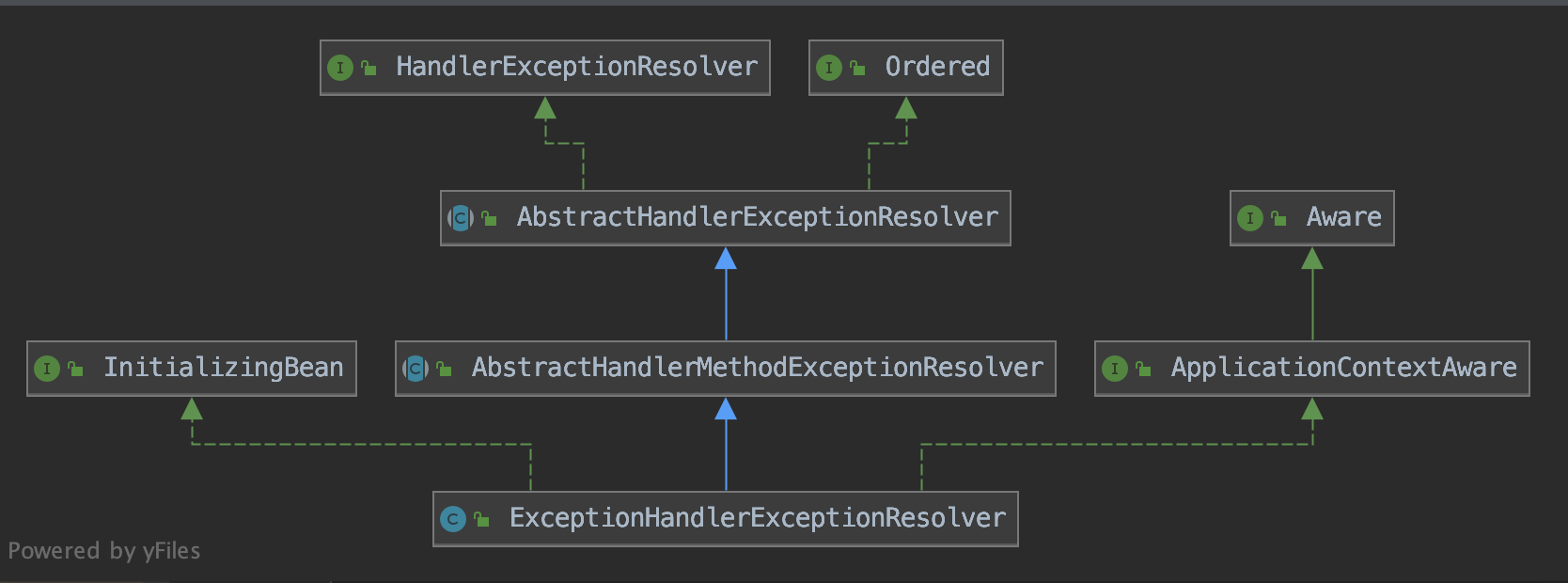
实现HandlerExceptionResolver接口,实现解析方法resolveException()
public interface HandlerExceptionResolver {

	/**
	 * Try to resolve the given exception that got thrown during handler execution,
	 * returning a {@link ModelAndView} that represents a specific error page if appropriate.
	 * <p>The returned {@code ModelAndView} may be {@linkplain ModelAndView#isEmpty() empty}
	 * to indicate that the exception has been resolved successfully but that no view
	 * should be rendered, for instance by setting a status code.
	 * @param request current HTTP request
	 * @param response current HTTP response
	 * @param handler the executed handler, or {@code null} if none chosen at the
	 * time of the exception (for example, if multipart resolution failed)
	 * @param ex the exception that got thrown during handler execution
	 * @return a corresponding {@code ModelAndView} to forward to,
	 * or {@code null} for default processing in the resolution chain
	 */
	@Nullable
	ModelAndView resolveException(
			HttpServletRequest request, HttpServletResponse response, @Nullable Object handler, Exception ex);

}
@Override
public void afterPropertiesSet() {
// Do this first, it may add ResponseBodyAdvice beans
// 初始化异常注解 @ControllerAdvice
initExceptionHandlerAdviceCache();
}
private void initExceptionHandlerAdviceCache() {
if (getApplicationContext() == null) {
return;
}
if (logger.isDebugEnabled()) {
logger.debug("Looking for exception mappings: " + getApplicationContext());
}
// 解析有@ControllerAdvice注解的bean,并将这个bean构建成ControllerAdviceBean对象
List<ControllerAdviceBean> adviceBeans = ControllerAdviceBean.findAnnotatedBeans(getApplicationContext());
// 将ControllerAdviceBean根据order排序
AnnotationAwareOrderComparator.sort(adviceBeans);
for (ControllerAdviceBean adviceBean : adviceBeans) {
Class<?> beanType = adviceBean.getBeanType();
if (beanType == null) {
throw new IllegalStateException("Unresolvable type for ControllerAdviceBean: " + adviceBean);
}
ExceptionHandlerMethodResolver resolver = new ExceptionHandlerMethodResolver(beanType);
// mappedMethods 映射不为空
if (resolver.hasExceptionMappings()) {
// 添加到缓存中
this.exceptionHandlerAdviceCache.put(adviceBean, resolver);
if (logger.isInfoEnabled()) {
logger.info("Detected @ExceptionHandler methods in " + adviceBean);
}
}
// 若实现了ResponseBodyAdvice接口(暂不介绍)
if (ResponseBodyAdvice.class.isAssignableFrom(beanType)) {
this.responseBodyAdvice.add(adviceBean);
if (logger.isInfoEnabled()) {
logger.info("Detected ResponseBodyAdvice implementation in " + adviceBean);
}
}
}
} ExceptionHandlerMethodResolver resolver = new ExceptionHandlerMethodResolver(beanType); 这行代码会解析拥有@ControllerAdvice 注解的class,并且会遍历class中带有 @ExceptionHandler 注解的方法,获取方法注解带有的异常类型,将异常类型和方法放入到mappedMethods中供后面获取,获取的时候若对应处理此异常类型的method有多个,则需要进行排序,选取一个异常类型与method ExceptionHandler注解异常类型最近的一个(深度最小的那个也即是继承关系最少的那个)具体代码如下:
public class ExceptionHandlerMethodResolver {

	/**
	 * A filter for selecting {@code @ExceptionHandler} methods.
	 */
	public static final MethodFilter EXCEPTION_HANDLER_METHODS = method ->
			(AnnotationUtils.findAnnotation(method, ExceptionHandler.class) != null);


	/**
	 * 异常类型与方法的映射map
	 */
	private final Map<Class<? extends Throwable>, Method> mappedMethods = new HashMap<>(16);

	/**
	 * 缓存,用来存储先前碰到过的异常类型与处理方法的映射
	 */
	private final Map<Class<? extends Throwable>, Method> exceptionLookupCache = new ConcurrentReferenceHashMap<>(16);


	/**
	 * A constructor that finds {@link ExceptionHandler} methods in the given type.
	 * @param handlerType the type to introspect
	 */
	public ExceptionHandlerMethodResolver(Class<?> handlerType) {
		// 获取并遍历@ExceptionHandler注解的方法
		for (Method method : MethodIntrospector.selectMethods(handlerType, EXCEPTION_HANDLER_METHODS)) {
			for (Class<? extends Throwable> exceptionType : detectExceptionMappings(method)) {
				addExceptionMapping(exceptionType, method);
			}
		}
	}


	/**
	 * Extract exception mappings from the {@code @ExceptionHandler} annotation first,
	 * and then as a fallback from the method signature itself.
	 */
	@SuppressWarnings("unchecked")
	private List<Class<? extends Throwable>> detectExceptionMappings(Method method) {
		List<Class<? extends Throwable>> result = new ArrayList<>();
		// 将注解ExceptionHandler value值异常添加到result中
		detectAnnotationExceptionMappings(method, result);
		// 注解值为空的话再去获取参数的异常类型
		if (result.isEmpty()) {
			for (Class<?> paramType : method.getParameterTypes()) {
				if (Throwable.class.isAssignableFrom(paramType)) {
					result.add((Class<? extends Throwable>) paramType);
				}
			}
		}
		if (result.isEmpty()) {
			throw new IllegalStateException("No exception types mapped to " + method);
		}
		return result;
	}

	protected void detectAnnotationExceptionMappings(Method method, List<Class<? extends Throwable>> result) {
		ExceptionHandler ann = AnnotationUtils.findAnnotation(method, ExceptionHandler.class);
		Assert.state(ann != null, "No ExceptionHandler annotation");
		result.addAll(Arrays.asList(ann.value()));
	}

	private void addExceptionMapping(Class<? extends Throwable> exceptionType, Method method) {
		// 将异常类型以及对应的method添加到map中,且异常类型不能有重复否则会报错
		Method oldMethod = this.mappedMethods.put(exceptionType, method);
		if (oldMethod != null && !oldMethod.equals(method)) {
			throw new IllegalStateException("Ambiguous @ExceptionHandler method mapped for [" +
					exceptionType + "]: {" + oldMethod + ", " + method + "}");
		}
	}

	/**
	 * Whether the contained type has any exception mappings.
	 */
	public boolean hasExceptionMappings() {
		return !this.mappedMethods.isEmpty();
	}

	/**
	 * Find a {@link Method} to handle the given exception.
	 * Use {@link ExceptionDepthComparator} if more than one match is found.
	 * @param exception the exception
	 * @return a Method to handle the exception, or {@code null} if none found
	 */
	@Nullable
	public Method resolveMethod(Exception exception) {
		return resolveMethodByThrowable(exception);
	}

	/**
	 * Find a {@link Method} to handle the given Throwable.
	 * Use {@link ExceptionDepthComparator} if more than one match is found.
	 * @param exception the exception
	 * @return a Method to handle the exception, or {@code null} if none found
	 * @since 5.0
	 */
	@Nullable
	public Method resolveMethodByThrowable(Throwable exception) {
		Method method = resolveMethodByExceptionType(exception.getClass());
		if (method == null) {
			Throwable cause = exception.getCause();
			if (cause != null) {
				method = resolveMethodByExceptionType(cause.getClass());
			}
		}
		return method;
	}

	/**
	 * Find a {@link Method} to handle the given exception type. This can be
	 * useful if an {@link Exception} instance is not available (e.g. for tools).
	 * @param exceptionType the exception type
	 * @return a Method to handle the exception, or {@code null} if none found
	 */
	@Nullable
	public Method resolveMethodByExceptionType(Class<? extends Throwable> exceptionType) {
		Method method = this.exceptionLookupCache.get(exceptionType);
		if (method == null) {
			method = getMappedMethod(exceptionType);
			this.exceptionLookupCache.put(exceptionType, method);
		}
		return method;
	}

	/**
	 * Return the {@link Method} mapped to the given exception type, or {@code null} if none.
	 */
	@Nullable
	private Method getMappedMethod(Class<? extends Throwable> exceptionType) {
		List<Class<? extends Throwable>> matches = new ArrayList<>();
		for (Class<? extends Throwable> mappedException : this.mappedMethods.keySet()) {
			if (mappedException.isAssignableFrom(exceptionType)) {
				matches.add(mappedException);
			}
		}
		if (!matches.isEmpty()) {
			// exceptionType 到matchs父类异常类型的深度
			matches.sort(new ExceptionDepthComparator(exceptionType));
			return this.mappedMethods.get(matches.get(0));
		}
		else {
			return null;
		}
	}

}
@Override
@Nullable
protected ModelAndView doResolveHandlerMethodException(HttpServletRequest request,
HttpServletResponse response, @Nullable HandlerMethod handlerMethod, Exception exception) {
// exception为controller方法抛出的异常
// 根据异常及其类型从上述的mappedMethods中获取对应的方法,再获取方法所在的对象 封装成ServletInvocableHandlerMethod
ServletInvocableHandlerMethod exceptionHandlerMethod = getExceptionHandlerMethod(handlerMethod, exception);
if (exceptionHandlerMethod == null) {
return null;
}
// 设置参数解析器,主要用来获取方法的参数值的,供后续反射调用方法
if (this.argumentResolvers != null) {
exceptionHandlerMethod.setHandlerMethodArgumentResolvers(this.argumentResolvers);
}
// 设置返回值解析器,当执行完方法后获取返回值,对返回值进行处理 或返回视图或将结果写入到response
if (this.returnValueHandlers != null) {
exceptionHandlerMethod.setHandlerMethodReturnValueHandlers(this.returnValueHandlers);
}
ServletWebRequest webRequest = new ServletWebRequest(request, response);
ModelAndViewContainer mavContainer = new ModelAndViewContainer();
try {
if (logger.isDebugEnabled()) {
logger.debug("Invoking @ExceptionHandler method: " + exceptionHandlerMethod);
}
Throwable cause = exception.getCause();
if (cause != null) {
// Expose cause as provided argument as well
// 执行异常处理方法,也就是我们的自定义的异常处理方法
exceptionHandlerMethod.invokeAndHandle(webRequest, mavContainer, exception, cause, handlerMethod);
}
else {
// Otherwise, just the given exception as-is
exceptionHandlerMethod.invokeAndHandle(webRequest, mavContainer, exception, handlerMethod);
}
}
catch (Throwable invocationEx) {
// Any other than the original exception is unintended here,
// probably an accident (e.g. failed assertion or the like).
if (invocationEx != exception && logger.isWarnEnabled()) {
logger.warn("Failed to invoke @ExceptionHandler method: " + exceptionHandlerMethod, invocationEx);
}
// Continue with default processing of the original exception...
return null;
}
// 根据后续的返回值解析器设置的,将返回值写入到response中了直接返回空的mav
if (mavContainer.isRequestHandled()) {
return new ModelAndView();
}
else {
ModelMap model = mavContainer.getModel();
HttpStatus status = mavContainer.getStatus();
ModelAndView mav = new ModelAndView(mavContainer.getViewName(), model, status);
mav.setViewName(mavContainer.getViewName());
// (this.view instanceof String)
if (!mavContainer.isViewReference()) {
mav.setView((View) mavContainer.getView());
}
if (model instanceof RedirectAttributes) {
Map<String, ?> flashAttributes = ((RedirectAttributes) model).getFlashAttributes();
RequestContextUtils.getOutputFlashMap(request).putAll(flashAttributes);
}
return mav;
}
}exceptionHandlerMethod.invokeAndHandle(webRequest, mavContainer, exception, cause, handlerMethod); 此方法执行完成后已经完成了异常处理方法的调用,若方法返回值为视图ModelAndView或其他视图类型,则还需要借助视图解析器如InternalResourceViewResolver对视图进行解析渲染,若为其他类型的值则将值写入到response响应中。
Controller类方法:
@Controller
@RequestMapping(value = "test")
public class HelloWorldController{

  @Data
  public static class User {
    private String username;

    private Integer age;

    private String address;
  }


  @RequestMapping(value = "user/get", method = RequestMethod.POST)
  @ResponseBody
  public Object testObject(@RequestBody @Valid User user, @RequestParam String address) {
    user.setAddress(address);
    // 这里特意抛出RuntimeException异常
    throw new RuntimeException("this is a exception");
  }

}
ExceptionHandlerController异常处理类
@ControllerAdvice
@ResponseBody
public class ExceptionHandlerController {

  @ExceptionHandler(value = Exception.class)
  public Object handleException(Exception e) {
    return CommonResult.fail("Exception:" + e.getMessage());
  }

  @ExceptionHandler(value = RuntimeException.class)
  public Object handlerRuntimeException(Exception e) {
    return CommonResult.fail("handlerRuntimeException:" + e.getMessage());
  }
}ExceptionHandlerController类中定义了两个异常处理方法,一个处理Exception异常,一个处理RuntimeException异常,那个根据controller方法抛出的异常RuntimeException再结合上面的分析(RuntimeException到RuntimeException深度为0,RuntimeException到Exception中间继承了一次深度为1)可以得出抛出异常类型的处理方法为handlerRuntimeException 方法。 运行程序结果如下:
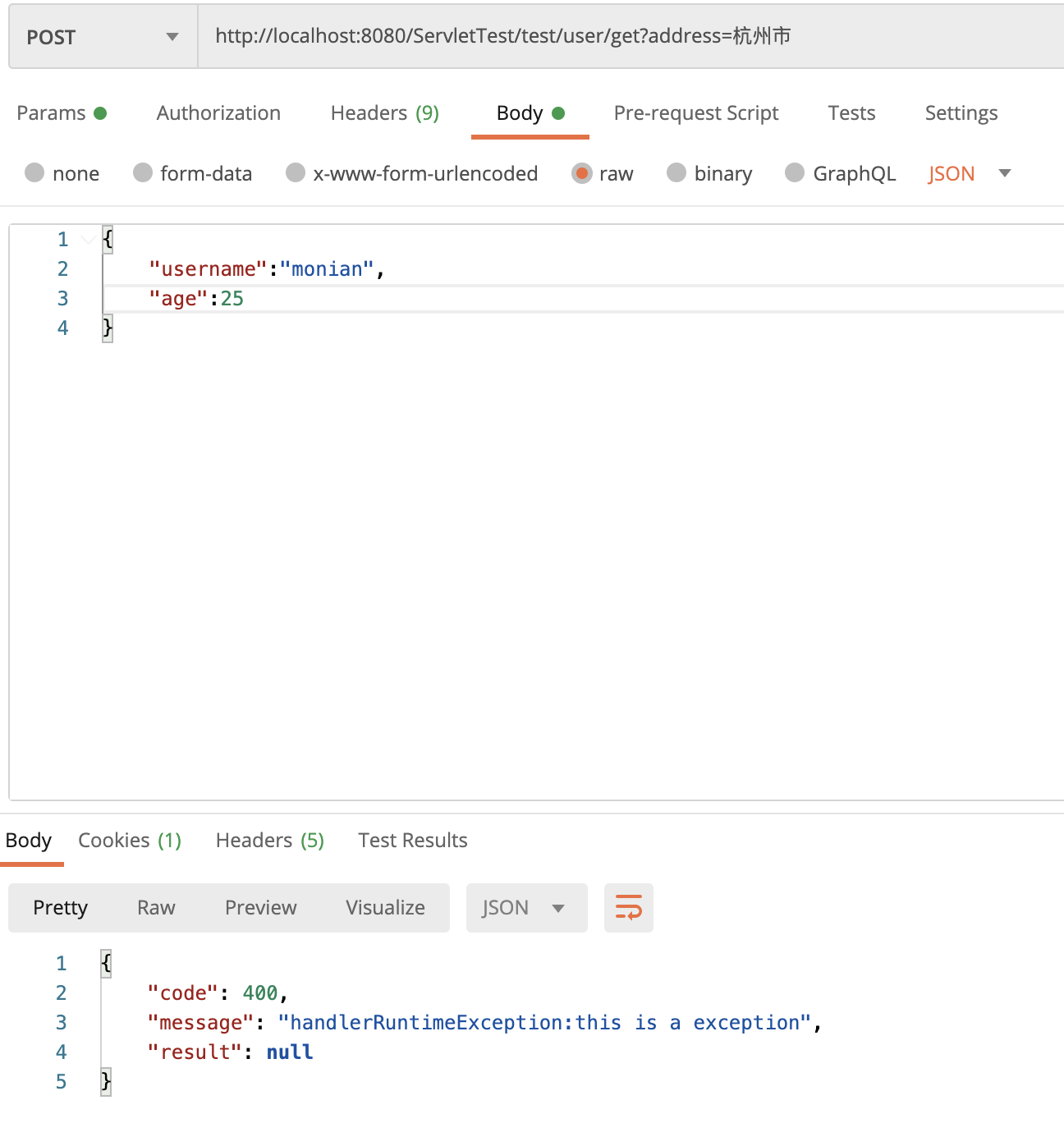
初步解析ExceptionHandlerExceptionResolver源码,若写的有误或者有不理解的地方,欢迎指出讨论~
我有一个字符串input="maybe(thisis|thatwas)some((nice|ugly)(day|night)|(strange(weather|time)))"Ruby中解析该字符串的最佳方法是什么?我的意思是脚本应该能够像这样构建句子:maybethisissomeuglynightmaybethatwassomenicenightmaybethiswassomestrangetime等等,你明白了......我应该一个字符一个字符地读取字符串并构建一个带有堆栈的状态机来存储括号值以供以后计算,还是有更好的方法?也许为此目的准备了一个开箱即用的库?
我主要使用Ruby来执行此操作,但到目前为止我的攻击计划如下:使用gemsrdf、rdf-rdfa和rdf-microdata或mida来解析给定任何URI的数据。我认为最好映射到像schema.org这样的统一模式,例如使用这个yaml文件,它试图描述数据词汇表和opengraph到schema.org之间的转换:#SchemaXtoschema.orgconversion#data-vocabularyDV:name:namestreet-address:streetAddressregion:addressRegionlocality:addressLocalityphoto:i
Rackup通过Rack的默认处理程序成功运行任何Rack应用程序。例如:classRackAppdefcall(environment)['200',{'Content-Type'=>'text/html'},["Helloworld"]]endendrunRackApp.new但是当最后一行更改为使用Rack的内置CGI处理程序时,rackup给出“NoMethodErrorat/undefinedmethod`call'fornil:NilClass”:Rack::Handler::CGI.runRackApp.newRack的其他内置处理程序也提出了同样的反对意见。例如Rack
我正在使用ruby1.9解析以下带有MacRoman字符的csv文件#encoding:ISO-8859-1#csv_parse.csvName,main-dialogue"Marceu","Giveittohimóhe,hiswife."我做了以下解析。require'csv'input_string=File.read("../csv_parse.rb").force_encoding("ISO-8859-1").encode("UTF-8")#=>"Name,main-dialogue\r\n\"Marceu\",\"Giveittohim\x97he,hiswife.\"\
我正在学习Rails,并阅读了关于乐观锁的内容。我已将类型为integer的lock_version列添加到我的articles表中。但现在每当我第一次尝试更新记录时,我都会收到StaleObjectError异常。这是我的迁移:classAddLockVersionToArticle当我尝试通过Rails控制台更新文章时:article=Article.first=>#我这样做:article.title="newtitle"article.save我明白了:(0.3ms)begintransaction(0.3ms)UPDATE"articles"SET"title"='dwdwd
在Cooper的书BeginningRuby中,第166页有一个我无法重现的示例。classSongincludeComparableattr_accessor:lengthdef(other)@lengthother.lengthenddefinitialize(song_name,length)@song_name=song_name@length=lengthendenda=Song.new('Rockaroundtheclock',143)b=Song.new('BohemianRhapsody',544)c=Song.new('MinuteWaltz',60)a.betwee
我早就知道Ruby中的“常量”(即大写的变量名)不是真正常量。与其他编程语言一样,对对象的引用是唯一存储在变量/常量中的东西。(侧边栏:Ruby确实具有“卡住”引用对象不被修改的功能,据我所知,许多其他语言都没有提供这种功能。)所以这是我的问题:当您将一个值重新分配给常量时,您会收到如下警告:>>FOO='bar'=>"bar">>FOO='baz'(irb):2:warning:alreadyinitializedconstantFOO=>"baz"有没有办法强制Ruby抛出异常而不是打印警告?很难弄清楚为什么有时会发生重新分配。 最佳答案
简而言之错误:NOTE:Gem::SourceIndex#add_specisdeprecated,useSpecification.add_spec.Itwillberemovedonorafter2011-11-01.Gem::SourceIndex#add_speccalledfrom/opt/local/lib/ruby/site_ruby/1.8/rubygems/source_index.rb:91./opt/local/lib/ruby/gems/1.8/gems/rails-2.3.8/lib/rails/gem_dependency.rb:275:in`==':und
SPI接收数据左移一位问题目录SPI接收数据左移一位问题一、问题描述二、问题分析三、探究原理四、经验总结最近在工作在学习调试SPI的过程中遇到一个问题——接收数据整体向左移了一位(1bit)。SPI数据收发是数据交换,因此接收数据时从第二个字节开始才是有效数据,也就是数据整体向右移一个字节(1byte)。请教前辈之后也没有得到解决,通过在网上查阅前人经验终于解决问题,所以写一个避坑经验总结。实际背景:MCU与一款芯片使用spi通信,MCU作为主机,芯片作为从机。这款芯片采用的是它规定的六线SPI,多了两根线:RDY和INT,这样从机就可以主动请求主机给主机发送数据了。一、问题描述根据从机芯片手
我正在使用ruby2.1.0我有一个json文件。例如:test.json{"item":[{"apple":1},{"banana":2}]}用YAML.load加载这个文件安全吗?YAML.load(File.read('test.json'))我正在尝试加载一个json或yaml格式的文件。 最佳答案 YAML可以加载JSONYAML.load('{"something":"test","other":4}')=>{"something"=>"test","other"=>4}JSON将无法加载YAML。JSON.load("
