其实和之前的deepsort没差
对应的yolov5去替代原文件中yolov5默认的osnet_x0_25_msmt17.pt也给到你们:
链接:https://pan.baidu.com/s/1RlB1oeiOQ7Le3XFd_QhmAg?pwd=nlsh 提取码:nlsh
或者是到csdn这里去下载把
一些没法自动下载的疯狂报错

在代码详解之前我认为了解整个代码的类和函数之间关系是非常非常重要的!!!
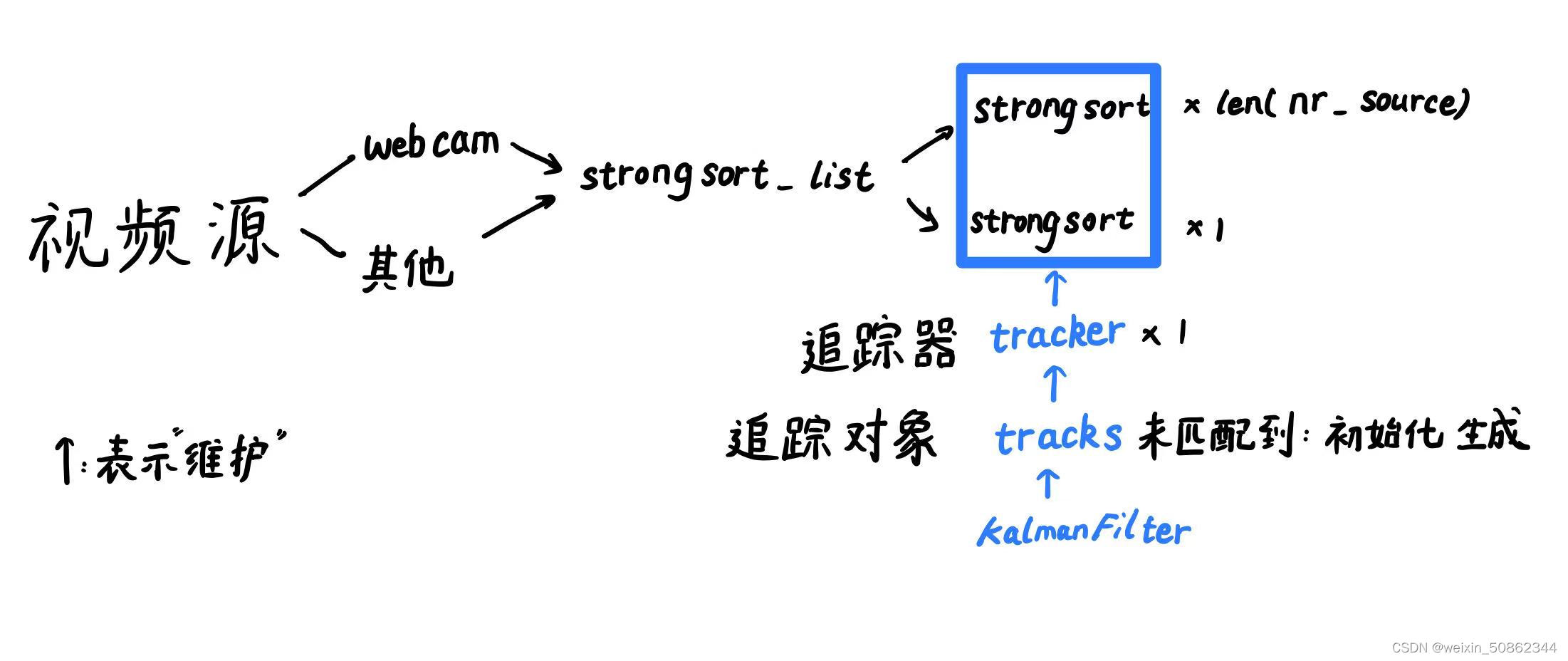
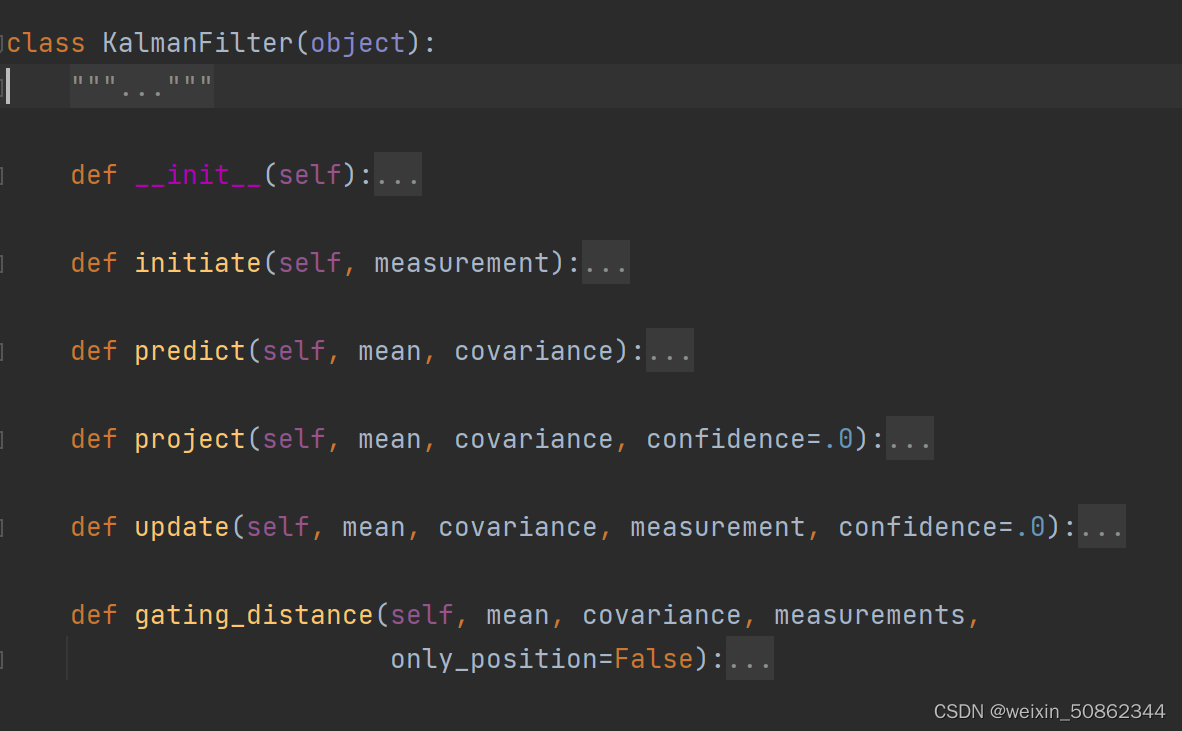
先从比较底层的KalmanFilter类搞起
(1)建议是先移步去学习【卡尔曼预测在视觉跟踪中的运用】(但是请注意有一个地方应该是讲错了,我在评论中已经给她指出了!)
(2)调用时机
class Tracker:
 def __init__(self, metric, max_iou_distance=0.7, max_age=30, n_init=3):
        ...
        self.kf = KalmanFilter()
        self.mean, self.covariance = self.kf.initiate(detection)
初始化只有1个时机:
①在self.tracker.update(detections, classes, confidences)对于 没有匹配到的检测目标
        for detection_idx in unmatched_detections:#直接初始化:外观特征(样子&距离) 和iou 已经能匹配上的基本上都捞回来了,不能匹配的一般都是新的
            self._initiate_track(detections[detection_idx], classes[detection_idx].item(), confidences[detection_idx].item())
class Tracker:
    def predict(self):
        for track in self.tracks:
            track.predict(self.kf)
(2)tracker.predict()调用track.predict(self.kf)
class Track:
    def predict(self, kf):
        self.mean, self.covariance = self.kf.predict(self.mean, self.covariance)
                                    #使用卡尔曼滤波返回预测状态的平均向量和协方差矩阵
        self.age += 1
        self.time_since_update += 1
self.tracker.update(detections, classes, confidences)
(2)在tracker.update调用track.update来 更新跟踪帧和检测帧
        for track_idx, detection_idx in matches:
            self.tracks[track_idx].update(#执行卡尔曼滤波测量更新mean和协方差 并更新特征缓存
                detections[detection_idx], classes[detection_idx], confidences[detection_idx])
                                            #类别信息
(3)track.update中调用kf.update来更新mean(状态向量)和协方差矩阵
self.mean, self.covariance = self.kf.update(self.mean, self.covariance, detection.to_xyah(), detection.confidence)
接下来我们从上往下看
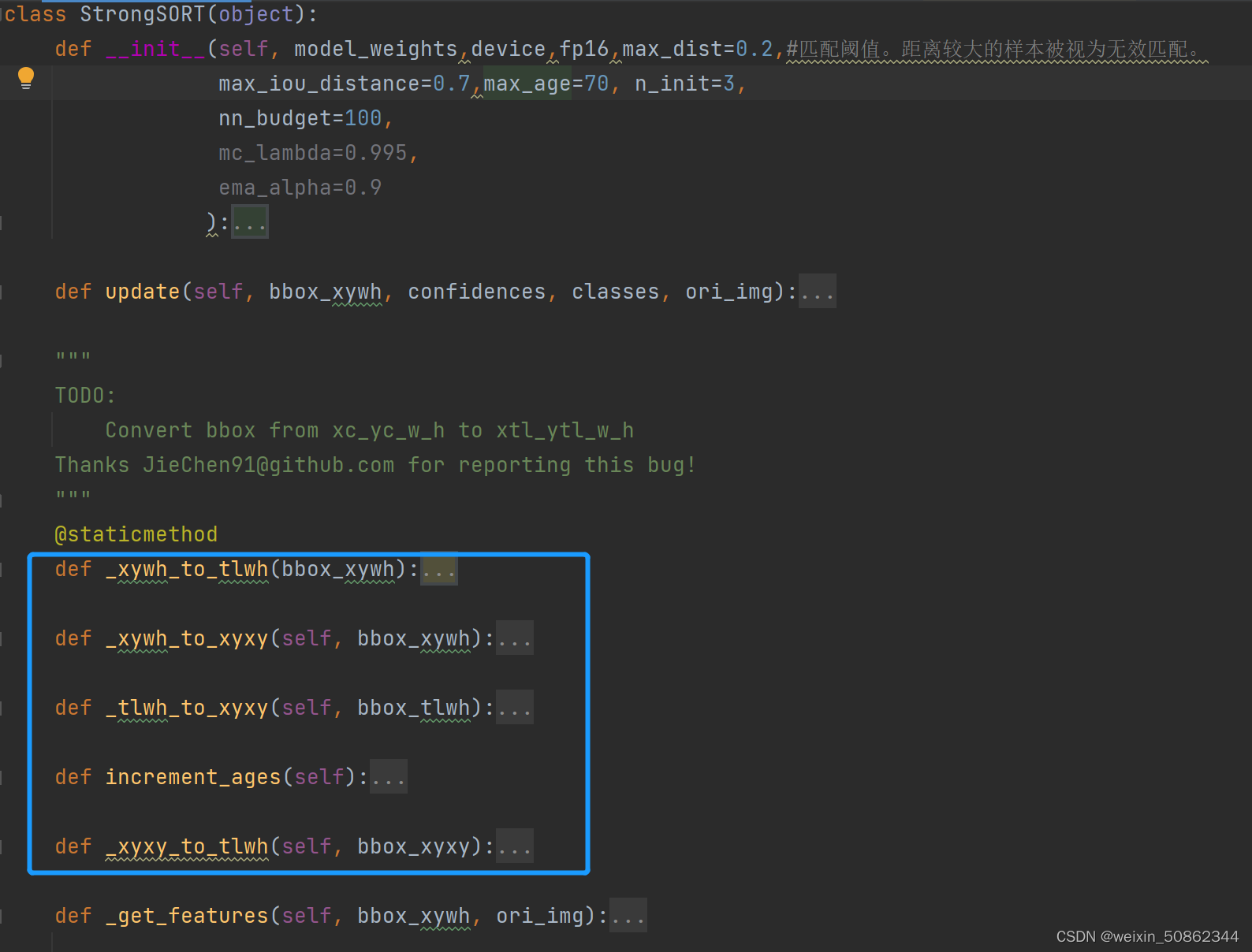
StrongSORT类中函数包括以上几个,打蓝色框看名字估计估计可以猜出来,四个bbox格式转换函数 和 一个增加追踪器年龄函数,这部分就不讲了。主要看_ init _ ,update 和 _get_features
    def __init__(self,
                 model_weights,
                 device,
                 fp16,
                 max_dist=0.2,#匹配阈值。距离较大的样本被视为无效匹配。
                 max_iou_distance=0.7,
                 max_age=70, n_init=3,
                 nn_budget=100,
                 mc_lambda=0.995,
                 ema_alpha=0.9
                ):

        #加载ReID模型
        self.model = ReIDDetectMultiBackend(weights=model_weights, device=device, fp16=fp16)
                                            #weights='osnet_x0_25_msmt17.pt'
        self.max_dist = max_dist

        metric = NearestNeighborDistanceMetric( "cosine", self.max_dist, nn_budget)
        # 默认使用 余弦距离"cosine"(也可以使用“euclidean”欧几里得距离)度量相似程度
        #self.max_dist:最大阈值距离,超过该距离说明不匹配
        #nn_budget:每个类中固定样本的最大数量

        #初始化tracker
        self.tracker = Tracker(
            metric, max_iou_distance=max_iou_distance, max_age=max_age, n_init=n_init)
        #metric:对应上面的NearestNeighborDistanceMetric
        #max_iou_distance:使用iou匹配的阈值(后面用的是1-iou,即iou损失,越大说明离得越远)。
        #n_init:track仍处于初始化阶段的帧数,超过该帧 track会转变成confirmed状态
对于每个目标,返回的最近邻距离度量。到目前为止观察到的任何样本的最近距离。
def __init__(self, metric, matching_threshold, budget=None):
    def _get_features(self, bbox_xywh, ori_img):
        im_crops = []
        #遍历所有的bbox截取原图中bbox
        for box in bbox_xywh:
            x1, y1, x2, y2 = self._xywh_to_xyxy(box)
            im = ori_img[y1:y2, x1:x2]
            im_crops.append(im)
        if im_crops:
            features = self.model(im_crops)#放进ReID模型(预处理之后放入对应的模型)
        else:#没定义im_crops的话返回空
            features = np.array([])
        return features
这是因为检测算法有时会出现漏检的情况.
在跟踪算法中一旦跟踪丢了目标就很难再继续跟踪下去了。
如果遇到漏检的情况,将失去身份ID。所以仅仅使用detection进行跟踪结果也并不理想。
【参考文档】DeepSORT(工作流程)
在_get_features中被调用
features = self._get_features(bbox_xywh, ori_img)#取出原图像对应区域放入ReID模型
(1)模型构建
        self.model = build_model(#检查模型仓库中是否存在该模型,如果存在调用该模型
            model_name,
            num_classes=1,
            pretrained=not (w and check_isfile(w)),
            use_gpu=device
        )#模型全部存放在strong_sort/deep/reid/torchreid/models/*
build_model函数会检查模型仓库是否存在该模型,如果存在初始化该模型
(2)预处理
    def _preprocess(self, im_batch):

        images = []
        for element in im_batch:
        	#先将该图片转化为pil格式
            image = self.to_pil(element)

			 #进行以下操作:(1)剪裁为(256, 128) (2)转换为张量(3)归一化
            image = self.preprocess(image)
            images.append(image)

        images = torch.stack(images, dim=0)#将图片张量在第0维堆叠起来
        images = images.to(self.device)

        return images
(3)forward
_get_features中的features = self.model(im_crops)实际上就是调用了forward函数
    def forward(self, im_batch):

        # preprocess batch
        im_batch = self._preprocess(im_batch)

        # 半精度 batch to half
        if self.fp16 and im_batch.dtype != torch.float16:
           im_batch = im_batch.half()

        # batch processing
        features = []
        if self.pt:
            features = self.model(im_batch)
		.......

		#将numpy转为tensor
        if isinstance(features, (list, tuple)):
            return self.from_numpy(features[0]) if len(features) == 1 else [self.from_numpy(x) for x in features]
        else:
            return self.from_numpy(features)
    def update(self, bbox_xywh, confidences, classes, ori_img):
        self.height, self.width = ori_img.shape[:2]#原图像的长宽高

#-------step1 生成检测目标---------------------------generate detections
        features = self._get_features(bbox_xywh, ori_img)#返回空feature,或取出原图像对应区域放入ReID模型
        bbox_tlwh = self._xywh_to_tlwh(bbox_xywh)#获得左上角和长宽
        detections = [Detection(bbox_tlwh[i], conf, features[i]) for i, conf in enumerate(confidences)]
                    #import类    bbox的左上宽高,置信度,使用ReID得到的feature

#-------step2 运行非极大抑制(好像没用上)------------ run on non-maximum supression
        boxes = np.array([d.tlwh for d in detections])
        scores = np.array([d.confidence for d in detections])

#------step3 更新追踪器tracker----------- update tracker

        #------step3.1 先进行预测获得状态向量mean和协方差矩阵covariance-------------
        self.tracker.predict()#对tracker对象维护的Track列表,每一个Track对象调用卡尔曼滤波对状态进行初始化和预测

        # ------step3.2 运行匹配级联,更新追踪-------------
        self.tracker.update(detections, classes, confidences)

#------step4 输出bbox标识-------------------------output bbox identities
        outputs = []
        for track in self.tracker.tracks:
            #排除掉没有被确认 而且 已经超过一帧没有更新的
            if not track.is_confirmed() or track.time_since_update > 1:
                continue

            box = track.to_tlwh()
            x1, y1, x2, y2 = self._tlwh_to_xyxy(box)

            track_id = track.track_id
            class_id = track.class_id
            conf = track.conf
            outputs.append(np.array([x1, y1, x2, y2, track_id, class_id, conf]))
        if len(outputs) > 0:
            outputs = np.stack(outputs, axis=0)
        return outputs
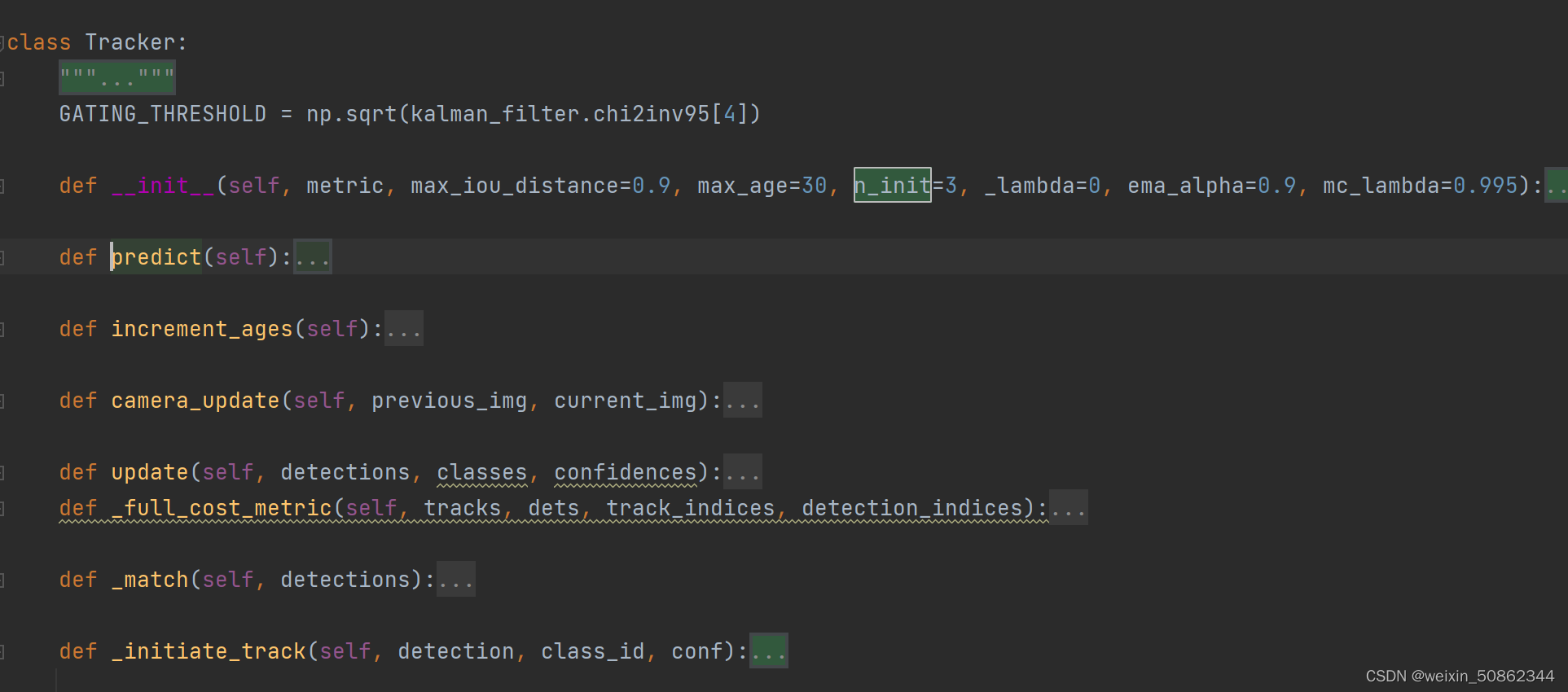
Tracker类在我的理解中相当于一个追踪器,用来管理所有track追踪对象
共同点:都是遍历所有track,调用track的函数
对每一个追踪对象进行预测
    def predict(self):
        for track in self.tracks:
            track.predict(self.kf)
Tracker维护了一个Track列表,Track对象调用卡尔曼滤波获得状态向量和协方差矩阵
    def increment_ages(self):
        for track in self.tracks:
            track.increment_age()
            track.mark_missed()#标记丢失
    def update(self, detections, classes, confidences):
#----------step1. 运行匹配级联 获得匹配到的--------------------------- Run matching cascade.
        matches, unmatched_tracks, unmatched_detections = \
            self._match(detections)#通过外观特征和iou匹配

#----------step2.更新跟踪对象-------------------Update track set.
        for track_idx, detection_idx in matches:
        #----------step2.1 执行卡尔曼滤波测量更新mean和协方差 并更新特征缓存----
            self.tracks[track_idx].update(
                detections[detection_idx], classes[detection_idx], confidences[detection_idx])
                                            #类别信息
        #----------step2.2 没有匹配上的的追踪对象track标记------
        for track_idx in unmatched_tracks:
            self.tracks[track_idx].mark_missed()#可能会删除

		#------step2.3遍历未匹配上的检测对象detection初始化----------------
        for detection_idx in unmatched_detections:#直接初始化:外观特征(样子&距离) 和iou 已经能匹配上的基本上都捞回来了,不能匹配的一般都是新的
            self._initiate_track(detections[detection_idx], classes[detection_idx].item(), confidences[detection_idx].item())

		#------step2.4更新追踪器tracker维护的track列表-----
        self.tracks = [t for t in self.tracks if not t.is_deleted()]

#----------step3  更新特征的距离度量。-------------------Update distance metric.
        active_targets = [t.track_id for t in self.tracks if t.is_confirmed()]
        features, targets = [], []
        for track in self.tracks:
            if not track.is_confirmed():
                continue
            features += track.features
            targets += [track.track_id for _ in track.features]
        self.metric.partial_fit(np.asarray(features), np.asarray(targets), active_targets)
                   #更新                              #获得更新后的{active_targets:feature}
在本函数中调用了本类的_match 和 _initiate_track,这里只讲_initiate_track。_match 比较重要放到后面
对于没有匹配上的检测对象,tracker会调用_initiate_track新建一个追踪对象track,并放入维护列表中
    def _initiate_track(self, detection, class_id, conf):
        #tracker维护列表中新增追踪对象Track
        self.tracks.append(Track(
            detection.to_xyah(), self._next_id, class_id, conf, self.n_init, self.max_age, self.ema_alpha,
            detection.feature))

        #id自增
        self._next_id += 1
这个部分是我认为比较难理解的。
先不要看这个函数内部创建的gated_metric,我们跟着步骤先理解大致作用。
    def _match(self, detections):
        '''
        其先调用 nnmatching.py-->distance函数计算出当前帧的所有检测目标detections
        与历史所有confrimed targets之间的外观相似度(基于两者之间的128维度特征,利用余弦距离计算的),得出相似度矩阵cost_matrix
        '''
        #综合了两点信息A:外观信息(128维度特征)B:运动信息(基于卡尔曼滤波预测的track的位置)对track与detection为同一个人的可能性进行判断,所以称为级联匹配
        def gated_metric(tracks, dets, track_indices, detection_indices):
            features = np.array([dets[i].feature for i in detection_indices])#检测到的目标
            targets = np.array([tracks[i].track_id for i in track_indices])#追踪的目标

            # 描述的是特征的相似程度
            cost_matrix = self.metric.distance(features, targets)# 创建了一个len(targets)*len(features)的二维矩阵用来描述距离
            #根据128特征,用余弦距离计算计算出当前帧的所有检测目标detections与历史所有confrimed targets之间的外观相似度

            # gate_cost_matrix:基于卡尔曼滤波得到的状态分布,使cost矩阵中的不可行项(距离)无效
            cost_matrix = linear_assignment.gate_cost_matrix(cost_matrix, tracks, dets, track_indices, detection_indices)
            # 这里将上面根据128特征,用余弦距离算的特征矩阵,再用卡尔曼滤波更新一下,用的是马氏距离
            return cost_matrix

#------step1. 将跟踪集拆分为确认跟踪集和未确认跟踪集----------------------Split track set into confirmed and unconfirmed tracks.
        confirmed_tracks = [
            i for i, t in enumerate(self.tracks) if t.is_confirmed()]
        unconfirmed_tracks = [
            i for i, t in enumerate(self.tracks) if not t.is_confirmed()]

 #------step2. 使用外观特征(特征的相似程度,距离)gated_metric关联 已确认跟踪集---------------------- Associate confirmed tracks using appearance features.
        matches_a, unmatched_tracks_a, unmatched_detections = \
            linear_assignment.matching_cascade(
                gated_metric, self.metric.matching_threshold, self.max_age,
                self.tracks, detections, confirmed_tracks)
        # gated_metric:len(targets)*len(features)的二维矩阵cost_matrix


# ------step3.将仍未关联上的跟踪和未确认跟踪 使用IOU 关联起来----------------------- Associate remaining tracks together with unconfirmed tracks using IOU.
        iou_track_candidates = unconfirmed_tracks + [
            k for k in unmatched_tracks_a if
            self.tracks[k].time_since_update == 1]

        unmatched_tracks_a = [
            k for k in unmatched_tracks_a if
            self.tracks[k].time_since_update != 1]

        matches_b, unmatched_tracks_b, unmatched_detections = \
            linear_assignment.min_cost_matching(
                iou_matching.iou_cost, self.max_iou_distance, self.tracks,
                #import
                detections, iou_track_candidates, unmatched_detections)
#更新匹配和未匹配(时间超过一帧&没匹配上)
        matches = matches_a + matches_b
        unmatched_tracks = list(set(unmatched_tracks_a + unmatched_tracks_b))
        return matches, unmatched_tracks, unmatched_detections
第一次调用是在linear_assignment.matching_cascade
第二次是在step3中将将仍未关联上的跟踪和未确认跟踪 使用IOU 关联起来
def min_cost_matching(
        distance_metric, max_distance, tracks, detections, track_indices=None,
        detection_indices=None):
    if track_indices is None:#索引为空,从输入中生成
        track_indices = np.arange(len(tracks))
    if detection_indices is None:#索引为空,从输入中生成
        detection_indices = np.arange(len(detections))

    if len(detection_indices) == 0 or len(track_indices) == 0:
        return [], track_indices, detection_indices  # Nothing to match.

#--------step1:先使用传入的distance_metric函数创建cost_matrix-------------------
    cost_matrix = distance_metric(
        tracks, detections, track_indices, detection_indices)#返回len(targets)*len(features)的二维矩阵cost_matrix
    cost_matrix[cost_matrix > max_distance] = max_distance + 1e-5#大于max_distance的全部等于max_distance + 1e-5

#--------step2:使用匈牙利算法-----------------------------
    row_indices, col_indices = linear_sum_assignment(cost_matrix)
    #追踪对象       #检测对象      #返回的是每一行的索引    #用来描述距离

    matches, unmatched_tracks, unmatched_detections = [], [], []

#----------step3:更新匹配对象和未匹配------------------------------------------------------

    #-----step3.1 遍历所有检测对象,没有匹配到(col_indices中不存在)放入unmatched_detections
    for col, detection_idx in enumerate(detection_indices):
        if col not in col_indices:
            unmatched_detections.append(detection_idx)

    #-----step3.2遍历所有追踪对象,没有匹配到(row_indices中不存在)放入unmatched_tracks
    for row, track_idx in enumerate(track_indices):
        if row not in row_indices:
            unmatched_tracks.append(track_idx)

    #-----step3.3 遍历所有匹配到的对象 超过最大距离重新置为未匹配------
    for row, col in zip(row_indices, col_indices):
        track_idx = track_indices[row]
        detection_idx = detection_indices[col]
        # 超过最大距离置为未匹配
        if cost_matrix[row, col] > max_distance:
            unmatched_tracks.append(track_idx)
            unmatched_detections.append(detection_idx)
        else:
            matches.append((track_idx, detection_idx))
    return matches, unmatched_tracks, unmatched_detections
其实只要你了解匈牙利算法,就会发现还是那两个步骤
(1)构建cost矩阵
(2)计算匈牙利算法
如果不清楚的话可以参考【目标跟踪初探(DeepSORT)】
这里只不过是增加了一步:
(3)只不过是将分配结果更新
 #------step2. 使用外观特征(特征的相似程度,距离)gated_metric关联 已确认跟踪集---------------------- Associate confirmed tracks using appearance features.
        matches_a, unmatched_tracks_a, unmatched_detections = \
            linear_assignment.matching_cascade(
                gated_metric, self.metric.matching_threshold, self.max_age,
                self.tracks, detections, confirmed_tracks)

# gated_metric:自定义函数 ,返回len(targets)*len(features)的二维矩阵cost_matrix
#self.metric.matching_threshold:其实是对应了StrongSORT类中NearestNeighborDistanceMetric创建时传入的self.max_dist参数
#self.max_age:tracker初始化创建的,表示 最大跟踪丢失次数
调用了linear_assignment.matching_cascade来实现级联匹配
def matching_cascade(
        distance_metric, max_distance, cascade_depth, tracks, detections,
        track_indices=None, detection_indices=None):
说明有点难理解,给一个简单的损失矩阵便于你们理解。distance_metric不过就是横坐标代表track索引,纵坐标代表detections索引,此时的值代表损失。
cost_matrix = np.array([
    [15.0, 40.0, 45.0],
    [20.0, 60., 35.],
    [20., 40.,25.]
])
cost_matrix中的行映射到tracks中的轨迹的轨迹索引列表(就是cost_matrix 的track索引)cost_matrix中的行映射到detections中的检测目标的检测目标索引列表(就是detections索引)gated_metric用于传入linear_assignment.matching_cascade
        def gated_metric(tracks, dets, track_indices, detection_indices):
            features = np.array([dets[i].feature for i in detection_indices])#检测到的目标
            targets = np.array([tracks[i].track_id for i in track_indices])#追踪的目标

            # 描述的是特征的相似程度
            cost_matrix = self.metric.distance(features, targets)# 创建了一个len(targets)*len(features)的二维矩阵用来描述距离
            #根据128特征,用余弦距离计算计算出当前帧的所有检测目标detections与历史所有confrimed targets之间的外观相似度

            # gate_cost_matrix:基于卡尔曼滤波得到的状态分布,使cost矩阵中的不可行项(距离)无效
            cost_matrix = linear_assignment.gate_cost_matrix(cost_matrix, tracks, dets, track_indices, detection_indices)
            # 这里将上面根据128特征,用余弦距离算的特征矩阵,再用卡尔曼滤波更新一下,用的是马氏距离
            return cost_matrix
//TODO:这个部分后面补上
def matching_cascade(
        distance_metric, max_distance, cascade_depth, tracks, detections,
        track_indices=None, detection_indices=None):
#----step1 如果检测索引或者跟踪索引为None,使用对应列表创建----------
    if track_indices is None:
        track_indices = list(range(len(tracks)))
    if detection_indices is None:
        detection_indices = list(range(len(detections)))

#----step2 使用min_cost_matching构建匈牙利算法-------
    unmatched_detections = detection_indices
    matches = []
    track_indices_l = [
        k for k in track_indices
        # if tracks[k].time_since_update == 1 + level
    ]
    matches_l, _, unmatched_detections = \
        min_cost_matching(
            distance_metric, max_distance, tracks, detections,
            track_indices_l, unmatched_detections)

#----step3 更新--------------------
    matches += matches_l
    unmatched_tracks = list(set(track_indices) - set(k for k, _ in matches))#没有直接使用min_cost_matching的第二个返回值
    return matches, unmatched_tracks, unmatched_detections
这里调用了min_cost_matching构建了匈牙利算法
终于到track类了
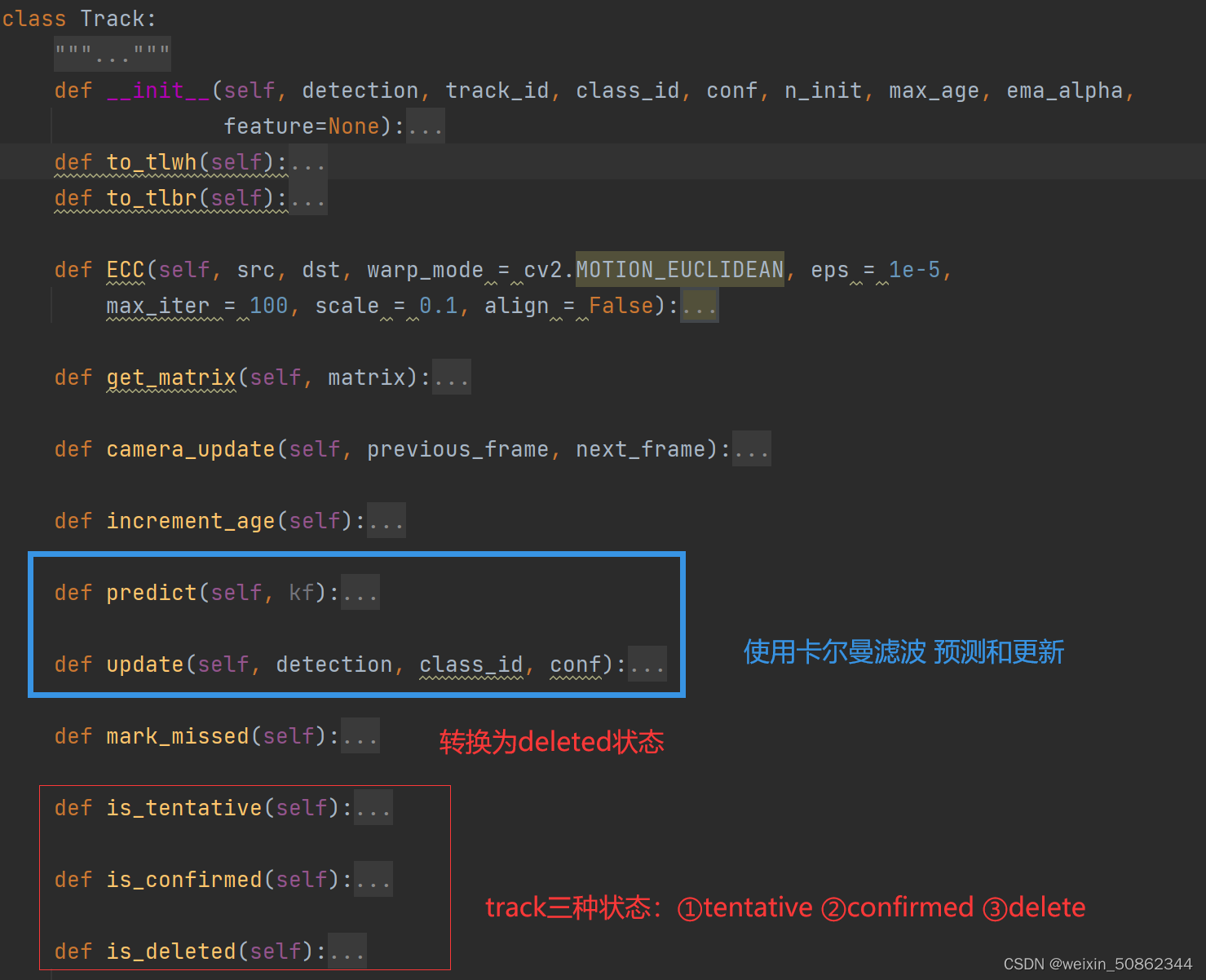
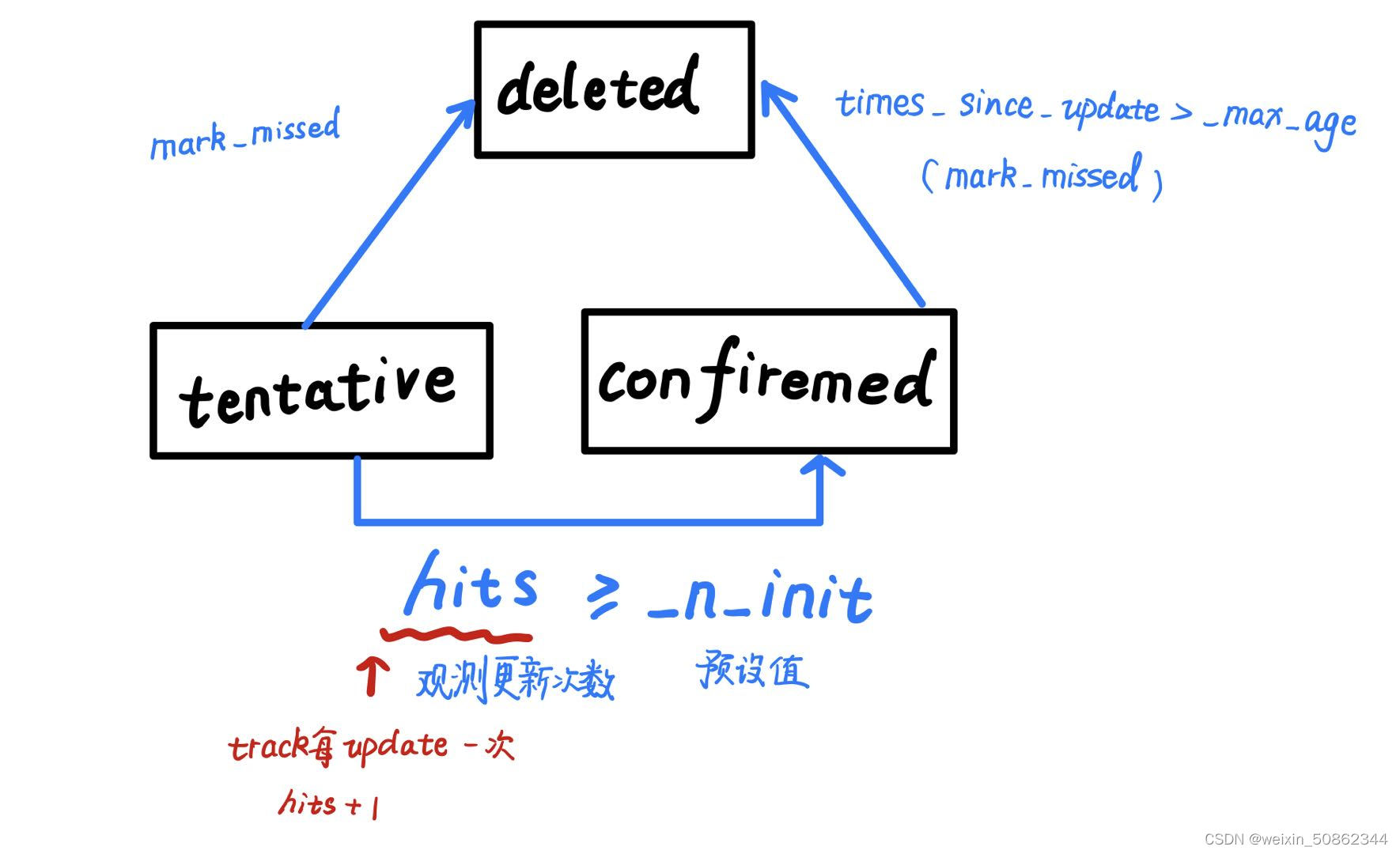
①tracker类中的increment_ages
    def increment_ages(self):
        for track in self.tracks:
            track.increment_age()
            track.mark_missed()
②tracker类中的update函数
对没有匹配上的track跟踪对象进行mark_missed
        for track_idx in unmatched_tracks:
            self.tracks[track_idx].mark_missed()#可能会删除
建议这部分结合上面的卡尔曼滤波一起服用
    def predict(self, kf):
        self.mean, self.covariance = self.kf.predict(self.mean, self.covariance)
                                    #使用卡尔曼滤波返回预测状态的平均状态向量和协方差矩阵
        self.age += 1
        self.time_since_update += 1
    def update(self, detection, class_id, conf):

        self.conf = conf
        self.class_id = class_id.int()
        self.mean, self.covariance = self.kf.update(self.mean, self.covariance, detection.to_xyah(), detection.confidence)

        feature = detection.feature / np.linalg.norm(detection.feature)#求范数

        #使用历史平滑
        smooth_feat = self.ema_alpha * self.features[-1] + (1 - self.ema_alpha) * feature
        smooth_feat /= np.linalg.norm(smooth_feat)
        self.features = [smooth_feat]

        self.hits += 1
        self.time_since_update = 0                 #观测更新>=预设值
        if self.state == TrackState.Tentative and self.hits >= self._n_init:
            self.state = TrackState.Confirmed
这两个部分都没有特别难以理解的的地方
我有一个字符串input="maybe(thisis|thatwas)some((nice|ugly)(day|night)|(strange(weather|time)))"Ruby中解析该字符串的最佳方法是什么?我的意思是脚本应该能够像这样构建句子:maybethisissomeuglynightmaybethatwassomenicenightmaybethiswassomestrangetime等等,你明白了......我应该一个字符一个字符地读取字符串并构建一个带有堆栈的状态机来存储括号值以供以后计算,还是有更好的方法?也许为此目的准备了一个开箱即用的库?
如何在buildr项目中使用Ruby?我在很多不同的项目中使用过Ruby、JRuby、Java和Clojure。我目前正在使用我的标准Ruby开发一个模拟应用程序,我想尝试使用Clojure后端(我确实喜欢功能代码)以及JRubygui和测试套件。我还可以看到在未来的不同项目中使用Scala作为后端。我想我要为我的项目尝试一下buildr(http://buildr.apache.org/),但我注意到buildr似乎没有设置为在项目中使用JRuby代码本身!这看起来有点傻,因为该工具旨在统一通用的JVM语言并且是在ruby中构建的。除了将输出的jar包含在一个独特的、仅限ruby
我主要使用Ruby来执行此操作,但到目前为止我的攻击计划如下:使用gemsrdf、rdf-rdfa和rdf-microdata或mida来解析给定任何URI的数据。我认为最好映射到像schema.org这样的统一模式,例如使用这个yaml文件,它试图描述数据词汇表和opengraph到schema.org之间的转换:#SchemaXtoschema.orgconversion#data-vocabularyDV:name:namestreet-address:streetAddressregion:addressRegionlocality:addressLocalityphoto:i
在rails源中:https://github.com/rails/rails/blob/master/activesupport/lib/active_support/lazy_load_hooks.rb可以看到以下内容@load_hooks=Hash.new{|h,k|h[k]=[]}在IRB中,它只是初始化一个空哈希。和做有什么区别@load_hooks=Hash.new 最佳答案 查看rubydocumentationforHashnew→new_hashclicktotogglesourcenew(obj)→new_has
我正在使用ruby1.9解析以下带有MacRoman字符的csv文件#encoding:ISO-8859-1#csv_parse.csvName,main-dialogue"Marceu","Giveittohimóhe,hiswife."我做了以下解析。require'csv'input_string=File.read("../csv_parse.rb").force_encoding("ISO-8859-1").encode("UTF-8")#=>"Name,main-dialogue\r\n\"Marceu\",\"Giveittohim\x97he,hiswife.\"\
我的主要目标是能够完全理解我正在使用的库/gem。我尝试在Github上从头到尾阅读源代码,但这真的很难。我认为更有趣、更温和的踏脚石就是在使用时阅读每个库/gem方法的源代码。例如,我想知道RubyonRails中的redirect_to方法是如何工作的:如何查找redirect_to方法的源代码?我知道在pry中我可以执行类似show-methodmethod的操作,但我如何才能对Rails框架中的方法执行此操作?您对我如何更好地理解Gem及其API有什么建议吗?仅仅阅读源代码似乎真的很难,尤其是对于框架。谢谢! 最佳答案 Ru
我的假设是moduleAmoduleBendend和moduleA::Bend是一样的。我能够从thisblog找到解决方案,thisSOthread和andthisSOthread.为什么以及什么时候应该更喜欢紧凑语法A::B而不是另一个,因为它显然有一个缺点?我有一种直觉,它可能与性能有关,因为在更多命名空间中查找常量需要更多计算。但是我无法通过对普通类进行基准测试来验证这一点。 最佳答案 这两种写作方法经常被混淆。首先要说的是,据我所知,没有可衡量的性能差异。(在下面的书面示例中不断查找)最明显的区别,可能也是最著名的,是你的
几个月前,我读了一篇关于rubygem的博客文章,它可以通过阅读代码本身来确定编程语言。对于我的生活,我不记得博客或gem的名称。谷歌搜索“ruby编程语言猜测”及其变体也无济于事。有人碰巧知道相关gem的名称吗? 最佳答案 是这个吗:http://github.com/chrislo/sourceclassifier/tree/master 关于ruby-寻找通过阅读代码确定编程语言的rubygem?,我们在StackOverflow上找到一个类似的问题:
我目前正在使用以下方法获取页面的源代码:Net::HTTP.get(URI.parse(page.url))我还想获取HTTP状态,而无需发出第二个请求。有没有办法用另一种方法做到这一点?我一直在查看文档,但似乎找不到我要找的东西。 最佳答案 在我看来,除非您需要一些真正的低级访问或控制,否则最好使用Ruby的内置Open::URI模块:require'open-uri'io=open('http://www.example.org/')#=>#body=io.read[0,50]#=>"["200","OK"]io.base_ur
简而言之错误:NOTE:Gem::SourceIndex#add_specisdeprecated,useSpecification.add_spec.Itwillberemovedonorafter2011-11-01.Gem::SourceIndex#add_speccalledfrom/opt/local/lib/ruby/site_ruby/1.8/rubygems/source_index.rb:91./opt/local/lib/ruby/gems/1.8/gems/rails-2.3.8/lib/rails/gem_dependency.rb:275:in`==':und
