TSP (traveling salesman problem,旅行商问题)是典型的NP完全问题,即其最坏情况下的时间复杂度随着问题规模的增大按指数方式增长,到目前为止还未找到一个多项式时间的有效算法。本文探讨了基于遗传算法求解TSP问题的Python实现。
本案例以31个城市为例,假定31个城市的位置坐标如表1所列。寻找出一条最短的遍历31个城市的路径。
| 城市编号 | X坐标 | Y坐标 | 城市编号 | X坐标 | Y坐标 |
|---|---|---|---|---|---|
| 1 | 1.304 | 2.312 | 17 | 3.918 | 2.179 |
| 2 | 3.639 | 1.315 | 18 | 4.061 | 2.37 |
| 3 | 4.177 | 2.244 | 19 | 3.78 | 2.212 |
| 4 | 3.712 | 1.399 | 20 | 3.676 | 2.578 |
| 5 | 3.488 | 1.535 | 21 | 4.029 | 2.838 |
| 6 | 3.326 | 1.556 | 22 | 4.263 | 2.931 |
| 7 | 3.238 | 1.229 | 23 | 3.429 | 1.908 |
| 8 | 4.196 | 1.044 | 24 | 3.507 | 2.376 |
| 9 | 4.312 | 0.79 | 25 | 3.394 | 2.643 |
| 10 | 4.386 | 0.57 | 26 | 3.439 | 3.201 |
| 11 | 3.007 | 1.97 | 27 | 2.935 | 3.24 |
| 12 | 2.562 | 1.756 | 28 | 3.14 | 3.55 |
| 13 | 2.788 | 1.491 | 29 | 2.545 | 2.357 |
| 14 | 2.381 | 1.676 | 30 | 2.778 | 2.826 |
| 15 | 1.332 | 0.695 | 31 | 2.37 | 2.975 |
| 16 | 3.715 | 1.678 |
第一步:初始化 t←0进化代数计数器;T是最大进化代数(也可以没有);随机生成M个个体作为初始群体P(t);
第二步:个体评价 计算P(t)中各个个体的适应度;
第三步:选择运算 将选择算子作用于群体;
第四步:交叉运算 将交叉算子作用于群体;
第五步:变异运算 将变异算子作用于群体,并通过以上运算得到下一代群体P(t + 1);
第六步:终止条件判断 t≦T:t← t+1 转到步骤2;t>T:终止 输出解。
1)确定决策变量及各种约束条件,即个体的表现型X和问题的解空间;
2)建立优化模型 (目标函数最大OR 最小) 数学描述形式 量化方法;
3)染色体编码方法;
4)解码方法;
5)个体适应度的量化评价方法 F(x)
6)设计遗传算子;
7)确定有关运行参数。
应用于TSP问题,选用整数编码,每个整数代表一个城市,一整条路径就是整个染色体编码;如此显式的编码,可以不用解码;
population = []

# 初始化种群

index = [i for i in range(w)]
for i in range(count):
    x = index.copy()
    random.shuffle(x)
    gailiang(x)
    population.append(x)
随机生成初始种群,并计算这个初始种群的个体适应度。初始化种群时,采用改良版本,为了初始化一个较好的种群,如果随即交换两个城市的位置,如果总距离减小,那么就更新这个染色体。
# 初始种群的改良
def gailiang(x):
    distance = get_total_distance(x)
    gailiang_num = 0
    while gailiang_num < gailiang_N:
        while True:
            a = random.randint(0, len(x) - 1)
            b = random.randint(0, len(x) - 1)
            if a != b:
                break
        new_x = x.copy()
        temp_a = new_x[a]
        new_x[a] = new_x[b]
        new_x[b] = temp_a
        if get_total_distance(new_x) < distance:
            x = new_x.copy()
        gailiang_num += 1
选择总距离作为适应度函数,距离越小适应度越高,(存活率与总距离的倒数成正比)
# 适应度
def get_total_distance(x):
    dista = 0
    for i in range(len(x)):
        if i == len(x) - 1:
            dista += distance[x[i]][x[0]]
        else:
            dista += distance[x[i]][x[i + 1]]
    return dista
1 部分映射交叉
选择交换部分,交换父代个体基因产生子代,然后建立映射表,根据映射表来消除基因冲突。
2 顺序交叉
在父代样本1中选择交换部分,根据父代1的交叉部分先生成子代1的部分基因片段,然后将父代2中未被选中的基因按顺序复制到子代1的空余部分;然后根据父代2选择交叉部分生成子代2,并将父代1中未选择的部分复制到子代2的空余;
3 基于位置的交叉
在父代1选择时随机选择需要交换的基因,根据交叉部分生成子代1;将父代2中未被选择到的基因复制到子代1中;然后根据父代2随机选择交叉部分生成子代2,并将父代1中未选择的部分复制到子代2的空余;
# 交叉繁殖
def crossover(parents):
    target_count = count - len(parents)
    children = []
    while len(children) < target_count:
        while True:
            male_index = random.randint(0, len(parents)-1)
            female_index = random.randint(0, len(parents)-1)
            if male_index != female_index:
                break
        male = parents[male_index]
        female = parents[female_index]
        left = random.randint(0, len(male) - 2)
        right = random.randint(left, len(male) - 1)
        gen_male = male[left:right]
        gen_female = female[left:right]
        child_a = []
        child_b = []

        len_ca = 0
        for g in male:
            if len_ca == left:
                child_a.extend(gen_female)
                len_ca += len(gen_female)
            if g not in gen_female:
                child_a.append(g)
                len_ca += 1

        len_cb = 0
        for g in female:
            if len_cb == left:
                child_b.extend(gen_male)
                len_cb += len(gen_male)
            if g not in gen_male:
                child_b.append(g)
                len_cb += 1

        children.append(child_a)
        children.append(child_b)
    return children
根据变异算子的概率,变异时随机选择两个不同的位置的基因进行交换。也可以采用三点变异法,随机生成abc三点,将ac基因片段与bc做交换。
# 变异操作
def mutation(children):
    for i in range(len(children)):
        if random.random() < mutation_rate:
            while True:
                u = random.randint(0, len(children[i]) - 1)
                v = random.randint(0, len(children[i]) - 1)
                if u != v:
                    break
            temp_a = children[i][u]
            children[i][u] = children[i][v]
            children[i][v] = temp_a
采用杰出父代+子代的方式来更新种群。
while i < iter_time:
    # 自然选择
    parents = nature_select(population)

    # 繁殖
    children = crossover(parents)

    # 变异
    mutation(children)

    # 更新
    population = parents + children

    result_cur_best, dist_cur_best = get_result(population)
    distance_list.append(dist_cur_best)
    i = i + 1
    print(result_cur_best)
    print(dist_cur_best)
我在求解时采用了在初始种群中进行改良的方法,收敛速度相对较快,求解结果比较满意。
距离和城市序列:

TSP图和Loss图:
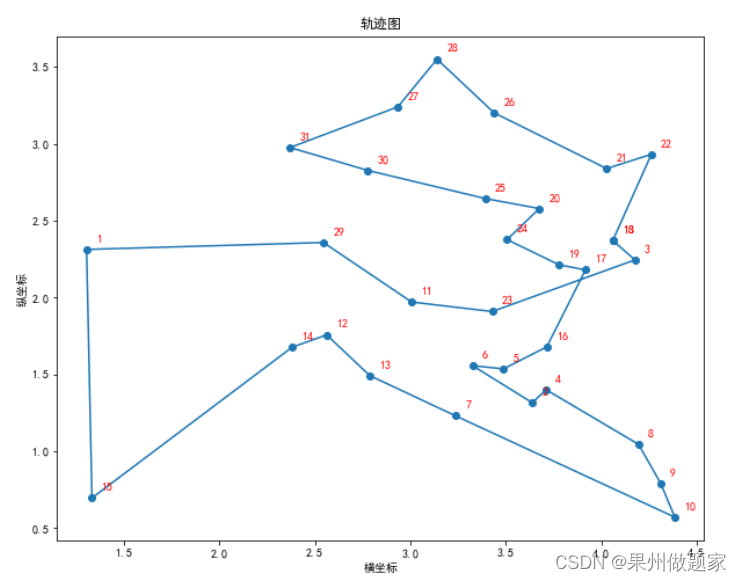
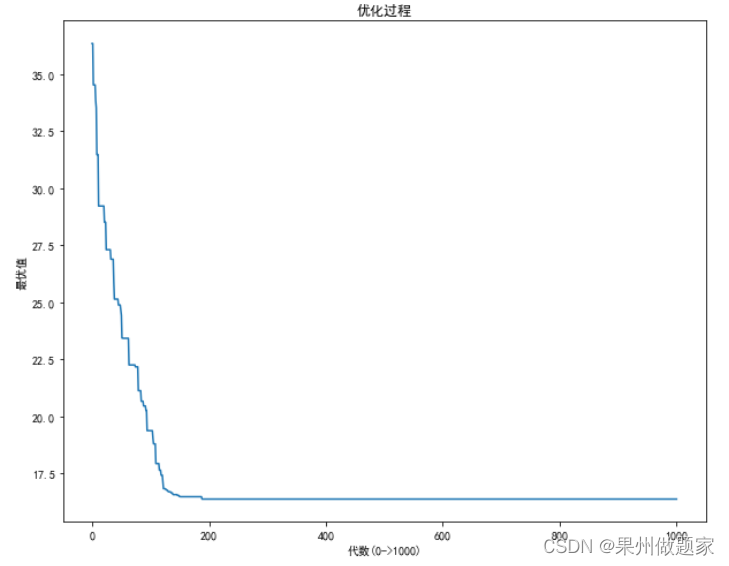
#遗传算法求解TSP问题完整代码:
import numpy as np
import pandas as pd
import matplotlib.pyplot as plt
import matplotlib
import math
import random

# 处理数据

coord = []
with open("data.txt", "r") as lines:
    lines = lines.readlines()
for line in lines:
    xy = line.split()
    coord.append(xy)

coord = np.array(coord)
w, h = coord.shape
coordinates = np.zeros((w, h), float)
for i in range(w):
    for j in range(h):
        coordinates[i, j] = float(coord[i, j])

# print(coordinates)

# 得到距离矩阵

distance = np.zeros((w, w))
for i in range(w):
    for j in range(w):
        distance[i, j] = distance[j, i] = np.linalg.norm(coordinates[i] - coordinates[j])

# 种群数
count = 300

# 进化次数
iter_time = 1000

# 最优选择概率
retain_rate = 0.3  # 适应度前30%可以活下来

# 弱者生存概率
random_select_rate = 0.5

# 变异
mutation_rate = 0.1

# 改良
gailiang_N = 3000


# 适应度
def get_total_distance(x):
    dista = 0
    for i in range(len(x)):
        if i == len(x) - 1:
            dista += distance[x[i]][x[0]]
        else:
            dista += distance[x[i]][x[i + 1]]
    return dista

# 初始种群的改良
def gailiang(x):
    distance = get_total_distance(x)
    gailiang_num = 0
    while gailiang_num < gailiang_N:
        while True:
            a = random.randint(0, len(x) - 1)
            b = random.randint(0, len(x) - 1)
            if a != b:
                break
        new_x = x.copy()
        temp_a = new_x[a]
        new_x[a] = new_x[b]
        new_x[b] = temp_a
        if get_total_distance(new_x) < distance:
            x = new_x.copy()
        gailiang_num += 1


# 自然选择

def nature_select(population):
    grad = [[x, get_total_distance(x)] for x in population]
    grad = [x[0] for x in sorted(grad, key=lambda x: x[1])]
    # 强者
    retain_length = int(retain_rate * len(grad))
    parents = grad[: retain_length]
    # 生存下来的弱者
    for ruozhe in grad[retain_length:]:
        if random.random() < random_select_rate:
            parents.append(ruozhe)
    return parents


# 交叉繁殖
def crossover(parents):
    target_count = count - len(parents)
    children = []
    while len(children) < target_count:
        while True:
            male_index = random.randint(0, len(parents)-1)
            female_index = random.randint(0, len(parents)-1)
            if male_index != female_index:
                break
        male = parents[male_index]
        female = parents[female_index]
        left = random.randint(0, len(male) - 2)
        right = random.randint(left, len(male) - 1)
        gen_male = male[left:right]
        gen_female = female[left:right]
        child_a = []
        child_b = []

        len_ca = 0
        for g in male:
            if len_ca == left:
                child_a.extend(gen_female)
                len_ca += len(gen_female)
            if g not in gen_female:
                child_a.append(g)
                len_ca += 1

        len_cb = 0
        for g in female:
            if len_cb == left:
                child_b.extend(gen_male)
                len_cb += len(gen_male)
            if g not in gen_male:
                child_b.append(g)
                len_cb += 1

        children.append(child_a)
        children.append(child_b)
    return children


# 变异操作
def mutation(children):
    for i in range(len(children)):
        if random.random() < mutation_rate:
            while True:
                u = random.randint(0, len(children[i]) - 1)
                v = random.randint(0, len(children[i]) - 1)
                if u != v:
                    break
            temp_a = children[i][u]
            children[i][u] = children[i][v]
            children[i][v] = temp_a


def get_result(population):
    grad = [[x, get_total_distance(x)] for x in population]
    grad = sorted(grad, key=lambda x: x[1])
    return grad[0][0], grad[0][1]


population = []
# 初始化种群
index = [i for i in range(w)]
for i in range(count):
    x = index.copy()
    random.shuffle(x)
    gailiang(x)
    population.append(x)

distance_list = []
result_cur_best, dist_cur_best = get_result(population)
distance_list.append(dist_cur_best)

i = 0
while i < iter_time:
    # 自然选择
    parents = nature_select(population)

    # 繁殖
    children = crossover(parents)

    # 变异
    mutation(children)

    # 更新
    population = parents + children

    result_cur_best, dist_cur_best = get_result(population)
    distance_list.append(dist_cur_best)
    i = i + 1
    print(result_cur_best)
    print(dist_cur_best)


for i in range(len(result_cur_best)):
    result_cur_best[i] += 1

result_path = result_cur_best
result_path.append(result_path[0])

print(result_path)

# 画图

X = []
Y = []
for index in result_path:
    X.append(coordinates[index-1, 0])
    Y.append(coordinates[index-1, 1])

plt.rcParams['font.sans-serif'] = 'SimHei'  # 设置中文显示
plt.rcParams['axes.unicode_minus'] = False
plt.figure(1)
plt.plot(X, Y, '-o')
for i in range(len(X)):
    plt.text(X[i] + 0.05, Y[i] + 0.05, str(result_path[i]), color='red')
plt.xlabel('横坐标')
plt.ylabel('纵坐标')
plt.title('轨迹图')

plt.figure(2)
plt.plot(np.array(distance_list))
plt.title('优化过程')
plt.ylabel('最优值')
plt.xlabel('代数({}->{})'.format(0, iter_time))
plt.show()
关闭。这个问题是opinion-based.它目前不接受答案。想要改进这个问题?更新问题,以便editingthispost可以用事实和引用来回答它.关闭4年前。Improvethisquestion我想在固定时间创建一系列低音和高音调的哔哔声。例如:在150毫秒时发出高音调的蜂鸣声在151毫秒时发出低音调的蜂鸣声200毫秒时发出低音调的蜂鸣声250毫秒的高音调蜂鸣声有没有办法在Ruby或Python中做到这一点?我真的不在乎输出编码是什么(.wav、.mp3、.ogg等等),但我确实想创建一个输出文件。
我想为Heroku构建一个Rails3应用程序。他们使用Postgres作为他们的数据库,所以我通过MacPorts安装了postgres9.0。现在我需要一个postgresgem并且共识是出于性能原因你想要pggem。但是我对我得到的错误感到非常困惑当我尝试在rvm下通过geminstall安装pg时。我已经非常明确地指定了所有postgres目录的位置可以找到但仍然无法完成安装:$envARCHFLAGS='-archx86_64'geminstallpg--\--with-pg-config=/opt/local/var/db/postgresql90/defaultdb/po
尝试通过RVM将RubyGems升级到版本1.8.10并出现此错误:$rvmrubygemslatestRemovingoldRubygemsfiles...Installingrubygems-1.8.10forruby-1.9.2-p180...ERROR:Errorrunning'GEM_PATH="/Users/foo/.rvm/gems/ruby-1.9.2-p180:/Users/foo/.rvm/gems/ruby-1.9.2-p180@global:/Users/foo/.rvm/gems/ruby-1.9.2-p180:/Users/foo/.rvm/gems/rub
我希望将Favorite模型添加到我的User和Link模型。业务逻辑用户可以有多个链接(即可以添加多个链接)用户可以收藏多个链接(他们自己的或其他用户的)一个链接可以被多个用户收藏,但只有一个所有者我对如何为这种关联建模以及在模型就位后如何创建用户收藏夹感到困惑?classUser 最佳答案 下面的数据模型怎么样:classUser:destroyhas_many:favorite_links,:through=>:favorites,:source=>:linkendclassLink:destroyhas_many:favor
我的最终目标是安装当前版本的RubyonRails。我在OSXMountainLion上运行。到目前为止,这是我的过程:已安装的RVM$\curl-Lhttps://get.rvm.io|bash-sstable检查已知(我假设已批准)安装$rvmlistknown我看到当前的稳定版本可用[ruby-]2.0.0[-p247]输入命令安装$rvminstall2.0.0-p247注意:我也试过这些安装命令$rvminstallruby-2.0.0-p247$rvminstallruby=2.0.0-p247我很快就无处可去了。结果:$rvminstall2.0.0-p247Search
由于fast-stemmer的问题,我很难安装我想要的任何rubygem。我把我得到的错误放在下面。Buildingnativeextensions.Thiscouldtakeawhile...ERROR:Errorinstallingfast-stemmer:ERROR:Failedtobuildgemnativeextension./System/Library/Frameworks/Ruby.framework/Versions/2.0/usr/bin/rubyextconf.rbcreatingMakefilemake"DESTDIR="cleanmake"DESTDIR=
我有一个用户工厂。我希望默认情况下确认用户。但是鉴于unconfirmed特征,我不希望它们被确认。虽然我有一个基于实现细节而不是抽象的工作实现,但我想知道如何正确地做到这一点。factory:userdoafter(:create)do|user,evaluator|#unwantedimplementationdetailshereunlessFactoryGirl.factories[:user].defined_traits.map(&:name).include?(:unconfirmed)user.confirm!endendtrait:unconfirmeddoenden
当我尝试安装Ruby时遇到此错误。我试过查看this和this但无济于事➜~brewinstallrubyWarning:YouareusingOSX10.12.Wedonotprovidesupportforthispre-releaseversion.Youmayencounterbuildfailuresorotherbreakages.Pleasecreatepull-requestsinsteadoffilingissues.==>Installingdependenciesforruby:readline,libyaml,makedepend==>Installingrub
我正在尝试使用boilerpipe来自JRuby。我看过guide从JRuby调用Java,并成功地将它与另一个Java包一起使用,但无法弄清楚为什么同样的东西不能用于boilerpipe。我正在尝试基本上从JRuby中执行与此Java等效的操作:URLurl=newURL("http://www.example.com/some-location/index.html");Stringtext=ArticleExtractor.INSTANCE.getText(url);在JRuby中试过这个:require'java'url=java.net.URL.new("http://www
我意识到这可能是一个非常基本的问题,但我现在已经花了几天时间回过头来解决这个问题,但出于某种原因,Google就是没有帮助我。(我认为部分问题在于我是一个初学者,我不知道该问什么......)我也看过O'Reilly的RubyCookbook和RailsAPI,但我仍然停留在这个问题上.我找到了一些关于多态关系的信息,但它似乎不是我需要的(尽管如果我错了请告诉我)。我正在尝试调整MichaelHartl'stutorial创建一个包含用户、文章和评论的博客应用程序(不使用脚手架)。我希望评论既属于用户又属于文章。我的主要问题是:我不知道如何将当前文章的ID放入评论Controller。
