
半 是 温 柔 半 是 风 , 一 生 从 容 一 生 花
目录
通常在确定指标权重时往往更多关注的是数据本身,而数据之间的波动性大小也是一种信息,或是数据之间的相关关系大小,也是一种信息,可利用数据波动性大小或数据相关关系大小计算权重。
CRITIC权重法是一种基于数据波动性的客观赋权法。其思想在于两项指标,分别是波动性(对比强度)和冲突性(相关性)指标。对比强度使用标准差进行表示,如果数据标准差越大说明波动越大,权重会越高;冲突性使用相关系数进行表示,如果指标之间的相关系数值越大,说明冲突性越小,那么其权重也就越低。权重计算时,对比强度与冲突性指标相乘,并且进行归一化处理,即得到最终的权重。
CRITIC权重法适用于数据稳定性可视作一种信息,并且分析的指标或因素之间有着一定的关联关系的数据。
假设现有一组数据,有m个待评价对象,n个评价指标,构成原始数据矩阵X:
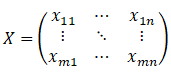
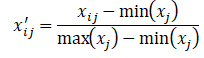
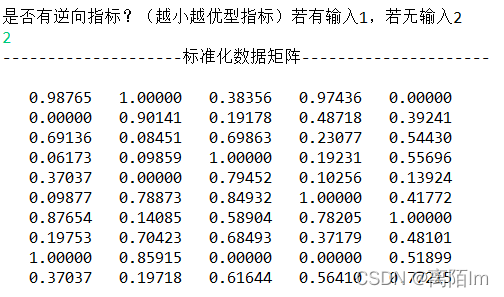
数据标准化的主要目的就是消除量纲影响,使所以数据能用统一的标准去衡量。
对于正向指标:
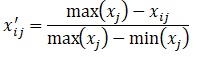
对于逆向指标:
波动性:

冲突性:
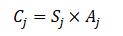
计算冲突性时要用到指标的相关性矩阵,计算公式如下:
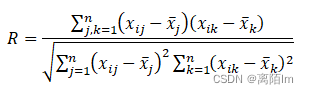
则,冲突性计公式:

信息量:
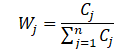
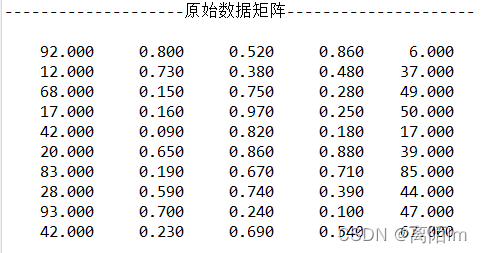
以下是某医院连续十天内的部分数据,其中某些指标的稳定性是一种信息,而且指标之间本身就可能有着相关性。
| 编号 | 出院人数 | 入出院诊断符合率 | 治疗有效率 | 平均床位使用率 | 病床周转次数 |
| 1 | 92 | 0.8 | 0.52 | 0.86 | 6 |
| 2 | 12 | 0.73 | 0.38 | 0.48 | 37 |
| 3 | 68 | 0.15 | 0.75 | 0.28 | 49 |
| 4 | 17 | 0.16 | 0.97 | 0.25 | 50 |
| 5 | 42 | 0.09 | 0.82 | 0.18 | 17 |
| 6 | 20 | 0.65 | 0.86 | 0.88 | 39 |
| 7 | 83 | 0.19 | 0.67 | 0.71 | 85 |
| 8 | 28 | 0.59 | 0.74 | 0.39 | 44 |
| 9 | 93 | 0.7 | 0.24 | 0.1 | 47 |
| 10 | 42 | 0.23 | 0.69 | 0.54 | 67 |
	/**
	 * 从Excel表格读取数据,列为评价指标行为待评价样本
	 *
	 * 假设有m个待评价样本,n个评价指标
	 *
	 * @param filepath 表格存储位置
	 * @return componentMartix 返回原始矩阵
	 */
	public double[][] read(String filepath) throws IOException, BiffException,WriteException {
		//创建输入流
		InputStream stream = new FileInputStream(filepath);
		//获取Excel文件对象
		Workbook  rwb = Workbook.getWorkbook(stream);
		//获取文件的指定工作表 默认的第一个
	    Sheet sheet = rwb.getSheet("Sheet1");
	    int rows = sheet.getRows();
	    int cols = sheet.getColumns();
	    double[][] componentMatrix = new double[rows][cols];//原始矩阵
		//row为行
		for(int i=0;i<sheet.getRows();i++) {
			for(int j=0;j<sheet.getColumns();j++) {
				String[] str = new String[sheet.getColumns()];
		        Cell cell = null;
		        cell = sheet.getCell(j,i);
			    str[j] = cell.getContents();
			    componentMatrix[i][j] = Double.valueOf(str[j]);
			}
	    }
		return componentMatrix;//返回原始矩阵
	}
输出:
	/**
	 * 数据标准化处理,消除量纲影响
	 * @param componentMatrix 输入原始矩阵
	 * @return normalizedMatrix 返回标准化后的矩阵
	 */
	public double[][] normalized(double[][] componentMatrix) {
		double[][] normalizedMatrix = new double[componentMatrix.length][componentMatrix[0].length];
		List<Integer> neg = new ArrayList<Integer>();//存储逆向指标所在列
		double[] max = Max(componentMatrix);
		double[] min = Min(componentMatrix);
		int a;


		for(int i=0; i < componentMatrix.length; i++) {
			for(int j=0; j < componentMatrix[0].length; j++) {
				normalizedMatrix[i][j] = (componentMatrix[i][j] - min[j])/(max[j] - min[j]);
			}
		}

		System.out.println("是否有逆向指标?(越小越优型指标)若有输入1,若无输入2");
		a = input.nextInt();
		if(a ==1 ) {
			System.out.println("输入逆向指标所在列(以“/”结尾):");
			while(!input.hasNext("/")) {
				neg.add(Integer.valueOf(input.nextInt()));
			}
			for(int i=0; i < componentMatrix.length; i++) {
				for(int j=0; j < neg.size(); j++) {
					normalizedMatrix[i][neg.get(j)] =
							(max[neg.get(j)]-componentMatrix[i][neg.get(j)])/(max[neg.get(j)] - min[neg.get(j)]);
				}
			}
		}
		return normalizedMatrix;
	}
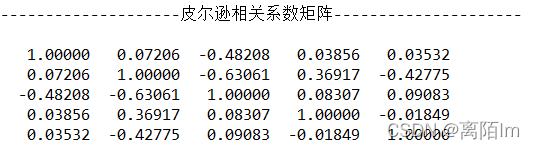
输出:
	/**
	 * 计算相关系数矩阵
	 * @param normalizedMatrix 标准化后数据
	 * @return pearson 皮尔逊相关系数矩阵
	 */

	public double[][] correlation(double[][] normalizedMatrix){
		double[][] pearson = new double[normalizedMatrix[0].length][normalizedMatrix[0].length];//皮尔逊相关系数矩阵
		double[] avr = Average(normalizedMatrix);//每列平均值

		double[] s = new double[normalizedMatrix[0].length];
		for(int j=0;j < normalizedMatrix[0].length;j++) {
			double sum = 0;
			 for(int i=0;i < normalizedMatrix.length;i++){
				sum += Math.pow(normalizedMatrix[i][j] - avr[j], 2);
			}
			 s[j] = Math.sqrt(sum/(normalizedMatrix[0].length - 1));
		}

		double[][] cxy = new double[normalizedMatrix[0].length][normalizedMatrix[0].length];
		for(int j=0;j<normalizedMatrix[0].length;j++) {
			for(int k=0;k<normalizedMatrix[0].length;k++) {
				double sum = 0;
				for(int i=0;i<normalizedMatrix.length;i++) {
					sum += (normalizedMatrix[i][j] - avr[j])*(normalizedMatrix[i][k] - avr[k]);
				}
				cxy[j][k] = sum/(pearson.length - 1);
				pearson[j][k] = cxy[j][k]/(s[j]*s[k]);
			}
		}
		return pearson;
	}
输出:
	/**
	 * 计算每个指标的信息承载量
	 * @param normalizedMatrix 标准化后的矩阵
	 * @param pearson 皮尔逊相关系数矩阵
	 * @return informationVolume 每个指标的信息承载量
	 */
	public double[] information(double[][] normalizedMatrix,double[][] pearson) {
		double[] informationVolume = new double[normalizedMatrix[0].length];
		double[] avr = Average(normalizedMatrix);//每列平均值

		//计算对比强度(标准差)
		double[] s = new double[normalizedMatrix[0].length];
		for(int j=0;j < normalizedMatrix[0].length;j++) {
			double sum = 0;
			 for(int i=0;i < normalizedMatrix.length;i++){
				sum += Math.pow(normalizedMatrix[i][j] - avr[j], 2);
			}
			 s[j] = Math.sqrt(sum/(normalizedMatrix[0].length - 1));
		}

		//计算冲突性
		double[] r = new double[normalizedMatrix[0].length];
		for(int j=0;j<normalizedMatrix[0].length;j++) {
			double sum = 0;
			for(int i=0;i<normalizedMatrix[0].length;i++) {
				sum += 1 - pearson[i][j];
			}
			r[j] = sum;
		}

		//计算信息量
		for(int j=0;j<normalizedMatrix[0].length;j++) {
			informationVolume[j] = s[j]*r[j];
		}
		return informationVolume;
	}
输出:

	/**
	 * 计算权重
	 * @param informationVolume 每个指标的信息量
	 * @return weight 返回每个指标的权重
	 */
	public double[] weight(double[] informationVolume) {
		double[] weight = new double[informationVolume.length];
		double sum = 0;
		for(int i=0;i<informationVolume.length;i++) {
			sum += informationVolume[i];
		}
		for(int i=0;i<informationVolume.length;i++) {
			weight[i] = informationVolume[i]/sum;
		}

		return weight;
	}
输出:

从上述计算步骤可以看出 CRITIC 法存在以下可以 改进和完善的地方 :(1)相关系数有正有负,对于绝对值相同的相关系数其反映指 标间的相关性程度大小应是一样的 ,因此在反映指标 之间的对比强度时用 (1−|rij|) 代替原方法中的 (1−rij) 更 适合 ;(2)CRITIC 法虽能有效考虑指标数据间的相关性(冲突性)和对比强度 (波动性),但未考虑指标数据间的离散程度。因此,需要对 CRITIC 法进行改进,以使改进的 CRITIC 法能够充分考虑指标数据本身的三大属性。
改进后的计算公式如下:
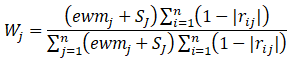
其中代表用熵权法计算得到的指标熵值(不会计算的可以点击阅读文章“权重计算方法二:熵权法(EWM)”),
为对比强度,
为第i个指标与第j个指标的相关系数。
	/**
	 * 改进算法
	 * @param normalizedMatrix 标准化后的矩阵
	 * @param pearson 皮尔逊相关系数矩阵
	 * @param ewm 熵权法求得的指标熵值
	 * @return
	 */
	public double[] weight1(double[][] normalizedMatrix,double[][] pearson,double[] ewm) {
		double[] informationVolume = new double[normalizedMatrix[0].length];
		double[] avr = Average(normalizedMatrix);//每列平均值
		double[] weight = new double[normalizedMatrix[0].length];
		double[] pear = new double[normalizedMatrix[0].length];

		//计算对比强度(标准差)
		double[] s = new double[normalizedMatrix[0].length];
		for(int j=0;j < normalizedMatrix[0].length;j++) {
			double sum = 0;
			 for(int i=0;i < normalizedMatrix.length;i++){
				sum += Math.pow(normalizedMatrix[i][j] - avr[j], 2);
			}
			 s[j] = Math.sqrt(sum/(normalizedMatrix[0].length - 1));
		}

		double total = 0;
		for(int j=0;j<normalizedMatrix[0].length;j++) {
			for(int i=0;i<normalizedMatrix[0].length;i++) {
				pear[j]  += Math.abs(pearson[i][j]);
			}
			total += ewm[j] + s[j];
		}

		for(int j=0;j<normalizedMatrix[0].length;j++) {
			informationVolume[j] = ((ewm[j] + s[j])*pear[j])/(total + pear[j]);
		}

		double sum = 0;
		for(int i=0;i<informationVolume.length;i++) {
			sum += informationVolume[i];
		}
		for(int i=0;i<informationVolume.length;i++) {
			weight[i] = informationVolume[i]/sum;
		}

		return weight;
	}
输出:

改进前后结果对比:

通过观察可以发现改进后得到的权重基本与改进前得到的权重一致,但部分指标改进前后权重有较大变化,但基本保持在5%以内。
package critic;

import java.io.FileInputStream;
import java.io.IOException;
import java.io.InputStream;
import java.util.ArrayList;
import java.util.List;
import java.util.Scanner;

import jxl.Cell;
import jxl.Sheet;
import jxl.Workbook;
import jxl.read.biff.BiffException;
import jxl.write.WriteException;

public class CRITIC {

	Scanner input = new Scanner(System.in);

	//矩阵每列最大值
	public double[] Max(double[][] m) {
		double max[] = new double[m[0].length];
		for(int j=0;j < m[0].length;j++) {
			max[j] = m[0][j];
			for(int i=0;i < m.length;i++) {
				if(m[i][j] >= max[j]) {
					max[j] = m[i][j];
				}
			}
		}
		return max;
	}

	//矩阵每列最小值
	public double[] Min(double[][] m) {
		double min[] = new double[m[0].length];
		for(int j=0;j < m[0].length;j++) {
			min[j] = m[0][j];
			for(int i=0;i < m.length;i++) {
				if(m[i][j] <= min[j]) {
					min[j] = m[i][j];
				}
			}
		}
		return min;
	}

	//矩阵每列平均值
	public double[] Average(double[][] m) {
		double avr[] = new double[m[0].length];
		for(int j=0;j < m[0].length;j++) {
			double sum = 0;
			for(int i=0;i < m.length;i++) {
				sum += m[i][j];
			}
			avr[j] = sum/m.length;
		}
		return avr;
	}

	//输出二维矩阵
	public void matrixoutput(double[][] x) {
		for(int i=0;i<x.length;i++) {
			for(int j=0;j<x[0].length;j++) {
				System.out.print(x[i][j]+"   ");
			}
			System.out.println();
		}
	}

	//输出一维矩阵
	public void matrixoutput1(double[] x) {
		for(int i=0;i<x.length;i++) {
			System.out.print(String.format("%.8f\t", x[i]));
		}
		System.out.println();
	}

	/**
	 * 从Excel表格读取数据,列为评价指标行为待评价样本
	 *
	 * 假设有m个待评价样本,n个评价指标
	 *
	 * @param filepath 表格存储位置
	 * @return componentMartix 返回原始矩阵
	 */
	public double[][] read(String filepath) throws IOException, BiffException,WriteException {
		//创建输入流
		InputStream stream = new FileInputStream(filepath);
		//获取Excel文件对象
		Workbook  rwb = Workbook.getWorkbook(stream);
		//获取文件的指定工作表 默认的第一个
	    Sheet sheet = rwb.getSheet("Sheet1");
	    int rows = sheet.getRows();
	    int cols = sheet.getColumns();
	    double[][] componentMatrix = new double[rows][cols];//原始矩阵
		//row为行
		for(int i=0;i<sheet.getRows();i++) {
			for(int j=0;j<sheet.getColumns();j++) {
				String[] str = new String[sheet.getColumns()];
		        Cell cell = null;
		        cell = sheet.getCell(j,i);
			    str[j] = cell.getContents();
			    componentMatrix[i][j] = Double.valueOf(str[j]);
			}
	    }
		return componentMatrix;//返回原始矩阵
	}

	/**
	 * 数据标准化处理,消除量纲影响
	 * @param componentMatrix 输入原始矩阵
	 * @return normalizedMatrix 返回标准化后的矩阵
	 */
	public double[][] normalized(double[][] componentMatrix) {
		double[][] normalizedMatrix = new double[componentMatrix.length][componentMatrix[0].length];
		List<Integer> neg = new ArrayList<Integer>();//存储逆向指标所在列
		double[] max = Max(componentMatrix);
		double[] min = Min(componentMatrix);
		int a;


		for(int i=0; i < componentMatrix.length; i++) {
			for(int j=0; j < componentMatrix[0].length; j++) {
				normalizedMatrix[i][j] = (componentMatrix[i][j] - min[j])/(max[j] - min[j]);
			}
		}

		System.out.println("是否有逆向指标?(越小越优型指标)若有输入1,若无输入2");
		a = input.nextInt();
		if(a ==1 ) {
			System.out.println("输入逆向指标所在列(以“/”结尾):");
			while(!input.hasNext("/")) {
				neg.add(Integer.valueOf(input.nextInt()));
			}
			for(int i=0; i < componentMatrix.length; i++) {
				for(int j=0; j < neg.size(); j++) {
					normalizedMatrix[i][neg.get(j)] =
							(max[neg.get(j)]-componentMatrix[i][neg.get(j)])/(max[neg.get(j)] - min[neg.get(j)]);
				}
			}
		}
		return normalizedMatrix;
	}


	/**
	 * 计算相关系数矩阵
	 * @param normalizedMatrix 标准化后数据
	 * @return pearson 皮尔逊相关系数矩阵
	 */

	public double[][] correlation(double[][] normalizedMatrix){
		double[][] pearson = new double[normalizedMatrix[0].length][normalizedMatrix[0].length];//皮尔逊相关系数矩阵
		double[] avr = Average(normalizedMatrix);//每列平均值

		double[] s = new double[normalizedMatrix[0].length];
		for(int j=0;j < normalizedMatrix[0].length;j++) {
			double sum = 0;
			 for(int i=0;i < normalizedMatrix.length;i++){
				sum += Math.pow(normalizedMatrix[i][j] - avr[j], 2);
			}
			 s[j] = Math.sqrt(sum/(normalizedMatrix[0].length - 1));
		}

		double[][] cxy = new double[normalizedMatrix[0].length][normalizedMatrix[0].length];
		for(int j=0;j<normalizedMatrix[0].length;j++) {
			for(int k=0;k<normalizedMatrix[0].length;k++) {
				double sum = 0;
				for(int i=0;i<normalizedMatrix.length;i++) {
					sum += (normalizedMatrix[i][j] - avr[j])*(normalizedMatrix[i][k] - avr[k]);
				}
				cxy[j][k] = sum/(pearson.length - 1);
				pearson[j][k] = cxy[j][k]/(s[j]*s[k]);
			}
		}
		return pearson;
	}

	/**
	 * 计算每个指标的信息承载量
	 * @param normalizedMatrix 标准化后的矩阵
	 * @param pearson 皮尔逊相关系数矩阵
	 * @return informationVolume 每个指标的信息承载量
	 */
	public double[] information(double[][] normalizedMatrix,double[][] pearson) {
		double[] informationVolume = new double[normalizedMatrix[0].length];
		double[] avr = Average(normalizedMatrix);//每列平均值

		//计算对比强度(标准差)
		double[] s = new double[normalizedMatrix[0].length];
		for(int j=0;j < normalizedMatrix[0].length;j++) {
			double sum = 0;
			 for(int i=0;i < normalizedMatrix.length;i++){
				sum += Math.pow(normalizedMatrix[i][j] - avr[j], 2);
			}
			 s[j] = Math.sqrt(sum/(normalizedMatrix[0].length - 1));
		}

		//计算冲突性
		double[] r = new double[normalizedMatrix[0].length];
		for(int j=0;j<normalizedMatrix[0].length;j++) {
			double sum = 0;
			for(int i=0;i<normalizedMatrix[0].length;i++) {
				sum += 1 - pearson[i][j];
			}
			r[j] = sum;
		}

		//计算信息量
		for(int j=0;j<normalizedMatrix[0].length;j++) {
			informationVolume[j] = s[j]*r[j];
		}
		return informationVolume;
	}

	/**
	 * 计算权重
	 * @param informationVolume 每个指标的信息量
	 * @return weight 返回每个指标的权重
	 */
	public double[] weight(double[] informationVolume) {
		double[] weight = new double[informationVolume.length];
		double sum = 0;
		for(int i=0;i<informationVolume.length;i++) {
			sum += informationVolume[i];
		}
		for(int i=0;i<informationVolume.length;i++) {
			weight[i] = informationVolume[i]/sum;
		}

		return weight;
	}

	/**
	 * 改进算法
	 * @param normalizedMatrix 标准化后的矩阵
	 * @param pearson 皮尔逊相关系数矩阵
	 * @param ewm 熵权法求得的指标熵值
	 * @return
	 */
	public double[] weight1(double[][] normalizedMatrix,double[][] pearson,double[] ewm) {
		double[] informationVolume = new double[normalizedMatrix[0].length];
		double[] avr = Average(normalizedMatrix);//每列平均值
		double[] weight = new double[normalizedMatrix[0].length];
		double[] pear = new double[normalizedMatrix[0].length];

		//计算对比强度(标准差)
		double[] s = new double[normalizedMatrix[0].length];
		for(int j=0;j < normalizedMatrix[0].length;j++) {
			double sum = 0;
			 for(int i=0;i < normalizedMatrix.length;i++){
				sum += Math.pow(normalizedMatrix[i][j] - avr[j], 2);
			}
			 s[j] = Math.sqrt(sum/(normalizedMatrix[0].length - 1));
		}

		double total = 0;
		for(int j=0;j<normalizedMatrix[0].length;j++) {
			for(int i=0;i<normalizedMatrix[0].length;i++) {
				pear[j]  += Math.abs(pearson[i][j]);
			}
			total += ewm[j] + s[j];
		}

		for(int j=0;j<normalizedMatrix[0].length;j++) {
			informationVolume[j] = ((ewm[j] + s[j])*pear[j])/(total + pear[j]);
		}

		double sum = 0;
		for(int i=0;i<informationVolume.length;i++) {
			sum += informationVolume[i];
		}
		for(int i=0;i<informationVolume.length;i++) {
			weight[i] = informationVolume[i]/sum;
		}

		return weight;
	}
}
package critic;

import java.io.IOException;
import java.util.Scanner;

import Jama.Matrix;
import jxl.read.biff.BiffException;
import jxl.write.WriteException;

public class CRITICmain {
	public static void main(String[] args) throws IOException, BiffException, WriteException {
		@SuppressWarnings("resource")
		Scanner input = new Scanner(System.in);
		CRITIC critic = new CRITIC();

		double[][] componentMatrix = critic.read("critic.xls");
		System.out.println("--------------------原始数据矩阵---------------------");
		Matrix A1 = new Matrix(componentMatrix);
		A1.print(8, 3);
		//critic.matrixoutput(componentMatrix);

		double[][] normalizedMatrix = critic.normalized(componentMatrix);
		System.out.println("--------------------标准化数据矩阵---------------------");
		Matrix A = new Matrix(normalizedMatrix);
		A.print(8, 5);
		//critic.matrixoutput(normalizedMatrix);

		double[][] pearson = critic.correlation(normalizedMatrix);
		System.out.println("--------------------皮尔逊相关系数矩阵---------------------");
		Matrix B = new Matrix(pearson);
		B.print(8, 5);
		//critic.matrixoutput(pearson);

		double[] informationVolume = critic.information(normalizedMatrix, pearson);
		System.out.println("--------------------指标信息承载量---------------------");
		critic.matrixoutput1(informationVolume);

		double[] weight = critic.weight(informationVolume);
		System.out.println("--------------------指标权重---------------------");
		critic.matrixoutput1(weight);

		double[] ewm = new double[normalizedMatrix[0].length];//熵权法计算所得指标权重
		System.out.println("输入用熵权法计算所得指标的熵值:");
		for(int i=0;i<ewm.length ;i++) {
			ewm[i] = input.nextDouble();
		}
		double[] weight1 = critic.weight1(normalizedMatrix,pearson,ewm);
		System.out.println("--------------------指标权重(改进)---------------------");
		critic.matrixoutput1(weight1);
	}
}
我正在学习如何使用Nokogiri,根据这段代码我遇到了一些问题:require'rubygems'require'mechanize'post_agent=WWW::Mechanize.newpost_page=post_agent.get('http://www.vbulletin.org/forum/showthread.php?t=230708')puts"\nabsolutepathwithtbodygivesnil"putspost_page.parser.xpath('/html/body/div/div/div/div/div/table/tbody/tr/td/div
总的来说,我对ruby还比较陌生,我正在为我正在创建的对象编写一些rspec测试用例。许多测试用例都非常基础,我只是想确保正确填充和返回值。我想知道是否有办法使用循环结构来执行此操作。不必为我要测试的每个方法都设置一个assertEquals。例如:describeitem,"TestingtheItem"doit"willhaveanullvaluetostart"doitem=Item.new#HereIcoulddotheitem.name.shouldbe_nil#thenIcoulddoitem.category.shouldbe_nilendend但我想要一些方法来使用
类classAprivatedeffooputs:fooendpublicdefbarputs:barendprivatedefzimputs:zimendprotecteddefdibputs:dibendendA的实例a=A.new测试a.foorescueputs:faila.barrescueputs:faila.zimrescueputs:faila.dibrescueputs:faila.gazrescueputs:fail测试输出failbarfailfailfail.发送测试[:foo,:bar,:zim,:dib,:gaz].each{|m|a.send(m)resc
我正在尝试设置一个puppet节点,但rubygems似乎不正常。如果我通过它自己的二进制文件(/usr/lib/ruby/gems/1.8/gems/facter-1.5.8/bin/facter)在cli上运行facter,它工作正常,但如果我通过由rubygems(/usr/bin/facter)安装的二进制文件,它抛出:/usr/lib/ruby/1.8/facter/uptime.rb:11:undefinedmethod`get_uptime'forFacter::Util::Uptime:Module(NoMethodError)from/usr/lib/ruby
我想了解Ruby方法methods()是如何工作的。我尝试使用“ruby方法”在Google上搜索,但这不是我需要的。我也看过ruby-doc.org,但我没有找到这种方法。你能详细解释一下它是如何工作的或者给我一个链接吗?更新我用methods()方法做了实验,得到了这样的结果:'labrat'代码classFirstdeffirst_instance_mymethodenddefself.first_class_mymethodendendclassSecond使用类#returnsavailablemethodslistforclassandancestorsputsSeco
我在我的项目中添加了一个系统来重置用户密码并通过电子邮件将密码发送给他,以防他忘记密码。昨天它运行良好(当我实现它时)。当我今天尝试启动服务器时,出现以下错误。=>BootingWEBrick=>Rails3.2.1applicationstartingindevelopmentonhttp://0.0.0.0:3000=>Callwith-dtodetach=>Ctrl-CtoshutdownserverExiting/Users/vinayshenoy/.rvm/gems/ruby-1.9.3-p0/gems/actionmailer-3.2.1/lib/action_mailer
设置:狂欢ruby1.9.2高线(1.6.13)描述:我已经相当习惯在其他一些项目中使用highline,但已经有几个月没有使用它了。现在,在Ruby1.9.2上全新安装时,它似乎不允许在同一行回答提示。所以以前我会看到类似的东西:require"highline/import"ask"Whatisyourfavoritecolor?"并得到:Whatisyourfavoritecolor?|现在我看到类似的东西:Whatisyourfavoritecolor?|竖线(|)符号是我的终端光标。知道为什么会发生这种变化吗? 最佳答案
我已经从我的命令行中获得了一切,所以我可以运行rubymyfile并且它可以正常工作。但是当我尝试从sublime中运行它时,我得到了undefinedmethod`require_relative'formain:Object有人知道我的sublime设置中缺少什么吗?我正在使用OSX并安装了rvm。 最佳答案 或者,您可以只使用“require”,它应该可以正常工作。我认为“require_relative”仅适用于ruby1.9+ 关于ruby-主要:Objectwhenrun
我有一个具有一些属性的模型:attr1、attr2和attr3。我需要在不执行回调和验证的情况下更新此属性。我找到了update_column方法,但我想同时更新三个属性。我需要这样的东西:update_columns({attr1:val1,attr2:val2,attr3:val3})代替update_column(attr1,val1)update_column(attr2,val2)update_column(attr3,val3) 最佳答案 您可以使用update_columns(attr1:val1,attr2:val2
我不确定传递给方法的对象的类型是否正确。我可能会将一个字符串传递给一个只能处理整数的函数。某种运行时保证怎么样?我看不到比以下更好的选择:defsomeFixNumMangler(input)raise"wrongtype:integerrequired"unlessinput.class==FixNumother_stuffend有更好的选择吗? 最佳答案 使用Kernel#Integer在使用之前转换输入的方法。当无法以任何合理的方式将输入转换为整数时,它将引发ArgumentError。defmy_method(number)
