有两种:一种是多个el-input通过同一个el-form表单来限制,这种用得最多的地方就是添加和修改功能;另一种是每个el-input通过各自的el-form表单来限制,这种通常是用在动态添加多个输入框等功能上,话不多说,上才艺噻.
举栗(element-ui官网的案例):

HTML代码:
<!-- 第一步对应 :model="ruleForm" ;第二步对应 :rules="rules" ;第三步对应 ref="ruleForm"-->
<el-form :model="ruleForm" :rules="rules" ref="ruleForm" label-width="100px" class="demo-ruleForm">
  <!-- 这里的 prop 也不可少,是与rules中定义的每个属性的校验规则是一一对应的-->
  <el-form-item label="活动名称" prop="name">
    <el-input v-model="ruleForm.name"></el-input>
  </el-form-item>
  <el-form-item label="活动区域" prop="region">
    <el-select v-model="ruleForm.region" placeholder="请选择活动区域">
      <el-option label="区域一" value="shanghai"></el-option>
      <el-option label="区域二" value="beijing"></el-option>
    </el-select>
  </el-form-item>
  <el-form-item label="活动时间" required>
    <el-col :span="11">
      <el-form-item prop="date1">
        <el-date-picker type="date" placeholder="选择日期" v-model="ruleForm.date1" style="width: 100%;"></el-date-picker>
      </el-form-item>
    </el-col>
    <el-col class="line" :span="2">-</el-col>
    <el-col :span="11">
      <el-form-item prop="date2">
        <el-time-picker placeholder="选择时间" v-model="ruleForm.date2" style="width: 100%;"></el-time-picker>
      </el-form-item>
    </el-col>
  </el-form-item>
  <el-form-item label="即时配送" prop="delivery">
    <el-switch v-model="ruleForm.delivery"></el-switch>
  </el-form-item>
  <el-form-item label="活动性质" prop="type">
    <el-checkbox-group v-model="ruleForm.type">
      <el-checkbox label="美食/餐厅线上活动" name="type"></el-checkbox>
      <el-checkbox label="地推活动" name="type"></el-checkbox>
      <el-checkbox label="线下主题活动" name="type"></el-checkbox>
      <el-checkbox label="单纯品牌曝光" name="type"></el-checkbox>
    </el-checkbox-group>
  </el-form-item>
  <el-form-item label="特殊资源" prop="resource">
    <el-radio-group v-model="ruleForm.resource">
      <el-radio label="线上品牌商赞助"></el-radio>
      <el-radio label="线下场地免费"></el-radio>
    </el-radio-group>
  </el-form-item>
  <el-form-item label="活动形式" prop="desc">
    <el-input type="textarea" v-model="ruleForm.desc"></el-input>
  </el-form-item>
  <el-form-item>
    <el-button type="primary" @click="submitForm('ruleForm')">立即创建</el-button>
    <el-button @click="resetForm('ruleForm')">重置</el-button>
  </el-form-item>
</el-form>
JavaScript代码:
<script>
  export default {
    data() {
      return {
        // 第一步,定义表单数据对象,并绑定
        ruleForm: {
          name: '',
          region: '',
          date1: '',
          date2: '',
          delivery: false,
          type: [],
          resource: '',
          desc: ''
        },
        // 第二步,定义表单数据校验对象,并绑定
        rules: {
          name: [
            { required: true, message: '请输入活动名称', trigger: 'blur' },
            { min: 3, max: 5, message: '长度在 3 到 5 个字符', trigger: 'blur' }
          ],
          region: [
            { required: true, message: '请选择活动区域', trigger: 'change' }
          ],
          date1: [
            { type: 'date', required: true, message: '请选择日期', trigger: 'change' }
          ],
          date2: [
            { type: 'date', required: true, message: '请选择时间', trigger: 'change' }
          ],
          type: [
            { type: 'array', required: true, message: '请至少选择一个活动性质', trigger: 'change' }
          ],
          resource: [
            { required: true, message: '请选择活动资源', trigger: 'change' }
          ],
          desc: [
            { required: true, message: '请填写活动形式', trigger: 'blur' }
          ]
        }
      };
    },
    methods: {
      submitForm(formName) {
        // 第三步,点击提交表单按钮的时候判断是否符合校验规则,符合才会往下运行,不符合会
        // 按照你定义的校验规则提示警告
        this.$refs[formName].validate((valid) => {
          if (valid) {
            alert('submit!');
          } else {
            console.log('error submit!!');
            return false;
          }
        });
      },
      resetForm(formName) {
        this.$refs[formName].resetFields();
      }
    }
  }
</script>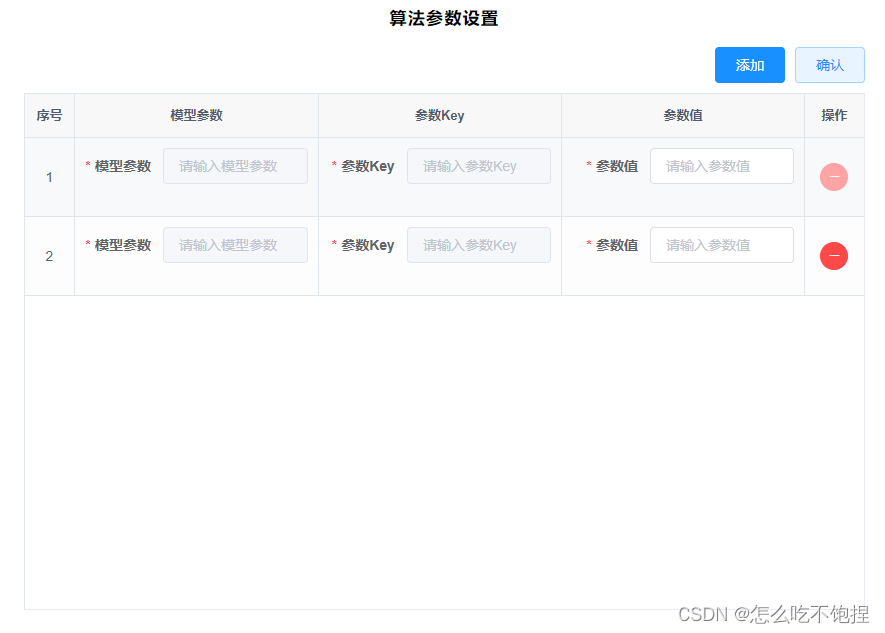


我是自己封装的组件,暂时没想到其他的方式,目前看来是能符合功能需求的。
1.定义组件input-required.vue
html代码:
<template>
  <div>
    <el-form ref="formRef" :model="form" :rules="formRules" label-width="80px" style="font-size:0.6vw">
      <el-form-item :label="labelValue" :prop="this.propValue">
        <el-input
          v-model="value"
          :placeholder="`请输入${labelValue}`"
          autocomplete="off"
          :disabled="isDisalbed"
          @change="isValid"
        ></el-input>
      </el-form-item>
    </el-form>
  </div>
</template>
javascript代码:
<script>
export default {
  data() {
    return {
      value: "",
      form: {},
      formRules: {}
    };
  },
  // 子组件使用props来接收父组件内传过来的数据
  props: ["propValue", "labelValue", "isDisalbed", "indexValue"],
  created() {
   // 给子组件的对象动态添加属性并设置属性值
    this.$set(this.form, this.propValue, "");
    this.$set(this.formRules, this.propValue, [
      { required: true, message: `${this.labelValue}不能为空`, trigger: "blur" }
    ]);
  },
  methods: {
    // el-input失去焦点后会校验数据,空的话会提示,符合校验规则会触发父组件内方法更新视图数据
    isValid() {
      // 把el-input输入框中的值赋给form对象,方便下一步向父组件传递
      this.form[this.propValue] = this.value;
      this.$refs["formRef"].validate(valid => {
        if (valid) {
          this.$emit("updateData", this.form, this.indexValue);
        }
      });
    }
  }
};
</script>
2.在要用到的地方引入使用组件
// 1.引入组件路径
import InputRequired from "./components/input-required.vue";

// 2.注册组件
components: {
    InputRequired
  },

// 3.使用组件 里面的disabled等属性按照自己需求添加就行,但是注意需要使用冒号 : 动态绑定数据
//   (1)这里的propValue是自定义组件里prop要绑定的属性,以及form中的属性;
//   (2)labelValue是自定义组件中label的值;
//   (3)isDisalbed是决定自定义组件中disabled是否启用;
//   (4)updateData方法用处是子组件内校验成功后触发父组件更新数据;

<input-required :propValue="'attrName'" :labelValue="'模型参数'" :isDisalbed="true"
 @updateData="updateData" ></input-required>
成功(*^▽^*)!
----------------------------------------------------手动分割线------------------------------------------
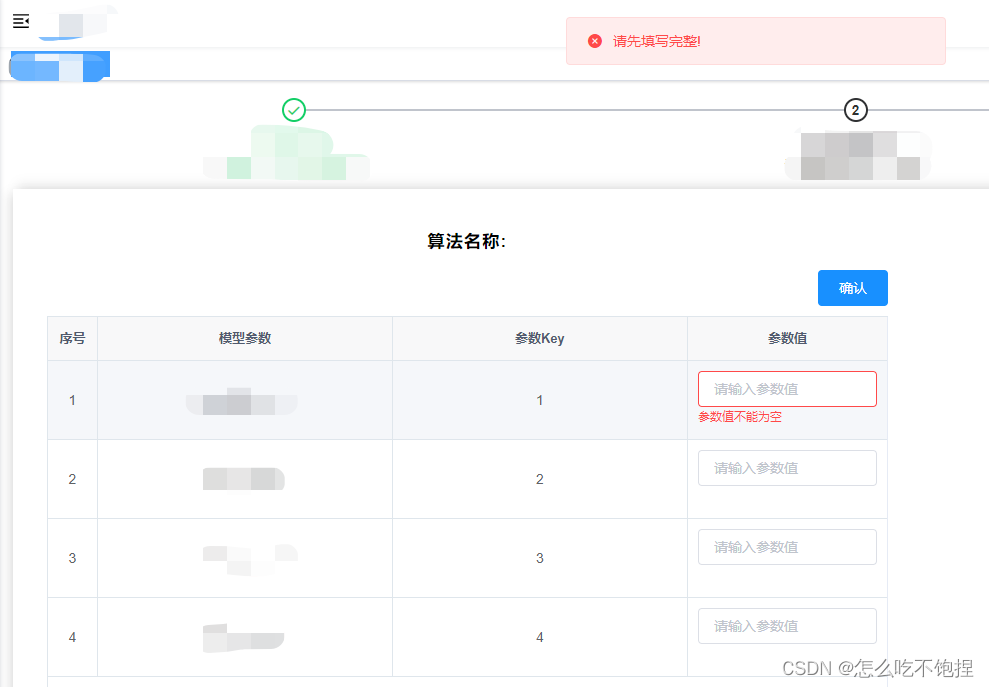
今天下午写着写着突然想到,需求好像又不完全像上面的第二种一样,再更新一下吧,而且个人用着感觉这一版可能判断更精准一点.
需求是点击确认按钮,会判断参数值是否都填写了,但凡有一个没填写都会提示需要填写完整;只有所有的都填写完整才会继续往下运行.

 代码更新:
代码更新:
<!--这里设置ref动态绑定是给每一行唯一标识,不然表单校验的时候只会校验其中一行的数据,
无法按照我们的想法每一行都去校验,这样即使有没填的也不会警告了,这可不行o(╯□╰)o -->
<input-required
                    :ref="`required${scope.$index}`"
                    :propValue="'attrValue'"
                    :labelValue="'参数值'"
                    :isDisalbed="false"
                    :indexValue="scope.$index"
                    @updateData="updateData"
                  ></input-required>
自定义组件内方法作如下修改:
isValid() {
      let flag = null;
      this.form[this.propValue] = this.value;
      this.$refs["formRef"].validate(valid => {
        if (valid) {
          flag = true;
          this.$emit("updateData", this.form, this.indexValue);
        } else {
          flag = false;
        }
      });
     // 把每次校验的结果返回给父组件
      return flag;
    }
父组件内判断是否全部填写完毕:
// 确认配置完成,生成模型配置信息
    submit() {
      let flag = true;
      // flag并上每一行校验的结果,如果全部填写,最后就是true,但凡有一行没有填写,flag都会是false
      for (let index = 0; index < this.algorithmParamOptions.length; index++) {
        flag = flag && this.$refs[`required` + index].isValid();
      }
      if (flag) {
        .......
      } else {
        this.$modal.msgError("请先填写完整!");
      }
    },
我有一个Ruby程序,它使用rubyzip压缩XML文件的目录树。gem。我的问题是文件开始变得很重,我想提高压缩级别,因为压缩时间不是问题。我在rubyzipdocumentation中找不到一种为创建的ZIP文件指定压缩级别的方法。有人知道如何更改此设置吗?是否有另一个允许指定压缩级别的Ruby库? 最佳答案 这是我通过查看rubyzip内部创建的代码。level=Zlib::BEST_COMPRESSIONZip::ZipOutputStream.open(zip_file)do|zip|Dir.glob("**/*")d
我正在尝试测试是否存在表单。我是Rails新手。我的new.html.erb_spec.rb文件的内容是:require'spec_helper'describe"messages/new.html.erb"doit"shouldrendertheform"dorender'/messages/new.html.erb'reponse.shouldhave_form_putting_to(@message)with_submit_buttonendendView本身,new.html.erb,有代码:当我运行rspec时,它失败了:1)messages/new.html.erbshou
我在从html页面生成PDF时遇到问题。我正在使用PDFkit。在安装它的过程中,我注意到我需要wkhtmltopdf。所以我也安装了它。我做了PDFkit的文档所说的一切......现在我在尝试加载PDF时遇到了这个错误。这里是错误:commandfailed:"/usr/local/bin/wkhtmltopdf""--margin-right""0.75in""--page-size""Letter""--margin-top""0.75in""--margin-bottom""0.75in""--encoding""UTF-8""--margin-left""0.75in""-
Rails2.3可以选择随时使用RouteSet#add_configuration_file添加更多路由。是否可以在Rails3项目中做同样的事情? 最佳答案 在config/application.rb中:config.paths.config.routes在Rails3.2(也可能是Rails3.1)中,使用:config.paths["config/routes"] 关于ruby-on-rails-Rails3中的多个路由文件,我们在StackOverflow上找到一个类似的问题
我在使用omniauth/openid时遇到了一些麻烦。在尝试进行身份验证时,我在日志中发现了这一点:OpenID::FetchingError:Errorfetchinghttps://www.google.com/accounts/o8/.well-known/host-meta?hd=profiles.google.com%2Fmy_username:undefinedmethod`io'fornil:NilClass重要的是undefinedmethodio'fornil:NilClass来自openid/fetchers.rb,在下面的代码片段中:moduleNetclass
我在我的项目目录中完成了compasscreate.和compassinitrails。几个问题:我已将我的.sass文件放在public/stylesheets中。这是放置它们的正确位置吗?当我运行compasswatch时,它不会自动编译这些.sass文件。我必须手动指定文件:compasswatchpublic/stylesheets/myfile.sass等。如何让它自动运行?文件ie.css、print.css和screen.css已放在stylesheets/compiled。如何在编译后不让它们重新出现的情况下删除它们?我自己编译的.sass文件编译成compiled/t
我有多个ActiveRecord子类Item的实例数组,我需要根据最早的事件循环打印。在这种情况下,我需要打印付款和维护日期,如下所示:ItemAmaintenancerequiredin5daysItemBpaymentrequiredin6daysItemApaymentrequiredin7daysItemBmaintenancerequiredin8days我目前有两个查询,用于查找maintenance和payment项目(非排他性查询),并输出如下内容:paymentrequiredin...maintenancerequiredin...有什么方法可以改善上述(丑陋的)代
我需要从一个View访问多个模型。以前,我的links_controller仅用于提供以不同方式排序的链接资源。现在我想包括一个部分(我假设)显示按分数排序的顶级用户(@users=User.all.sort_by(&:score))我知道我可以将此代码插入每个链接操作并从View访问它,但这似乎不是“ruby方式”,我将需要在不久的将来访问更多模型。这可能会变得很脏,是否有针对这种情况的任何技术?注意事项:我认为我的应用程序正朝着单一格式和动态页面内容的方向发展,本质上是一个典型的网络应用程序。我知道before_filter但考虑到我希望应用程序进入的方向,这似乎很麻烦。最终从任何
我有一个对象has_many应呈现为xml的子对象。这不是问题。我的问题是我创建了一个Hash包含此数据,就像解析器需要它一样。但是rails自动将整个文件包含在.........我需要摆脱type="array"和我该如何处理?我没有在文档中找到任何内容。 最佳答案 我遇到了同样的问题;这是我的XML:我在用这个:entries.to_xml将散列数据转换为XML,但这会将条目的数据包装到中所以我修改了:entries.to_xml(root:"Contacts")但这仍然将转换后的XML包装在“联系人”中,将我的XML代码修改为
为了将Cucumber用于命令行脚本,我按照提供的说明安装了arubagem。它在我的Gemfile中,我可以验证是否安装了正确的版本并且我已经包含了require'aruba/cucumber'在'features/env.rb'中为了确保它能正常工作,我写了以下场景:@announceScenario:Testingcucumber/arubaGivenablankslateThentheoutputfrom"ls-la"shouldcontain"drw"假设事情应该失败。它确实失败了,但失败的原因是错误的:@announceScenario:Testingcucumber/ar
