
✅作者简介:2022年博客新星 第八。热爱国学的Java后端开发者,修心和技术同步精进。
🍎个人主页:Java Fans的博客
🍊个人信条:不迁怒,不贰过。小知识,大智慧。
💞当前专栏:SSM 框架从入门到精通
✨特色专栏:国学周更-心性养成之路
🥭本文内容:一文吃透 Spring 中的IOC和DI
文章目录
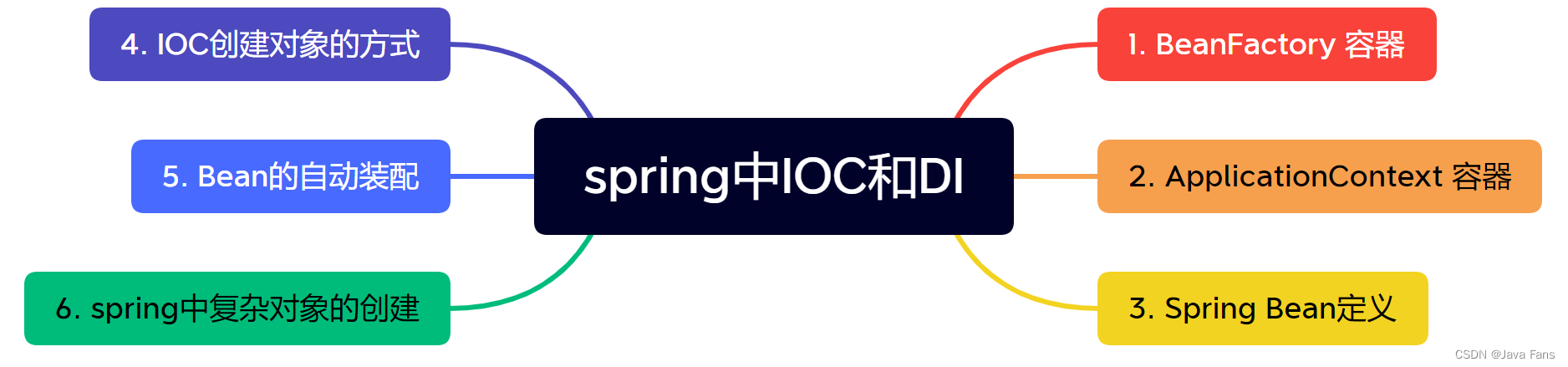
IoC 容器是 Spring 的核心,也可以称为 Spring 容器。Spring 通过 IoC 容器来管理对象的实例化和初始化,以及对象从创建到销毁的整个生命周期。
Spring 中使用的对象都由 IoC 容器管理,不需要我们手动使用 new 运算符创建对象。由 IoC 容器管理的对象称为 Spring Bean,Spring Bean 就是 Java 对象,和使用 new 运算符创建的对象没有区别。
Spring 通过读取 XML 或 Java 注解中的信息来获取哪些对象需要实例化。Spring 提供 2 种不同类型的 IoC 容器,即 BeanFactory 和 ApplicationContext 容器
BeanFactory 是最简单的容器,由 org.springframework.beans.factory.BeanFactory 接口定义,采用懒加载(lazy-load),所以容器启动比较快。BeanFactory 提供了容器最基本的功能,配置文件加载时不会创建对象,在获取bean时才会创建对象
为了能够兼容 Spring 集成的第三方框架(如 BeanFactoryAware、InitializingBean、DisposableBean),所以目前仍然保留了该接口。简单来说,BeanFactory 就是一个管理 Bean 的工厂,它主要负责初始化各种 Bean,并调用它们的生命周期方法。BeanFactory 接口有多个实现类 org.springframework.beans.factory.xml.XmlBeanFactory最常见
使用 BeanFactory 需要创建 XmlBeanFactory 类的实例,通过 XmlBeanFactory 类的构造函数来传递 Resource 对象。如下所示。
Resource resource = new ClassPathResource("applicationContext.xml");
BeanFactory factory = new XmlBeanFactory(resource);
ApplicationContext 继承了 BeanFactory 接口,由 org.springframework.context.ApplicationContext 接口定义,对象在启动容器时加载。ApplicationContext 在 BeanFactory 的基础上增加了很多企业级功能,例如 AOP、国际化、事件支持等。
ApplicationContext 接口有两个常用的实现类,具体如下。
【1】ClassPathXmlApplicationContext
该类从类路径 ClassPath 中寻找指定的 XML 配置文件,并完成 ApplicationContext 的实例化工作,具体如下所示。
ApplicationContext applicationContext = new ClassPathXmlApplicationContext(String configLocation);
配置文件加载,则创建对象
在上述代码中,configLocation 参数用于指定 Spring 配置文件的名称和位置,如 Beans.xml。
【2】FileSystemXmlApplicationContext
该类从指定的文件系统路径中寻找指定的 XML 配置文件,并完成 ApplicationContext 的实例化工作,具体如下所示。
ApplicationContext applicationContext = new FileSystemXmlApplicationContext(String configLocation);
二者的主要区别在于,如果 Bean 的某一个属性没有注入,使用 BeanFacotry 加载后,第一次调用 getBean() 方法时会抛出异常,而 ApplicationContext 则会在初始化时自检,这样有利于检查所依赖的属性是否注入。
因此,在实际开发中,通常都选择使用 ApplicationContext,只有在系统资源较少时,才考虑使用 BeanFactory。
【3】spring容器加载多个配置文件
//加载spring的配置文件  启动spring容器
ApplicationContext ac = new ClassPathXmlApplicationContext("config/student.xml","config/springConfig.xml");
String[] config = {"config/student.xml","config/springConfig.xml"};
 //加载spring的配置文件  启动spring容器
 ApplicationContext ac = new ClassPathXmlApplicationContext(config);
<?xml version="1.0" encoding="UTF-8"?>
<beans xmlns="http://www.springframework.org/schema/beans"
       xmlns:xsi="http://www.w3.org/2001/XMLSchema-instance"
       xsi:schemaLocation="http://www.springframework.org/schema/beans http://www.springframework.org/schema/beans/spring-beans.xsd">
    <import resource="student.xml"/>
    <import resource="springConfig.xml"/>
</beans>
 //加载spring的配置文件  启动spring容器
   ApplicationContext ac = new ClassPathXmlApplicationContext("config/applicationContext.xml");
由 Spring IoC 容器管理的对象称为 Bean,Bean 根据 Spring 配置文件中的信息创建。
可以把 Spring IoC 容器看作是一个大工厂,Bean 相当于工厂的产品,如果希望这个大工厂生产和管理 Bean,则需要告诉容器需要哪些 Bean,以及需要哪种方式装配 Bean。
Spring 配置文件支持两种格式,即 XML 文件格式和 Properties 文件格式。
通常情况下,Spring 的配置文件使用 XML 格式。XML 配置文件的根元素是 ,该元素包含了多个子元素 。每一个 元素都定义了一个 Bean,并描述了该 Bean 如何被装配到 Spring 容器中 元素中可以包含很多属性,其常用属性如下表所示。
| 属性名称 | 描述 |
|---|---|
| id | Bean 的唯一标识符,Spring 容器对 Bean 的配置和管理都通过该属性完成。id 的值必须以字母开始,可以使用字母、数字、下划线等符号。 |
| name | name 属性中可以为 Bean 指定多个名称,每个名称之间用逗号或分号隔开。Spring 容器可以通过 name 属性配置和管理容器中的 Bean。 |
| class | 该属性指定了 Bean 的具体实现类,它必须是一个完整的类名,即类的全限定名。 |
| scope | 用于设定 Bean 实例的作用域,属性值可以为 singleton(单例)、prototype(原型)、request、session 和 global Session。其默认值是 singleton |
| constructor-arg | 元素的子元素,可以使用此元素传入构造参数进行实例化。该元素的 index 属性指定构造参数的序号(从 0 开始),type 属性指定构造参数的类型 |
| property | 元素的子元素,用于调用 Bean 实例中的 setter 方法来属性赋值,从而完成依赖注入。该元素的 name 属性用于指定 Bean 实例中相应的属性名 |
| ref | 和 等元素的子元索,该元素中的 bean 属性用于指定对某个 Bean 实例的引用 |
| value | 和 等元素的子元素,用于直接指定一个常量值 |
| list | 用于封装 List 或数组类型的依赖注入 |
| set | 用于封装 Set 类型的依赖注入 |
| map | 用于封装 Map 类型的依赖注入 |
| entry | |
| init-method | 容器加载 Bean 时调用该方法,类似于 Servlet 中的 init() 方法 |
| destroy-method | 容器删除 Bean 时调用该方法,类似于 Servlet 中的 destroy() 方法。该方法只在 scope=singleton 时有效 |
| lazy-init | 懒加载,值为 true,容器在首次请求时才会创建 Bean 实例;值为 false,容器在启动时创建 Bean 实例。该方法只在 scope=singleton 时有效 |
【1】无参构造器创建对象 (默认)
【2】有参构造创建对象
 <!--    使用索引匹配参数-->
<bean id="student" class="cn.kgc.spring.entity.Student">
    <constructor-arg index="0" value="20"/>
    <constructor-arg index="1" value="李四"/>
    <constructor-arg index="2" value="20210814"/>
    <constructor-arg index="3" value="2021/08/14"/>
</bean>
<!--使用数据类型匹配参数  有相同的参数类型可配合索引一起使用-->
 <bean id="student" class="cn.kgc.spring.entity.Student">
        <constructor-arg type="int" value="20"/>
        <constructor-arg type="java.lang.String" index="1" value="李四"/>
        <constructor-arg type="java.lang.String"  value="20210814"/>
        <constructor-arg type="java.util.Date" value="2021/08/14"/>
 </bean>
<!--使用属性名赋值-->
    <bean id="student" class="cn.kgc.spring.entity.Student">
        <constructor-arg  name="age" value="20"/>
        <constructor-arg  name="name" value="李四"/>
        <constructor-arg   name="stuNo" value="20210814"/>
        <constructor-arg   name="birth" value="2021/08/14" />
    </bean>
【3】创建对象时属性的其它注入方式
<bean id="studentService" class="cn.kgc.spring.service.StudentServiceImpl">
    <!-- 属性是引用类型 赋值时使用ref-->
        <property name="studentDao" ref="studentDao"/>
    <!-- 属性是基本类型 String类型 Date类型 赋值时使用value -->
        <property name="age" value="20"/>
        <property name="stuName" value="张三"/>
        <property name="price" value="20.4"/>
        <property name="score" value="80.3"/>
        <property name="birth" value="2021/8/13"/>
        <property name="str" >
            <array>
                <value>张三</value>
                <value>李四</value>
                <value>王五</value>
            </array>
        </property>
        <property name="lis">
            <list>
                <value>抽烟</value>
                <value>喝酒</value>
                <value>烫头</value>
            </list>
        </property>
        <!-- spring容器中组件默认都是单例的 全局共享一个对象-->
      <property name="lis2">
          <list>
              <ref bean="studentDao"></ref>
              <ref bean="studentDao"></ref>
              <ref bean="studentDao"></ref>
          </list>
      </property>
        <property name="books">
            <set>
                <value>java</value>
                <value>php</value>
                <value>c#</value>
            </set>
        </property>
        <property name="scores">
            <map>
                <entry key="math" value="89" ></entry>
                <entry key="english" value="90" ></entry>
                <entry key="java" value="80" ></entry>
            </map>
        </property>
        <property name="map">
            <map>
                <entry key="01" value-ref="studentDao"></entry>
                <entry key="02" value-ref="studentDao"></entry>
                <entry key="03" value-ref="studentDao"></entry>
            </map>
        </property>
        <property name="ps">
            <props>
                <prop key="driver">com.mysql.jdbc.Driver</prop>
                <prop key="url">jdbc:mysql:///mybatis</prop>
                <prop key="username">root</prop>
                <prop key="password">rooot</prop>
            </props>
        </property>
    </bean>
使用set注入,每个属性必须含有对应的set方法,否则无法进行属性的注入
p命名空间是set注入的一种快捷实现方式,想要使用p命名空间注入,需要注意一下几点。
- 实体类中必须有set方法;
- 实体类中必须有无参构造器(默认存在);
- 必须导入p命名空间注入方式依赖。
xml依赖代码:
xmlns:p="http://www.springframework.org/schema/p"
导入后即可使用
<bean id="user" class="com.yd.pojo.User" p:age="18" p:name="老王"/>
<!--需要有属性的set方法-->
<bean id="student" class="cn.kgc.spring.entity.Student" p:age="20" p:name="lisi" p:birth="2021/1/1" p:stuNo="20210814001"></bean>
c命名空间是构造器注入的一种快捷实现方式,想要使用c命名空间,需要注意一下几点。
- 实体类中必须存在有参构造器;
- 必须导入c命名空间注入方式依赖。
xml依赖代码:
xmlns:c="http://www.springframework.org/schema/c"
导入后即可使用
<bean id="user2" class="com.yd.pojo.User" c:age="23" c:name="中王"/>
<!--需要有有参构造方法-->
<bean id="student" class="cn.kgc.spring.entity.Student" c:age="30" c:name="王五" c:birth="1991/12/08" c:stuNo="20210814001"></bean>
类型转换器的使用:
作用:自定义注入参数和实体类中类型的匹配方式
import org.springframework.core.convert.converter.Converter;

public class MyConverter  implements Converter<String, Date> {

    @Override
    public Date convert(String source) {
        SimpleDateFormat simpleDateFormat = new SimpleDateFormat("yyyy-MM-dd");
        try {
            Date parse = simpleDateFormat.parse(source);
            return parse;
        } catch (ParseException e) {
            e.printStackTrace();
        }
        return null;
    }
}
xml文件配置:
<bean id="convert" class="cn.kgc.spring.basic.convert.MyConverter"></bean>
    <bean id="conversionService" class="org.springframework.context.support.ConversionServiceFactoryBean">
        <property name="converters">
            <set>
                <ref bean="convert"></ref>
            </set>
        </property>
</bean>
【1】autowire="byName"在容器的上下文中寻找与类中属性对应的set方法名字相同的id属性值进行装配
 	<bean id="teacher" class="cn.kgc.spring.entity.Teacher">
        <property name="name" value="李老师"/>
        <property name="teaNo" value="001"/>
    </bean>
    <bean id="classRoom1" class="cn.kgc.spring.entity.ClassRoom">
        <property name="address" value="学思楼1楼"/>
        <property name="classNo" value="1"/>
    </bean>
    <bean id="student" class="cn.kgc.spring.entity.Student" autowire="byName" ></bean>
【2】autowire="byType"在容器的上下文中寻找与类中属性类型相同的Bean进行装配
<bean id="teacher" class="cn.kgc.spring.entity.Teacher">
        <property name="name" value="李老师"/>
        <property name="teaNo" value="001"/>
    </bean>
    <bean id="classRoom1" class="cn.kgc.spring.entity.ClassRoom">
        <property name="address" value="学思楼1楼"/>
        <property name="classNo" value="1"/>
    </bean>
    <bean id="student" class="cn.kgc.spring.entity.Student" autowire="byType" ></bean>
【3】使用注解自动装配
<beans xmlns="http://www.springframework.org/schema/beans"
       xmlns:xsi="http://www.w3.org/2001/XMLSchema-instance"
       xmlns:p="http://www.springframework.org/schema/p"
       xmlns:c="http://www.springframework.org/schema/c"
       xmlns:context="http://www.springframework.org/schema/context"
       xsi:schemaLocation=
               "http://www.springframework.org/schema/beans
                http://www.springframework.org/schema/beans/spring-beans.xsd
                http://www.springframework.org/schema/context
                http://www.springframework.org/schema/context/spring-context.xsd" >
<context:annotation-config/>
public class Student {

    @Value("2021")
    private String stuNo;
    @Value("wangwu")
    private String name;
    @Value("20")
    private int age;
    @Value("2021/12/08")
    private Date birth;

    @Autowired
    private Teacher teacher;
    @Resource
    private ClassRoom classRoom;

}
获取配置文件中的值
public class Aoo {

    @Value("${test.boolean}")
    private Boolean testBoolean;

    @Value("${test.string}")
    private String testString;

    @Value("${test.integer}")
    private Integer testInteger;

    @Value("${test.long}")
    private Long testLong;

    @Value("${test.float}")
    private Float testFloat;

    @Value("${test.double}")
    private Double testDouble;

    @Value("#{'${test.array}'.split(',')}")
    private String[] testArray;

    @Value("#{'${test.list}'.split(',')}")
    private List<String> testList;

    @Value("#{'${test.set}'.split(',')}")
    private Set<String> testSet;

    @Value("#{${test.map}}")
    private Map<String, Object> testMap;

}
配置文件 properties
test.boolean=true
test.string=abc
test.integer=123
test.long=123
test.float=1.2345678123456
test.double=1.2345678123456
test.array=1,3,4,5,6,1,2,3
test.list=1,3,4,5,6,1,2,3
test.set=1,3,4,5,6,1,2,3
test.map={name:"zhangsan", age:18}
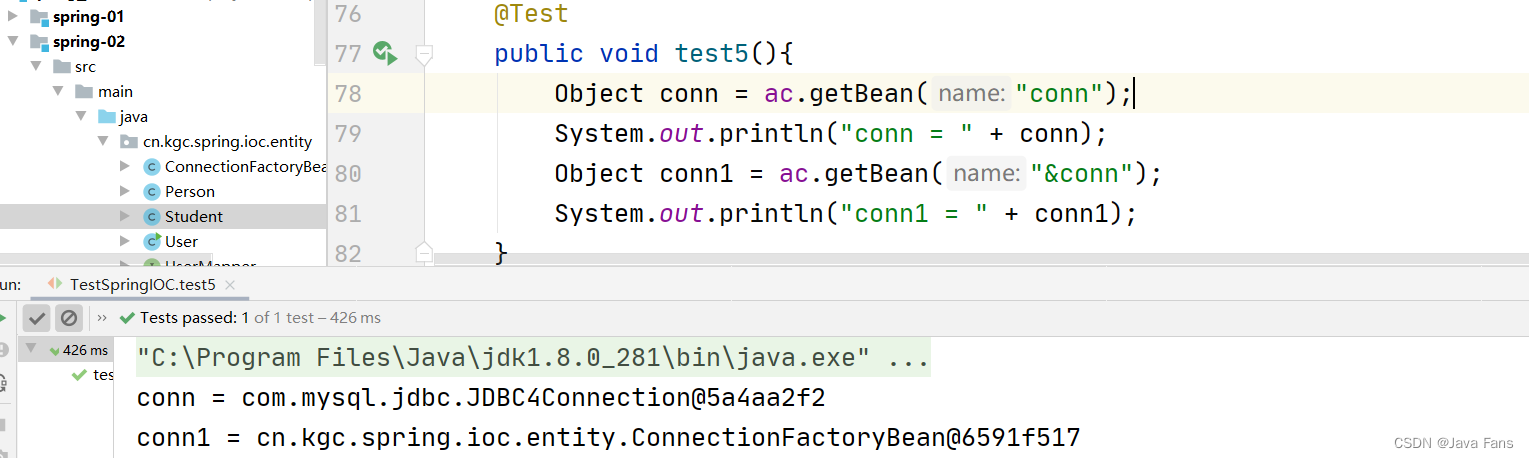
【1】FactoryBean
public class ConnectionFactoryBean  implements FactoryBean<Connection> {

    @Override
    public Connection getObject() throws Exception {

        Class.forName("com.mysql.jdbc.Driver");
        Connection connection = DriverManager.getConnection("jdbc:mysql:///java2215?serverTimezone=UTC", "root", "root");
        return connection;
    }

    @Override
    public Class<?> getObjectType() {
        return Connection.class;
    }

    @Override
    public boolean isSingleton() {
        return false;
    }
}
xml配置方式:
<bean id="conn" class="cn.kgc.spring.ioc.entity.ConnectionFactoryBean"></bean>
【2】实例工厂
public class ConnectionFactoryBean {

    public Connection getConnection() throws Exception {
        Class.forName("com.mysql.jdbc.Driver");
        Connection connection = DriverManager.getConnection("jdbc:mysql:///java2215?serverTimezone=UTC&useSSL=false", "root", "root");
        return connection;
    }

}
xml配置方式:
<bean id="conn" class="cn.kgc.spring.ioc.entity.ConnectionFactoryBean"></bean>
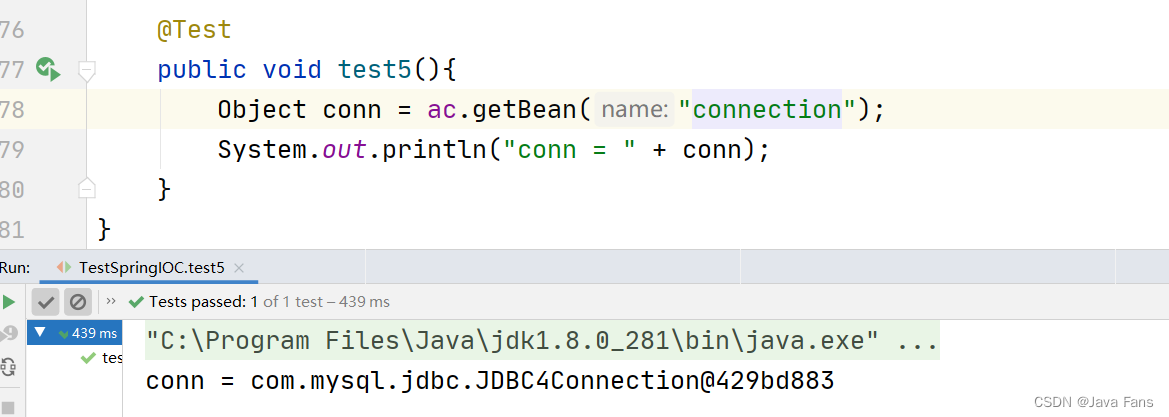
<bean id="connection" factory-bean="conn" factory-method="getConnection"></bean>
【3】静态工厂
public class ConnectionFactoryBean {

    public static Connection getConnection() throws Exception {
        Class.forName("com.mysql.jdbc.Driver");
        Connection connection = DriverManager.getConnection("jdbc:mysql:///java2215?serverTimezone=UTC&useSSL=false", "root", "root");
        return connection;
    }

}
xml配置方式:
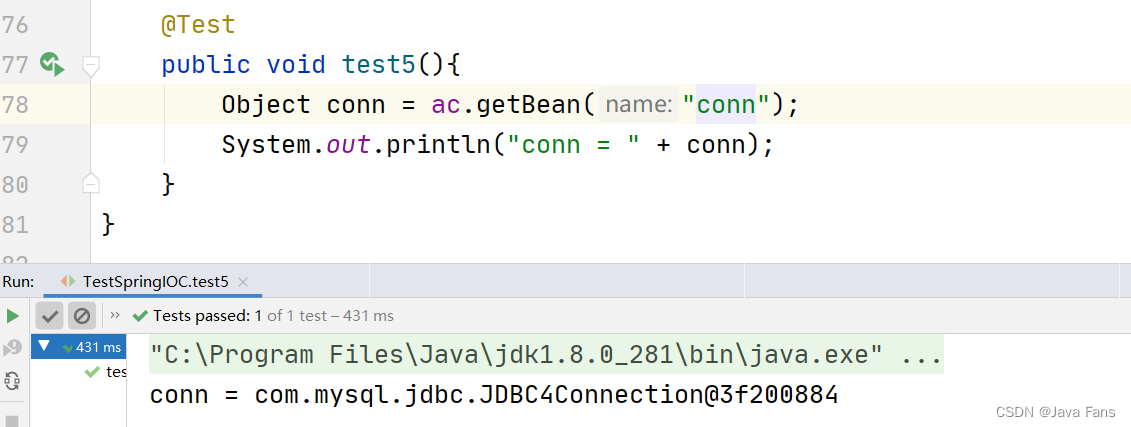
<bean id="conn" class="cn.kgc.spring.ioc.entity.ConnectionFactoryBean" factory-method="getConnection"></bean>
码文不易,本篇文章就介绍到这里,如果想要学习更多Java系列知识,点击关注博主,博主带你零基础学习Java知识。与此同时,对于日常生活有困扰的朋友,欢迎阅读我的第四栏目:《国学周更—心性养成之路》,学习技术的同时,我们也注重了心性的养成。

总的来说,我对ruby还比较陌生,我正在为我正在创建的对象编写一些rspec测试用例。许多测试用例都非常基础,我只是想确保正确填充和返回值。我想知道是否有办法使用循环结构来执行此操作。不必为我要测试的每个方法都设置一个assertEquals。例如:describeitem,"TestingtheItem"doit"willhaveanullvaluetostart"doitem=Item.new#HereIcoulddotheitem.name.shouldbe_nil#thenIcoulddoitem.category.shouldbe_nilendend但我想要一些方法来使用
我试图在一个项目中使用rake,如果我把所有东西都放到Rakefile中,它会很大并且很难读取/找到东西,所以我试着将每个命名空间放在lib/rake中它自己的文件中,我添加了这个到我的rake文件的顶部:Dir['#{File.dirname(__FILE__)}/lib/rake/*.rake'].map{|f|requiref}它加载文件没问题,但没有任务。我现在只有一个.rake文件作为测试,名为“servers.rake”,它看起来像这样:namespace:serverdotask:testdoputs"test"endend所以当我运行rakeserver:testid时
作为我的Rails应用程序的一部分,我编写了一个小导入程序,它从我们的LDAP系统中吸取数据并将其塞入一个用户表中。不幸的是,与LDAP相关的代码在遍历我们的32K用户时泄漏了大量内存,我一直无法弄清楚如何解决这个问题。这个问题似乎在某种程度上与LDAP库有关,因为当我删除对LDAP内容的调用时,内存使用情况会很好地稳定下来。此外,不断增加的对象是Net::BER::BerIdentifiedString和Net::BER::BerIdentifiedArray,它们都是LDAP库的一部分。当我运行导入时,内存使用量最终达到超过1GB的峰值。如果问题存在,我需要找到一些方法来更正我的代
Rails2.3可以选择随时使用RouteSet#add_configuration_file添加更多路由。是否可以在Rails3项目中做同样的事情? 最佳答案 在config/application.rb中:config.paths.config.routes在Rails3.2(也可能是Rails3.1)中,使用:config.paths["config/routes"] 关于ruby-on-rails-Rails3中的多个路由文件,我们在StackOverflow上找到一个类似的问题
我需要从一个View访问多个模型。以前,我的links_controller仅用于提供以不同方式排序的链接资源。现在我想包括一个部分(我假设)显示按分数排序的顶级用户(@users=User.all.sort_by(&:score))我知道我可以将此代码插入每个链接操作并从View访问它,但这似乎不是“ruby方式”,我将需要在不久的将来访问更多模型。这可能会变得很脏,是否有针对这种情况的任何技术?注意事项:我认为我的应用程序正朝着单一格式和动态页面内容的方向发展,本质上是一个典型的网络应用程序。我知道before_filter但考虑到我希望应用程序进入的方向,这似乎很麻烦。最终从任何
我在我的项目中添加了一个系统来重置用户密码并通过电子邮件将密码发送给他,以防他忘记密码。昨天它运行良好(当我实现它时)。当我今天尝试启动服务器时,出现以下错误。=>BootingWEBrick=>Rails3.2.1applicationstartingindevelopmentonhttp://0.0.0.0:3000=>Callwith-dtodetach=>Ctrl-CtoshutdownserverExiting/Users/vinayshenoy/.rvm/gems/ruby-1.9.3-p0/gems/actionmailer-3.2.1/lib/action_mailer
刚入门rails,开始慢慢理解。有人可以解释或给我一些关于在application_controller中编码的好处或时间和原因的想法吗?有哪些用例。您如何为Rails应用程序使用应用程序Controller?我不想在那里放太多代码,因为据我了解,每个请求都会调用此Controller。这是真的? 最佳答案 ApplicationController实际上是您应用程序中的每个其他Controller都将从中继承的类(尽管这不是强制性的)。我同意不要用太多代码弄乱它并保持干净整洁的态度,尽管在某些情况下ApplicationContr
我想向我的Controller传递一个参数,它是一个简单的复选框,但我不知道如何在模型的form_for中引入它,这是我的观点:{:id=>'go_finance'}do|f|%>Transferirde:para:Entrada:"input",:placeholder=>"Quantofoiganho?"%>Saída:"output",:placeholder=>"Quantofoigasto?"%>Nota:我想做一个额外的复选框,但我该怎么做,模型中没有一个对象,而是一个要检查的对象,以便在Controller中创建一个ifelse,如果没有检查,请帮助我,非常感谢,谢谢
我注意到像bundler这样的项目在每个specfile中执行requirespec_helper我还注意到rspec使用选项--require,它允许您在引导rspec时要求一个文件。您还可以将其添加到.rspec文件中,因此只要您运行不带参数的rspec就会添加它。使用上述方法有什么缺点可以解释为什么像bundler这样的项目选择在每个规范文件中都需要spec_helper吗? 最佳答案 我不在Bundler上工作,所以我不能直接谈论他们的做法。并非所有项目都checkin.rspec文件。原因是这个文件,通常按照当前的惯例,只
我正在使用active_admin,我在Rails3应用程序的应用程序中有一个目录管理,其中包含模型和页面的声明。时不时地我也有一个类,当那个类有一个常量时,就像这样:classFooBAR="bar"end然后,我在每个必须在我的Rails应用程序中重新加载一些代码的请求中收到此警告:/Users/pupeno/helloworld/app/admin/billing.rb:12:warning:alreadyinitializedconstantBAR知道发生了什么以及如何避免这些警告吗? 最佳答案 在纯Ruby中:classA
