前脚刚研究了一轮GPT3.5,OpenAI很快就升级了GPT-4,整体表现有进一步提升。追赶一下潮流,研究研究GPT-4干了啥。
本文内容全部源于对OpenAI公开的技术报告的解读,通篇以PR效果为主,实际内容不多。主要强调的工作,是“Predictable Scaling”这个概念。
上一版ChatGPT的主要挑战是,因为模型的训练量极大,很难去进行优化(ChatGPT是fine-tuning的模式)。因此,OpenAI希望能够在模型训练初期,就进行优化,从而大幅提升人工调优迭代的效率。而想要进行调优,就得知道当前模型的效果如何。因此,这个问题就被转化为了:如何在模型训练初期,就能够预测最终训练完成后的实际效果。
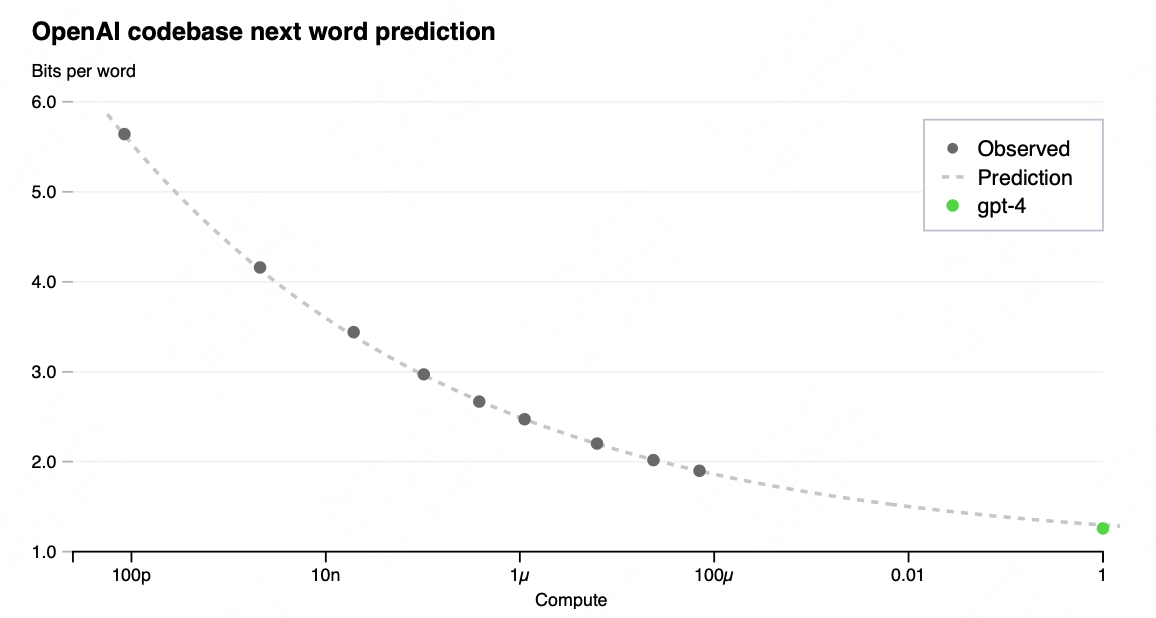
从结果来看,ChatGPT实现了,仅仅执行千分之一到万分之一的训练量,就可以大致预测模型的结果。
实现原理相对简单,就是在某一个模型的不同训练阶段进行实际效果测量,然后做函数拟合,发现符合幂等曲线。然后再基于采样值,测算一下幂等函数的相关参数,下一轮就可以只进行少量训练,就去预测最终效果了。
至于其他效果上的优化,OpenAI没有进一步解读原理,但整体应该还是基于“训练-奖励”的优化模型,去生成更针对性的奖励模型(比如增加法律、安全之类的奖励判断),以实现更优的效果。
原版内容如下:
3 Predictable Scaling
A large focus of the GPT-4 project was building a deep learning stack that scales predictably. The primary reason is that for very large training runs like GPT-4, it is not feasible to do extensive model-specific tuning. To address this, we developed infrastructure and optimization methods that have very predictable behavior across multiple scales. These improvements allowed us to reliably predict some aspects of the performance of GPT-4 from smaller models trained using 1, 000× – 10, 000× less compute.
3.1 Loss Prediction
The final loss of properly-trained large language models is thought to be well approximated by power laws in the amount of compute used to train the model [35, 36, 2, 14, 15].
To verify the scalability of our optimization infrastructure, we predicted GPT-4’s final loss on our internal codebase (not part of the training set) by fitting a scaling law with an irreducible loss term (as in Henighan et al. [15]): L(C) = aCb + c, from models trained using the same methodology but using at most 10,000x less compute than GPT-4. This prediction was made shortly after the run started, without use of any partial results. The fitted scaling law predicted GPT-4’s final loss with high accuracy (Figure 1).
3.2 Scaling of Capabilities on HumanEval
Having a sense of the capabilities of a model before training can improve decisions around alignment, safety, and deployment. In addition to predicting final loss, we developed methodology to predict more interpretable metrics of capability. One such metric is pass rate on the HumanEval dataset [37], which measures the ability to synthesize Python functions of varying complexity. We successfully predicted the pass rate on a subset of the HumanEval dataset by extrapolating from models trained with at most 1, 000× less compute (Figure 2).
For an individual problem in HumanEval, performance may occasionally worsen with scale. Despite these challenges, we find an approximate power law relationship −EP [log(pass_rate(C))] = α∗C−k
where k and α are positive constants, and P is a subset of problems in the dataset. We hypothesize that this relationship holds for all problems in this dataset. In practice, very low pass rates are difficult or impossible to estimate, so we restrict to problems P and models M such that given some large sample budget, every problem is solved at least once by every model.
We registered predictions for GPT-4’s performance on HumanEval before training completed, using only information available prior to training. All but the 15 hardest HumanEval problems were split into 6 difficulty buckets based on the performance of smaller models. The results on the 3rd easiest bucket are shown in Figure 2, showing that the resulting predictions were very accurate for this subset of HumanEval problems where we can accurately estimate log(pass_rate) for several smaller models. Predictions on the other five buckets performed almost as well, the main exception being GPT-4 underperforming our predictions on the easiest bucket.
Certain capabilities remain hard to predict. For example, the Inverse Scaling Prize [38] proposed several tasks for which model performance decreases as a function of scale. Similarly to a recent result by Wei et al. [39], we find that GPT-4 reverses this trend, as shown on one of the tasks called Hindsight Neglect [40] in Figure 3.
We believe that accurately predicting future capabilities is important for safety. Going forward we plan to refine these methods and register performance predictions across various capabilities before large model training begins, and we hope this becomes a common goal in the field.
类classAprivatedeffooputs:fooendpublicdefbarputs:barendprivatedefzimputs:zimendprotecteddefdibputs:dibendendA的实例a=A.new测试a.foorescueputs:faila.barrescueputs:faila.zimrescueputs:faila.dibrescueputs:faila.gazrescueputs:fail测试输出failbarfailfailfail.发送测试[:foo,:bar,:zim,:dib,:gaz].each{|m|a.send(m)resc
我有一个模型:classItem项目有一个属性“商店”基于存储的值,我希望Item对象对特定方法具有不同的行为。Rails中是否有针对此的通用设计模式?如果方法中没有大的if-else语句,这是如何干净利落地完成的? 最佳答案 通常通过Single-TableInheritance. 关于ruby-on-rails-Rails-子类化模型的设计模式是什么?,我们在StackOverflow上找到一个类似的问题: https://stackoverflow.co
我正在使用的第三方API的文档状态:"[O]urAPIonlyacceptspaddedBase64encodedstrings."什么是“填充的Base64编码字符串”以及如何在Ruby中生成它们。下面的代码是我第一次尝试创建转换为Base64的JSON格式数据。xa=Base64.encode64(a.to_json) 最佳答案 他们说的padding其实就是Base64本身的一部分。它是末尾的“=”和“==”。Base64将3个字节的数据包编码为4个编码字符。所以如果你的输入数据有长度n和n%3=1=>"=="末尾用于填充n%
我主要使用Ruby来执行此操作,但到目前为止我的攻击计划如下:使用gemsrdf、rdf-rdfa和rdf-microdata或mida来解析给定任何URI的数据。我认为最好映射到像schema.org这样的统一模式,例如使用这个yaml文件,它试图描述数据词汇表和opengraph到schema.org之间的转换:#SchemaXtoschema.orgconversion#data-vocabularyDV:name:namestreet-address:streetAddressregion:addressRegionlocality:addressLocalityphoto:i
为什么4.1%2返回0.0999999999999996?但是4.2%2==0.2。 最佳答案 参见此处:WhatEveryProgrammerShouldKnowAboutFloating-PointArithmetic实数是无限的。计算机使用的位数有限(今天是32位、64位)。因此计算机进行的浮点运算不能代表所有的实数。0.1是这些数字之一。请注意,这不是与Ruby相关的问题,而是与所有编程语言相关的问题,因为它来自计算机表示实数的方式。 关于ruby-为什么4.1%2使用Ruby返
它不等于主线程的binding,这个toplevel作用域是什么?此作用域与主线程中的binding有何不同?>ruby-e'putsTOPLEVEL_BINDING===binding'false 最佳答案 事实是,TOPLEVEL_BINDING始终引用Binding的预定义全局实例,而Kernel#binding创建的新实例>Binding每次封装当前执行上下文。在顶层,它们都包含相同的绑定(bind),但它们不是同一个对象,您无法使用==或===测试它们的绑定(bind)相等性。putsTOPLEVEL_BINDINGput
我可以得到Infinity和NaNn=9.0/0#=>Infinityn.class#=>Floatm=0/0.0#=>NaNm.class#=>Float但是当我想直接访问Infinity或NaN时:Infinity#=>uninitializedconstantInfinity(NameError)NaN#=>uninitializedconstantNaN(NameError)什么是Infinity和NaN?它们是对象、关键字还是其他东西? 最佳答案 您看到打印为Infinity和NaN的只是Float类的两个特殊实例的字符串
如果您尝试在Ruby中的nil对象上调用方法,则会出现NoMethodError异常并显示消息:"undefinedmethod‘...’fornil:NilClass"然而,有一个tryRails中的方法,如果它被发送到一个nil对象,它只返回nil:require'rubygems'require'active_support/all'nil.try(:nonexisting_method)#noNoMethodErrorexceptionanymore那么try如何在内部工作以防止该异常? 最佳答案 像Ruby中的所有其他对象
关闭。这个问题需要detailsorclarity.它目前不接受答案。想改进这个问题吗?通过editingthispost添加细节并澄清问题.关闭8年前。Improvethisquestion为什么SecureRandom.uuid创建一个唯一的字符串?SecureRandom.uuid#=>"35cb4e30-54e1-49f9-b5ce-4134799eb2c0"SecureRandom.uuid方法创建的字符串从不重复?
我刚刚被困在这个问题上一段时间了。以这个基地为例:moduleTopclassTestendmoduleFooendend稍后,我可以通过这样做在Foo中定义扩展Test的类:moduleTopmoduleFooclassSomeTest但是,如果我尝试通过使用::指定模块来最小化缩进:moduleTop::FooclassFailure这失败了:NameError:uninitializedconstantTop::Foo::Test这是一个错误,还是仅仅是Ruby解析变量名的方式的逻辑结果? 最佳答案 Isthisabug,or
