| OS | Framework | CPU/GPU | Time(ms)/Frame | Framework | Time(ms)/Frame |
|---|---|---|---|---|---|
| Linux 16.04 | Darknet | 12x Intel Core i7-6850K CPU @ 3.60GHz | 9370 | Darknet | 9370 |
| Linux 16.04 | Darknet + OpenMP | 12x Intel Core i7-6850K CPU @ 3.60GHz | 1942 | Darknet + OpenMP | 1942 |
| Linux 16.04 | OpenCV [CPU] | 12x Intel Core i7-6850K CPU @ 3.60GHz | 220 | OpenCV [CPU] | 220 |
| Linux 16.04 | Darknet | NVIDIA GeForce 1080 Ti GPU | 23 | Darknet | 23 |
| macOS | DarkNet | 2.5 GHz Intel Core i7 CPU | 7260 | DarkNet | 7260 |
| macOS | OpenCV [CPU] | 2.5 GHz Intel Core i7 CPU | 400 | OpenCV [CPU] | 400 |
    // Give the configuration and weight files for the model 模型参数文件
    String modelConfiguration = "./model/yolov3.cfg";
    String modelWeights = "./model/yolov3.weights";
    // Load names of classes 读取分类类名
    string classesFile = "./model/coco.names";
    ifstream ifs(classesFile.c_str());
    string line;
    while (getline(ifs, line))
    {
        classes.push_back(line);
    }

    // Load the network 导入网络
    Net net = readNetFromDarknet(modelConfiguration, modelWeights);
    net.setPreferableBackend(DNN_BACKEND_OPENCV);
    //仅仅使用CPU
    net.setPreferableTarget(DNN_TARGET_CPU);
    Mat blob;
    clock_t start, finish;
    //读图
    Mat frame = imread("bird.jpg");
    //根据需求决定是不是重置图像
    //resize(frame, frame, Size(300, 300));

    start = clock();
    // Create a 4D blob from a frame. 创建神经网络输入图像
    blobFromImage(frame, blob, 1 / 255.0, cvSize(inpWidth, inpHeight), Scalar(0, 0, 0), true, false);

    //Sets the input to the network 设置输出
    net.setInput(blob);

    // Runs the forward pass to get output of the output layers 获取输出层结果
    vector<Mat> outs;
    net.forward(outs, getOutputsNames(net));

    // Remove the bounding boxes with low confidence
    postprocess(frame, outs);
    finish = clock();

    cout << "time is " << double(finish - start) / CLOCKS_PER_SEC << endl;
    // Put efficiency information. The function getPerfProfile returns the overall time for inference(t) and the timings for each of the layers(in layersTimes)
    //输出前向传播的时间
    vector<double> layersTimes;
    double freq = getTickFrequency() / 1000;
    double t = net.getPerfProfile(layersTimes) / freq;
    string label = format("Inference time for a frame : %.2f ms", t);
    putText(frame, label, Point(0, 15), FONT_HERSHEY_SIMPLEX, 0.5, Scalar(0, 0, 255));
// Get the names of the output layers 获取输出层
/**
 * @brief Get the Outputs Names object
 *
 * @param net
 * @return vector<String>
 */
vector<String> getOutputsNames(const Net& net)
{
    //输出
    static vector<String> names;
    if (names.empty())
    {
        //Get the indices of the output layers, i.e. the layers with unconnected outputs
        vector<int> outLayers = net.getUnconnectedOutLayers();

        //get the names of all the layers in the network
        vector<String> layersNames = net.getLayerNames();

        // Get the names of the output layers in names
        names.resize(outLayers.size());
        for (size_t i = 0; i < outLayers.size(); ++i)
        {
            names[i] = layersNames[outLayers[i] - 1];
        }
    }
    return names;
}
/**
 * @brief Remove the bounding boxes with low confidence using non-maxima suppression 基于非极大性抑制去除边框
 *
 * @param frame 视频图像
 * @param outs 输出层结果
 */
void postprocess(Mat& frame, const vector<Mat>& outs)
{
    //输出类
    vector<int> classIds;
    //置信度
    vector<float> confidences;
    vector<Rect> boxes;

    //遍历所有的输出层
    for (size_t i = 0; i < outs.size(); ++i)
    {
        // Scan through all the bounding boxes output from the network and keep only the
        // ones with high confidence scores. Assign the box's class label as the class
        // with the highest score for the box.
        //扫描所有来自网络的边界框输出,只保留具有高置信度分数的边界框。将框的类标签指定为框得分最高的类。
        //读取框
        float* data = (float*)outs[i].data;
        for (int j = 0; j < outs[i].rows; ++j, data += outs[i].cols)
        {
            Mat scores = outs[i].row(j).colRange(5, outs[i].cols);
            Point classIdPoint;
            double confidence;
            // Get the value and location of the maximum score 获取置信度和位置参数
            minMaxLoc(scores, 0, &confidence, 0, &classIdPoint);
            //如果大于置信度阈值
            if (confidence > confThreshold)
            {
                //获取坐标
                int centerX = (int)(data[0] * frame.cols);
                int centerY = (int)(data[1] * frame.rows);
                int width = (int)(data[2] * frame.cols);
                int height = (int)(data[3] * frame.rows);
                int left = centerX - width / 2;
                int top = centerY - height / 2;

                classIds.push_back(classIdPoint.x);
                confidences.push_back((float)confidence);
                boxes.push_back(Rect(left, top, width, height));
            }
        }
    }

    // Perform non maximum suppression to eliminate redundant overlapping boxes with
    // lower confidences
    //输出非极大性抑制结果,按置信度从大到小输出
    vector<int> indices;
    //非极大性抑制
    NMSBoxes(boxes, confidences, confThreshold, nmsThreshold, indices);
    //绘图
    for (size_t i = 0; i < indices.size(); ++i)
    {
        int idx = indices[i];
        Rect box = boxes[idx];
        //类,置信度
        drawPred(classIds[idx], confidences[idx], box.x, box.y,
            box.x + box.width, box.y + box.height, frame);
    }
}
/**
 * @brief Draw the predicted bounding box 画框
 *
 * @param classId 类别
 * @param conf 置信度
 * @param left
 * @param top
 * @param right
 * @param bottom
 * @param frame
 */
void drawPred(int classId, float conf, int left, int top, int right, int bottom, Mat& frame)
{
    //Draw a rectangle displaying the bounding box
    rectangle(frame, Point(left, top), Point(right, bottom), Scalar(255, 178, 50), 3);

    //Get the label for the class name and its confidence
    string label = format("%.2f", conf);
    if (!classes.empty())
    {
        CV_Assert(classId < (int)classes.size());
        label = classes[classId] + ":" + label;
    }

    //Display the label at the top of the bounding box 在每个框左上角标上标签
    int baseLine;
    Size labelSize = getTextSize(label, FONT_HERSHEY_SIMPLEX, 0.5, 1, &baseLine);
    top = max(top, labelSize.height);
    rectangle(frame, Point(left, top - round(1.5*labelSize.height)), Point(left + round(1.5*labelSize.width), top + baseLine), Scalar(255, 255, 255), FILLED);
    putText(frame, label, Point(left, top), FONT_HERSHEY_SIMPLEX, 0.75, Scalar(0, 0, 0), 1);
}
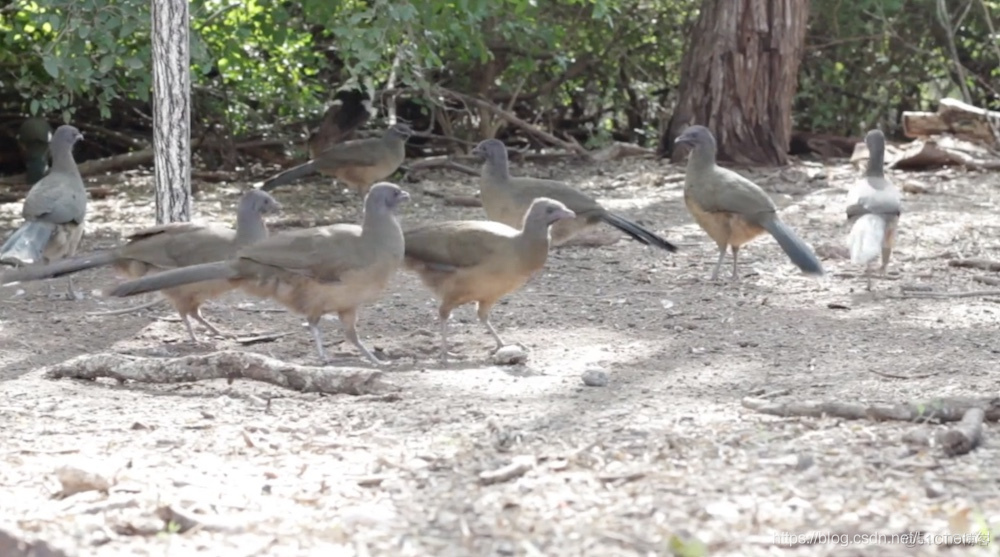
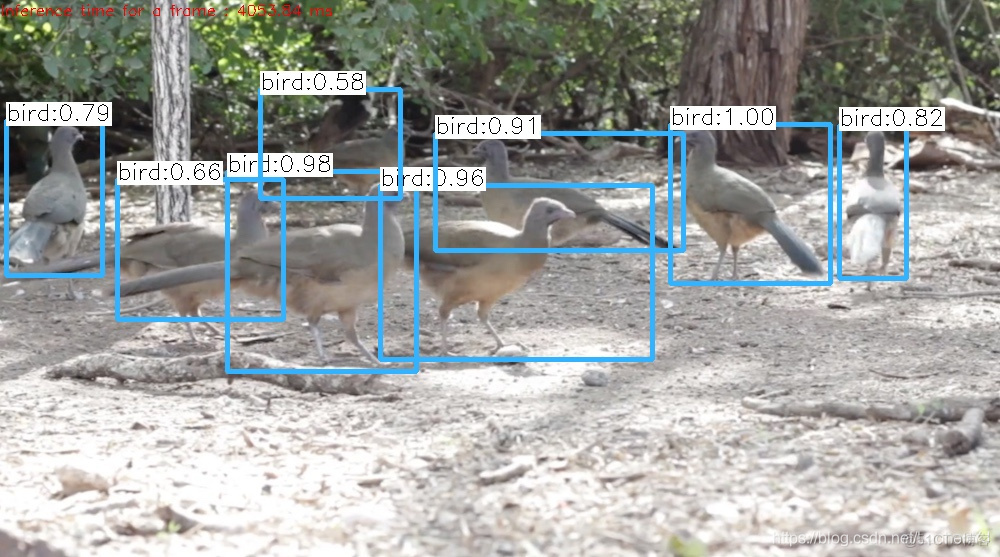
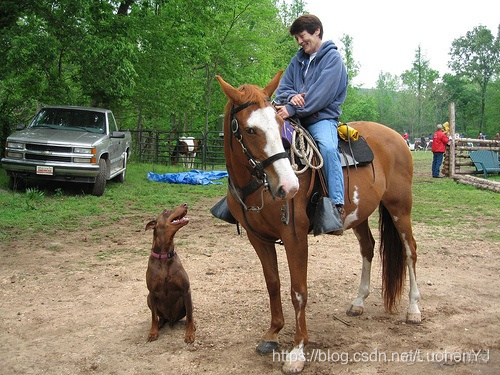
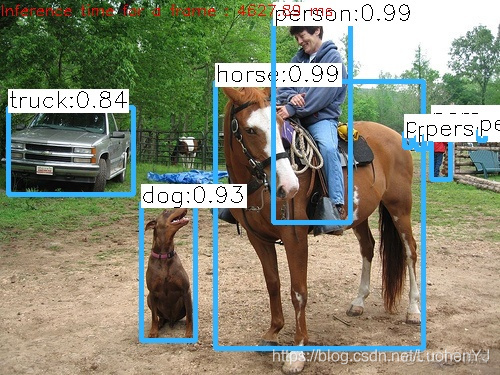 yolov3很强大,上面是在debug模型跑的。但是yolov3参数还是要学会调整。
#include "pch.h"
#include <fstream>
#include <sstream>
#include <iostream>
#include <time.h>
#include <opencv2/dnn.hpp>
#include <opencv2/imgproc.hpp>
#include <opencv2/highgui.hpp>

;
using namespace cv;
using namespace dnn;
using namespace std;

// Initialize the parameters 初始参数
 // Confidence threshold 置信度阈值
float confThreshold = 0.5;
// Non-maximum suppression threshold 非极大性抑制阈值
float nmsThreshold = 0.4;
//检测图像宽高
int inpWidth = 416;
int inpHeight = 416;
//类别参数
vector<string> classes;

// Remove the bounding boxes with low confidence using non-maxima suppression
// 基于非极大性抑制去除低置信度的检测框
void postprocess(Mat& frame, const vector<Mat>& out);

// 画预测框
void drawPred(int classId, float conf, int left, int top, int right, int bottom, Mat& frame);

// 提取输出输出层
vector<String> getOutputsNames(const Net& net);

int main()
{
    // Give the configuration and weight files for the model 模型参数文件
    String modelConfiguration = "./model/yolov3.cfg";
    String modelWeights = "./model/yolov3.weights";
    // Load names of classes 读取分类类名
    string classesFile = "./model/coco.names";
    ifstream ifs(classesFile.c_str());
    string line;
    while (getline(ifs, line))
    {
        classes.push_back(line);
    }

    // Load the network 导入网络
    Net net = readNetFromDarknet(modelConfiguration, modelWeights);
    net.setPreferableBackend(DNN_BACKEND_OPENCV);
    //仅仅使用CPU
    net.setPreferableTarget(DNN_TARGET_CPU);

    // Open a video file or an image file or a camera stream.
    string str, outputFile;
    Mat blob;
    clock_t start, finish;
    //读图
    Mat frame = imread("test.jpg");
    //根据需求决定是不是重置图像
    //resize(frame, frame, Size(300, 300));

    start = clock();
    // Create a 4D blob from a frame. 创建神经网络输入图像
    blobFromImage(frame, blob, 1 / 255.0, cvSize(inpWidth, inpHeight), Scalar(0, 0, 0), true, false);

    //Sets the input to the network 设置输出
    net.setInput(blob);

    // Runs the forward pass to get output of the output layers 获取输出层结果
    vector<Mat> outs;
    net.forward(outs, getOutputsNames(net));

    // Remove the bounding boxes with low confidence
    postprocess(frame, outs);
    finish = clock();

    cout << "time is " << double(finish - start) / CLOCKS_PER_SEC << endl;
    // Put efficiency information. The function getPerfProfile returns the overall time for inference(t) and the timings for each of the layers(in layersTimes)
    //输出前向传播的时间
    vector<double> layersTimes;
    double freq = getTickFrequency() / 1000;
    double t = net.getPerfProfile(layersTimes) / freq;
    string label = format("Inference time for a frame : %.2f ms", t);
    putText(frame, label, Point(0, 15), FONT_HERSHEY_SIMPLEX, 0.5, Scalar(0, 0, 255));

    imshow("result", frame);
    //保存图像
    imwrite("result.jpg", frame);
    waitKey(0);

    return 0;
}

/**
 * @brief Remove the bounding boxes with low confidence using non-maxima suppression 基于非极大性抑制去除边框
 *
 * @param frame 视频图像
 * @param outs 输出层结果
 */
void postprocess(Mat& frame, const vector<Mat>& outs)
{
    //输出类
    vector<int> classIds;
    //置信度
    vector<float> confidences;
    vector<Rect> boxes;

    //遍历所有的输出层
    for (size_t i = 0; i < outs.size(); ++i)
    {
        // Scan through all the bounding boxes output from the network and keep only the
        // ones with high confidence scores. Assign the box's class label as the class
        // with the highest score for the box.
        //扫描所有来自网络的边界框输出,只保留具有高置信度分数的边界框。将框的类标签指定为框得分最高的类。
        //读取框
        float* data = (float*)outs[i].data;
        for (int j = 0; j < outs[i].rows; ++j, data += outs[i].cols)
        {
            Mat scores = outs[i].row(j).colRange(5, outs[i].cols);
            Point classIdPoint;
            double confidence;
            // Get the value and location of the maximum score 获取置信度和位置参数
            minMaxLoc(scores, 0, &confidence, 0, &classIdPoint);
            //如果大于置信度阈值
            if (confidence > confThreshold)
            {
                //获取坐标
                int centerX = (int)(data[0] * frame.cols);
                int centerY = (int)(data[1] * frame.rows);
                int width = (int)(data[2] * frame.cols);
                int height = (int)(data[3] * frame.rows);
                int left = centerX - width / 2;
                int top = centerY - height / 2;

                classIds.push_back(classIdPoint.x);
                confidences.push_back((float)confidence);
                boxes.push_back(Rect(left, top, width, height));
            }
        }
    }

    // Perform non maximum suppression to eliminate redundant overlapping boxes with
    // lower confidences
    //输出非极大性抑制结果,按置信度从大到小输出
    vector<int> indices;
    //非极大性抑制
    NMSBoxes(boxes, confidences, confThreshold, nmsThreshold, indices);
    //绘图
    for (size_t i = 0; i < indices.size(); ++i)
    {
        int idx = indices[i];
        Rect box = boxes[idx];
        //类,置信度
        drawPred(classIds[idx], confidences[idx], box.x, box.y,
            box.x + box.width, box.y + box.height, frame);
    }
}

/**
 * @brief Draw the predicted bounding box 画框
 *
 * @param classId 类别
 * @param conf 置信度
 * @param left
 * @param top
 * @param right
 * @param bottom
 * @param frame
 */
void drawPred(int classId, float conf, int left, int top, int right, int bottom, Mat& frame)
{
    //Draw a rectangle displaying the bounding box
    rectangle(frame, Point(left, top), Point(right, bottom), Scalar(255, 178, 50), 3);

    //Get the label for the class name and its confidence
    string label = format("%.2f", conf);
    if (!classes.empty())
    {
        CV_Assert(classId < (int)classes.size());
        label = classes[classId] + ":" + label;
    }

    //Display the label at the top of the bounding box 在每个框左上角标上标签
    int baseLine;
    Size labelSize = getTextSize(label, FONT_HERSHEY_SIMPLEX, 0.5, 1, &baseLine);
    top = max(top, labelSize.height);
    rectangle(frame, Point(left, top - round(1.5*labelSize.height)), Point(left + round(1.5*labelSize.width), top + baseLine), Scalar(255, 255, 255), FILLED);
    putText(frame, label, Point(left, top), FONT_HERSHEY_SIMPLEX, 0.75, Scalar(0, 0, 0), 1);
}

// Get the names of the output layers 获取输出层
/**
 * @brief Get the Outputs Names object
 *
 * @param net
 * @return vector<String>
 */
vector<String> getOutputsNames(const Net& net)
{
    //输出
    static vector<String> names;
    if (names.empty())
    {
        //Get the indices of the output layers, i.e. the layers with unconnected outputs
        vector<int> outLayers = net.getUnconnectedOutLayers();

        //get the names of all the layers in the network
        vector<String> layersNames = net.getLayerNames();

        // Get the names of the output layers in names
        names.resize(outLayers.size());
        for (size_t i = 0; i < outLayers.size(); ++i)
        {
            names[i] = layersNames[outLayers[i] - 1];
        }
    }
    return names;
}
# This code is written at BigVision LLC. It is based on the OpenCV project. It is subject to the license terms in the LICENSE file found in this distribution and at http://opencv.org/license.html

# Usage example:  python3 object_detection_yolo.py --video=run.mp4
#                 python3 object_detection_yolo.py --image=bird.jpg

import cv2 as cv
import argparse
import sys
import numpy as np
import os.path

# Initialize the parameters
confThreshold = 0.5  #Confidence threshold
nmsThreshold = 0.4   #Non-maximum suppression threshold
inpWidth = 416       #Width of network's input image
inpHeight = 416      #Height of network's input image

parser = argparse.ArgumentParser(description='Object Detection using YOLO in OPENCV')
parser.add_argument('--image', help='Path to image file.')
parser.add_argument('--video', help='Path to video file.')
args = parser.parse_args()

# Load names of classes
classesFile = "coco.names";
classes = None
with open(classesFile, 'rt') as f:
    classes = f.read().rstrip('\n').split('\n')

# Give the configuration and weight files for the model and load the network using them.
modelConfiguration = "yolov3.cfg";
modelWeights = "yolov3.weights";

net = cv.dnn.readNetFromDarknet(modelConfiguration, modelWeights)
net.setPreferableBackend(cv.dnn.DNN_BACKEND_OPENCV)
net.setPreferableTarget(cv.dnn.DNN_TARGET_CPU)

# Get the names of the output layers
def getOutputsNames(net):
    # Get the names of all the layers in the network
    layersNames = net.getLayerNames()
    # Get the names of the output layers, i.e. the layers with unconnected outputs
    return [layersNames[i[0] - 1] for i in net.getUnconnectedOutLayers()]

# Draw the predicted bounding box
def drawPred(classId, conf, left, top, right, bottom):
    # Draw a bounding box.
    cv.rectangle(frame, (left, top), (right, bottom), (255, 178, 50), 3)

    label = '%.2f' % conf

    # Get the label for the class name and its confidence
    if classes:
        assert(classId < len(classes))
        label = '%s:%s' % (classes[classId], label)

    #Display the label at the top of the bounding box
    labelSize, baseLine = cv.getTextSize(label, cv.FONT_HERSHEY_SIMPLEX, 0.5, 1)
    top = max(top, labelSize[1])
    cv.rectangle(frame, (left, top - round(1.5*labelSize[1])), (left + round(1.5*labelSize[0]), top + baseLine), (255, 255, 255), cv.FILLED)
    cv.putText(frame, label, (left, top), cv.FONT_HERSHEY_SIMPLEX, 0.75, (0,0,0), 1)

# Remove the bounding boxes with low confidence using non-maxima suppression
def postprocess(frame, outs):
    frameHeight = frame.shape[0]
    frameWidth = frame.shape[1]

    # Scan through all the bounding boxes output from the network and keep only the
    # ones with high confidence scores. Assign the box's class label as the class with the highest score.
    classIds = []
    confidences = []
    boxes = []
    for out in outs:
        for detection in out:
            scores = detection[5:]
            classId = np.argmax(scores)
            confidence = scores[classId]
            if confidence > confThreshold:
                center_x = int(detection[0] * frameWidth)
                center_y = int(detection[1] * frameHeight)
                width = int(detection[2] * frameWidth)
                height = int(detection[3] * frameHeight)
                left = int(center_x - width / 2)
                top = int(center_y - height / 2)
                classIds.append(classId)
                confidences.append(float(confidence))
                boxes.append([left, top, width, height])

    # Perform non maximum suppression to eliminate redundant overlapping boxes with
    # lower confidences.
    indices = cv.dnn.NMSBoxes(boxes, confidences, confThreshold, nmsThreshold)
    for i in indices:
        i = i[0]
        box = boxes[i]
        left = box[0]
        top = box[1]
        width = box[2]
        height = box[3]
        drawPred(classIds[i], confidences[i], left, top, left + width, top + height)

# Process inputs
winName = 'Deep learning object detection in OpenCV'
cv.namedWindow(winName, cv.WINDOW_NORMAL)

outputFile = "yolo_out_py.avi"
if (args.image):
    # Open the image file
    if not os.path.isfile(args.image):
        print("Input image file ", args.image, " doesn't exist")
        sys.exit(1)
    cap = cv.VideoCapture(args.image)
    outputFile = args.image[:-4]+'_yolo_out_py.jpg'
elif (args.video):
    # Open the video file
    if not os.path.isfile(args.video):
        print("Input video file ", args.video, " doesn't exist")
        sys.exit(1)
    cap = cv.VideoCapture(args.video)
    outputFile = args.video[:-4]+'_yolo_out_py.avi'
else:
    # Webcam input
    cap = cv.VideoCapture(0)

# Get the video writer initialized to save the output video
if (not args.image):
    vid_writer = cv.VideoWriter(outputFile, cv.VideoWriter_fourcc('M','J','P','G'), 30, (round(cap.get(cv.CAP_PROP_FRAME_WIDTH)),round(cap.get(cv.CAP_PROP_FRAME_HEIGHT))))

while cv.waitKey(1) < 0:

    # get frame from the video
    hasFrame, frame = cap.read()

    # Stop the program if reached end of video
    if not hasFrame:
        print("Done processing !!!")
        print("Output file is stored as ", outputFile)
        cv.waitKey(3000)
        # Release device
        cap.release()
        break

    # Create a 4D blob from a frame.
    blob = cv.dnn.blobFromImage(frame, 1/255, (inpWidth, inpHeight), [0,0,0], 1, crop=False)

    # Sets the input to the network
    net.setInput(blob)

    # Runs the forward pass to get output of the output layers
    outs = net.forward(getOutputsNames(net))

    # Remove the bounding boxes with low confidence
    postprocess(frame, outs)

    # Put efficiency information. The function getPerfProfile returns the overall time for inference(t) and the timings for each of the layers(in layersTimes)
    t, _ = net.getPerfProfile()
    label = 'Inference time: %.2f ms' % (t * 1000.0 / cv.getTickFrequency())
    cv.putText(frame, label, (0, 15), cv.FONT_HERSHEY_SIMPLEX, 0.5, (0, 0, 255))

    # Write the frame with the detection boxes
    if (args.image):
        cv.imwrite(outputFile, frame.astype(np.uint8));
    else:
        vid_writer.write(frame.astype(np.uint8))

    cv.imshow(winName, frame)
我正在学习如何使用Nokogiri,根据这段代码我遇到了一些问题:require'rubygems'require'mechanize'post_agent=WWW::Mechanize.newpost_page=post_agent.get('http://www.vbulletin.org/forum/showthread.php?t=230708')puts"\nabsolutepathwithtbodygivesnil"putspost_page.parser.xpath('/html/body/div/div/div/div/div/table/tbody/tr/td/div
我有一个Ruby程序,它使用rubyzip压缩XML文件的目录树。gem。我的问题是文件开始变得很重,我想提高压缩级别,因为压缩时间不是问题。我在rubyzipdocumentation中找不到一种为创建的ZIP文件指定压缩级别的方法。有人知道如何更改此设置吗?是否有另一个允许指定压缩级别的Ruby库? 最佳答案 这是我通过查看rubyzip内部创建的代码。level=Zlib::BEST_COMPRESSIONZip::ZipOutputStream.open(zip_file)do|zip|Dir.glob("**/*")d
类classAprivatedeffooputs:fooendpublicdefbarputs:barendprivatedefzimputs:zimendprotecteddefdibputs:dibendendA的实例a=A.new测试a.foorescueputs:faila.barrescueputs:faila.zimrescueputs:faila.dibrescueputs:faila.gazrescueputs:fail测试输出failbarfailfailfail.发送测试[:foo,:bar,:zim,:dib,:gaz].each{|m|a.send(m)resc
很好奇,就使用rubyonrails自动化单元测试而言,你们正在做什么?您是否创建了一个脚本来在cron中运行rake作业并将结果邮寄给您?git中的预提交Hook?只是手动调用?我完全理解测试,但想知道在错误发生之前捕获错误的最佳实践是什么。让我们理所当然地认为测试本身是完美无缺的,并且可以正常工作。下一步是什么以确保他们在正确的时间将可能有害的结果传达给您? 最佳答案 不确定您到底想听什么,但是有几个级别的自动代码库控制:在处理某项功能时,您可以使用类似autotest的内容获得关于哪些有效,哪些无效的即时反馈。要确保您的提
假设我做了一个模块如下:m=Module.newdoclassCendend三个问题:除了对m的引用之外,还有什么方法可以访问C和m中的其他内容?我可以在创建匿名模块后为其命名吗(就像我输入“module...”一样)?如何在使用完匿名模块后将其删除,使其定义的常量不再存在? 最佳答案 三个答案:是的,使用ObjectSpace.此代码使c引用你的类(class)C不引用m:c=nilObjectSpace.each_object{|obj|c=objif(Class===objandobj.name=~/::C$/)}当然这取决于
我正在尝试使用ruby和Savon来使用网络服务。测试服务为http://www.webservicex.net/WS/WSDetails.aspx?WSID=9&CATID=2require'rubygems'require'savon'client=Savon::Client.new"http://www.webservicex.net/stockquote.asmx?WSDL"client.get_quotedo|soap|soap.body={:symbol=>"AAPL"}end返回SOAP异常。检查soap信封,在我看来soap请求没有正确的命名空间。任何人都可以建议我
关闭。这个问题是opinion-based.它目前不接受答案。想要改进这个问题?更新问题,以便editingthispost可以用事实和引用来回答它.关闭4年前。Improvethisquestion我想在固定时间创建一系列低音和高音调的哔哔声。例如:在150毫秒时发出高音调的蜂鸣声在151毫秒时发出低音调的蜂鸣声200毫秒时发出低音调的蜂鸣声250毫秒的高音调蜂鸣声有没有办法在Ruby或Python中做到这一点?我真的不在乎输出编码是什么(.wav、.mp3、.ogg等等),但我确实想创建一个输出文件。
在控制台中反复尝试之后,我想到了这种方法,可以按发生日期对类似activerecord的(Mongoid)对象进行分组。我不确定这是完成此任务的最佳方法,但它确实有效。有没有人有更好的建议,或者这是一个很好的方法?#eventsisanarrayofactiverecord-likeobjectsthatincludeatimeattributeevents.map{|event|#converteventsarrayintoanarrayofhasheswiththedayofthemonthandtheevent{:number=>event.time.day,:event=>ev
我在我的项目目录中完成了compasscreate.和compassinitrails。几个问题:我已将我的.sass文件放在public/stylesheets中。这是放置它们的正确位置吗?当我运行compasswatch时,它不会自动编译这些.sass文件。我必须手动指定文件:compasswatchpublic/stylesheets/myfile.sass等。如何让它自动运行?文件ie.css、print.css和screen.css已放在stylesheets/compiled。如何在编译后不让它们重新出现的情况下删除它们?我自己编译的.sass文件编译成compiled/t
我想将html转换为纯文本。不过,我不想只删除标签,我想智能地保留尽可能多的格式。为插入换行符标签,检测段落并格式化它们等。输入非常简单,通常是格式良好的html(不是整个文档,只是一堆内容,通常没有anchor或图像)。我可以将几个正则表达式放在一起,让我达到80%,但我认为可能有一些现有的解决方案更智能。 最佳答案 首先,不要尝试为此使用正则表达式。很有可能你会想出一个脆弱/脆弱的解决方案,它会随着HTML的变化而崩溃,或者很难管理和维护。您可以使用Nokogiri快速解析HTML并提取文本:require'nokogiri'h
