关于lua中封装的类模板以及相关知识可参考以下链接:
https://ufgnix0802.blog.csdn.net/article/details/128854786
该案例的主要目的是使用矩阵的加减乘除这个功能来练习C++与Lua之间的交互(针对性地说就是熟练使用C++与Lua之间的交互API以及深刻理解lua堆栈的原理)。
在这个过程中,CppToLua表示矩阵的数据来源于C++端,然后让Lua使用Lua的矩阵运算逻辑进行计算并返回结果给C++端。C++端使用自己定义的C++矩阵类进行本地矩阵运算,然后与lua端返回的矩阵运算结果进行比对展示。
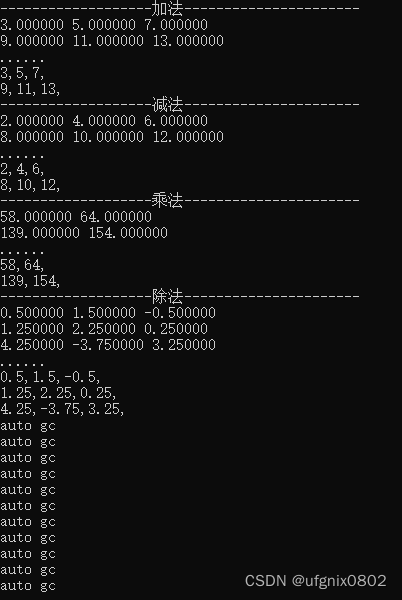
LuaToCpp同理,与CppToLua相反。表示矩阵的数据来源于lua端,然后调用C++端暴露给Lua端的API创建C++矩阵类实例,并进行矩阵运算。lua端本地使用lua端的类构建矩阵table,并进行本地运算,然后使用运算结果与C++端API的运算结果进行比对展示。
该部分封装C++端Matrix类,下面两个调用方式都有进行实际应用。
#pragma once
#include <iostream>
#include <vector>

typedef std::vector<double> vec;
typedef std::vector<vec>    matrixData;

class Matrix {
public:
    Matrix()  { }
    ~Matrix() { }

    bool Init(const std::vector<std::vector<double>>& data) {
        m_data.assign(data.begin(), data.end());
        m_row = m_data.size();
        if (m_row > 0) {
            m_column = m_data[0].size();
        }
        else {
            m_column = 0;
        }
        return true;
    }

    bool UnInit() {
        m_row = 0;
        m_column = 0;
        m_data.clear();
        return true;
    }

    Matrix(const Matrix& matrix) {
        Init(matrix.m_data);
    }

    Matrix operator+(const Matrix& matrix) {
        Matrix res;
        if (this->m_row != matrix.m_row ||
            this->m_column != matrix.m_column) {
            return res;
        }

        std::vector<std::vector<double>> data(m_row,
            std::vector<double>(m_column, 0));
        for (int32_t i = 0; i < m_row; i++) {
            for (int32_t j = 0; j < m_column; j++) {
                data[i][j] = this->m_data[i][j] + matrix.m_data[i][j];
            }
        }
        res.Init(data);
        return res;
    }

    Matrix operator-(const Matrix& matrix) {
        Matrix res;
        if (this->m_row != matrix.m_row ||
            this->m_column != matrix.m_column) {
            return res;
        }

        std::vector<std::vector<double>> data(m_row,
            std::vector<double>(m_column, 0));
        for (int32_t i = 0; i < m_row; i++) {
            for (int32_t j = 0; j < m_column; j++) {
                data[i][j] = this->m_data[i][j] - matrix.m_data[i][j];
            }
        }
        res.Init(data);
        return res;
    }

    Matrix operator*(const Matrix& matrix) {
        Matrix res;
        if (this->m_column != matrix.m_row) {
            return res;
        }

        res.Init(_MatrixMul(matrix.m_data));
        return res;
    }

    Matrix operator/(const Matrix& matrix) {
        Matrix res;
        double nDetRet = _GetDetValue(matrix.m_data);
        if (0 == nDetRet) {
            return res;
        }

        matrixData data = _GetCompanyMatrix(matrix.m_data);
        _NumMul(data, 1 / nDetRet);
        res.Init(_MatrixMul(data));
        return res;
    }

    void Print() {
        for (int i = 0; i < m_row; i++) {
            for (int j = 0; j < m_column; j++)
                printf("%lf ", m_data[i][j]);
            std::cout << '\n';
        }
        std::cout << "......\n";
    }
private:
    matrixData _MatrixMul(const matrixData& destMatrixData) {
        std::vector<std::vector<double>> data(this->m_row,
            std::vector<double>(destMatrixData[0].size(), 0));
        for (int32_t i = 0; i < this->m_row; i++) {
            for (int32_t j = 0; j < destMatrixData[0].size(); j++) {
                for (int32_t k = 0; k < this->m_column; k++) {
                    data[i][j] += (m_data[i][k] * destMatrixData[k][j]);
                }
            }
        }
        return data;
    }

    matrixData _CutoffMatrix(const matrixData& data,
        int32_t rowIndex, int32_t colIndex) {
        int32_t row = data.size() - 1;
        int32_t col = data[0].size() - 1;
        matrixData res(row, vec(col, 0));
        for (int32_t i = 0; i < row; i++) {
            for (int32_t j = 0; j < col; j++) {
                res[i][j] =
                    data[i + (i >= rowIndex)][j + (j >= colIndex)];
            }
        }
        return res;
    }

    double _GetDetValue(const matrixData& data) {
        if (1 == data.size()) {
            return data[0][0];
        }

        double ans = 0;
        for (int32_t i = 0; i < data[0].size(); i++) {
            ans += data[0][i] * _GetDetValue(_CutoffMatrix(data, 0, i))
                * (i % 2 ? -1 : 1);
        }
        return ans;
    }

    matrixData _GetCompanyMatrix(const matrixData& data) {
        int32_t row = data.size();
        int32_t col = data[0].size();
        matrixData res(col, vec(row));

        for (int32_t i = 0; i < row; i++) {
            for (int32_t j = 0; j < col; j++) {
                res[j][i] = _GetDetValue(_CutoffMatrix(data, i, j))
                    * ((i + j) % 2 ? -1 : 1);
            }
        }
        return res;
    }

    bool _NumMul(matrixData& putOutData, double num) {
        for (int i = 0; i < putOutData.size(); i++)
            for (int j = 0; j < putOutData[0].size(); j++)
                putOutData[i][j] = putOutData[i][j] * num;
        return true;
    }

private:
    int32_t m_row;
    int32_t m_column;
    std::vector<std::vector<double>> m_data;
};
#include <iostream>
#include <vector>
#include "lua.hpp"
#include "Matrix.hpp"

// 在Lua中创建Matrix对象
bool CreateLuaMatrixObj(lua_State* const L,
    const std::vector<std::vector<double>>& data, const char* name) {
    bool result = false;
    int  top;

    /*top = lua_gettop(L);
    std::cout << "stack top:" << top << std::endl;*/

    if (LUA_TFUNCTION != lua_getfield(L, -1, "New")) {
        goto Exit;
    }

    //创建表
    lua_newtable(L);
    for (int32_t i = 0; i < data.size(); i++) {
        lua_newtable(L);
        for (int32_t j = 0; j < data[0].size(); j++) {
            lua_pushnumber(L, data[i][j]);
            lua_rawseti(L, -2, j + 1);
        }
        lua_rawseti(L, -2, i + 1);
    }

    //调用New方法
    if (lua_pcall(L, 1, 1, 0)) {
        printf("error[%s]\n", lua_tostring(L, -1));
        goto Exit;
    }

    if (LUA_TTABLE != lua_type(L, -1)) {
        goto Exit;
    }

    //需要使用一个全局变量保存起来
    lua_setglobal(L, name);

    /*top = lua_gettop(L);
    std::cout << "stack top:" << top << std::endl;*/
    result = true;
Exit:
    return result;
}

// 矩阵运算
enum class MATRIX_OPERATE {
    ADD,
    SUB,
    MUL,
    DIV,
    NONE
};

// 使用Lua中的两个Matrix对象相加,并获取相加结果
bool MatrixOperate(lua_State* const L,
    const char* matrix1Name, const char* matrix2Name,
    std::vector<std::vector<double>>& outRes, MATRIX_OPERATE type) {
    bool result = false;
    int  top;

    int32_t row = 0;
    int32_t col = 0;

    const char* operate = NULL;
    switch (type) {
    case MATRIX_OPERATE::ADD:
        operate = "Add";
        break;
    case MATRIX_OPERATE::SUB:
        operate = "Sub";
        break;
    case MATRIX_OPERATE::MUL:
        operate = "Mul";
        break;
    case MATRIX_OPERATE::DIV:
        operate = "Div";
        break;
    case MATRIX_OPERATE::NONE:
        break;
    default:
        break;
    }

    lua_getglobal(L, matrix1Name);
    if (LUA_TFUNCTION != lua_getfield(L, -1, operate)) {
        goto Exit;
    }

    //top = 3
    /*top = lua_gettop(L);
    std::cout << "--- stack top:" << top << std::endl;*/

    lua_getglobal(L, matrix1Name);
    lua_getglobal(L, matrix2Name);

    //top = 5
    /*top = lua_gettop(L);
    std::cout << "stack top:" << top << std::endl;*/

    //调用矩阵运算方法
    if (lua_pcall(L, 2, 1, 0)) {
        printf("error[%s]\n", lua_tostring(L, -1));
        goto Exit;
    }

    //top = 3
    /*top = lua_gettop(L);
    std::cout << "222 stack top:" << top << std::endl;*/
    luaL_checktype(L, -1, LUA_TTABLE);

    if (LUA_TTABLE != lua_getfield(L, -1, "tbData")) {
        goto Exit;
    }

    //top = 4
    luaL_checktype(L, -1, LUA_TTABLE);
    /*top = lua_gettop(L);
    std::cout << "stack top:" << top << std::endl;*/

    lua_getfield(L, -2, "nRow");
    /*top = lua_gettop(L);
    std::cout << "stack top:" << top << std::endl;*/
    row = lua_tointeger(L, -1);
    lua_pop(L, 1);
    lua_getfield(L, -2, "nColumn");
    /*top = lua_gettop(L);
    std::cout << "stack top:" << top << std::endl;*/
    col = lua_tointeger(L, -1);
    lua_pop(L, 1);

    //top = 4
    /*top = lua_gettop(L);
    std::cout << "stack top:" << top << std::endl;*/

    for (int32_t i = 0; i < row; i++) {
        lua_rawgeti(L, -1, i + 1);
        std::vector<double> data;
        for (int32_t j = 0; j < col; j++) {
            lua_rawgeti(L, -1, j + 1);
            data.push_back(lua_tonumber(L, -1));
            lua_pop(L, 1);
        }
        outRes.push_back(data);
        lua_pop(L, 1);
    }

    // lua堆栈平衡
    lua_pop(L, 3);
    // top = 1
    /*top = lua_gettop(L);
    std::cout << "stack top:" << top << std::endl;*/
    result = true;
Exit:
    return result;
}

int main() {
    lua_State* L = luaL_newstate();

    luaL_openlibs(L);

    std::vector<std::vector<double>> luaMat1 = { { 1,2,3 }, { 4,5,6 } };
    std::vector<std::vector<double>> luaMat2 = { { 2,3,4 }, { 5,6,7 } };

    std::vector<std::vector<double>> luaMat3 = { {1,2,3},{4,5,6} };
    std::vector<std::vector<double>> luaMat4 = { {7,8},{9,10},{11,12} };

    std::vector<std::vector<double>> luaMat5 = { {1,2,3},{4,5,6},{7,8,0} };
    std::vector<std::vector<double>> luaMat6 = { {1,2,1},{1,1,2},{2,1,1} };

    if (luaL_dofile(L, "matrix2.0.lua")) {
        printf("%s\n", lua_tostring(L, -1));
    }

    lua_getglobal(L, "Matrix");
    luaL_checktype(L, -1, LUA_TTABLE);

    //C++ -》 lua 及 lua -》 C++
    CreateLuaMatrixObj(L, luaMat1, "mat1");
    CreateLuaMatrixObj(L, luaMat2, "mat2");

    std::cout <<
        "----------------------------加法运算结果:----------------------------"
        << std::endl;
    std::vector<std::vector<double>> addRes;
    MatrixOperate(L, "mat1", "mat2", addRes, MATRIX_OPERATE::ADD);
    Matrix mat1;
    mat1.Init(luaMat1);
    Matrix mat2;
    mat2.Init(luaMat2);
    Matrix mat3;
    mat3 = mat1 + mat2;
    std::cout << "lua运算结果:" << std::endl;
    for (int i = 0; i < addRes.size(); i++) {
        for (int j = 0; j < addRes[0].size(); j++)
            printf("%lf ", addRes[i][j]);
        std::cout << '\n';
    }
    std::cout << "......\n";

    std::cout << "C++运算结果:" << std::endl;
    mat3.Print();

    std::cout <<
        "----------------------------减法运算结果:----------------------------"
        << std::endl;
    std::vector<std::vector<double>> subRes;
    MatrixOperate(L, "mat1", "mat2", subRes, MATRIX_OPERATE::SUB);
    Matrix mat4;
    mat4 = mat1 - mat2;
    std::cout << "lua运算结果:" << std::endl;
    for (int i = 0; i < subRes.size(); i++) {
        for (int j = 0; j < subRes[0].size(); j++)
            printf("%lf ", subRes[i][j]);
        std::cout << '\n';
    }
    std::cout << "......\n";
    std::cout << "C++运算结果:" << std::endl;
    mat4.Print();

    std::cout <<
        "----------------------------乘法运算结果:----------------------------"
        << std::endl;
    CreateLuaMatrixObj(L, luaMat3, "mat3");
    CreateLuaMatrixObj(L, luaMat4, "mat4");
    std::vector<std::vector<double>> mulRes;
    MatrixOperate(L, "mat3", "mat4", mulRes, MATRIX_OPERATE::MUL);
    Matrix mat5;
    mat5.Init(luaMat3);
    Matrix mat6;
    mat6.Init(luaMat4);
    Matrix mat7;
    mat7 = mat5 * mat6;
    std::cout << "lua运算结果:" << std::endl;
    for (int i = 0; i < mulRes.size(); i++) {
        for (int j = 0; j < mulRes[0].size(); j++)
            printf("%lf ", mulRes[i][j]);
        std::cout << '\n';
    }
    std::cout << "......\n";
    std::cout << "C++运算结果:" << std::endl;
    mat7.Print();

    std::cout <<
        "----------------------------除法运算结果:----------------------------"
        << std::endl;
    CreateLuaMatrixObj(L, luaMat5, "mat5");
    CreateLuaMatrixObj(L, luaMat6, "mat6");
    std::vector<std::vector<double>> divRes;
    if (!MatrixOperate(L, "mat5", "mat6", divRes, MATRIX_OPERATE::DIV)) {
        std::cout << "无法进行矩阵的除法" << std::endl;
    }
    Matrix mat8;
    mat8.Init(luaMat5);
    Matrix mat9;
    mat9.Init(luaMat6);
    mat9 = mat8 / mat9;
    std::cout << "lua运算结果:" << std::endl;
    for (int i = 0; i < divRes.size(); i++) {
        for (int j = 0; j < divRes[0].size(); j++)
            printf("%lf ", divRes[i][j]);
        std::cout << '\n';
    }
    std::cout << "......\n";
    std::cout << "C++运算结果:" << std::endl;
    mat9.Print();

    lua_close(L);
    system("pause");
	return 0;
}
local _class = {}

function class(super)
    local tbClassType = {}
    tbClassType.Ctor  = false
    tbClassType.super = super
    tbClassType.New   = function(...)
        local tbObj   = {}
        do
            local funcCreate
            funcCreate = function(tbClass,...)
                if tbClass.super then
                    funcCreate(tbClass.super,...)
                end

                if tbClass.Ctor then
                    tbClass.Ctor(tbObj,...)
                end
            end
            funcCreate(tbClassType,...)
        end
        -- 防止调用Ctor初始化时,在Ctor内部设置了元表的情况发生
        if getmetatable(tbObj) then
            getmetatable(tbObj).__index = _class[tbClassType]
        else
            setmetatable(tbObj, { __index = _class[tbClassType] })
        end
        return tbObj
    end

    local vtbl          = {}
    _class[tbClassType] = vtbl

    setmetatable(tbClassType, { __newindex =
        function(tb,k,v)
            vtbl[k] = v
        end
    })

    if super then
        setmetatable(vtbl, { __index =
            function(tb,k)
                local varRet = _class[super][k]
                vtbl[k]      = varRet
                return varRet
            end
        })
    end
    return tbClassType
end


Matrix = class()

function Matrix:Ctor(data)
    self.tbData = data
    self.nRow   = #data
    if self.nRow > 0 then
        self.nColumn = (#data[1])
    else
        self.nColumn = 0
    end
    -- print("row:",self.nRow," col:",self.nColumn)

    setmetatable(self,{
        __add = function(tbSource, tbDest)
            assert(tbSource,"tbSource not exist")
            assert(tbDest,  "tbDest not exist")
            local tbRes = Matrix.New({})
            -- print(tbSource,tbDest)
            -- print("tbSource:",tbSource.nRow,tbSource.nColumn)
            -- tbSource:Print()
            -- print("tbDest:",tbDest.nRow,tbDest.nColumn)
            -- tbDest:Print()
            if tbSource.nRow ~= tbDest.nRow
                or tbSource.nColumn ~= tbDest.nColumn then
                print("row or column not equal...")
                return tbRes
            else
                for rowKey,rowValue in ipairs(tbSource.tbData) do
                    for colKey,colValue in ipairs(tbSource.tbData[rowKey]) do
                        if tbRes.tbData[rowKey] == nil then
                            tbRes.tbData[rowKey] = {}
                        end

                        if tbRes.tbData[rowKey][colKey] == nil then
                            tbRes.tbData[rowKey][colKey] = 0
                        end

                        tbRes.tbData[rowKey][colKey] =
                            tbSource.tbData[rowKey][colKey] + tbDest.tbData[rowKey][colKey]
                    end
                end
                tbRes.nRow    = tbSource.nRow
                tbRes.nColumn = tbSource.nColumn
                return tbRes
            end
        end,

        __sub = function(tbSource, tbDest)
            assert(tbSource,"tbSource not exist")
            assert(tbDest,  "tbDest not exist")
            local tbRes = Matrix.New({})
            if tbSource.nRow ~= tbDest.nRow
                or tbSource.nColumn ~= tbDest.nColumn then
                print("row or column not equal...")
                return tbRes
            else
                for rowKey,rowValue in ipairs(tbSource.tbData) do
                    for colKey,colValue in ipairs(tbSource.tbData[rowKey]) do
                        if tbRes.tbData[rowKey] == nil then
                            tbRes.tbData[rowKey] = {}
                        end

                        if tbRes.tbData[rowKey][colKey] == nil then
                            tbRes.tbData[rowKey][colKey] = 0
                        end

                        tbRes.tbData[rowKey][colKey] =
                            tbSource.tbData[rowKey][colKey] - tbDest.tbData[rowKey][colKey]
                    end
                end
                tbRes.nRow    = tbSource.nRow
                tbRes.nColumn = tbSource.nColumn
                return tbRes
            end
        end,

        __mul = function(tbSource, tbDest)
            return self:_MartixMul(tbSource, tbDest)
        end,

        __div = function(tbSource, tbDest)
            assert(tbSource,"tbSource not exist")
            assert(tbDest,  "tbDest not exist")

            local nDet = self:_GetDetValue(tbDest)
            if nDet == 0 then
                print("matrix no inverse matrix...")
                return nil
            end
            -- print("det ",nDet)
            local tbInverseDest = self:_MatrixNumMul(self:_GetCompanyMatrix(tbDest), 1 / nDet)
            -- self:_GetCompanyMatrix(tbDest):Print()
            -- print(nDet)
            tbInverseDest:Print()
            return self:_MartixMul(tbSource, tbInverseDest)
        end
    }
)


end

function Matrix:Print()
    for rowKey,rowValue in ipairs(self.tbData) do
        for colKey,colValue in ipairs(self.tbData[rowKey]) do
            io.write(self.tbData[rowKey][colKey],',')
        end
        print('')
    end
end

-- 加
function Matrix:Add(matrix)
    return self + matrix
end

-- 减
function Matrix:Sub(matrix)
    return self - matrix
end

-- 乘
function Matrix:Mul(matrix)
    return self * matrix
end

-- 除
function Matrix:Div(matrix)
    return self / matrix
end


-- 切割,切去第rowIndex以及第colIndex列
function Matrix:_CutoffMatrix(tbMatrix, rowIndex, colIndex)
    assert(tbMatrix,"tbMatrix not exist")
    assert(rowIndex >= 1,"rowIndex < 1")
    assert(colIndex >= 1,"colIndex < 1")
    local tbRes   = Matrix.New({})
    tbRes.nRow    = tbMatrix.nRow    - 1
    tbRes.nColumn = tbMatrix.nColumn - 1
    for i = 1, tbMatrix.nRow - 1 do
        for j = 1, tbMatrix.nColumn - 1 do
            if tbRes.tbData[i] == nil then
                tbRes.tbData[i] = {}
            end

            local nRowDir = 0
            local nColDir = 0
            if i >= rowIndex then
                nRowDir = 1
            end

            if j >= colIndex then
                nColDir = 1
            end

            tbRes.tbData[i][j] = tbMatrix.tbData[i + nRowDir][j + nColDir]
        end
    end
    return tbRes
end

-- 获取矩阵的行列式对应的值
function Matrix:_GetDetValue(tbMatrix)
    assert(tbMatrix,"tbMatrix not exist")
    -- 当矩阵为一阶矩阵时,直接返回A中唯一的元素
    if tbMatrix.nRow == 1 then
        return tbMatrix.tbData[1][1]
    end

    local nAns = 0
    for i = 1, tbMatrix.nColumn do
        local nFlag = -1
        if i % 2 ~= 0 then
            nFlag = 1
        end

        nAns =
            nAns + tbMatrix.tbData[1][i] *
                self:_GetDetValue(self:_CutoffMatrix(tbMatrix, 1, i)) * nFlag
        -- print("_GetDetValue nflag:",nFlag)
    end
    return nAns
end


-- 获取矩阵的伴随矩阵
function Matrix:_GetCompanyMatrix(tbMatrix)
    assert(tbMatrix,"tbMatrix not exist")
    local tbRes   = Matrix.New({})
    -- 伴随矩阵与原矩阵存在转置关系
    tbRes.nRow    = tbMatrix.nColumn
    tbRes.nColumn = tbMatrix.nRow

    for i = 1, tbMatrix.nRow do
        for j = 1, tbMatrix.nColumn do
            local nFlag = 1
            if ((i + j) % 2) ~= 0 then
                nFlag = -1
            end

            if tbRes.tbData[j] == nil then
                tbRes.tbData[j] = {}
            end
            -- print(Matrix:_GetDetValue(Matrix:_CutoffMatrix(tbMatrix, i, j)))
            -- Matrix:_CutoffMatrix(tbMatrix, i, j):Print()
            -- print("---11----")

            tbRes.tbData[j][i] =
                self:_GetDetValue(self:_CutoffMatrix(tbMatrix, i, j)) * nFlag
        end
    end
    return tbRes
end


-- 矩阵数乘
function Matrix:_MatrixNumMul(tbMatrix, num)
    for i = 1, tbMatrix.nRow do
        for j = 1, tbMatrix.nColumn do
            tbMatrix.tbData[i][j] = tbMatrix.tbData[i][j] * num
        end
    end
    return tbMatrix
end


-- 矩阵相乘
function Matrix:_MartixMul(tbSource, tbDest)
    assert(tbSource,"tbSource not exist")
    assert(tbDest,  "tbDest not exist")
    if tbSource.nColumn ~= tbDest.nRow then
        print("column not equal row...")
        return tbSource
    else
        local tbRes = Matrix.New({})
        for i = 1, tbSource.nRow do
            for j = 1, tbDest.nColumn do
                if tbRes.tbData[i] == nil then
                    tbRes.tbData[i] = {}
                end

                if tbRes.tbData[i][j] == nil then
                    tbRes.tbData[i][j] = 0
                end

                for k = 1, tbSource.nColumn do
                    tbRes.tbData[i][j] =
                        tbRes.tbData[i][j] + (tbSource.tbData[i][k] * tbDest.tbData[k][j])
                end
            end
        end
        tbRes.nRow    = tbSource.nRow
        tbRes.nColumn = tbDest.nColumn
        return tbRes
    end
end
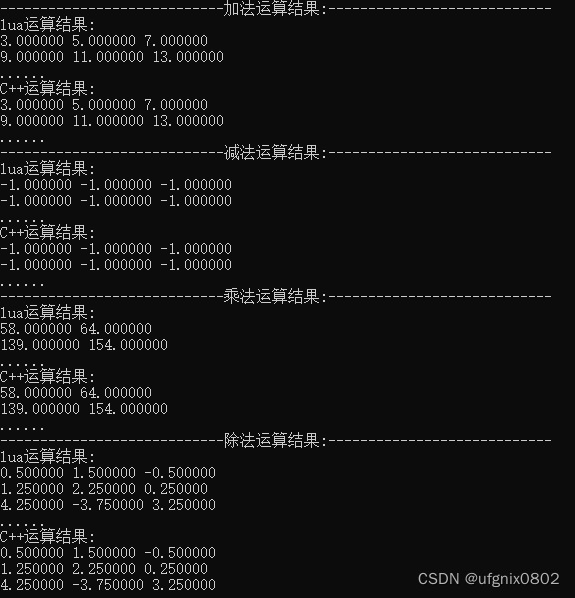
这里由于我们接收来源Lua的table数据,luaL_len(两个参数,分别为lua虚拟机状态以及lua堆栈位置)该API由Lua提供,用于获取table表的大小。
该方式主要用于C++端自定义数据,该数据存放至lua端(即所占的空间由lua端分配,C++端无需关系其生命周期,lua_newuserdata创建的用户数据生命周期由lua的gc负责管理)。这里在我们平常使用的时候会遇到一些问题,比如C++的STL库等。由于lua是使用C语言实现的,并没有STL库以及内部模板这些概念,所以如果我们使用下面的语句(下方)当我们的用户数据userdata从lua端回来时,会出现无法解析的情况,从而导致C++程序崩溃。
Matrix* pp = (Matrix*)lua_newuserdata(L, sizeof(Matrix)); //Matrix实体的空间由lua分配,无法解析其中的vector stl容器
那么我们如何解决这个问题呢?利用一下巧妙的方式即可完美解决。
Matrix** pp = (Matrix**)lua_newuserdata(L, sizeof(Matrix*));
*pp = new Matrix();                     //该部分内存由C++分配
那就是在lua端我们分配的是Matrix实体地址所占用的空间(一般为4个字节或8个字节),也就是说我们在lua端分配的空间中存储的只是类实体的地址,而真正的类实体实在C++端进行分配的,这样每次我们从lua端回来时我们可以通过在lua端记录的实体地址在C++端索引具体类实体所在地。
#include <iostream>
#include "lua.hpp"
#include "Matrix.hpp"

#define CPP_MATRIX "CPP_MATRIX"

static int gs_Top = 0;
#define STACK_NUM(L) \
        gs_Top = lua_gettop(L); \
        std::cout<<"stack top:"<< gs_Top <<std::endl\


extern "C" {
    static int InitMatrix(lua_State* L) {
        //STACK_NUM(L);
        //std::cout << "len:" << luaL_len(L, -1) << std::endl;
        int32_t row = luaL_len(L, -1);
        //STACK_NUM(L);
        lua_rawgeti(L, -1, 1);
        int32_t col = luaL_len(L, -1);
        //STACK_NUM(L);
        lua_pop(L, 1);

        std::vector<std::vector<double>> inputData;
        for (int32_t i = 0; i < row; i++) {
            lua_rawgeti(L, -1, i + 1);
            std::vector<double> data;
            for (int32_t j = 0; j < col; j++) {
                lua_rawgeti(L, -1, j + 1);
                data.push_back(lua_tonumber(L, -1));
                lua_pop(L, 1);
            }
            inputData.push_back(data);
            lua_pop(L, 1);
        }

        Matrix** pp = (Matrix**)luaL_checkudata(L, 1, CPP_MATRIX);
        //STACK_NUM(L);
        (*pp)->Init(inputData);

        //lua堆栈平衡
        //STACK_NUM(L);
        lua_pop(L, 2);
        //STACK_NUM(L);
        return 0;
    }

    static int UnMatrix(lua_State* L) {
        Matrix** pp = (Matrix**)luaL_checkudata(L, 1, CPP_MATRIX);
        std::cout << "auto gc" << std::endl;
        if (*pp) {
            delete *pp;
        }
        return 0;
    }

    static int AddMatrix(lua_State* L) {
        //STACK_NUM(L);
        Matrix** pp1 = (Matrix**)luaL_checkudata(L, 1, CPP_MATRIX);
        Matrix** pp2 = (Matrix**)luaL_checkudata(L, 2, CPP_MATRIX);

        Matrix** pp = (Matrix**)lua_newuserdata(L, sizeof(Matrix*));
        *pp = new Matrix((**pp1) + (**pp2));     //该部分内存由C++分配
        luaL_setmetatable(L, CPP_MATRIX);
        //STACK_NUM(L);
        return 1;
    }

    static int SubMatrix(lua_State* L) {
        //STACK_NUM(L);
        Matrix** pp1 = (Matrix**)luaL_checkudata(L, 1, CPP_MATRIX);
        Matrix** pp2 = (Matrix**)luaL_checkudata(L, 2, CPP_MATRIX);

        Matrix** pp = (Matrix**)lua_newuserdata(L, sizeof(Matrix*));
        *pp = new Matrix((**pp1) - (**pp2));     //该部分内存由C++分配
        luaL_setmetatable(L, CPP_MATRIX);
        //STACK_NUM(L);
        return 1;
    }

    static int MulMatrix(lua_State* L) {
        //STACK_NUM(L);
        Matrix** pp1 = (Matrix**)luaL_checkudata(L, 1, CPP_MATRIX);
        Matrix** pp2 = (Matrix**)luaL_checkudata(L, 2, CPP_MATRIX);

        Matrix** pp = (Matrix**)lua_newuserdata(L, sizeof(Matrix*));
        *pp = new Matrix((**pp1) * (**pp2));     //该部分内存由C++分配
        luaL_setmetatable(L, CPP_MATRIX);
        //STACK_NUM(L);
        return 1;
    }

    static int DivMatrix(lua_State* L) {
        //STACK_NUM(L);
        Matrix** pp1 = (Matrix**)luaL_checkudata(L, 1, CPP_MATRIX);
        Matrix** pp2 = (Matrix**)luaL_checkudata(L, 2, CPP_MATRIX);

        Matrix** pp = (Matrix**)lua_newuserdata(L, sizeof(Matrix*));
        *pp = new Matrix((**pp1) / (**pp2));     //该部分内存由C++分配
        luaL_setmetatable(L, CPP_MATRIX);
        //STACK_NUM(L);
        return 1;
    }

    static int PrintMatrix(lua_State* L) {
        Matrix** pp = (Matrix**)luaL_checkudata(L, 1, CPP_MATRIX);
        (*pp)->Print();
        return 0;
    }

    static int CreateMatrix(lua_State* L) {
        Matrix** pp = (Matrix**)lua_newuserdata(L, sizeof(Matrix*));
        *pp = new Matrix();                     //该部分内存由C++分配
        luaL_setmetatable(L, CPP_MATRIX);
        //STACK_NUM(L);
        return 1;
    }
}

static const luaL_Reg MatrixFuncs[] = {
    {"InitMatrix", InitMatrix  },
    {"__gc",       UnMatrix    },
    {"__add",      AddMatrix   },
    {"__sub",      SubMatrix   },
    {"__mul",      MulMatrix   },
    {"__div",      DivMatrix   },
    {"PrintMatrix",PrintMatrix },
    {NULL,         NULL        }
};

extern "C" {
    static bool CreateMatrixMetaTable(lua_State* L) {
        luaL_newmetatable(L, CPP_MATRIX);
        lua_pushvalue(L, -1);
        lua_setfield(L, -2, "__index");
        luaL_setfuncs(L, MatrixFuncs, 0);
        //STACK_NUM(L);
        lua_pop(L, 1);
        return true;
    }
}

int main() {
    lua_State* L = luaL_newstate();

    luaL_openlibs(L);

    CreateMatrixMetaTable(L);

    //注册构造对象方法
    lua_pushcfunction(L, CreateMatrix);
    lua_setglobal(L, "CreateMatrix");

    if (luaL_dofile(L, "matrix2.0.lua")) {
        printf("%s\n", lua_tostring(L, -1));
    }

    lua_close(L);
	return 0;
}
local _class = {}

function class(super)
    local tbClassType = {}
    tbClassType.Ctor  = false
    tbClassType.super = super
    tbClassType.New   = function(...)
        local tbObj   = {}
        do
            local funcCreate
            funcCreate = function(tbClass,...)
                if tbClass.super then
                    funcCreate(tbClass.super,...)
                end

                if tbClass.Ctor then
                    tbClass.Ctor(tbObj,...)
                end
            end
            funcCreate(tbClassType,...)
        end
        -- 防止调用Ctor初始化时,在Ctor内部设置了元表的情况发生
        if getmetatable(tbObj) then
            getmetatable(tbObj).__index = _class[tbClassType]
        else
            setmetatable(tbObj, { __index = _class[tbClassType] })
        end
        return tbObj
    end

    local vtbl          = {}
    _class[tbClassType] = vtbl

    setmetatable(tbClassType, { __newindex =
        function(tb,k,v)
            vtbl[k] = v
        end
    })

    if super then
        setmetatable(vtbl, { __index =
            function(tb,k)
                local varRet = _class[super][k]
                vtbl[k]      = varRet
                return varRet
            end
        })
    end
    return tbClassType
end


Matrix = class()

function Matrix:Ctor(data)
    self.tbData = data
    self.nRow   = #data
    if self.nRow > 0 then
        self.nColumn = (#data[1])
    else
        self.nColumn = 0
    end
    -- print("row:",self.nRow," col:",self.nColumn)

    setmetatable(self,{
        __add = function(tbSource, tbDest)
            assert(tbSource,"tbSource not exist")
            assert(tbDest,  "tbDest not exist")
            local tbRes = Matrix.New({})
            -- print(tbSource,tbDest)
            -- print("tbSource:",tbSource.nRow,tbSource.nColumn)
            -- tbSource:Print()
            -- print("tbDest:",tbDest.nRow,tbDest.nColumn)
            -- tbDest:Print()
            if tbSource.nRow ~= tbDest.nRow
                or tbSource.nColumn ~= tbDest.nColumn then
                print("row or column not equal...")
                return tbRes
            else
                for rowKey,rowValue in ipairs(tbSource.tbData) do
                    for colKey,colValue in ipairs(tbSource.tbData[rowKey]) do
                        if tbRes.tbData[rowKey] == nil then
                            tbRes.tbData[rowKey] = {}
                        end

                        if tbRes.tbData[rowKey][colKey] == nil then
                            tbRes.tbData[rowKey][colKey] = 0
                        end

                        tbRes.tbData[rowKey][colKey] =
                            tbSource.tbData[rowKey][colKey] + tbDest.tbData[rowKey][colKey]
                    end
                end
                tbRes.nRow    = tbSource.nRow
                tbRes.nColumn = tbSource.nColumn
                return tbRes
            end
        end,

        __sub = function(tbSource, tbDest)
            assert(tbSource,"tbSource not exist")
            assert(tbDest,  "tbDest not exist")
            local tbRes = Matrix.New({})
            if tbSource.nRow ~= tbDest.nRow
                or tbSource.nColumn ~= tbDest.nColumn then
                print("row or column not equal...")
                return tbRes
            else
                for rowKey,rowValue in ipairs(tbSource.tbData) do
                    for colKey,colValue in ipairs(tbSource.tbData[rowKey]) do
                        if tbRes.tbData[rowKey] == nil then
                            tbRes.tbData[rowKey] = {}
                        end

                        if tbRes.tbData[rowKey][colKey] == nil then
                            tbRes.tbData[rowKey][colKey] = 0
                        end

                        tbRes.tbData[rowKey][colKey] =
                            tbSource.tbData[rowKey][colKey] - tbDest.tbData[rowKey][colKey]
                    end
                end
                tbRes.nRow    = tbSource.nRow
                tbRes.nColumn = tbSource.nColumn
                return tbRes
            end
        end,

        __mul = function(tbSource, tbDest)
            return self:_MartixMul(tbSource, tbDest)
        end,

        __div = function(tbSource, tbDest)
            assert(tbSource,"tbSource not exist")
            assert(tbDest,  "tbDest not exist")

            local nDet = self:_GetDetValue(tbDest)
            if nDet == 0 then
                print("matrix no inverse matrix...")
                return nil
            end
            -- print("det ",nDet)
            local tbInverseDest = self:_MatrixNumMul(self:_GetCompanyMatrix(tbDest), 1 / nDet)
            -- self:_GetCompanyMatrix(tbDest):Print()
            -- print(nDet)
            tbInverseDest:Print()
            return self:_MartixMul(tbSource, tbInverseDest)
        end
    }
)


end

function Matrix:Print()
    for rowKey,rowValue in ipairs(self.tbData) do
        for colKey,colValue in ipairs(self.tbData[rowKey]) do
            io.write(self.tbData[rowKey][colKey],',')
        end
        print('')
    end
end

-- 加
function Matrix:Add(matrix)
    return self + matrix
end

-- 减
function Matrix:Sub(matrix)
    return self - matrix
end

-- 乘
function Matrix:Mul(matrix)
    return self * matrix
end

-- 除
function Matrix:Div(matrix)
    return self / matrix
end


-- 切割,切去第rowIndex以及第colIndex列
function Matrix:_CutoffMatrix(tbMatrix, rowIndex, colIndex)
    assert(tbMatrix,"tbMatrix not exist")
    assert(rowIndex >= 1,"rowIndex < 1")
    assert(colIndex >= 1,"colIndex < 1")
    local tbRes   = Matrix.New({})
    tbRes.nRow    = tbMatrix.nRow    - 1
    tbRes.nColumn = tbMatrix.nColumn - 1
    for i = 1, tbMatrix.nRow - 1 do
        for j = 1, tbMatrix.nColumn - 1 do
            if tbRes.tbData[i] == nil then
                tbRes.tbData[i] = {}
            end

            local nRowDir = 0
            local nColDir = 0
            if i >= rowIndex then
                nRowDir = 1
            end

            if j >= colIndex then
                nColDir = 1
            end

            tbRes.tbData[i][j] = tbMatrix.tbData[i + nRowDir][j + nColDir]
        end
    end
    return tbRes
end

-- 获取矩阵的行列式对应的值
function Matrix:_GetDetValue(tbMatrix)
    assert(tbMatrix,"tbMatrix not exist")
    -- 当矩阵为一阶矩阵时,直接返回A中唯一的元素
    if tbMatrix.nRow == 1 then
        return tbMatrix.tbData[1][1]
    end

    local nAns = 0
    for i = 1, tbMatrix.nColumn do
        local nFlag = -1
        if i % 2 ~= 0 then
            nFlag = 1
        end

        nAns =
            nAns + tbMatrix.tbData[1][i] *
                self:_GetDetValue(self:_CutoffMatrix(tbMatrix, 1, i)) * nFlag
        -- print("_GetDetValue nflag:",nFlag)
    end
    return nAns
end


-- 获取矩阵的伴随矩阵
function Matrix:_GetCompanyMatrix(tbMatrix)
    assert(tbMatrix,"tbMatrix not exist")
    local tbRes   = Matrix.New({})
    -- 伴随矩阵与原矩阵存在转置关系
    tbRes.nRow    = tbMatrix.nColumn
    tbRes.nColumn = tbMatrix.nRow

    for i = 1, tbMatrix.nRow do
        for j = 1, tbMatrix.nColumn do
            local nFlag = 1
            if ((i + j) % 2) ~= 0 then
                nFlag = -1
            end

            if tbRes.tbData[j] == nil then
                tbRes.tbData[j] = {}
            end
            -- print(Matrix:_GetDetValue(Matrix:_CutoffMatrix(tbMatrix, i, j)))
            -- Matrix:_CutoffMatrix(tbMatrix, i, j):Print()
            -- print("---11----")

            tbRes.tbData[j][i] =
                self:_GetDetValue(self:_CutoffMatrix(tbMatrix, i, j)) * nFlag
        end
    end
    return tbRes
end


-- 矩阵数乘
function Matrix:_MatrixNumMul(tbMatrix, num)
    for i = 1, tbMatrix.nRow do
        for j = 1, tbMatrix.nColumn do
            tbMatrix.tbData[i][j] = tbMatrix.tbData[i][j] * num
        end
    end
    return tbMatrix
end


-- 矩阵相乘
function Matrix:_MartixMul(tbSource, tbDest)
    assert(tbSource,"tbSource not exist")
    assert(tbDest,  "tbDest not exist")
    if tbSource.nColumn ~= tbDest.nRow then
        print("column not equal row...")
        return tbSource
    else
        local tbRes = Matrix.New({})
        for i = 1, tbSource.nRow do
            for j = 1, tbDest.nColumn do
                if tbRes.tbData[i] == nil then
                    tbRes.tbData[i] = {}
                end

                if tbRes.tbData[i][j] == nil then
                    tbRes.tbData[i][j] = 0
                end

                for k = 1, tbSource.nColumn do
                    tbRes.tbData[i][j] =
                        tbRes.tbData[i][j] + (tbSource.tbData[i][k] * tbDest.tbData[k][j])
                end
            end
        end
        tbRes.nRow    = tbSource.nRow
        tbRes.nColumn = tbDest.nColumn
        return tbRes
    end
end


-- 矩阵加法
local matrix1 = Matrix.New({{1,2,3},{4,5,6}})
local matrix2 = Matrix.New({{2,3,4},{5,6,7}})

-- local matrix3 = matrix1 + matrix2
local matrix3 = matrix1.Add(matrix1,matrix2)
matrix3:Print()
print("-----------------------------------")

-- 矩阵减法
local matrix4 = Matrix.New({{1,1,1},{1,1,1}})
local matrix5 = matrix3 - matrix4
matrix5:Print()
print("-----------------------------------")


-- 矩阵乘法
local matrix6 = Matrix.New({{1,2,3},{4,5,6}})
local matrix7 = Matrix.New({{7,8},{9,10},{11,12}})

local matrix8 = matrix6 * matrix7
matrix8:Print()
print("-----------------------------------")


-- 矩阵除法
local matrix9 = Matrix.New({{1,2,3},{4,5,6},{7,8,0}})
local matrix10 = Matrix.New({{1,2,1},{1,1,2},{2,1,1}})
local matrix11 = matrix7 / matrix8
matrix11:Print()


-- 加法
local cppMatrix1 = CreateMatrix()
cppMatrix1:InitMatrix({{1,2,3},{4,5,6}})
local cppMatrix2 = CreateMatrix()
cppMatrix2:InitMatrix({{2,3,4},{5,6,7}})
print('-------------------加法----------------------')
local cppMatrix3 = cppMatrix1 + cppMatrix2
cppMatrix3:PrintMatrix()

local matrix1 = Matrix.New({{1,2,3},{4,5,6}})
local matrix2 = Matrix.New({{2,3,4},{5,6,7}})
local matrix3 = matrix1 + matrix2
-- local matrix3 = matrix1.Add(matrix1,matrix2)
matrix3:Print()


-- 减法
local cppMatrix4 = CreateMatrix()
cppMatrix4:InitMatrix({{1,1,1},{1,1,1}})
print('-------------------减法----------------------')
local cppMatrix5 = cppMatrix3 - cppMatrix4
cppMatrix5:PrintMatrix()

local matrix4 = Matrix.New({{1,1,1},{1,1,1}})
local matrix5 = matrix3 - matrix4
matrix5:Print()

-- 乘法
local cppMatrix6 = CreateMatrix()
cppMatrix6:InitMatrix({{1,2,3},{4,5,6}})
local cppMatrix7 = CreateMatrix()
cppMatrix7:InitMatrix({{7,8},{9,10},{11,12}})
print('-------------------乘法----------------------')
local cppMatrix8 = cppMatrix6 * cppMatrix7
cppMatrix8:PrintMatrix()

local matrix6 = Matrix.New({{1,2,3},{4,5,6}})
local matrix7 = Matrix.New({{7,8},{9,10},{11,12}})
local matrix8 = matrix6 * matrix7
matrix8:Print()

-- 除法
local cppMatrix9 = CreateMatrix()
cppMatrix9:InitMatrix({{1,2,3},{4,5,6},{7,8,0}})
local cppMatrix10 = CreateMatrix()
cppMatrix10:InitMatrix({{1,2,1},{1,1,2},{2,1,1}})
print('-------------------除法----------------------')
local cppMatrix11 = cppMatrix9 / cppMatrix10
cppMatrix11:PrintMatrix()

local matrix9  = Matrix.New({{1,2,3},{4,5,6},{7,8,0}})
local matrix10 = Matrix.New({{1,2,1},{1,1,2},{2,1,1}})
local matrix11 = matrix9 / matrix10
matrix11:Print()
我好像记得Lua有类似Ruby的method_missing的东西。还是我记错了? 最佳答案 表的metatable的__index和__newindex可以用于与Ruby的method_missing相同的效果。 关于ruby-难道Lua没有和Ruby的method_missing相媲美的东西吗?,我们在StackOverflow上找到一个类似的问题: https://stackoverflow.com/questions/7732154/
我正在查看instance_variable_set的文档并看到给出的示例代码是这样做的:obj.instance_variable_set(:@instnc_var,"valuefortheinstancevariable")然后允许您在类的任何实例方法中以@instnc_var的形式访问该变量。我想知道为什么在@instnc_var之前需要一个冒号:。冒号有什么作用? 最佳答案 我的第一直觉是告诉你不要使用instance_variable_set除非你真的知道你用它做什么。它本质上是一种元编程工具或绕过实例变量可见性的黑客攻击
在我的应用程序中,我需要能够找到所有数字子字符串,然后扫描每个子字符串,找到第一个匹配范围(例如5到15之间)的子字符串,并将该实例替换为另一个字符串“X”。我的测试字符串s="1foo100bar10gee1"我的初始模式是1个或多个数字的任何字符串,例如,re=Regexp.new(/\d+/)matches=s.scan(re)给出["1","100","10","1"]如果我想用“X”替换第N个匹配项,并且只替换第N个匹配项,我该怎么做?例如,如果我想替换第三个匹配项“10”(匹配项[2]),我不能只说s[matches[2]]="X"因为它做了两次替换“1fooX0barXg
我在我的Rails项目中使用Pow和powifygem。现在我尝试升级我的ruby版本(从1.9.3到2.0.0,我使用RVM)当我切换ruby版本、安装所有gem依赖项时,我通过运行railss并访问localhost:3000确保该应用程序正常运行以前,我通过使用pow访问http://my_app.dev来浏览我的应用程序。升级后,由于错误Bundler::RubyVersionMismatch:YourRubyversionis1.9.3,butyourGemfilespecified2.0.0,此url不起作用我尝试过的:重新创建pow应用程序重启pow服务器更新战俘
我正在尝试修改当前依赖于定义为activeresource的gem:s.add_dependency"activeresource","~>3.0"为了让gem与Rails4一起工作,我需要扩展依赖关系以与activeresource的版本3或4一起工作。我不想简单地添加以下内容,因为它可能会在以后引起问题:s.add_dependency"activeresource",">=3.0"有没有办法指定可接受版本的列表?~>3.0还是~>4.0? 最佳答案 根据thedocumentation,如果你想要3到4之间的所有版本,你可以这
这可能是个愚蠢的问题。但是,我是一个新手......你怎么能在交互式rubyshell中有多行代码?好像你只能有一条长线。按回车键运行代码。无论如何我可以在不运行代码的情况下跳到下一行吗?再次抱歉,如果这是一个愚蠢的问题。谢谢。 最佳答案 这是一个例子:2.1.2:053>a=1=>12.1.2:054>b=2=>22.1.2:055>a+b=>32.1.2:056>ifa>b#Thecode‘if..."startsthedefinitionoftheconditionalstatement.2.1.2:057?>puts"f
我有一个正在构建的应用程序,我需要一个模型来创建另一个模型的实例。我希望每辆车都有4个轮胎。汽车模型classCar轮胎模型classTire但是,在make_tires内部有一个错误,如果我为Tire尝试它,则没有用于创建或新建的activerecord方法。当我检查轮胎时,它没有这些方法。我该如何补救?错误是这样的:未定义的方法'create'forActiveRecord::AttributeMethods::Serialization::Tire::Module我测试了两个环境:测试和开发,它们都因相同的错误而失败。 最佳答案
我正在处理旧代码的一部分。beforedoallow_any_instance_of(SportRateManager).toreceive(:create).and_return(true)endRubocop错误如下:Avoidstubbingusing'allow_any_instance_of'我读到了RuboCop::RSpec:AnyInstance我试着像下面那样改变它。由此beforedoallow_any_instance_of(SportRateManager).toreceive(:create).and_return(true)end对此:let(:sport_
如果我使用ruby版本2.5.1和Rails版本2.3.18会怎样?我有基于rails2.3.18和ruby1.9.2p320构建的rails应用程序,我只想升级ruby的版本,而不是rails,这可能吗?我必须面对哪些挑战? 最佳答案 GitHub维护apublicfork它有针对旧Rails版本的分支,有各种变化,它们一直在运行。有一段时间,他们在较新的Ruby版本上运行较旧的Rails版本,而不是最初支持的版本,因此您可能会发现一些关于需要向后移植的有用提示。不过,他们现在已经有几年没有使用2.3了,所以充其量只能让更
我安装了ruby版本管理器,并将RVM安装的ruby实现设置为默认值,这样'哪个ruby'显示'~/.rvm/ruby-1.8.6-p383/bin/ruby'但是当我在emacs中打开inf-ruby缓冲区时,它使用安装在/usr/bin中的ruby。有没有办法让emacs像shell一样尊重ruby的路径?谢谢! 最佳答案 我创建了一个emacs扩展来将rvm集成到emacs中。如果您有兴趣,可以在这里获取:http://github.com/senny/rvm.el
