文章目录
后端规范入门参考:Spring Boot后端接口规范
Spring在3.2版本增加了一个注解@ControllerAdvice,可以与@ExceptionHandler、@InitBinder、@ModelAttribute 等注解注解配套使用。不过跟异常处理相关的只有注解@ExceptionHandler,从字面上看,就是 异常处理器 的意思
简单的说,该注解可以把异常处理器应用到所有控制器,而不是单个控制器。借助该注解,我们可以实现:在独立的某个地方,比如单独一个类,定义一套对各种异常的处理机制,然后在类的签名加上注解@ControllerAdvice,统一对 不同阶段的、不同异常 进行处理。这就是统一异常处理的原理。
对异常按阶段进行分类,大体可以分成:进入Controller前的异常 和 Service 层异常
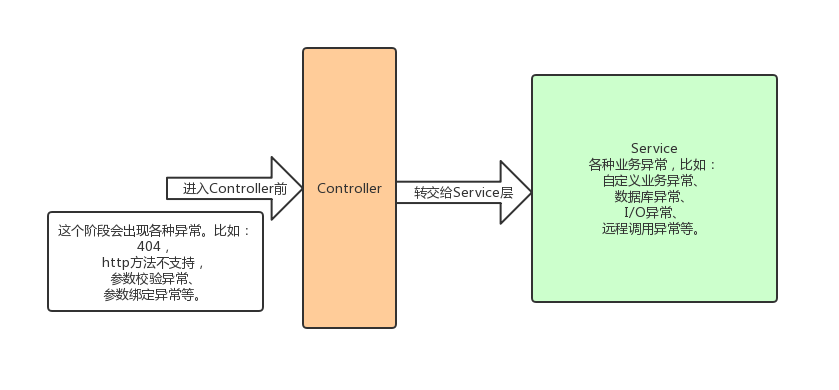
目标就是消灭95%以上的 try catch 代码块,并以优雅的 Assert(断言) 方式来校验业务的异常情况,只关注业务逻辑,而不用花费大量精力写冗余的 try catch 代码块。
**Assert(断言)**是Spring 家族的 org.springframework.util.Assert,在我们写测试用例的时候经常会用到,使用断言能让我们编码的时候有一种非一般丝滑的感觉
Assert 的部分源码,可以看到,Assert 其实就是帮我们把 if {…} 封装了一下,抛出的异常是IllegalArgumentException()
public abstract class Assert {
    public Assert() {
    }

    public static void notNull(@Nullable Object object, String message) {
        if (object == null) {
            throw new IllegalArgumentException(message);
        }
    }
}
Assert断言方法是使用接口的默认方法定义的,然后有没有发现当断言失败后,抛出的异常不是具体的某个异常,而是交由2个newException接口方法提供。因为业务逻辑中出现的异常基本都是对应特定的场景,比如根据用户id获取用户信息,查询结果为null,此时抛出的异常可能为UserNotFoundException,并且有特定的异常码(比如7001)和异常信息"用户不存在"。所以具体抛出什么异常,有Assert的实现类决定。
public interface Assert {
    /**
     * 创建异常
     * @param args
     * @return
     */
    BaseException newException(Object... args);

    /**
     * 创建异常
     * @param t
     * @param args
     * @return
     */
    BaseException newException(Throwable t, Object... args);

    /**
     * <p>断言对象<code>obj</code>非空。如果对象<code>obj</code>为空,则抛出异常
     *
     * @param obj 待判断对象
     */
    default void assertNotNull(Object obj) {
        if (obj == null) {
            throw newException(obj);
        }
    }

    /**
     * <p>断言对象<code>obj</code>非空。如果对象<code>obj</code>为空,则抛出异常
     * <p>异常信息<code>message</code>支持传递参数方式,避免在判断之前进行字符串拼接操作
     *
     * @param obj 待判断对象
     * @param args message占位符对应的参数列表
     */
    default void assertNotNull(Object obj, Object... args) {
        if (obj == null) {
            throw newException(args);
        }
    }
}
public interface IResponseEnum {
    int getCode();
    String getMessage();
}

/**
 * <p>业务异常</p>
 * <p>业务处理时,出现异常,可以抛出该异常</p>
 */
public class BusinessException extends  BaseException {

    private static final long serialVersionUID = 1L;

    public BusinessException(IResponseEnum responseEnum, Object[] args, String message) {
        super(responseEnum, args, message);
    }

    public BusinessException(IResponseEnum responseEnum, Object[] args, String message, Throwable cause) {
        super(responseEnum, args, message, cause);
    }
}
代码示例中定义了两个枚举实例:BAD_LICENCE_TYPE、LICENCE_NOT_FOUND,分别对应了BadLicenceTypeException、LicenceNotFoundException两种异常。以后每增加一种异常情况,只需增加一个枚举实例即可,再也不用每一种异常都定义一个异常类了
public interface BusinessExceptionAssert extends IResponseEnum, Assert {

    @Override
    default BaseException newException(Object... args) {
        String msg = MessageFormat.format(this.getMessage(), args);

        return new BusinessException(this, args, msg);
    }

    @Override
    default BaseException newException(Throwable t, Object... args) {
        String msg = MessageFormat.format(this.getMessage(), args);

        return new BusinessException(this, args, msg, t);
    }

}
@Getter
@AllArgsConstructor
public enum ResponseEnum implements BusinessExceptionAssert {

    /**
     * Bad licence type
     */
    BAD_LICENCE_TYPE(7001, "Bad licence type."),
    /**
     * Licence not found
     */
    LICENCE_NOT_FOUND(7002, "Licence not found.")
    ;

    /**
     * 返回码
     */
    private int code;
    /**
     * 返回消息
     */
    private String message;
}
使用枚举类结合(继承)Assert,只需根据特定的异常情况定义不同的枚举实例,如上面的BAD_LICENCE_TYPE、LICENCE_NOT_FOUND,就能够针对不同情况抛出特定的异常(这里指携带特定的异常码和异常消息),这样既不用定义大量的异常类,同时还具备了断言的良好可读性
private void checkNotNull(Licence licence) {
    ResponseEnum.LICENCE_NOT_FOUND.assertNotNull(licence,"测试");
}
// 替代下面的方法
private void checkNotNull(Licence licence) {
    if (licence == null) {
        throw new LicenceNotFoundException();
        // 或者这样
        throw new BusinessException(7001, "Bad licence type.");
    }
}
一个http请求,在到达Controller前,会对该请求的请求信息与目标控制器信息做一系列校验
NoHandlerFoundException:首先根据请求Url查找有没有对应的控制器,若没有则会抛该异常,也就是大家非常熟悉的404异常,但是实际上当出现404的时候,默认是不抛异常的,而是 forward跳转到/error控制器,spring也提供了默认的error控制器,如果要抛出异常,需要配置
spring.mvc.throw-exception-if-no-handler-found=true
spring.web.resources.add-mappings=false
HttpRequestMethodNotSupportedException:若匹配到了(匹配结果是一个列表,不同的是http方法不同,如:Get、Post等),则尝试将请求的http方法与列表的控制器做匹配,若没有对应http方法的控制器,则抛该异常;
HttpMediaTypeNotSupportedException:然后再对请求头与控制器支持的做比较,比如content-type请求头,若控制器的参数签名包含注解@RequestBody,但是请求的content-type请求头的值没有包含application/json,那么会抛该异常(当然,不止这种情况会抛这个异常);
MissingPathVariableException:未检测到路径参数。比如url为:/licence/{licenceId},参数签名包含@PathVariable("licenceId"),当请求的url为/licence,在没有明确定义url为/licence的情况下,会被判定为:缺少路径参数;
MissingServletRequestParameterException:缺少请求参数。比如定义了参数@RequestParam("licenceId") String licenceId,但发起请求时,未携带该参数,则会抛该异常;
TypeMismatchException: 参数类型匹配失败。比如:接收参数为Long型,但传入的值确是一个字符串,那么将会出现类型转换失败的情况,这时会抛该异常;
HttpMessageNotReadableException:与上面的HttpMediaTypeNotSupportedException举的例子完全相反,即请求头携带了"content-type: application/json;charset=UTF-8",但接收参数却没有添加注解@RequestBody,或者请求体携带的 json 串反序列化成 pojo 的过程中失败了,也会抛该异常;
HttpMessageNotWritableException:返回的 pojo 在序列化成 json 过程失败了,那么抛该异常;
参数校验异常
处理自定义的业务异常,只是handleBaseException处理的是除了 BusinessException 意外的所有业务异常。就目前来看,这2个是可以合并成一个的
处理所有未知的异常,比如操作数据库失败的异常。
注:上面的
handleServletException、handleException这两个处理器,返回的异常信息,不同环境返回的可能不一样,以为这些异常信息都是框架自带的异常信息,一般都是英文的,不太好直接展示给用户看,所以统一返回SERVER_ERROR代表的异常信息
将异常分成几类,实际上只有两大类,一类是ServletException、ServiceException,还记得上文提到的 按阶段分类 吗,即对应 进入Controller前的异常 和 Service 层异常;然后 ServiceException 再分成自定义异常、未知异常。对应关系如下:
进入Controller前的异常: handleServletException、handleBindException、handleValidException
自定义异常:handleBusinessException、handleBaseException
未知异常: handleException
@Slf4j
@Component
@ControllerAdvice
@ConditionalOnWebApplication
@ConditionalOnMissingBean(UnifiedExceptionHandler.class)
public class UnifiedExceptionHandler {
    /**
     * 生产环境
     */
    private final static String ENV_PROD = "prod";

    @Autowired
    private UnifiedMessageSource unifiedMessageSource;

    /**
     * 当前环境
     */
    @Value("${spring.profiles.active}")
    private String profile;

    /**
     * 获取国际化消息
     * 这里可以做处理
     * @param e 异常
     * @return
     */
    public String getMessage(BaseException e) {
        String code = "response." + e.getResponseEnum().toString();
        String message = unifiedMessageSource.getMessage(code, e.getArgs());

        if (message == null || message.isEmpty()) {
            return e.getMessage();
        }

        return message;
    }

    /**
     * 业务异常
     *
     * @param e 异常
     * @return 异常结果
     */
    @ExceptionHandler(value = BusinessException.class)
    @ResponseBody
    public ErrorResponse handleBusinessException(BaseException e) {
        log.error(e.getMessage(), e);

        return new ErrorResponse(e.getResponseEnum().getCode(), getMessage(e));
    }

    /**
     * 自定义异常
     *
     * @param e 异常
     * @return 异常结果
     */
    @ExceptionHandler(value = BaseException.class)
    @ResponseBody
    public ErrorResponse handleBaseException(BaseException e) {
        log.error(e.getMessage(), e);

        return new ErrorResponse(e.getResponseEnum().getCode(), getMessage(e));
    }

    /**
     * Controller上一层相关异常
     *
     * @param e 异常
     * @return 异常结果
     */
    @ExceptionHandler({
            NoHandlerFoundException.class,
            HttpRequestMethodNotSupportedException.class,
            HttpMediaTypeNotSupportedException.class,
            MissingPathVariableException.class,
            MissingServletRequestParameterException.class,
            TypeMismatchException.class,
            HttpMessageNotReadableException.class,
            HttpMessageNotWritableException.class,
            // BindException.class,
            // MethodArgumentNotValidException.class
            HttpMediaTypeNotAcceptableException.class,
            ServletRequestBindingException.class,
            ConversionNotSupportedException.class,
            MissingServletRequestPartException.class,
            AsyncRequestTimeoutException.class
    })
    @ResponseBody
    public ErrorResponse handleServletException(Exception e) {
        log.error(e.getMessage(), e);
        int code = CommonResponseEnum.SERVER_ERROR.getCode();
        try {
            ServletResponseEnum servletExceptionEnum = ServletResponseEnum.valueOf(e.getClass().getSimpleName());
            code = servletExceptionEnum.getCode();
        } catch (IllegalArgumentException e1) {
            log.error("class [{}] not defined in enum {}", e.getClass().getName(), ServletResponseEnum.class.getName());
        }

        if (ENV_PROD.equals(profile)) {
            // 当为生产环境, 不适合把具体的异常信息展示给用户, 比如404.
            code = CommonResponseEnum.SERVER_ERROR.getCode();
            BaseException baseException = new BaseException(CommonResponseEnum.SERVER_ERROR);
            String message = getMessage(baseException);
            return new ErrorResponse(code, message);
        }

        return new ErrorResponse(code, e.getMessage());
    }


    /**
     * 参数绑定异常
     *
     * @param e 异常
     * @return 异常结果
     */
    @ExceptionHandler(value = BindException.class)
    @ResponseBody
    public ErrorResponse handleBindException(BindException e) {
        log.error("参数绑定校验异常", e);

        return wrapperBindingResult(e.getBindingResult());
    }

    /**
     * 参数校验异常,将校验失败的所有异常组合成一条错误信息
     *
     * @param e 异常
     * @return 异常结果
     */
    @ExceptionHandler(value = MethodArgumentNotValidException.class)
    @ResponseBody
    public ErrorResponse handleValidException(MethodArgumentNotValidException e) {
        log.error("参数绑定校验异常", e);

        return wrapperBindingResult(e.getBindingResult());
    }

    /**
     * 包装绑定异常结果
     *
     * @param bindingResult 绑定结果
     * @return 异常结果
     */
    private ErrorResponse wrapperBindingResult(BindingResult bindingResult) {
        StringBuilder msg = new StringBuilder();

        for (ObjectError error : bindingResult.getAllErrors()) {
            msg.append(", ");
            if (error instanceof FieldError) {
                msg.append(((FieldError) error).getField()).append(": ");
            }
            msg.append(error.getDefaultMessage() == null ? "" : error.getDefaultMessage());

        }

        return new ErrorResponse(ArgumentResponseEnum.VALID_ERROR.getCode(), msg.substring(2));
    }

    /**
     * 未定义异常
     *
     * @param e 异常
     * @return 异常结果
     */
    @ExceptionHandler(value = Exception.class)
    @ResponseBody
    public ErrorResponse handleException(Exception e) {
        log.error(e.getMessage(), e);

        if (ENV_PROD.equals(profile)) {
            // 当为生产环境, 不适合把具体的异常信息展示给用户, 比如数据库异常信息.
            int code = CommonResponseEnum.SERVER_ERROR.getCode();
            BaseException baseException = new BaseException(CommonResponseEnum.SERVER_ERROR);
            String message = getMessage(baseException);
            return new ErrorResponse(code, message);
        }

        return new ErrorResponse(CommonResponseEnum.SERVER_ERROR.getCode(), e.getMessage());
    }

}
@Slf4j
@RestControllerAdvice
public class GlobalExceptionHandler {

    /**
     * 没有登录
     * @param request
     * @param response
     * @param e
     * @return
     */
    @ExceptionHandler(NoLoginException.class)
    public Object noLoginExceptionHandler(HttpServletRequest request,HttpServletResponse response,Exception e)
    {
        log.error("[GlobalExceptionHandler][noLoginExceptionHandler] exception",e);
        JsonResult jsonResult = new JsonResult();
        jsonResult.setCode(JsonResultCode.NO_LOGIN);
        jsonResult.setMessage("用户登录失效或者登录超时,请先登录");
        return jsonResult;
    }

    /**
     * 业务异常
     * @param request
     * @param response
     * @param e
     * @return
     */
    @ExceptionHandler(ServiceException.class)
    public Object businessExceptionHandler(HttpServletRequest request,HttpServletResponse response,Exception e)
    {
        log.error("[GlobalExceptionHandler][businessExceptionHandler] exception",e);
        JsonResult jsonResult = new JsonResult();
        jsonResult.setCode(JsonResultCode.FAILURE);
        jsonResult.setMessage("业务异常,请联系管理员");
        return jsonResult;
    }

    /**
     * 全局异常处理
     * @param request
     * @param response
     * @param e
     * @return
     */
    @ExceptionHandler(Exception.class)
    public Object exceptionHandler(HttpServletRequest request,HttpServletResponse response,Exception e)
    {
        log.error("[GlobalExceptionHandler][exceptionHandler] exception",e);
        JsonResult jsonResult = new JsonResult();
        jsonResult.setCode(JsonResultCode.FAILURE);
        jsonResult.setMessage("系统错误,请联系管理员");
        return jsonResult;
    }
}
code、message 是所有返回结果中必有的字段,而当需要返回数据时,则需要另一个字段 data 来表示。所以首先定义一个 BaseResponse 来作为所有返回结果的基类
然后定义一个通用返回结果类CommonResponse,继承 BaseResponse,而且多了字段 data;为了区分成功和失败返回结果,于是再定义一个 ErrorResponse
最后还有一种常见的返回结果,即返回的数据带有分页信息,因为这种接口比较常见,所以有必要单独定义一个返回结果类 QueryDataResponse,该类继承自 CommonResponse,只是把 data 字段的类型限制为 QueryDdata,QueryDdata中定义了分页信息相应的字段,即totalCount、pageNo、 pageSize、records。其中比较常用的只有 CommonResponse 和 QueryDataResponse,但是名字又贼鬼死长,何不定义2个名字超简单的类来替代呢?于是 R 和 QR 诞生了,以后返回结果的时候只需这样写:new R<>(data)、new QR<>(queryData)
因为这一套统一异常处理可以说是通用的,所有可以设计成一个
common包,以后每一个新项目/模块只需引入该包即可
参考文章:
我主要使用Ruby来执行此操作,但到目前为止我的攻击计划如下:使用gemsrdf、rdf-rdfa和rdf-microdata或mida来解析给定任何URI的数据。我认为最好映射到像schema.org这样的统一模式,例如使用这个yaml文件,它试图描述数据词汇表和opengraph到schema.org之间的转换:#SchemaXtoschema.orgconversion#data-vocabularyDV:name:namestreet-address:streetAddressregion:addressRegionlocality:addressLocalityphoto:i
Rackup通过Rack的默认处理程序成功运行任何Rack应用程序。例如:classRackAppdefcall(environment)['200',{'Content-Type'=>'text/html'},["Helloworld"]]endendrunRackApp.new但是当最后一行更改为使用Rack的内置CGI处理程序时,rackup给出“NoMethodErrorat/undefinedmethod`call'fornil:NilClass”:Rack::Handler::CGI.runRackApp.newRack的其他内置处理程序也提出了同样的反对意见。例如Rack
我正在学习Rails,并阅读了关于乐观锁的内容。我已将类型为integer的lock_version列添加到我的articles表中。但现在每当我第一次尝试更新记录时,我都会收到StaleObjectError异常。这是我的迁移:classAddLockVersionToArticle当我尝试通过Rails控制台更新文章时:article=Article.first=>#我这样做:article.title="newtitle"article.save我明白了:(0.3ms)begintransaction(0.3ms)UPDATE"articles"SET"title"='dwdwd
在Cooper的书BeginningRuby中,第166页有一个我无法重现的示例。classSongincludeComparableattr_accessor:lengthdef(other)@lengthother.lengthenddefinitialize(song_name,length)@song_name=song_name@length=lengthendenda=Song.new('Rockaroundtheclock',143)b=Song.new('BohemianRhapsody',544)c=Song.new('MinuteWaltz',60)a.betwee
我早就知道Ruby中的“常量”(即大写的变量名)不是真正常量。与其他编程语言一样,对对象的引用是唯一存储在变量/常量中的东西。(侧边栏:Ruby确实具有“卡住”引用对象不被修改的功能,据我所知,许多其他语言都没有提供这种功能。)所以这是我的问题:当您将一个值重新分配给常量时,您会收到如下警告:>>FOO='bar'=>"bar">>FOO='baz'(irb):2:warning:alreadyinitializedconstantFOO=>"baz"有没有办法强制Ruby抛出异常而不是打印警告?很难弄清楚为什么有时会发生重新分配。 最佳答案
导读:随着叮咚买菜业务的发展,不同的业务场景对数据分析提出了不同的需求,他们希望引入一款实时OLAP数据库,构建一个灵活的多维实时查询和分析的平台,统一数据的接入和查询方案,解决各业务线对数据高效实时查询和精细化运营的需求。经过调研选型,最终引入ApacheDoris作为最终的OLAP分析引擎,Doris作为核心的OLAP引擎支持复杂地分析操作、提供多维的数据视图,在叮咚买菜数十个业务场景中广泛应用。作者|叮咚买菜资深数据工程师韩青叮咚买菜创立于2017年5月,是一家专注美好食物的创业公司。叮咚买菜专注吃的事业,为满足更多人“想吃什么”而努力,通过美好食材的供应、美好滋味的开发以及美食品牌的孵
SPI接收数据左移一位问题目录SPI接收数据左移一位问题一、问题描述二、问题分析三、探究原理四、经验总结最近在工作在学习调试SPI的过程中遇到一个问题——接收数据整体向左移了一位(1bit)。SPI数据收发是数据交换,因此接收数据时从第二个字节开始才是有效数据,也就是数据整体向右移一个字节(1byte)。请教前辈之后也没有得到解决,通过在网上查阅前人经验终于解决问题,所以写一个避坑经验总结。实际背景:MCU与一款芯片使用spi通信,MCU作为主机,芯片作为从机。这款芯片采用的是它规定的六线SPI,多了两根线:RDY和INT,这样从机就可以主动请求主机给主机发送数据了。一、问题描述根据从机芯片手
我对图像处理完全陌生。我对JPEG内部是什么以及它是如何工作一无所知。我想知道,是否可以在某处找到执行以下简单操作的ruby代码:打开jpeg文件。遍历每个像素并将其颜色设置为fx绿色。将结果写入另一个文件。我对如何使用ruby-vips库实现这一点特别感兴趣https://github.com/ender672/ruby-vips我的目标-学习如何使用ruby-vips执行基本的图像处理操作(Gamma校正、亮度、色调……)任何指向比“helloworld”更复杂的工作示例的链接——比如ruby-vips的github页面上的链接,我们将不胜感激!如果有ruby-
我有一个super简单的脚本,它几乎包含了FayeWebSocketGitHub页面上用于处理关闭连接的内容:ws=Faye::WebSocket::Client.new(url,nil,:headers=>headers)ws.on:opendo|event|p[:open]#sendpingcommand#sendtestcommand#ws.send({command:'test'}.to_json)endws.on:messagedo|event|#hereistheentrypointfordatacomingfromtheserver.pJSON.parse(event.d
我们如何捕获或/和处理ruby中所有未处理的异常?例如,这样做的动机可能是将某种异常记录到不同的文件或发送电子邮件给系统管理。在Java中我们会做Thread.setDefaultUncaughtExceptionHandler(UncaughtExceptionHandlerex);在Node.js中process.on('uncaughtException',function(error){/*code*/});在PHP中register_shutdown_function('errorHandler');functionerrorHandler(){$error=error_
