(1)自学《SystemVerilog Testbench Lab Guide》pdf文档,理解掌握相关内容;
(2)用SV给待测试模块(DUT)搭建最简单的测试平台(testbench);
(3)用SV写一个任务(Task)来重置(Reset)DUT;
(4)编译(Complie)和仿真(Simulate)这个SV程序。
(1)熟练使用Questa Sim软件编写程序、进行验证;
(2)掌握16输入,16输出的路由器的验证。
1、创建router_io.sv文件,并用编辑器打开它;
2、以下是需要连接的DUT信号;
interface router_io(input bit clock);
logic reset_n;
logic [15:0] din;
logic [15:0] frame_n;
logic [15:0] valid_n;
logic [15:0] dout;
logic [15:0] valido_n;
logic [15:0] busy_n;
logic [15:0] frameo_n;
注意:①在这一部分的所有接口都是异步且没有方向的(但input,output,inout任有方向)。
②接口的方向只能在针对同步信号的时钟模块(Clocking block)或是针对异步信号的(modport)中被说明。
下一步是为测试程序创建一组同步信号,以驱动和采样DUT信号。
3、声明一个由时钟上升沿驱动的时钟模块(Clocking block,);
这个时钟模块将会被测试程序用来实施同步驱动和采样。此时钟块中信号的所有方向必须与DUT中的信号方向一致。
clocking cb @(posedge clock);
output reset_n;
output din;
output frame_n;
output valid_n;
input dout;
input valido_n;
input busy_n;
input frameo_n;
endclocking: cb
所有的数据驱动都是从Clocking走的。
4、如果需要的话,可以对input和output的偏移添加说明;
default input #1ns output #1ns;
从Clocking驱动出来的数据,加了之后就是相对于时钟的上升沿会有1ns的延迟。
5、最后创建一个modport TB(),来连接这个测试程序;
在它的参数列表中,应该引用我们之前创建的时钟模块Clocking block和其它所有可能会用到的异步信号。
modport TB(clocking cb,output reset_n);
endinterface: router_io
告诉program里面所有的模块要做驱动,必须通过modport。
6、保存并关闭router_io.sv。
1、创建测试程序文件test.sv,并用编辑器打开它;
2、在这个文件中,引用接口模块中的modport TB()作为参数,来将interface和test program连接在一起;
`timescale 1ns/100ps
program automatic test(router_io.TB router);
3、在这个程序(program)模块中,定义一个任务(Task):Reset(),实现重置DUT的功能;
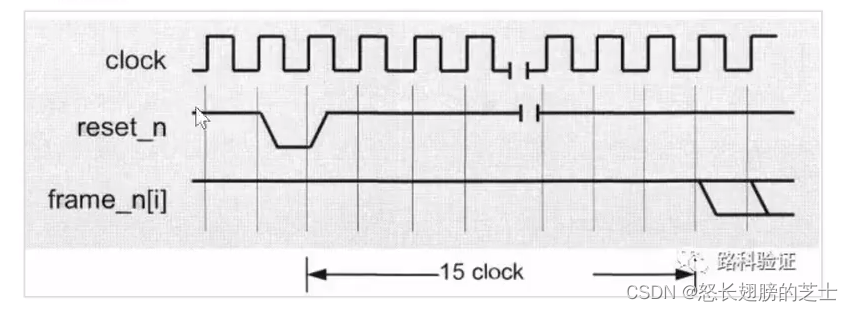
(reset_n既可以是同步信号也可是异步信号)
4、在初始化模块中(initial begin),调用reset()任务来重置DUT;
initial begin
$vcdpluson;
reset();
end
task reset();
router.reset_n <= 1'b0;
router.cb.frame_n <= '1;
router.cb.valid_n <= '1;
#2 router.cb.reset_n <= 1'b1;
repeat(15) @(router.cb);
endtask: reset
5、保存和关闭test.sv文件。
1、创建和打开router_test_top.sv文件;
2、 给Top文件中添加接口的实例化(instance);
router_io top_io(SystemClock);
3、实例化这个测试程序;
test t(top_io);
4、将待测试模块和top_io连在一起,实现DUT与Top的连接;
router dut(
.reset_n (top_io.reset_n),
.clock (top_io.clock),
.din (top_io.din),
.frame_n (top_io.frame_n),
.valid_n (top_io.valid_n),
.dout (top_io.dout),
.valido_n (top_io.valido_n),
.busy_n (top_io.busy_n),
.frameo_n(top_io.frameo_n)
);
5、添加`timescale和$timeformat;
`timescale 1ns/100ps
$timeformat(-9,1,"ns",10);
6、保存并关闭文件。
此时,一共有四个文件: 1、顶层(TOP)文件:router_test_top.sv
2、接口(interface)文件:router_io.sv
3、待测试(DUT)文件:router.v
4、测试(test.sv)文件:test.sv
接下来就将文件库中的文件进行编译和仿真。具体操作如下:
(1)建立项目:新建项目名称File -> New -> Project,在project name处填入名称;
(2)添加文件和编译:在project窗口单击右键,选择Add to Project -> Existing File,找到四个文件;
(3)编译文件;
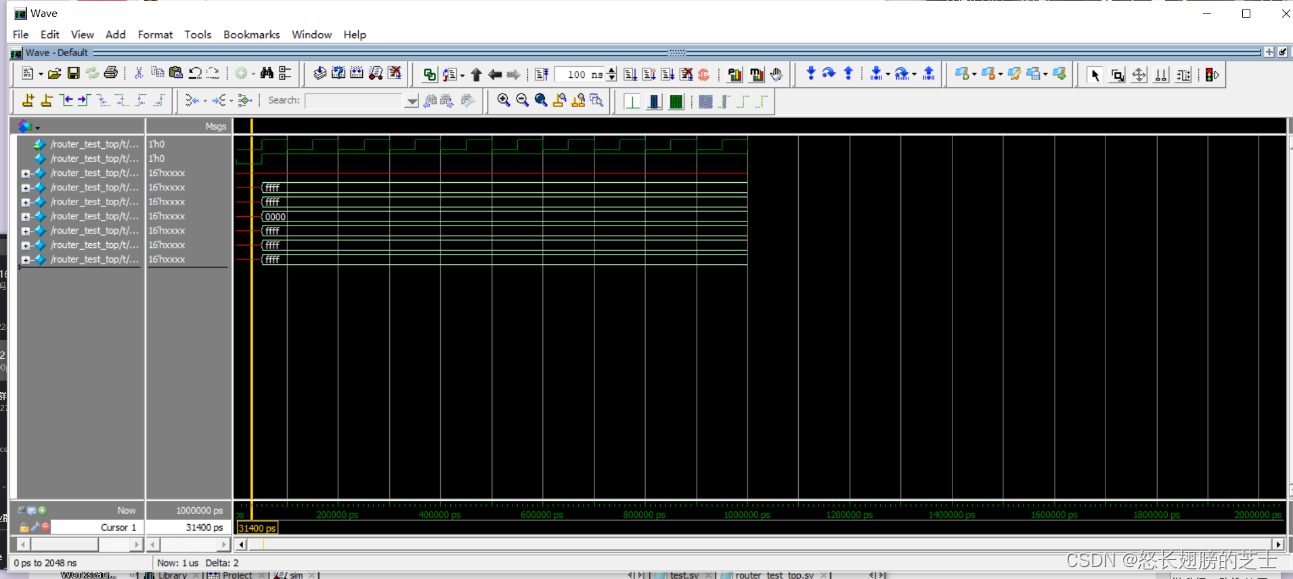
(4)仿真与添加波形:在Library -> Work中找到顶层router_test_top,点击右键选择“Simulate without Optimization”,这种仿真模式是为了消除仿真器可能会加入的一些优化处理。选中top_io,在objects一栏中可以看到它的端口和内部信号。接下来在instance ->router_test_top ->top_io上点击右键,选择Add Wave,这是为了在仿真时存储波形。在命令窗口中敲入命令“run 1us”或者在工具栏中运行1us。观察波形。
1、实验代码
(1)router_io.sv
`timescale 1ns/100ps
interface router_io(input bit clock); //声明由信号时钟摆位驱动的时钟,例化接口
logic reset_n; // 添加将测试程序连接到 DUT 所需的所有信号
logic [15:0] din; // 参数应列出时钟块和所有其他潜在的异步信号
logic [15:0] frame_n;
logic [15:0] valid_n;
logic [15:0] dout;
logic [15:0] valido_n;
logic [15:0] busy_n;
logic [15:0] frameo_n;
clocking cb @(posedge clock); // 声明一个由时钟上升沿驱动的时钟模块
default input #1ns output #1ns; // 相对于时钟的上升沿会有1ns的延迟
output reset_n; // 在时钟块中添加输入和输出
output din;
output frame_n;
output valid_n;
input dout;
input valido_n;
input busy_n;
input frameo_n;
endclocking: cb
modport TB(clocking cb,output reset_n); // 重新生成一个模块端口以连接到测试程序
endinterface: router_io 应列出时钟块和所有其他潜在的异步信号
(2) test.sv
`timescale 1ns/100ps
program automatic test(router_io.TB router); // 声明一个带有要连接的参数的程序块
以修改接口中声明的 TB
initial begin
$vcdpluson;
reset(); //在程序内部定义一个名为 reset() 的任务
end 以根据规范重置 DUT
task reset();
router.reset_n <= 1'b0; //给复位赋值0
router.cb.frame_n <= '1; //给时钟模块中的frame_n赋值1
router.cb.valid_n <= '1; //给时钟模块中的valid_n赋值1,此时不出传输数据
#2 router.cb.reset_n <= 1'b1; //延迟2us,给时钟模块中的复位赋值为1
注意#和##含义不同
repeat(15) @(router.cb); //等待15个有效时钟沿
endtask: reset
endprogram: test
(3) router_test_top.sv
`timescale 1ns/100ps
module router_test_top;
parameter simulation_cycle = 100; // 添加一个接口实例, 实例化测试程序
通过接口进行 I/O 连接
bit SystemClock;
router_io top_io(SystemClock); //调用底层函数
test t(top_io);
router dut( //修改 DUT 连接以通过接口连接
.reset_n (top_io.reset_n),
.clock (top_io.clock),
.din (top_io.din),
.frame_n (top_io.frame_n),
.valid_n (top_io.valid_n),
.dout (top_io.dout),
.valido_n (top_io.valido_n),
.busy_n (top_io.busy_n),
.frameo_n (top_io.frameo_n)
);
initial begin
$timeformat(-9,1,"ns",10); //精确到小数点后一位
SystemClock = 0; 以及显示数值的最小宽度为10,单位为n
forever begin
#(simulation_cycle/2)
SystemClock = ~SystemClock;
end
end
endmodule
2、仿真波形图
给定这段代码defcreate@upgrades=User.update_all(["role=?","upgraded"],:id=>params[:upgrade])redirect_toadmin_upgrades_path,:notice=>"Successfullyupgradeduser."end我如何在该操作中实际验证它们是否已保存或未重定向到适当的页面和消息? 最佳答案 在Rails3中,update_all不返回任何有意义的信息,除了已更新的记录数(这可能取决于您的DBMS是否返回该信息)。http://ar.ru
我想安装一个带有一些身份验证的私有(private)Rubygem服务器。我希望能够使用公共(public)Ubuntu服务器托管内部gem。我读到了http://docs.rubygems.org/read/chapter/18.但是那个没有身份验证-如我所见。然后我读到了https://github.com/cwninja/geminabox.但是当我使用基本身份验证(他们在他们的Wiki中有)时,它会提示从我的服务器获取源。所以。如何制作带有身份验证的私有(private)Rubygem服务器?这是不可能的吗?谢谢。编辑:Geminabox问题。我尝试“捆绑”以安装新的gem..
我希望我的UserPrice模型的属性在它们为空或不验证数值时默认为0。这些属性是tax_rate、shipping_cost和price。classCreateUserPrices8,:scale=>2t.decimal:tax_rate,:precision=>8,:scale=>2t.decimal:shipping_cost,:precision=>8,:scale=>2endendend起初,我将所有3列的:default=>0放在表格中,但我不想要这样,因为它已经填充了字段,我想使用占位符。这是我的UserPrice模型:classUserPrice回答before_val
我有一个表单,其中有很多字段取自数组(而不是模型或对象)。我如何验证这些字段的存在?solve_problem_pathdo|f|%>... 最佳答案 创建一个简单的类来包装请求参数并使用ActiveModel::Validations。#definedsomewhere,atthesimplest:require'ostruct'classSolvetrue#youcouldevencheckthesolutionwithavalidatorvalidatedoerrors.add(:base,"WRONG!!!")unlesss
我有一些非常大的模型,我必须将它们迁移到最新版本的Rails。这些模型有相当多的验证(User有大约50个验证)。是否可以将所有这些验证移动到另一个文件中?说app/models/validations/user_validations.rb。如果可以,有人可以提供示例吗? 最佳答案 您可以为此使用关注点:#app/models/validations/user_validations.rbrequire'active_support/concern'moduleUserValidationsextendActiveSupport:
当我的预订模型通过rake任务在状态机上转换时,我试图找出如何跳过对ActiveRecord对象的特定实例的验证。我想在reservation.close时跳过所有验证!叫做。希望调用reservation.close!(:validate=>false)之类的东西。仅供引用,我们正在使用https://github.com/pluginaweek/state_machine用于状态机。这是我的预订模型的示例。classReservation["requested","negotiating","approved"])}state_machine:initial=>'requested
我有一个服务模型/表及其注册表。在表单中,我几乎拥有服务的所有字段,但我想在验证服务对象之前自动设置其中一些值。示例:--服务Controller#创建Action:defcreate@service=Service.new@service_form=ServiceFormObject.new(@service)@service_form.validate(params[:service_form_object])and@service_form.saverespond_with(@service_form,location:admin_services_path)end在验证@ser
这里有一个很好的答案解释了如何在Ruby中下载文件而不将其加载到内存中:https://stackoverflow.com/a/29743394/4852737require'open-uri'download=open('http://example.com/image.png')IO.copy_stream(download,'~/image.png')我如何验证下载文件的IO.copy_stream调用是否真的成功——这意味着下载的文件与我打算下载的文件完全相同,而不是下载一半的损坏文件?documentation说IO.copy_stream返回它复制的字节数,但是当我还没有下
我正在尝试使用正则表达式验证美元金额:^[0-9]+\.[0-9]{2}$这工作正常,但每当用户提交表单并且美元金额以0(零)结尾时,ruby(或rails?)将0砍掉。所以500.00变成500.0,因此正则表达式验证失败。有没有办法让ruby/rails保持用户输入的格式,而不管尾随零? 最佳答案 我假设您的美元金额是小数类型。因此,用户在字段中输入的任何值在保存到数据库之前都会从字符串转换为适当的类型。验证适用于已转换为数字类型的值,因此在您的情况下,正则表达式并不是真正合适的验证过滤器。不过,您有几种可能性可以解决这个问
关于这个有很多问题,但似乎都没有帮助。是的,我看过thisrailscast.我有一个作者,他有很多书,像这样:作者:classAuthor书:classBook我创建了以下表单以在authors#show中向作者添加一本书:#labelsandbuttons......使用以下authors_controller方法:defshow@author=Author.find(params[:id])@book=@author.books.buildend...以及以下books_controller方法:defcreate@author=Author.find(params[:autho
