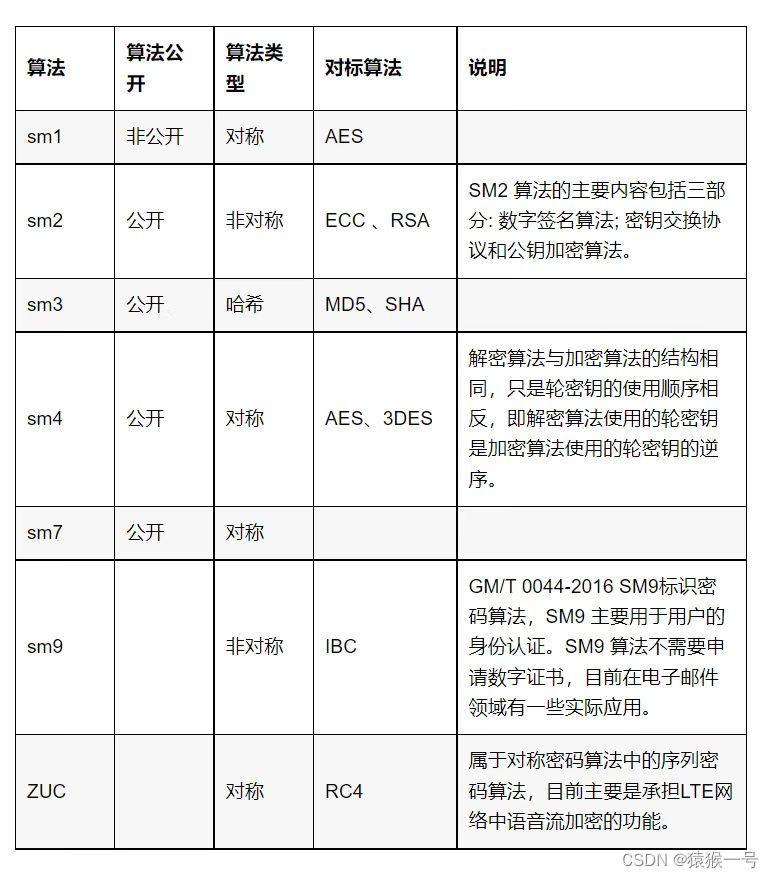
SM3密码杂凑算法是中国国家密码管理局2010年公布的中国商用密码杂凑算法标准。具体算法标准原始文本参见参考文献[1]。该算法于2012年发布为密码行业标准(GM/T 0004-2012),2016年发布为国家密码杂凑算法标准(GB/T 32905-2016)。
SM3适用于商用密码应用中的数字签名和验证,是在[SHA-256]基础上改进实现的一种算法,其安全性和SHA-256相当。SM3和MD5的迭代过程类似,也采用Merkle-Damgard结构。消息分组长度为512位,摘要值长度为256位。
整个算法的执行过程可以概括成四个步骤:消息填充、消息扩展、迭代压缩、输出结果。
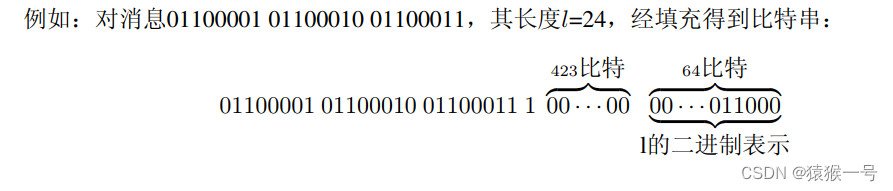
SM3的消息扩展步骤是以512位的数据分组作为输入的。因此,我们需要在一开始就把数据长度填充至512位的倍数。数据填充规则和MD5一样,具体步骤如下:
1、先填充一个“1”,后面加上k个“0”。其中k是满足(n+1+k) mod 512 = 448的最小正整数。
2、追加64位的数据长度(bit为单位,大端序存放1。观察算法标准原文附录A运算示例可以推知。)
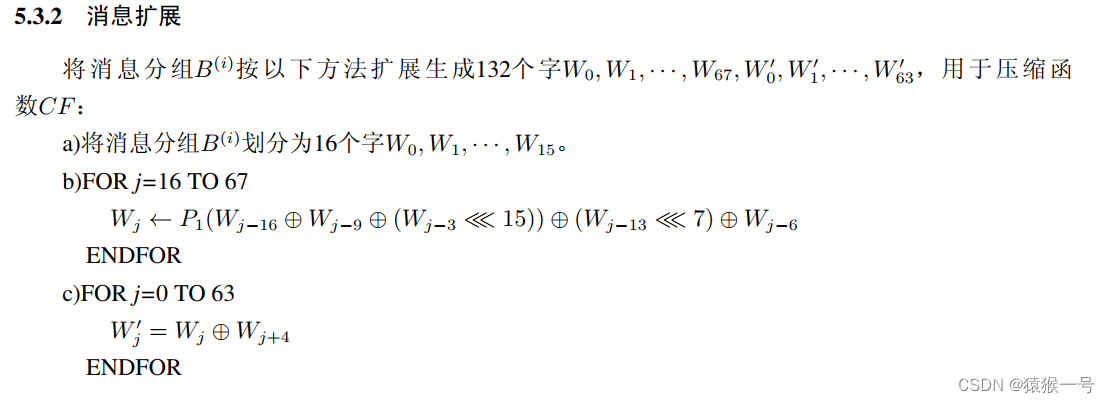
SM3的迭代压缩步骤没有直接使用数据分组进行运算,而是使用这个步骤产生的132个消息字。(一个消息字的长度为32位/4个字节/8个16j进制数字)概括来说,先将一个512位数据分组划分为16个消息字,并且作为生成的132个消息字的前16个。再用这16个消息字递推生成剩余的116个消息字。
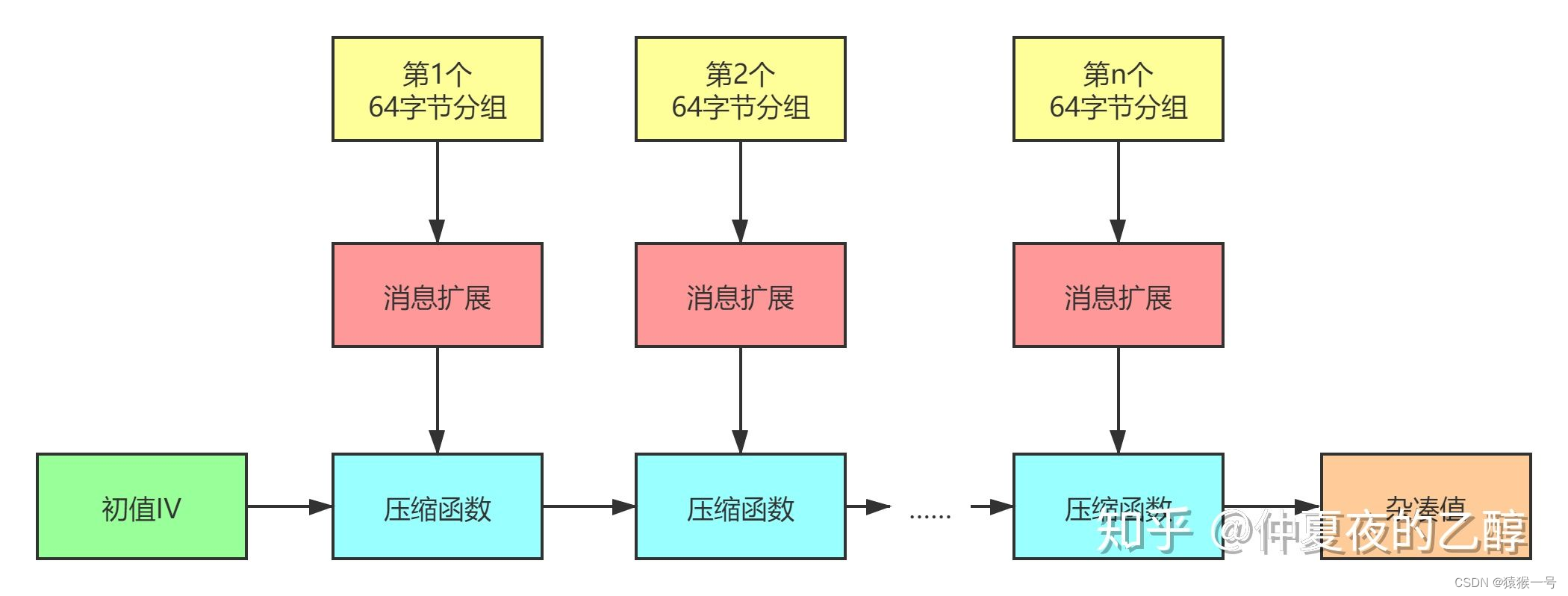
SM3的迭代过程和MD5类似,也是Merkle-Damgard结构。但和MD5不同的是,SM3使用消息扩展得到的消息字进行运算。这个迭代过程可以用这幅图表示:
初值IV被放在A、B、C、D、E、F、G、H八个32位变量中,其具体数值参见参考文献[1]。整个算法中最核心、也最复杂的地方就在于压缩函数。压缩函数将这八个变量进行64轮相同的计算,一轮的计算过程如下图所示:

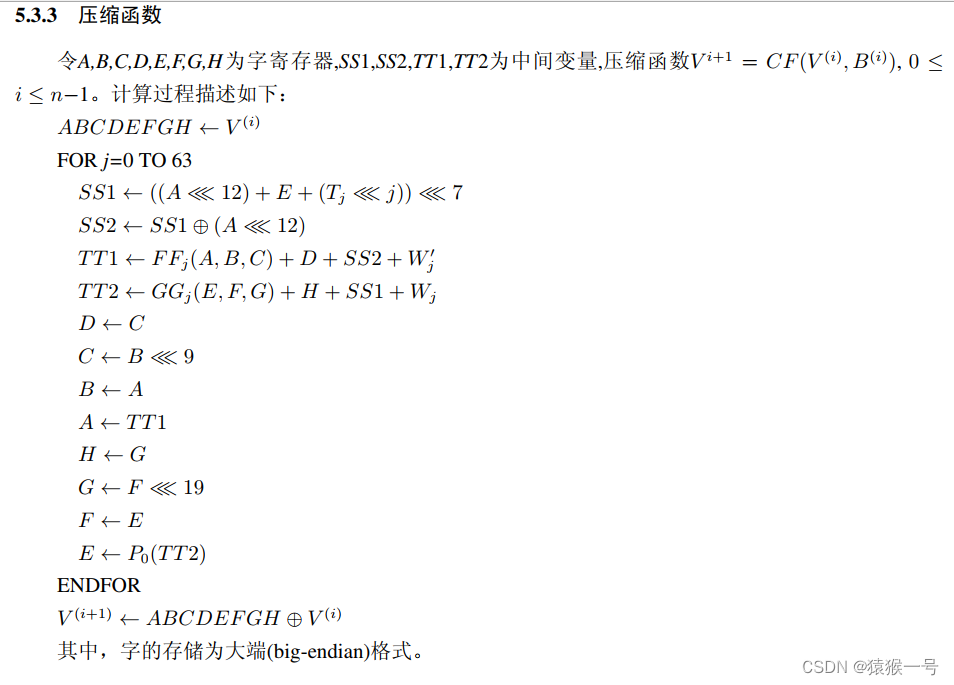
图中不同的数据流向用不同颜色的箭头表示。
最后,再将计算完成的A、B、C、D、E、F、G、H和原来的A、B、C、D、E、F、G、H分别进行异或,就是压缩函数的输出。这个输出再作为下一次调用压缩函数时的初值。依次类推,直到用完最后一组132个消息字为止。
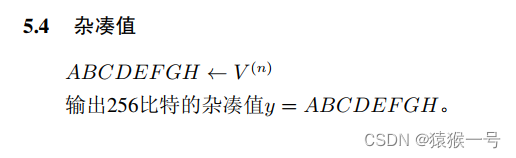
将得到的A、B、C、D、E、F、G、H八个变量拼接输出,就是SM3算法的输出。
<!-- https://mvnrepository.com/artifact/org.bouncycastle/bcprov-jdk15on -->
<dependency>
    <groupId>org.bouncycastle</groupId>
    <artifactId>bcprov-jdk15on</artifactId>
    <version>1.70</version>
</dependency>
private static final String ENCODING = "UTF-8";
    /**
     * 加密
     *
     * @param src 明文
     * @param key 密钥
     * @return
     * @throws Exception
     */
    public static String encrypt(String src, String key) throws Exception {
        return ByteUtils.toHexString(getEncryptByKey(src, key));
    }


    /**
     * SM3加密方式之: 根据自定义密钥进行加密,返回加密后长度为32位的16进制字符串
     *
     * @param src 源数据
     * @param key 密钥
     * @return 加密后长度为32位的16进制字符串
     * @throws Exception
     */
    public static byte[] getEncryptByKey(String src, String key) throws Exception {
        byte[] srcByte = src.getBytes(ENCODING);
        byte[] keyByte = key.getBytes(ENCODING);
        KeyParameter keyParameter = new KeyParameter(keyByte);
        SM3Digest sm3 = new SM3Digest();
        HMac hMac = new HMac(sm3);
        hMac.init(keyParameter);
        hMac.update(srcByte, 0, srcByte.length);
        byte[] result = new byte[hMac.getMacSize()];
        hMac.doFinal(result, 0);
        return result;
    }


    /**
     * 利用源数据+密钥校验与密文是否一致
     *
     * @param src       源数据
     * @param key       密钥
     * @param sm3HexStr 密文
     * @return
     * @throws Exception
     */
    public static boolean verify(String src, String key, String sm3HexStr) throws Exception {
        byte[] sm3HashCode = ByteUtils.fromHexString(sm3HexStr);
        byte[] newHashCode = getEncryptByKey(src, key);
        return Arrays.equals(newHashCode, sm3HashCode);
    }


    /**
     * SM3加密方式之:不提供密钥的方式 SM3加密,返回加密后长度为64位的16进制字符串
     *
     * @param src 明文
     * @return 加密后长度为64位的16进制字符串
     */
    public static String encrypt(String src) {
        return ByteUtils.toHexString(getEncryptBySrcByte(src.getBytes()));
    }

    /**
     * 返回长度为32位的加密后的byte数组
     *
     * @param srcByte
     * @return
     */
    public static byte[] getEncryptBySrcByte(byte[] srcByte) {
        SM3Digest sm3 = new SM3Digest();
        sm3.update(srcByte, 0, srcByte.length);
        byte[] encryptByte = new byte[sm3.getDigestSize()];
        sm3.doFinal(encryptByte, 0);
        return encryptByte;
    }


    /**
     * 校验源数据与加密数据是否一致
     *
     * @param src       源数据
     * @param sm3HexStr 16进制的加密数据
     * @return
     * @throws Exception
     */
    public static boolean verify(String src, String sm3HexStr) throws Exception {
        byte[] sm3HashCode = ByteUtils.fromHexString(sm3HexStr);
        byte[] newHashCode = getEncryptBySrcByte(src.getBytes(ENCODING));
        return Arrays.equals(newHashCode, sm3HashCode);
    }


public static void main(String[] args) throws Exception {
        String srcStr = "今天天气很晴朗";
        String key = "zjqzjq";
        // ******************************自定义密钥加密及校验*****************************************
        String hexStrByKey = SM3Utils.encrypt(srcStr, key);
        System.out.println("带密钥加密后的密文:" + hexStrByKey);

        System.out.println("明文(带密钥)与密文校验结果:" + SM3Utils.verify(srcStr, key, hexStrByKey));

        // ******************************无密钥的加密及校验******************************************
        String hexStrNoKey = SM3Utils.encrypt(srcStr);
        System.out.println("不带密钥加密后的密文:" + hexStrNoKey);

        System.out.println("明文(不带密钥)与密文校验结果:" + SM3Utils.verify(srcStr, hexStrNoKey));

    }
import java.io.ByteArrayOutputStream;
import java.io.File;
import java.io.FileInputStream;
import java.io.FileNotFoundException;
import java.io.IOException;
import java.io.InputStream;
import java.math.BigInteger;
import java.util.Arrays;

import ltd.snowland.utils.NumberTool;
import ltd.snowland.utils.StreamTool;

/**
 * SM3杂凑算法实现
 *
 * @author Potato
 *
 */
public class SM3 {

	private static char[] hexDigits = { '0', '1', '2', '3', '4', '5', '6', '7', '8', '9', 'A', 'B', 'C', 'D', 'E',
			'F' };
	private static final String ivHexStr = "7380166f 4914b2b9 172442d7 da8a0600 a96f30bc 163138aa e38dee4d b0fb0e4e";
	private static final BigInteger IV = new BigInteger(ivHexStr.replaceAll(" ", ""), 16);
	private static final Integer Tj15 = Integer.valueOf("79cc4519", 16);
	private static final Integer Tj63 = Integer.valueOf("7a879d8a", 16);
	private static final byte[] FirstPadding = { (byte) 0x80 };
	private static final byte[] ZeroPadding = { (byte) 0x00 };

	private static int T(int j) {
		if (j >= 0 && j <= 15) {
			return Tj15.intValue();
		} else if (j >= 16 && j <= 63) {
			return Tj63.intValue();
		} else {
			throw new RuntimeException("data invalid");
		}
	}

	private static Integer FF(Integer x, Integer y, Integer z, int j) {
		if (j >= 0 && j <= 15) {
			return Integer.valueOf(x.intValue() ^ y.intValue() ^ z.intValue());
		} else if (j >= 16 && j <= 63) {
			return Integer.valueOf(
					(x.intValue() & y.intValue()) | (x.intValue() & z.intValue()) | (y.intValue() & z.intValue()));
		} else {
			throw new RuntimeException("data invalid");
		}
	}

	private static Integer GG(Integer x, Integer y, Integer z, int j) {
		if (j >= 0 && j <= 15) {
			return Integer.valueOf(x.intValue() ^ y.intValue() ^ z.intValue());
		} else if (j >= 16 && j <= 63) {
			return Integer.valueOf((x.intValue() & y.intValue()) | (~x.intValue() & z.intValue()));
		} else {
			throw new RuntimeException("data invalid");
		}
	}

	private static Integer P0(Integer x) {
		return Integer
				.valueOf(x.intValue() ^ Integer.rotateLeft(x.intValue(), 9) ^ Integer.rotateLeft(x.intValue(), 17));
	}

	private static Integer P1(Integer x) {
		return Integer
				.valueOf(x.intValue() ^ Integer.rotateLeft(x.intValue(), 15) ^ Integer.rotateLeft(x.intValue(), 23));
	}

	private static byte[] padding(byte[] source) throws IOException {
		if (source.length >= 0x2000000000000000l) {
			throw new RuntimeException("src data invalid.");
		}
		long l = source.length * 8;
		long k = 448 - (l + 1) % 512;
		if (k < 0) {
			k = k + 512;
		}
		ByteArrayOutputStream baos = new ByteArrayOutputStream();
		baos.write(source);
		baos.write(FirstPadding);
		long i = k - 7;
		while (i > 0) {
			baos.write(ZeroPadding);
			i -= 8;
		}
		baos.write(long2bytes(l));
		return baos.toByteArray();
	}

	private static byte[] long2bytes(long l) {
		byte[] bytes = new byte[8];
		for (int i = 0; i < 8; i++) {
			bytes[i] = (byte) (l >>> ((7 - i) * 8));
		}
		return bytes;
	}

	public static byte[] hash(byte[] source) throws IOException {
		byte[] m1 = padding(source);
		int n = m1.length / (512 / 8);
		byte[] b;
		byte[] vi = IV.toByteArray();
		byte[] vi1 = null;
		for (int i = 0; i < n; i++) {
			b = Arrays.copyOfRange(m1, i * 64, (i + 1) * 64);
			vi1 = CF(vi, b);
			vi = vi1;
		}
		return vi1;
	}

	public static byte[] hash(String source) throws Exception {
		return hash(source.getBytes());
	}

	public static byte[] hash(File file) throws Exception {
		if (file.exists()) {
			InputStream inStream = new FileInputStream(file);
			return hash(StreamTool.readInputStream2ByteArray(inStream));
		} else {
			throw new FileNotFoundException();
		}
	}

	private static byte[] CF(byte[] vi, byte[] bi) throws IOException {
		int a, b, c, d, e, f, g, h;
		a = toInteger(vi, 0);
		b = toInteger(vi, 1);
		c = toInteger(vi, 2);
		d = toInteger(vi, 3);
		e = toInteger(vi, 4);
		f = toInteger(vi, 5);
		g = toInteger(vi, 6);
		h = toInteger(vi, 7);

		int[] w = new int[68];
		int[] w1 = new int[64];
		for (int i = 0; i < 16; i++) {
			w[i] = toInteger(bi, i);
		}
		for (int j = 16; j < 68; j++) {
			w[j] = P1(w[j - 16] ^ w[j - 9] ^ Integer.rotateLeft(w[j - 3], 15)) ^ Integer.rotateLeft(w[j - 13], 7)
					^ w[j - 6];
		}
		for (int j = 0; j < 64; j++) {
			w1[j] = w[j] ^ w[j + 4];
		}
		int ss1, ss2, tt1, tt2;
		for (int j = 0; j < 64; j++) {
			ss1 = Integer.rotateLeft(Integer.rotateLeft(a, 12) + e + Integer.rotateLeft(T(j), j), 7);
			ss2 = ss1 ^ Integer.rotateLeft(a, 12);
			tt1 = FF(a, b, c, j) + d + ss2 + w1[j];
			tt2 = GG(e, f, g, j) + h + ss1 + w[j];
			d = c;
			c = Integer.rotateLeft(b, 9);
			b = a;
			a = tt1;
			h = g;
			g = Integer.rotateLeft(f, 19);
			f = e;
			e = P0(tt2);
		}
		byte[] v = toByteArray(a, b, c, d, e, f, g, h);
		for (int i = 0; i < v.length; i++) {
			v[i] = (byte) (v[i] ^ vi[i]);
		}
		return v;
	}

	private static int toInteger(byte[] source, int index) {
		StringBuilder valueStr = new StringBuilder("");
		for (int i = 0; i < 4; i++) {
			valueStr.append(hexDigits[(byte) ((source[index * 4 + i] & 0xF0) >> 4)]);
			valueStr.append(hexDigits[(byte) (source[index * 4 + i] & 0x0F)]);
		}
		return Long.valueOf(valueStr.toString(), 16).intValue();

	}

	private static byte[] toByteArray(int a, int b, int c, int d, int e, int f, int g, int h) throws IOException {
		ByteArrayOutputStream baos = new ByteArrayOutputStream(32);
		baos.write(toByteArray(a));
		baos.write(toByteArray(b));
		baos.write(toByteArray(c));
		baos.write(toByteArray(d));
		baos.write(toByteArray(e));
		baos.write(toByteArray(f));
		baos.write(toByteArray(g));
		baos.write(toByteArray(h));
		return baos.toByteArray();
	}

	public static byte[] toByteArray(int i) {
		byte[] byteArray = new byte[4];
		byteArray[0] = (byte) (i >>> 24);
		byteArray[1] = (byte) ((i & 0xFFFFFF) >>> 16);
		byteArray[2] = (byte) ((i & 0xFFFF) >>> 8);
		byteArray[3] = (byte) (i & 0xFF);
		return byteArray;
	}

	private static String byteToHexString(byte b) {
		int n = b;
		if (n < 0)
			n = 256 + n;
		int d1 = n / 16;
		int d2 = n % 16;
		return "" + hexDigits[d1] + hexDigits[d2];
	}

	public static String byteArrayToHexString(byte[] b) {
		StringBuffer resultSb = new StringBuffer();
		for (int i = 0; i < b.length; i++) {
			resultSb.append(byteToHexString(b[i]));
		}
		return resultSb.toString();
	}

	public static String hashHex(byte[] b) {
		try {
			return SM3.byteArrayToHexString(SM3.hash(b));
		} catch (IOException e) {
			e.printStackTrace();
		}
		return null;
	}

	public static String hashHex(String str) {
		return hashHex(str.getBytes());
	}

	public static void main(String[] args) throws IOException {
		System.out.println(SM3.byteArrayToHexString(SM3.hash("abc".getBytes())));
	}
}
目录一.加解密算法数字签名对称加密DES(DataEncryptionStandard)3DES(TripleDES)AES(AdvancedEncryptionStandard)RSA加密法DSA(DigitalSignatureAlgorithm)ECC(EllipticCurvesCryptography)非对称加密签名与加密过程非对称加密的应用对称加密与非对称加密的结合二.数字证书图解一.加解密算法加密简单而言就是通过一种算法将明文信息转换成密文信息,信息的的接收方能够通过密钥对密文信息进行解密获得明文信息的过程。根据加解密的密钥是否相同,算法可以分为对称加密、非对称加密、对称加密和非
我已经在mountainlion上成功安装了rbenv和rubybuild。运行rbenvinstall1.9.3-p392结束于:校验和不匹配:ruby-1.9.3-p392.tar.gz(文件已损坏)预期f689a7b61379f83cbbed3c7077d83859,得到1cfc2ff433dbe80f8ff1a9dba2fd5636它正在下载的文件看起来没问题,如果我使用curl手动下载文件,我会得到同样不正确的校验和。有没有人遇到过这个?他们是如何解决的? 最佳答案 tl:博士;使用浏览器从http://ftp.rub
我需要尝试一些AES片段。我有一些密文c和一个keyk。密文已使用AES-CBC加密,并在前面加上IV。不存在填充,纯文本的长度是16的倍数。所以我这样做:aes=OpenSSL::Cipher::Cipher.new("AES-128-CCB")aes.decryptaes.key=kaes.iv=c[0..15]aes.update(c[16..63])+aes.final它工作得很好。现在我需要手动执行CBC模式,所以我需要单个block的“普通”AES解密。我正在尝试这个:aes=OpenSSL::Cipher::Cipher.new("AES-128-ECB")aes.dec
我在加密来self正在使用的第三方供应商的值时遇到问题。他们的指令如下:1)Converttheencryptionpasswordtoabytearray.2)Convertthevaluetobeencryptedtoabytearray.3)Theentirelengthofthearrayisinsertedasthefirstfourbytesontothefrontofthefirstblockoftheresultantbytearraybeforeencryption.4)EncryptthevalueusingAESwith:1.256-bitkeysize,2.25
root@li417-132:~#rvmpkginstallzlibFetchingzlib-1.2.7.tar.gzto/usr/local/rvm/archivesThereisnochecksumfor'http://prdownloads.sourceforge.net/libpng/zlib-1.2.7.tar.gz'or'zlib-1.2.7.tar.gz',it'snotpossibletovalidateit.Ifyouwishtocontinuewithunverifieddownloadadd'--verify-downloads1'afterthecommand.
首先,关于我们系统的一些信息,它基本上是建筑行业的电子招标解决方案。所以:列表项我们的系统有多家公司每个公司都有多个用户每家公司可以创建多个拍卖然后其他公司可以为可用的拍卖提交他们的出价。一个出价包含数百或数千个单独的项目,我们只需要加密这些记录的“价格”部分。我们面临的问题是,我们的大客户不希望我们知道投标价格,至少在投标过程中是这样,这是完全可以理解的。现在,我们只是通过对称加密对价格进行加密,因此即使价格在数据库中有效加密,他们担心的是我们拥有解密价格的key。因此,我们正在研究某种形式的公钥加密系统。以下是我们对解决方案的初步想法:当一家公司注册时,我们会使用OpenSSL为其
我正在尝试对某些帖子的评论使用简单的身份验证。用户使用即时ID和密码输入评论我使用“bcrypt”gem将密码存储在数据库中。在comments_controller.rb中像这样@comment=Comment.new(comment_params)bcrypted_pwd=BCrypt::Password.create(@comment.user_pwd)@comment.user_pwd=bcrypted_pwd当用户想要删除他们的评论时,我使用data-confirm-modalgem来确认数据在这部分,我必须解密用户输入的密码以与数据库中的加密密码进行比较我怎样才能解密密码,
我在Rails中有一个具有以下方法的应用程序,该方法可以加密和解密文本并与Java客户端通信。defencrypt(string,key)cipher=OpenSSL::Cipher::AES.new(128,:CBC)cipher.encryptcipher.padding=1cipher.key=hex_to_bin(Digest::SHA1.hexdigest(key)[0..32])cipher_text=cipher.update(string)cipher_textexcenddefhex_to_bin(str)[str].pack"H*"enddefbin_to_hex(
gem串口(1.0.4)作者:GuillaumePierronnet、AlanStern、DanielE.Shipton、Tobin理查德、赫克托·帕拉、瑞安·C·佩恩首页:http://github.com/hparra/ruby-serialport/使用RS-232串行端口的库。我正在使用这个gem,我的设备规范如下。9600bps7位1个停止位偶数当我收到如下数据时,解压后的数据仍然带有奇偶校验位。sp=SerialPort.new("/dev/serial-device",9600,7,1,SerialPort::EVEN)data=sp.getsdata.chars.eac
我正在考虑使用attr_encrypted在Rails应用程序中用于字段级加密的gem。如何生成用于此gem的加密key?更新:Encryptor的文档,它是attr_encrypted使用的底层加密,声明如下(在Usage|Basic下):secret_key=Digest::SHA256.hexdigest('asecretkey')encrypted_value=Encryptor.encrypt('somestringtoencrypt',:key=>secret_key)我猜想key可以是任意长度的随机字符串,而对hexdigest的调用将从中计算出适当的固定长度字符串。这是
