《编译原理(第三版)》陈意云著
叙述由下列正规式描述的语言
0 ( 0 ∣ 1 ) ∗ 0 \space\space0\space\space(\space\space 0\space\space |\space\space 1\space\space)^{\space*\space\space}0 0 ( 0 ∣ 1 ) ∗ 0
正规式规定开头和结尾必须包括0,中间由0或1的闭包构成,可以看出该正规式描述的语言包含的串长度至少为2,所以总结为:以0开头和结尾的长度至少是2的串01.
( ( ε ∣ 0 ) 1 ∗ ) ∗ \space\space(\space\space (\space\space \varepsilon\space\space|\space\space0\space\space)\space\space1^{\space*\space\space}) ^{\space*} ( ( ε ∣ 0 ) 1 ∗ ) ∗
内层括号中是对空和0的选择,再与外面的1的闭包相连接,可能构成的串有: ε \varepsilon ε、 1 1 1、 1...1 1...1 1...1 、 0 0 0、 01 01 01、 01...1 01...1 01...1,再加上外层的闭包,可以让 0 0 0 的个数变成任意多且可以为空串的闭包,所以总结为:所有的01串(包含空串).
( 0 ∣ 1 ) ∗ 0 ( 0 ∣ 1 ) ( 0 ∣ 1 ) \space\space(\space\space0\space\space|\space\space1\space\space)^{\space*\space\space}0\space\space(\space\space0\space\space|\space\space1\space\space)\space\space(\space\space0\space\space|\space\space1\space\space) ( 0 ∣ 1 ) ∗ 0 ( 0 ∣ 1 ) ( 0 ∣ 1 )
0 ( 0 ∣ 1 ) ( 0 ∣ 1 ) 0\space\space(\space\space0\space\space|\space\space1\space\space)\space\space(\space\space0\space\space|\space\space1\space\space) 0 ( 0 ∣ 1 ) ( 0 ∣ 1 )描述了长度为3,第一位为0的01串,在前面加上0或1的闭包使得串可以以任意二进制或空开头,所以结论为:至少包括三位且倒数第三位是0的01串.
0 ∗ 10 ∗ 10 ∗ 10 ∗ \space\space0\space^*\space10\space^*\space10\space^*\space10\space^* 0 ∗ 10 ∗ 10 ∗ 10 ∗
三个1是必然存在于串中的,而剩下0的闭包则说明0的个数为任意多,所以结论为:含有三个1的01串.
( 00 ∣ 11 ) ∗ ( ( 01 ∣ 10 ) ( 00 ∣ 11 ) ∗ ( 01 ∣ 10 ) ( 00 ∣ 11 ) ∗ ) ∗ \space\space(\space\space00\space\space|\space\space11\space\space)\space^*\space\space(\space\space(\space\space01\space\space|\space\space10\space\space)\space\space(\space\space00\space\space|\space\space11\space\space)\space^*\space\space(\space\space01\space\space|\space\space10\space\space)\space\space(\space\space00\space\space|\space\space11\space\space)\space^*\space\space)\space^* ( 00 ∣ 11 ) ∗ ( ( 01 ∣ 10 ) ( 00 ∣ 11 ) ∗ ( 01 ∣ 10 ) ( 00 ∣ 11 ) ∗ ) ∗
第一个闭包可以选择00或11,后面的两个内层闭包所描述的语言与第一个闭包相同,外层闭包让其内部的串可以出现任意次。由于该正规式过于复杂,所以可以将其描述的语言简单概括为:含有偶数(含0个)个0和偶数(含0个)个1的01串.
为下列语言写出正规定义
包含5个元音的所有字母串,其中每个元音只出现一次且按顺序排列。
不含五个元音的任意字符: [ B − D F − H J − N P − T V − Z b − d f − h j − n p − t v − z ] [B-DF-HJ-NP-TV-Zb-df-hj-np-tv-z] [B−DF−HJ−NP−TV−Zb−df−hj−np−tv−z],记为 α \alpha α
故, α ∗ ( a ∣ A ) α ∗ ( e ∣ E ) α ∗ ( i ∣ I ) α ∗ ( o ∣ O ) α ∗ ( u ∣ U ) α ∗ \alpha\space^*\space\space(\space\space a\space\space|\space\space A\space\space)\space\space\alpha\space^*\space\space(\space\space e\space\space|\space\space E\space\space)\space\space\alpha\space^*\space\space(\space\space i\space\space|\space\space I\space\space)\space\space\alpha\space^*\space\space(\space\space o\space\space|\space\space O)\space\space\alpha\space^*\space\space(\space\space u\space\space|\space\space U\space\space)\space\space \alpha\space^* α ∗ ( a ∣ A ) α ∗ ( e ∣ E ) α ∗ ( i ∣ I ) α ∗ ( o ∣ O) α ∗ ( u ∣ U ) α ∗
按词典序排列的所有字母串。
A ∗ a ∗ B ∗ b ∗ . . . Z ∗ z ∗ A\space^*\space\space a\space^*\space\space B\space^*\space\space b\space^*\space\space...\space\space Z\space^*\space\space z\space^* A ∗ a ∗ B ∗ b ∗ ... Z ∗ z ∗
某语言的注释,它是以 / ∗ /* /∗开始并以 ∗ / */ ∗/结束的任意字符串,但它的任何前缀(本身除外)不以 ∗ / */ ∗/结尾。
不含 / / /, ∗ * ∗的任意字符记为 α \alpha α
不含 ∗ / */ ∗/的任意字符串可以表示为 ( ∗ ∗ α + / ∗ ) ∗ (*^*\alpha^+/^*)^* (∗∗α+/∗)∗
故, / ∗ ( ∗ ∗ α + / ∗ ) ∗ ∗ / /*(*^*\alpha^+/^*)^**/ /∗(∗∗α+/∗)∗∗/
相邻数字都不相同的所有数字串。
最多只有一处相邻数字相同的所有数字串。
由偶数个0和偶数个1组成的所有01串。
( 00 ∣ 11 ) ∗ ( ( 01 ∣ 10 ) ( 00 ∣ 11 ) ∗ ( 01 ∣ 10 ) ( 00 ∣ 11 ) ∗ ) ∗ (\space\space00\space\space|\space\space11\space\space)\space^*\space\space(\space\space(\space\space01\space\space|\space\space10\space\space)\space\space(\space\space00\space\space|\space\space11\space\space)\space^*\space\space(\space\space01\space\space|\space\space10\space\space)\space\space(\space\space00\space\space|\space\space11\space\space)\space^*\space\space)\space^* ( 00 ∣ 11 ) ∗ ( ( 01 ∣ 10 ) ( 00 ∣ 11 ) ∗ ( 01 ∣ 10 ) ( 00 ∣ 11 ) ∗ ) ∗
由偶数个0和奇数个1组成的所有01串。
1 ( 00 ∣ 11 ) ∗ ( ( 01 ∣ 10 ) ( 00 ∣ 11 ) ∗ ( 01 ∣ 10 ) ( 00 ∣ 11 ) ∗ ) ∗ 1\space\space(\space\space00\space\space|\space\space11\space\space)\space^*\space\space(\space\space(\space\space01\space\space|\space\space10\space\space)\space\space(\space\space00\space\space|\space\space11\space\space)\space^*\space\space(\space\space01\space\space|\space\space10\space\space)\space\space(\space\space00\space\space|\space\space11\space\space)\space^*\space\space)\space^* 1 ( 00 ∣ 11 ) ∗ ( ( 01 ∣ 10 ) ( 00 ∣ 11 ) ∗ ( 01 ∣ 10 ) ( 00 ∣ 11 ) ∗ ) ∗
不含字串011的01串。
( 1 ∗ ( 0 + 1 ) ∗ ) 0 ∗ (\space\space1\space^*\space\space(\space\space 0\space^+\space\space1\space\space)\space^*\space\space)\space\space0\space^* ( 1 ∗ ( 0 + 1 ) ∗ ) 0 ∗
字母表 { a , b } \{a, b\} {a,b}上, a a a不会相邻出现的所有串。
b ∗ ( a ? b + ) ∗ a ? b\space^*\space\space(\space\space a\space?\space\space b\space^+\space\space)\space^*\space\space a\space? b ∗ ( a ? b + ) ∗ a ?
用算法 2.4 为下列正规式构造不确定有限自动机,给出它们处理输入串 a b a b b a b ababbab ababbab 的状态转化序列
方式一:(算法 2.4)
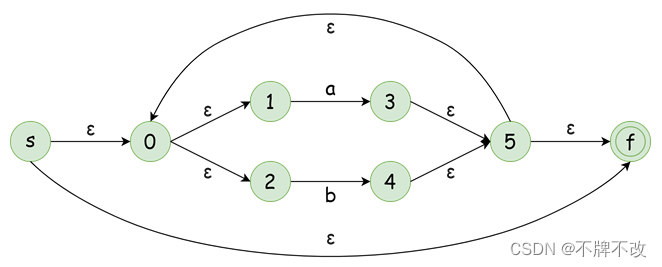
a b a b b a b : s → 0 → 1 → 3 → 5 → 0 → 2 → 4 → 5 → 0 → 1 → 3 → 5 → 0 → 2 → 4 → 5 → 0 → 2 → 4 → 5 → 0 → 1 → 3 → 5 → 0 → 2 → 4 → 5 → f ababbab\space\space :\space\space s\rightarrow0\rightarrow1\rightarrow3\rightarrow5\rightarrow0\rightarrow2\rightarrow4\rightarrow5\rightarrow0\rightarrow1\rightarrow3\rightarrow5\rightarrow0\rightarrow2\\\space\space\space\space\space\space\space\space\space\space\space\space\space\space\space\space\space\space\space\space\space\space\space\space\space\space\space\space\space\rightarrow4\rightarrow5\rightarrow0\rightarrow2\rightarrow4\rightarrow5\rightarrow0\rightarrow1\rightarrow3\rightarrow5\rightarrow0\rightarrow2\rightarrow4\rightarrow5\rightarrow f ababbab : s→0→1→3→5→0→2→4→5→0→1→3→5→0→2 →4→5→0→2→4→5→0→1→3→5→0→2→4→5→f
方式二:(分裂法)
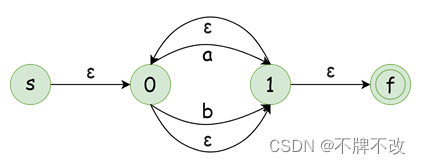
a b a b b a b : s → 0 → 1 → 0 → 1 → 0 → 1 → 0 → 1 → 0 → 1 → 0 → 1 → 0 → 1 → f ababbab\space\space :\space\space s\rightarrow0\rightarrow1\rightarrow0\rightarrow1\rightarrow0\rightarrow1\rightarrow0\rightarrow1\rightarrow0\rightarrow1\rightarrow0\rightarrow1\rightarrow0\rightarrow1\rightarrow f ababbab : s→0→1→0→1→0→1→0→1→0→1→0→1→0→1→f
方式三:
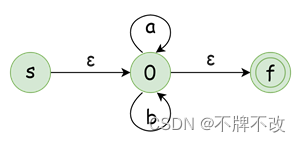
a b a b b a b : s → 0 → 0 → 0 → 0 → 0 → 0 → 0 → 0 → f ababbab\space\space :\space\space s\rightarrow0\rightarrow0\rightarrow0\rightarrow0\rightarrow0\rightarrow0\rightarrow0\rightarrow0\rightarrow f ababbab : s→0→0→0→0→0→0→0→0→f
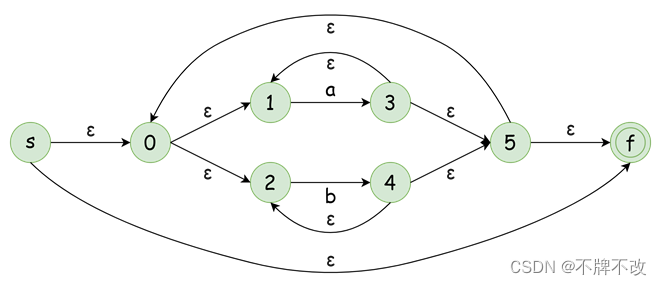
a b a b b a b : s → 0 → 1 → 3 → 5 → 0 → 2 → 4 → 5 → 0 → 1 → 3 → 5 → 0 → 2 → 4 → 2 → 4 → 5 → 0 → 1 → 3 → 5 → 0 → 2 → 4 → 4 → f ababbab\space\space :\space\space s\rightarrow0\rightarrow1\rightarrow3\rightarrow5\rightarrow0\rightarrow2\rightarrow4\rightarrow5\rightarrow0\rightarrow1\rightarrow3\rightarrow5\rightarrow0\\\space\space\space\space\space\space\space\space\space\space\space\space\space\space\space\space\space\space\space\space\space\space\space\space\space\space\space\space\space\space\rightarrow2\rightarrow4\rightarrow2\rightarrow4\rightarrow5\rightarrow0\rightarrow1\rightarrow3\rightarrow5\rightarrow0\rightarrow2\rightarrow4\rightarrow4\rightarrow f ababbab : s→0→1→3→5→0→2→4→5→0→1→3→5→0 →2→4→2→4→5→0→1→3→5→0→2→4→4→f
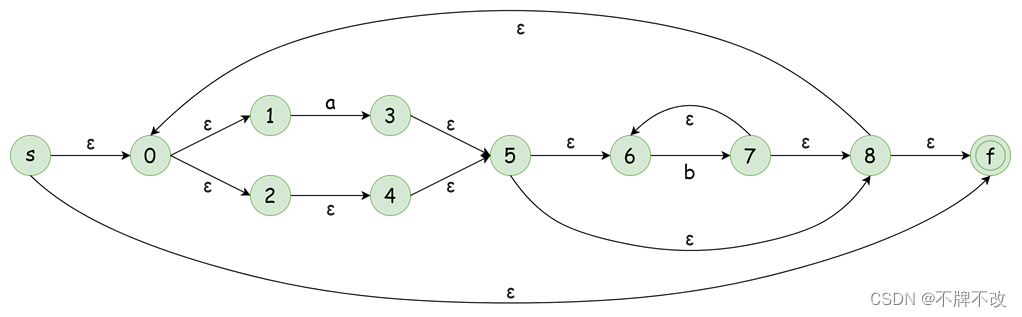
a b a b b a b : s → 0 → 1 → 3 → 5 → 6 → 7 → 8 → 0 → 1 → 3 → 5 → 6 → 7 → 6 → 7 → 8 → 0 → 1 → 3 → 5 → 6 → 7 → 8 → f ababbab\space\space :\space\space s\rightarrow0\rightarrow1\rightarrow3\rightarrow5\rightarrow6\rightarrow7\rightarrow8\rightarrow0\rightarrow1\rightarrow3\rightarrow5\rightarrow6\\\space\space\space\space\space\space\space\space\space\space\space\space\space\space\space\space\space\space\space\space\space\space\rightarrow7\rightarrow6\rightarrow7\rightarrow8\rightarrow0\rightarrow1\rightarrow3\rightarrow5\rightarrow6\rightarrow7\rightarrow8\rightarrow f ababbab : s→0→1→3→5→6→7→8→0→1→3→5→6 →7→6→7→8→0→1→3→5→6→7→8→f

a b a b b a b : s → 0 → 1 → 3 → 5 → 0 → 2 → 4 → 5 → 6 → 7 → 8 → 9 → 10 → 11 → 13 → 15 → 10 → 12 → 14 → 15 → f ababbab\space\space :\space\space s\rightarrow0\rightarrow1\rightarrow3\rightarrow5\rightarrow0\rightarrow2\rightarrow4\rightarrow5\rightarrow6\rightarrow7\rightarrow8\rightarrow9\rightarrow10\rightarrow11\rightarrow13\rightarrow15\rightarrow10\rightarrow12\rightarrow14\rightarrow15\rightarrow f ababbab : s→0→1→3→5→0→2→4→5→6→7→8→9→10→11→13→15→10→12→14→15→f
用算法2.2把习题2.7中的第三问的NFA变换成DFA。给出它们处理输入串 a b a b b a b ababbab ababbab 的状态转换序列
为了书写的方便,将上面 NFA 中的状态重新编号,得到下图:
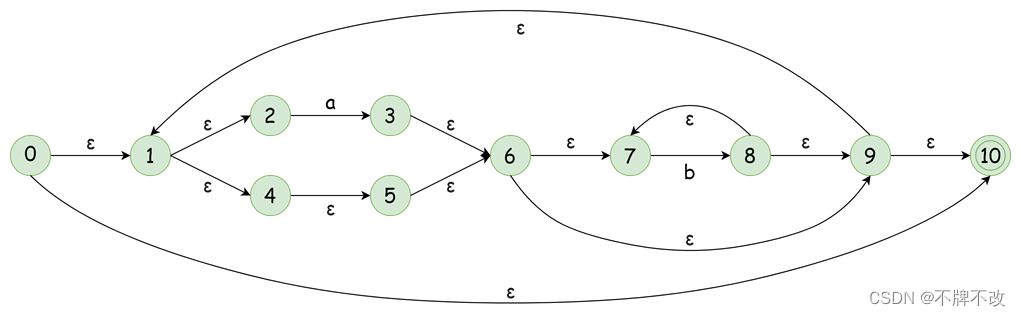
上图的 NFA 等价的 DFA 的开始状态是 ε − c l o s u r e ( 0 ) \varepsilon-closure(0) ε−closure(0),记为 A = { 0 , 1 , 2 , 4 , 5 , 6 , 7 , 9 , 10 } A=\{0,1,2,4,5,6,7,9,10\} A={0,1,2,4,5,6,7,9,10};
输入字母表是 { a , b } \{a,b\} {a,b} ,计算 ε − c l o s u r e ( m o v e ( A , a ) ) \varepsilon-closure(move(A,a)) ε−closure(move(A,a)),由于只有状态 2 2 2 能发生 a a a 转换,所以 m o v e ( A , a ) = { 3 } move (A, a)=\{3\} move(A,a)={3},故 ε − c l o s u r e ( m o v e ( A , a ) ) = ε − c l o s u r e ( { 3 } ) = ε − c l o s u r e ( 3 ) = { 1 , 2 , 3 , 4 , 5 , 6 , 7 , 9 , 10 } \varepsilon-closure(move(A,a))=\varepsilon-closure(\{3\})=\varepsilon-closure(3)=\{1,2,3,4,5,6,7,9,10\} ε−closure(move(A,a))=ε−closure({3})=ε−closure(3)={1,2,3,4,5,6,7,9,10},称该集合为 B B B;
计算 ε − c l o s u r e ( m o v e ( A , b ) ) \varepsilon-closure(move(A,b)) ε−closure(move(A,b)),由于只有状态 7 7 7 能发生 b b b 转换,所以 m o v e ( A , b ) = 8 move(A, b)={8} move(A,b)=8,故 ε − c l o s u r e ( m o v e ( A , b ) ) = ε − c l o s u r e ( { 8 } ) = ε − c l o s u r e ( 8 ) = { 1 , 2 , 4 , 5 , 6 , 7 , 8 , 9 , 10 } \varepsilon-closure(move(A,b))=\varepsilon-closure(\{8\})=\varepsilon-closure(8)=\{1,2,4,5,6,7,8,9,10\} ε−closure(move(A,b))=ε−closure({8})=ε−closure(8)={1,2,4,5,6,7,8,9,10},称该集合为 C C C;
对新集合 B B B 和 C C C 重复上面的过程可以得到完整的转换表如下:
| 状态 | 输入符号 | |
| a | b | |
| A | B | C |
| B | B | C |
| C | B | C |
根据转换表得到等价的 DFA 如下:
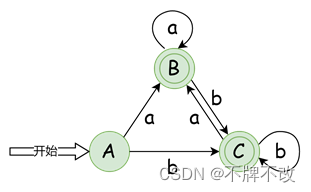
a b a b b a b : A → B → C → B → C → C → B → C ababbab\space\space :\space\space A\rightarrow B \rightarrow C \rightarrow B \rightarrow C \rightarrow C \rightarrow B \rightarrow C ababbab : A→B→C→B→C→C→B→C
可以从正规式的最简 DFA 同构来证明两个正规式等价。使用这种计数,证明正规式 ( a ∣ b ) ∗ (\space\space a\space\space|\space\space b\space\space)\space^* ( a ∣ b ) ∗、 ( a ∗ ∣ b ∗ ) ∗ (\space\space a\space^*\space\space|\space\space b\space^*\space\space)\space^* ( a ∗ ∣ b ∗ ) ∗ 和 ( ( ε ∣ a ) b ∗ ) ∗ (\space\space(\space\space \varepsilon\space\space |\space\space a\space\space)\space\space b\space^*\space\space)\space^* ( ( ε ∣ a ) b ∗ ) ∗ 等价
与 T 2.8 类似,先将上面的 NFA 中的状态重新编号便于计算。
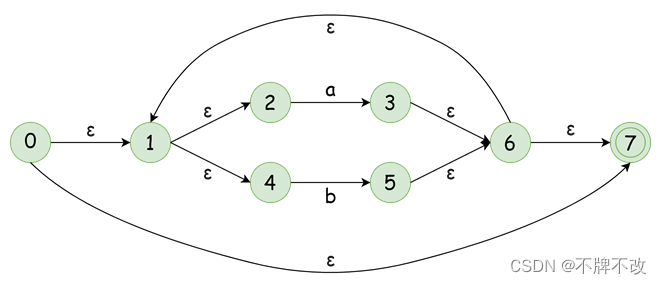
( a ∣ b ) ∗ (\space\space a\space\space|\space\space b\space\space)\space^* ( a ∣ b ) ∗ 对应的 NFA:
( a ∣ b ) ∗ (\space\space a\space\space|\space\space b\space\space)\space^* ( a ∣ b ) ∗ 对应的状态转换表:
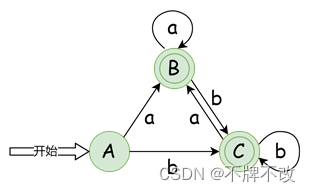
A = { 0 , 1 , 2 , 4 , 7 } A=\{0,1,2,4,7\} A={0,1,2,4,7}
B = { 1 , 2 , 3 , 4 , 6 , 7 } B=\{1,2,3,4,6,7\} B={1,2,3,4,6,7}
C = { 1 , 2 , 4 , 5 , 6 , 7 } C=\{1,2,4,5,6,7\} C={1,2,4,5,6,7}
| 状态 | 输入符号 | |
| a | b | |
| A | B | C |
| B | B | C |
| C | B | C |
( a ∣ b ) ∗ (\space\space a\space\space|\space\space b\space\space)\space^* ( a ∣ b ) ∗ 对应的 DFA:
( a ∣ b ) ∗ (\space\space a\space\space|\space\space b\space\space)\space^* ( a ∣ b ) ∗ 对应的最简 DFA:
初始划分两个子集:接受状态子集 { B , C } \{B,\space C\} {B, C} 和非接受状态 { A } \{A\} {A};
{ A } \{A\} {A} 不可进一步划分,所以对 { B , C } \{B,\space C\} {B, C} 进一步划分;
m o v e ( { B , C } , a ) = { B } move(\{B, \space C\},\space a)=\{B\} move({B, C}, a)={B}
m o v e ( { B , C } , b ) = { C } move(\{B, \space C\},\space b)=\{C\} move({B, C}, b)={C}
这说明 { B , C } \{B,\space C\} {B, C} 是不可区分的子集,故无需进一步划分。
最终上图即为最简 DFA。
( a ∗ ∣ b ∗ ) ∗ (\space\space a\space^*\space\space|\space\space b\space^*\space\space)\space^* ( a ∗ ∣ b ∗ ) ∗ 对应的 NFA:
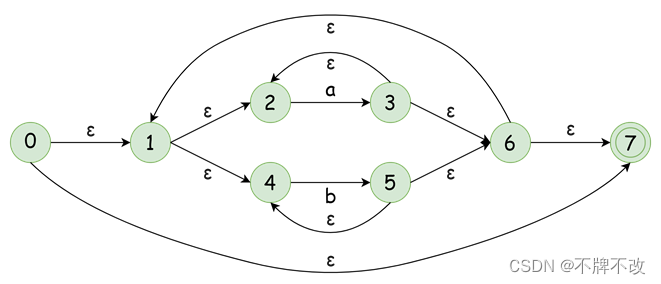
( a ∗ ∣ b ∗ ) ∗ (\space\space a\space^*\space\space|\space\space b\space^*\space\space)\space^* ( a ∗ ∣ b ∗ ) ∗ 对应的状态转换表:
A = { 0 , 1 , 2 , 4 , 7 } A=\{0,1,2,4,7\} A={0,1,2,4,7}
B = { 1 , 2 , 3 , 4 , 6 , 7 } B=\{1,2,3,4,6,7\} B={1,2,3,4,6,7}
C = { 1 , 2 , 4 , 5 , 6 , 7 } C=\{1,2,4,5,6,7\} C={1,2,4,5,6,7}
| 状态 | 输入符号 | |
| a | b | |
| A | B | C |
| B | B | C |
| C | B | C |
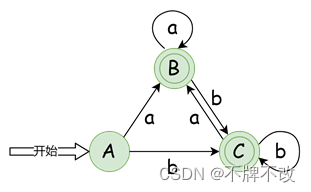
( a ∗ ∣ b ∗ ) ∗ (\space\space a\space^*\space\space|\space\space b\space^*\space\space)\space^* ( a ∗ ∣ b ∗ ) ∗ 对应的 DFA:
( a ∗ ∣ b ∗ ) ∗ (\space\space a\space^*\space\space|\space\space b\space^*\space\space)\space^* ( a ∗ ∣ b ∗ ) ∗ 对应的最简 DFA:
由于 ( a ∗ ∣ b ∗ ) ∗ (\space\space a\space^*\space\space|\space\space b\space^*\space\space)\space^* ( a ∗ ∣ b ∗ ) ∗ 对应的 DFA 与 ( a ∣ b ) ∗ (\space\space a\space\space|\space\space b\space\space)\space^* ( a ∣ b ) ∗ 对应的 DFA 完全一致,所以最终化简得到的 DFA 也是一样的,即上图。
( ( ε ∣ a ) b ∗ ) ∗ (\space\space(\space\space \varepsilon\space\space |\space\space a\space\space)\space\space b\space^*\space\space)\space^* ( ( ε ∣ a ) b ∗ ) ∗ 的 DFA 在 T 2.8 中已经得到,由于其与 ( a ∣ b ) ∗ (\space\space a\space\space|\space\space b\space\space)\space^* ( a ∣ b ) ∗ 对应的 DFA 完全一致,所以最终化简得到的 DFA 也是一样的,即:
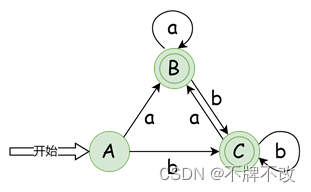
由于已知“最简 DFA 同构的正规式等价”可知,三者的最简 DFA 同构,所以三个正规式等价。
为下列正规式构造最简的 DFA
对应的 NFA 如下:
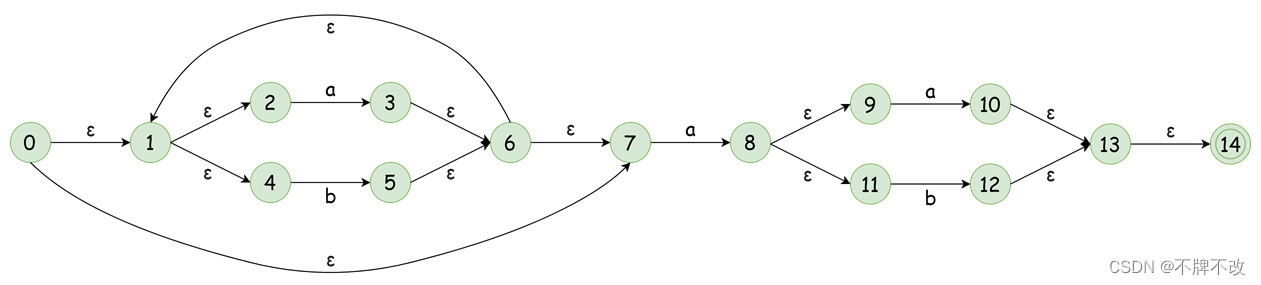
对应的转换表如下:
A = { 0 , 1 , 2 , 4 , 7 } A=\{0,1,2,4,7\} A={0,1,2,4,7}
B = { 1 , 2 , 3 , 4 , 6 , 7 , 8 , 9 , 11 } B=\{1,2,3,4,6,7,8,9,11\} B={1,2,3,4,6,7,8,9,11}
C = { 1 , 2 , 4 , 5 , 6 , 7 } C=\{1,2,4,5,6,7\} C={1,2,4,5,6,7}
D = { 1 , 2 , 3 , 4 , 6 , 7 , 8 , 9 , 10 , 11 , 13 , 14 } D = \{1,2,3,4,6,7,8,9,10,11,13,14\} D={1,2,3,4,6,7,8,9,10,11,13,14}
E = { 1 , 2 , 4 , 5 , 6 , 7 , 12 , 13 , 14 } E=\{1,2,4,5,6,7,12,13,14\} E={1,2,4,5,6,7,12,13,14}
| 状态 | 输入符号 | |
| a | b | |
| A | B | C |
| B | D | E |
| C | B | C |
| D | D | E |
| E | B | C |
对应的 DFA 如下:
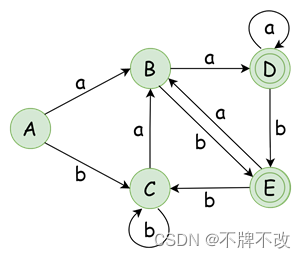
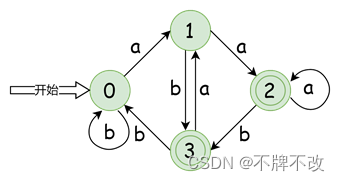
对应的最简 DFA 如下:
初始划分两个子集:接受状态子集 { D , E } \{D,E\} {D,E} 和非接受状态子集 { A , B , C } \{A,B,C\} {A,B,C};
对于接受状态子集,输入字符 a a a,状态 D D D 和状态 E E E 分别变换到状态 D D D 和状态 B B B,二者不在同一子集中,所以需要划分成 { D } \{D\} {D}、 { E } \{E\} {E};
对于非接受状态子集,输入字符 a a a,状态 A A A 和状态 C C C 均变换到状态 B B B,而状态 B B B 变换到状态 D D D,属于另一个子集,所以初步划分为 { A , C } \{A,C\} {A,C}、 { B } \{B\} {B};输入字符 b b b,状态 A A A 和状态 C C C 均变换到状态 C C C,所以两个状态不可区分,无需进一步划分。
故,最终状态子集为 { A , C } \{A,C\} {A,C}、 { B } \{B\} {B}、 { D } \{D\} {D} 和 { E } \{E\} {E}。
为了绘制 DFA 方便,令 { A , C } \{A,C\} {A,C} 为状态 0 0 0, { B } \{B\} {B} 为状态 1 1 1, { D } \{D\} {D} 为状态 2 2 2, { E } \{E\} {E} 为状态 3 3 3。
方法一: 子集构造法得到的 NFA 如下:

对应的转换表如下:
A = { 0 , 1 , 2 , 4 , 7 } A=\{0,1,2,4,7\} A={0,1,2,4,7}
B = ε − c l o s u r e ( { 3 , 8 } ) = { 1 , 2 , 3 , 4 , 6 , 7 , 8 , 9 , 11 } B=\varepsilon-closure(\{3,8\})=\{1,2,3,4,6,7,8,9,11\} B=ε−closure({3,8})={1,2,3,4,6,7,8,9,11}
C = ε − c l o s u r e ( { 5 } ) = { 1 , 2 , 4 , 5 , 6 , 7 } C=\varepsilon-closure(\{5\})=\{1,2,4,5,6,7\} C=ε−closure({5})={1,2,4,5,6,7}
D = ε − c l o s u r e ( { 3 , 8 , 10 } ) = { 1 , 2 , 3 , 4 , 6 , 7 , 8 , 9 , 10 , 11 , 13 , 14 , 16 } D=\varepsilon-closure(\{3,8,10\})=\{1,2,3,4,6,7,8,9,10,11,13,14,16\} D=ε−closure({3,8,10})={1,2,3,4,6,7,8,9,10,11,13,14,16}
E = ε − c l o s u r e ( { 5 , 12 } ) = { 1 , 2 , 4 , 5 , 6 , 7 , 12 , 13 , 14 , 16 } E=\varepsilon-closure(\{5,12\})=\{1,2,4,5,6,7,12,13,14,16\} E=ε−closure({5,12})={1,2,4,5,6,7,12,13,14,16}
F = ε − c l o s u r e ( { 3 , 8 , 10 , 15 } ) = { 1 , 2 , 3 , 4 , 6 , 7 , 8 , 9 , 10 , 11 , 13 , 14 , 15 , 16 , 18 , 19 } F=\varepsilon-closure(\{3,8,10,15\})=\{1,2,3,4,6,7,8,9,10,11,13,14,15,16,18,19\} F=ε−closure({3,8,10,15})={1,2,3,4,6,7,8,9,10,11,13,14,15,16,18,19}
G = ε − c l o s u r e ( { 5 , 12 , 17 } ) = { 1 , 2 , 4 , 5 , 6 , 7 , 12 , 13 , 14 , 16 , 17 , 18 , 19 } G=\varepsilon-closure(\{5,12,17\})=\{1,2,4,5,6,7,12,13,14,16,17,18,19\} G=ε−closure({5,12,17})={1,2,4,5,6,7,12,13,14,16,17,18,19}
H = ε − c l o s u r e ( { 3 , 8 , 15 } ) = { 1 , 2 , 3 , 4 , 6 , 7 , 8 , 9 , 11 , 15 , 18 , 19 } H=\varepsilon-closure(\{3,8,15\})=\{1,2,3,4,6,7,8,9,11,15,18,19\} H=ε−closure({3,8,15})={1,2,3,4,6,7,8,9,11,15,18,19}
I = ε − c l o s u r e ( { 5 , 17 } ) = { 1 , 2 , 4 , 5 , 6 , 7 , 17 , 18 , 19 } I=\varepsilon-closure(\{5,17\})=\{1,2,4,5,6,7,17,18,19\} I=ε−closure({5,17})={1,2,4,5,6,7,17,18,19}
| 状态 | 输入符号 | |
| a | b | |
| A | B | C |
| B | D | E |
| C | B | C |
| D | F | G |
| E | H | I |
| F | F | G |
| G | H | I |
| H | D | E |
| I | B | C |
方法二: 分裂法得到的 NFA 如下:
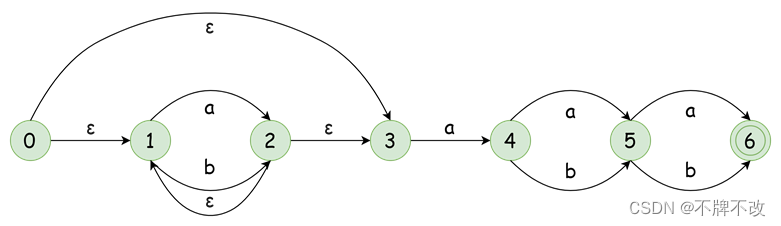
对应的转换表如下:
A = { 0 , 1 , 3 } A=\{0,1,3\} A={0,1,3}
B = ε − c l o s u r e ( { 2 , 4 } ) = { 1 , 2 , 3 , 4 } B=\varepsilon-closure(\{2,4\})=\{1,2,3,4\} B=ε−closure({2,4})={1,2,3,4}
C = ε − c l o s u r e ( { 2 } ) = { 1 , 2 , 3 } C=\varepsilon-closure(\{2\})=\{1,2,3\} C=ε−closure({2})={1,2,3}
D = ε − c l o s u r e ( { 2 , 4 , 5 } ) = B ∪ { 5 } = { 1 , 2 , 3 , 4 , 5 } D=\varepsilon-closure(\{2,4,5\})=B∪\{5\}=\{1,2,3,4,5\} D=ε−closure({2,4,5})=B∪{5}={1,2,3,4,5}
E = ε − c l o s u r e ( { 2 , 5 } ) = C ∪ { 5 } = { 1 , 2 , 3 , 5 } E=\varepsilon-closure(\{2,5\})=C∪\{5\}=\{1,2,3,5\} E=ε−closure({2,5})=C∪{5}={1,2,3,5}
F = ε − c l o s u r e ( { 2 , 4 , 5 , 6 } ) = D ∪ { 6 } = { 1 , 2 , 3 , 4 , 5 , 6 } F=\varepsilon-closure(\{2,4,5,6\})=D∪\{6\}=\{1,2,3,4,5,6\} F=ε−closure({2,4,5,6})=D∪{6}={1,2,3,4,5,6}
G = ε − c l o s u r e ( { 2 , 5 , 6 } ) = E ∪ { 6 } = { 1 , 2 , 3 , 5 , 6 } G=\varepsilon-closure(\{2,5,6\})=E∪\{6\}=\{1,2,3,5,6\} G=ε−closure({2,5,6})=E∪{6}={1,2,3,5,6}
H = ε − c l o s u r e ( { 2 , 4 , 6 } ) = B ∪ { 6 } = { 1 , 2 , 3 , 4 , 6 } H=\varepsilon-closure(\{2,4,6\})=B∪\{6\}=\{1,2,3,4,6\} H=ε−closure({2,4,6})=B∪{6}={1,2,3,4,6}
I = ε − c l o s u r e ( { 2 , 6 } ) = C ∪ { 6 } = { 1 , 2 , 3 , 6 } I=\varepsilon-closure(\{2,6\})=C∪\{6\}=\{1,2,3,6\} I=ε−closure({2,6})=C∪{6}={1,2,3,6}
| 状态 | 输入符号 | |
| a | b | |
| A | B | C |
| B | D | E |
| C | B | C |
| D | F | G |
| E | H | I |
| F | F | G |
| G | H | I |
| H | D | E |
| I | B | C |
可以看出“子集构造法”和“分裂法”得到的状态转换表一样,所以化出的DFA也一致。
对应的 DFA 如下:
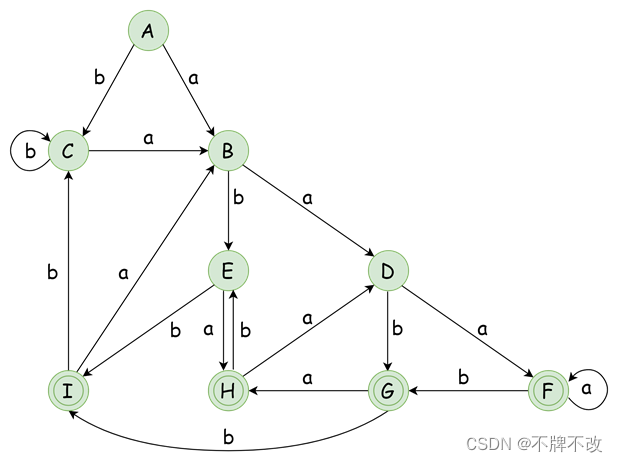
对应的最简 DFA 如下:
初始划分两个子集:接受状态子集 { F , G , H , I } \{F,G,H,I\} {F,G,H,I} 和非接受状态子集 { A , B , C , D , E } \{A,B,C,D,E\} {A,B,C,D,E};
对于接受状态子集,分别输入字符 a a a 和字符 b b b,可将原集合划分为 { F , G } \{F,G\} {F,G} 和 { H , I } \{H,I\} {H,I};
对于非接受状态子集,分别输入字符 a a a 和字符 b b b,可将原集合划分为 { A , B , C } \{A,B,C\} {A,B,C} 和 { D , E } \{D,E\} {D,E};
对 { F , G } \{F,G\} {F,G} 集合进一步划分成 { F } \{F\} {F} 和 { G } \{G\} {G};
对 { H , I } \{H,I\} {H,I} 集合进一步划分成 { H } \{H\} {H} 和 { I } \{I\} {I};
对 { A , B , C } \{A,B,C\} {A,B,C} 集合进一步划分成 { A , C } \{A, C\} {A,C} 和 { B } \{B\} {B};
对 { D , E } \{D,E\} {D,E} 集合进一步划分成 { D } \{D\} {D} 和 { E } \{E\} {E};
故,最终状态子集为 { A , C } \{A,C\} {A,C}、 { B } \{B\} {B} 、 { D } \{D\} {D} 、 { E } \{E\} {E} 、 { F } \{F\} {F}、 { G } \{G\} {G} 、 { H } \{H\} {H} 和 { I } \{I\} {I}。
为了绘制 DFA 方便,令 { A , C } \{A,C\} {A,C} 为状态 0 0 0, { B } \{B\} {B} 为状态 1 1 1, { D } \{D\} {D} 为状态 2 2 2, { E } \{E\} {E} 为状态 3 3 3, { F } \{F\} {F} 为状态 4 4 4、 { G } \{G\} {G} 为状态 5 5 5 、 { H } \{H\} {H} 为状态 6 6 6、 { I } \{I\} {I} 为状态 7 7 7。
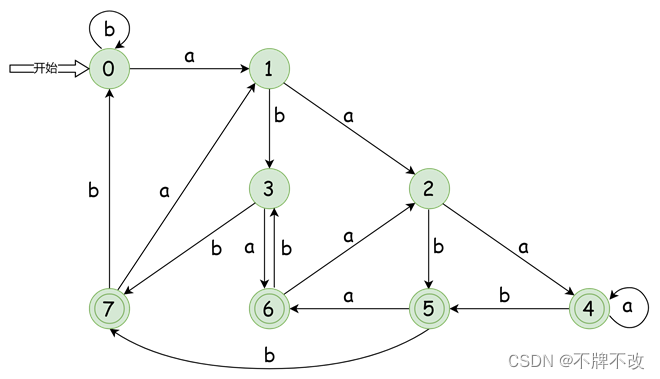
方法一: 子集构造法得到的 NFA 如下:

对应的转换表如下:
A = { 0 , 1 , 2 , 4 , 7 } A=\{0,1,2,4,7\} A={0,1,2,4,7}
B = ε − c l o s u r e ( { 3 , 8 } ) = { 1 , 2 , 3 , 4 , 6 , 7 , 8 , 9 , 11 } B=\varepsilon-closure(\{3,8\})=\{1,2,3,4,6,7,8,9,11\} B=ε−closure({3,8})={1,2,3,4,6,7,8,9,11}
C = ε − c l o s u r e ( { 5 } ) = { 1 , 2 , 4 , 5 , 6 , 7 } C=\varepsilon-closure(\{5\})=\{1,2,4,5,6,7\} C=ε−closure({5})={1,2,4,5,6,7}
D = ε − c l o s u r e ( { 3 , 8 , 10 } ) = { 1 , 2 , 3 , 4 , 6 , 7 , 8 , 9 , 10 , 11 , 13 , 14 , 16 } D=\varepsilon-closure(\{3,8,10\})=\{1,2,3,4,6,7,8,9,10,11,13,14,16\} D=ε−closure({3,8,10})={1,2,3,4,6,7,8,9,10,11,13,14,16}
E = ε − c l o s u r e ( { 5 , 12 } ) = { 1 , 2 , 4 , 5 , 6 , 7 , 12 , 13 , 14 , 16 } E=\varepsilon-closure(\{5,12\})=\{1,2,4,5,6,7,12,13,14,16\} E=ε−closure({5,12})={1,2,4,5,6,7,12,13,14,16}
F = ε − c l o s u r e ( { 3 , 8 , 10 , 15 } ) = { 1 , 2 , 3 , 4 , 6 , 7 , 8 , 9 , 10 , 11 , 13 , 14 , 15 , 16 , 18 , 19 , 21 } F=\varepsilon-closure(\{3,8,10,15\})=\{1,2,3,4,6,7,8,9,10,11,13,14,15,16,18,19,21\} F=ε−closure({3,8,10,15})={1,2,3,4,6,7,8,9,10,11,13,14,15,16,18,19,21}
G = ε − c l o s u r e ( { 5 , 12 , 17 } ) = { 1 , 2 , 4 , 5 , 6 , 7 , 12 , 13 , 14 , 16 , 17 , 18 , 19 , 21 } G=\varepsilon-closure(\{5,12,17\})=\{1,2,4,5,6,7,12,13,14,16,17,18,19,21\} G=ε−closure({5,12,17})={1,2,4,5,6,7,12,13,14,16,17,18,19,21}
H = ε − c l o s u r e ( { 3 , 8 , 15 } ) = { 1 , 2 , 3 , 4 , 6 , 7 , 8 , 9 , 11 , 15 , 18 , 19 , 21 } H=\varepsilon-closure(\{3,8,15\})=\{1,2,3,4,6,7,8,9,11,15,18,19,21\} H=ε−closure({3,8,15})={1,2,3,4,6,7,8,9,11,15,18,19,21}
I = ε − c l o s u r e ( { 5 , 17 } ) = { 1 , 2 , 4 , 5 , 6 , 7 , 17 , 18 , 19 , 21 } I=\varepsilon-closure(\{5,17\})=\{1,2,4,5,6,7,17,18,19,21\} I=ε−closure({5,17})={1,2,4,5,6,7,17,18,19,21}
J = ε − c l o s u r e ( { 3 , 8 , 10 , 15 , 20 } ) = { 1 , 2 , 3 , 4 , 6 , 7 , 8 , 9 , 10 , 11 , 13 , 14 , 15 , 16 , 18 , 19 , 20 , 21 , 23 , 24 } J=\varepsilon-closure(\{3,8,10,15,20\})=\{1,2,3,4,6,7,8,9,10,11,13,14,15,16,18,19,20,21,23,24\} J=ε−closure({3,8,10,15,20})={1,2,3,4,6,7,8,9,10,11,13,14,15,16,18,19,20,21,23,24}
K = ε − c l o s u r e ( { 5 , 12 , 17 , 22 } ) = { 1 , 2 , 4 , 5 , 6 , 7 , 12 , 13 , 14 , 16 , 17 , 18 , 19 , 21 , 22 , 23 , 24 } K=\varepsilon-closure(\{5,12,17,22\})=\{1,2,4,5,6,7,12,13,14,16,17,18,19,21,22,23,24\} K=ε−closure({5,12,17,22})={1,2,4,5,6,7,12,13,14,16,17,18,19,21,22,23,24}
L = ε − c l o s u r e ( { 3 , 8 , 15 , 20 } ) = { 1 , 2 , 3 , 4 , 6 , 7 , 8 , 9 , 11 , 15 , 18 , 19 , 20 , 21 , 23 , 24 } L=\varepsilon-closure(\{3,8,15,20\})=\{1,2,3,4,6,7,8,9,11,15,18,19,20,21,23,24\} L=ε−closure({3,8,15,20})={1,2,3,4,6,7,8,9,11,15,18,19,20,21,23,24}
M = ε − c l o s u r e ( { 5 , 17 , 22 } ) = { 1 , 2 , 4 , 5 , 6 , 7 , 17 , 18 , 19 , 21 , 22 , 23 , 24 } M=\varepsilon-closure(\{5,17,22\})=\{1,2,4,5,6,7,17,18,19,21,22,23,24\} M=ε−closure({5,17,22})={1,2,4,5,6,7,17,18,19,21,22,23,24}
N = ε − c l o s u r e ( { 3 , 8 , 10 , 20 } ) = { 1 , 2 , 3 , 4 , 6 , 7 , 8 , 9 , 10 , 11 , 13 , 14 , 16 , 20 , 23 , 24 } N=\varepsilon-closure(\{3,8,10,20\})=\{1,2,3,4,6,7,8,9,10,11,13,14,16,20,23,24\} N=ε−closure({3,8,10,20})={1,2,3,4,6,7,8,9,10,11,13,14,16,20,23,24}
O = ε − c l o s u r e ( { 5 , 12 , 22 } ) = { 1 , 2 , 4 , 5 , 6 , 7 , 12 , 13 , 14 , 16 , 22 , 23 , 24 } O=\varepsilon-closure(\{5,12,22\})=\{1,2,4,5,6,7,12,13,14,16,22,23,24\} O=ε−closure({5,12,22})={1,2,4,5,6,7,12,13,14,16,22,23,24}
P = ε − c l o s u r e ( { 3 , 8 , 20 } ) = { 1 , 2 , 3 , 4 , 6 , 7 , 8 , 9 , 11 , 23 , 24 } P=\varepsilon-closure(\{3,8,20\})=\{1,2,3,4,6,7,8,9,11,23,24\} P=ε−closure({3,8,20})={1,2,3,4,6,7,8,9,11,23,24}
Q = ε − c l o s u r e ( { 5 , 22 } ) = { 1 , 2 , 4 , 5 , 6 , 7 , 22 , 23 , 24 } Q=\varepsilon-closure(\{5,22\})=\{1,2,4,5,6,7,22,23,24\} Q=ε−closure({5,22})={1,2,4,5,6,7,22,23,24}
| 状态 | 输入符号 | |
| a | b | |
| A | B | C |
| B | D | E |
| C | B | C |
| D | F | G |
| E | H | I |
| F | J | K |
| G | L | M |
| H | N | O |
| I | P | Q |
| J | J | K |
| K | L | M |
| L | N | O |
| M | P | Q |
| N | F | G |
| O | H | I |
| P | D | E |
| Q | B | C |
可以看出“子集构造法”和“分裂法”得到的状态转换表一样,所以化出的DFA也一致。
方法二: 分裂法得到的 NFA 如下:
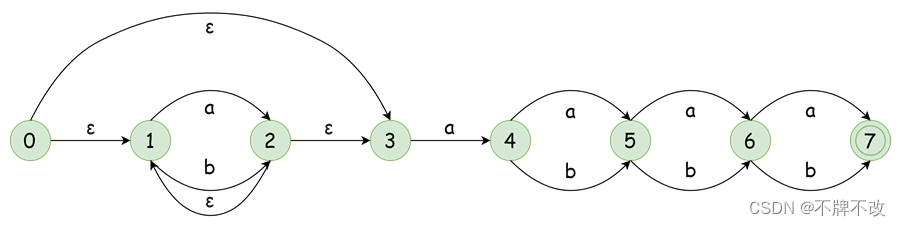
对应的转换表如下:
A = { 0 , 1 , 3 } A=\{0,1,3\} A={0,1,3}
B = ε − c l o s u r e ( { 2 , 4 } ) = { 1 , 2 , 3 , 4 } B=\varepsilon-closure(\{2,4\})=\{1,2,3,4\} B=ε−closure({2,4})={1,2,3,4}
C = ε − c l o s u r e ( { 2 } ) = { 1 , 2 , 3 } C=\varepsilon-closure(\{2\})=\{1,2,3\} C=ε−closure({2})={1,2,3}
D = ε − c l o s u r e ( { 2 , 4 , 5 } ) = B ∪ { 5 } = { 1 , 2 , 3 , 4 , 5 } D=\varepsilon-closure(\{2,4,5\})=B∪\{5\}=\{1,2,3,4,5\} D=ε−closure({2,4,5})=B∪{5}={1,2,3,4,5}
E = ε − c l o s u r e ( { 2 , 5 } ) = C ∪ { 5 } = { 1 , 2 , 3 , 5 } E=\varepsilon-closure(\{2,5\})=C∪\{5\}=\{1,2,3,5\} E=ε−closure({2,5})=C∪{5}={1,2,3,5}
F = ε − c l o s u r e ( { 2 , 4 , 5 , 6 } ) = D ∪ { 6 } = { 1 , 2 , 3 , 4 , 5 , 6 } F=\varepsilon-closure(\{2,4,5,6\})=D∪\{6\}=\{1,2,3,4,5,6\} F=ε−closure({2,4,5,6})=D∪{6}={1,2,3,4,5,6}
G = ε − c l o s u r e ( { 2 , 5 , 6 } ) = E ∪ { 6 } = { 1 , 2 , 3 , 5 , 6 } G=\varepsilon-closure(\{2,5,6\})=E∪\{6\}=\{1,2,3,5,6\} G=ε−closure({2,5,6})=E∪{6}={1,2,3,5,6}
H = ε − c l o s u r e ( { 2 , 4 , 6 } ) = B ∪ { 6 } = { 1 , 2 , 3 , 4 , 6 } H=\varepsilon-closure(\{2,4,6\})=B∪\{6\}=\{1,2,3,4,6\} H=ε−closure({2,4,6})=B∪{6}={1,2,3,4,6}
I = ε − c l o s u r e ( { 2 , 6 } ) = C ∪ { 6 } = { 1 , 2 , 3 , 6 } I=\varepsilon-closure(\{2,6\})=C∪\{6\}=\{1,2,3,6\} I=ε−closure({2,6})=C∪{6}={1,2,3,6}
J = ε − c l o s u r e ( { 2 , 4 , 5 , 6 , 7 } ) = F ∪ { 7 } = { 1 , 2 , 3 , 4 , 5 , 6 , 7 } J=\varepsilon-closure(\{2,4,5,6,7\})=F∪\{7\}=\{1,2,3,4,5,6,7\} J=ε−closure({2,4,5,6,7})=F∪{7}={1,2,3,4,5,6,7}
K = ε − c l o s u r e ( { 2 , 5 , 6 , 7 } ) = G ∪ { 6 } = { 1 , 2 , 3 , 5 , 6 , 7 } K=\varepsilon-closure(\{2,5,6,7\})=G∪\{6\}=\{1,2,3,5,6,7\} K=ε−closure({2,5,6,7})=G∪{6}={1,2,3,5,6,7}
L = ε − c l o s u r e ( { 2 , 4 , 6 , 7 } ) = H ∪ { 7 } = { 1 , 2 , 3 , 4 , 6 , 7 } L=\varepsilon-closure(\{2,4,6,7\})=H∪\{7\}=\{1,2,3,4,6,7\} L=ε−closure({2,4,6,7})=H∪{7}={1,2,3,4,6,7}
M = ε − c l o s u r e ( { 2 , 6 , 7 } ) = I ∪ { 7 } = { 1 , 2 , 3 , 6 , 7 } M=\varepsilon-closure(\{2,6,7\})=I∪\{7\}=\{1,2,3,6,7\} M=ε−closure({2,6,7})=I∪{7}={1,2,3,6,7}
N = ε − c l o s u r e ( { 2 , 4 , 5 , 7 } ) = D ∪ { 7 } = { 1 , 2 , 3 , 4 , 5 , 7 } N=\varepsilon-closure(\{2,4,5,7\})=D∪\{7\}=\{1,2,3,4,5,7\} N=ε−closure({2,4,5,7})=D∪{7}={1,2,3,4,5,7}
O = ε − c l o s u r e ( { 2 , 5 , 7 } ) = E ∪ { 7 } = { 1 , 2 , 3 , 5 , 7 } O=\varepsilon-closure(\{2,5,7\})=E∪\{7\}=\{1,2,3,5,7\} O=ε−closure({2,5,7})=E∪{7}={1,2,3,5,7}
P = ε − c l o s u r e ( { 2 , 4 , 7 } ) = B ∪ { 7 } = { 1 , 2 , 3 , 4 , 7 } P=\varepsilon-closure(\{2,4,7\})=B∪\{7\}=\{1,2,3,4,7\} P=ε−closure({2,4,7})=B∪{7}={1,2,3,4,7}
Q = ε − c l o s u r e ( { 2 , 7 } ) = C ∪ { 7 } = { 1 , 2 , 3 , 7 } Q=\varepsilon-closure(\{2,7\})=C∪\{7\}=\{1,2,3,7\} Q=ε−closure({2,7})=C∪{7}={1,2,3,7}
| 状态 | 输入符号 | |
| a | b | |
| A | B | C |
| B | D | E |
| C | B | C |
| D | F | G |
| E | H | I |
| F | J | K |
| G | L | M |
| H | N | O |
| I | P | Q |
| J | J | K |
| K | L | M |
| L | N | O |
| M | P | Q |
| N | F | G |
| O | H | I |
| P | D | E |
| Q | B | C |
对应的 DFA 如下:
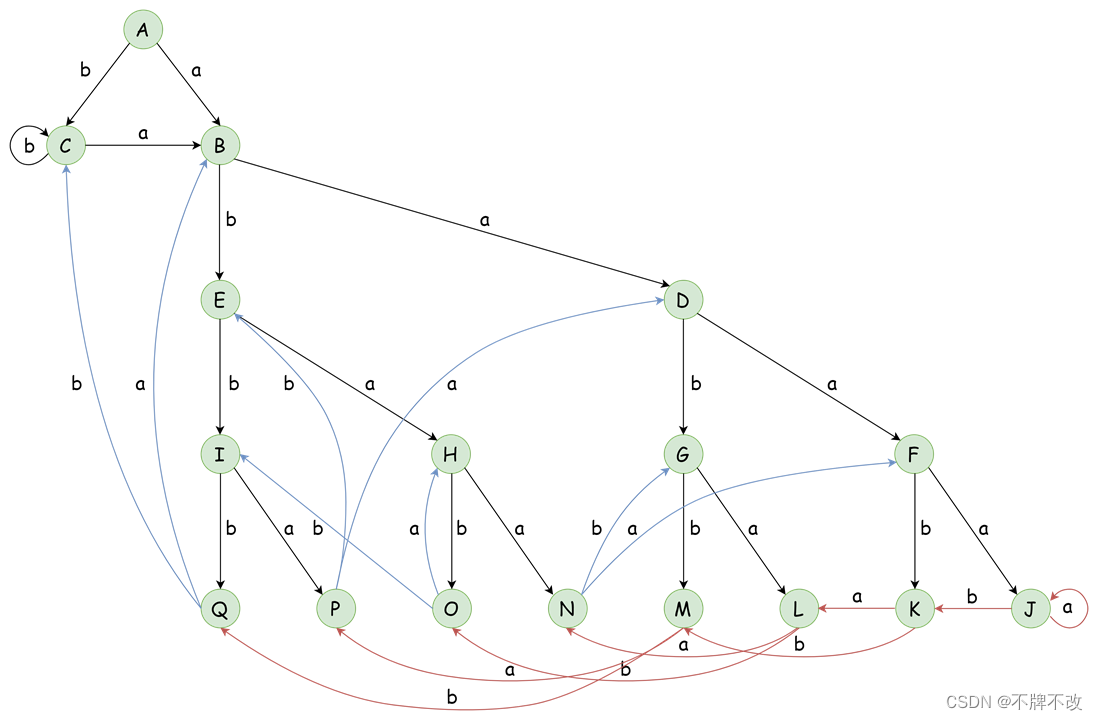
对应的最简 DFA 如下:
初次划分: { A , B , C , D , E , F , G , H , I } \{A,B,C,D,E,F,G,H,I\} {A,B,C,D,E,F,G,H,I} 和 { J , K , L , M , N , O , P , Q } \{J,K,L,M,N,O,P,Q\} {J,K,L,M,N,O,P,Q}
第二次划分: { A , B , C , D , E } \{A,B,C,D,E\} {A,B,C,D,E}、 { F , G , H , I } \{F,G,H,I\} {F,G,H,I}、 { J , K , L , M } \{J,K,L,M\} {J,K,L,M} 和 { N , O , P , Q } \{N,O,P,Q\} {N,O,P,Q}
第三次划分: { A , B , C } \{A,B,C\} {A,B,C}、 { D , E } \{D,E\} {D,E}、 { F , G } \{F,G\} {F,G}、 { H , I } \{H,I\} {H,I}、 { J , K } \{J,K\} {J,K}、 { L , M } \{L,M\} {L,M}、 { N , O } \{N,O\} {N,O} 和 { P , Q } \{P,Q\} {P,Q}
第四次划分: { A , C } \{A,C\} {A,C}、 { B } \{B\} {B}、 { D } \{D\} {D}、 { E } \{E\} {E}、 { F } \{F\} {F}、 { G } \{G\} {G}、 { H } \{H\} {H}、 { I } \{I\} {I}、 { J } \{J\} {J}、 { K } \{K\} {K}、 { L } \{L\} {L}、 { M } \{M\} {M}、 { N } \{N\} {N}、 { O } \{O\} {O}、 { P } \{P\} {P} 和 { Q } \{Q\} {Q}
最终划分结果为: { A , C } \{A,C\} {A,C}、 { B } \{B\} {B}、 { D } \{D\} {D}、 { E } \{E\} {E}、 { F } \{F\} {F}、 { G } \{G\} {G}、 { H } \{H\} {H}、 { I } \{I\} {I}、 { J } \{J\} {J}、 { K } \{K\} {K}、 { L } \{L\} {L}、 { M } \{M\} {M}、 { N } \{N\} {N}、 { O } \{O\} {O}、 { P } \{P\} {P} 和 { Q } \{Q\} {Q}
为了绘制 DFA 方便,令 { A , C } \{A,C\} {A,C} 为状态 0 0 0, { B } \{B\} {B} 为状态 1 1 1, { D } \{D\} {D} 为状态 2 2 2, { E } \{E\} {E} 为状态 3 3 3, { F } \{F\} {F} 为状态 4 4 4、 { G } \{G\} {G} 为状态 5 5 5 、 { H } \{H\} {H} 为状态 6 6 6、 { I } \{I\} {I} 为状态 7 7 7, { J } \{J\} {J} 为状态 8 8 8, { K } \{K\} {K} 为状态 9 9 9, { L } \{L\} {L} 为状态 10 10 10, { M } \{M\} {M} 为状态 11 11 11, { N } \{N\} {N} 为状态 12 12 12、 { O } \{O\} {O} 为状态 13 13 13 、 { P } \{P\} {P} 为状态 14 14 14、 { Q } \{Q\} {Q} 为状态 15 15 15。
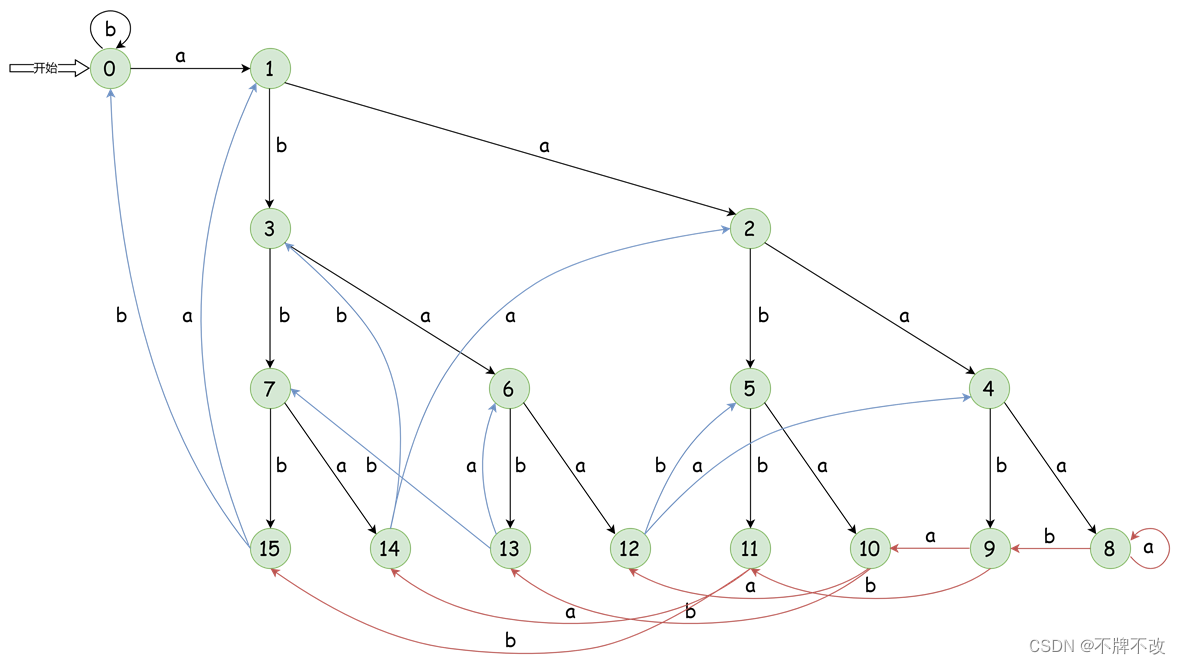
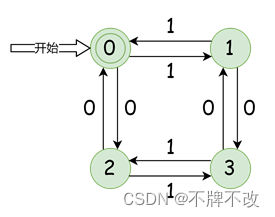
构造一个 DFA,它接受 Σ = { 0 , 1 } \Sigma=\{0,1\} Σ={0,1} 上 0 0 0 和 1 1 1 的个数都是偶数的字符串
对于一个01串,无论其 0 和 1 的个数有多少,总属于下面四种情况之一:
0:0和1的个数都是偶数;
1:0的个数是偶数,1的个数是奇数;
2:0的个数是奇数,1的个数是偶数;
3:0和1的个数都是奇数.
无论上述哪种情况,在01串后添加一个0或1后,总会处于另一种情况中,因此构造的 DFA 可以通过四个状态表示出来:
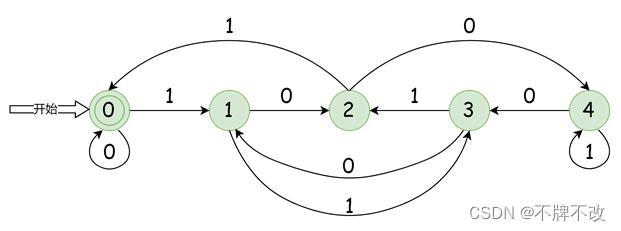
构造一个 DFA,它接受 Σ = { 0 , 1 } \Sigma=\{0,1\} Σ={0,1} 上能被 5 5 5 整除的二进制数
一个数对5取模,存在五种结果,结果为0、1、2、3、4。结果为0对应的是接受状态,其余是非接受状态。这样便可通过五个状态构造 DFA。
0:对5取模得0;
1:对5取模得1;
2:对5取模得2;
3:对5取模得3;
4:对5取模得4.
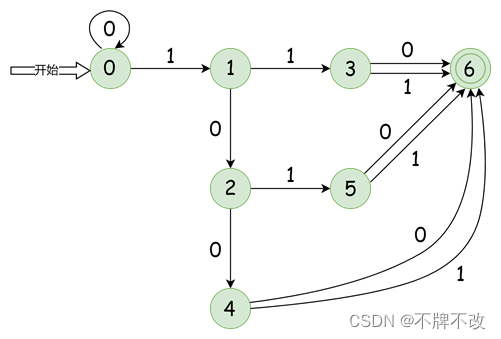
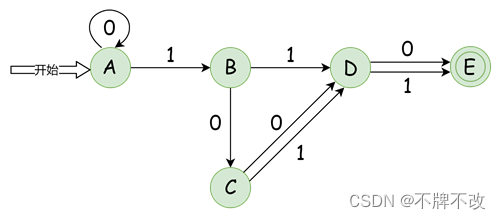
构造一个最简的 DFA,它接受所有大于 101 101 101 的二进制整数
根据题意,先简单地将状态分为六种,为 0 0 0、 1 1 1、 2 2 2、 3 3 3、 4 4 4、 5 5 5和大于 5 5 5的整数。
0:对应二进制整数为0;
1:对应二进制整数为1;
2:对应二进制整数为2;
3:对应二进制整数为3;
4:对应二进制整数为4;
5:对应二进制整数为5;
6:对应二进制整数大于5.
初步构造 DFA:
对上面的 DFA 进行化简:
初步划分为接受状态子集 { 6 } \{6\} {6} 和非接受状态子集 { 0 , 1 , 2 , 3 , 4 , 5 } \{0,\space 1,\space2, \space 3,\space4,\space5\} {0, 1, 2, 3, 4, 5};
接受状态子集无法进一步划分;
对非接受状态子集进一步划分:
m o v e ( { 0 , 1 , 2 , 3 , 4 , 5 } , 0 ) = { 0 , 2 , 4 , 6 } move(\{0,\space 1,\space2, \space 3,\space4,\space5\}, \space0)=\{0, \space 2, \space 4, \space 6\} move({0, 1, 2, 3, 4, 5}, 0)={0, 2, 4, 6},其中状态 0 0 0 转换到状态 0 0 0,状态 1 1 1 转换到状态 2 2 2,状态 2 2 2 转换到状态 4 4 4,状态 3 , 4 , 5 3,\space4,\space5 3, 4, 5 均转换到状态 6 6 6。
m o v e ( { 0 , 1 , 2 , 3 , 4 , 5 } , 1 ) = { 1 , 3 , 5 , 6 } move(\{0,\space 1,\space2, \space 3,\space4,\space5\}, \space1)=\{1, \space 3, \space 5, \space 6\} move({0, 1, 2, 3, 4, 5}, 1)={1, 3, 5, 6},其中状态 0 0 0 转换到状态 1 1 1,状态 1 1 1 转换到状态 3 3 3,状态 2 2 2 转换到状态 5 5 5,状态 3 , 4 , 5 3,\space4,\space5 3, 4, 5 均转换到状态 6 6 6。
由于 0 , 1 , 2 , 3 , 4 , 5 0,\space1,\space2,\space 3,\space4,\space5 0, 1, 2, 3, 4, 5 属于同一个子集,所以 0 , 1 , 2 0,\space1,\space2 0, 1, 2 仍属于同一子集,而由于 3 , 4 , 5 3,\space4,\space5 3, 4, 5 转换到了另一个不同的子集中,所以 3 , 4 , 5 3,\space4,\space5 3, 4, 5 被归为新的一个子集,子集 { 0 , 1 , 2 } \{0,\space1,\space2\} {0, 1, 2} 和子集 { 3 , 4 , 5 } \{3,\space4,\space5\} {3, 4, 5} 代替了原先的子集 { 0 , 1 , 2 , 3 , 4 , 5 } \{0,\space 1,\space2, \space 3,\space4,\space5\} {0, 1, 2, 3, 4, 5};
现在全部子集为 { 6 } \{6\} {6} 、 { 0 , 1 , 2 } \{0,\space1,\space2\} {0, 1, 2} 和 { 3 , 4 , 5 } \{3,\space4,\space5\} {3, 4, 5},分别对子集 { 0 , 1 , 2 } \{0,\space1,\space2\} {0, 1, 2} 和子集 { 3 , 4 , 5 } \{3,\space4,\space5\} {3, 4, 5} 进一步划分:
m o v e ( { 0 , 1 , 2 } , 0 ) = { 0 , 2 , 4 } move(\{0,\space 1,\space2\}, \space0)=\{0, \space 2, \space 4\} move({0, 1, 2}, 0)={0, 2, 4},其中状态 0 0 0 转换到状态 0 0 0,状态 1 1 1 转换到状态 2 2 2,状态 2 2 2 转换到状态 4 4 4。
m o v e ( { 0 , 1 , 2 } , 1 ) = { 1 , 3 , 5 } move(\{0,\space 1,\space2\}, \space1)=\{1, \space 3, \space 5\} move({0, 1, 2}, 1)={1, 3, 5},其中状态 0 0 0 转换到状态 1 1 1,状态 1 1 1 转换到状态 3 3 3,状态 2 2 2 转换到状态 5 5 5。
在输入字符为 0 0 0的情况下,状态 0 0 0 和 状态 1 1 1 均转换到同一集合 { 0 , 1 , 2 } \{0,\space 1,\space2\} {0, 1, 2} 中,但是状态 2 2 2 转换到了另一个集合 { 3 , 4 , 5 } \{3,\space4,\space5\} {3, 4, 5} 中,所以状态 2 2 2 将被划分到与状态 0 0 0 和状态 1 1 1 不同的子集中;在输入字符为 1 1 1的情况下,状态 0 0 0 转换到子集 { 0 , 1 , 2 } \{0,\space 1,\space2\} {0, 1, 2} 中,而状态 1 1 1 转移到子集 { 3 , 4 , 5 } \{3,\space4,\space5\} {3, 4, 5} 中,根据子集划分的要求“两个状态 s s s 和 t t t 被划分到同一子集中,当且仅当对任意输入符号 α \alpha α,状态 s s s 和 t t t 转换到本次划分前的同一子集中”,所以状态 0 0 0 和 状态 1 1 1 也要被划分到不同子集。故,经过本次划分,得到全部子集 { 0 } \{0\} {0}、 { 1 } \{1\} {1}、 { 2 } \{2\} {2}、 { 3 , 4 , 5 } \{3,\space4,\space5\} {3, 4, 5} 和 { 6 } \{6\} {6}。
m o v e ( { 3 , 4 , 5 } , 0 ) = m o v e ( { 3 , 4 , 5 } , 1 ) = { 6 } move(\{3,\space4,\space5\}, \space0) = move(\{3,\space4,\space5\}, \space1) = \{6\} move({3, 4, 5}, 0)=move({3, 4, 5}, 1)={6},所以无需进一步划分。
最终得到全部子集 { 0 } \{0\} {0}、 { 1 } \{1\} {1}、 { 2 } \{2\} {2}、 { 3 , 4 , 5 } \{3,\space4,\space5\} {3, 4, 5} 和 { 6 } \{6\} {6}。令 A = { 0 } A=\{0\} A={0}, B = { 1 } B=\{1\} B={1}, C = { 2 } C=\{2\} C={2}, D = { 3 , 4 , 5 } D=\{3,\space4,\space5\} D={3, 4, 5}, E = { 6 } E=\{6\} E={6},最简 DFA 如下:
我不知道为什么,但是当我设置这个设置时它无法编译设置:static_cache_control,[:public,:max_age=>300]这是我得到的syntaxerror,unexpectedtASSOC,expecting']'(SyntaxError)set:static_cache_control,[:public,:max_age=>300]^我只想将“过期”header设置为css、javaascript和图像文件。谢谢。 最佳答案 我猜您使用的是Ruby1.8.7。Sinatra文档中显示的语法似乎是在Ruby1.
最近因为项目需要,需要将Android手机系统自带的某个系统软件反编译并更改里面某个资源,并重新打包,签名生成新的自定义的apk,下面我来介绍一下我的实现过程。APK修改,分为以下几步:反编译解包,修改,重打包,修改签名等步骤。安卓apk修改准备工作1.系统配置好JavaJDK环境变量2.需要root权限的手机(针对系统自带apk,其他软件免root)3.Auto-Sign签名工具4.apktool工具安卓apk修改开始反编译本文拿Android系统里面的Settings.apk做demo,具体如何将apk获取出来在此就不过多介绍了,直接进入主题:按键win+R输入cmd,打开命令窗口,并将路
有没有办法跳过CSV文件的第一行,让第二行作为标题?我有一个CSV文件,第一行是日期,第二行是标题,所以我需要能够在遍历它时跳过第一行。我尝试使用slice但它会将CSV转换为数组,我真的很想将其读取为CSV,以便我可以利用header。 最佳答案 根据您的数据,您可以使用另一种方法和skip_lines-option此示例跳过所有以#开头的行require'csv'CSV.parse(DATA.read,:col_sep=>';',:headers=>true,:skip_lines=>/^#/#Markcomments!)do|
是否有适用于Ruby语言的.NETFramework编译器?我听说过DLR(动态语言运行时),这是否将使Ruby能够用于.NET开发? 最佳答案 IronRuby是Microsoft支持的项目,建立在动态语言运行时之上。 关于.net-是否有Ruby.NET编译器?,我们在StackOverflow上找到一个类似的问题: https://stackoverflow.com/questions/199638/
关闭。这个问题是off-topic.它目前不接受答案。想改进这个问题吗?Updatethequestion所以它是on-topic用于堆栈溢出。关闭10年前。ImprovethisquestionLinux专家正在转向Mac(10.8)。因为我懒...我使用MacPorts安装MacVim。它似乎安装没有错误。我只需要mvim中的python、ruby和perl支持。$/opt/local/bin/mvim--version|egrep'patches|python|ruby|perl'Includedpatches:1-244,246-646+multi_lang-mzscheme+
我想使用部分字符串搜索数组,然后获取找到该字符串的索引。例如:a=["Thisisline1","Wehaveline2here","andfinallyline3","potato"]a.index("potato")#thisreturns3a.index("Wehave")#thisreturnsnil使用a.grep将返回完整的字符串,使用a.any?将返回正确的true/false语句,但都不会返回匹配的索引找到了,或者至少我不知道该怎么做。我正在编写一段代码,该代码读取文件、查找特定header,然后返回该header的索引,以便它可以将其用作future搜索的偏移量。如果
当我刚刚运行middleman时服务,all.css编译得很好,只包含对+box-shadow(none)的调用:/*line1,/home/yang/asdf/source/stylesheets/content.css.sass*/div{-webkit-box-shadow:none;-moz-box-shadow:none;box-shadow:none;}但是当我构建网站时,我得到了这个Sass/Compass错误:$middlemanbuildSlim::EmbeddedEngineisdeprecated,itiscalledSlim::EmbeddedinSlim2.0
K伙计们,所以我创建了这个赞成/反对的投票脚本(基本上就像stackoverflow上的那个),我试图向其中添加一些Ajax,这样页面就不会在您每次投票时都重新加载。我有两个Controller,一个叫grinder,一个叫votes。(磨床基本都是帖子)所以这是所有研磨机的索引(看起来像这样)这是该页面的代码。Listinggrinders"grinders/grinders")%>这就是我在views/grinders/_grinders.erb中的内容true)do|u|%>grinder.id%>"up"%>'create')%>true)do|d|%>grinder.id%>
我将restclient用于多部分表单,以将数据发送到restfulweb服务(它是Panda视频编码服务)。不过,诀窍在于我传递给restclient(Technoweenie分支)的文件来自用户提交的我自己的表单。那么,让我们来看看这个。用户将文件发布到我的Rails应用程序。在我的Controller中,它从params[:file]接收文件。然后我想使用RestClient将params[:file]传递给Panda。我在Panda服务器上遇到的错误如下。我注意到堆栈跟踪中的文件参数也在一个字符串中(我假设Panda将其转换为字符串以获得更好的堆栈跟踪)。~Startedreq
我知道Ruby是动态和强类型的,但据我所知,由于每个参数缺少显式类型表示法(或契约),当前语法不允许在编译时检查参数类型。如果我想执行编译时类型检查,我有哪些(实际成熟的)选项?更新我的意思是类型检查类似于典型的静态类型语言。比如C。例如,C函数表示每个参数的类型,编译器检查传入的参数是否正确。voidfunc1(structAAAaaa){structBBBbbb;func1(bbb);//Wrongtype.Compiletimeerror.}作为另一个例子,Objective-C通过放置显式类型信息来做到这一点。-(id)method1:(AAA*)aaa{BBB*bbb=[[A
