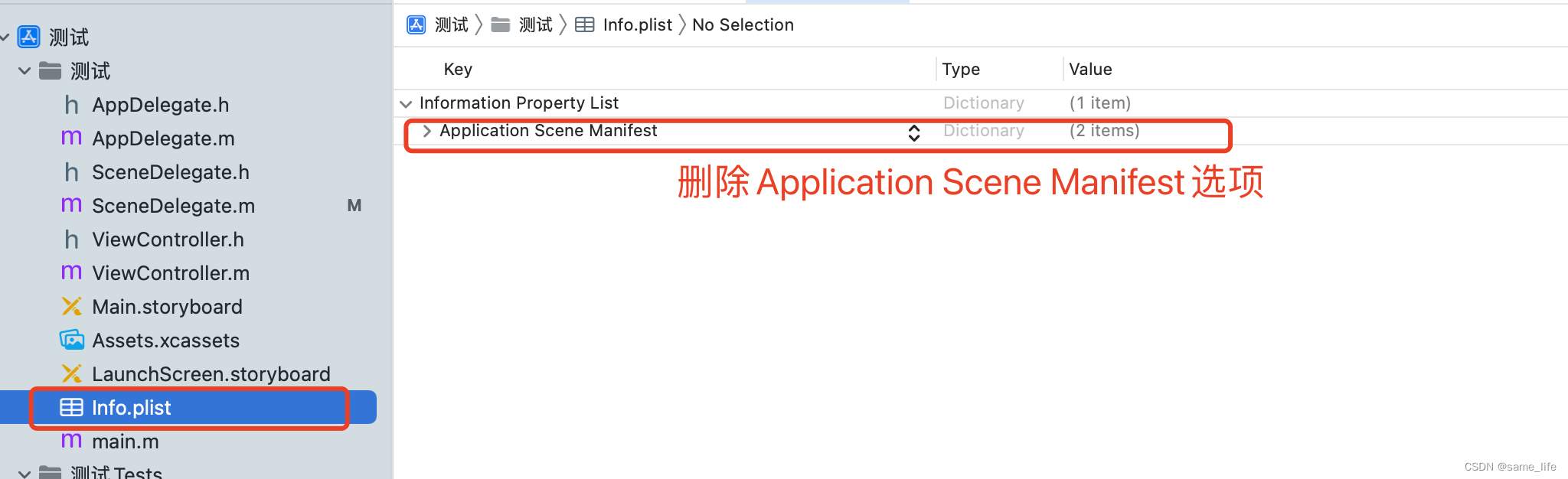
场景一:如果App不需要支持多个scene,同时兼容ios13以下,可以删除info.plist文件中的Application Scene Manifest的配置数据。在AppDelegate.h中添加window属性,同时删除UISceneSession的生命周期方法。和以前的使用方式一样。
步骤:
1、打开info.plist文件,删除Application Scene Manifest选项。
2、在AppDelegate中新增window属性,代码:
- (BOOL)application:(UIApplication *)application didFinishLaunchingWithOptions:(NSDictionary *)launchOptions {
    ViewController  *startVC=[[ViewController alloc]init];
    UINavigationController *nav = [[UINavigationController alloc]initWithRootViewController:startVC];
    self.window.rootViewController = nav;
    [self.window makeKeyAndVisible];
    return YES;
}
3、删除 SceneDelegate 文件,注释掉 AppDelegate.m 文件中两个UISceneSession的生命周期方法:
#pragma mark - UISceneSession lifecycle
//注释掉这两个UISceneSession的生命周期的代理方法
- (UISceneConfiguration *)application:(UIApplication *)application configurationForConnectingSceneSession:(UISceneSession *)connectingSceneSession options:(UISceneConnectionOptions *)options {
    // Called when a new scene session is being created.
    // Use this method to select a configuration to create the new scene with.
    return [[UISceneConfiguration alloc] initWithName:@"Default Configuration" sessionRole:connectingSceneSession.role];
}

- (void)application:(UIApplication *)application didDiscardSceneSessions:(NSSet<UISceneSession *> *)sceneSessions {
    // Called when the user discards a scene session.
    // If any sessions were discarded while the application was not running, this will be called shortly after application:didFinishLaunchingWithOptions.
    // Use this method to release any resources that were specific to the discarded scenes, as they will not return.
}
场景二:App不需要支持scene,如果不删除Application Scene Manifest这个配置,则需要针对ios13需要在Scene中配置和ios13以下在AppDelegate中做两套配置。
场景三: 支持多个scene,原先AppDelegate的生命周期方法不再起作用。需要在SceneDelegate中使用UIScene提供的生命周期方法。需要兼容iOS13以下:利用@available添加版本判断。
1.SceneDelegate中添加@available(iOS 13, *);
2.AppDelegate中同样声明window属性。
开启支持多scene步骤:
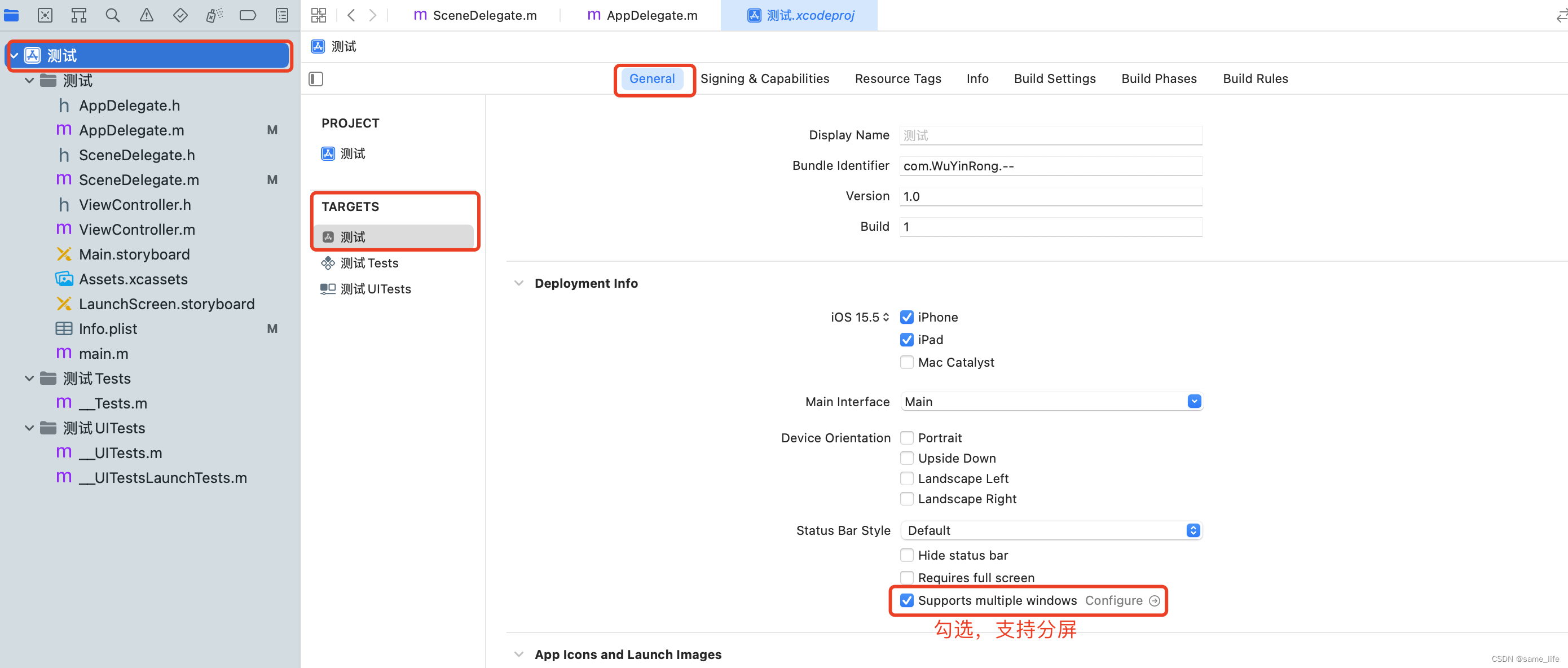
1、点击TARGETS 的 General选项,在Deployment Info 中勾选 Supports multiple windows支持分屏。
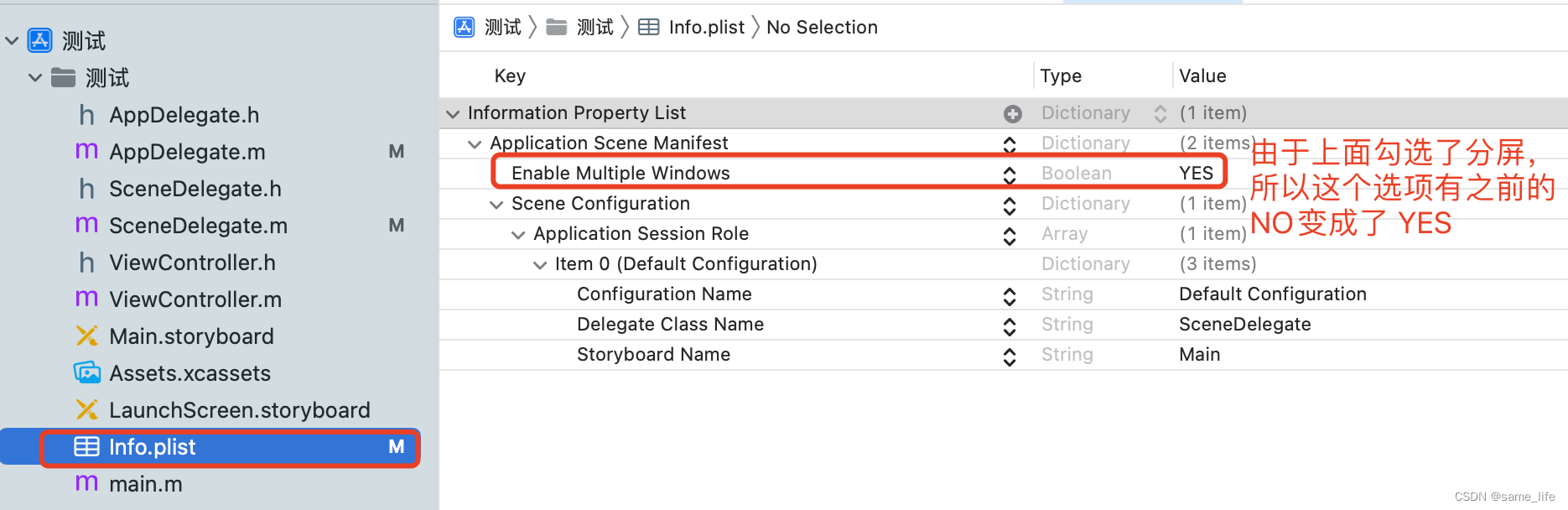
2、ios13中对info.plist文件进行了修改,多了一个参数用于配置分屏Application Scene Manifest,由于上面勾选了分屏,enable Multipe Windows 由之前的 NO 设置成了 YES。
3、兼容iOS13以下:AppDelegate中同样声明window属性。利用@available添加版本判断
//APPDelegate文件中初始化 window 的方法
- (BOOL)application:(UIApplication *)application didFinishLaunchingWithOptions:(NSDictionary *)launchOptions {
    if(@available(iOS 13, *)){

    }else
    {
       ViewController  *startVC=[[ViewController alloc]init];
       UINavigationController *nav = [[UINavigationController alloc]initWithRootViewController:startVC];
       self.window.rootViewController = nav;
       [self.window makeKeyAndVisible];
    }
    return YES;
}
4、在SceneDelegate 文件中添加@available(iOS 13, *)做版本判断。
//场景加载完成
- (void)scene:(UIScene *)scene willConnectToSession:(UISceneSession *)session options:(UISceneConnectionOptions *)connectionOptions {
    //ios13在SceneDelegate中不使用storyboard创建
    if (@available(iOS 13.0, *)) {
        if (scene) {
            //初始化 window 对象
            UIWindowScene *windowScene = (UIWindowScene *)scene;
            self.window = [[UIWindow alloc] initWithWindowScene:windowScene];
            self.window.frame = windowScene.coordinateSpace.bounds;
            ViewController *startVC = [[ViewController alloc]init];
            UINavigationController *nav = [[UINavigationController alloc]initWithRootViewController:startVC];
            self.window.rootViewController = nav;
            [self.window makeKeyAndVisible];
        }
    } else {
    }
}
5、AppDelegate两个关于Scene的方法也添加版本控制。
//返回一个UISceneConfiguration对象
- (UISceneConfiguration *)application:(UIApplication *)application configurationForConnectingSceneSession:(UISceneSession *)connectingSceneSession options:(UISceneConnectionOptions *)options {
    //在 iOS13 之前的版本需要做版本控制
    if (@available(iOS 13.0, *)) {
        return [[UISceneConfiguration alloc] initWithName:@"Default Configuration" sessionRole:connectingSceneSession.role];
    } else {
        return nil;
    }
}
- (void)application:(UIApplication *)application didDiscardSceneSessions:(NSSet<UISceneSession *> *)sceneSessions {
    if (@available(iOS 13.0, *)) {
        //在分屏中关闭其中一个或多个scene时候会调用。
        NSLog(@"%s",__func__);
    } else {
    }
}
//场景加载完成
- (void)scene:(UIScene *)scene willConnectToSession:(UISceneSession *)session options:(UISceneConnectionOptions *)connectionOptions {
    NSLog(@"场景加载完成");
}

//场景已经断开连接
- (void)sceneDidDisconnect:(UIScene *)scene {
    NSLog(@"场景已经断开连接");
}

//已经从后台进入前台
- (void)sceneDidBecomeActive:(UIScene *)scene {
    NSLog(@"已经从后台进入前台");
}

//即将从前台进入后台
- (void)sceneWillResignActive:(UIScene *)scene {
    NSLog(@"即将从前台进入后台");
}

//即将从后台进入前台
- (void)sceneWillEnterForeground:(UIScene *)scene {
    NSLog(@"即将从后台进入前台");
}

//已经从前台进入后台
- (void)sceneDidEnterBackground:(UIScene *)scene {
    NSLog(@"已经从前台进入后台");
}
我有一个Ruby程序,它使用rubyzip压缩XML文件的目录树。gem。我的问题是文件开始变得很重,我想提高压缩级别,因为压缩时间不是问题。我在rubyzipdocumentation中找不到一种为创建的ZIP文件指定压缩级别的方法。有人知道如何更改此设置吗?是否有另一个允许指定压缩级别的Ruby库? 最佳答案 这是我通过查看rubyzip内部创建的代码。level=Zlib::BEST_COMPRESSIONZip::ZipOutputStream.open(zip_file)do|zip|Dir.glob("**/*")d
我试图在一个项目中使用rake,如果我把所有东西都放到Rakefile中,它会很大并且很难读取/找到东西,所以我试着将每个命名空间放在lib/rake中它自己的文件中,我添加了这个到我的rake文件的顶部:Dir['#{File.dirname(__FILE__)}/lib/rake/*.rake'].map{|f|requiref}它加载文件没问题,但没有任务。我现在只有一个.rake文件作为测试,名为“servers.rake”,它看起来像这样:namespace:serverdotask:testdoputs"test"endend所以当我运行rakeserver:testid时
我的目标是转换表单输入,例如“100兆字节”或“1GB”,并将其转换为我可以存储在数据库中的文件大小(以千字节为单位)。目前,我有这个:defquota_convert@regex=/([0-9]+)(.*)s/@sizes=%w{kilobytemegabytegigabyte}m=self.quota.match(@regex)if@sizes.include?m[2]eval("self.quota=#{m[1]}.#{m[2]}")endend这有效,但前提是输入是倍数(“gigabytes”,而不是“gigabyte”)并且由于使用了eval看起来疯狂不安全。所以,功能正常,
Rails2.3可以选择随时使用RouteSet#add_configuration_file添加更多路由。是否可以在Rails3项目中做同样的事情? 最佳答案 在config/application.rb中:config.paths.config.routes在Rails3.2(也可能是Rails3.1)中,使用:config.paths["config/routes"] 关于ruby-on-rails-Rails3中的多个路由文件,我们在StackOverflow上找到一个类似的问题
对于具有离线功能的智能手机应用程序,我正在为Xml文件创建单向文本同步。我希望我的服务器将增量/差异(例如GNU差异补丁)发送到目标设备。这是计划:Time=0Server:hasversion_1ofXmlfile(~800kiB)Client:hasversion_1ofXmlfile(~800kiB)Time=1Server:hasversion_1andversion_2ofXmlfile(each~800kiB)computesdeltaoftheseversions(=patch)(~10kiB)sendspatchtoClient(~10kiBtransferred)Cl
我正在寻找执行以下操作的正确语法(在Perl、Shell或Ruby中):#variabletoaccessthedatalinesappendedasafileEND_OF_SCRIPT_MARKERrawdatastartshereanditcontinues. 最佳答案 Perl用__DATA__做这个:#!/usr/bin/perlusestrict;usewarnings;while(){print;}__DATA__Texttoprintgoeshere 关于ruby-如何将脚
使用带有Rails插件的vim,您可以创建一个迁移文件,然后一次性打开该文件吗?textmate也可以这样吗? 最佳答案 你可以使用rails.vim然后做类似的事情::Rgeneratemigratonadd_foo_to_bar插件将打开迁移生成的文件,这正是您想要的。我不能代表textmate。 关于ruby-使用VimRails,您可以创建一个新的迁移文件并一次性打开它吗?,我们在StackOverflow上找到一个类似的问题: https://sta
好的,所以我的目标是轻松地将一些数据保存到磁盘以备后用。您如何简单地写入然后读取一个对象?所以如果我有一个简单的类classCattr_accessor:a,:bdefinitialize(a,b)@a,@b=a,bendend所以如果我从中非常快地制作一个objobj=C.new("foo","bar")#justgaveitsomerandomvalues然后我可以把它变成一个kindaidstring=obj.to_s#whichreturns""我终于可以将此字符串打印到文件或其他内容中。我的问题是,我该如何再次将这个id变回一个对象?我知道我可以自己挑选信息并制作一个接受该信
我正在编写一个小脚本来定位aws存储桶中的特定文件,并创建一个临时验证的url以发送给同事。(理想情况下,这将创建类似于在控制台上右键单击存储桶中的文件并复制链接地址的结果)。我研究过回形针,它似乎不符合这个标准,但我可能只是不知道它的全部功能。我尝试了以下方法:defauthenticated_url(file_name,bucket)AWS::S3::S3Object.url_for(file_name,bucket,:secure=>true,:expires=>20*60)end产生这种类型的结果:...-1.amazonaws.com/file_path/file.zip.A
我注意到像bundler这样的项目在每个specfile中执行requirespec_helper我还注意到rspec使用选项--require,它允许您在引导rspec时要求一个文件。您还可以将其添加到.rspec文件中,因此只要您运行不带参数的rspec就会添加它。使用上述方法有什么缺点可以解释为什么像bundler这样的项目选择在每个规范文件中都需要spec_helper吗? 最佳答案 我不在Bundler上工作,所以我不能直接谈论他们的做法。并非所有项目都checkin.rspec文件。原因是这个文件,通常按照当前的惯例,只
