我会简述如何得到v5模型中各层的参数量和计算量(烂大街的参量表),然后再将如何得到各层的计算量FLOPs(基本没人教怎么获得各层FLOPs,花我一番功夫,其实特别简单,轮子U神都造好了)
文章目录
在侧端部署深度学习模型时,我们一直都说说这些模型很小,属于轻量级网络。当他人问如何横向对比这一批轻量级网络时,我们该如何证明这个网络比另一个网络优秀呢?除了mAP外,我们还可以 比对参数量param和计算量FlOPs。
以yolov5的官方参数表为例:
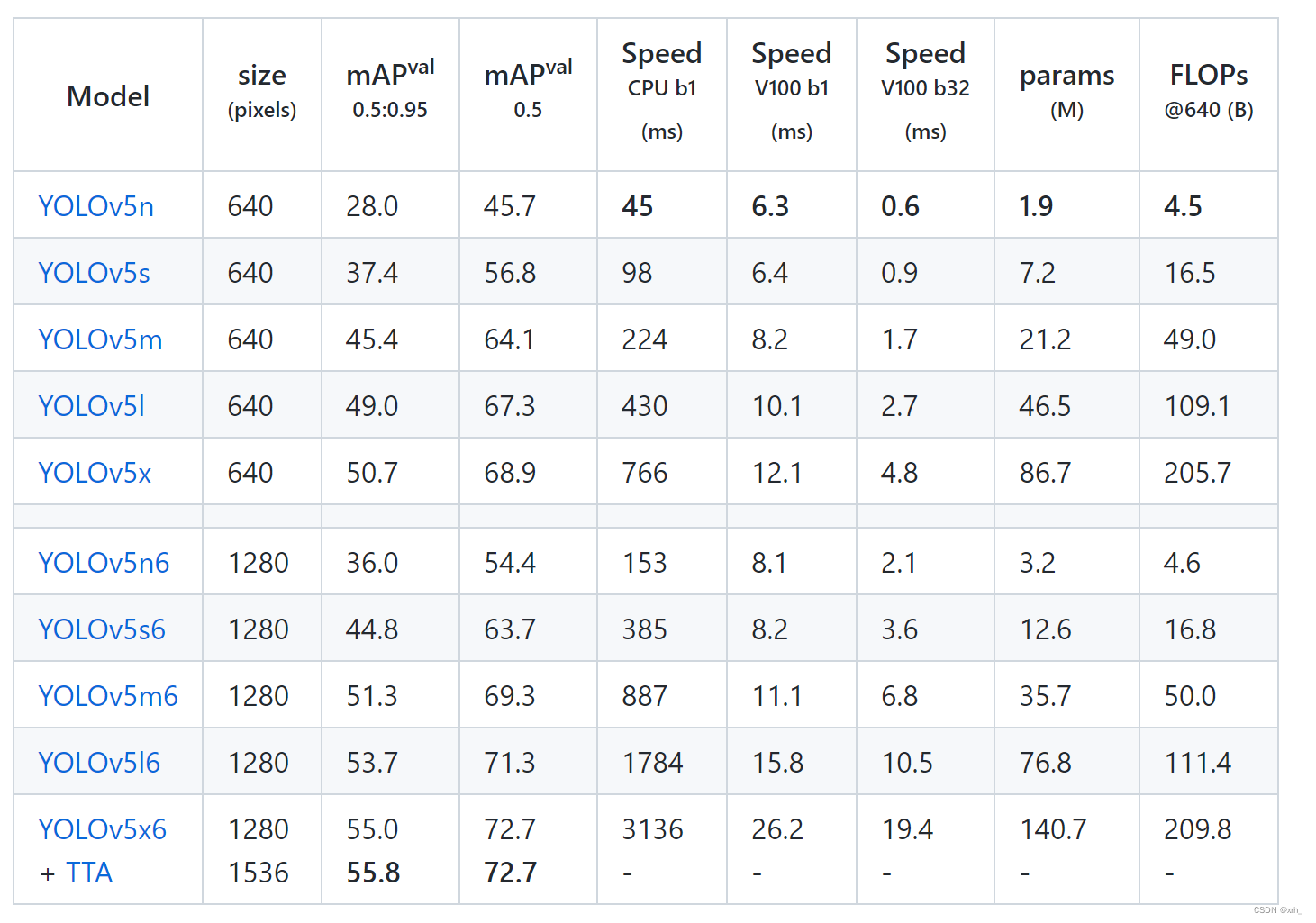
mAP:平均精度指标
params:参数量,单位M:minllion 10^6
FLOPs:模型总计算量 ,单位B/G:billion 10^9
注意:FLOPS为每秒浮点运算次数,常用于描述GPU性能,注意s的大小写
其实U神在yolov5的工程文件已经写好了打印各项参数的代码,细心的小伙伴也在train或detect时也留意到程序会计算模型信息并打印。
在 .\yolov5\utils\torch_utilis.py 文件中model_info函数负责打印param和FLOPs信息
def model_info(model, verbose=False, img_size=640):
    #打印模型参数、计算量
    # Model information. img_size may be int or list, i.e. img_size=640 or img_size=[640, 320]
    #train阶段会输出迭代数,等于param
    n_p = sum(x.numel() for x in model.parameters())  # number parameters
    n_g = sum(x.numel() for x in model.parameters() if x.requires_grad)  # number gradients
    if verbose:
    #if True:
        print(f"{'layer':>5} {'name':>40} {'gradient':>9} {'parameters':>12} {'shape':>20} {'mu':>10} {'sigma':>10}")
        for i, (name, p) in enumerate(model.named_parameters()):
            name = name.replace('module_list.', '')
            print('%5g %40s %9s %12g %20s %10.3g %10.3g' %
                  (i, name, p.requires_grad, p.numel(), list(p.shape), p.mean(), p.std()))

    try:  # FLOPs
        # FLOPs 核心计算库 thop.profile
        from thop import profile
        stride = max(int(model.stride.max()), 32) if hasattr(model, 'stride') else 32
        img = torch.zeros((1, model.yaml.get('ch', 3), stride, stride), device=next(model.parameters()).device)  # input
        flops = profile(deepcopy(model), inputs=(img,), verbose=False)[0] / 1E9 * 2  # stride GFLOPs
        img_size = img_size if isinstance(img_size, list) else [img_size, img_size]  # expand if int/float

        fs = ', %.1f GFLOPs' % (flops * img_size[0] / stride * img_size[1] / stride)  # 640x640 GFLOPs

    except (ImportError, Exception):
        fs = ''

    name = Path(model.yaml_file).stem.replace('yolov5', 'YOLOv5') if hasattr(model, 'yaml_file') else 'Model'
    LOGGER.info(f"{name} summary: {len(list(model.modules()))} layers, {n_p} parameters, {n_g} gradients{fs}")
yolo.py会生成一个Model类并调用model_info函数,并结合parse_model函数,我们会得到烂大街的参数表
                 from  n    params  module                                  arguments
  0                -1  1      3520  models.common.Conv                      [3, 32, 6, 2, 2]
  1                -1  1     18560  models.common.Conv                      [32, 64, 3, 2]
  2                -1  1     18816  models.common.C3                        [64, 64, 1]
  3                -1  1     73984  models.common.Conv                      [64, 128, 3, 2]
  4                -1  2    115712  models.common.C3                        [128, 128, 2]
  5                -1  1    295424  models.common.Conv                      [128, 256, 3, 2]
  6                -1  3    625152  models.common.C3                        [256, 256, 3]
  7                -1  1   1180672  models.common.Conv                      [256, 512, 3, 2]
  8                -1  1   1182720  models.common.C3                        [512, 512, 1]
  9                -1  1    656896  models.common.SPPF                      [512, 512, 5]
 10                -1  1    131584  models.common.Conv                      [512, 256, 1, 1]
 11                -1  1         0  torch.nn.modules.upsampling.Upsample    [None, 2, 'nearest']
 12           [-1, 6]  1         0  models.common.Concat                    [1]
 13                -1  1    361984  models.common.C3                        [512, 256, 1, False]
 14                -1  1     33024  models.common.Conv                      [256, 128, 1, 1]
 15                -1  1         0  torch.nn.modules.upsampling.Upsample    [None, 2, 'nearest']
 16           [-1, 4]  1         0  models.common.Concat                    [1]
 17                -1  1     90880  models.common.C3                        [256, 128, 1, False]
 18                -1  1    147712  models.common.Conv                      [128, 128, 3, 2]
 19          [-1, 14]  1         0  models.common.Concat                    [1]
 20                -1  1    296448  models.common.C3                        [256, 256, 1, False]
 21                -1  1    590336  models.common.Conv                      [256, 256, 3, 2]
 22          [-1, 10]  1         0  models.common.Concat                    [1]
 23                -1  1   1182720  models.common.C3                        [512, 512, 1, False]
 24      [17, 20, 23]  1     26970  Detect                                  [5, [[10, 13, 16, 30, 33, 23], [30, 61, 62, 45, 59, 119], [116, 90, 156, 198, 373, 326]], [128, 256, 512]]
YOLOv5s summary: 270 layers, 7033114 parameters, 7033114 gradients, 15.9 GFLOPs
笔者发现FLOPs的核心计算是利用profile库完成的
from thop import profile
flops = profile(deepcopy(model), inputs=(img,), verbose=False)[0] / 1E9 * 2  # stride GFLOPs
当时笔者进一步进入profile.py的底层逻辑中进行修改,想简单的获得各层的计算量或者是计算量的峰值,后续发现其实U神在torch_utilis.py中重构了一个profile函数。
该函数用于输出训练过程中的一些相关信息,如前向传播时间、反向传播时间、输入变量的shape、输出变量的shape等
def profile(input, ops, n=10, device=None):
    # YOLOv5 speed/memory/FLOPs profiler
    #
    # Usage:
    #     input = torch.randn(16, 3, 640, 640)
    #     m1 = lambda x: x * torch.sigmoid(x)
    #     m2 = nn.SiLU()
    #     profile(input, [m1, m2], n=100)  # profile over 100 iterations

    results = []
    device = device or select_device()
    print(f"{'Params':>12s}{'GFLOPs':>12s}{'GPU_mem (GB)':>14s}{'forward (ms)':>14s}{'backward (ms)':>14s}"
          f"{'input':>24s}{'output':>24s}")

    for x in input if isinstance(input, list) else [input]:
        x = x.to(device)
        x.requires_grad = True
        for m in ops if isinstance(ops, list) else [ops]:
            m = m.to(device) if hasattr(m, 'to') else m  # device
            m = m.half() if hasattr(m, 'half') and isinstance(x, torch.Tensor) and x.dtype is torch.float16 else m
            tf, tb, t = 0, 0, [0, 0, 0]  # dt forward, backward
            try:
                flops = thop.profile(m, inputs=(x,), verbose=False)[0] / 1E9 * 2  # GFLOPs
            except Exception:
                flops = 0

            try:
                for _ in range(n):
                    t[0] = time_sync()
                    y = m(x)
                    t[1] = time_sync()
                    try:
                        _ = (sum(yi.sum() for yi in y) if isinstance(y, list) else y).sum().backward()
                        t[2] = time_sync()
                    except Exception:  # no backward method
                        # print(e)  # for debug
                        t[2] = float('nan')
                    tf += (t[1] - t[0]) * 1000 / n  # ms per op forward
                    tb += (t[2] - t[1]) * 1000 / n  # ms per op backward
                mem = torch.cuda.memory_reserved() / 1E9 if torch.cuda.is_available() else 0  # (GB)
                s_in = tuple(x.shape) if isinstance(x, torch.Tensor) else 'list'
                s_out = tuple(y.shape) if isinstance(y, torch.Tensor) else 'list'
                p = sum(list(x.numel() for x in m.parameters())) if isinstance(m, nn.Module) else 0  # parameters
                print(f'{p:12}{flops:12.4g}{mem:>14.3f}{tf:14.4g}{tb:14.4g}{str(s_in):>24s}{str(s_out):>24s}')
                results.append([p, flops, mem, tf, tb, s_in, s_out])
            except Exception as e:
                print(e)
                results.append(None)
            torch.cuda.empty_cache()
    return results
当时就想利用这个函数进行修改,嵌入到model_info函数中,达到输出每一层网络的FLOPs的目的,历经尝试失败了。
神奇的发现U神其实都写好了造好轮子的,只是我们不知道哪里去用,怎么用,真的郁闷。
AnyWay,自己琢磨的过程也是学习的过程吧。
yolo.py文件中,U神写好了用法:
if __name__ == '__main__':
    parser = argparse.ArgumentParser()
    parser.add_argument('--cfg', type=str, default='yolov5s.yaml', help='model.yaml')
    parser.add_argument('--batch-size', type=int, default=1, help='total batch size for all GPUs')
    parser.add_argument('--device', default='', help='cuda device, i.e. 0 or 0,1,2,3 or cpu')
    parser.add_argument('--profile', action='store_true', help='profile model speed')
    parser.add_argument('--line-profile', action='store_true', help='profile model speed layer by layer')
    parser.add_argument('--test', action='store_true', help='test all yolo*.yaml')
    opt = parser.parse_args()
    opt.cfg = check_yaml(opt.cfg)  # check YAML
    print_args(vars(opt))
    device = select_device(opt.device)

    # Create model
    im = torch.rand(opt.batch_size, 3, 640, 640).to(device)
    model = Model(opt.cfg).to(device)

    # Options
    if opt.line_profile:  # profile layer by layer
        _ = model(im, profile=True)

    elif opt.profile:  # profile forward-backward
        results = profile(input=im, ops=[model], n=3)

    elif opt.test:  # test all models
        for cfg in Path(ROOT / 'models').rglob('yolo*.yaml'):
            try:
                _ = Model(cfg)
            except Exception as e:
                print(f'Error in {cfg}: {e}')
    parser.add_argument('--profile', action='store_true', help='profile model speed')
    parser.add_argument('--line-profile', action='store_true', help='profile model speed layer by layer')
#其实这里就明明白白写着怎么输出各层FLOPs
稍微修改代码,然后
终端行输入python .\models\yolo.py --line-profile我们得到:
 time (ms)     GFLOPs     params  module
     22.01       0.72       3520  models.common.Conv
     16.48       0.95      18560  models.common.Conv
     41.61       0.96      18816  models.common.C3
     10.80       0.95      73984  models.common.Conv
     33.24       1.48     115712  models.common.C3
      8.00       0.95     295424  models.common.Conv
     26.01       2.00     625152  models.common.C3
      6.80       0.94    1180672  models.common.Conv
     10.16       0.95    1182720  models.common.C3
     11.60       0.53     656896  models.common.SPPF
      1.20       0.11     131584  models.common.Conv
      0.40       0.00          0  torch.nn.modules.upsampling.Upsample
      0.40       0.00          0  models.common.Concat
     16.00       1.16     361984  models.common.C3
      1.60       0.11      33024  models.common.Conv
      0.80       0.00          0  torch.nn.modules.upsampling.Upsample
      1.20       0.00          0  models.common.Concat
     26.04       1.16      90880  models.common.C3
      4.00       0.47     147712  models.common.Conv
      0.40       0.00          0  models.common.Concat
     14.44       0.95     296448  models.common.C3
      4.09       0.47     590336  models.common.Conv
      0.00       0.00          0  models.common.Concat
     10.40       0.95    1182720  models.common.C3
      2.80       0.09      26970  Detect
    270.49      15.88 7033114.00  Total
得到完整的各层参量和FLOPs表,简洁多了
如果你看到这里,我希望你研究下profile函数,这个函数可移植性高,可以适用大部分模型。
最初我是想自己调用U神写的profile函数,发现真的好难实现,输入比较难写,后续也发现了U神在yolo.py留下的彩蛋。
其实获取各层的计算量很简单,一行代码就可以了,但为什么网上基本就没有资料没人记录呢,哪怕用来指导后来人也很好啊,这个profile函数其实可以使用于大部分模型,可移植。
我就边絮絮叨叨记录踩坑过程,希望后来人不用踩坑吧,毕竟大部分都是像我这样的萌新。虽然后面是用了U神的代码,但前期自己琢磨的过程也很有收获,笑
exe应该在我打开页面时运行。异步进程需要运行。有什么方法可以在ruby中使用两个参数异步运行exe吗?我已经尝试过ruby命令-system()、exec()但它正在等待过程完成。我需要用参数启动exe,无需等待进程完成是否有任何rubygems会支持我的问题? 最佳答案 您可以使用Process.spawn和Process.wait2:pid=Process.spawn'your.exe','--option'#Later...pid,status=Process.wait2pid您的程序将作为解释器的子进程执行。除
我有一些Ruby代码,如下所示:Something.createdo|x|x.foo=barend我想编写一个测试,它使用double代替block参数x,这样我就可以调用:x_double.should_receive(:foo).with("whatever").这可能吗? 最佳答案 specify'something'dox=doublex.should_receive(:foo=).with("whatever")Something.should_receive(:create).and_yield(x)#callthere
我正在为一个项目制作一个简单的shell,我希望像在Bash中一样解析参数字符串。foobar"helloworld"fooz应该变成:["foo","bar","helloworld","fooz"]等等。到目前为止,我一直在使用CSV::parse_line,将列分隔符设置为""和.compact输出。问题是我现在必须选择是要支持单引号还是双引号。CSV不支持超过一个分隔符。Python有一个名为shlex的模块:>>>shlex.split("Test'helloworld'foo")['Test','helloworld','foo']>>>shlex.split('Test"
我不确定传递给方法的对象的类型是否正确。我可能会将一个字符串传递给一个只能处理整数的函数。某种运行时保证怎么样?我看不到比以下更好的选择:defsomeFixNumMangler(input)raise"wrongtype:integerrequired"unlessinput.class==FixNumother_stuffend有更好的选择吗? 最佳答案 使用Kernel#Integer在使用之前转换输入的方法。当无法以任何合理的方式将输入转换为整数时,它将引发ArgumentError。defmy_method(number)
两者都可以defsetup(options={})options.reverse_merge:size=>25,:velocity=>10end和defsetup(options={}){:size=>25,:velocity=>10}.merge(options)end在方法的参数中分配默认值。问题是:哪个更好?您更愿意使用哪一个?在性能、代码可读性或其他方面有什么不同吗?编辑:我无意中添加了bang(!)...并不是要询问nobang方法与bang方法之间的区别 最佳答案 我倾向于使用reverse_merge方法:option
我有一个只接受一个参数的方法:defmy_method(number)end如果使用number调用方法,我该如何引发错误??通常,我如何定义方法参数的条件?比如我想在调用的时候报错:my_method(1) 最佳答案 您可以添加guard在函数的开头,如果参数无效则引发异常。例如:defmy_method(number)failArgumentError,"Inputshouldbegreaterthanorequalto2"ifnumbereputse.messageend#=>Inputshouldbegreaterthano
我没有找到太多关于如何执行此操作的信息,尽管有很多关于如何使用像这样的redirect_to将参数传递给重定向的建议:action=>'something',:controller=>'something'在我的应用程序中,我在路由文件中有以下内容match'profile'=>'User#show'我的表演Action是这样的defshow@user=User.find(params[:user])@title=@user.first_nameend重定向发生在同一个用户Controller中,就像这样defregister@title="Registration"@user=Use
对于作为String#tr参数的单引号字符串文字中反斜杠的转义状态,我觉得有些神秘。你能解释一下下面三个例子之间的对比吗?我特别不明白第二个。为了避免复杂化,我在这里使用了'd',在双引号中转义时不会改变含义("\d"="d")。'\\'.tr('\\','x')#=>"x"'\\'.tr('\\d','x')#=>"\\"'\\'.tr('\\\d','x')#=>"x" 最佳答案 在tr中转义tr的第一个参数非常类似于正则表达式中的括号字符分组。您可以在表达式的开头使用^来否定匹配(替换任何不匹配的内容)并使用例如a-f来匹配一
我正在使用RubyonRails3.0.9,我想生成一个传递一些自定义参数的link_toURL。也就是说,有一个articles_path(www.my_web_site_name.com/articles)我想生成如下内容:link_to'Samplelinktitle',...#HereIshouldimplementthecode#=>'http://www.my_web_site_name.com/articles?param1=value1¶m2=value2&...我如何编写link_to语句“alàRubyonRailsWay”以实现该目的?如果我想通过传递一些
我有一个名为Post的类,我需要能够适应以下场景:如果用户选择了一个类别,则只显示该类别的帖子如果用户选择了一种类型,则只显示该类型的帖子如果用户选择了一个类别和类型,则只显示该类别中该类型的帖子如果用户没有选择任何内容,则显示所有帖子我想知道我的Controller是否不可避免地会因大量条件语句而显得粗糙...这是我解决此问题的错误方法-有谁知道我如何才能做到这一点?classPostsController 最佳答案 您最好遵循“胖模型,瘦Controller”的惯例,这意味着您应该将这种逻辑放在模型本身中。Post类应该能够报告
