需要源码和数据集请点赞关注收藏后评论区留言私信~~~
下面对天池项目中的红酒数据集进行分析与挖掘
1:导入模块
2:颜色和打印精度设置
3:获取数据并显示数据维度
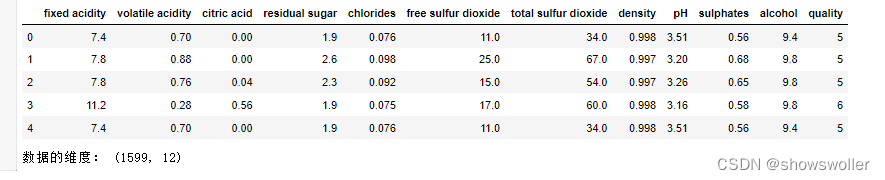
字段中英文对照表如下

然后利用describe函数显示数值属性的统计描述值

显示quality取值的相关信息

显示各个变量的直方图如下

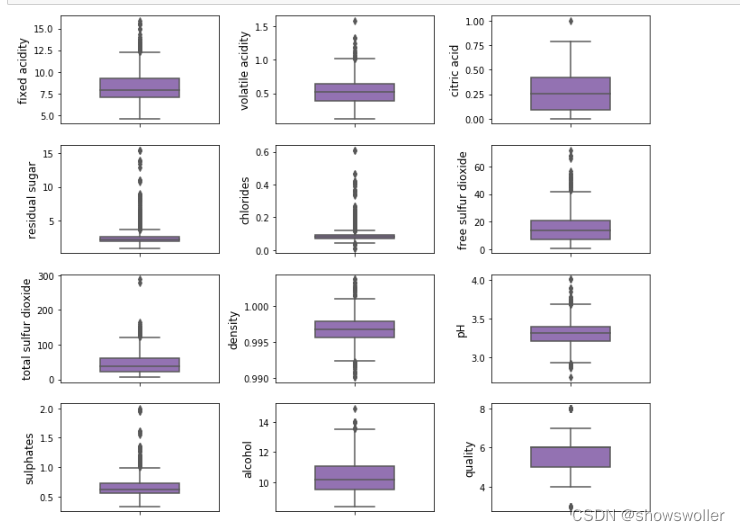
显示各个变量的盒图
酸性相关的特征分析 该数据集与酸度相关的特征有’fixed acidity’, ‘volatile acidity’, ‘citric acid’,‘chlorides’, ‘free sulfur dioxide’, ‘total sulfur dioxide’,‘PH’。其中前6中酸度特征都会对PH产生影响。PH在对数尺度,然后对6中酸度取对数做直方图
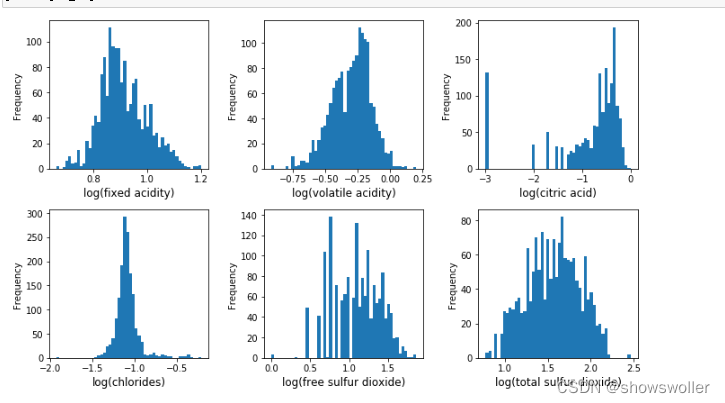
pH值主要是与fixed acidity有关,fixed acidity比volatile acidity和citric acid高1到2个数量级(Figure 4),比free sulfur dioxide, total sulfur dioxide, sulphates高3个数量级。 一个新特征total acid来自于前三个特征的和
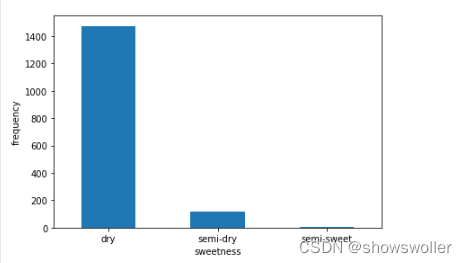
甜度(sweetness) residual sugar主要与酒的甜度有关,干红(<= 4g/L),半干(4-12g/L),半甜(12-45g/L),甜(>= 45g/L),该数据集中没有甜葡萄酒
绘制甜度的直方图如下
绘制不同品质红酒的各个属性的盒图
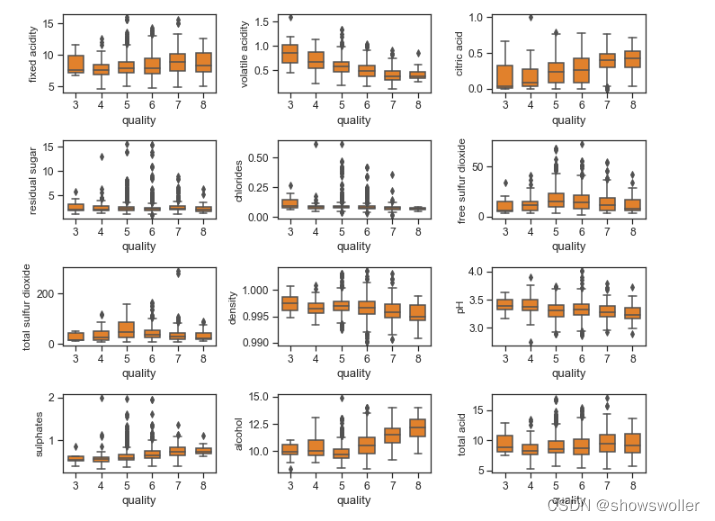
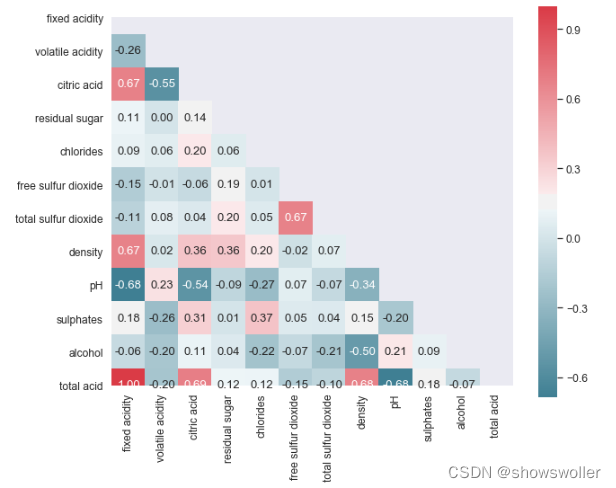
从上图可以看出:
红酒品质与柠檬酸,硫酸盐,酒精度成正相关 红酒品质与易挥发性酸,密度,PH成负相关 残留糖分,氯离子,二氧化硫对红酒品质没有什么影响
下面分析密度和酒精浓度的关系
密度和酒精浓度是相关的,物理上,但两者并不是线性关系。另外密度还与酒精中的其中物质含量有关,但是相关性很小

酸性物质含量和PH 因为PH和非挥发性酸之间存在着-0.68的相关性,因为非挥发性酸的总量特别高,所以total acid这个指标意义不大

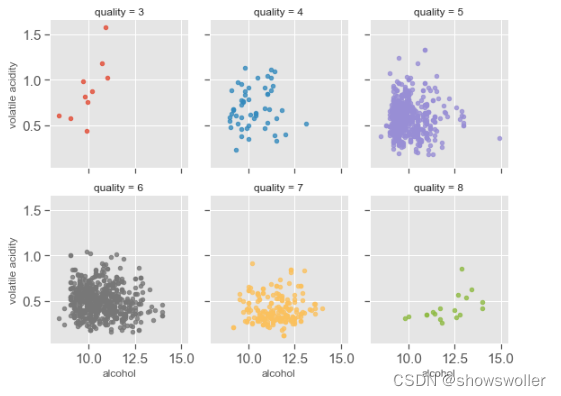
多变量分析 与红酒品质相关性最高的三个特征分别是酒精浓度,挥发性酸含量,柠檬酸。下面研究三个特征对红酒的品质有何影响

PH和非挥发性酸,柠檬酸成负相关

总结 对于红酒品质影响最重要的三个特征:酒精度、挥发性酸含量和柠檬酸。对于品质高于7的优质红酒和品质低于4的劣质红酒,直观上线性可分,对于品质为5和6的红酒很难进行线性区分
对数据类型编码,将数据集划分为训练集和测试集等等
对比原始数据与做了标准化处理的数据,其结果相差不大,所以该数据集不需要做标准化处理
下面我们展示各种算法的预测精度结果
可以发现误差都比较大,其中随机森林误差较高



部分代码如下 需要全部代码请点赞关注收藏后评论区留言私信~~~
#!/usr/bin/env python
# coding: utf-8
# ## 数据分析部分
# In[1]:
import numpy as np
import pandas as pd
import matplotlib.pyplot as plt
import seaborn as sns
# from sklearn.datasets import load_wine
# In[2]:
# 颜色
color = sns.color_palette()
# 数据print精度
pd.set_option('precision',3)
# In[3]:
df = pd.read_csv('.\winequality-red.csv',sep = ';')
display(df.head())
print('数据的维度:',df.shape)
# 
# In[4]:
df.info()
# In[5]:
df.describe()
# In[6]:
print('quality的取值:',df['quality'].unique())
print('quality的取值个数:',df['quality'].nunique())
print(df.groupby('quality').mean())
# 显示各个变量的直方图
# In[ ]:
# In[7]:
color = sns.color_palette()
column= df.columns.tolist()
fig = plt.figure(figsize = (10,8))
for i in range(12):
plt.subplot(4,3,i+1)
df[column[i]].hist(bins = 100,color = color[3])
plt.xlabel(column[i],fontsize = 12)
plt.ylabel('Frequency',fontsize = 12)
plt.tight_layout()
# 显示各个变量的盒图
# In[8]:
fig = plt.figure(figsize = (10,8))
for i in range(12):
plt.subplot(4,3,i+1)
sns.boxplot(df[column[i]],orient = 'v',width = 0.5,color = color[4])
plt.ylabel(column[i],fontsize = 12)
plt.tight_layout()
# 酸性相关的特征分析
# 该数据集与酸度相关的特征有’fixed acidity’, ‘volatile acidity’, ‘citric acid’,‘chlorides’, ‘free sulfur dioxide’, ‘total sulfur dioxide’,‘PH’。其中前6中酸度特征都会对PH产生影响。PH在对数尺度,然后对6中酸度取对数做直方图。
# In[9]:
acidityfeat = ['fixed acidity',
'volatile acidity',
'citric acid',
'chlorides',
'free sulfur dioxide',
'total sulfur dioxide',]
fig = plt.figure(figsize = (10,6))
for i in range(6):
plt.subplot(2,3,i+1)
v = np.log10(np.clip(df[acidityfeat[i]].values,a_min = 0.001,a_max = None))
plt.hist(v,bins = 50,color = color[0])
plt.xlabel('log('+ acidityfeat[i] +')',fontsize = 12)
plt.ylabel('Frequency')
plt.tight_layout()
# In[10]:
plt.figure(figsize=(6,3))
bins = 10**(np.linspace(-2,2)) # linspace 默认50等分
plt.hist(df['fixed acidity'], bins=bins, edgecolor = 'k', label='Fixed Acidity') #bins: 直方图的柱数,可选项,默认为10
plt.hist(df['volatile acidity'], bins=bins, edgecolor = 'k', label='Volatitle Acidity')#label:字符串或任何可以用'%s'转换打印的内容。
plt.hist(df['citric acid'], bins=bins, edgecolor = 'k', label='Citric Acid')
plt.xscale('log')
plt.xlabel('Acid Concentration(g/dm^3)')
plt.ylabel('Frequency')
plt.title('Histogram of Acid Contacts')#title :图形标题
plt.legend()#plt.legend()函数主要的作用就是给图加上图例
plt.tight_layout()
print('Figure 4')
"""
pH值主要是与fixed acidity有关,
fixed acidity比volatile acidity和citric acid高1到2个数量级(Figure 4),比free sulfur dioxide, total sulfur dioxide, sulphates高3个数量级。
一个新特征total acid来自于前三个特征的和。
"""
# 甜度(sweetness)
# residual sugar主要与酒的甜度有关,干红(<= 4g/L),半干(4-12g/L),半甜(12-45g/L),甜(>= 45g/L),该数据集中没有甜葡萄酒。
# In[11]:
df['sweetness'] = pd.cut(df['residual sugar'],bins = [0,4,12,45],labels = ['dry','semi-dry','semi-sweet'])
df.head()
# In[12]:
plt.figure(figsize = (6,4))
df['sweetness'].value_counts().plot(kind = 'bar',color = color[0])
plt.xticks(rotation = 0)
plt.xlabel('sweetness')
plt.ylabel('frequency')
plt.tight_layout()
print('Figure 5')
# In[13]:
# 创建一个新特征total acid
df['total acid'] = df['fixed acidity'] + df['volatile acidity'] + df['citric acid']
columns = df.columns.tolist()
columns.remove('sweetness')
# columns
# ['fixed acidity',
# 'volatile acidity',
# 'citric acid',
# 'residual sugar',
# 'chlorides',
# 'free sulfur dioxide',
# 'total sulfur dioxide',
# 'density',
# 'pH',
# 'sulphates',
# 'alcohol',
# 'quality',
# 'total acid']
sns.set_style('ticks')
sns.set_context('notebook',font_scale = 1.1)
column = columns[0:11] + ['total acid']
plt.figure(figsize = (10,8))
for i in range(12):
plt.subplot(4,3,i+1)
sns.boxplot(x = 'quality',y = column[i], data = df,color = color[1],width = 0.6)
plt.ylabel(column[i],fontsize = 12)
plt.tight_layout()
print('Figure 7:PhysicoChemico Propertise and Wine Quality by Boxplot')
# 从上图可以看出:
#
# 红酒品质与柠檬酸,硫酸盐,酒精度成正相关
# 红酒品质与易挥发性酸,密度,PH成负相关
# 残留糖分,氯离子,二氧化硫对红酒品质没有什么影响
# In[14]:
sns.set_style('dark')
plt.figure(figsize = (10,8))
mcorr = df[column].corr()
mask = np.zeros_like(mcorr,dtype = np.bool)
mask[np.triu_indices_from(mask)] = True
cmap = sns.diverging_palette(220, 10, as_cmap=True)
g = sns.heatmap(mcorr, mask=mask, cmap=cmap, square=True, annot=True, fmt='0.2f')
# print('Figure 8:Pairwise colleration plot')
# In[ ]:
# In[15]:
# 密度和酒精浓度
# 密度和酒精浓度是相关的,物理上,但两者并不是线性关系。另外密度还与酒精中的其中物质含量有关,但是相关性很小。
sns.set_style('ticks')
sns.set_context('notebook',font_scale = 1.4)
plt.figure(figsize = (6,4))
sns.regplot(x = 'density',y = 'alcohol',data = df,scatter_kws = {'s':10},color = color[1])
plt.xlabel('density',fontsize = 12)
plt.ylabel('alcohol',fontsize = 12)
plt.xlim(0.989,1.005)
plt.ylim(7,16)
# print('Figure 9: Density vs Alcohol')
# 酸性物质含量和PH
# 因为PH和非挥发性酸之间存在着-0.68的相关性,因为非挥发性酸的总量特别高,所以total acid这个指标意义不大。
# In[16]:
column
# In[17]:
acidity_raleted = ['fixed acidity','volatile acidity','total sulfur dioxide','chlorides','total acid']
plt.figure(figsize = (10,6))
for i in range(5):
plt.subplot(2,3,i+1)
sns.regpltx = 'pH',y = acidity_raleted[i],data = df,scatter_kws = {'s':10},color = color[1])
plt.xlabel('PH',fontsize = 12)
plt.ylabel(acidity_raleted[i],fontsize = 12)
plt.tight_layout()
print('Figure 10:The correlation between different acid and PH')
# 多变量分析
# 与红酒品质相性最高的三个特征分别是酒精浓度,挥发性酸含量,柠檬酸。下面研究三个特征对红酒的品质有何影响。
# In[18]:
plt.style.use('ggplot')
plt.figure(figsize = (6,4))
sns.lmplot(x = 'alcohol',y = 'volatile acidity',hue = 'quality',data = df,fit_reg = False,scatter_kws = {'s':10},size = 5)
# In[19]:
sns.lmplot(x = 'alcohol', y = 'volatile acidity', col='quality', hue = 'quality',
data = df,fit_reg = False, size = 3, aspect = 0.9, col_wrap=3,
={'s':20})
print("Figure 11-2: Scatter Plots of Alcohol, Volatile Acid and Quality")
# PH和非挥发性酸,柠檬酸
# PH和非挥发性酸,柠檬酸成负相关
# In[20]:
sns.set_style('ticks')
sns.set_context("notebook", font_scale= 1.4)
plt.figure(figsize=(6,5))
cm = plt.cm.get_cmap('RdBu')
sc = plt.scatter(df['fixed acidity'], df['citric acid'], c=df['pH'], vmin=2.6, vmax=4, s=15, cmap=cm)
bar = plt.colorbar(sc)
bar.n = 0)
plt.xlabel('fixed acidity')
plt.ylabel('ciric acid')
plt.xlim(4,18)
plt.ylim(0,1)
print('Figure 12: pH with Fixed Acidity and Citric Acid')
# 总结
# 对于红酒品质影响最重要的三个特征:酒精度、挥发性酸含量和柠檬酸。对于品质高于7的优质红酒和品质低于4的劣质红酒,直观上线性可分,对于品质为5和6的红酒很难进行线性区分。
# ## 数据掘时间部分
# In[21]:
# 数据建模
# 线性回归
# 集成算法
# 提升算
# 模型评估
# 确定模型参数
# 1.数据集切分
# 1.1 切分特征和标签
# 1.2 切分训练集个测试集
df.head()
# In[22]:
# 数据预处理工作
# 检查数据的完整性
df.isnull().sum()
# In[23]:
# 将object类型的数据转化为int类型
sweetness = pd.get_dummies(df['sweetness'])
df = pd.concat([df,sweetness],axis = 1)
df.head()
# In[24]:
df = df.drop('sweetness',axis = 1)
labels = df['quality']
features = df.drop('quality',axis = 1)
# 对原始数据集进行切分
from sklearn.model_selection import train_test_split
train_features,test_fatures,train_labels,test_labels = train_test_split(features,labels,test_size = 0.3,random_state = 0
print('训练特征的规模:'.shape)
print('训练标签的规模:',train_labels.shape)
print('测试特征的规模:',test_features.shape)
print('测试标签的规模:',test_labels.shape)
# In[25]:
from sklearn import svm
classifier=svm.SVC(kernel='linear',gamma=0.1)
classifier.fit(train_features,train_labels)
print('训练集的准确率',classifier.score(train_features,train_labels))
print('测试集的准确率',classifier.score(test_features,test_labels))
# In[26]:
from sklearn.linear_model import LinearRegression
LR = LinearRegression)LR.fit(train_features,train_labels
prediction = LR.predict(test_features)
prediction[:5]
# In[27]:
#对模型进行评估
from sklearn.metrics import mean_squared_error
RMSE = np.sqrt(mean_squared_error(test_labels,prediction))
print('线性回归模型的预测误差:',RMSE)
# In[28]:
# 对训练特征和测试特征做标准化处理,观察结果
from sklearn.preprocessing import StandardScaler
train_features_std = StandardScaler().fit_transform(train_features)
test_features_std = StandardScaler().fit_transform(test_features)
LR = LinearRegression()
LR.fit(train_features_std,train_labels)
prediction = LR.predict(test_features_std)
#观察预测结果误差
RMSE = np.sqrt(mean_squared_error(prediction,test_labels))
print('线性回归模型预测误差:',RMSE)
# 对比原始数据与做了标准化处理的数据,其结果相差不大,所以该数据集不需要做标准化处理。
#
# 集成算法:随机森林
# In[29]:
from sklearn.ensemble import RandomForestRegressor
RF = RandomForestRegressor()
RF.fit(train_features,train_labels)
prediction = RF.pre
# In[30]:
RF.get_params
# In[31]:
from sklearn.model_selection import GridSearchCV
param_grid = {'n_estimators':[100,200,300,400,500],
'max_depth':[3,4,5,6],
'min_samples_split':[2,3,4]}
RF = RandomForestRegressor()
grid = GridSearchCV(RF,param_grid = param_grid,scoring = 'neg_mean_squared_error',cv = 3,n_jobs = -1)
grid.fit(train_features,train_labels)
# In[32]:
# GridSearchCV(cv=3, error_score='raise-deprecating',
# estimator=RandomForestRegressor(bootstrap=True, criterion='mse', max_depth=None,
# max_features='auto', max_leaf_nodes=None,
# min_impurity_decrease=0.0, min_impurity_split=None,
# min_samples_leaf=1, min_samples_split=2,
# min_weight_fraction_leaf=0.0, n_estimators='warn', n_jobs=None,
# oob_sc
# In[33]:
grid.best_params_
# In[34]:
RF = RandomForestRegressor(n_estimators = 300,min_samples_split = 2,max_depth = 6)
RF.fit(train_features,train_labels)
# In[35]:
RandomForestRe
# In[36]:
prediction = RF.predict(test_features)
RF_RMSE = np.sqrt(mean_squared_error(prediction,test_labels))
print('随机森林模型的预测误差:',RF_RMSE)
# 集成算法:GBDT
# In[37]:
from sklearn.ensemble import GradientBoostingRegressor
GBDT = GradientBoostingRegressor()
GBDT.fit(train_features,train_labels)
gbdt_prediction =
GBDT.get_params
# In[ ]:
创作不易 觉得有帮助请点赞关注收藏~~~
很好奇,就使用rubyonrails自动化单元测试而言,你们正在做什么?您是否创建了一个脚本来在cron中运行rake作业并将结果邮寄给您?git中的预提交Hook?只是手动调用?我完全理解测试,但想知道在错误发生之前捕获错误的最佳实践是什么。让我们理所当然地认为测试本身是完美无缺的,并且可以正常工作。下一步是什么以确保他们在正确的时间将可能有害的结果传达给您? 最佳答案 不确定您到底想听什么,但是有几个级别的自动代码库控制:在处理某项功能时,您可以使用类似autotest的内容获得关于哪些有效,哪些无效的即时反馈。要确保您的提
关闭。这个问题是opinion-based.它目前不接受答案。想要改进这个问题?更新问题,以便editingthispost可以用事实和引用来回答它.关闭4年前。Improvethisquestion我想在固定时间创建一系列低音和高音调的哔哔声。例如:在150毫秒时发出高音调的蜂鸣声在151毫秒时发出低音调的蜂鸣声200毫秒时发出低音调的蜂鸣声250毫秒的高音调蜂鸣声有没有办法在Ruby或Python中做到这一点?我真的不在乎输出编码是什么(.wav、.mp3、.ogg等等),但我确实想创建一个输出文件。
在控制台中反复尝试之后,我想到了这种方法,可以按发生日期对类似activerecord的(Mongoid)对象进行分组。我不确定这是完成此任务的最佳方法,但它确实有效。有没有人有更好的建议,或者这是一个很好的方法?#eventsisanarrayofactiverecord-likeobjectsthatincludeatimeattributeevents.map{|event|#converteventsarrayintoanarrayofhasheswiththedayofthemonthandtheevent{:number=>event.time.day,:event=>ev
我主要使用Ruby来执行此操作,但到目前为止我的攻击计划如下:使用gemsrdf、rdf-rdfa和rdf-microdata或mida来解析给定任何URI的数据。我认为最好映射到像schema.org这样的统一模式,例如使用这个yaml文件,它试图描述数据词汇表和opengraph到schema.org之间的转换:#SchemaXtoschema.orgconversion#data-vocabularyDV:name:namestreet-address:streetAddressregion:addressRegionlocality:addressLocalityphoto:i
我正在编写一个包含C扩展的gem。通常当我写一个gem时,我会遵循TDD的过程,我会写一个失败的规范,然后处理代码直到它通过,等等......在“ext/mygem/mygem.c”中我的C扩展和在gemspec的“扩展”中配置的有效extconf.rb,如何运行我的规范并仍然加载我的C扩展?当我更改C代码时,我需要采取哪些步骤来重新编译代码?这可能是个愚蠢的问题,但是从我的gem的开发源代码树中输入“bundleinstall”不会构建任何native扩展。当我手动运行rubyext/mygem/extconf.rb时,我确实得到了一个Makefile(在整个项目的根目录中),然后当
这是一道面试题,我没有答对,但还是很好奇怎么解。你有N个人的大家庭,分别是1,2,3,...,N岁。你想给你的大家庭拍张照片。所有的家庭成员都排成一排。“我是家里的friend,建议家庭成员安排如下:”1岁的家庭成员坐在这一排的最左边。每两个坐在一起的家庭成员的年龄相差不得超过2岁。输入:整数N,1≤N≤55。输出:摄影师可以拍摄的照片数量。示例->输入:4,输出:4符合条件的数组:[1,2,3,4][1,2,4,3][1,3,2,4][1,3,4,2]另一个例子:输入:5输出:6符合条件的数组:[1,2,3,4,5][1,2,3,5,4][1,2,4,3,5][1,2,4,5,3][
我已经构建了一些serverspec代码来在多个主机上运行一组测试。问题是当任何测试失败时,测试会在当前主机停止。即使测试失败,我也希望它继续在所有主机上运行。Rakefile:namespace:specdotask:all=>hosts.map{|h|'spec:'+h.split('.')[0]}hosts.eachdo|host|begindesc"Runserverspecto#{host}"RSpec::Core::RakeTask.new(host)do|t|ENV['TARGET_HOST']=hostt.pattern="spec/cfengine3/*_spec.r
有时我需要处理键/值数据。我不喜欢使用数组,因为它们在大小上没有限制(很容易不小心添加超过2个项目,而且您最终需要稍后验证大小)。此外,0和1的索引变成了魔数(MagicNumber),并且在传达含义方面做得很差(“当我说0时,我的意思是head...”)。散列也不合适,因为可能会不小心添加额外的条目。我写了下面的类来解决这个问题:classPairattr_accessor:head,:taildefinitialize(h,t)@head,@tail=h,tendend它工作得很好并且解决了问题,但我很想知道:Ruby标准库是否已经带有这样一个类? 最佳
我们的git存储库中目前有一个Gemfile。但是,有一个gem我只在我的环境中本地使用(我的团队不使用它)。为了使用它,我必须将它添加到我们的Gemfile中,但每次我checkout到我们的master/dev主分支时,由于与跟踪的gemfile冲突,我必须删除它。我想要的是类似Gemfile.local的东西,它将继承从Gemfile导入的gems,但也允许在那里导入新的gems以供使用只有我的机器。此文件将在.gitignore中被忽略。这可能吗? 最佳答案 设置BUNDLE_GEMFILE环境变量:BUNDLE_GEMFI
我即将开始一个将录制和编辑音频文件的项目,我正在寻找一个好的库(最好是Ruby,但会考虑Java或.NET以外的任何库)以进行实时可视化波形。有人知道我应该从哪里开始搜索吗? 最佳答案 要流入浏览器的数据量很大。Flash或Flex图表可能是唯一能提高内存效率的解决方案。Javascript图表往往会因大型数据集而崩溃。 关于ruby-Ruby中的波形可视化,我们在StackOverflow上找到一个类似的问题: https://stackoverflow.c
