
目录
产品告诉UI设计设计图时要使用炫酷字体。因为Android不像网页项目可以使用浏览器本机的字体,Android只有那几种字体。
可以使用两种方法:
android:typeface="serif"
android:fontFamily="@font/xxxx"
typeface值如下
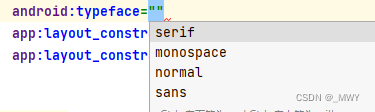
fontFamily 值如下
sans-serif
sans-serif-condensed
sans-serif-smallcaps
serif
serif-monospace
monospace
casual
cursive
fontFamily优先级大于typeface优先级
可以查看下面Android常用字体库
Android自带字体库 https://blog.csdn.net/weixin_41620505/article/details/114673516
使用的反射方式
import android.content.Context
import android.graphics.Typeface

object FontsOverride {

/**
*staticTypefaceFieldName :最好是 normal、sans、serif、monospace其中一个
*/
    fun setDefaultFont(context: Context, staticTypefaceFieldName: String, fontAssetName: String?) {
        val regular = Typeface.createFromAsset(context.assets, fontAssetName)
        replaceFont(staticTypefaceFieldName, regular)
    }

    internal fun replaceFont(staticTypefaceFieldName: String, newTypeface: Typeface?) {
        try {
            val staticField = Typeface::class.java.getDeclaredField(staticTypefaceFieldName)
            staticField.isAccessible = true
            staticField[null] = newTypeface
        } catch (e: NoSuchFieldException) {
            e.printStackTrace()
        } catch (e: IllegalAccessException) {
            e.printStackTrace()
        }
    }
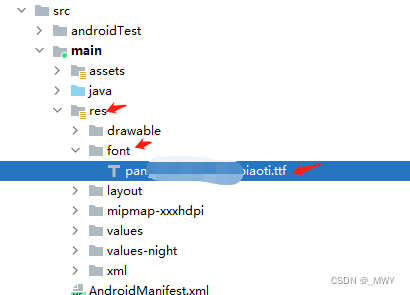
}要把字体ttf文件放到assets/fonts目录下,没有此目录手动创建
//staticTypefaceFieldName :最好是 normal、sans、serif、monospace其中一个
FontsOverride.setDefaultFont(this, "SERIF", "fonts/pangmenzhengdaobiaoti.ttf")
代码如下(示例):
    <TextView
                android:id="@+id/newHomeLoction"
                android:textColor="@color/white"
                android:textSize="26sp"
                android:typeface="serif"
                app:layout_constraintStart_toStartOf="@+id/newHomeLeaveTitle"
app:layout_constraintTop_toBottomOf="@+id/newHomeLeaveTitle" />如下图所示:
        <TextView
                android:id="@+id/newHomeLoction"
                android:layout_width="match_parent"
                android:layout_height="0dp"
                android:layout_weight="1"
                android:gravity="bottom|end"
                android:includeFontPadding="false"
                android:paddingBottom="28dp"
                android:fontFamily="@font/pangiaoti"
android:text="字体水水水水" />使用typeface这种方式不用每一个TextView都需要写,因为有默认字体样式(monospace)
使用fontFamily方式需要每一个TextView需要写一遍
在xml布局使用的
1:
android:typeface2:
android:fontFamily做好区分
我有一个Ruby程序,它使用rubyzip压缩XML文件的目录树。gem。我的问题是文件开始变得很重,我想提高压缩级别,因为压缩时间不是问题。我在rubyzipdocumentation中找不到一种为创建的ZIP文件指定压缩级别的方法。有人知道如何更改此设置吗?是否有另一个允许指定压缩级别的Ruby库? 最佳答案 这是我通过查看rubyzip内部创建的代码。level=Zlib::BEST_COMPRESSIONZip::ZipOutputStream.open(zip_file)do|zip|Dir.glob("**/*")d
我试图在一个项目中使用rake,如果我把所有东西都放到Rakefile中,它会很大并且很难读取/找到东西,所以我试着将每个命名空间放在lib/rake中它自己的文件中,我添加了这个到我的rake文件的顶部:Dir['#{File.dirname(__FILE__)}/lib/rake/*.rake'].map{|f|requiref}它加载文件没问题,但没有任务。我现在只有一个.rake文件作为测试,名为“servers.rake”,它看起来像这样:namespace:serverdotask:testdoputs"test"endend所以当我运行rakeserver:testid时
我的目标是转换表单输入,例如“100兆字节”或“1GB”,并将其转换为我可以存储在数据库中的文件大小(以千字节为单位)。目前,我有这个:defquota_convert@regex=/([0-9]+)(.*)s/@sizes=%w{kilobytemegabytegigabyte}m=self.quota.match(@regex)if@sizes.include?m[2]eval("self.quota=#{m[1]}.#{m[2]}")endend这有效,但前提是输入是倍数(“gigabytes”,而不是“gigabyte”)并且由于使用了eval看起来疯狂不安全。所以,功能正常,
Rails2.3可以选择随时使用RouteSet#add_configuration_file添加更多路由。是否可以在Rails3项目中做同样的事情? 最佳答案 在config/application.rb中:config.paths.config.routes在Rails3.2(也可能是Rails3.1)中,使用:config.paths["config/routes"] 关于ruby-on-rails-Rails3中的多个路由文件,我们在StackOverflow上找到一个类似的问题
我在使用omniauth/openid时遇到了一些麻烦。在尝试进行身份验证时,我在日志中发现了这一点:OpenID::FetchingError:Errorfetchinghttps://www.google.com/accounts/o8/.well-known/host-meta?hd=profiles.google.com%2Fmy_username:undefinedmethod`io'fornil:NilClass重要的是undefinedmethodio'fornil:NilClass来自openid/fetchers.rb,在下面的代码片段中:moduleNetclass
对于具有离线功能的智能手机应用程序,我正在为Xml文件创建单向文本同步。我希望我的服务器将增量/差异(例如GNU差异补丁)发送到目标设备。这是计划:Time=0Server:hasversion_1ofXmlfile(~800kiB)Client:hasversion_1ofXmlfile(~800kiB)Time=1Server:hasversion_1andversion_2ofXmlfile(each~800kiB)computesdeltaoftheseversions(=patch)(~10kiB)sendspatchtoClient(~10kiBtransferred)Cl
我正在寻找执行以下操作的正确语法(在Perl、Shell或Ruby中):#variabletoaccessthedatalinesappendedasafileEND_OF_SCRIPT_MARKERrawdatastartshereanditcontinues. 最佳答案 Perl用__DATA__做这个:#!/usr/bin/perlusestrict;usewarnings;while(){print;}__DATA__Texttoprintgoeshere 关于ruby-如何将脚
使用带有Rails插件的vim,您可以创建一个迁移文件,然后一次性打开该文件吗?textmate也可以这样吗? 最佳答案 你可以使用rails.vim然后做类似的事情::Rgeneratemigratonadd_foo_to_bar插件将打开迁移生成的文件,这正是您想要的。我不能代表textmate。 关于ruby-使用VimRails,您可以创建一个新的迁移文件并一次性打开它吗?,我们在StackOverflow上找到一个类似的问题: https://sta
我正在编写一个包含C扩展的gem。通常当我写一个gem时,我会遵循TDD的过程,我会写一个失败的规范,然后处理代码直到它通过,等等......在“ext/mygem/mygem.c”中我的C扩展和在gemspec的“扩展”中配置的有效extconf.rb,如何运行我的规范并仍然加载我的C扩展?当我更改C代码时,我需要采取哪些步骤来重新编译代码?这可能是个愚蠢的问题,但是从我的gem的开发源代码树中输入“bundleinstall”不会构建任何native扩展。当我手动运行rubyext/mygem/extconf.rb时,我确实得到了一个Makefile(在整个项目的根目录中),然后当
我正在查看instance_variable_set的文档并看到给出的示例代码是这样做的:obj.instance_variable_set(:@instnc_var,"valuefortheinstancevariable")然后允许您在类的任何实例方法中以@instnc_var的形式访问该变量。我想知道为什么在@instnc_var之前需要一个冒号:。冒号有什么作用? 最佳答案 我的第一直觉是告诉你不要使用instance_variable_set除非你真的知道你用它做什么。它本质上是一种元编程工具或绕过实例变量可见性的黑客攻击
