WPF 实现带蒙版的 MessageBox 消息提示框
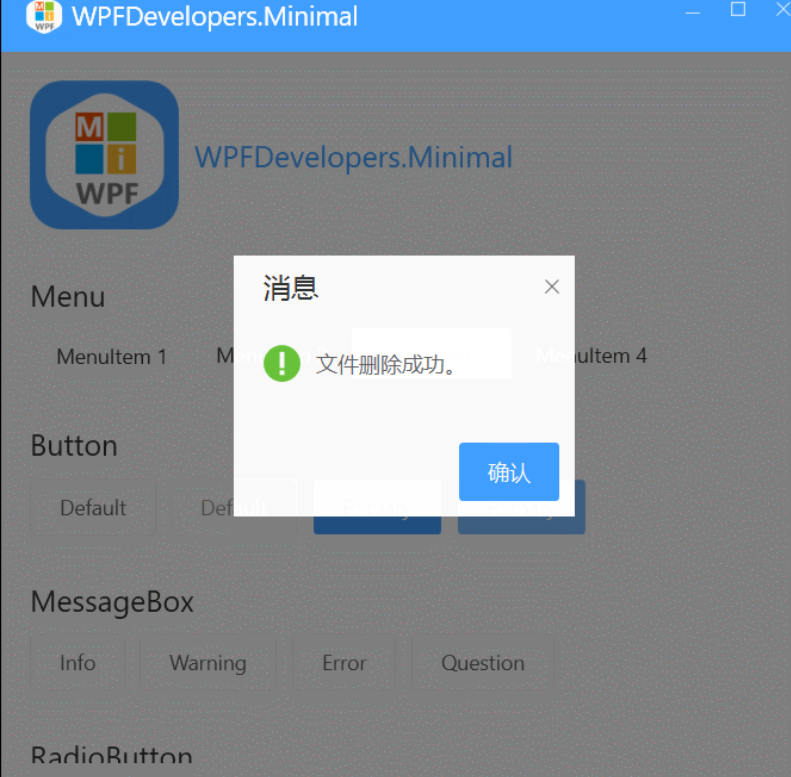
WPF 实现带蒙版的 MessageBox 消息提示框
作者:WPFDevelopersOrg
原文链接: https://github.com/WPFDevelopersOrg/WPFDevelopers.Minimal
.NET40;Visual Studio 2022;Install-Package WPFDevelopers.Minimal 3.2.6-previewMessageBox
MessageBox的Show五种方法;
Show(string messageBoxText) 传入Msg参数; Show(string messageBoxText, string caption) 传入Msg与标题参数; Show(string messageBoxText, string caption, MessageBoxButton button) 传入Msg与标题、操作按钮参数; Show(string messageBoxText, string caption, MessageBoxImage icon) 传入Msg与标题、消息图片参数; Show(string messageBoxText, string caption, MessageBoxButton button, MessageBoxImage icon) 传入Msg与标题、操作按钮、消息图片参数;Window窗体的内容Content,放入一个Grid里,再在容器里放入一个半透明的Grid,最后将整个Grid赋给父级Window窗体的内容Content;一、MessageBox.cs 代码如下;
using System;
using System.Collections.Generic;
using System.Linq;
using System.Text;
using System.Windows;
using System.Windows.Controls;
using System.Windows.Media;

namespace WPFDevelopers.Minimal.Controls
{
    public static class MessageBox
    {
        public static MessageBoxResult Show(string messageBoxText)
        {
            var msg = new WPFMessageBox(messageBoxText);
            return GetWindow(msg);
        }
        public static MessageBoxResult Show(string messageBoxText, string caption)
        {
            var msg = new WPFMessageBox(messageBoxText, caption);
            return GetWindow(msg);
        }
        public static MessageBoxResult Show(string messageBoxText, string caption, MessageBoxButton button)
        {
            var msg = new WPFMessageBox(messageBoxText, caption, button);
            return GetWindow(msg);
        }
        public static MessageBoxResult Show(string messageBoxText, string caption, MessageBoxImage icon)
        {
            var msg = new WPFMessageBox(messageBoxText, caption, icon);
            return GetWindow(msg);
        }
        public static MessageBoxResult Show(string messageBoxText, string caption, MessageBoxButton button, MessageBoxImage icon)
        {
            var msg = new WPFMessageBox(messageBoxText, caption,button,icon);
            return GetWindow(msg);
        }

        static MessageBoxResult GetWindow(WPFMessageBox msg)
        {
            msg.WindowStartupLocation = WindowStartupLocation.CenterOwner;
            Window win = null;
            if (Application.Current.Windows.Count > 0)
                win = Application.Current.Windows.OfType<Window>().FirstOrDefault(o => o.IsActive);
            if (win != null)
            {
                var layer = new Grid() { Background = new SolidColorBrush(Color.FromArgb(128, 0, 0, 0)) };
                UIElement original = win.Content as UIElement;
                win.Content = null;
                var container = new Grid();
                container.Children.Add(original);
                container.Children.Add(layer);
                win.Content = container;
                msg.Owner = win;
                msg.ShowDialog();
                container.Children.Clear();
                win.Content = original;
            }
            else
                msg.Show();
            return msg.Result;
        }
    }
}
二、Styles.MessageBox.xaml 代码如下;
<ResourceDictionary xmlns="http://schemas.microsoft.com/winfx/2006/xaml/presentation"
                    xmlns:x="http://schemas.microsoft.com/winfx/2006/xaml"
                    xmlns:sys="clr-namespace:System;assembly=mscorlib"
                    xmlns:wpfsc="clr-namespace:WPFDevelopers.Minimal.Controls">

    <ResourceDictionary.MergedDictionaries>
        <ResourceDictionary Source="../Themes/Basic/ControlBasic.xaml"/>
        <ResourceDictionary Source="../Themes/Basic/Animations.xaml"/>
    </ResourceDictionary.MergedDictionaries>

    <Style TargetType="{x:Type wpfsc:WPFMessageBox}">
        <Setter Property="Foreground" Value="{DynamicResource PrimaryTextSolidColorBrush}" />
        <Setter Property="Background"  Value="{DynamicResource WhiteSolidColorBrush}" />
        <Setter Property="BorderBrush" Value="{DynamicResource PrimaryNormalSolidColorBrush}" />
        <Setter Property="SizeToContent"  Value="WidthAndHeight" />
        <Setter Property="ResizeMode" Value="NoResize" />
        <Setter Property="ShowInTaskbar" Value="False" />
        <Setter Property="SnapsToDevicePixels" Value="True"/>
        <Setter Property="UseLayoutRounding" Value="True" />
        <Setter Property="TextOptions.TextFormattingMode" Value="Display" />
        <Setter Property="TextOptions.TextRenderingMode" Value="ClearType" />
        <Setter Property="WindowStyle"  Value="None" />
        <Setter Property="FontFamily" Value="{DynamicResource NormalFontFamily}" />
        <Setter Property="Template">
            <Setter.Value>
                <ControlTemplate TargetType="{x:Type wpfsc:WPFMessageBox}">
                    <Border Background="{TemplateBinding Background}"
                            BorderBrush="{TemplateBinding BorderBrush}"
                            BorderThickness="{TemplateBinding BorderThickness}">
                        <Grid>
                            <Grid.RowDefinitions>
                                <RowDefinition/>
                                <RowDefinition />
                                <RowDefinition/>
                            </Grid.RowDefinitions>
                            <Grid Grid.Row="0">
                                <DockPanel Margin="20,0,0,0">
                                    <TextBlock x:Name="PART_Title"
                                           HorizontalAlignment="Left"
                                           VerticalAlignment="Center"
                                           FontSize="{DynamicResource TitleFontSize}"
                                           Foreground="{DynamicResource PrimaryTextSolidColorBrush}"/>
                                    <Button Name="PART_CloseButton" Margin="0,6"
                                            ToolTip="Close" HorizontalAlignment="Right"
                                            IsTabStop="False" Style="{DynamicResource WindowButtonStyle}">
                                        <Path Width="10" Height="10"
                              HorizontalAlignment="Center"
                              VerticalAlignment="Center"
                              Data="{DynamicResource PathMetroWindowClose}"
                              Fill="{DynamicResource PrimaryTextSolidColorBrush}"
                              Stretch="Fill" />
                                    </Button>
                                </DockPanel>
                            </Grid>
                            <Grid Grid.Row="1" Margin="20">
                                <DockPanel>
                                    <Path x:Name="PART_Path" Data="{DynamicResource PathInformation}"
                                      Fill="{DynamicResource PrimaryNormalSolidColorBrush}"
                                      Height="25" Width="25" Stretch="Fill"></Path>
                                    <TextBlock x:Name="PART_Message" TextWrapping="Wrap"
                                           MaxWidth="500" Width="Auto" VerticalAlignment="Center"
                                           FontSize="{DynamicResource NormalFontSize}"
                                           Padding="10,0"
                                           Foreground="{DynamicResource RegularTextSolidColorBrush}"/>
                                </DockPanel>
                            </Grid>
                            <Grid Grid.Row="2" Margin="140,20,10,10">
                                <StackPanel Orientation="Horizontal" HorizontalAlignment="Right">
                                    <Button x:Name="PART_ButtonCancel" Content="取消" Visibility="Collapsed"/>
                                    <Button x:Name="PART_ButtonOK" Style="{DynamicResource PrimaryButton}"
                                        Margin="10,0,0,0" Content="确认"/>
                                </StackPanel>
                            </Grid>
                        </Grid>
                    </Border>
                </ControlTemplate>
            </Setter.Value>
        </Setter>
    </Style>

</ResourceDictionary>
三、WPFMessageBox.cs 代码如下;
using System;
using System.Collections.Generic;
using System.ComponentModel;
using System.Text;
using System.Windows;
using System.Windows.Controls;
using System.Windows.Media;
using System.Windows.Shapes;

namespace WPFDevelopers.Minimal.Controls
{
    [TemplatePart(Name = TitleTemplateName, Type = typeof(TextBlock))]
    [TemplatePart(Name = CloseButtonTemplateName, Type = typeof(Button))]
    [TemplatePart(Name = MessageTemplateName, Type = typeof(TextBlock))]
    [TemplatePart(Name = ButtonCancelTemplateName, Type = typeof(Button))]
    [TemplatePart(Name = ButtonCancelTemplateName, Type = typeof(Button))]
    [TemplatePart(Name = PathTemplateName, Type = typeof(Path))]
    public sealed class WPFMessageBox : Window
    {

        private const string TitleTemplateName = "PART_Title";
        private const string CloseButtonTemplateName = "PART_CloseButton";
        private const string MessageTemplateName = "PART_Message";
        private const string ButtonCancelTemplateName = "PART_ButtonCancel";
        private const string ButtonOKTemplateName = "PART_ButtonOK";
        private const string PathTemplateName = "PART_Path";

        private string _messageString;
        private string _titleString;
        private Geometry _geometry;
        private SolidColorBrush _solidColorBrush;
        private Visibility _cancelVisibility = Visibility.Collapsed;
        private Visibility _okVisibility;

        private TextBlock _title;
        private TextBlock _message;
        private Button _closeButton;
        private Button _buttonCancel;
        private Button _buttonOK;
        private Path _path;


        static WPFMessageBox()
        {
            DefaultStyleKeyProperty.OverrideMetadata(typeof(WPFMessageBox), new FrameworkPropertyMetadata(typeof(WPFMessageBox)));
        }
        public override void OnApplyTemplate()
        {
            base.OnApplyTemplate();
            _title = GetTemplateChild(TitleTemplateName) as TextBlock;
            _message = GetTemplateChild(MessageTemplateName) as TextBlock;

            if (_title == null || _message == null)
                throw new InvalidOperationException("the title or message control is null!");

            _title.Text = _titleString;
            _message.Text = _messageString;
            _path = GetTemplateChild(PathTemplateName) as Path;
            if (_path != null)
            {
                _path.Data = _geometry;
                _path.Fill = _solidColorBrush;
            }
            _closeButton = GetTemplateChild(CloseButtonTemplateName) as Button;
            if (_closeButton != null)
                _closeButton.Click += _closeButton_Click;
            _buttonCancel = GetTemplateChild(ButtonCancelTemplateName) as Button;
            if (_buttonCancel != null)
            {
                _buttonCancel.Visibility = _cancelVisibility;
                _buttonCancel.Click += _buttonCancel_Click;
            }
            _buttonOK = GetTemplateChild(ButtonOKTemplateName) as Button;
            if (_buttonOK != null)
            {
                _buttonOK.Visibility = _okVisibility;
                _buttonOK.Click += _buttonOK_Click;
            }
            if (Owner == null)
            {
                BorderThickness = new Thickness(1);
                WindowStartupLocation = WindowStartupLocation.CenterScreen;
            }
        }

        private void _buttonOK_Click(object sender, RoutedEventArgs e)
        {
            Result = MessageBoxResult.OK;
            Close();
        }

        private void _buttonCancel_Click(object sender, RoutedEventArgs e)
        {
            Result = MessageBoxResult.Cancel;
            Close();
        }

        private void _closeButton_Click(object sender, RoutedEventArgs e)
        {
            Close();
        }

        protected override void OnClosed(EventArgs e)
        {
            base.OnClosed(e);
            if (Owner == null)
                return;
            var grid = Owner.Content as Grid;
            UIElement original = VisualTreeHelper.GetChild(grid, 0) as UIElement;
            grid.Children.Remove(original);
            Owner.Content = original;
        }

        public MessageBoxResult Result { get; set; }

        public WPFMessageBox(string message)
        {

            _messageString = message;
        }

        public WPFMessageBox(string message, string caption)
        {
            _titleString = caption;
            _messageString = message;

        }

        public WPFMessageBox(string message, string caption, MessageBoxButton button)
        {
            _titleString = caption;
            _messageString = message; ;
        }

        public WPFMessageBox(string message, string caption, MessageBoxImage image)
        {
            _titleString = caption;
            _messageString = message;
            DisplayImage(image);
        }

        public WPFMessageBox(string message, string caption, MessageBoxButton button, MessageBoxImage image)
        {
            _titleString = caption;
            _messageString = message;
            DisplayImage(image);
            DisplayButtons(button);
        }

        private void DisplayButtons(MessageBoxButton button)
        {
            switch (button)
            {
                case MessageBoxButton.OKCancel:
                case MessageBoxButton.YesNo:
                    _cancelVisibility = Visibility.Visible;
                    _okVisibility = Visibility.Visible;
                    break;
                //case MessageBoxButton.YesNoCancel:
                //    break;
                default:
                    _okVisibility = Visibility.Visible;
                    break;
            }
        }
        private void DisplayImage(MessageBoxImage image)
        {
            switch (image)
            {
                case MessageBoxImage.Warning:
                    _geometry = Application.Current.Resources["PathWarning"] as Geometry;
                    _solidColorBrush = Application.Current.Resources["WarningSolidColorBrush"] as SolidColorBrush;
                    break;
                case MessageBoxImage.Error:
                    _geometry = Application.Current.Resources["PathError"] as Geometry;
                    _solidColorBrush = Application.Current.Resources["DangerSolidColorBrush"] as SolidColorBrush;
                    break;
                case MessageBoxImage.Information:
                    _geometry = Application.Current.Resources["PathWarning"] as Geometry;
                    _solidColorBrush = Application.Current.Resources["SuccessSolidColorBrush"] as SolidColorBrush;
                    break;
                case MessageBoxImage.Question:
                    _geometry = Application.Current.Resources["PathQuestion"] as Geometry;
                    _solidColorBrush = Application.Current.Resources["PrimaryNormalSolidColorBrush"] as SolidColorBrush;
                    break;
                default:
                    break;
            }
        }

    }
}
Nuget Install-Package WPFDevelopers.Minimal
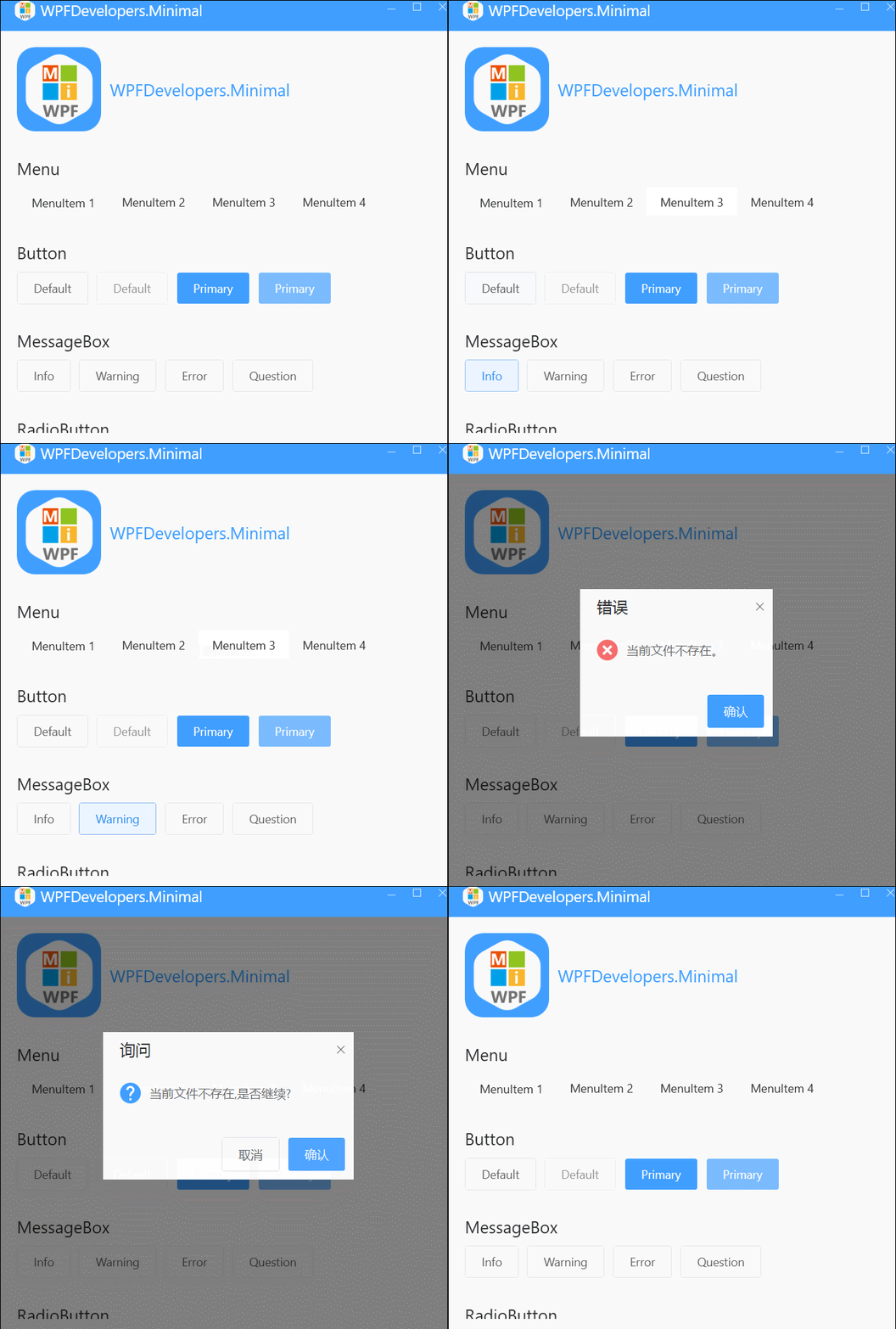
1.Window
2.Button
3.CheckBox
4.ComboBox
5.DataGrid
6.DatePicker
7.Expander
8.GroupBox
9.ListBox
10.ListView
11.Menu
12.PasswordBox
13.TextBox
14.RadioButton
15.ToggleButton
16.Slider
17.TreeView
18.TabControl
我有一个用户工厂。我希望默认情况下确认用户。但是鉴于unconfirmed特征,我不希望它们被确认。虽然我有一个基于实现细节而不是抽象的工作实现,但我想知道如何正确地做到这一点。factory:userdoafter(:create)do|user,evaluator|#unwantedimplementationdetailshereunlessFactoryGirl.factories[:user].defined_traits.map(&:name).include?(:unconfirmed)user.confirm!endendtrait:unconfirmeddoenden
我是rails的新手,想在form字段上应用验证。myviewsnew.html.erb.....模拟.rbclassSimulation{:in=>1..25,:message=>'Therowmustbebetween1and25'}end模拟Controller.rbclassSimulationsController我想检查模型类中row字段的整数范围,如果不在范围内则返回错误信息。我可以检查上面代码的范围,但无法返回错误消息提前致谢 最佳答案 关键是您使用的是模型表单,一种显示ActiveRecord模型实例属性的表单。c
我的工作要求我为某些测试自动生成电子邮件。我一直在四处寻找,但未能找到可以快速实现的合理解决方案。它需要在outlook而不是其他邮件服务器中,因为我们有一些奇怪的身份验证规则,我们需要保存草稿而不是仅仅发送邮件的选项。显然win32ole可以做到这一点,但我找不到任何相当简单的例子。 最佳答案 假设存储了Outlook凭据并且您设置为自动登录到Outlook,WIN32OLE可以很好地完成此操作:require'win32ole'outlook=WIN32OLE.new('Outlook.Application')message=
我正在使用Ruby,我正在与一个网络端点通信,该端点在发送消息本身之前需要格式化“header”。header中的第一个字段必须是消息长度,它被定义为网络字节顺序中的2二进制字节消息长度。比如我的消息长度是1024。如何将1024表示为二进制双字节? 最佳答案 Ruby(以及Perl和Python等)中字节整理的标准工具是pack和unpack。ruby的packisinArray.您的长度应该是两个字节长,并且按网络字节顺序排列,这听起来像是n格式说明符的工作:n|Integer|16-bitunsigned,network(bi
华为OD机试题本篇题目:明明的随机数题目输入描述输出描述:示例1输入输出说明代码编写思路最近更新的博客华为od2023|什么是华为od,od薪资待遇,od机试题清单华为OD机试真题大全,用Python解华为机试题|机试宝典【华为OD机试】全流程解析+经验分享,题型分享,防作弊指南华为o
C#实现简易绘图工具一.引言实验目的:通过制作窗体应用程序(C#画图软件),熟悉基本的窗体设计过程以及控件设计,事件处理等,熟悉使用C#的winform窗体进行绘图的基本步骤,对于面向对象编程有更加深刻的体会.Tutorial任务设计一个具有基本功能的画图软件**·包括简单的新建文件,保存,重新绘图等功能**·实现一些基本图形的绘制,包括铅笔和基本形状等,学习橡皮工具的创建**·设计一个合理舒适的UI界面**注明:你可能需要先了解一些关于winform窗体应用程序绘图的基本知识,以及关于GDI+类和结构的知识二.实验环境Windows系统下的visualstudio2017C#窗体应用程序三.
MIMO技术的优缺点优点通过下面三个增益来总体概括:阵列增益。阵列增益是指由于接收机通过对接收信号的相干合并而活得的平均SNR的提高。在发射机不知道信道信息的情况下,MIMO系统可以获得的阵列增益与接收天线数成正比复用增益。在采用空间复用方案的MIMO系统中,可以获得复用增益,即信道容量成倍增加。信道容量的增加与min(Nt,Nr)成正比分集增益。在采用空间分集方案的MIMO系统中,可以获得分集增益,即可靠性性能的改善。分集增益用独立衰落支路数来描述,即分集指数。在使用了空时编码的MIMO系统中,由于接收天线或发射天线之间的间距较远,可认为它们各自的大尺度衰落是相互独立的,因此分布式MIMO
如果我在模型中设置验证消息validates:name,:presence=>{:message=>'Thenamecantbeblank.'}我如何让该消息显示在闪光警报中,这是我迄今为止尝试过的方法defcreate@message=Message.new(params[:message])if@message.valid?ContactMailer.send_mail(@message).deliverredirect_to(root_path,:notice=>"Thanksforyourmessage,Iwillbeintouchsoon")elseflash[:error]
遍历文件夹我们通常是使用递归进行操作,这种方式比较简单,也比较容易理解。本文为大家介绍另一种不使用递归的方式,由于没有使用递归,只用到了循环和集合,所以效率更高一些!一、使用递归遍历文件夹整体思路1、使用File封装初始目录,2、打印这个目录3、获取这个目录下所有的子文件和子目录的数组。4、遍历这个数组,取出每个File对象4-1、如果File是否是一个文件,打印4-2、否则就是一个目录,递归调用代码实现publicclassSearchFile{publicstaticvoidmain(String[]args){//初始目录Filedir=newFile("d:/Dev");Datebeg
通常,数组被实现为内存块,集合被实现为HashMap,有序集合被实现为跳跃列表。在Ruby中也是如此吗?我正在尝试从性能和内存占用方面评估Ruby中不同容器的使用情况 最佳答案 数组是Ruby核心库的一部分。每个Ruby实现都有自己的数组实现。Ruby语言规范只规定了Ruby数组的行为,并没有规定任何特定的实现策略。它甚至没有指定任何会强制或至少建议特定实现策略的性能约束。然而,大多数Rubyist对数组的性能特征有一些期望,这会迫使不符合它们的实现变得默默无闻,因为实际上没有人会使用它:插入、前置或追加以及删除元素的最坏情况步骤复
