文章目录
下面对v0.1版本的整体网络结构及各个组件,结合源码和train文件夹中的yolov7.yaml配置文件进行解析。
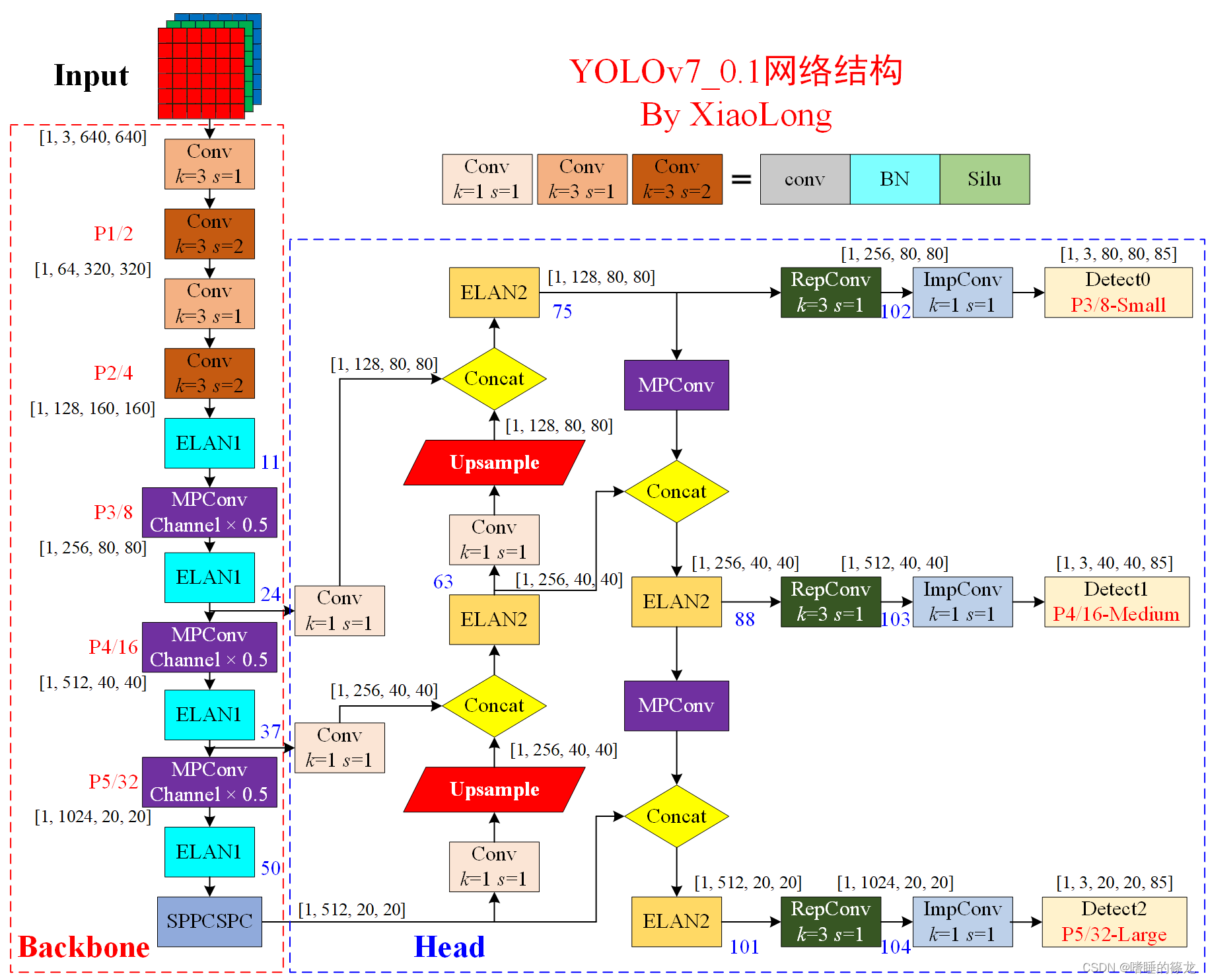
# parameters
nc: 80  # number of classes
depth_multiple: 1.0  # model depth multiple
width_multiple: 1.0  # layer channel multiple

# anchors
anchors:
  - [12,16, 19,36, 40,28]  # P3/8
  - [36,75, 76,55, 72,146]  # P4/16
  - [142,110, 192,243, 459,401]  # P5/32

# yolov7 backbone
backbone:
  # [from, number, module, args]
  [[-1, 1, Conv, [32, 3, 1]],  # 0
   [-1, 1, Conv, [64, 3, 2]],  # 1-P1/2
   [-1, 1, Conv, [64, 3, 1]],
   [-1, 1, Conv, [128, 3, 2]],  # 3-P2/4

   # ELAN1
   [-1, 1, Conv, [64, 1, 1]],
   [-2, 1, Conv, [64, 1, 1]],
   [-1, 1, Conv, [64, 3, 1]],
   [-1, 1, Conv, [64, 3, 1]],
   [-1, 1, Conv, [64, 3, 1]],
   [-1, 1, Conv, [64, 3, 1]],
   [[-1, -3, -5, -6], 1, Concat, [1]],
   [-1, 1, Conv, [256, 1, 1]],  # 11

   # MPConv
   [-1, 1, MP, []],
   [-1, 1, Conv, [128, 1, 1]],
   [-3, 1, Conv, [128, 1, 1]],
   [-1, 1, Conv, [128, 3, 2]],
   [[-1, -3], 1, Concat, [1]],  # 16-P3/8

   # ELAN1
   [-1, 1, Conv, [128, 1, 1]],
   [-2, 1, Conv, [128, 1, 1]],
   [-1, 1, Conv, [128, 3, 1]],
   [-1, 1, Conv, [128, 3, 1]],
   [-1, 1, Conv, [128, 3, 1]],
   [-1, 1, Conv, [128, 3, 1]],
   [[-1, -3, -5, -6], 1, Concat, [1]],
   [-1, 1, Conv, [512, 1, 1]],  # 24

   # MPConv
   [-1, 1, MP, []],
   [-1, 1, Conv, [256, 1, 1]],
   [-3, 1, Conv, [256, 1, 1]],
   [-1, 1, Conv, [256, 3, 2]],
   [[-1, -3], 1, Concat, [1]],  # 29-P4/16

   # ELAN1
   [-1, 1, Conv, [256, 1, 1]],
   [-2, 1, Conv, [256, 1, 1]],
   [-1, 1, Conv, [256, 3, 1]],
   [-1, 1, Conv, [256, 3, 1]],
   [-1, 1, Conv, [256, 3, 1]],
   [-1, 1, Conv, [256, 3, 1]],
   [[-1, -3, -5, -6], 1, Concat, [1]],
   [-1, 1, Conv, [1024, 1, 1]],  # 37

   # MPConv
   [-1, 1, MP, []],
   [-1, 1, Conv, [512, 1, 1]],
   [-3, 1, Conv, [512, 1, 1]],
   [-1, 1, Conv, [512, 3, 2]],
   [[-1, -3], 1, Concat, [1]],  # 42-P5/32

   # ELAN1
   [-1, 1, Conv, [256, 1, 1]],
   [-2, 1, Conv, [256, 1, 1]],
   [-1, 1, Conv, [256, 3, 1]],
   [-1, 1, Conv, [256, 3, 1]],
   [-1, 1, Conv, [256, 3, 1]],
   [-1, 1, Conv, [256, 3, 1]],
   [[-1, -3, -5, -6], 1, Concat, [1]],
   [-1, 1, Conv, [1024, 1, 1]],  # 50
  ]

# yolov7 head
head:
  [[-1, 1, SPPCSPC, [512]], # 51

   [-1, 1, Conv, [256, 1, 1]],
   [-1, 1, nn.Upsample, [None, 2, 'nearest']],
   [37, 1, Conv, [256, 1, 1]], # route backbone P4
   [[-1, -2], 1, Concat, [1]],

   # ELAN2
   [-1, 1, Conv, [256, 1, 1]],
   [-2, 1, Conv, [256, 1, 1]],
   [-1, 1, Conv, [128, 3, 1]],
   [-1, 1, Conv, [128, 3, 1]],
   [-1, 1, Conv, [128, 3, 1]],
   [-1, 1, Conv, [128, 3, 1]],
   [[-1, -2, -3, -4, -5, -6], 1, Concat, [1]],
   [-1, 1, Conv, [256, 1, 1]], # 63

   [-1, 1, Conv, [128, 1, 1]],
   [-1, 1, nn.Upsample, [None, 2, 'nearest']],
   [24, 1, Conv, [128, 1, 1]], # route backbone P3
   [[-1, -2], 1, Concat, [1]],

   # ELAN2
   [-1, 1, Conv, [128, 1, 1]],
   [-2, 1, Conv, [128, 1, 1]],
   [-1, 1, Conv, [64, 3, 1]],
   [-1, 1, Conv, [64, 3, 1]],
   [-1, 1, Conv, [64, 3, 1]],
   [-1, 1, Conv, [64, 3, 1]],
   [[-1, -2, -3, -4, -5, -6], 1, Concat, [1]],
   [-1, 1, Conv, [128, 1, 1]], # 75

   # MPConv Channel × 2
   [-1, 1, MP, []],
   [-1, 1, Conv, [128, 1, 1]],
   [-3, 1, Conv, [128, 1, 1]],
   [-1, 1, Conv, [128, 3, 2]],
   [[-1, -3, 63], 1, Concat, [1]],

   # ELAN2
   [-1, 1, Conv, [256, 1, 1]],
   [-2, 1, Conv, [256, 1, 1]],
   [-1, 1, Conv, [128, 3, 1]],
   [-1, 1, Conv, [128, 3, 1]],
   [-1, 1, Conv, [128, 3, 1]],
   [-1, 1, Conv, [128, 3, 1]],
   [[-1, -2, -3, -4, -5, -6], 1, Concat, [1]],
   [-1, 1, Conv, [256, 1, 1]], # 88

   # MPConv Channel × 2
   [-1, 1, MP, []],
   [-1, 1, Conv, [256, 1, 1]],
   [-3, 1, Conv, [256, 1, 1]],
   [-1, 1, Conv, [256, 3, 2]],
   [[-1, -3, 51], 1, Concat, [1]],

   # ELAN2
   [-1, 1, Conv, [512, 1, 1]],
   [-2, 1, Conv, [512, 1, 1]],
   [-1, 1, Conv, [256, 3, 1]],
   [-1, 1, Conv, [256, 3, 1]],
   [-1, 1, Conv, [256, 3, 1]],
   [-1, 1, Conv, [256, 3, 1]],
   [[-1, -2, -3, -4, -5, -6], 1, Concat, [1]],
   [-1, 1, Conv, [512, 1, 1]], # 101

   [75, 1, RepConv, [256, 3, 1]],
   [88, 1, RepConv, [512, 3, 1]],
   [101, 1, RepConv, [1024, 3, 1]],

   [[102,103,104], 1, IDetect, [nc, anchors]],   # Detect(P3, P4, P5)
  ]

yolov7.yaml中对应部分:# ELAN1
[-1, 1, Conv, [64, 1, 1]],
[-2, 1, Conv, [64, 1, 1]],
[-1, 1, Conv, [64, 3, 1]],
[-1, 1, Conv, [64, 3, 1]],
[-1, 1, Conv, [64, 3, 1]],
[-1, 1, Conv, [64, 3, 1]],
[[-1, -3, -5, -6], 1, Concat, [1]],
[-1, 1, Conv, [256, 1, 1]], # 11

yolov7.yaml中对应部分:# ELAN2
[-1, 1, Conv, [256, 1, 1]],
[-2, 1, Conv, [256, 1, 1]],
[-1, 1, Conv, [128, 3, 1]],
[-1, 1, Conv, [128, 3, 1]],
[-1, 1, Conv, [128, 3, 1]],
[-1, 1, Conv, [128, 3, 1]],
[[-1, -2, -3, -4, -5, -6], 1, Concat, [1]],
[-1, 1, Conv, [256, 1, 1]], # 63
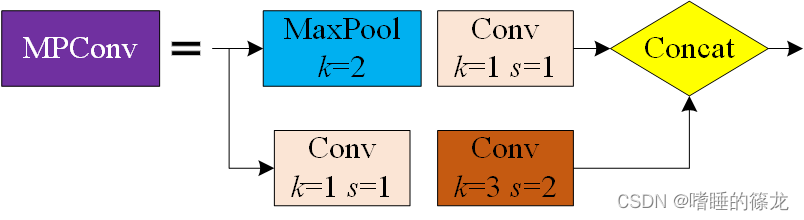
backnone中的对应部分MP函数之前,通道数减少一半 [-1, 1, Conv, [256, 1, 1]], # 11
# MPConv
[-1, 1, MP, []],
[-1, 1, Conv, [128, 1, 1]],
[-3, 1, Conv, [128, 1, 1]],
[-1, 1, Conv, [128, 3, 2]],
[[-1, -3], 1, Concat, [1]], # 16-P3/8
head中的对应部分MP函数之前,通道数不变 [-1, 1, Conv, [128, 1, 1]], # 75
# MPConv Channel × 2
[-1, 1, MP, []],
[-1, 1, Conv, [128, 1, 1]],
[-3, 1, Conv, [128, 1, 1]],
[-1, 1, Conv, [128, 3, 2]],
[[-1, -3, 63], 1, Concat, [1]],
类似于yolov5中的SPPF,不同的是,使用了5×5、9×9、13×13最大池化。
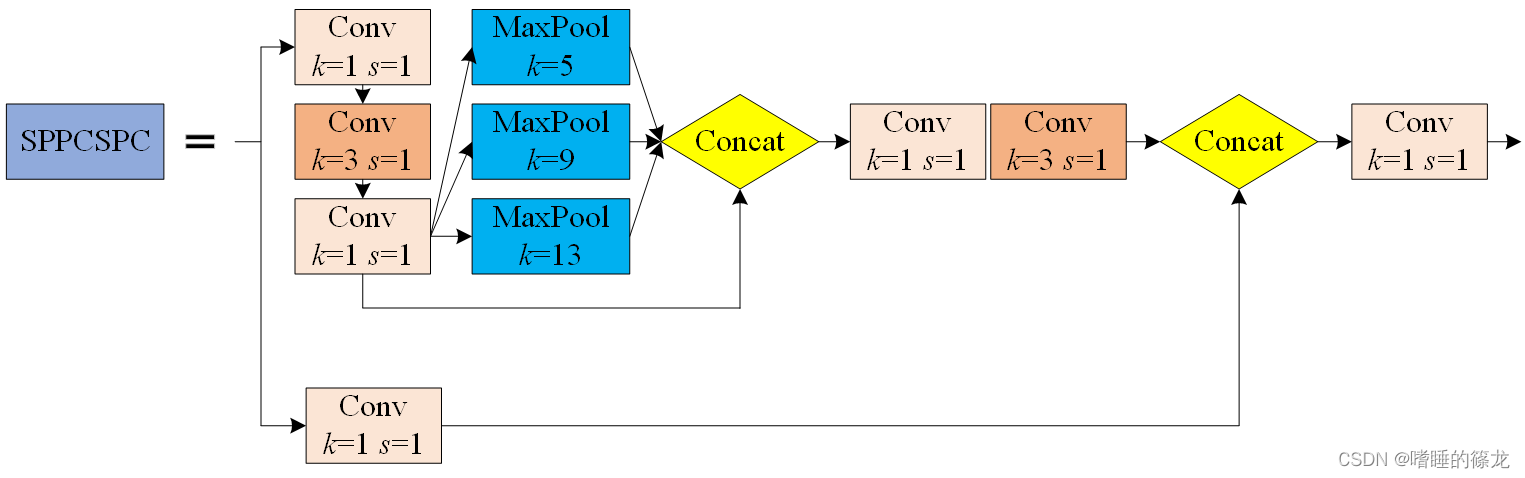
common.py中对应部分:class SPPCSPC(nn.Module):
# CSP https://github.com/WongKinYiu/CrossStagePartialNetworks
def __init__(self, c1, c2, n=1, shortcut=False, g=1, e=0.5, k=(5, 9, 13)):
super(SPPCSPC, self).__init__()
c_ = int(2 * c2 * e) # hidden channels
self.cv1 = Conv(c1, c_, 1, 1)
self.cv2 = Conv(c1, c_, 1, 1)
self.cv3 = Conv(c_, c_, 3, 1)
self.cv4 = Conv(c_, c_, 1, 1)
self.m = nn.ModuleList([nn.MaxPool2d(kernel_size=x, stride=1, padding=x // 2) for x in k])
self.cv5 = Conv(4 * c_, c_, 1, 1)
self.cv6 = Conv(c_, c_, 3, 1)
self.cv7 = Conv(2 * c_, c2, 1, 1)
def forward(self, x):
x1 = self.cv4(self.cv3(self.cv1(x)))
y1 = self.cv6(self.cv5(torch.cat([x1] + [m(x1) for m in self.m], 1)))
y2 = self.cv2(x)
return self.cv7(torch.cat((y1, y2), dim=1))
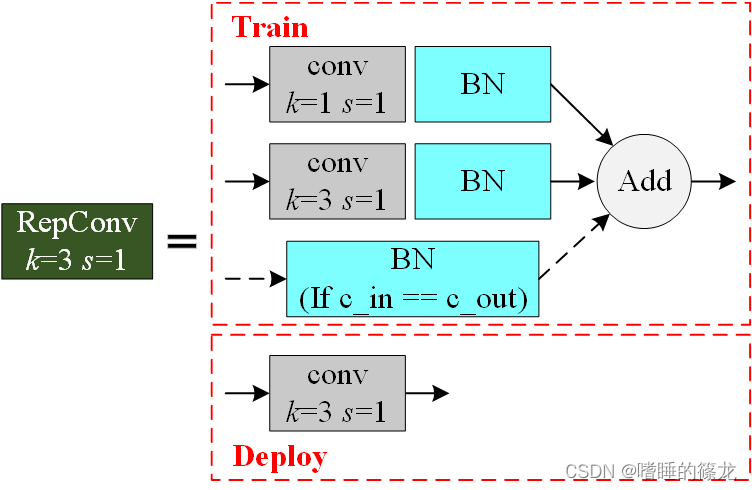
Model类的fuse函数attempt_load函数加载训练好的模型时,会执行Model类的fuse函数,进而调用fuse_repvgg_block函数,实现将三个卷积重参数化,合并为一个卷积输出common.py中对应部分:# Represented convolution https://arxiv.org/abs/2101.03697
class RepConv(nn.Module):
'''重参数卷积
训练时:
deploy = False
rbr_dense(3*3卷积) + rbr_1x1(1*1卷积) + rbr_identity(c2 == c1时) 三者相加
rbr_reparam = None
推理时:
deploy = True
rbr_reparam = Conv2d
rbr_dense = None
rbr_1x1 = None
rbr_identity = None
'''
def __init__(self, c1, c2, k=3, s=1, p=None, g=1, act=True, deploy=False):
super(RepConv, self).__init__()
self.deploy = deploy
self.groups = g
self.in_channels = c1
self.out_channels = c2
assert k == 3
assert autopad(k, p) == 1
padding_11 = autopad(k, p) - k // 2
self.act = nn.SiLU() if act is True else (act if isinstance(act, nn.Module) else nn.Identity())
# 推理阶段,仅有一个3×3的卷积来替换
if deploy:
self.rbr_reparam = nn.Conv2d(c1, c2, k, s, autopad(k, p), groups=g, bias=True)
else:
# 训练阶段,当输入和输出的通道数相同时,会在加一个BN层
self.rbr_identity = (nn.BatchNorm2d(num_features=c1) if c2 == c1 and s == 1 else None)
# 3×3的卷积(padding=1)
self.rbr_dense = nn.Sequential(
nn.Conv2d(c1, c2, k, s, autopad(k, p), groups=g, bias=False),
nn.BatchNorm2d(num_features=c2),
)
# 1×1的卷积
self.rbr_1x1 = nn.Sequential(
nn.Conv2d(c1, c2, 1, s, padding_11, groups=g, bias=False),
nn.BatchNorm2d(num_features=c2),
)
def forward(self, inputs):
if hasattr(self, "rbr_reparam"):
return self.act(self.rbr_reparam(inputs))
if self.rbr_identity is None:
id_out = 0
else:
id_out = self.rbr_identity(inputs)
return self.act(self.rbr_dense(inputs) + self.rbr_1x1(inputs) + id_out)
# Conv2D + BN -> Conv2D
def fuse_conv_bn(self, conv, bn):
std = (bn.running_var + bn.eps).sqrt()
bias = bn.bias - bn.running_mean * bn.weight / std
t = (bn.weight / std).reshape(-1, 1, 1, 1)
weights = conv.weight * t
bn = nn.Identity()
conv = nn.Conv2d(in_channels=conv.in_channels,
out_channels=conv.out_channels,
kernel_size=conv.kernel_size,
stride=conv.stride,
padding=conv.padding,
dilation=conv.dilation,
groups=conv.groups,
bias=True,
padding_mode=conv.padding_mode)
conv.weight = torch.nn.Parameter(weights)
conv.bias = torch.nn.Parameter(bias)
return conv
# 在推理阶段才执行重参数操作
def fuse_repvgg_block(self):
if self.deploy:
return
print(f"RepConv.fuse_repvgg_block")
self.rbr_dense = self.fuse_conv_bn(self.rbr_dense[0], self.rbr_dense[1])
self.rbr_1x1 = self.fuse_conv_bn(self.rbr_1x1[0], self.rbr_1x1[1])
rbr_1x1_bias = self.rbr_1x1.bias
# self.rbr_1x1.weight [256, 128, 1, 1]
# weight_1x1_expanded [256, 128, 3, 3]
weight_1x1_expanded = torch.nn.functional.pad(self.rbr_1x1.weight, [1, 1, 1, 1])
# Fuse self.rbr_identity
if (isinstance(self.rbr_identity, nn.BatchNorm2d) or isinstance(self.rbr_identity,
nn.modules.batchnorm.SyncBatchNorm)):
# print(f"fuse: rbr_identity == BatchNorm2d or SyncBatchNorm")
identity_conv_1x1 = nn.Conv2d(
in_channels=self.in_channels,
out_channels=self.out_channels,
kernel_size=1,
stride=1,
padding=0,
groups=self.groups,
bias=False)
identity_conv_1x1.weight.data = identity_conv_1x1.weight.data.to(self.rbr_1x1.weight.data.device)
identity_conv_1x1.weight.data = identity_conv_1x1.weight.data.squeeze().squeeze()
# print(f" identity_conv_1x1.weight = {identity_conv_1x1.weight.shape}")
identity_conv_1x1.weight.data.fill_(0.0)
identity_conv_1x1.weight.data.fill_diagonal_(1.0)
identity_conv_1x1.weight.data = identity_conv_1x1.weight.data.unsqueeze(2).unsqueeze(3)
# print(f" identity_conv_1x1.weight = {identity_conv_1x1.weight.shape}")
identity_conv_1x1 = self.fuse_conv_bn(identity_conv_1x1, self.rbr_identity)
bias_identity_expanded = identity_conv_1x1.bias
weight_identity_expanded = torch.nn.functional.pad(identity_conv_1x1.weight, [1, 1, 1, 1])
else:
# print(f"fuse: rbr_identity != BatchNorm2d, rbr_identity = {self.rbr_identity}")
bias_identity_expanded = torch.nn.Parameter(torch.zeros_like(rbr_1x1_bias))
weight_identity_expanded = torch.nn.Parameter(torch.zeros_like(weight_1x1_expanded))
# print(f"self.rbr_1x1.weight = {self.rbr_1x1.weight.shape}, ")
# print(f"weight_1x1_expanded = {weight_1x1_expanded.shape}, ")
# print(f"self.rbr_dense.weight = {self.rbr_dense.weight.shape}, ")
self.rbr_dense.weight = torch.nn.Parameter(
self.rbr_dense.weight + weight_1x1_expanded + weight_identity_expanded)
self.rbr_dense.bias = torch.nn.Parameter(self.rbr_dense.bias + rbr_1x1_bias + bias_identity_expanded)
self.rbr_reparam = self.rbr_dense
# 前向推理时,使用重参数化后的 rbr_reparam 函数
self.deploy = True
if self.rbr_identity is not None:
del self.rbr_identity
self.rbr_identity = None
if self.rbr_1x1 is not None:
del self.rbr_1x1
self.rbr_1x1 = None
if self.rbr_dense is not None:
del self.rbr_dense
self.rbr_dense = None
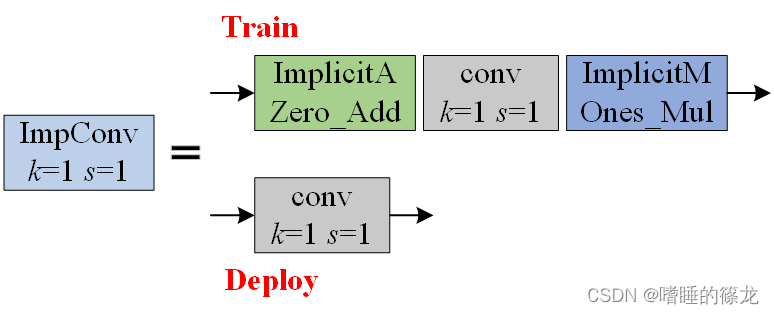
这一部分直接继承自YOLOR中的显隐性知识学习。一般情况下,将神经网络的浅层特征称为显性知识,深层特征称为隐性知识。而YOLOR的作者(同时也是YOLOv7的作者)则直接把神经网络最终观察到的知识称为显性知识,那些观察不到、与观察无关的知识称为隐性知识。
在model/common.py文件中,定义了两类隐性知识:ImplicitA和ImplicitM,分别对输入 相加 和 相乘:
# Add
class ImplicitA(nn.Module):
    def __init__(self, channel, mean=0., std=.02):
        super(ImplicitA, self).__init__()
        self.channel = channel
        self.mean = mean
        self.std = std
        # 全0矩阵
        self.implicit = nn.Parameter(torch.zeros(1, channel, 1, 1))
        nn.init.normal_(self.implicit, mean=self.mean, std=self.std)

    def forward(self, x):
        # 全0矩阵 与 输入 相加
        return self.implicit + x

# Multiply
class ImplicitM(nn.Module):
    def __init__(self, channel, mean=0., std=.02):
        super(ImplicitM, self).__init__()
        self.channel = channel
        self.mean = mean
        self.std = std
        # 全1矩阵
        self.implicit = nn.Parameter(torch.ones(1, channel, 1, 1))
        nn.init.normal_(self.implicit, mean=self.mean, std=self.std)

    def forward(self, x):
        # 全1矩阵 与 输入相乘
        return self.implicit * x
在模型训练阶段,先对输入进行ImplicitA操作, 在进行1*1卷积,最后进行ImplicitM操作:
class IDetect(nn.Module):
    stride = None  # strides computed during build
    export = False  # onnx export
    end2end = False
    include_nms = False

    def __init__(self, nc=80, anchors=(), ch=()):  # detection layer
        super(IDetect, self).__init__()
        self.nc = nc  # number of classes
        self.no = nc + 5  # number of outputs per anchor
        self.nl = len(anchors)  # number of detection layers
        self.na = len(anchors[0]) // 2  # number of anchors
        self.grid = [torch.zeros(1)] * self.nl  # init grid
        a = torch.tensor(anchors).float().view(self.nl, -1, 2)
        self.register_buffer('anchors', a)  # shape(nl,na,2)
        self.register_buffer('anchor_grid', a.clone().view(self.nl, 1, -1, 1, 1, 2))  # shape(nl,1,na,1,1,2)
        self.m = nn.ModuleList(nn.Conv2d(x, self.no * self.na, 1) for x in ch)  # output conv

		# 初始化隐性知识
        self.ia = nn.ModuleList(ImplicitA(x) for x in ch)
        self.im = nn.ModuleList(ImplicitM(self.no * self.na) for _ in ch)

    def forward(self, x):
        # x = x.copy()  # for profiling
        z = []  # inference output
        self.training |= self.export
        for i in range(self.nl):
            # 加入隐性知识
            x[i] = self.m[i](self.ia[i](x[i]))  # conv
            x[i] = self.im[i](x[i])

            bs, _, ny, nx = x[i].shape  # x(bs,255,20,20) to x(bs,3,20,20,85)
            x[i] = x[i].view(bs, self.na, self.no, ny, nx).permute(0, 1, 3, 4, 2).contiguous()

            if not self.training:  # inference
                if self.grid[i].shape[2:4] != x[i].shape[2:4]:
                    self.grid[i] = self._make_grid(nx, ny).to(x[i].device)

                y = x[i].sigmoid()
                y[..., 0:2] = (y[..., 0:2] * 2. - 0.5 + self.grid[i]) * self.stride[i]  # xy
                y[..., 2:4] = (y[..., 2:4] * 2) ** 2 * self.anchor_grid[i]  # wh
                z.append(y.view(bs, -1, self.no))

        return x if self.training else (torch.cat(z, 1), x)
在模型推理阶段,将ImplicitA-Conv-ImplicitM融合为一个1*1的Conv操作:
# 将隐性知识与Detect层的1*1卷积进行融合
def fuse(self):
    print("IDetect.fuse")
    # fuse ImplicitA and Convolution
    for i in range(len(self.m)):
        c1, c2, _, _ = self.m[i].weight.shape
        c1_, c2_, _, _ = self.ia[i].implicit.shape
        self.m[i].bias += torch.matmul(self.m[i].weight.reshape(c1, c2),
                                       self.ia[i].implicit.reshape(c2_, c1_)).squeeze(1)

    # fuse ImplicitM and Convolution
    for i in range(len(self.m)):
        c1, c2, _, _ = self.im[i].implicit.shape
        self.m[i].bias *= self.im[i].implicit.reshape(c2)
        self.m[i].weight *= self.im[i].implicit.transpose(0, 1)
[1] 深入浅出 Yolo 系列之 Yolov7 基础网络结构详解
[2] 【yolov7系列】网络框架细节拆解
[3] yolov7-GradCAM
我有一个字符串input="maybe(thisis|thatwas)some((nice|ugly)(day|night)|(strange(weather|time)))"Ruby中解析该字符串的最佳方法是什么?我的意思是脚本应该能够像这样构建句子:maybethisissomeuglynightmaybethatwassomenicenightmaybethiswassomestrangetime等等,你明白了......我应该一个字符一个字符地读取字符串并构建一个带有堆栈的状态机来存储括号值以供以后计算,还是有更好的方法?也许为此目的准备了一个开箱即用的库?
我想将html转换为纯文本。不过,我不想只删除标签,我想智能地保留尽可能多的格式。为插入换行符标签,检测段落并格式化它们等。输入非常简单,通常是格式良好的html(不是整个文档,只是一堆内容,通常没有anchor或图像)。我可以将几个正则表达式放在一起,让我达到80%,但我认为可能有一些现有的解决方案更智能。 最佳答案 首先,不要尝试为此使用正则表达式。很有可能你会想出一个脆弱/脆弱的解决方案,它会随着HTML的变化而崩溃,或者很难管理和维护。您可以使用Nokogiri快速解析HTML并提取文本:require'nokogiri'h
我主要使用Ruby来执行此操作,但到目前为止我的攻击计划如下:使用gemsrdf、rdf-rdfa和rdf-microdata或mida来解析给定任何URI的数据。我认为最好映射到像schema.org这样的统一模式,例如使用这个yaml文件,它试图描述数据词汇表和opengraph到schema.org之间的转换:#SchemaXtoschema.orgconversion#data-vocabularyDV:name:namestreet-address:streetAddressregion:addressRegionlocality:addressLocalityphoto:i
我正在使用ruby1.9解析以下带有MacRoman字符的csv文件#encoding:ISO-8859-1#csv_parse.csvName,main-dialogue"Marceu","Giveittohimóhe,hiswife."我做了以下解析。require'csv'input_string=File.read("../csv_parse.rb").force_encoding("ISO-8859-1").encode("UTF-8")#=>"Name,main-dialogue\r\n\"Marceu\",\"Giveittohim\x97he,hiswife.\"\
我想在Ruby中创建一个用于开发目的的极其简单的Web服务器(不,不想使用现成的解决方案)。代码如下:#!/usr/bin/rubyrequire'socket'server=TCPServer.new('127.0.0.1',8080)whileconnection=server.acceptheaders=[]length=0whileline=connection.getsheaders想法是从命令行运行这个脚本,提供另一个脚本,它将在其标准输入上获取请求,并在其标准输出上返回完整的响应。到目前为止一切顺利,但事实证明这真的很脆弱,因为它在第二个请求上中断并出现错误:/usr/b
简而言之错误:NOTE:Gem::SourceIndex#add_specisdeprecated,useSpecification.add_spec.Itwillberemovedonorafter2011-11-01.Gem::SourceIndex#add_speccalledfrom/opt/local/lib/ruby/site_ruby/1.8/rubygems/source_index.rb:91./opt/local/lib/ruby/gems/1.8/gems/rails-2.3.8/lib/rails/gem_dependency.rb:275:in`==':und
给定一个复杂的对象层次结构,幸运的是它不包含循环引用,我如何实现支持各种格式的序列化?我不是来讨论实际实现的。相反,我正在寻找可能会派上用场的设计模式提示。更准确地说:我正在使用Ruby,我想解析XML和JSON数据以构建复杂的对象层次结构。此外,应该可以将该层次结构序列化为JSON、XML和可能的HTML。我可以为此使用Builder模式吗?在任何提到的情况下,我都有某种结构化数据-无论是在内存中还是文本中-我想用它来构建其他东西。我认为将序列化逻辑与实际业务逻辑分开会很好,这样我以后就可以轻松支持多种XML格式。 最佳答案 我最
一、引擎主循环UE版本:4.27一、引擎主循环的位置:Launch.cpp:GuardedMain函数二、、GuardedMain函数执行逻辑:1、EnginePreInit:加载大多数模块int32ErrorLevel=EnginePreInit(CmdLine);PreInit模块加载顺序:模块加载过程:(1)注册模块中定义的UObject,同时为每个类构造一个类默认对象(CDO,记录类的默认状态,作为模板用于子类实例创建)(2)调用模块的StartUpModule方法2、FEngineLoop::Init()1、检查Engine的配置文件找出使用了哪一个GameEngine类(UGame
网络编程套接字网络编程基础知识理解源`IP`地址和目的`IP`地址理解源MAC地址和目的MAC地址认识端口号理解端口号和进程ID理解源端口号和目的端口号认识`TCP`协议认识`UDP`协议网络字节序socket编程接口`sockaddr``UDP`网络程序服务器端代码逻辑:需要用到的接口服务器端代码`udp`客户端代码逻辑`udp`客户端代码`TCP`网络程序服务器代码逻辑多个版本服务器单进程版本多进程版本多线程版本线程池版本服务器端代码客户端代码逻辑客户端代码TCP协议通讯流程TCP协议的客户端/服务器程序流程三次握手(建立连接)数据传输四次挥手(断开连接)TCP和UDP对比网络编程基础知识
您将如何构建一个简单的Sinatra应用程序?我正在制作,我希望该应用具有以下功能:“应用程序”更像是一个包含所有信息的管理仪表板。然后另一个应用程序将通过REST访问信息。我还没有创建仪表板,只是从数据库中获取东西session和身份验证(尚未实现)您可以上传图片,其他应用可以显示这些图片我已经使用RSpec创建了一个测试文件通过Prawn生成报告目前的设置是这样的:app.rbtest_app.rb因为我实际上只有应用程序和测试文件。到目前为止,我已经将Datamapper用于ORM,将SQLite用于数据库。这是我的第一个Ruby/Sinatra项目,所以欢迎任何和所有建议-我应
