(1)准备基本结构
<script lang="ts" setup name="Numbox">
//
</script>
<template>
  <div class="numbox">
    <div class="label">数量</div>
    <div class="numbox">
      <a href="javascript:;">-</a>
      <input type="text" readonly value="1" />
      <a href="javascript:;">+</a>
    </div>
  </div>
</template>

<style scoped lang="less">
.numbox {
  display: flex;
  align-items: center;
  .label {
    width: 60px;
    color: #999;
    padding-left: 10px;
  }
  .numbox {
    width: 120px;
    height: 30px;
    border: 1px solid #e4e4e4;
    display: flex;
    > a {
      width: 29px;
      line-height: 28px;
      text-align: center;
      background: #f8f8f8;
      font-size: 16px;
      color: #666;
      &:first-of-type {
        border-right: 1px solid #e4e4e4;
      }
      &:last-of-type {
        border-left: 1px solid #e4e4e4;
      }
    }
    > input {
      width: 60px;
      padding: 0 5px;
      text-align: center;
      color: #666;
    }
  }
}
</style>
(2)全局注册
import Numbox from '@/components/numbox/index.vue'
export default {
  install(app: App) {
    app.component('Numbox', Numbox)
  },
}
(3)提供类型声明
import Numbox from '@/components/numbox/index.vue'
declare module 'vue' {
  export interface GlobalComponents {
    Numbox: typeof Numbox
  }
}

export {}
(4)渲染
<div class="spec">
  <!-- 数字选择框 -->
  <XtxNumbox></XtxNumbox>
</div>
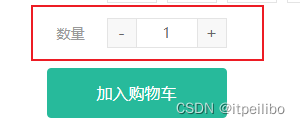
效果
目标:掌握vue3.0的v-model语法糖原理
在vue2.0中v-mode语法糖简写的代码 <Son :value="msg" @input="msg=$event" />
在vue3.0中v-model语法糖有所调整:<Son :modelValue="msg" @update:modelValue="msg=$event" />
演示代码:
<script lang="ts" setup>
defineProps({
  money: {
    type: Number,
    default: 0,
  },
})

const emit = defineEmits(['update:money'])
</script>

<template>
  <h3>子组件-{{ money }}</h3>
  <button @click="emit('update:money', money + 1)">+1</button>
</template>

<style scoped lang="less"></style>
总结: vue3.0封装组件支持v-model的时候,父传子:modelValue 子传父 @update:modelValue
补充: vue2.0的 xxx.sync 语法糖解析 父传子 :xxx 子传父 @update:xxx 在vue3.0 使用 v-model:xxx 代替。
大致功能分析:
<script lang="ts" setup name="Numbox">
const props = defineProps({
  modelValue: {
    type: Number,
    default: 1,
  },
  min: {
    type: Number,
    default: 1,
  },
  max: {
    type: Number,
    default: 20,
  },
  showLabel: {
    type: Boolean,
    default: false,
  },
})

const emit = defineEmits<{
  (e: 'update:modelValue', value: number): void
}>()

const add = () => {
  if (props.modelValue >= props.max) return
  emit('update:modelValue', props.modelValue + 1)
}

const sub = () => {
  if (props.modelValue <= props.min) return
  emit('update:modelValue', props.modelValue - 1)
}
</script>
<template>
  <div class="numbox">
    <div class="label" v-if="showLabel"><slot>数量</slot></div>
    <div class="numbox">
      <a href="javascript:;" @click="sub">-</a>
      <input type="text" readonly :value="modelValue"/>
      <a href="javascript:;" @click="add">+</a>
    </div>
  </div>
</template>

<style scoped lang="less">
.numbox {
  display: flex;
  align-items: center;
  .label {
    width: 60px;
    color: #999;
    padding-left: 10px;
  }
  .numbox {
    width: 120px;
    height: 30px;
    border: 1px solid #e4e4e4;
    display: flex;
    > a {
      width: 29px;
      line-height: 28px;
      text-align: center;
      background: #f8f8f8;
      font-size: 16px;
      color: #666;
      &:first-of-type {
        border-right: 1px solid #e4e4e4;
      }
      &:last-of-type {
        border-left: 1px solid #e4e4e4;
      }
    }
    > input {
      width: 60px;
      padding: 0 5px;
      text-align: center;
      color: #666;
    }
  }
}
</style>
动态控制禁用效果
<script lang="ts" setup name="Numbox">
const props = defineProps({
  modelValue: {
    type: Number,
    default: 1,
  },
  min: {
    type: Number,
    default: 1,
  },
  max: {
    type: Number,
    default: 20,
  },
  showLabel: {
    type: Boolean,
    default: false,
  },
})

const emit = defineEmits<{
  (e: 'update:modelValue', value: number): void
}>()

const add = () => {
  if (props.modelValue >= props.max) return
  emit('update:modelValue', props.modelValue + 1)
}

const sub = () => {
  if (props.modelValue <= props.min) return
  emit('update:modelValue', props.modelValue - 1)
}
</script>
<template>
  <div class="numbox">
    <div class="label" v-if="showLabel"><slot>数量</slot></div>
    <div class="numbox">
     + <a href="javascript:;" @click="sub" :class="{not:props.modelValue <= props.main}">-</a>
      <input type="text" readonly :value="modelValue" />
     + <a href="javascript:;" @click="add" :class="{not:props.modelValue >= props.max}">+</a>
    </div>
  </div>
</template>

<style scoped lang="less">
.numbox {
  display: flex;
  align-items: center;
  .label {
    width: 60px;
    color: #999;
    padding-left: 10px;
  }
  .numbox {
    width: 120px;
    height: 30px;
    border: 1px solid #e4e4e4;
    display: flex;
    > a {
      width: 29px;
      line-height: 28px;
      text-align: center;
      background: #f8f8f8;
      font-size: 16px;
      color: #666;
 +     &.not {
 +       cursor: not-allowed;
 +     }
      &:first-of-type {
        border-right: 1px solid #e4e4e4;
      }
      &:last-of-type {
        border-left: 1px solid #e4e4e4;
      }
    }
    > input {
      width: 60px;
      padding: 0 5px;
      text-align: center;
      color: #666;
    }
  }
}
</style>
使用组件:src/views/goods/index.vue
<script lang="ts" setup name="Numbox">
import {ref} from "vue";

const count = ref(1)
</script>

<!-- 商品信息 -->
<div class="goods-info">
    <!-- 数字选择框 -->
    <XtxNumbox v-model="count" min:"1" :max="20" ></XtxNumbox>
</div>
思考:
我们的输入框不仅能点击加减还可以输入数字,如果用户通过输入框输入非数字会出现什么问题?

优化代码
<script lang="ts" setup name="Numbox">
const props = defineProps({
  modelValue: {
    type: Number,
    default: 1,
  },
  min: {
    type: Number,
    default: 1,
  },
  max: {
    type: Number,
    default: 20,
  },
  showLabel: {
    type: Boolean,
    default: false,
  },
})
+const { proxy } = getCurrentInstance() as ComponentInternalInstance
const emit = defineEmits<{
  (e: 'update:modelValue', value: number): void
}>()

const add = () => {
  if (props.modelValue >= props.max) return
  emit('update:modelValue', props.modelValue + 1)
}

const sub = () => {
  if (props.modelValue <= props.min) return
  emit('update:modelValue', props.modelValue - 1)
}

+const handleChange = (e: Event) => {
+  // 通过类型断言,让ts知道目前元素的类型
+  const element = e.target as HTMLInputElement
+  let value = +element.value
+  if (isNaN(value)) value = 1
+  if (value >= props.max) value = props.max
+  if (value <= props.main) value = props.main
+  emit('update:modelValue',value)

+  // 强制刷新
+  proxy?.$forceUpdate()
}
</script>
<template>
  <div class="numbox">
    <div class="label" v-if="showLabel"><slot>数量</slot></div>
    <div class="numbox">
      <a href="javascript:;" @click="sub" :class="{not:props.modelValue <= props.main}">-</a>
      <input type="text" readonly :value="modelValue" @change="handleChange($event)"/>
      <a href="javascript:;" @click="add" :class="{not:props.modelValue >= props.max}">+</a>
    </div>
  </div>
</template>

<style scoped lang="less">
.numbox {
  display: flex;
  align-items: center;
  .label {
    width: 60px;
    color: #999;
    padding-left: 10px;
  }
  .numbox {
    width: 120px;
    height: 30px;
    border: 1px solid #e4e4e4;
    display: flex;
    > a {
      width: 29px;
      line-height: 28px;
      text-align: center;
      background: #f8f8f8;
      font-size: 16px;
      color: #666;
      &.not {
        cursor: not-allowed;
      }
      &:first-of-type {
        border-right: 1px solid #e4e4e4;
      }
      &:last-of-type {
        border-left: 1px solid #e4e4e4;
      }
    }
    > input {
      width: 60px;
      padding: 0 5px;
      text-align: center;
      color: #666;
    }
  }
}
</style>
我正在尝试解析一个CSV文件并使用SQL命令自动为其创建一个表。CSV中的第一行给出了列标题。但我需要推断每个列的类型。Ruby中是否有任何函数可以找到每个字段中内容的类型。例如,CSV行:"12012","Test","1233.22","12:21:22","10/10/2009"应该产生像这样的类型['integer','string','float','time','date']谢谢! 最佳答案 require'time'defto_something(str)if(num=Integer(str)rescueFloat(s
目录一.加解密算法数字签名对称加密DES(DataEncryptionStandard)3DES(TripleDES)AES(AdvancedEncryptionStandard)RSA加密法DSA(DigitalSignatureAlgorithm)ECC(EllipticCurvesCryptography)非对称加密签名与加密过程非对称加密的应用对称加密与非对称加密的结合二.数字证书图解一.加解密算法加密简单而言就是通过一种算法将明文信息转换成密文信息,信息的的接收方能够通过密钥对密文信息进行解密获得明文信息的过程。根据加解密的密钥是否相同,算法可以分为对称加密、非对称加密、对称加密和非
项目介绍随着我国经济迅速发展,人们对手机的需求越来越大,各种手机软件也都在被广泛应用,但是对于手机进行数据信息管理,对于手机的各种软件也是备受用户的喜爱小学生兴趣延时班预约小程序的设计与开发被用户普遍使用,为方便用户能够可以随时进行小学生兴趣延时班预约小程序的设计与开发的数据信息管理,特开发了小程序的设计与开发的管理系统。小学生兴趣延时班预约小程序的设计与开发的开发利用现有的成熟技术参考,以源代码为模板,分析功能调整与小学生兴趣延时班预约小程序的设计与开发的实际需求相结合,讨论了小学生兴趣延时班预约小程序的设计与开发的使用。开发环境开发说明:前端使用微信微信小程序开发工具:后端使用ssm:VU
在Ruby中,是否有一种简单的方法可以将n维数组中的每个元素乘以一个数字?这样:[1,2,3,4,5].multiplied_by2==[2,4,6,8,10]和[[1,2,3],[1,2,3]].multiplied_by2==[[2,4,6],[2,4,6]]?(很明显,我编写了multiplied_by函数以区别于*,它似乎连接了数组的多个副本,不幸的是这不是我需要的)。谢谢! 最佳答案 它的长格式等价物是:[1,2,3,4,5].collect{|n|n*2}其实并没有那么复杂。你总是可以使你的multiply_by方法:c
我正在使用Ruby解决一些ProjectEuler问题,特别是这里我要讨论的问题25(Fibonacci数列中包含1000位数字的第一项的索引是多少?)。起初,我使用的是Ruby2.2.3,我将问题编码为:number=3a=1b=2whileb.to_s.length但后来我发现2.4.2版本有一个名为digits的方法,这正是我需要的。我转换为代码:whileb.digits.length当我比较这两种方法时,digits慢得多。时间./025/problem025.rb0.13s用户0.02s系统80%cpu0.190总计./025/problem025.rb2.19s用户0.0
我正在构建一个小部件来显示奥运会的奖牌数。我有一个“国家”对象的集合,其中每个对象都有一个“名称”属性,以及奖牌计数的“金”、“银”、“铜”。列表应该排序:1.首先是奖牌总数2.如果奖牌相同,按类型分割(金>银>铜,即2金>1金+1银)3.如果奖牌和类型相同,则按字母顺序子排序我正在用ruby做这件事,但我想语言并不重要。我确实找到了一个解决方案,但如果感觉必须有更优雅的方法来实现它。这是我做的:使用加权奖牌总数创建一个虚拟属性。因此,如果他们有2个金牌和1个银牌,加权总数将为“3.020100”。1金1银1铜为“3.010101”由于我们希望将奖牌数排序为最高的,因此列表按降序排
我想为名字验证编写一个正则表达式。正则表达式应包括所有字母(拉丁/法语/德语字符等)。但是我想从中排除数字并允许-。所以基本上它是\w(减)数(加)-。请帮忙。 最佳答案 ^[\p{L}-]+$\p{L}匹配anykindofletterfromanylanguage. 关于ruby-on-rails-rails中的正则表达式匹配[\w]和"-"但不匹配数字,我们在StackOverflow上找到一个类似的问题: https://stackoverflow.c
在我的应用程序中,我有一个文本字段,用户可以在其中输入类似这样的内容"1,2,3,4"存储到数据库中。现在,当我想使用内部数字时,我有两个选择:"1,2,3,4".split(',')或string.scan(/\d+/)do|x|a两种方式我都得到一个像这样的数组["1","2","3","4"]然后我可以通过在每个数字上调用to_i来使用这些数字。有没有更好的方法可以转换"1,2,3"to[1,2,3]andnot["1","2","3"] 最佳答案 str.split(",").map{|i|i.to_i}但是这个想法对你来说
我有一个随机大小的散列,它可能有类似"100"的值,我想将其转换为整数。我知道我可以使用value.to_iifvalue.to_i.to_s==value来做到这一点,但我不确定我将如何在我的散列中递归地做到这一点,考虑到一个值可以是一个字符串,或一个数组(哈希或字符串),或另一个哈希。 最佳答案 这是一个非常简单的递归实现(尽管必须同时处理数组和散列会增加一些技巧)。deffixnumifyobjifobj.respond_to?:to_i#IfwecancastittoaFixnum,doit.obj.to_ielsifobj
什么是测试格式验证的最佳方法让我们说一个用户名,使用字母数字的正则表达式,但不是纯数字?我一直在我的模型中使用以下验证validates:username,:format=>{:with=>/^[a-z0-9]+[-a-z0-9]*[a-z0-9]+$/i}数字用户名(例如“342”)通过了验证,这是我不想要的。 最佳答案 您想“向前看”一封信:/\A(?=.*[a-z])[a-z\d]+\Z/i 关于ruby-on-rails-Rails格式验证——字母数字,但不是纯数字,我们在Sta
