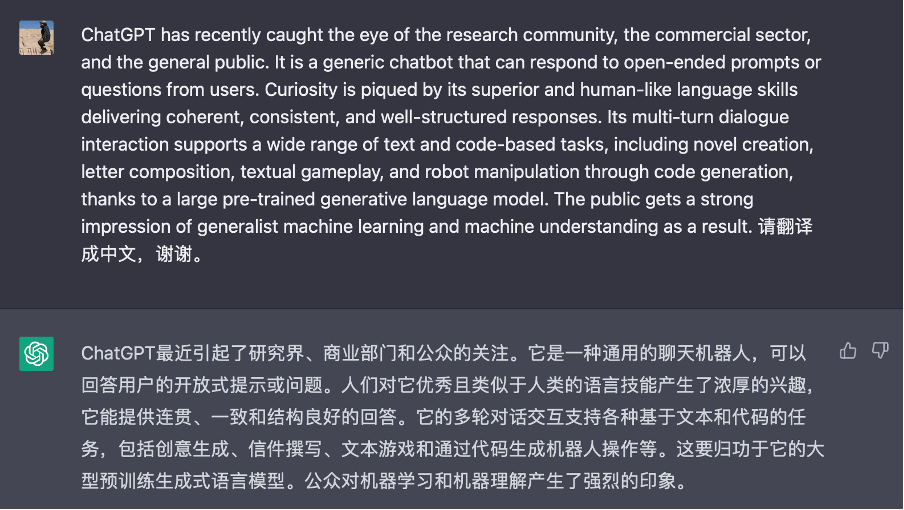
 图 1 ChatGPT 用于机器翻译的屏幕截图。用户提示信息仅包含说明,无需演示示例。虽然上述理论仍然适用,但基础语言模型的出现可能改变了我们对机器学习的方法。新的机器学习流程可以如下(以机器翻译问题为例,见图 1):1.API 访问其他人训练的基础语言模型,例如训练有包括英语 / 中文配对语料在内的多样文档的模型。2.根据少量示例或没有示例,为手头任务设计合适的文本描述(称为提示),例如提示
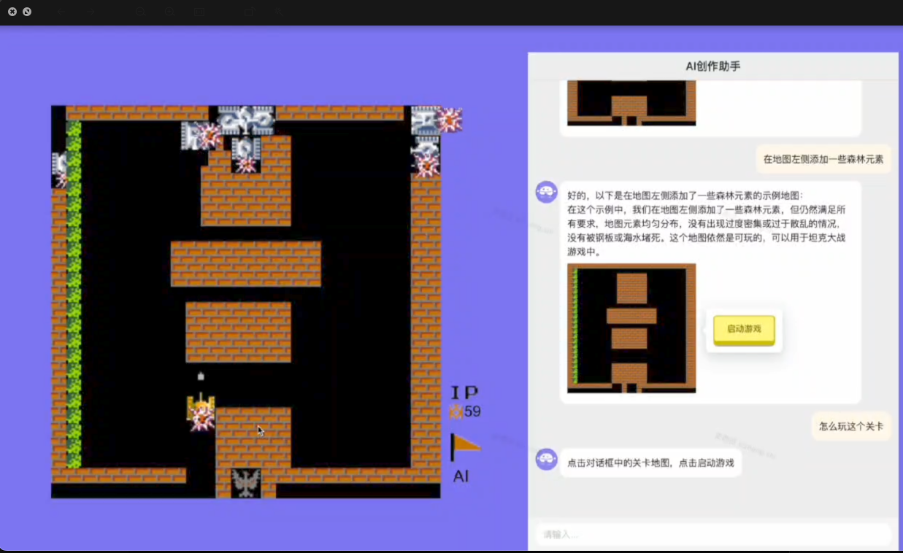 图 2 人工智能决策生成(AIGA)用于设计计算机游戏的插图。2.磨练推理技能我们正处于一个令人兴奋的时代边缘,在这个时代里,我们所有的语言和行为数据都可以被挖掘出来,用于训练(并被巨大的计算机化模型吸收)。这是一个巨大的成就,因为我们整个集体的经验和文明都可以消化成一个(隐藏的)知识库(以人工神经网络的形式),以供日后使用。实际上,ChatGPT 和大型基础模型被认为展示了某种形式的推理能力,甚至可能在某种程度上理解他人的心态(心智理论)。这是通过数据拟合(将掩码语言标记预测作为训练信号)和模仿(人类行为)来实现的。然而,这种完全基于数据驱动的策略是否会带来更大的智能还有待商榷。为了说明这个观点,以指导一个代理(智能体)如何下棋为例。即使代理(智能体)可以访问无限量的人类下棋数据,仅通过模仿现有策略来生成比已有数据更优的新策略将是非常困难的。但是,使用这些数据,可以建立对世界的理解(例如,游戏规则),并将其用于 “思考”(在其大脑中构建一个模拟器,以收集反馈来创建更优的策略)。这突显了归纳偏置的重要性;与其单纯地采用蛮力方法,要求学习代理(智能体)具有一定的世界模型以便自我改进。因此,迫切需要深入研究和理解基础模型的新兴能力。除了语言技能,我们主张通过研究底层机制来获得实际推理能力。一个有前途的方法是从神经科学和脑科学中汲取灵感,以解密人类推理的机制,并推进语言模型的发展。同时,建立一个扎实的心智理论可能也需要深入了解多智能体学习及其基本原理。3.从 AI 生成内容(AIGC)到 AI 生成行动(AIGA)人类语言所发展出的隐式语义对于基础语言模型来说至关重要。如何利用它是通用机器学习的一个关键话题。例如,一旦语义空间与其他媒体(如照片、视频和声音)或其他形式的人类和机器行为数据(如机器人轨迹 / 动作)对齐,我们就可以无需额外成本地为它们获得语义解释能力。这样,机器学习(预测、生成和决策)就会变得通用和可分解。然而,处理跨模态对齐是我们面临的一个重大难题,因为标注关系需要耗费大量的人力。此外,当许多利益方存在冲突时,人类价值观的对齐变得困难。ChatGPT 的一个基本缺点是它只能直接与人类进行交流。然而,一旦与外部世界建立了足够的对齐,基础语言模型应该能够学习如何与各种各样的参与者和环境进行交互。这很重要,因为它将赋予其推理能力和基于语言的语义更广泛的应用和能力,超越了仅仅进行对话。例如,它可以发展成为一个通用代理(智能体),能够浏览互联网、控制计算机和操纵机器人。因此,更加重要的是实施确保代理(智能体)的响应(通常以生成的操作形式)安全、可靠、无偏和可信的程序。图 2 展示了 AIGA 与游戏引擎交互的示例,以自动化设计电子游戏的过程。4.多智能体与基础语言模型交互的理论ChatGPT 使用上下文学习和提示工程来在单个会话中驱动与人的多轮对话,即给定问题或提示,整个先前的对话(问题和回答)被发送到系统作为额外的上下文来构建响应。这是一个简单的对话驱动的马尔可夫决策过程(MDP)模型:{状态 = 上下文,行动 = 响应,奖励 = 赞 / 踩评级}。虽然有效,但这种策略具有以下缺点:首先,提示只是提供了用户响应的描述,但用户真正的意图可能没有被明确说明,必须被推断。也许一个强大的模型,如之前针对对话机器人提出的部分可观察马尔可夫决策过程(POMDP),可以准确地建模隐藏的用户意图。其次,ChatGPT 首先以拟合语言的生成为目标
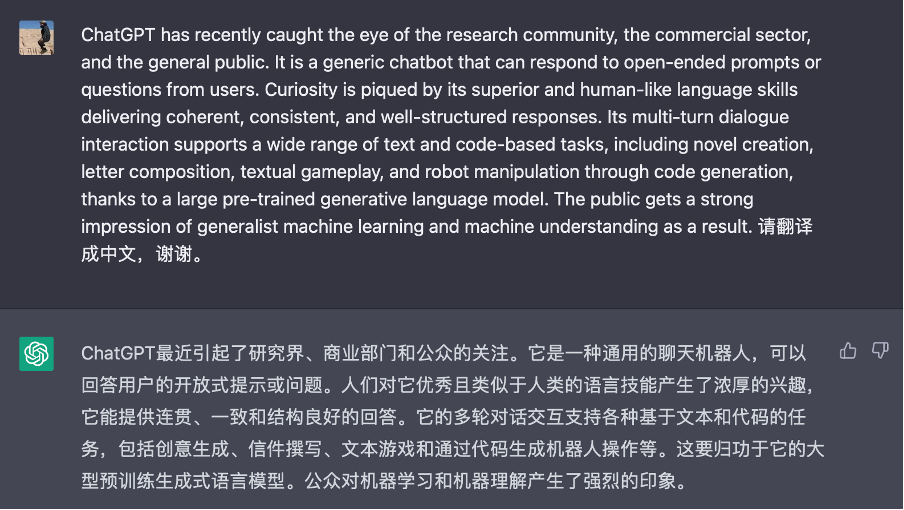 Figure 1 A screenshot of ChatGPT used for machine translation. The prompt contains instruction only, and no demonstration example is necessary.While the above theories still hold, the arrival of foundation language models may have altered our approach to machine learning. The new machine learning pipeline could be the following (using the same machine translation problem as an example; see Figure 1): 1.API access to a foundation language model trained elsewhere by others, e.g., a model trained with diverse documents, including paring corpus of English/Chinese, 2.with a few examples or no example at all, design a suitable text description (known as a prompt) for the task at hand, e.g., Prompt = {a few examples E→C },3.conditioned on the prompt and a given new test data point, the language model generates the answer, e.g., append E’ to the prompt and generate C’ from the model,4.interpret the answer as the predicted result.As shown in step 1, the foundation language model serves as a one-size-fits-all knowledge repository. The prompt (and context) presented in step 2 allow the foundation language model to be customised to a specific goal or problem with only a few demonstration instances. While the aforementioned pipeline is primarily limited to text-based problems, it is reasonable to assume that, as the development of cross-modality (see Section 3) foundation pre-trained models continues, it will become the standard for machine learning in general. This could break down the necessary task barriers to pave the way for AGI. But, it is still early in the process of determining how the demonstration examples in a prompt text operate. Empirically, we now understand, from some early work [2], that the format of demonstration samples is more significant than the correctness of the labels (for instance, as illustrated in Figure 1, we don’t need to provide example translation but are required to provide language instruction), but are there any theoretical limits to its adaptability as stated in the no-free-lunch theorem? Can the context and instruction-based knowledge stated in prompts (step 2) be integrated into the model for future usage? We're only scratching the surface with these inquiries. We therefore call for a new understanding and new principles behind this new form of in-context learning and its theoretical limitations and properties, such as generalisation bounds.
 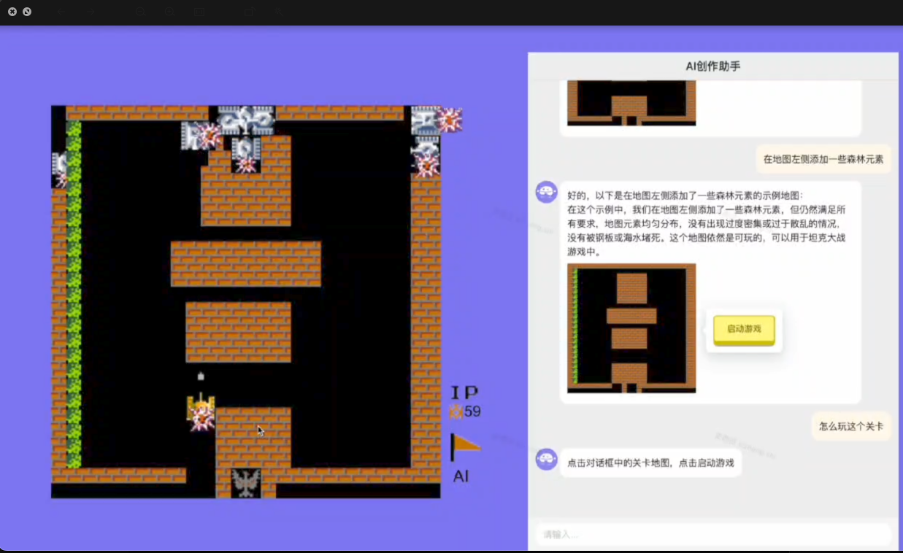 Figure 2 An illustration of AIGA for designing computer games.2.Developing reasoning skillsWe are on the edge of an exciting era in which all our linguistic and behavioural data can be mined to train (and be absorbed by) an enormous computerised model. It is a tremendous accomplishment as our whole collective experience and civilisation could be digested into a single (hidden) knowledge base (in the form of artificial neural networks) for later use. In fact, ChatGPT and large foundation models are said to demonstrate some form of reasoning capacity. They may even arguably grasp the mental states of others to some extent (theory of mind) [6]. This is accomplished by data fitting (predicting masked language tokens as training signals) and imitation (of human behaviours). Yet, it is debatable if this entirely data-driven strategy will bring us greater intelligence. To illustrate this notion, consider instructing an agent how to play chess as an example. Even if the agent has access to a limitless amount of human play data, it will be very difficult for it, by only imitating existing policies, to generate new policies that are more optimal than those already present in the data. Using the data, one can, however, develop an understanding of the world (e.g., the rules of the game) and use it to “think” (construct a simulator in its brain to gather feedback in order to create more optimal policies). This highlights the importance of inductive bias; rather than simple brute force, a learning agent is demanded to have some model of the world and infer it from the data in order to improve itself. Thus, there is an urgent need to thoroughly investigate and understand the emerging capabilities of foundation models. Apart from language skills, we advocate research into acquiring of actual reasoning ability by investigating the underlying mechanisms [9]. One promising approach would be to draw inspiration from neuroscience and brain science to decipher the mechanics of human reasoning and advance language model development. At the same time, building a solid theory of mind may also necessitate an in-depth knowledge of multiagent learning [10,11] and its underlying principles. 3.From AI Generating Content (AIGC) to AI Generating Action (AIGA)The implicit semantics developed on top of human languages is integral to foundation language models. How to utilise it is a crucial topic for generalist machine learning. For example, once the semantic space is aligned with other media (such as photos, videos, and sounds) or other forms of data from human and machine behaviours, such as robotic trajectory/actions, we acquire semantic interpretation power for them with no additional cost [7, 14]. In this manner, machine learning (prediction, generation, and decision-making) would be generic and decomposable. Yet, dealing with cross-modality alignment is a substantial hurdle for us due to the labour-intensive nature of labelling the relationships. Additionally, human value alignment becomes difficult when numerous parties have conflicting interests. A fundamental drawback of ChatGPT is that it can communicate directly with humans only. Yet, once a sufficient alignment with the external world has been established, foundation language models should be able to learn how to interact with various parties and environments [7, 14]. This is significant because it will bestow its power on reasoning ability and semantics based on language for broader applications and capabilities beyond conversation. For instance, it may evolve into a generalist agent capable of navigating the Internet [7], controlling computers [13], and manipulating robots [12]. Thus, it becomes more important to implement procedures that ensure responses from the agent (often in the form of generated actions) are secure, reliable, unbiased, and trustworthy. Figure 2 provides a demonstration of AIGA [7] for interacting with a game engine to automate the process of designing a video game. 4.Multiagent theories of interactions with foundation language modelsChatGPT uses in-context learning and prompt engineering to drive multi-turn dialogue with people in a single session, i.e., given the question or prompt, the entire prior conversation (questions and responses) is sent to the system as extra context to construct the response. It is a straightforward Markov decision process (MDP) model for conversation: {State = context, Action = response, Reward = thumbs up/down rating}. While effective, this strategy has the following drawbacks: first, a prompt simply provides a description of the user's response, but the user's genuine intent may not be explicitly stated and must be inferred. Perhaps a robust model, as proposed previously for conversation bots, would be a partially observable Markov decision process (POMDP) that accurately models a hidden user intent. Second, ChatGPT is first trained using language fitness and then human labels for conversation goals. Due to the platform's open-ended nature, actual user's aim and objective may not align with the trained/fined-tuned rewards. In order to examine the equilibrium and conflicting interests of humans and agents, it may be worthwhile to use a game-theoretic perspective [9]. 5.Novel applicationsAs proven by ChatGPT, there are two distinctive characteristics of foundation language models that we believe will be the driving force behind future machine learning and foundation language model applications. The first is its superior linguistic skills, while the second is its embedded semantics and early reasoning abilities (in the form of human language). As an interface, the former will greatly lessen the entry barrier to applied machine learning, whilst the latter will significantly generalise how machine learning is applied. As demonstrated in the new learning pipeline presented in Section 1, prompts and in-context learning eliminate the bottleneck of data engineering and the effort required to construct and train a model. Moreover, exploiting the reasoning capabilities could enable us to automatically dissect and solve each subtask of a hard task. Hence, it will dramatically transform numerous industries and application sectors. In internet-based enterprises, the dialogue-based interface is an obvious application for web and mobile search, recommender systems, and advertising. Yet, as we are accustomed to the keyword-based URL inverted index search system, the change is not straightforward. People must be retaught to utilise longer queries and natural language as queries. In addition, foundation language models are typically rigid and inflexible. It lacks access to current information regarding recent events. They typically hallucinate facts and do not provide retrieval capabilities and verification. Thus, we need a just-in-time foundation model capable of undergoing dynamic evolution over time. We therefore call for novel applications including but not limited to the following areas:
 英文版英文链接关注公众号在“亚特兰蒂斯的回声”中踏上一段难忘的冒险之旅,深入未知的海洋深处。足智多谋的考古学家AriaSeaborne偶然发现了一件古代神器,揭示了一张通往失落之城亚特兰蒂斯的隐藏地图。在她神秘的导师内森·兰登教授的指导和勇敢的冒险家亚历克斯·默瑟的帮助下,阿丽亚开始了一段危险的旅程,以揭开这座传说中城市的真相。他们的冒险之旅带领他们穿越险恶的大海、神秘的岛屿和充满陷阱和谜语的致命迷宫。随着Aria潜在的魔法能力的觉醒,她被睿智勇敢的QueenNeria的幻象所指引,她让她为即将到来的挑战做好准备。三人组揭开亚特兰蒂斯令人惊叹的隐藏文明,并了解到邪恶的巫师马拉卡勋爵试图利用其古
前面一篇关于智能合约翻译文讲到了,是一种计算机程序,既然是程序,那就可以使用程序语言去编写智能合约了。而若想玩区块链上的项目,大部分区块链项目都是开源的,能看得懂智能合约代码,或找出其中的漏洞,那么,学习Solidity这门高级的智能合约语言是有必要的,当然,这都得在公链``````以太坊上,毕竟国内的联盟链有些是不兼容Solidity。Solidity是一种面向对象的高级语言,用于实现智能合约。智能合约是管理以太坊状态下的账户行为的程序。Solidity是运行在以太坊(Ethereum)虚拟机(EVM)上,其语法受到了c++、python、javascript影响。Solidity是静态类型
2022年底,OpenAI的预训练模型ChatGPT给人工智能领域的爱好者和研究人员留下了深刻的印象和启发,他展现的惊人能力将人工智能的研究和应用热度推向高潮,网上也充斥着和ChatGPT的各种聊天,他可以作诗、写小说、写代码、讨论疫情问题等。下面就是一些他的神回复:人命关天的坑: 写歌,留给词作者的机会不多了。。。 回答人类怎么样面对人工智能: 什么是ChatGPT?借用网上的一段介绍,ChatGPT是由人工智能研究实验室OpenAI在2022年11月30日发布的全新聊天机器人模型,一款人工智能技术驱动的自然语言处理工具。它能够通过学习和理解人类的语言来进行对话,还能根据聊天的上下文进行互动
目录ChatGPT简介技术原理应用未来发展ChatGPT的10 种用法ChatGPT简介ChatGPT是一种基于深度学习的大型语言模型,由OpenAI公司开发。技术原理GPT是GenerativePre-trainedTransformer的缩写,意为生成式预训练变压器。它的技术原理是使用了一个基于注意力机制的变压器(Trans
♥️作者:白日参商🤵♂️个人主页:白日参商主页♥️坚持分析平时学习到的项目以及学习到的软件开发知识,和大家一起努力呀!!!🎈🎈加油!加油!加油!加油🎈欢迎评论💬点赞👍🏻收藏📂加关注+!「想体验ChatGPT中文聊天?」那快进来,你用不上算我输项目场景:项目条件一、那就开始吧1、安装ChatGPT-Desktop2、OpenAPI设置二、使用实例恭喜你!!!配置成功了!!!API和URL都是博主免费提供给大家的!!!恭喜你!!!配置成功了!!!API和URL都是博主免费提供给大家的!!!🎈🎈加油!加油!加油!加油🎈欢迎评论💬点赞👍🏻收藏📂加关注+!项目场景:近几个月可以说ChatGPT是火得一
对于体育新闻中文文本的关键字提取,常用的算法包括TF-IDF、TextRank和LDA等。它们的基本步骤如下:1.TF-IDF算法: -将文本进行分词和词性标注处理。-统计每个词在文本中的词频(TF)。-计算每个词在整个语料库中出现的文档频率(DF)和逆文档频率(IDF)。-计算每个词的TF-IDF值,并按照值的大小进行排序,选择排名前几的词作为关键字。2.TextRank算法:-将文本进行分词和词性标注处理。-将分词结果转化成图模型,每个词语为节点,根据词语之间的共现关系建立边。-对图模型进行迭代计算,计算每个节点的PageRank值,表示该节点的重要性。-选择排名前几的节点作为关键字。3.
光度学中的能量、通量、出度、照度、强度、亮度参数及其联系光度学中评价光的强弱有两种方式,一种是将光作为电磁波,考察其辐射的能量;另一种是以人眼视觉体验来评价光的强弱。前者被称为辐射量,后者被称为光学量。辐射量包括辐射能、辐通量、辐出量、辐照度、辐强度、辐亮度参数,与之相对应,光学量包括光能量、光通量、光出量、光照度、光强度、光亮度参数。通过该文章的阅读,读者还能掌握光学中的几个单位:流明,勒克斯,坎德拉,尼特的意义以及他们之间的关系。辐射量1.辐射能光以电磁波形式发射、传输或接收的能量。单位:焦耳。2.辐通量单位时间发射、传输和接收的辐射能。单位:瓦特。3.辐出度单位面积的辐射源辐射出的辐通量
ChatGPT掀起了AI股历史上最疯狂的一轮市值狂飙。自春节后至今,ChatGPT概念股开始了暴走模式,短短半月时间,海天瑞声、开普云等ChatGPT概念股市值累计增加了近1400亿。如此的爆炸效应,得益于ChatGPT所展现出商业化落地的巨大潜力。要知道,在此之前,无论是十年AI投入超千亿的百度,还是困在硬件化里的AI四小龙,都在重复着AI商业化难落地的故事。ChatGPT的出现,让AI从生产力的赋能者直接成为一种创造生产力的工具。随着订阅模式的推出,ChatGPT已经成为第一个以AI技术为核心直接变现的消费者应用。本文持有以下核心观点:1、ChatGPT是AI技术迭代的受益者。过去受限技术
文章目录前言1.AI的发展历程2.我是如何接触到人工智能的概念和产品的3.对于ChatGPT的一点看法4.AI对大学毕业生的职业发展的利与弊5.对于AI的思考和问题前言随着ChatGPT的爆火,生成式AI,大模型的人工智能被越来越多的人注意到,同时他也带来了许多问题。本文将对几方面进行探讨。1.AI的发展历程远古时期在公元前第一个千禧年,中国,印度和希腊哲学家都提出了一些推理的研究理论,比如亚里士多德(Aristotle)进行了演绎推理三段论的完整分析,欧几里得(Euclid)所著Elements是一种形式推理的模型,MuḥammadibnMūsāal-Khwārizmī,发明了代数学,即我们
我有一个带有多个模型和View页面的Rails4应用程序。我的应用程序的应用程序布局包含一个搜索栏。但它目前处于非事件状态。搜索栏的目的是让用户在所有模型中搜索输入的关键字,基本上使其成为全局搜索。有没有通用搜索的gem?或者它必须通过sql查询手动完成?我可以看到在其View页面上实现对特定模型的搜索的方法。但我希望它一次搜索所有模型。我该怎么办? 最佳答案 我认为在您的情况下最好的方法是使用ElasticSearch。提供了一个简洁的集成gemhere.该页面上提供了指向文档的链接。
