在上一篇的MyProxyProvider类中,我们的输出语句功能比较弱,在实际开发中,我们希望是以一个方法的形式,嵌入到真正执行的目标方法前,怎么办?
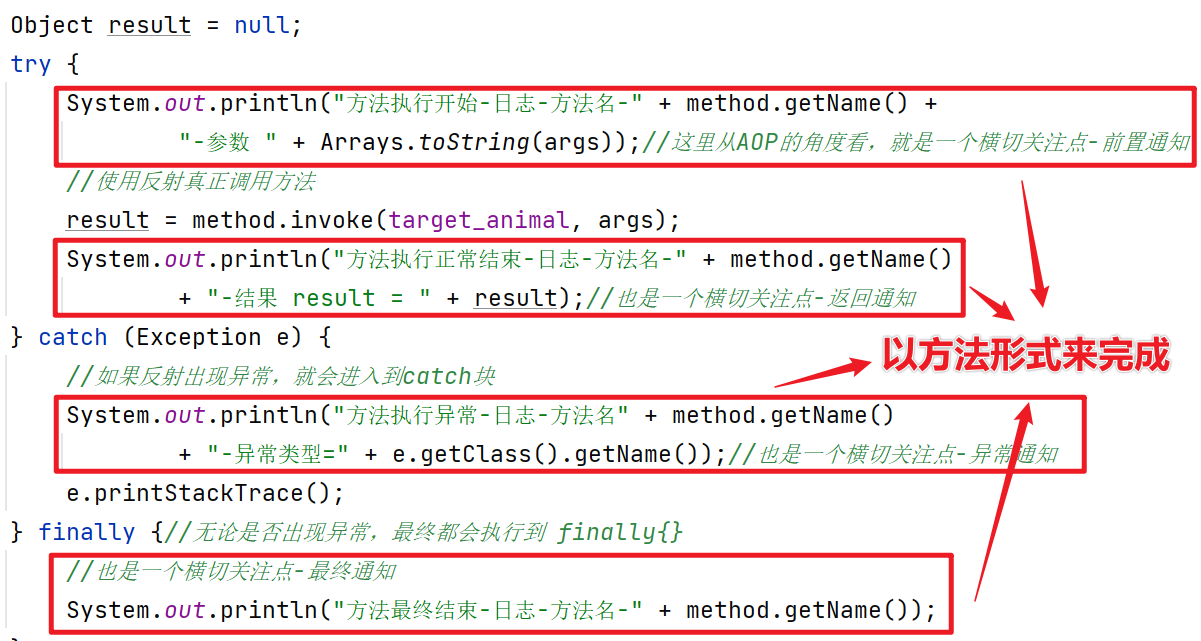
1.使用土方法解决
需求分析:使用土方法解决前面的问题,后面使用spring的aop组件完成
改进MyProxyProvider:
主要是对前置/返回/异常/最终通知的代码进行封装,封装到不同的方法中进行调用。
package com.li.aop.proxy3;

import java.lang.reflect.InvocationHandler;
import java.lang.reflect.Method;
import java.lang.reflect.Proxy;
import java.util.Arrays;

/**
 * @author 李
 * @version 1.0
 * 返回一个动态代理对象,可以执行被代理的对象的方法
 */
public class MyProxyProvider {

    //定义要执行的目标对象,该对象需要实现 SmartAnimal接口
    private SmartAnimal target_animal;

    //构造器
    public MyProxyProvider(SmartAnimal target_animal) {
        this.target_animal = target_animal;
    }

    //定义一个方法,在目标对象执行前执行
    public void before(Method method, Object[] args) {
        System.out.println("before-方法执行开始-日志-方法名-" + method.getName() +
                "-参数 " + Arrays.toString(args));//AOP的角度看,是一个横切关注点-前置通知
    }

    //定义一个方法,在目标对象执行后行
    public void after(Method method, Object result) {
        System.out.println("after-方法执行正常结束-日志-方法名-" + method.getName()
                + "-结果 result = " + result);//也是一个横切关注点-返回通知
    }

    //定义方法返回代理对象,该代理对象可以执行目标对象
    public SmartAnimal getProxy() {
        //(1)先得到类加载器对象
        ClassLoader classLoader = target_animal.getClass().getClassLoader();
        //(2)得到要执行的目标对象的接口信息
        Class<?>[] interfaces = target_animal.getClass().getInterfaces();
        //(3)使用匿名内部类 创建 InvocationHandler对象
        InvocationHandler invocationHandler = new InvocationHandler() {
            @Override
            public Object invoke(Object proxy, Method method, Object[] args) throws Throwable {
                Object result = null;
                try {

                    before(method, args);

                    //使用反射真正调用方法
                    result = method.invoke(target_animal, args);

                    after(method, result);

                } catch (Exception e) {
                    //如果反射出现异常,就会进入到catch块
                    System.out.println("方法执行异常-日志-方法名" + method.getName()
                            + "-异常类型=" + e.getClass().getName());//横切关注点-异常通知
                    e.printStackTrace();
                } finally {//无论是否出现异常,最终都会执行到 finally{}
                    //也是一个横切关注点-最终通知
                    System.out.println("方法最终结束-日志-方法名-" + method.getName());
                }
                return result;
            }
        };

        //创建代理对象
        SmartAnimal proxy = (SmartAnimal) Proxy.newProxyInstance(classLoader, interfaces, invocationHandler);
        return proxy;
    }
}
2.对土方法进行解耦-开发简易的AOP类
上面的代码因为前后置等处理方法都写在同一个类中,造成代码耦合度高的问题。因此,更好的解决方法是新建一个类MyAOP,在该类中进行处理方法的编写,然后在MyProxyProvider类中调用该类的方法。
MyAOP类:
package com.li.aop.proxy3;

import java.lang.reflect.Method;
import java.util.Arrays;

/**
 * @author 李
 * @version 1.0
 * 自己写的一个极简AOP类
 */
public class MyAOP {
    //定义一个方法,在目标对象执行前执行
    public static void before(Method method, Object[] args) {
        System.out.println("MyAOP-方法执行开始-日志-方法名-" + method.getName() +
                "-参数 " + Arrays.toString(args));//前置通知
    }

    //定义一个方法,在目标对象执行后行
    public static void after(Method method, Object result) {
        System.out.println("MyAOP-方法执行正常结束-日志-方法名-" + method.getName()
                + "-结果 result = " + result);//返回通知
    }

}
3.再次分析-提出Spring AOP
使用上面的办法仍存在一些问题:
1.什么是AOP?
官方文档:核心技术 (spring.io)
AOP全称:aspect oriented programming,即面向切面编程。
AOP 是一种编程思想,是面向对象编程(OOP)的一种补充。面向对象编程将程序抽象成各个层次的对象,而面向切面编程是将程序抽象成各个切面。
2.AOP和OOP的区别:
OOP 针对业务处理过程的实体及其属性和行为进行抽象封装,以获得更加清晰高效的逻辑单元划分。
而 AOP 则是针对业务处理过程中的切面进行提取,它所面对的是处理过程中的某个步骤或阶段,以获得逻辑过程中各部分之间低耦合性的隔离效果。
这两种设计思想在目标上有着本质的差异:
面向目标不同:简单来说 OOP 是面向名词领域,AOP 面向动词领域。
思想结构不同:OOP 是纵向结构,AOP 是横向结构。
注重方面不同:OOP 注重业务逻辑单元的划分,AOP 偏重业务处理过程中的某个步骤或阶段。
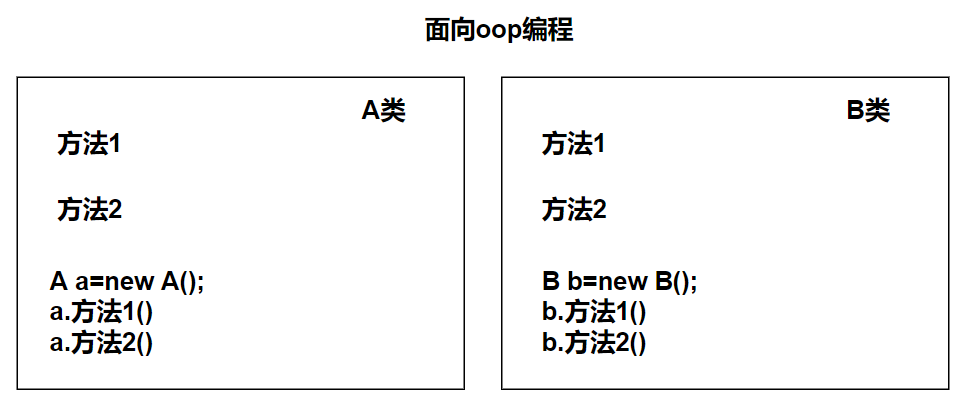
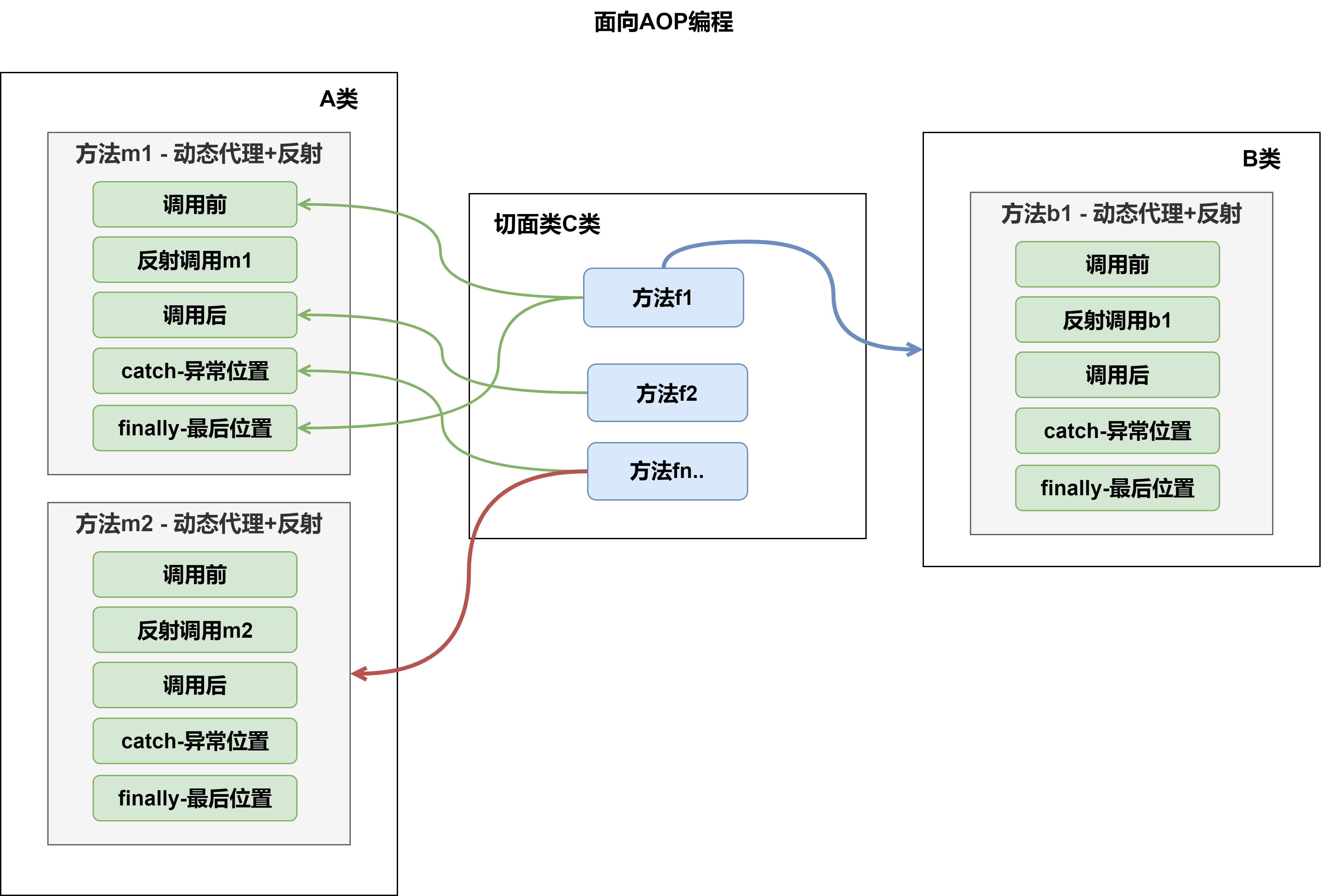
aop通过动态代理+反射的方式,对被代理对象的方法进行调用。
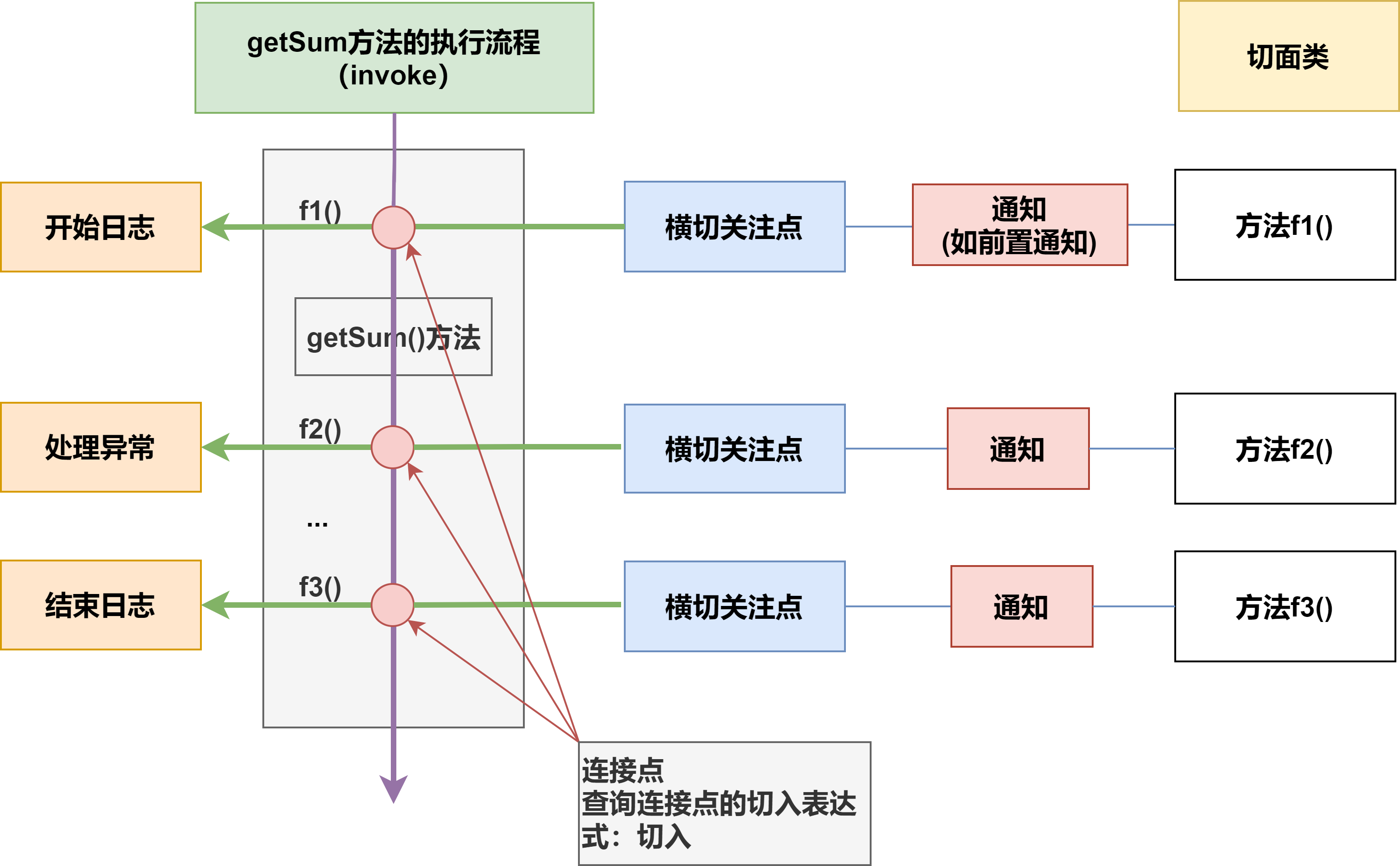
这个被代理对象的方法的调用过程,会拆分成几个横切关注点:
如下,切面类C的不同方法f1……fn可以在不同类A,B......的方法m1,m2......执行的过程中,在方法的不同横切关注点任意切入/调用。
即切面类的任意方法可以在任意类的任意方法执行的过程中,在该方法的不同横切关注点任意切入。
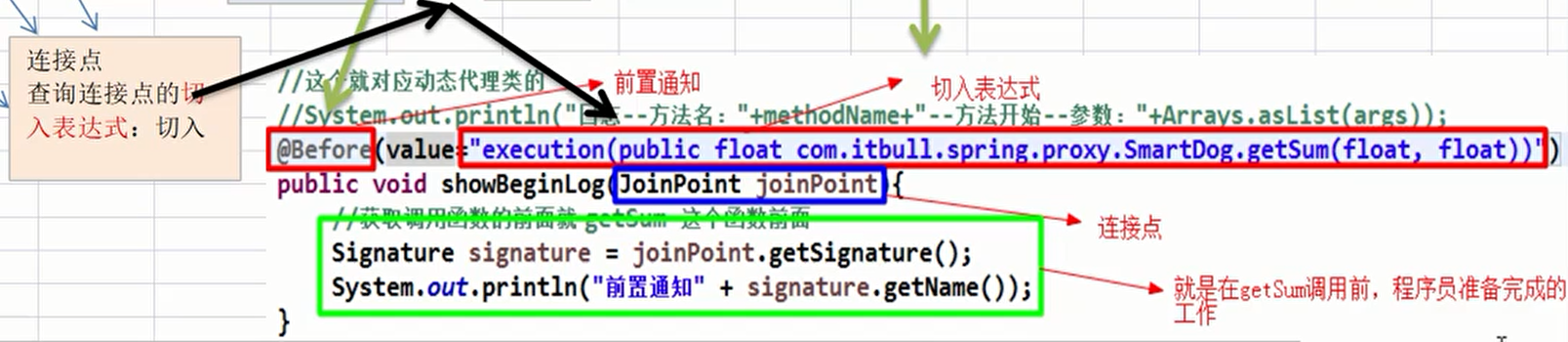
3.AOP的实现方式
这里使用框架aspectj来实现:
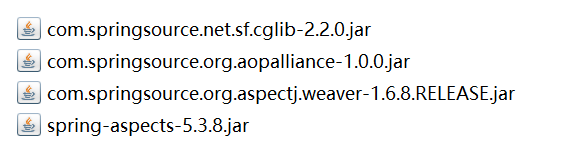
引入核心的aspect包
在切面类中声明通知方法
五种通知和前面写的动态代理类方法的对应关系:
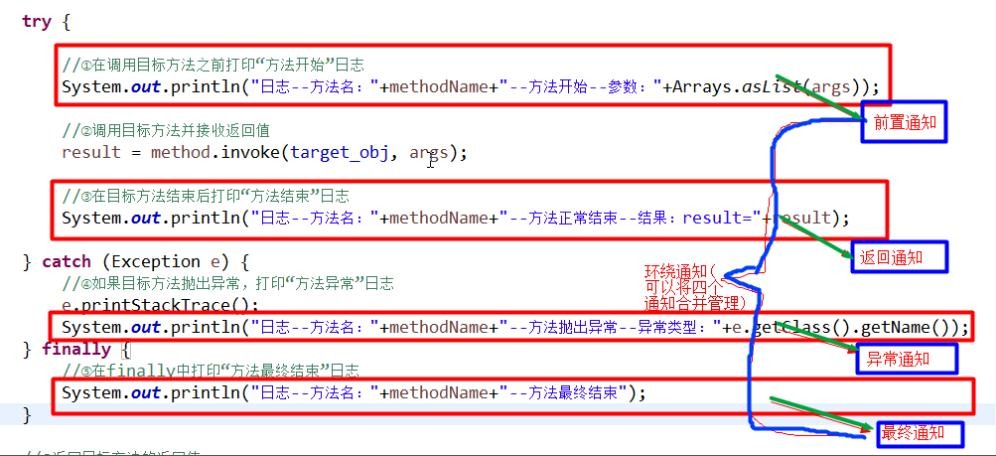
使用aop编程的方式,来实现手写的动态代理案例的效果。以上一篇的3.1为例子:
需求说明:有一个SmartAnimal接口,可以完成简单的加减法,要求在执行getSum()和getSub()时,输出执行前、执行过程、执行后的日志输出,请思考如何实现
1.导入AOP编程需要的包
2.代码实现
2.1SmartAnimal接口:
package com.li.aop.aspectj;

/**
 * @author 李
 * @version 1.0
 */
public interface SmartAnimal {
    //求和
    float getSum(float a, float b);

    //求差
    float getSub(float a, float b);
}
2.2SmartDog实现类:
package com.li.aop.aspectj;

import org.springframework.stereotype.Component;

/**
 * @author 李
 * @version 1.0
 */

//使用component注解,当spring容器启动时,将SmartDog注入容器
@Component
public class SmartDog implements SmartAnimal {
    @Override
    public float getSum(float a, float b) {
        float result = a + b;
        System.out.println("方法内部打印 result = " + result);
        return result;
    }

    @Override
    public float getSub(float a, float b) {
        float result = a - b;
        System.out.println("方法内部打印 result = " + result);
        return result;
    }
}
2.3SmartAnimalAspect切面类:
package com.li.aop.aspectj;

import org.aspectj.lang.JoinPoint;
import org.aspectj.lang.Signature;
import org.aspectj.lang.annotation.*;
import org.springframework.stereotype.Component;

import java.util.Arrays;

/**
 * @author 李
 * @version 1.0
 * 切面类,类似之前写的 MyProxyProvider,但是功能比它强大得多
 */
@Aspect //表示一个切面类[底层自动注入切面编程的支撑(动态代理+反射+动态绑定)]
@Component  //注入切面类到ioc容器
public class SmartAnimalAspect {

    /**
     * 前置通知
     * 1.@Before表示前置通知,即在我们的目标对象执行方法前执行
     * 2.value = "execution(public float com.li.aop.aspectj.SmartDog.getSum(float, float))"
     * 指定切入到哪个类的哪个方法 形式为:execution(访问修饰符 返回类型 全类名.方法名(形参列表))
     * 3.f1方法就是一个切入方法,方法名随意
     * 4.JoinPoint joinPoint 在底层执行时,由AspectJ切面框架,给切入方法传入joinPoint连接点对象
     * 通过切面方法,可以获取你想要的信息
     *
     * @param joinPoint
     */
    @Before(value = "execution(public float com.li.aop.aspectj.SmartDog.getSum(float, float))")
    public void f1(JoinPoint joinPoint) {
        //通过连接点对象joinPoint 拿到方法签名
        Signature signature = joinPoint.getSignature();
        System.out.println("切面类f1()-方法执行开始-日志-方法名-" + signature.getName() +
                "-参数 " + Arrays.toString(joinPoint.getArgs()));
    }

    //返回通知:把 f2方法切入到目标对象方法正常执行完毕后的位置
    @AfterReturning(value = "execution(public float com.li.aop.aspectj.SmartDog.getSum(float, float))")
    public void f2(JoinPoint joinPoint) {
        Signature signature = joinPoint.getSignature();
        System.out.println("切面类f2()-方法执行正常结束-日志-方法名-" + signature.getName());
    }

    //异常通知:把 f3方法切入到目标对象方法出现异常后的catch块位置
    @AfterThrowing(value = "execution(public float com.li.aop.aspectj.SmartDog.getSum(float, float))")
    public void f3(JoinPoint joinPoint) {
        Signature signature = joinPoint.getSignature();
        System.out.println("切面类f3()-方法执行异常-日志-方法名-" + signature.getName());
    }

    //最终通知:把 f4方法切入到目标对象方法执行后的位置,无论有无出现异常都会执行
    @After(value = "execution(public float com.li.aop.aspectj.SmartDog.getSum(float, float))")
    public void f4(JoinPoint joinPoint) {
        Signature signature = joinPoint.getSignature();
        System.out.println("切面类f4()-方法最终执行完毕-日志-方法名-" + signature.getName());
    }

}
2.4配置容器文件beans07.xml:
<?xml version="1.0" encoding="UTF-8"?>
<beans xmlns="http://www.springframework.org/schema/beans"
       xmlns:xsi="http://www.w3.org/2001/XMLSchema-instance"
       xmlns:context="http://www.springframework.org/schema/context"
       xmlns:aop="http://www.springframework.org/schema/aop"
       xsi:schemaLocation="http://www.springframework.org/schema/beans
       http://www.springframework.org/schema/beans/spring-beans.xsd
       http://www.springframework.org/schema/context
       https://www.springframework.org/schema/context/spring-context.xsd
       http://www.springframework.org/schema/aop
       https://www.springframework.org/schema/aop/spring-aop.xsd">

    <!--配置自动扫描的包-->
    <context:component-scan base-package="com.li.aop.aspectj"/>

    <!--一定要开启基于注解的 AOP 功能-->
    <aop:aspectj-autoproxy/>
</beans>
2.5测试类:
package com.li.aop.aspectj;

import org.springframework.context.ApplicationContext;
import org.springframework.context.support.ClassPathXmlApplicationContext;
import org.testng.annotations.Test;

/**
 * @author 李
 * @version 1.0
 * 测试类
 */
public class AopAspectjTest {
    @Test
    public void smartDogTestByAspectj() {

        //得到Spring容器
        ApplicationContext ioc =
                new ClassPathXmlApplicationContext("beans07.xml");

        //通过接口类型来获得注入的SmartDog对象(实际上是代理对象proxy)
        SmartAnimal smartAnimal = ioc.getBean(SmartAnimal.class);

        //class com.sun.proxy.$Proxy15
        //System.out.println("smartAnimal的运行类型=" + smartAnimal.getClass());

        smartAnimal.getSum(100, 48);
    }
}
测试结果:
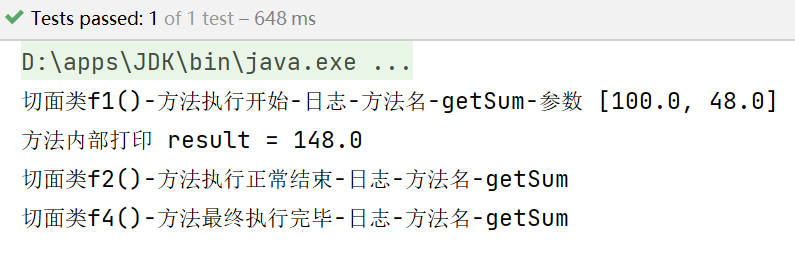
关于切面类方法命名可以自己规范一下
切入表达式的更多配置,比如使用模糊配置
形式为:execution(访问修饰符 返回类型 全类名.方法名(形参列表))
@Before(value = "execution(* com.li.aop.aspect.SmartDog.*(..))")
下面表示所有访问权限,所有包下所有类的所有方法(前提是基于动态代理的类),都会被执行前置通知方法
@Before(value = "execution(* *.*(..))")
spring容器开启了基于注解的AOP功能<aop:aspectj-autoproxy/>,获取注入的对象则需要以接口的类型来获取,因为你注入的对象.getClass()已经是代理类型了!
spring容器开启了基于注解的AOP功能,也可以通过id来获取注入的对象,但也要转成接口类型来获取。
(1)UsbInterface接口:
package com.li.aop.hw;

/**
 * @author 李
 * @version 1.0
 */
public interface UsbInterface {
    public void work(String s);
}
(2)Phone实现类:
package com.li.aop.hw;

import org.springframework.stereotype.Component;

/**
 * @author 李
 * @version 1.0
 */
@Component //将Phone对象当做组件注入到容器中
public class Phone implements UsbInterface {
    @Override
    public void work(String s) {
        System.out.println("手机开始工作,参数是=" + s);
    }
}
(3)Camera实现类:
package com.li.aop.hw;

import org.springframework.stereotype.Component;

/**
 * @author 李
 * @version 1.0
 */
@Component
public class Camera implements UsbInterface {
    @Override
    public void work(String s) {
        System.out.println("相机开始工作,参数是=" + s);
    }
}
(4)配置容器文件:
<!--配置自动扫描的包-->
<context:component-scan base-package="com.li.aop.hw"/>

<!--开启基于注解的aop功能-->
<aop:aspectj-autoproxy/>
(5)MyAspect切面类:
package com.li.aop.hw;

import org.aspectj.lang.JoinPoint;
import org.aspectj.lang.annotation.Aspect;
import org.aspectj.lang.annotation.Before;
import org.springframework.stereotype.Component;

import java.util.Arrays;

/**
 * @author 李
 * @version 1.0
 * 切面类
 */

@Component
@Aspect
public class MyAspect {
    //前置通知
    @Before(value = "execution(public void com.li.aop.hw.*.work(String))")
    public void beforeRunning(JoinPoint joinPoint) {
        String methodName = joinPoint.getSignature().getName();
        System.out.println("MyAspect前置通知-目标方法-" + methodName +
                " 参数-" + Arrays.toString(joinPoint.getArgs()));
    }

    //其他通知逻辑相同,略

}
(6)测试类:
package com.li.aop.hw;

import org.springframework.context.ApplicationContext;
import org.springframework.context.support.ClassPathXmlApplicationContext;
import org.testng.annotations.Test;

/**
 * @author 李
 * @version 1.0
 */
public class UsbTest {
    @Test
    public void UsbAspectTest() {
        ApplicationContext ioc = new ClassPathXmlApplicationContext("beans08.xml");
        //获取的实际都是代理对象
        UsbInterface phoneProxy = ioc.getBean("phone", UsbInterface.class);
        UsbInterface cameraProxy = ioc.getBean("camera", UsbInterface.class);
        phoneProxy.work("三星");
        System.out.println("============");
        cameraProxy.work("莱卡");
    }
}
测试结果:
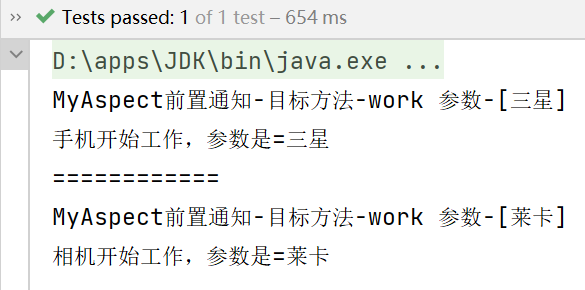
需要注意的是,如果测试类中使用接口类型获取bean,是因为当前ioc容器中只有一个代理对象。即只有一个类实现了SmartAnimal接口,因此这里只会有一个代理类。
如果有多个类实现接口,就不能使用接口类型获取bean。单例对象id默认分配的id是:id=类名(首字母小写)。或者通过自定义id来获取实现类的代理对象。
//1.验证返回状态码是否是200pm.test("Statuscodeis200",function(){pm.response.to.have.status(200);});//2.验证返回body内是否含有某个值pm.test("Bodymatchesstring",function(){pm.expect(pm.response.text()).to.include("string_you_want_to_search");});//3.验证某个返回值是否是100pm.test("Yourtestname",function(){varjsonData=pm.response.json
1.在Python3中,下列关于数学运算结果正确的是:(B)a=10b=3print(a//b)print(a%b)print(a/b)A.3,3,3.3333...B.3,1,3.3333...C.3.3333...,3.3333...,3D.3.3333...,1,3.3333...解析: 在Python中,//表示地板除(向下取整),%表示取余,/表示除(Python2向下取整返回3)2.如下程序Python2会打印多少个数:(D)k=1000whilek>1: print(k)k=k/2A.1000 B.10C.11D.9解析: 按照题意每次循环K/2,直到K值小于等
我有一个任务列表(名称、starts_at),我试图在每日View中显示它们(就像iCal)。deftodays_tasks(day)Task.find(:all,:conditions=>["starts_atbetween?and?",day.beginning,day.ending]end我不知道如何将Time.now(例如“2009-04-1210:00:00”)动态转换为一天的开始(和结束),以便进行比较。 最佳答案 deftodays_tasks(now=Time.now)Task.find(:all,:conditio
什么是0day漏洞?0day漏洞,是指已经被发现,但是还未被公开,同时官方还没有相关补丁的漏洞;通俗的讲,就是除了黑客,没人知道他的存在,其往往具有很大的突发性、破坏性、致命性。0day漏洞之所以称为0day,正是因为其补丁永远晚于攻击。所以攻击者利用0day漏洞攻击的成功率极高,往往可以达到目的并全身而退,而防守方却一无所知,只有在漏洞公布之后,才后知后觉,却为时已晚。“后知后觉、反应迟钝”就是当前安全防护面对0day攻击的真实写照!为了方便大家理解,中科三方为大家梳理当前安全防护模式下,一个漏洞从发现到解决的三个时间节点:T0:此时漏洞即0day漏洞,是已经被发现,还未被公开,官方还没有相
ruby1.9.3dev(2011-09-23修订版33323)[i686-linux]轨道3.0.20最近为什么在与DateTimeonRails相关的RSpecs项目上工作我发现在给定日期以下语句发出的值date.end_of_day.to_datetime和date.to_datetime.end_of_day虽然它们表示相同的日期时间,但比较时返回false。为了确认这一点,我打开了Rails控制台并尝试了以下操作1.9.3dev:053>monday=Time.now.monday=>2013-02-2500:00:00+05301.9.3dev:054>monday.cla
我找到了这个方法here.start=DateTime.nowsleep15stop=DateTime.now#minutesputs((stop-start)*24*60).to_ihours,minutes,seconds,frac=Date.day_fraction_to_time(stop-start)我有以下错误:`':privatemethod`day_fraction_to_time'calledforDate:Class(NoMethodError)我检查了/usr/lib/ruby/1.9.1/date.rb并找到了它:defday_fraction_to_time(
我正在尝试用没有前导零的日期来格式化日期使用%d它工作正常,但前导零date_time.strftime("%d/%m/%y")result:04/01/11我搜索了一下,发现我应该使用%e而不是%d,但是执行以下操作会得到一个空字符串。date_time.strftime("%e/%m/%y")result:这跟Ruby的版本有关系吗?我在Windows机器上使用v1.8.7。更重要的是,是否有另一种方法可以在没有前导零的情况下完成一天(比gsub更方便)? 最佳答案 如果你想删除月份或日期的前导零,只需在格式前添加一个减号,如下
使用rails控制台,我只是被这个咬住了:假设今天是12月11日。Date.today-1.day#December10(nospaces)Date.today-1.day#December10(aspaceonbothsidesoftheminussign)Date.today-1.day#December11whaaaat?Date.today-5.days#Stilldecember11!有人能解释一下这是怎么回事吗?我有点担心这在代码中很容易被遗漏。关于如何对此进行编码还有其他建议吗? 最佳答案 您看到的差异是由ruby
据我了解.round()-ruby中的功能将小数向上舍入,最后一个有效数字是5?例如1.5.round(0)#=>2(OK)但为什么1.025.round(2)#=>1.02而不是我期望的1.03?irb(main):037:0>1.025.round(2)=>1.02我该怎么做才能解决这个问题? 最佳答案 这与最后一位数字为5无关,与将十进制值转换为double浮点值有关。http://en.wikipedia.org/wiki/Double_precision_floating-point_format基本上,十进制数必须以有限
数组理论基础数组是存放在连续内存空间上的相同类型数据的集合。数组下标从0开始数组内存空间的地址是连续的c++中vector和array的区别1、vector是顺序容器,其利用连续的内存空间来存储元素,但是其内存空间大小是能够改变的。2、array是顺序容器,其也是利用连续的内存空间来存储元素,但它的内存空间是固定大小的,申请之后就无法改变。3、vector的底层是array实现的二维数组二维数组在内存的空间地址是连续的704|二分查找思路1、把整个数组一分为二;2、判断目标值在左区间还是右区间,若在左区间,则修改右区间指针的位置;若在右区间,则修改新区间的左区间位置3、重复上述过程,直到lef
