 探究Presto SQL引擎 系列:第1篇《探究Presto SQL引擎(1)-巧用Antlr》介绍了Antlr的基本用法以及如何使用Antlr4实现解析SQL查询CSV数据,在第2篇《探究Presto SQL引擎(2)-浅析Join》结合了Join的原理,以及Join的原理,在Presto中的思路。本文是系列第3篇,介绍基于 Antlr 实现where条件的解析原理,并对比了直接解析与代码生成实现两种实现思路的性能,经实验基于代码生成的实现相比直接解析有 3 倍的性能提升。
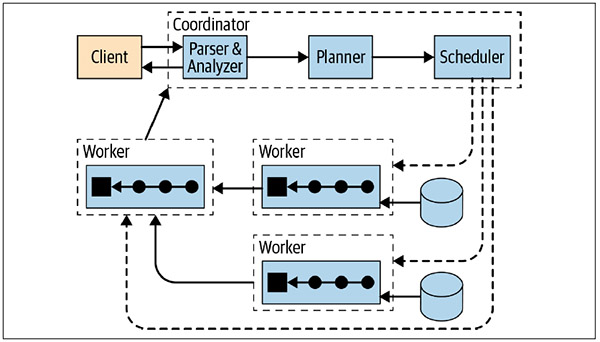 其中,Parser&Analyzer就是Antlr的用武之地。任何的SQL语句,必须经过Parser&Analyzer这一步,所谓一夫当关万夫莫开。关于Antlr的背景及基础操作等内容,在《探究Antlr在Presto 引擎的应用》一文已有描述,不再赘述。本文依然采用驱动Antlr的三板斧来实现SQL语句对where条件的支持。对于where条件,首先拆解where条件最简单的结构:
querySpecification
: SELECT selectItem (',' selectItem)*
(FROM relation (',' relation)*)?
(WHERE where=booleanExpression)?
;
...
booleanExpression
: valueExpression predicate[$valueExpression.ctx]? #predicated
| NOT booleanExpression #logicalNot
| left=booleanExpression operator=AND right=booleanExpression #logicalBinary
| left=booleanExpression operator=OR right=booleanExpression #logicalBinary
;
predicate[ParserRuleContext value]
: comparisonOperator right=valueExpression #comparison
;antlr4 -package org.example.antlr -no-listener -visitor .\SqlBase.g4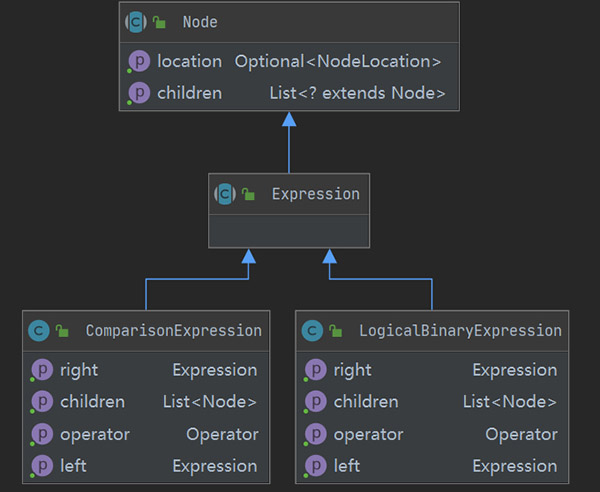 这两个类从结构上是同构的:左右各一个分支表达式,中间一个运算符。2.3.2 构建语法树在AstBuilder实现中,新增对logicalBinary, comparison相关语法的解析实现。这些工作都是依样画葫芦,没有什么难度。
@Override
public Node visitComparison(Select1Parser.ComparisonContext context)
{
return new ComparisonExpression(
getLocation(context.comparisonOperator()),
getComparisonOperator(((TerminalNode) context.comparisonOperator().getChild(0)).getSymbol()),
(Expression) visit(context.value),
(Expression) visit(context.right));
}
@Override
public Node visitLogicalBinary(Select1Parser.LogicalBinaryContext context)
{
return new LogicalBinaryExpression(
getLocation(context.operator),
getLogicalBinaryOperator(context.operator),
(Expression) visit(context.left),
(Expression) visit(context.right));
}public abstract class Node{
{
/**
* Accessible for {@link AstVisitor}, use {@link AstVisitor#process(Node, Object)} instead.
*/
protected <R, C> R accept(AstVisitor<R, C> visitor, C context)
{
return visitor.visitNode(this, context);
}
}
public abstract class AstVisitor<R, C>
{
protected R visitStatement(Statement node, C context)
{
return visitNode(node, context);
}
protected R visitQuery(Query node, C context)
{
return visitStatement(node, context);
}
....
}querySpecification
: SELECT setQuantifier? selectItem (',' selectItem)*
(FROM relation (',' relation)*)?
(WHERE where=booleanExpression)?
(GROUP BY groupBy)?
(HAVING having=booleanExpression)?
;@Override
protected Void visitQuerySpecification(QuerySpecification node, Integer indent)
{
process(node.getSelect(), indent);
if (node.getFrom().isPresent()) {
append(indent, "FROM");
builder.append('\n');
append(indent, " ");
process(node.getFrom().get(), indent);
}
builder.append('\n');
if (node.getWhere().isPresent()) {
append(indent, "WHERE " + formatExpression(node.getWhere().get(), parameters))
.append('\n');
}
if (node.getGroupBy().isPresent()) {
append(indent, "GROUP BY " + (node.getGroupBy().get().isDistinct() ? " DISTINCT " : "") + formatGroupBy(node.getGroupBy().get().getGroupingElements())).append('\n');
}
if (node.getHaving().isPresent()) {
append(indent, "HAVING " + formatExpression(node.getHaving().get(), parameters))
.append('\n');
}
if (node.getOrderBy().isPresent()) {
process(node.getOrderBy().get(), indent);
}
if (node.getLimit().isPresent()) {
append(indent, "LIMIT " + node.getLimit().get())
.append('\n');
}
return null;
}/**
• 处理比较表达式
• @param node
• @param context
• @return
*/
@Override
protected Void visitComparisonExpression(ComparisonExpression node, Map<String,Long> context) {
Expression left = node.getLeft();
Expression right = node.getRight();
String leftKey = ((Identifier) left).getValue();
Long rightKey = ((LongLiteral) right).getValue();
Long leftVal = context.get(leftKey);
if(leftVal == null){
stack.push(false);
}
ComparisonExpression.Operator op = node.getOperator();
switch (op){
case EQUAL:
stack.push(leftVal.equals(rightKey));break;
case LESS_THAN:
stack.push( leftVal < rightKey);;break;
case NOT_EQUAL:
stack.push( !leftVal.equals(rightKey));break;
case GREATER_THAN:
stack.push( leftVal>rightKey);break;
case LESS_THAN_OR_EQUAL:
stack.push( leftVal<=rightKey);break;
case GREATER_THAN_OR_EQUAL:
stack.push( leftVal>=rightKey);break;
case IS_DISTINCT_FROM:
default:
throw new UnsupportedOperationException("not supported");
}
return null;
}// antlr处理表达式语句,生成Expression对象
SqlParser sqlParser = new SqlParser();
Expression expression = sqlParser.createExpression("a>1 and b<2");
// 基于AstVisitor实现
WhereExpFilter rowFilter = new WhereExpFilter(expression);
Random r = new Random();
for(int i=0;i<10;i++){
Map<String,Long> row = new HashMap<>();
row.put("a", (long) r.nextInt(10));
row.put("b", (long) r.nextInt(10));
System.out.println("exp: a>1 and b<2, param:"+row+", ret:"+rowFilter.filter(row));
}
// ====== 执行结果如下
/**
exp: a>1 and b<2, param:{a=9, b=8}, ret:false
exp: a>1 and b<2, param:{a=7, b=3}, ret:false
exp: a>1 and b<2, param:{a=0, b=7}, ret:false
exp: a>1 and b<2, param:{a=6, b=0}, ret:true
exp: a>1 and b<2, param:{a=2, b=0}, ret:true
exp: a>1 and b<2, param:{a=9, b=0}, ret:true
exp: a>1 and b<2, param:{a=3, b=6}, ret:false
exp: a>1 and b<2, param:{a=8, b=7}, ret:false
exp: a>1 and b<2, param:{a=6, b=1}, ret:true
exp: a>1 and b<2, param:{a=4, b=6}, ret:false
*/ 即在早期CPU执行指令采用串行的方式,为了提升CPU的吞吐量,在RISC的架构中通过流水线的方式实现了多条指令重叠进行操作的一种准并行处理实现技术。通过上面的图示,可以看出:增加一条流水后,单位时间执行的指令数量就翻倍,即性能提升了1倍。当然这是理想的情况,现实中会遇到两类问题:
案例1:
stackoverflow上有个著名的问题:why-is-processing-a-sorted-array-faster-than-processing-an-unsorted-array。即对于有序数组和无序数组的遍历,执行时间差不多有2~3倍的差距。
在笔者的计算机上,运行案例结果符合描述。需要注意的是用system.nanotime()来衡量,system.currenttimemillis()精度不够。案例2:
Dubbo源码ChannelEventRunnable中通过将switch代码优化成if获得了近似2倍的效率提升。
简单总结一下,代码中的分支逻辑会影响性能,通过一些优化处理(比如数据排序/热点代码前置)能够提升分支预测的成功率,从而提升程序执行的效率。public class TestInline {
public int addOp(int a,int b){
return a+b;
}
@Benchmark
public int testAdd(){
int sum=0;
for(int i=0;i<100000;i++){
sum=addOp(sum,i);
}
return sum;
}
public static void main(String[] args) throws RunnerException {
Options options = new OptionsBuilder()
.warmupIterations(2).measurementIterations(2)
.forks(1).build();
new Runner(options).run();
}
}
// 执行结果如下:
/**
Benchmark Mode Cnt Score Error Units
TestInline.testAdd thrpt 2 18588.318 ops/s(正常执行)
TestInline.testAdd thrpt 2 3131.466 ops/s(禁用内联)
**/ 对于任意一门编程语言:程序分析、程序生成、程序转换技术在开发中应用广泛,通常应用在如下的场景中:
程序分析:基于语法和语义分析,识别潜在的bug和无用代码,或者进行逆向工程,研究软件内部原理(比如软件破解或开发爬虫)
程序生成:比如传统的编译器、用于分布式系统的stub或skeleton编译器或者JIT编译器等。
程序转换: 优化或者混淆代码、插入调试代码、性能监控等。无需源码。这对于闭源的商业软件也能非常方便实现跨平台的性能监控等需求。
运行时分析、生成、转换。只要在class字节码被加载到虚拟机之前处理完就可以了,这样整个处理流程就对用户透明了。private static final AtomicLong CLASS_ID = new AtomicLong();
private static final DateTimeFormatter TIMESTAMP_FORMAT = DateTimeFormatter.ofPattern("YYYYMMdd_HHmmss");
private String clazzName;
private ClassDefinition classDefinition;
public ByteCodeGenDemo(String clazzName){
this.clazzName=clazzName;
}
public static ParameterizedType makeClassName(String baseName, Optional suffix)
{
String className = baseName
+ "" + suffix.orElseGet(() -> Instant.now().atZone(UTC).format(TIMESTAMP_FORMAT))
+ "" + CLASS_ID.incrementAndGet();
return typeFromJavaClassName("org.shgy.demo.$gen." + toJavaIdentifierString(className));
}
public void buildClass(){
ClassDefinition classDefinition = new ClassDefinition(
a(PUBLIC, FINAL),
makeClassName(clazzName,Optional.empty()),
type(Object.class));
this.classDefinition=classDefinition;
}/**
• 生成if分支代码
• if(a<0){
System.out.println(a +" a<0");
• }else{
System.out.println(a +" a>=0");
• }
• @param methodName
*/
public void buildMethod1(String methodName){
Parameter argA = arg("a", int.class);
MethodDefinition method = classDefinition.declareMethod(
a(PUBLIC, STATIC),
methodName,
type(void.class),
ImmutableList.of(argA));
BytecodeExpression out = getStatic(System.class, "out");
IfStatement ifStatement = new IfStatement();
ifStatement.condition(lessThan(argA,constantInt(0)))
.ifTrue(new BytecodeBlock()
.append(out.invoke("print", void.class, argA))
.append(out.invoke("println", void.class, constantString(" a<0")))
)
.ifFalse(new BytecodeBlock()
.append(out.invoke("print", void.class, argA))
.append(out.invoke("println", void.class, constantString(" a>=0")))
);
method.getBody().append(ifStatement).ret();
}/**
• 生成switch分支代码
switch (a){
case 1:
System.out.println("a=1");
break;
case 2:
System.out.println("a=2");
break;
default:
System.out.println("a=others");
}
• @param methodName
*/
public void buildMethod2(String methodName){
Parameter argA = arg("a", int.class);
MethodDefinition method = classDefinition.declareMethod(
a(PUBLIC, STATIC),
methodName,
type(void.class),
ImmutableList.of(argA));
SwitchStatement.SwitchBuilder switchBuilder = new SwitchStatement.SwitchBuilder().expression(argA);
switchBuilder.addCase(1, BytecodeExpressions.print(BytecodeExpressions.constantString("a=1")));
switchBuilder.addCase(2,BytecodeExpressions.print(BytecodeExpressions.constantString("a=2")));
switchBuilder.defaultCase(invokeStatic(ByteCodeGenDemo.class,"defaultCase", void.class));
method.getBody().append(switchBuilder.build()).ret();
}
public static void defaultCase(){
System.out.println("a=others");
}/**
* 生成循环逻辑代码
* int sum=0;
* for(int i=s;i<=e;i++){
* sum+=i;
* System.out.println("i="+i+",sum="+sum);
* }
* @param methodName
*/
public void buildMethodLoop(String methodName){
Parameter argS = arg("s", int.class);
Parameter argE = arg("e", int.class);
MethodDefinition method = classDefinition.declareMethod(
a(PUBLIC, STATIC),
methodName,
type(int.class),
ImmutableList.of(argS, argE));
Scope scope = method.getScope();
Variable i = scope.declareVariable(int.class,"i");
Variable sum = scope.declareVariable(int.class,"sum");
BytecodeExpression out = getStatic(System.class, "out");
ForLoop loop = new ForLoop()
.initialize(i.set(argS))
.condition(lessThanOrEqual(i, argE))
.update(incrementVariable(i,(byte)1))
.body(new BytecodeBlock()
.append(sum.set(add(sum,i)))
.append(out.invoke("print", void.class, constantString("i=")))
.append(out.invoke("print", void.class, i))
.append(out.invoke("print", void.class, constantString(",sum=")))
.append(out.invoke("println", void.class,sum))
);
method.getBody().initializeVariable(i).putVariable(sum,0).append(loop).append(sum).retInt();
}public void executeLoop(String methodName) throws NoSuchMethodException, InvocationTargetException, IllegalAccessException {
// invoke
Class<?> clazz = classGenerator(new DynamicClassLoader(this.getClass().getClassLoader())).defineClass(this.classDefinition,Object.class);
Method loopMethod = clazz.getMethod(methodName, int.class,int.class);
loopMethod.invoke(null,1,10);
}public void buildMapGetter(String methodName){
Parameter argRow = arg("row", Map.class);
MethodDefinition method = classDefinition.declareMethod(
a(PUBLIC, STATIC),
methodName,
type(void.class),
of(argRow));
BytecodeExpression out = getStatic(System.class, "out");
Scope scope = method.getScope();
Variable a = scope.declareVariable(int.class,"a");
// 从map中获取key=aa对应的值
method.getBody().append(out.invoke("print", void.class, argRow.invoke("get",Object.class,constantString("aa").cast(Object.class)))).ret();
}
// 代码执行
public void executeMapOp(String methodName) throws NoSuchMethodException, InvocationTargetException, IllegalAccessException {
// invoke
Class<?> clazz = classGenerator(new DynamicClassLoader(this.getClass().getClassLoader())).defineClass(this.classDefinition,Object.class);
Method loopMethod = clazz.getMethod(methodName, Map.class);
Map<String,Integer> map = Maps.newHashMap();
map.put("aa",111);
loopMethod.invoke(null,map);
}输入:antlr生成的expression表达式
输出:airlift.bytecode生成的class
s1:定义清晰生成类的基础配置:类名、修饰符等信息
s2:定义一个栈用于存储比较运算(ComparisonExpression)计算结果
s3:使用递归方式遍历expression
s4:对于叶子节点(ComparisonExpression),代码生成逻辑如下:从方法定义的参数中取出对应的值,根据比较符号生成计算代码,并将计算结果push到stack
s5:对于非叶子节点
(LogicalBinaryExpression), 代码生成逻辑如下:取出栈顶的两个值,进行and或or操作运算,将计算结果push到stack
s6:当递归回退到根节点时,取出栈顶的值作为计算的最终结果
s7:基于类和方法的定义生成Class/**
• 生成比较条件语句
**/
@Override
protected Void visitComparisonExpression(ComparisonExpression node, MethodDefinition context) {
ComparisonExpression.Operator op = node.getOperator();
Expression left = node.getLeft();
Expression right = node.getRight();
if(left instanceof Identifier && right instanceof LongLiteral){
String leftKey = ((Identifier) left).getValue();
Long rightKey = ((LongLiteral) right).getValue();
Parameter argRow = context.getParameters().get(0);
Variable stack = context.getScope().getVariable("stack");
BytecodeBlock body = context.getBody();
BytecodeExpression leftVal = argRow.invoke("get", Object.class,constantString(leftKey).cast(Object.class)).cast(long.class);
BytecodeExpression cResult;
switch (op){
case EQUAL:
cResult = equal(leftVal,constantLong(rightKey));
break;
case LESS_THAN:
cResult = lessThan(leftVal,constantLong(rightKey));
break;
case GREATER_THAN:
cResult =greaterThan(leftVal,constantLong(rightKey));
break;
case NOT_EQUAL:
cResult = notEqual(leftVal,constantLong(rightKey));
break;
case LESS_THAN_OR_EQUAL:
cResult = lessThanOrEqual(leftVal,constantLong(rightKey));
break;
case GREATER_THAN_OR_EQUAL:
cResult = greaterThanOrEqual(leftVal,constantLong(rightKey));
break;
default:
throw new UnsupportedOperationException("not implemented");
}
body.append(stack.invoke("push",Object.class, cResult.cast(Object.class)));
return null;
}else{
throw new UnsupportedOperationException("not implemented");
}
}/**
* 生成比较and or语句
**/
@Override
protected Void visitLogicalBinaryExpression(LogicalBinaryExpression node, MethodDefinition context)
{
Expression left = node.getLeft();
Expression right = node.getRight();
// 处理左子树
if(left instanceof ComparisonExpression){
visitComparisonExpression((ComparisonExpression)left,context);
}else if(left instanceof LogicalBinaryExpression){
visitLogicalBinaryExpression((LogicalBinaryExpression) left,context);
}else{
throw new UnsupportedOperationException("not implemented");
}
// 处理右子树
if(right instanceof ComparisonExpression){
visitComparisonExpression((ComparisonExpression)right,context);
}else if(right instanceof LogicalBinaryExpression){
visitLogicalBinaryExpression((LogicalBinaryExpression) right,context);
}else{
throw new UnsupportedOperationException("not implemented");
}
// 根据运算符生成字节码
LogicalBinaryExpression.Operator op = node.getOperator();
Variable stack = context.getScope().getVariable("stack");
BytecodeExpression result;
switch (op){
case AND:
result = stack.invoke("push",Object.class,
and(
stack.invoke("pop",Object.class).cast(boolean.class),
stack.invoke("pop",Object.class).cast(boolean.class)
).cast(Object.class));
break;
case OR:
result = stack.invoke("push",Object.class,
or(
stack.invoke("pop",Object.class).cast(boolean.class),
stack.invoke("pop",Object.class).cast(boolean.class)
).cast(Object.class));
break;
default:
throw new UnsupportedOperationException("not implemented");
}
context.getBody().append(result);
return null;
}@BenchmarkMode(Mode.Throughput)
@Fork(1)
@State(value = Scope.Benchmark)
public class RowFilterBenchmark {
private RowFilter filter1;
private RowFilter filter2;
private List<Map<String,Long>> dataSet = Lists.newArrayListWithCapacity(100000);
@Setup
public void init(){
// antlr处理表达式语句,生成Expression对象
SqlParser sqlParser = new SqlParser();
Expression expression = sqlParser.createExpression("a>5 and b<5");
// 基于AstVisitor实现
this.filter1 = new WhereExpFilter(expression);
// 基于AstVisitor实现
ExpressionCodeCompiler compiler = new ExpressionCodeCompiler();
Class clazz = compiler.compile(expression);
try {
this.filter2 = (RowFilter) clazz.newInstance();
} catch (InstantiationException e) {
e.printStackTrace();
} catch (IllegalAccessException e) {
e.printStackTrace();
}
Random r = new Random();
for(int i=0;i<100000;i++){
Map<String,Long> row = new HashMap<>();
row.put("a", (long) r.nextInt(10));
row.put("b", (long) r.nextInt(10));
dataSet.add(row);
}
}
@Benchmark
public int testAstDirect() {
int cnt =0;
for(Map<String,Long> row:dataSet){
boolean ret = filter1.filter(row);
if(ret){
cnt++;
}
}
return cnt;
}
@Benchmark
public int testAstCompile() {
int cnt =0;
for(Map<String,Long> row:dataSet){
boolean ret = filter2.filter(row);
if(ret){
cnt++;
}
}
return cnt;
}
public static void main(String[] args) throws RunnerException {
Options opt = new OptionsBuilder()
.include(RowFilterBenchmark.class.getSimpleName())
.build();
new Runner(opt).run();
}
}Benchmark Mode Cnt Score Error Units
RowFilterBenchmark.testAstCompile thrpt 5 211.298 ± 30.832 ops/s
RowFilterBenchmark.testAstDirect thrpt 5 62.254 ± 8.269 ops/s我有一个Ruby程序,它使用rubyzip压缩XML文件的目录树。gem。我的问题是文件开始变得很重,我想提高压缩级别,因为压缩时间不是问题。我在rubyzipdocumentation中找不到一种为创建的ZIP文件指定压缩级别的方法。有人知道如何更改此设置吗?是否有另一个允许指定压缩级别的Ruby库? 最佳答案 这是我通过查看rubyzip内部创建的代码。level=Zlib::BEST_COMPRESSIONZip::ZipOutputStream.open(zip_file)do|zip|Dir.glob("**/*")d
如何在buildr项目中使用Ruby?我在很多不同的项目中使用过Ruby、JRuby、Java和Clojure。我目前正在使用我的标准Ruby开发一个模拟应用程序,我想尝试使用Clojure后端(我确实喜欢功能代码)以及JRubygui和测试套件。我还可以看到在未来的不同项目中使用Scala作为后端。我想我要为我的项目尝试一下buildr(http://buildr.apache.org/),但我注意到buildr似乎没有设置为在项目中使用JRuby代码本身!这看起来有点傻,因为该工具旨在统一通用的JVM语言并且是在ruby中构建的。除了将输出的jar包含在一个独特的、仅限ruby
在rails源中:https://github.com/rails/rails/blob/master/activesupport/lib/active_support/lazy_load_hooks.rb可以看到以下内容@load_hooks=Hash.new{|h,k|h[k]=[]}在IRB中,它只是初始化一个空哈希。和做有什么区别@load_hooks=Hash.new 最佳答案 查看rubydocumentationforHashnew→new_hashclicktotogglesourcenew(obj)→new_has
在MRIRuby中我可以这样做:deftransferinternal_server=self.init_serverpid=forkdointernal_server.runend#Maketheserverprocessrunindependently.Process.detach(pid)internal_client=self.init_client#Dootherstuffwithconnectingtointernal_server...internal_client.post('somedata')ensure#KillserverProcess.kill('KILL',
我正在编写一个小脚本来定位aws存储桶中的特定文件,并创建一个临时验证的url以发送给同事。(理想情况下,这将创建类似于在控制台上右键单击存储桶中的文件并复制链接地址的结果)。我研究过回形针,它似乎不符合这个标准,但我可能只是不知道它的全部功能。我尝试了以下方法:defauthenticated_url(file_name,bucket)AWS::S3::S3Object.url_for(file_name,bucket,:secure=>true,:expires=>20*60)end产生这种类型的结果:...-1.amazonaws.com/file_path/file.zip.A
我想在一个没有Sass引擎的类中使用Sass颜色函数。我已经在项目中使用了sassgem,所以我认为搭载会像以下一样简单:classRectangleincludeSass::Script::FunctionsdefcolorSass::Script::Color.new([0x82,0x39,0x06])enddefrender#hamlengineexecutedwithcontextofself#sothatwithintemlateicouldcall#%stop{offset:'0%',stop:{color:lighten(color)}}endend更新:参见上面的#re
我的主要目标是能够完全理解我正在使用的库/gem。我尝试在Github上从头到尾阅读源代码,但这真的很难。我认为更有趣、更温和的踏脚石就是在使用时阅读每个库/gem方法的源代码。例如,我想知道RubyonRails中的redirect_to方法是如何工作的:如何查找redirect_to方法的源代码?我知道在pry中我可以执行类似show-methodmethod的操作,但我如何才能对Rails框架中的方法执行此操作?您对我如何更好地理解Gem及其API有什么建议吗?仅仅阅读源代码似乎真的很难,尤其是对于框架。谢谢! 最佳答案 Ru
我的假设是moduleAmoduleBendend和moduleA::Bend是一样的。我能够从thisblog找到解决方案,thisSOthread和andthisSOthread.为什么以及什么时候应该更喜欢紧凑语法A::B而不是另一个,因为它显然有一个缺点?我有一种直觉,它可能与性能有关,因为在更多命名空间中查找常量需要更多计算。但是我无法通过对普通类进行基准测试来验证这一点。 最佳答案 这两种写作方法经常被混淆。首先要说的是,据我所知,没有可衡量的性能差异。(在下面的书面示例中不断查找)最明显的区别,可能也是最著名的,是你的
几个月前,我读了一篇关于rubygem的博客文章,它可以通过阅读代码本身来确定编程语言。对于我的生活,我不记得博客或gem的名称。谷歌搜索“ruby编程语言猜测”及其变体也无济于事。有人碰巧知道相关gem的名称吗? 最佳答案 是这个吗:http://github.com/chrislo/sourceclassifier/tree/master 关于ruby-寻找通过阅读代码确定编程语言的rubygem?,我们在StackOverflow上找到一个类似的问题:
我是Rails的新手,所以请原谅简单的问题。我正在为一家公司创建一个网站。那家公司想在网站上展示它的客户。我想让客户自己管理这个。我正在为“客户”生成一个表格,我想要的三列是:公司名称、公司描述和Logo。对于名称,我使用的是name:string但不确定如何在脚本/生成脚手架终端命令中最好地创建描述列(因为我打算将其设置为文本区域)和图片。我怀疑描述(我想成为一个文本区域)应该仍然是描述:字符串,然后以实际形式进行调整。不确定如何处理图片字段。那么……说来话长:我在脚手架命令中输入什么来生成描述和图片列? 最佳答案 对于“文本”数
