之前了解过postgresql的Bitmap scan,只是粗略地了解到是通过标记数据页面来实现数据检索的,执行计划中的的Bitmap scan一些细节并不十分清楚。这里借助一个执行计划来分析bitmap scan以及index only scan,以及两者的一些区别。
这里有关于Bitmap scan的一些实现过程,https://dba.stackexchange.com/questions/119386/understanding-bitmap-heap-scan-and-bitmap-index-scan
0. 构建测试环境
PG版本为11,如下测试脚本,构建一个简单的测试表
create table my_test_table01
(
    c1     serial not null primary key,
    c2    varchar(100),
    c3     timestamp
)
--c3字段上建索引
create index ix_c3 on my_test_table01(c3);

truncate table my_test_table01;

--写入300W行测试数据,c3列生成随机时间
insert into my_test_table01 (c2,c3)
select  uuid_generate_v1(),NOW() - (random() * (NOW()+'1000 days' - NOW())) from generate_series(1,3000000);
1. Bitmap Scan的剖析
用最最容易理解的场景来测试Bitmap Index Scan,执行如下sql,来分析bitma scan这个执行计划的含义。
explain (analyze, buffers,verbose,timing)
select count(1) from my_test_table01 a
where a.c3 >'20220328' or a.c1 < 100;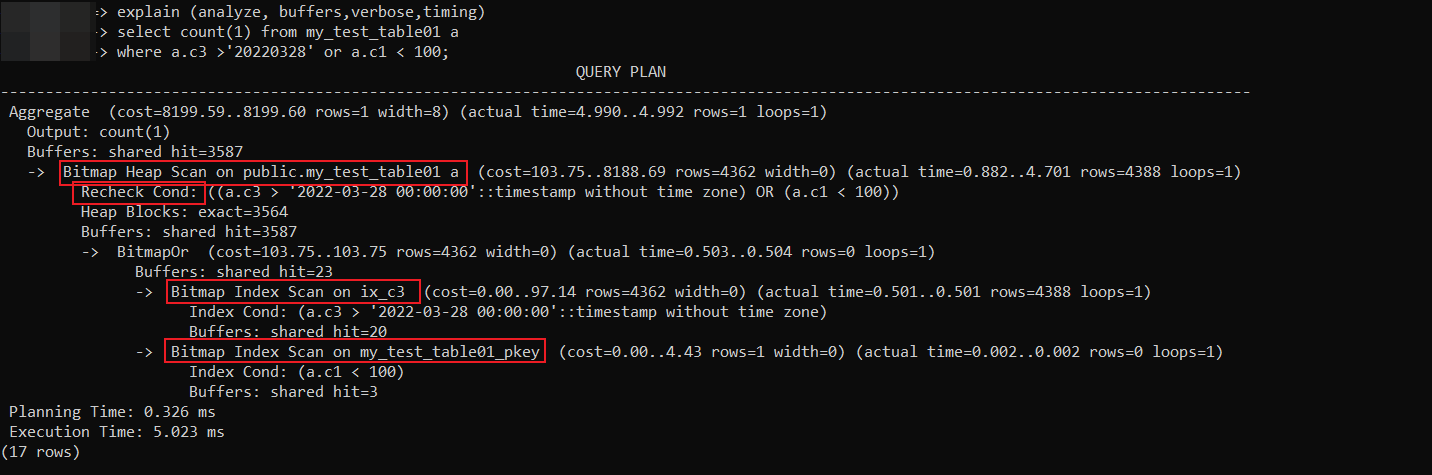
对以上的执行计划,有几个问题先弄清楚:
1,Bitmap Index Scan做了什么?
2,Bitmap Heap Scan做了什么?
3,Recheck Cond的目的是什么?
第一个问题:Bitmap Index Scan做了什么?
Bitmap scan的目标是一个bit数组,bit数组中的每一位映射到表中的一个数据页Id(One bit per heap page, in the same order as the heap)。
Bitmap Index Scan对于所有的查询条件,从扫描索引的所有页面,如果数据页面中有符合条件的数据,那么就将bit为标记为1,否则标记为0。
其他的查询条件依次创建一个一样的bit数组,同样扫描索引的所有页面,将符合条件的page的bit位标记为1。
最后多个条件生成的多个bit数组进行与(或)操作(取决于where多个条件是and组合或者or组合,上面截图中的BitmapOr),合并成一个最终的bit数组。
此时最终的bit数组标记的符合条件的数据页,而不是最终的数据行,所以最终还要去数据页中进行筛选。
https://dba.stackexchange.com/questions/119386/understanding-bitmap-heap-scan-and-bitmap-index-scan
第二个问题:Bitmap Heap Scan做了什么
而BitMap Index Scan一次性将满足条件的索引项全部取出,并在内存中进行排序, 然后根据排序后的索引项访问表数据,也就是执行计划中的Bitmap Heap Scan。
bitmap index scan 内部优化机制:https://www.postgresql.org/message-id/12553.1135634231@sss.pgh.pa.us
第三个问题:Recheck Cond的目的是什么
BitMap Heap Scan指示找到符合条件的数据页面,而不是具体的记录,此时找到数据页后再用where条件进行筛选其中的数据行,也就是执行计划中的Recheck Cond。
https://stackoverflow.com/questions/50959814/what-does-recheck-cond-in-explain-result-mean
If the bitmap gets too large we convert it to "lossy" style, in which we only remember which pages contain matching tuples instead of remembering each tuple individually. When that happens, the table-visiting phase has to examine each tuple on the page and recheck the scan condition to see which tuples to return.
bitmap scan示例图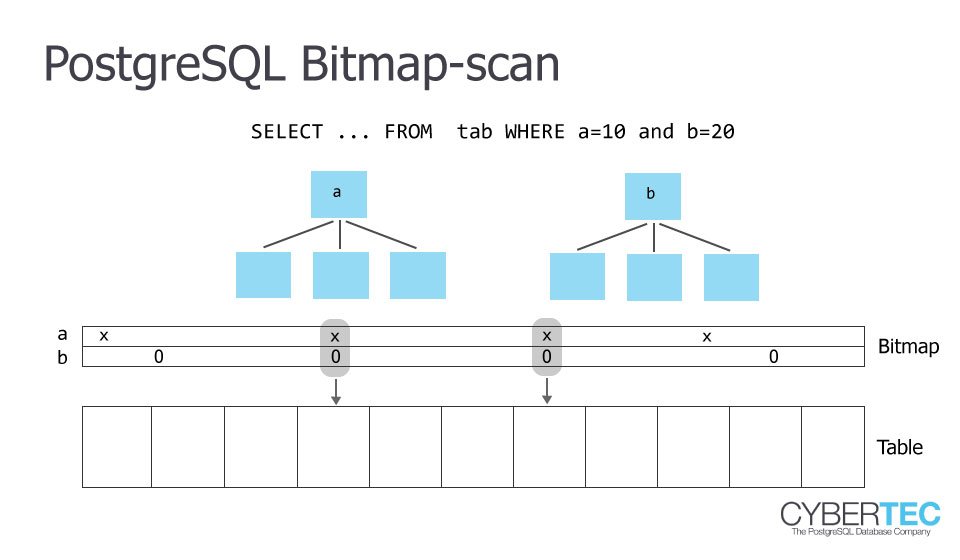
图片来源:https://www.cybertec-postgresql.com/en/postgresql-indexing-index-scan-vs-bitmap-scan-vs-sequential-scan-basics/
bitmap index scan不仅仅发生在where条件中有多个筛选条件的场景(比如where c1 = m and c2 =n),其实对于一个条件的范围查询,也同样适用bitmap index scan,见下例。
2. 为什么执行计划走Bitmap Index Scan,而不是Index only Scan?
对于如下这个查询,表中有300W测试数据符合条件的数据比例很少,很明显,ix_c3上的索引扫描才是更优化的执行计划,为什么在默认情况下是Bitmap Index Scan?
select count(1) from my_test_table01 a
where a.c3 >'20220328' ;
从如下截图可以看到,vacuum是打开的,在造完测试数据后,默认情况下上述sql查询走了bitmap Index scan,因为c3上有索引,预期是走ix_c3上的索引。
原本以为vacuum是异步的,或者说有滞后性,但是这个case在测试数据构造完之后几个小时甚至几天,该查询都依旧走bitmap Index scan的方式。
当关闭enable_bitmapscan和enable_seqscan,强制优化器走ix_c3上的index only scan,代价明显更大,这就有点说不通了,原因下文会具体分析。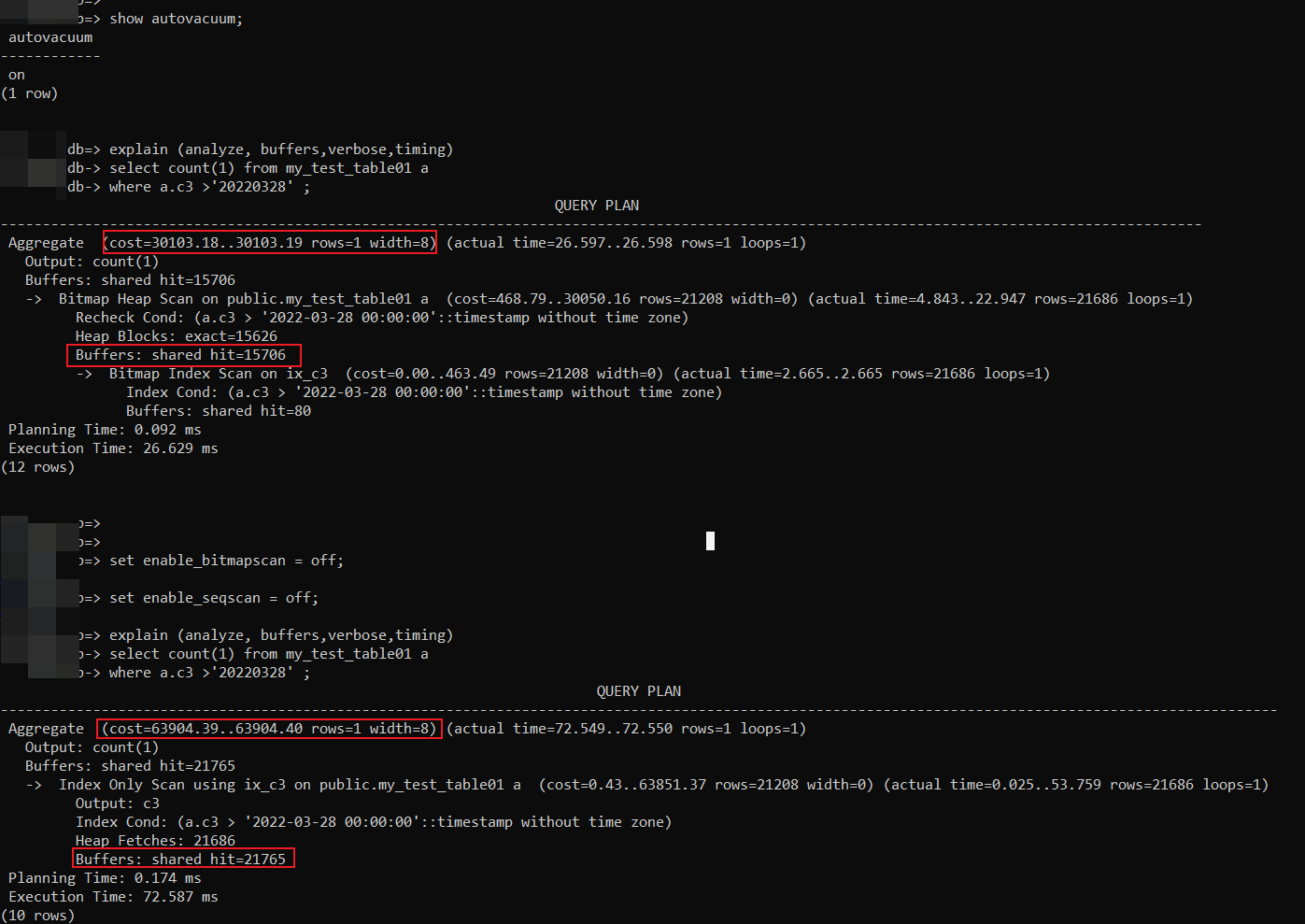
本人对该现象一开始也是百思不得其解,难道是bitmap scan有什么魔法?
看到这里有一个提到这个问题:https://www.datadoghq.com/blog/postgresql-vacuum-monitoring/,里面相关的内容的是这么说的:
1. Large insert-only tables. Large insert-only tables are not automatically vacuumed (except for transaction-ID wraparound), because autovacuum is triggered by updates and deletes. This is generally a good thing, because it saves a great deal of not-very-useful work. However, it's problematic for index-only scans, because it also means the visibility map bits won't get set. I don't have a very clear idea what to do about this, but it's likely to need thought and work. For a first version of this feature, we'll likely have to rely on users to do a manual VACUUM in this case.
既然这种场景无法主从出发vacuum,那么这里就手动vacuum测试表,然后打开bitmap scan选项,继续观察此时的默认情况下,该查询是不是可以走index only scan,这一次终于是预期的ix_c3上的index only scan了。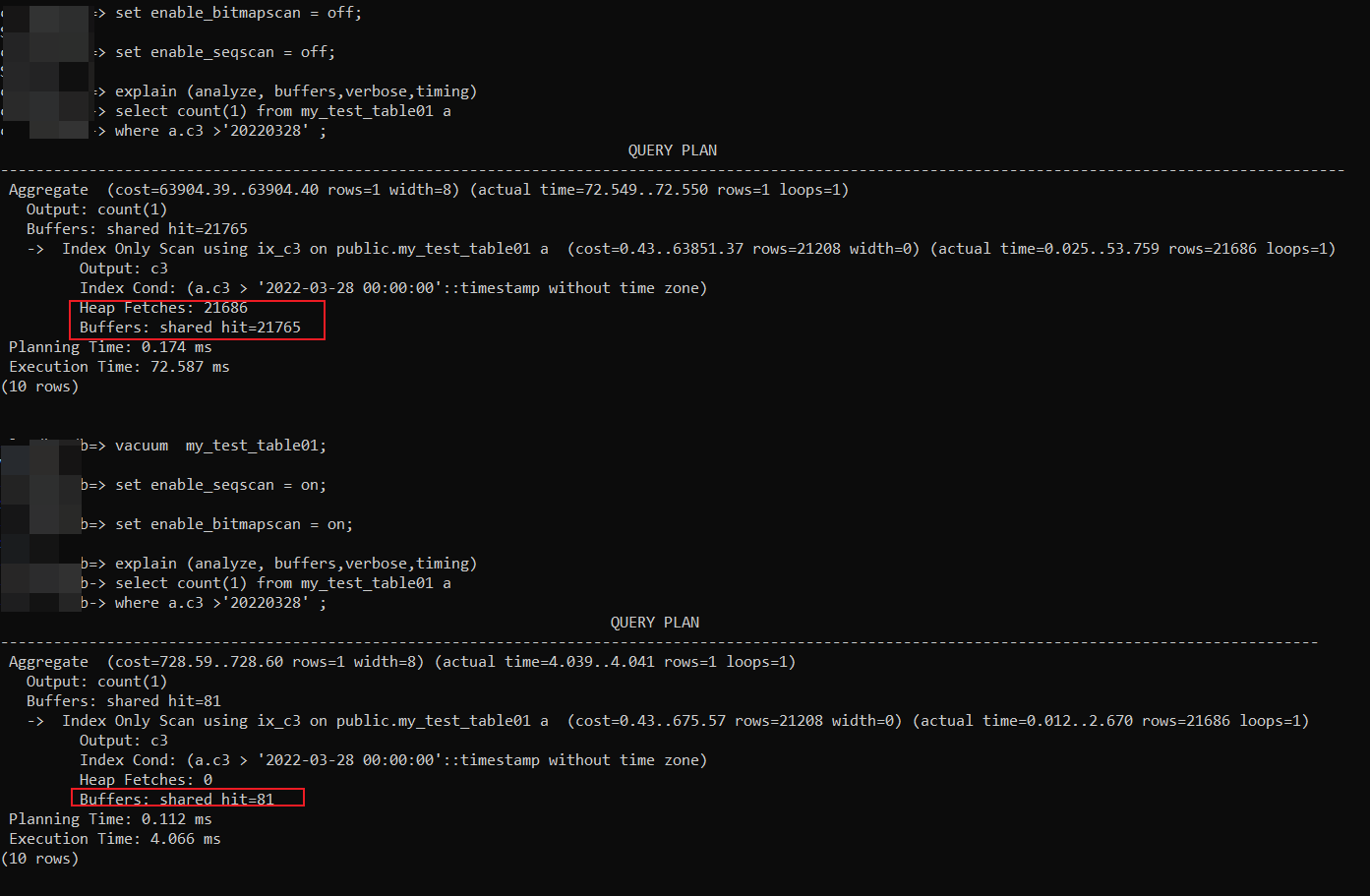
同时还有一个疑问:对表执行vacuum前后,index only scan的shared hit差别这么大?
上述得知在large-insert的情况下,不会触发表上的vacuum,此时如果强制使用index only scan,因为索引上的没有数据行的可见性信息(Index Only Scan operation must visit the heap to check if the row is visible.)所以在vacuum之前,强制使用index only scan的过程中,对于任何一行数据都要回表进行可见性判断,因此会产生大量的shared hit。一旦vacuum之后,由于索引上更新了数据行的可见性,不需要回表判断,因此shared hit会大幅度地降低。
3. 主动触发vacuum.
Large insert-only tables are not automatically vacuumed,也就是大批量的插入无法主动发出vacuum,vacuum由update和delete产生,那么尝试对表执行一些update或者delete操作,会不会主动触发vacuum?
基于第一步的脚本,重新初始化测试表,在插入300W行数据后,删除其中一部分数据,目前是让delete操作触发vacuum,然后再通过执行计划,观察是否会想手动vacuum一样,走index only scan。
经过三次删除,完美触发vacuum,执行计划有一开始bitmap scan更新为index only scan。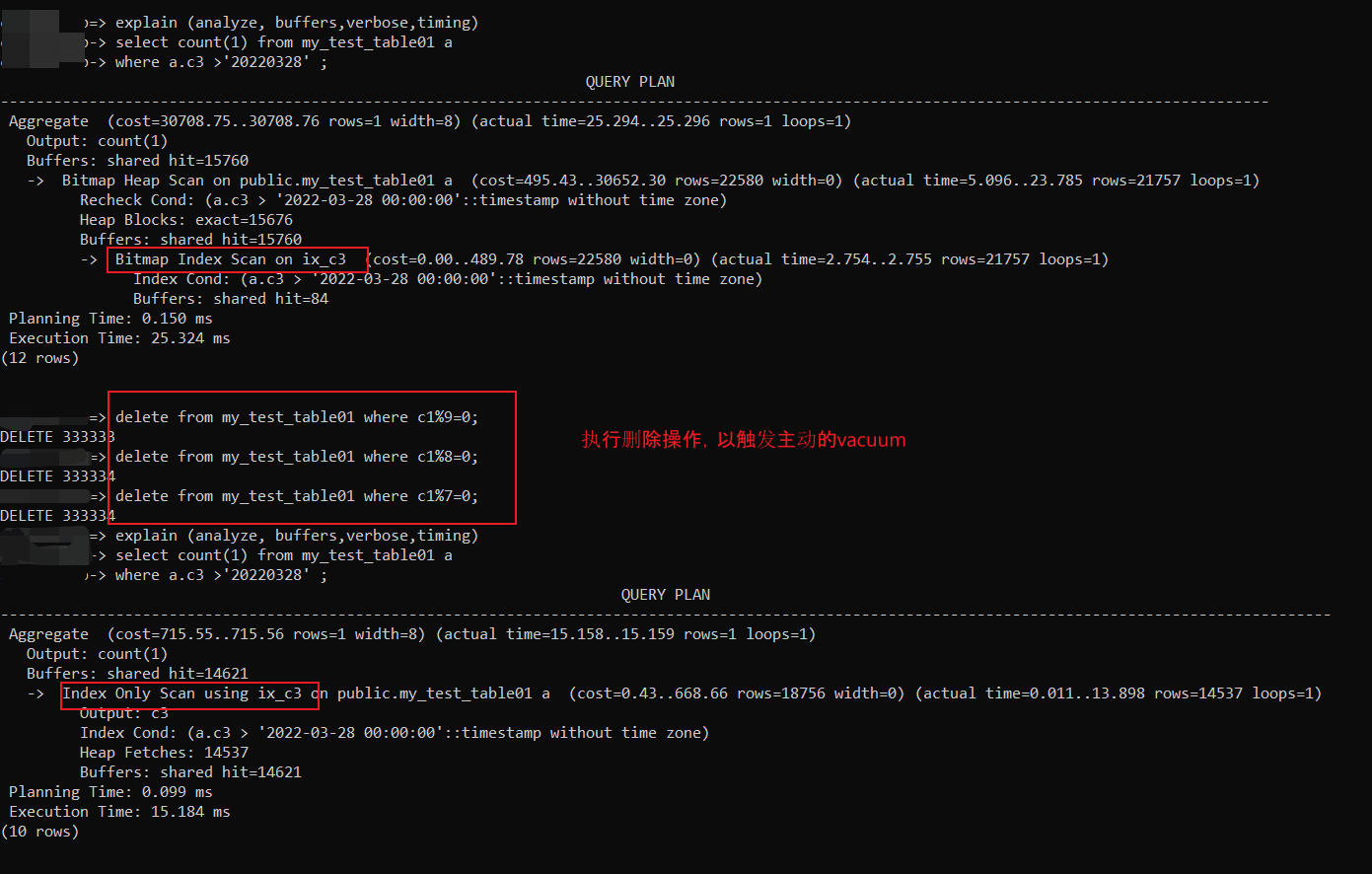
4. bitmp index scan VS index-only scan
参考这里https://www.cybertec-postgresql.com/en/killed-index-tuples/ 对 bitmap index scan 和 index-only scan的解释
PostgreSQL 8.1 introduced the “bitmp index scan”. This scan method first creates a list of heap blocks to visit and then scans them sequentially.
This not only reduces the random I/O, but also avoids that the same block is visited several times during an index scan.

PostgreSQL 9.2 introduced the “index-only scan”, which avoids fetching the heap tuple.
This requires that all the required columns are in the index and the “visibility map” shows that all tuples in the table block are visible to everybody.
bitmp index scan不仅可以避免随机的IO操作,而且可以避免同一个页面(在一个查询执行过程中)被重复读取(一个页面中可能存在多条满足查询条件的元组,其他方式可能会多次读取同一个页面)。
index-only scan避免了从堆中读取数据,但是他要求所有请求的字段都在索引中,并且“visibility map” 中显示表块中的所有元组对所有事物都是可见的,但是索引中并不包含元组的可见性。
本文通过一个看似不起眼的问题sql执行计划的分析,尝试分析bitmap scan 和index only scan的差异以及选择二者的原因,同时会涉index索引元组的可见性及vacuum没有触发的一些特殊场景。一个问题往往不是一个点,是一系列问题的合集,此事要躬行。
参考链接:
https://stackoverflow.com/questions/55651068/why-is-bitmap-scan-faster-than-index-scan-when-fetching-a-moderately-large-perce
https://ask.use-the-index-luke.com/questions/148/why-is-this-postgres-query-doing-a-bitmap-heap-scan-after-the-index-scan
http://rhaas.blogspot.com/2010/11/index-only-scans.html
https://smartkeyerror.com/PostgreSQL-MVCC-01
https://www.cnblogs.com/haylee/p/12206170.html
https://stackoverflow.com/questions/20386719/postgres-not-using-index-on-select-count-for-a-large-table
我在使用omniauth/openid时遇到了一些麻烦。在尝试进行身份验证时,我在日志中发现了这一点:OpenID::FetchingError:Errorfetchinghttps://www.google.com/accounts/o8/.well-known/host-meta?hd=profiles.google.com%2Fmy_username:undefinedmethod`io'fornil:NilClass重要的是undefinedmethodio'fornil:NilClass来自openid/fetchers.rb,在下面的代码片段中:moduleNetclass
我遵循了教程http://gettingstartedwithchef.com/,第1章。我的运行list是"run_list":["recipe[apt]","recipe[phpap]"]我的phpapRecipe默认Recipeinclude_recipe"apache2"include_recipe"build-essential"include_recipe"openssl"include_recipe"mysql::client"include_recipe"mysql::server"include_recipe"php"include_recipe"php::modul
我在用Ruby执行简单任务时遇到了一件奇怪的事情。我只想用每个方法迭代字母表,但迭代在执行中先进行:alfawit=("a".."z")puts"That'sanalphabet:\n\n#{alfawit.each{|litera|putslitera}}"这段代码的结果是:(缩写)abc⋮xyzThat'sanalphabet:a..z知道为什么它会这样工作或者我做错了什么吗?提前致谢。 最佳答案 因为您的each调用被插入到在固定字符串之前执行的字符串文字中。此外,each返回一个Enumerable,实际上您甚至打印它。试试
如何检查Ruby文件是否是通过“require”或“load”导入的,而不是简单地从命令行执行的?例如:foo.rb的内容:puts"Hello"bar.rb的内容require'foo'输出:$./foo.rbHello$./bar.rbHello基本上,我想调用bar.rb以不执行puts调用。 最佳答案 将foo.rb改为:if__FILE__==$0puts"Hello"end检查__FILE__-当前ruby文件的名称-与$0-正在运行的脚本的名称。 关于ruby-检查是否
//1.验证返回状态码是否是200pm.test("Statuscodeis200",function(){pm.response.to.have.status(200);});//2.验证返回body内是否含有某个值pm.test("Bodymatchesstring",function(){pm.expect(pm.response.text()).to.include("string_you_want_to_search");});//3.验证某个返回值是否是100pm.test("Yourtestname",function(){varjsonData=pm.response.json
我从Ubuntu服务器上的RVM转移到rbenv。当我使用RVM时,使用bundle没有问题。转移到rbenv后,我在Jenkins的执行shell中收到“找不到命令”错误。我内爆并删除了RVM,并从~/.bashrc'中删除了所有与RVM相关的行。使用后我仍然收到此错误:rvmimploderm~/.rvm-rfrm~/.rvmrcgeminstallbundlerecho'exportPATH="$HOME/.rbenv/bin:$PATH"'>>~/.bashrcecho'eval"$(rbenvinit-)"'>>~/.bashrc.~/.bashrcrbenvversions
我有一个使用SeleniumWebdriver和Nokogiri的Ruby应用程序。我想选择一个类,然后对于那个类对应的每个div,我想根据div的内容执行一个Action。例如,我正在解析以下页面:https://www.google.com/webhp?sourceid=chrome-instant&ion=1&espv=2&ie=UTF-8#q=puppies这是一个搜索结果页面,我正在寻找描述中包含“Adoption”一词的第一个结果。因此机器人应该寻找带有className:"result"的div,对于每个检查它的.descriptiondiv是否包含单词“adoption
我写了一个非常简单的rake任务来尝试找到这个问题的根源。namespace:foodotaskbar::environmentdoputs'RUNNING'endend当在控制台中执行rakefoo:bar时,输出为:RUNNINGRUNNING当我执行任何rake任务时会发生这种情况。有没有人遇到过这样的事情?编辑上面的rake任务就是写在那个.rake文件中的所有内容。这是当前正在使用的Rakefile。requireFile.expand_path('../config/application',__FILE__)OurApp::Application.load_tasks这里
我已经找到了几个使用datamapper的示例,并且能够让它们正常工作。不过,所有这些示例都是针对sqlite数据库的。我正在尝试将数据映射器与postgresql一起使用。我将datamapper中的调用从sqlite3更改为postgres,并且我已经安装了dm-postgres-adapter。但它仍然不起作用。我还需要做什么? 最佳答案 与SQLite不同,PostgreSQL不将数据库存储在单个文件中。在你拥有createdyourdatabase之后,尝试这样的事情:DataMapper.setup:default,{:
如果names为nil,则以下中断。我怎样才能让这个map只有在它不是nil时才执行?self.topics=names.split(",").mapdo|n|Topic.where(name:n.strip).first_or_create!end 最佳答案 其他几个选项:选项1(在其上执行map时检查split的结果):names_list=names.try(:split,",")self.topics=names_list.mapdo|n|Topic.where(name:n.strip).first_or_create!e
