1. 回退(驳回)
回退的思路就是动态更改节点的流向。先遇水搭桥,最后再过河拆桥。
具体操作如下:
代码实现起来可能是这样的:
@Test
public void huitui() throws Exception {
    ProcessEngine processEngine = ProcessEngines.getDefaultProcessEngine();
    TaskService taskService = processEngine.getTaskService();
    Task task = taskService.createTaskQuery().processInstanceId("55001").singleResult();
    backProcess(task);
}

/**
 * 驳回 / 回退
 * 按照这种方法,可以回退至任意节点
 * @param task
 * @throws Exception
 */
public void backProcess(Task task) throws Exception {
    ProcessEngine processEngine = ProcessEngines.getDefaultProcessEngine();
    HistoryService historyService = processEngine.getHistoryService();
    RepositoryService repositoryService = processEngine.getRepositoryService();
    TaskService taskService = processEngine.getTaskService();

    String processInstanceId = task.getProcessInstanceId();

    //  获取所有历史任务(按创建时间降序)
    List<HistoricTaskInstance> hisTaskList = historyService.createHistoricTaskInstanceQuery()
            .processInstanceId(processInstanceId)
            .orderByTaskCreateTime()
            .desc()
            .list();

    List<HistoricActivityInstance> hisActivityList = historyService.createHistoricActivityInstanceQuery()
            .processInstanceId(processInstanceId).list();

    if (CollectionUtils.isEmpty(hisTaskList) || hisTaskList.size() < 2) {
        return;
    }

    //  当前任务
    HistoricTaskInstance currentTask = hisTaskList.get(0);
    //  前一个任务
    HistoricTaskInstance lastTask = hisTaskList.get(1);
    //  当前活动
    HistoricActivityInstance currentActivity = hisActivityList.stream().filter(e -> currentTask.getId().equals(e.getTaskId())).collect(Collectors.toList()).get(0);
    //  前一个活动
    HistoricActivityInstance lastActivity = hisActivityList.stream().filter(e -> lastTask.getId().equals(e.getTaskId())).collect(Collectors.toList()).get(0);

    BpmnModel bpmnModel = repositoryService.getBpmnModel(task.getProcessDefinitionId());

    //  获取前一个活动节点
    FlowNode lastFlowNode = (FlowNode) bpmnModel.getMainProcess().getFlowElement(lastActivity.getActivityId());
    //  获取当前活动节点
    FlowNode currentFlowNode = (FlowNode) bpmnModel.getMainProcess().getFlowElement(currentActivity.getActivityId());

    //  临时保存当前活动的原始方向
    List<SequenceFlow> originalSequenceFlowList = new ArrayList<>();
    originalSequenceFlowList.addAll(currentFlowNode.getOutgoingFlows());
    //  清理活动方向
    currentFlowNode.getOutgoingFlows().clear();

    //  建立新方向
    SequenceFlow newSequenceFlow = new SequenceFlow();
    newSequenceFlow.setId("newSequenceFlowId");
    newSequenceFlow.setSourceFlowElement(currentFlowNode);
    newSequenceFlow.setTargetFlowElement(lastFlowNode);
    List<SequenceFlow> newSequenceFlowList = new ArrayList<>();
    newSequenceFlowList.add(newSequenceFlow);
    //  当前节点指向新的方向
    currentFlowNode.setOutgoingFlows(newSequenceFlowList);

    //  完成当前任务
    taskService.complete(task.getId());

    //  重新查询当前任务
    Task nextTask = taskService.createTaskQuery().processInstanceId(processInstanceId).singleResult();
    if (null != nextTask) {
        taskService.setAssignee(nextTask.getId(), lastTask.getAssignee());
    }

    //  恢复原始方向
    currentFlowNode.setOutgoingFlows(originalSequenceFlowList);
}
以请假为例

<process id="holiday" name="holiday" isExecutable="true">
    <startEvent id="startevent1" name="Start"></startEvent>
    <userTask id="usertask1" name="填写请假单" activiti:assignee="${assignee1}"></userTask>
    <sequenceFlow id="flow1" sourceRef="startevent1" targetRef="usertask1"></sequenceFlow>
    <userTask id="usertask2" name="部门经理审批" activiti:assignee="${assignee2}"></userTask>
    <sequenceFlow id="flow2" sourceRef="usertask1" targetRef="usertask2"></sequenceFlow>
    <userTask id="usertask3" name="人事审批" activiti:candidateUsers="tom,jerry"></userTask>
    <sequenceFlow id="flow3" sourceRef="usertask2" targetRef="usertask3"></sequenceFlow>
    <endEvent id="endevent1" name="End"></endEvent>
    <sequenceFlow id="flow4" sourceRef="usertask3" targetRef="endevent1"></sequenceFlow>
</process>
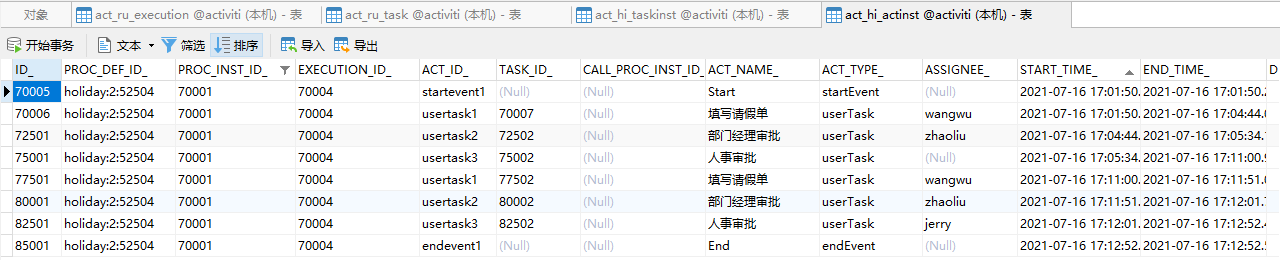
假设现在已经到“人事审批”这个节点了,当前活动是usertask3




接下来,我们运行上面的代码,回退到上一个节点“部门经理审批”,于是




流程重新从“部门经理审批”节点开始往下走,当流程走完以后


证明,思路正确,写法没啥问题。但是,上面的代码可以简化一下,如下:
/**
 * 跳到最开始的任务节点(直接打回)
 * @param task 当前任务
 */
public void jumpToStart(Task task) {
    ProcessEngine processEngine = ProcessEngines.getDefaultProcessEngine();
    HistoryService historyService = processEngine.getHistoryService();
    RepositoryService repositoryService = processEngine.getRepositoryService();
    TaskService taskService = processEngine.getTaskService();

    String processInstanceId = task.getProcessInstanceId();

    //  获取所有历史任务(按创建时间升序)
    List<HistoricTaskInstance> hisTaskList = historyService.createHistoricTaskInstanceQuery()
            .processInstanceId(processInstanceId)
            .orderByTaskCreateTime()
            .asc()
            .list();

    if (CollectionUtils.isEmpty(hisTaskList) || hisTaskList.size() < 2) {
        return;
    }

    //  第一个任务
    HistoricTaskInstance startTask = hisTaskList.get(0);
    //  当前任务
    HistoricTaskInstance currentTask = hisTaskList.get(hisTaskList.size() - 1);

    BpmnModel bpmnModel = repositoryService.getBpmnModel(task.getProcessDefinitionId());

    //  获取第一个活动节点
    FlowNode startFlowNode = (FlowNode) bpmnModel.getMainProcess().getFlowElement(startTask.getTaskDefinitionKey());
    //  获取当前活动节点
    FlowNode currentFlowNode = (FlowNode) bpmnModel.getMainProcess().getFlowElement(currentTask.getTaskDefinitionKey());

    //  临时保存当前活动的原始方向
    List<SequenceFlow> originalSequenceFlowList = new ArrayList<>();
    originalSequenceFlowList.addAll(currentFlowNode.getOutgoingFlows());
    //  清理活动方向
    currentFlowNode.getOutgoingFlows().clear();

    //  建立新方向
    SequenceFlow newSequenceFlow = new SequenceFlow();
    newSequenceFlow.setId("newSequenceFlowId");
    newSequenceFlow.setSourceFlowElement(currentFlowNode);
    newSequenceFlow.setTargetFlowElement(startFlowNode);
    List<SequenceFlow> newSequenceFlowList = new ArrayList<>();
    newSequenceFlowList.add(newSequenceFlow);
    //  当前节点指向新的方向
    currentFlowNode.setOutgoingFlows(newSequenceFlowList);

    //  完成当前任务
    taskService.complete(task.getId());

    //  重新查询当前任务
    Task nextTask = taskService.createTaskQuery().processInstanceId(processInstanceId).singleResult();
    if (null != nextTask) {
        taskService.setAssignee(nextTask.getId(), startTask.getAssignee());
    }

    //  恢复原始方向
    currentFlowNode.setOutgoingFlows(originalSequenceFlowList);
}

2. 会签
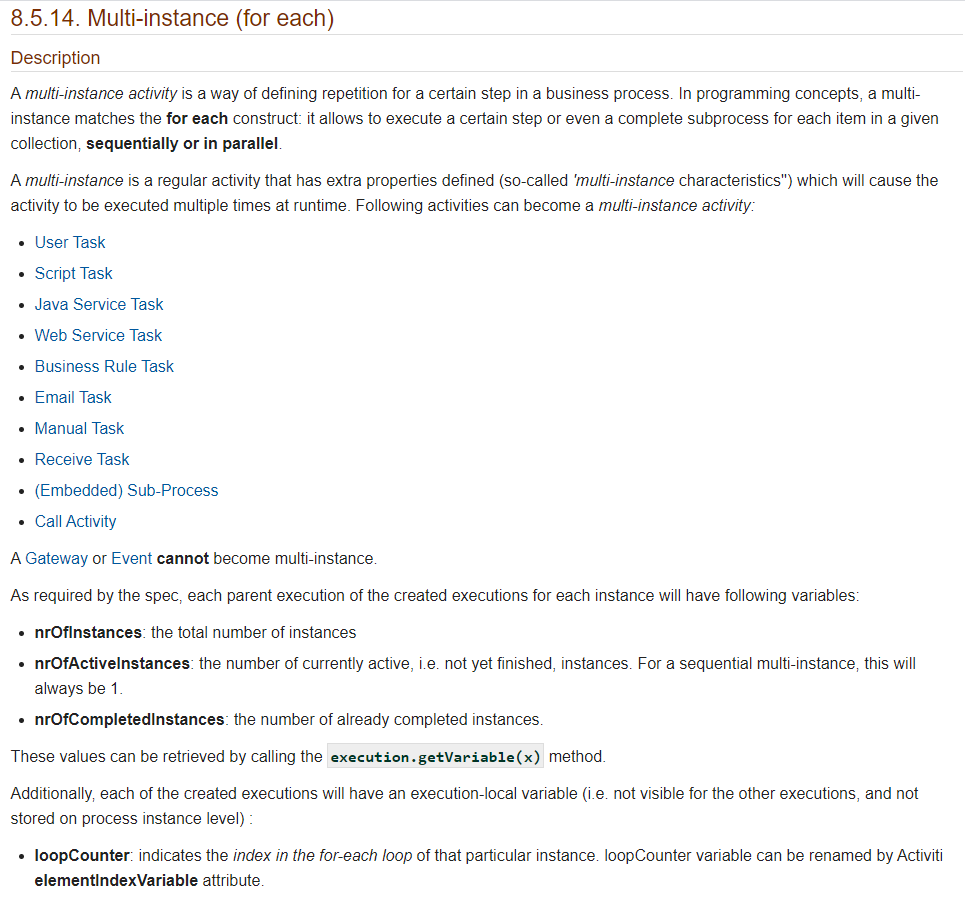
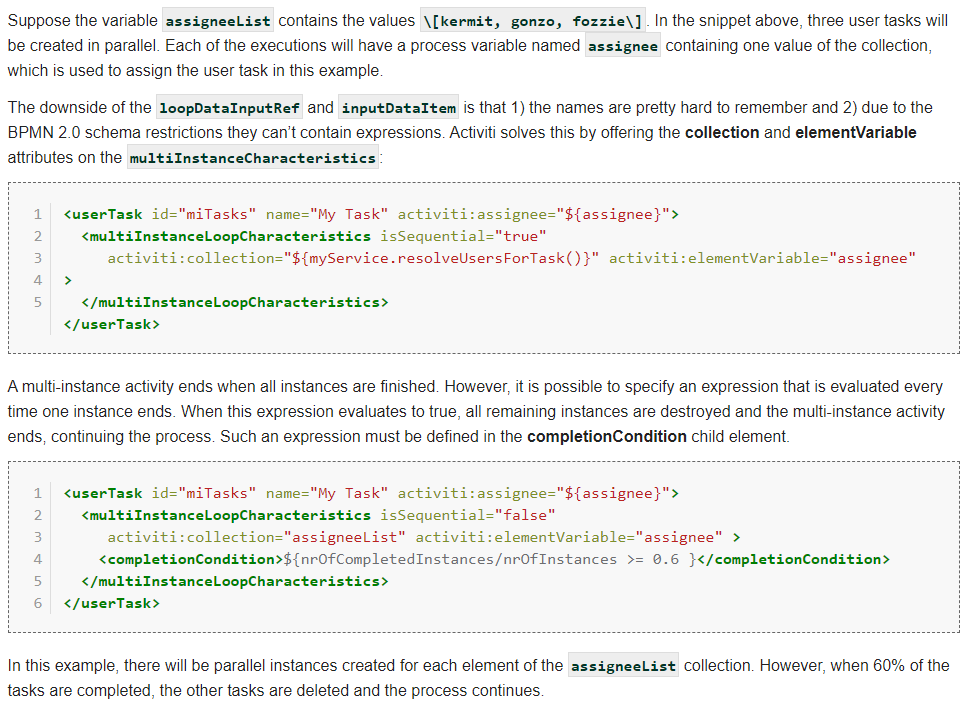
多个人同时处理一个任务,这种任务我们称之为会签任务 。Activiti实现会签是基于多实例任务,将节点设置成多实例,主要通过在UserTask节点的属性上配置。

会签的种类:
每个实例有以下变量:
nrOfActiveInstances: 当前激活的(未完成的)实例总数。 如果串行执行,则改值永远是1
条件${nrOfInstances == nrOfCompletedInstances}表示所有人员审批完成后会签结束。
条件${ nrOfCompletedInstances == 1}表示一个人完成审批,该会签就结束。
其他条件依次类推,同时这里也可以写自己添加的流程变量。
相关文档如下:
下面举个例子:
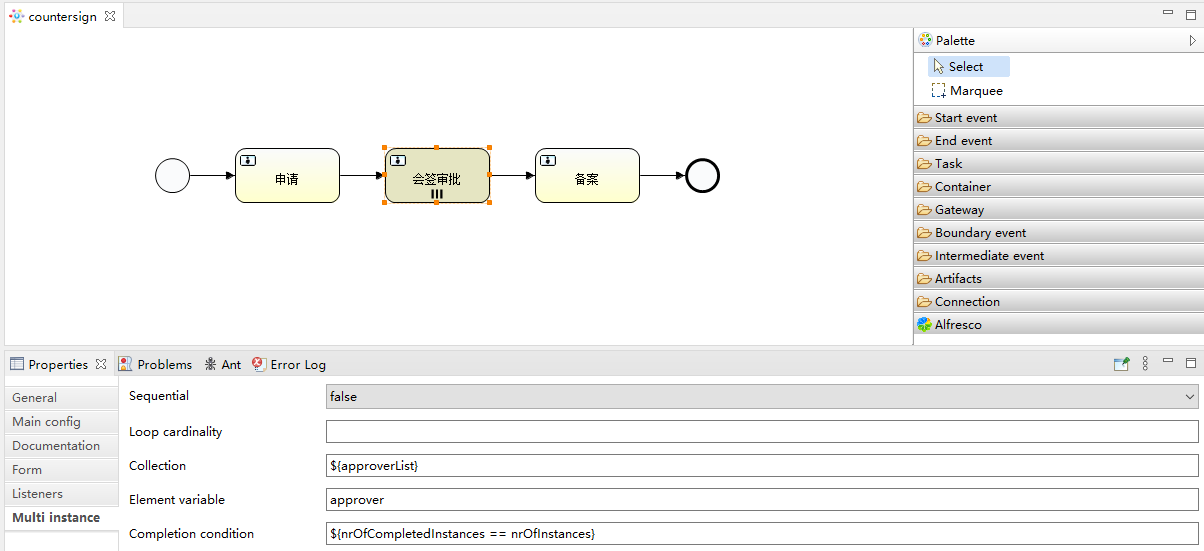
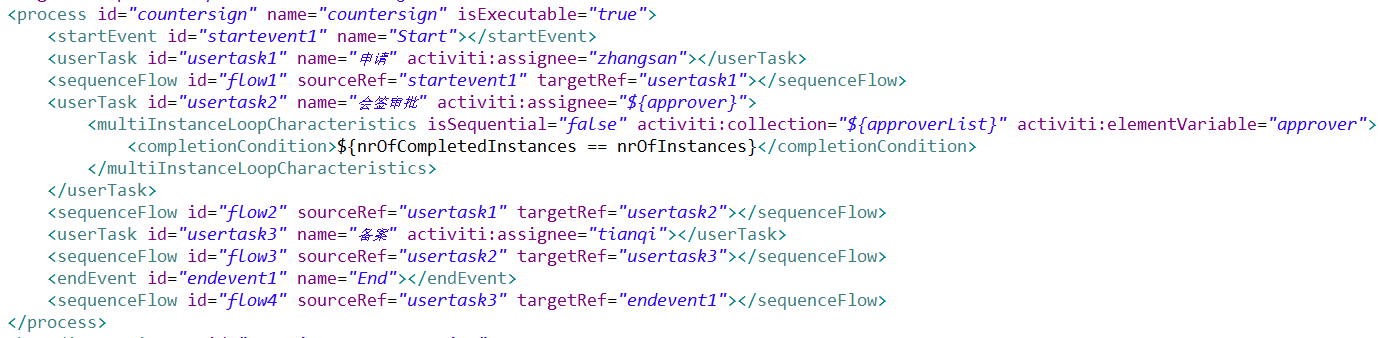
<process id="countersign" name="countersign" isExecutable="true">
    <startEvent id="startevent1" name="Start"></startEvent>
    <userTask id="usertask1" name="申请" activiti:assignee="zhangsan"></userTask>
    <sequenceFlow id="flow1" sourceRef="startevent1" targetRef="usertask1"></sequenceFlow>
    <userTask id="usertask2" name="会签审批" activiti:assignee="${approver}">
        <multiInstanceLoopCharacteristics isSequential="false"
            activiti:collection="${approverList}" activiti:elementVariable="approver">
            <completionCondition>${nrOfCompletedInstances == nrOfInstances}</completionCondition>
        </multiInstanceLoopCharacteristics>
    </userTask>
    <sequenceFlow id="flow2" sourceRef="usertask1" targetRef="usertask2"></sequenceFlow>
    <userTask id="usertask3" name="备案" activiti:assignee="tianqi"></userTask>
    <sequenceFlow id="flow3" sourceRef="usertask2" targetRef="usertask3"></sequenceFlow>
    <endEvent id="endevent1" name="End"></endEvent>
    <sequenceFlow id="flow4" sourceRef="usertask3" targetRef="endevent1"></sequenceFlow>
</process>
编写代码:
//  部署流程定义
RepositoryService repositoryService = processEngine.getRepositoryService();
Deployment deployment = repositoryService.createDeployment()
                .addClasspathResource("diagram/countersign.bpmn")
                .name("会签示例")
                .key("countersign")
                .deploy();

//  启动流程实例
RuntimeService runtimeService = processEngine.getRuntimeService();
Map<String, Object> variables = new HashMap<>();
variables.put("approverList", Arrays.asList("lisi","wangwu","zhaoliu"));
ProcessInstance processInstance = runtimeService.startProcessInstanceByKey("countersign", variables);

//  完成任务
TaskService taskService = processEngine.getTaskService();
Task task = taskService.createTaskQuery().processInstanceId("107501").taskAssignee("zhaoliu").singleResult();
if (null != task) {
    taskService.complete(task.getId());
}
流程启动后,首先是zhangsan审批


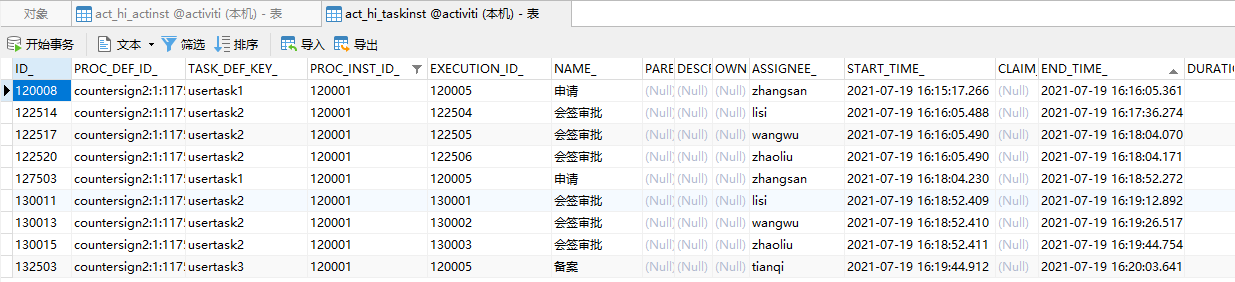
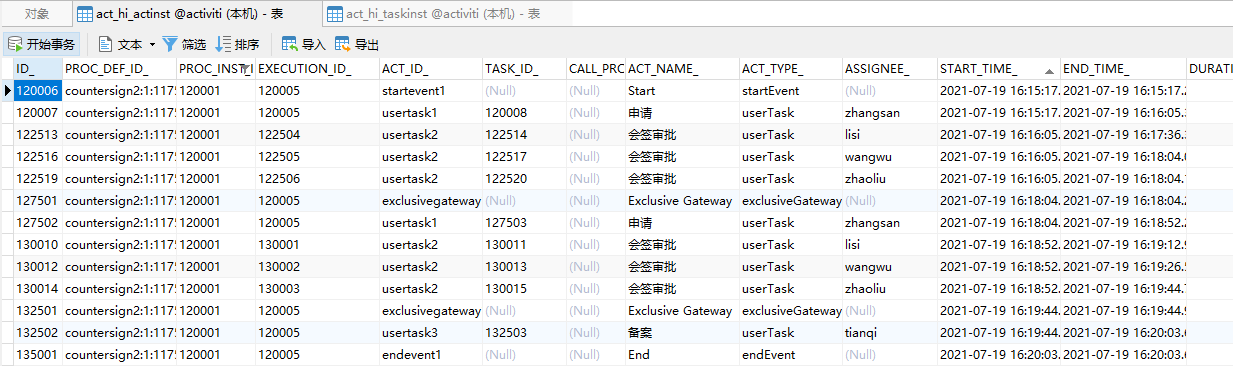
当zhangsan完成自己的任务后,进入会签环节,于是我们看到当前有3个激活的任务


当lisi完成任务以后,当前任务剩下2个


当wangwu和zhaoliu都完成任务了以后,会签任务完成,进入下一个环节


刚才的例子中没有考虑到审批不通过的情况,接下来我们完善一下,考虑下面的流程
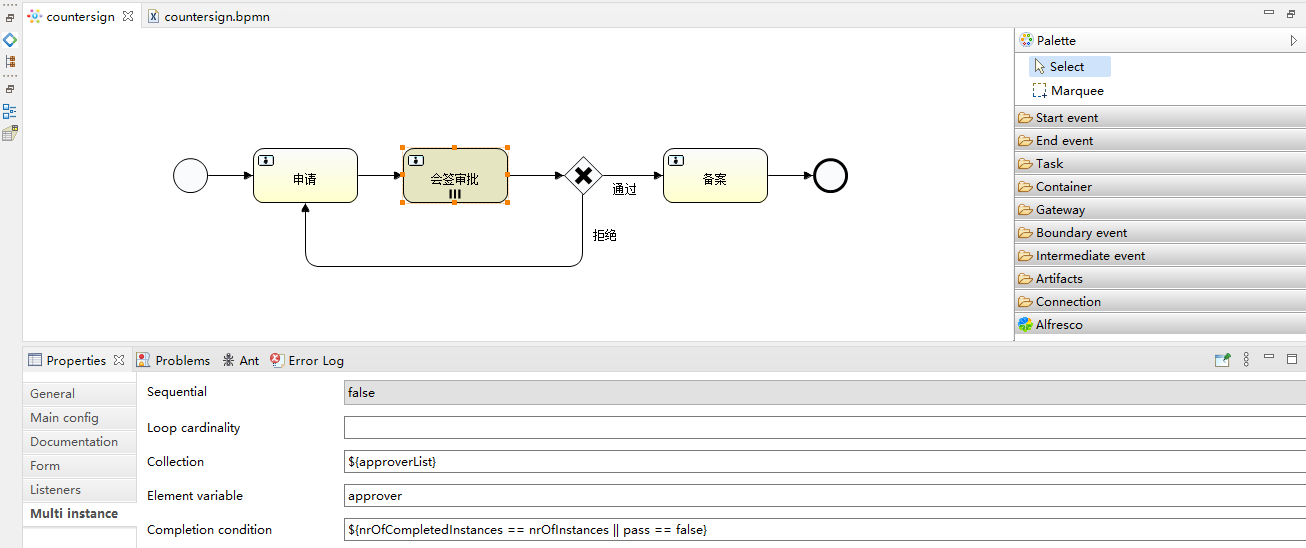
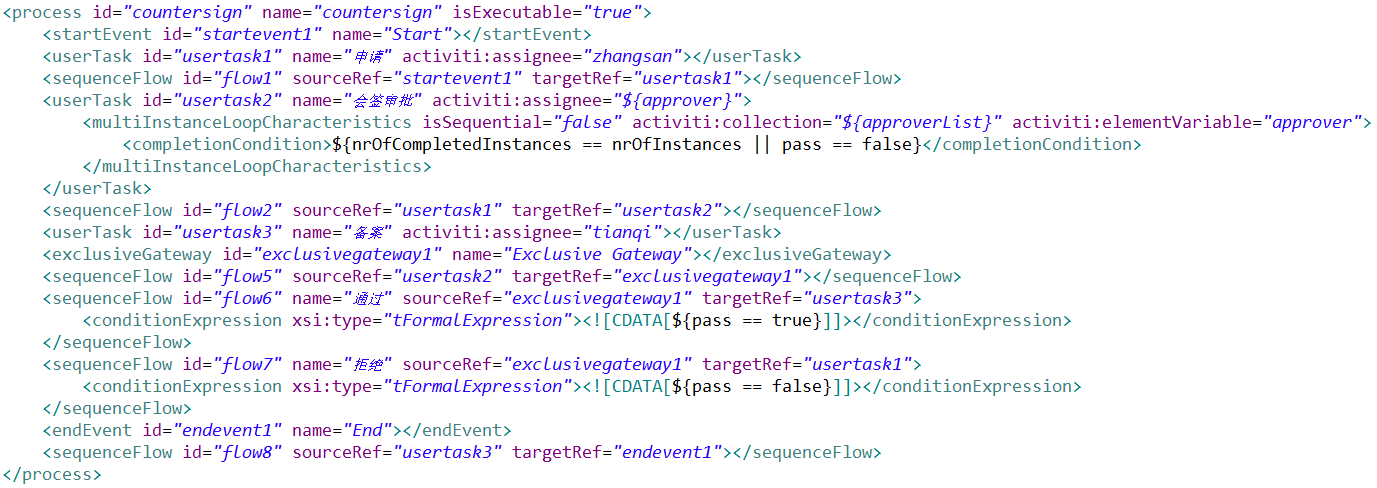
<process id="countersign" name="countersign" isExecutable="true">
    <startEvent id="startevent1" name="Start"></startEvent>
    <userTask id="usertask1" name="申请" activiti:assignee="zhangsan"></userTask>
    <sequenceFlow id="flow1" sourceRef="startevent1" targetRef="usertask1"></sequenceFlow>
    <userTask id="usertask2" name="会签审批" activiti:assignee="${approver}">
        <multiInstanceLoopCharacteristics isSequential="false" activiti:collection="${approverList}" activiti:elementVariable="approver">
            <completionCondition>${nrOfCompletedInstances / nrOfInstances == 1 || pass == false}</completionCondition>
        </multiInstanceLoopCharacteristics>
    </userTask>
    <sequenceFlow id="flow2" sourceRef="usertask1" targetRef="usertask2"></sequenceFlow>
    <userTask id="usertask3" name="备案" activiti:assignee="tianqi"></userTask>
    <exclusiveGateway id="exclusivegateway1" name="Exclusive Gateway"></exclusiveGateway>
    <sequenceFlow id="flow5" sourceRef="usertask2" targetRef="exclusivegateway1"></sequenceFlow>
    <sequenceFlow id="flow6" name="通过" sourceRef="exclusivegateway1" targetRef="usertask3">
        <conditionExpression xsi:type="tFormalExpression"><![CDATA[${pass == true}]]></conditionExpression>
    </sequenceFlow>
    <sequenceFlow id="flow7" name="拒绝" sourceRef="exclusivegateway1" targetRef="usertask1">
        <conditionExpression xsi:type="tFormalExpression"><![CDATA[${pass == false}]]></conditionExpression>
    </sequenceFlow>
    <endEvent id="endevent1" name="End"></endEvent>
    <sequenceFlow id="flow8" sourceRef="usertask3" targetRef="endevent1"></sequenceFlow>
</process>
在会签审批完成任务时就要加上流程变量pass了
RuntimeService runtimeService = processEngine.getRuntimeService();
TaskService taskService = processEngine.getTaskService();

Task task = taskService.createTaskQuery().processInstanceId("152501").taskAssignee("lisi").singleResult();
if (null != task) {
    Map<String, Object> variables = new HashMap<>();
    variables.put("pass", true);
//            variables.put("pass", false);
    taskService.complete(task.getId(), variables);

    runtimeService.getVariable(task.getExecutionId(), "nrOfCompletedInstances");
}
zhaoliu审批的时候pass传的false,于是流程又走到zhangsan那里,流程重新又走了一遍才全部完成
回退和会签就先讲到这里
我在从html页面生成PDF时遇到问题。我正在使用PDFkit。在安装它的过程中,我注意到我需要wkhtmltopdf。所以我也安装了它。我做了PDFkit的文档所说的一切......现在我在尝试加载PDF时遇到了这个错误。这里是错误:commandfailed:"/usr/local/bin/wkhtmltopdf""--margin-right""0.75in""--page-size""Letter""--margin-top""0.75in""--margin-bottom""0.75in""--encoding""UTF-8""--margin-left""0.75in""-
我在我的项目目录中完成了compasscreate.和compassinitrails。几个问题:我已将我的.sass文件放在public/stylesheets中。这是放置它们的正确位置吗?当我运行compasswatch时,它不会自动编译这些.sass文件。我必须手动指定文件:compasswatchpublic/stylesheets/myfile.sass等。如何让它自动运行?文件ie.css、print.css和screen.css已放在stylesheets/compiled。如何在编译后不让它们重新出现的情况下删除它们?我自己编译的.sass文件编译成compiled/t
我花了三天的时间用头撞墙,试图弄清楚为什么简单的“rake”不能通过我的规范文件。如果您遇到这种情况:任何文件夹路径中都不要有空格!。严重地。事实上,从现在开始,您命名的任何内容都没有空格。这是我的控制台输出:(在/Users/*****/Desktop/LearningRuby/learn_ruby)$rake/Users/*******/Desktop/LearningRuby/learn_ruby/00_hello/hello_spec.rb:116:in`require':cannotloadsuchfile--hello(LoadError) 最佳
关闭。这个问题需要detailsorclarity.它目前不接受答案。想改进这个问题吗?通过editingthispost添加细节并澄清问题.关闭8年前。Improvethisquestion在首页我有:汽车:VolvoSaabMercedesAudistatic_pages_spec.rb中的测试代码:it"shouldhavetherightselect"dovisithome_pathit{shouldhave_select('cars',:options=>['volvo','saab','mercedes','audi'])}end响应是rspec./spec/request
在Rails4.0.2中,我使用s3_direct_upload和aws-sdkgems直接为s3存储桶上传文件。在开发环境中它工作正常,但在生产环境中它会抛出如下错误,ActionView::Template::Error(noimplicitconversionofnilintoString)在View中,create_cv_url,:id=>"s3_uploader",:key=>"cv_uploads/{unique_id}/${filename}",:key_starts_with=>"cv_uploads/",:callback_param=>"cv[direct_uplo
使用Ruby1.9.2运行IDE提示说需要gemruby-debug-base19x并提供安装它。但是,在尝试安装它时会显示消息Failedtoinstallgems.Followinggemswerenotinstalled:C:/ProgramFiles(x86)/JetBrains/RubyMine3.2.4/rb/gems/ruby-debug-base19x-0.11.30.pre2.gem:Errorinstallingruby-debug-base19x-0.11.30.pre2.gem:The'linecache19'nativegemrequiresinstall
我知道全局变量$!包含最新的异常对象,但我对下面的语法感到困惑。谁能帮助我理解以下语法?rescue$! 最佳答案 此构造可防止异常停止您的程序并使堆栈跟踪冒泡。它还会将该异常作为值返回,这很有用。a=get_me_datarescue$!在此行之后,a将保存请求的数据或异常。然后您可以分析该异常并采取相应措施。defget_me_dataraise'Nodataforyou'enda=get_me_datarescue$!puts"Executioncarrieson"pa#>>Executioncarrieson#>>#更现实的
我在我正在处理的一些代码中发现了这一点。它旨在解决从磁盘读取key文件的要求。在生产环境中,key文件的内容位于环境变量中。旧代码:key=File.read('path/to/key.pem')新代码:key=File.read('|echo$KEY_VARIABLE')这是如何工作的? 最佳答案 来自IOdocs:Astringstartingwith“|”indicatesasubprocess.Theremainderofthestringfollowingthe“|”isinvokedasaprocesswithappro
我今天看到了一个ruby代码片段。[1,2,3,4,5,6,7].inject(:+)=>28[1,2,3,4,5,6,7].inject(:*)=>5040这里的注入(inject)和之前看到的完全不一样,比如[1,2,3,4,5,6,7].inject{|sum,x|sum+x}请解释一下它是如何工作的? 最佳答案 没有魔法,符号(方法)只是可能的参数之一。这是来自文档:#enum.inject(initial,sym)=>obj#enum.inject(sym)=>obj#enum.inject(initial){|mem
我刚刚有一个关于RubyonRails和模型(Rails3)中的attr_accessible属性的一般性问题。有人可以解释应该在那里定义哪些模型属性吗?我记得一些关于批量分配风险的事情,虽然我在这方面不太了解......谢谢:) 最佳答案 想象一个带有一些字段的订单类:Order.new({:type=>'Corn',:quantity=>6})现在假设订单也有折扣代码,比如:price_off。您不想将:price_off标记为attr_accessible。这会阻止恶意代码制作最终会执行如下操作的帖子:Order.new({: