文章目录
gym环境: https://www.gymlibrary.dev/
环境安装:
我的版本:
| package | module |
|---|---|
| gym | 0.24.0 |
| ale-py | 0.7.5 |
| torch | 1.11.0 |
| torchvision | 0.12.0 |
| tensorboard | 2.6.0 |
安装方法:
pip install -i https://pypi.tuna.tsinghua.edu.cn/simple gym
pip install --no-index -f https://github.com/Kojoley/atari-py/releases atari_py
pip install gym[atari]
pip uninstall ale-py
pip install ale-py
安装box2d: 可能会遇到building wheel failed for box2d
在 https://www.lfd.uci.edu/~gohlke/pythonlibs/ 下载相应的 PyBox2D的whl文件
然后在命令行:
pip install D:\FILES\PYTHON_PROJECTS\Box2D-2.3.10-cp37-cp37m-win_amd64.whl
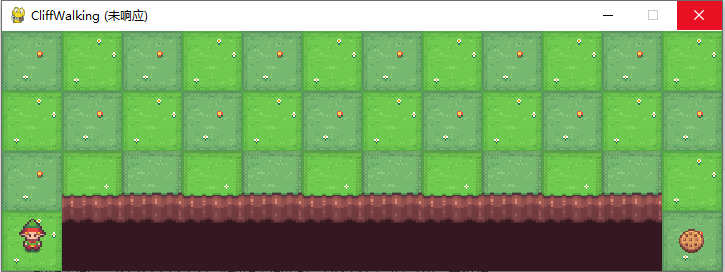
在一个4x12的网格中,智能体以网格的左下角位置为起点,以网格的下角位置为终点,目标是移动智能体到达终点位置,智能体每次可以在上、下、左、右这4个方向中移动一步,每移动一步会得到 -1 的奖励。
如果智能体“掉入悬崖” ,会立即回到起点位置,并得到-100单位的奖励
当智能体移动到终点时,该回合结束,该回合总奖励为各步奖励之和
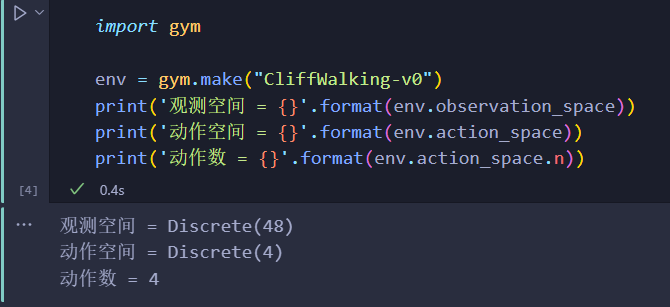
import gym

env = gym.make("CliffWalking-v0")
observation = env.reset()
env.render()
算法参数: 步长 α < 1 \alpha<1 α<1 极小值 ϵ \epsilon ϵ (两个超参数)
对于所有 Q ( s , a ) Q(s,a) Q(s,a)随机初始化,终点处$ Q(s_{end},a) = 0$
for (each trajectory):
初始化 S S S
a t = ϵ − g r e e d y ( s t ) a_t = \epsilon -greedy \quad(s_t) at=ϵ−greedy(st)
for (each step):
执行 a t a_t at,得到 ( r t + 1 , s t + 1 ) (r_{t+1},s_{t+1}) (rt+1,st+1)
a t + 1 = ϵ − g r e e d y ( s t + 1 ) a_{t+1} = \epsilon -greedy \quad(s_{t+1}) at+1=ϵ−greedy(st+1)
Q ( s t , a t ) = Q ( s t , a t ) + α [ r t + 1 + γ Q ( s t + 1 , a t + 1 ) − Q ( s t , a t ) ] Q(s_{t},a_{t})=Q(s_{t},a_{t})+\alpha[r_{t+1}+\gamma Q(s_{t+1},a_{t+1})-Q(s_{t},a_{t})] Q(st,at)=Q(st,at)+α[rt+1+γQ(st+1,at+1)−Q(st,at)]
s t = s t + 1 , a t = a t + 1 s_t = s_{t+1},a_t = a_{t+1} st=st+1,at=at+1
import numpy as np
import gym
import time

class SarsaAgent:
    def __init__(self, obs_n, act_n, learning_rate=0.01, gamma=0.9, e_greed=0.1):
        self.act_n = act_n
        self.lr = learning_rate
        self.gamma = gamma
        self.epsilon = e_greed
        self.Q = np.zeros((obs_n, act_n))
    # e_greed:根据s_t,选择a_t
    def sample(self,obs):
        if np.random.uniform(0,1) < (1.0 - self.epsilon):
            action = self.predict(obs)
        else:
            action = np.random.choice(self.act_n) # 0,1,2,3
        return action
    # a_t = argmax Q(s)
    def predict(self, obs):
        Q_list = self.Q[obs, :] #当前s下所有a对应的Q值
        maxQ = np.max(Q_list)
        action_list = np.where(Q_list == maxQ)[0] # action_list=所有=Qmax的索引
        action = np.random.choice(action_list)
        return action

    def learn(self, obs, action, reward, next_obs, next_action, done): # (S,A,R,S,A)
        '''
        done: episode是否结束
        '''
        predict_Q = self.Q[obs,action]
        if done:
            target_Q = reward
        else:
            target_Q = reward + self.gamma * self.Q[next_obs,next_action]
        # 更新Q表格
        self.Q[obs,action] += self.lr * (target_Q - predict_Q)
    def save(self):
        npy_file = './q-table.npy'
        np.save(npy_file, self.Q)
        print(npy_file + ' saved.')
    def load(self, npy_file='./q_table.npy'):
        self.Q = np.load(npy_file)
        print(npy_file + ' loaded.')

def run_episode(env, agent, render=False):
    total_steps = 0 # 记录当前episode走了多少step
    total_reward = 0
    obs = env.reset()
    action = agent.sample(obs)
    while True:
        next_obs, reward, done, _ = env.step(action)
        next_action = agent.sample(next_obs)
        agent.learn(obs, action, reward, next_obs, next_action, done)
        action = next_action
        obs = next_obs
        total_reward += reward
        total_steps += 1
        if render:
            env.render()
            time.sleep(0.)
        if done:
            break
    return total_reward, total_steps

def test_episode(env, agent):
    total_steps = 0 # 记录当前episode走了多少step
    total_reward = 0
    obs = env.reset()
    while True:
        action = agent.predict(obs)
        next_obs, reward, done, _ = env.step(action)
        total_reward += reward
        total_steps += 1
        obs = next_obs
        time.sleep(0.5)
        env.render()
        if done:
            break
    return total_reward, total_steps

def main():
    env = gym.make("CliffWalking-v0")
    agent = SarsaAgent(obs_n=env.observation_space.n,
                       act_n=env.action_space.n,
                       learning_rate=0.025, gamma=0.9, e_greed=0.1)
    for episode in range(1000):
        total_reward, total_steps = run_episode(env, agent, False)
        print('Episode %s: total_steps = %s , total_reward = %.1f' % (episode, total_steps, total_reward))
    test_episode(env, agent)

main()
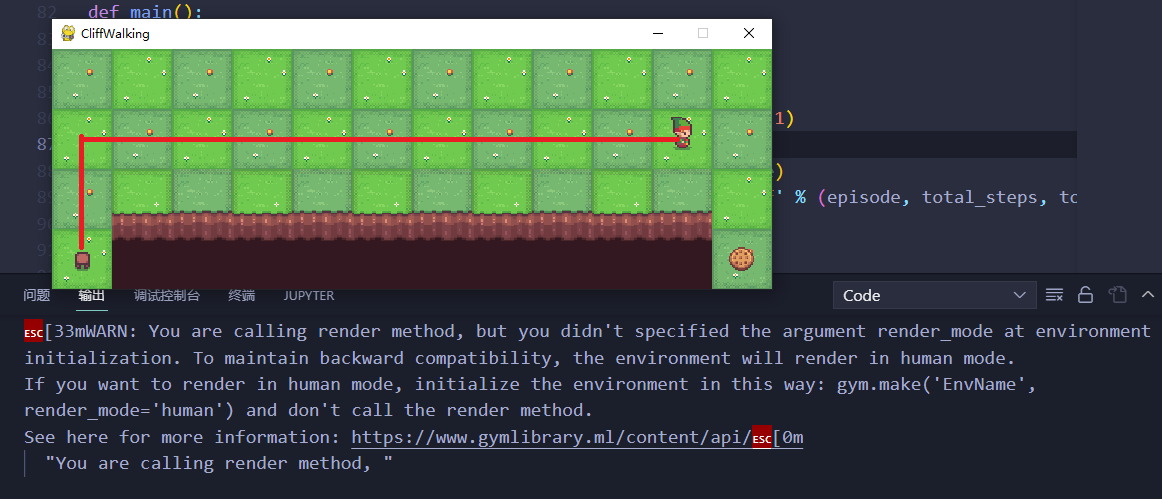
训练了1000个episode, r e w a r d = − 23 reward=-23 reward=−23
(介绍见1.1)
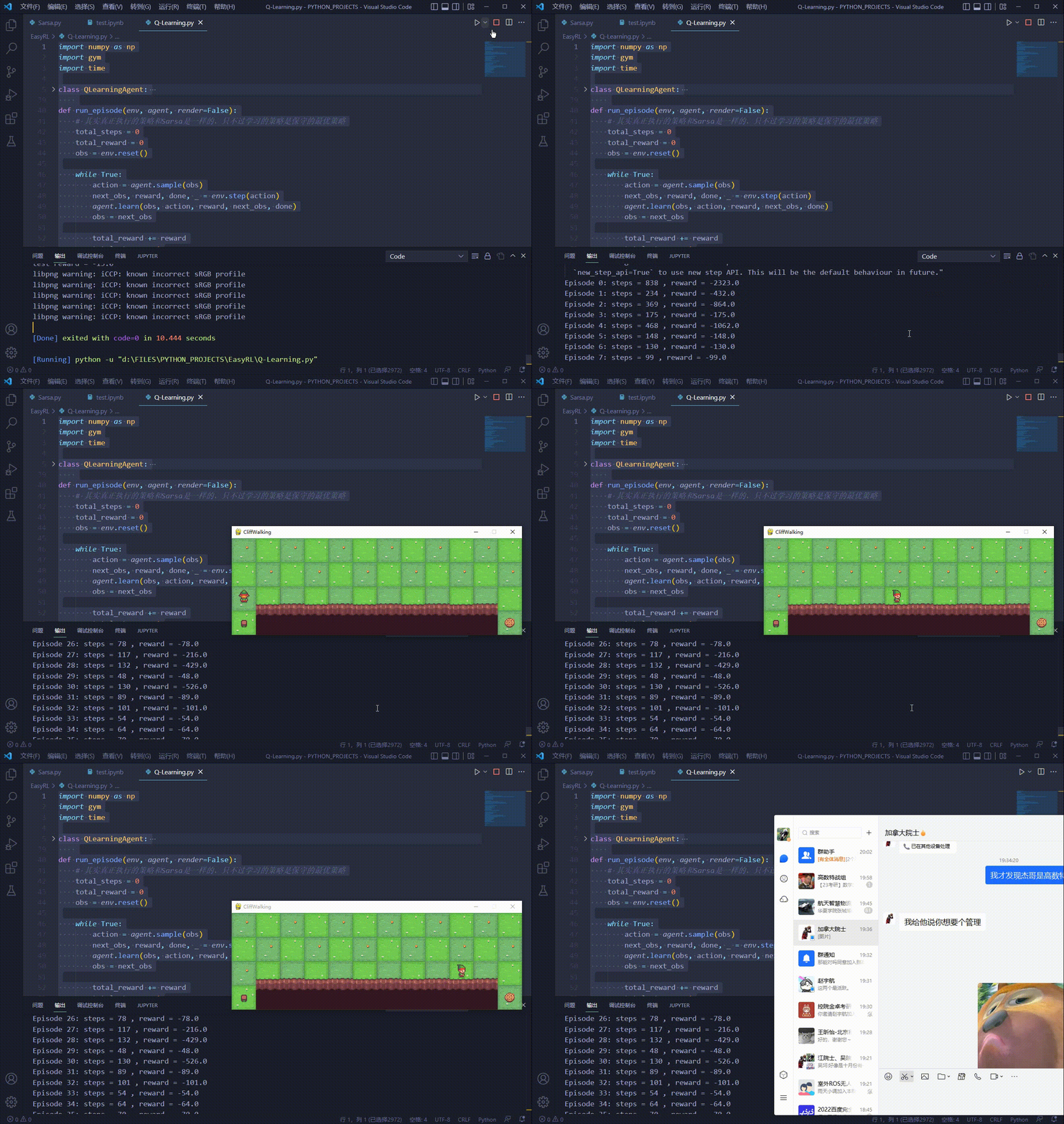
(Q-Learning其实真正执行的策略和Sarsa是一样的,只不过学习的策略是保守的最优策略)
算法参数: 步长 α < 1 \alpha<1 α<1 极小值 ϵ \epsilon ϵ (两个超参数)
对于所有 Q ( s , a ) Q(s,a) Q(s,a)随机初始化,终点处 Q ( s e n d , a ) = 0 Q(s_{end},a) = 0 Q(send,a)=0
for (each trajectory):初始化 S S S
for (each step):
a t = ϵ − g r e e d y ( s t ) a_{t} = \epsilon -greedy \quad(s_{t}) at=ϵ−greedy(st)(行为策略)
执行 a t a_t at,得到 ( r t + 1 , s t + 1 ) (r_{t+1},s_{t+1}) (rt+1,st+1)
Q ( s t , a t ) = Q ( s t , a t ) + α [ r t + 1 + γ m a x a Q ( s t + 1 , a ) − Q ( s t , a t ) ] Q(s_{t},a_{t})=Q(s_{t},a_{t})+\alpha[r_{t+1}+\gamma \underset{a}{max}Q(s_{t+1},a)-Q(s_{t},a_{t})] Q(st,at)=Q(st,at)+α[rt+1+γamaxQ(st+1,a)−Q(st,at)]
s t = s t + 1 s_t = s_{t+1} st=st+1
import numpy as np
import gym
import time

class QLearningAgent:
    def __init__(self, obs_n, act_n, learning_rate=1e-2, gamma=0.9, e_greed=0.1):
        self.act_n = act_n  # 动作维度,有几个动作可选
        self.lr = learning_rate  # 学习率
        self.gamma = gamma  # reward的衰减率
        self.epsilon = e_greed  # 按一定概率随机选动作
        self.Q = np.zeros((obs_n, act_n))
    def sample(self, obs):
        if np.random.uniform(0, 1) < (1.0 - self.epsilon):  # 根据table的Q值选动作
            action = self.predict(obs)
        else:
            action = np.random.choice(self.act_n)  # 有一定概率随机探索选取一个动作
        return action
    # 根据输入观察值,预测输出的动作值
    def predict(self, obs):
        Q_list = self.Q[obs, :]
        maxQ = np.max(Q_list)
        action_list = np.where(Q_list == maxQ)[0]  # maxQ可能对应多个action
        action = np.random.choice(action_list)
        return action
    def learn(self, obs, action, reward, next_obs, done): #(S,A,R,S)
        predict_Q = self.Q[obs, action]
        if done:
            target_Q = reward
        else:
            target_Q = reward + self.gamma * np.max(self.Q[next_obs,:])
        self.Q[obs, action] += self.lr * (target_Q - predict_Q)
    def save(self):
        npy_file = './q-table.npy'
        np.save(npy_file, self.Q)
        print(npy_file + ' saved.')
    def load(self, npy_file='./q_table.npy'):
        self.Q = np.load(npy_file)
        print(npy_file + ' loaded.')

def run_episode(env, agent, render=False):
    # 其实真正执行的策略和Sarsa是一样的,只不过学习的策略是保守的最优策略
    total_steps = 0
    total_reward = 0
    obs = env.reset()

    while True:
        action = agent.sample(obs)
        next_obs, reward, done, _ = env.step(action)
        agent.learn(obs, action, reward, next_obs, done)
        obs = next_obs

        total_reward += reward
        total_steps += 1
        if render:
            env.render()
        if done:
            break
    return total_reward, total_steps

def test_episode(env, agent):
    total_reward = 0
    obs = env.reset()
    while True:
        action = agent.predict(obs)  # greedy
        next_obs, reward, done, _ = env.step(action)
        total_reward += reward
        obs = next_obs
        time.sleep(0.5)
        env.render()
        if done:
            break
    return total_reward

def main():
    env = gym.make("CliffWalking-v0")  # 0 up, 1 right, 2 down, 3 left

    # 创建一个agent实例,输入超参数
    agent = QLearningAgent(
        obs_n=env.observation_space.n,
        act_n=env.action_space.n,
        learning_rate=0.1,
        gamma=0.9,
        e_greed=0.1)

    # 训练500个episode,打印每个episode的分数
    for episode in range(500):
        ep_reward, ep_steps = run_episode(env, agent, False)
        print('Episode %s: steps = %s , reward = %.1f' % (episode, ep_steps, ep_reward))

    # 全部训练结束,查看算法效果
    test_reward = test_episode(env, agent)
    print('test reward = %.1f' % (test_reward))

main()
(Cart Pole - Gym Documentation (gymlibrary.dev))
一根杆通过一个未驱动的关节连接到一辆小车上,小车沿着一条无摩擦的轨道移动。将钟摆垂直放置在推车上,目标是通过在推车上施加左右方向的力来平衡杆。
倒立摆:
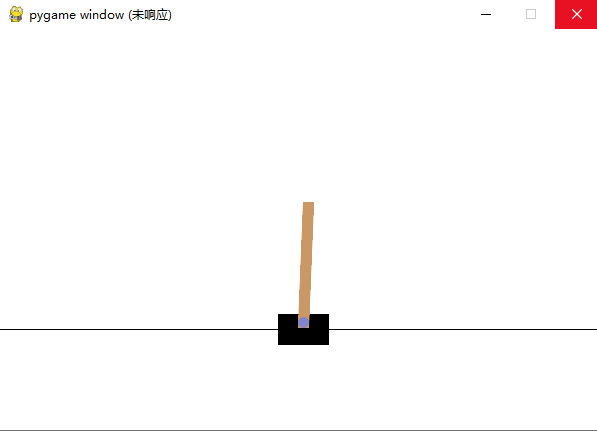
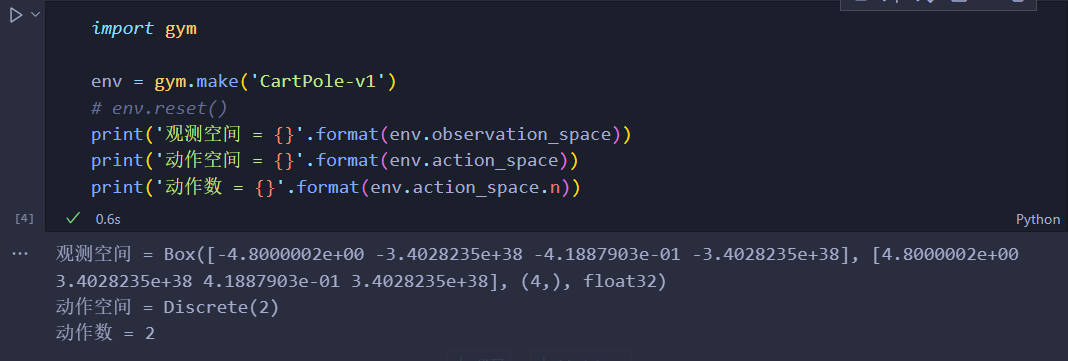
obs: (1,4)
| Num | Observation | Min | Max |
|---|---|---|---|
| 0 | Cart Position0 | -4.8 | 4.8 |
| 1 | Cart Velocity | -Inf | Inf |
| 2 | Pole Angle | -0.418 rad | 0.418 rad |
| 3 | Pole Angular Velocity | -Inf | Inf |
action: (1,2)
动作空间是离散的:
| Num | Action |
|---|---|
| 0 | 向左推车 |
| 1 | 向右推车 |
reward
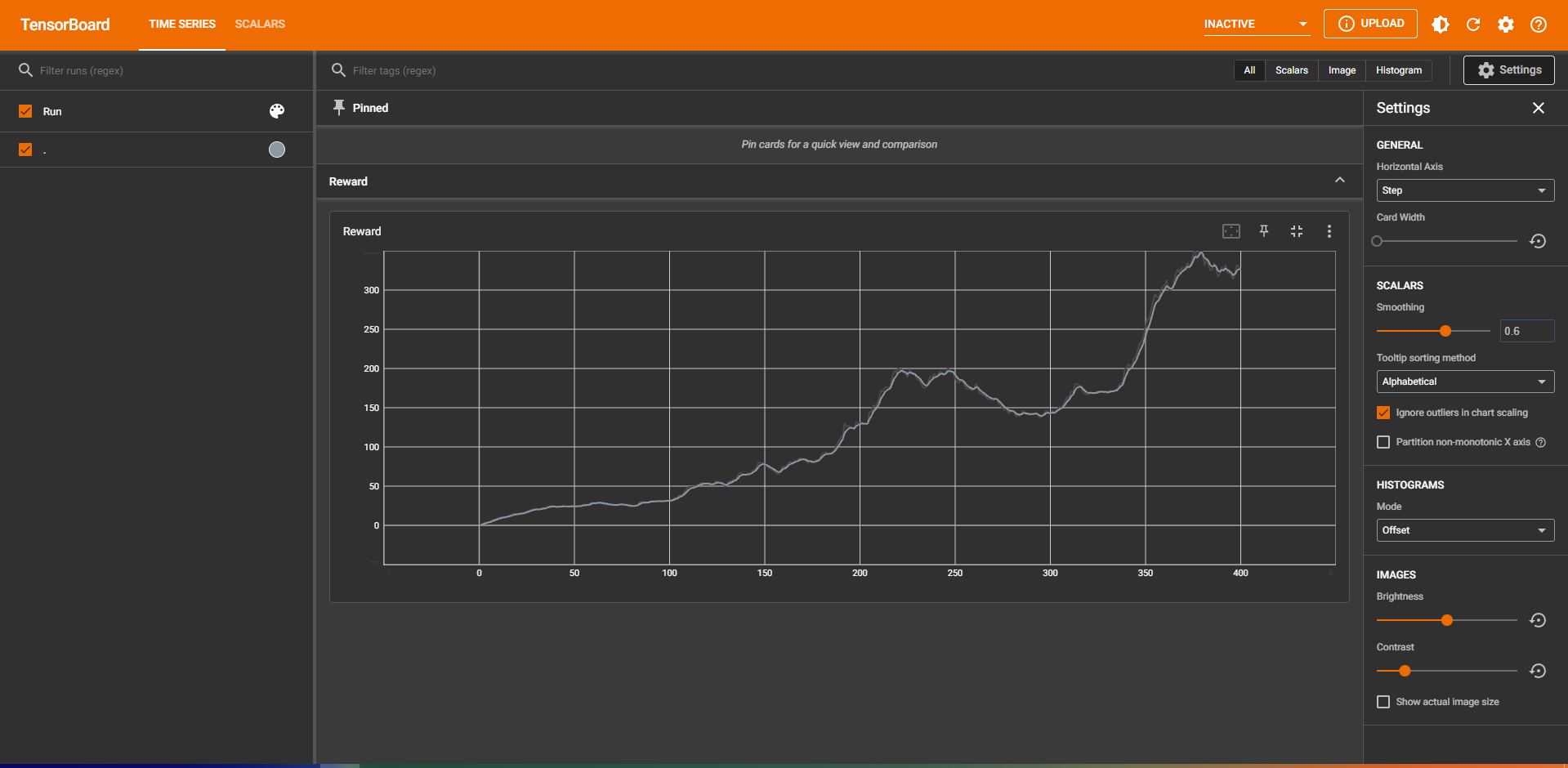
每活着经过一个时间步,奖励 + 1。
终止条件:
输入: 可微调的策略参数 π ( a ∣ s , θ ) \pi(a|s,\theta) π(a∣s,θ)
算法参数: 步长大小 α > 0 \alpha>0 α>0
初始化的策略参数 θ \theta θ
循环(each trajectory):
根据 π ( ⋅ ∣ ⋅ , θ ) \pi(\cdot|\cdot,\theta) π(⋅∣⋅,θ),生成 S 0 , A 0 , R 1 , . . . S T − 1 , A T − 1 , R T S_0,A_0,R_1,...S_{T-1},A_{T-1},R_{T} S0,A0,R1,...ST−1,AT−1,RT
对一个回合的每一步进行循环, t = 0 , 1 , . . . , T − 1 t=0,1,...,T-1 t=0,1,...,T−1
G = ∑ k = t + 1 T γ k − t − 1 R k G = \sum_{k=t+1}^{T} \gamma^{k-t-1} R_k G=∑k=t+1Tγk−t−1Rk
θ = θ + α γ t G ▽ l n [ π ( a t ∣ s t , θ ) ] \theta = \theta + \alpha \gamma^t G \bigtriangledown ln[\pi(a_t|s_t,\theta)] θ=θ+αγtG▽ln[π(at∣st,θ)]
import torch
import gym
import numpy as np
import torch.nn as nn
from torch.nn import Linear
import torch.nn.functional as F
import torch.optim as optim
from torch.distributions import Categorical
import time

lr = 0.002
gamma = 0.8

class PGPolicy(nn.Module):
    def __init__(self, input_size=4, hidden_size=128, output_size=2):
        super(PGPolicy, self).__init__()
        self.fc1 = Linear(input_size, hidden_size)
        self.fc2 = Linear(hidden_size, output_size)
        self.dropout = nn.Dropout(p=0.6)

        self.saved_log_probs = []# 记录每一步的动作概率
        self.rewards = []#记录每一步的r
    def forward(self, x):
        x = self.fc1(x)
        x = self.dropout(x)
        x = F.relu(x)
        x = self.fc2(x)
        out = F.softmax(x, dim=1)
        return out

def choose_action(state, policy):
    state = torch.from_numpy(state).float().unsqueeze(0) # 在索引0对应位置增加一个维度
    probs = policy(state)
    m = Categorical(probs) #创建以参数probs为标准的类别分布,之后的m.sampe就会按此概率选择动作
    action = m.sample()
    policy.saved_log_probs.append(m.log_prob(action))
    return action.item()#返回的就是int

def learn(policy, optimizer):
    R = 0
    policy_loss = []
    returns = []
    for r in policy.rewards[::-1]:
        R = r + gamma*R
        returns.insert(0,R)#从头部插入,即反着插入
    returns = torch.tensor(returns)
    # 归一化(均值方差),eps是一个非常小的数,避免除数为0
    eps = np.finfo(np.float64).eps.item()
    returns = (returns - returns.mean()) / (returns.std() + eps)
    for log_prob, R in zip(policy.saved_log_probs, returns):
        policy_loss.append(-log_prob*R)

    optimizer.zero_grad()
    policy_loss = torch.cat(policy_loss).sum()
    policy_loss.backward()
    optimizer.step()

    del policy.rewards[:]  # 清空数据
    del policy.saved_log_probs[:]

def train(episode_num):
    env = gym.make('CartPole-v1')
    env.seed(1)
    torch.manual_seed(1)
    policy = PGPolicy()
    # policy.load_state_dict(torch.load('save_model.pt'))  # 模型导入
    optimizer = optim.Adam(policy.parameters(), lr)
    average_r = 0

    for i in range(1, episode_num+1): #采这么多轨迹
        obs = env.reset()
        ep_r = 0
        for t in range(1, 10000):
            action = choose_action(obs, policy)
            obs, reward, done, _ = env.step(action)
            policy.rewards.append(reward)
            ep_r += reward
            if done:
                break
        average_r = 0.05 * ep_r + (1-0.05) * average_r
        learn(policy, optimizer)
        if i % 10 == 0:
                print('Episode {}\tLast reward: {:.2f}\tAverage reward: {:.2f}'.format(i, ep_r, average_r))

    torch.save(policy.state_dict(), 'PGPolicy.pt')
def test():
    env = gym.make('CartPole-v1')
    env.seed(1)
    torch.manual_seed(1)
    policy = PGPolicy()
    policy.load_state_dict(torch.load('PGPolicy.pt'))  # 模型导入
    average_r = 0
    with torch.no_grad():
        obs = env.reset()
        ep_r = 0
        for t in range(1, 10000):
            action = choose_action(obs, policy)
            obs, reward, done, _ = env.step(action)
            policy.rewards.append(reward)
            env.render()
            time.sleep(0.1)
            ep_r += reward
            if done:
                break

train(1000)

#  test()
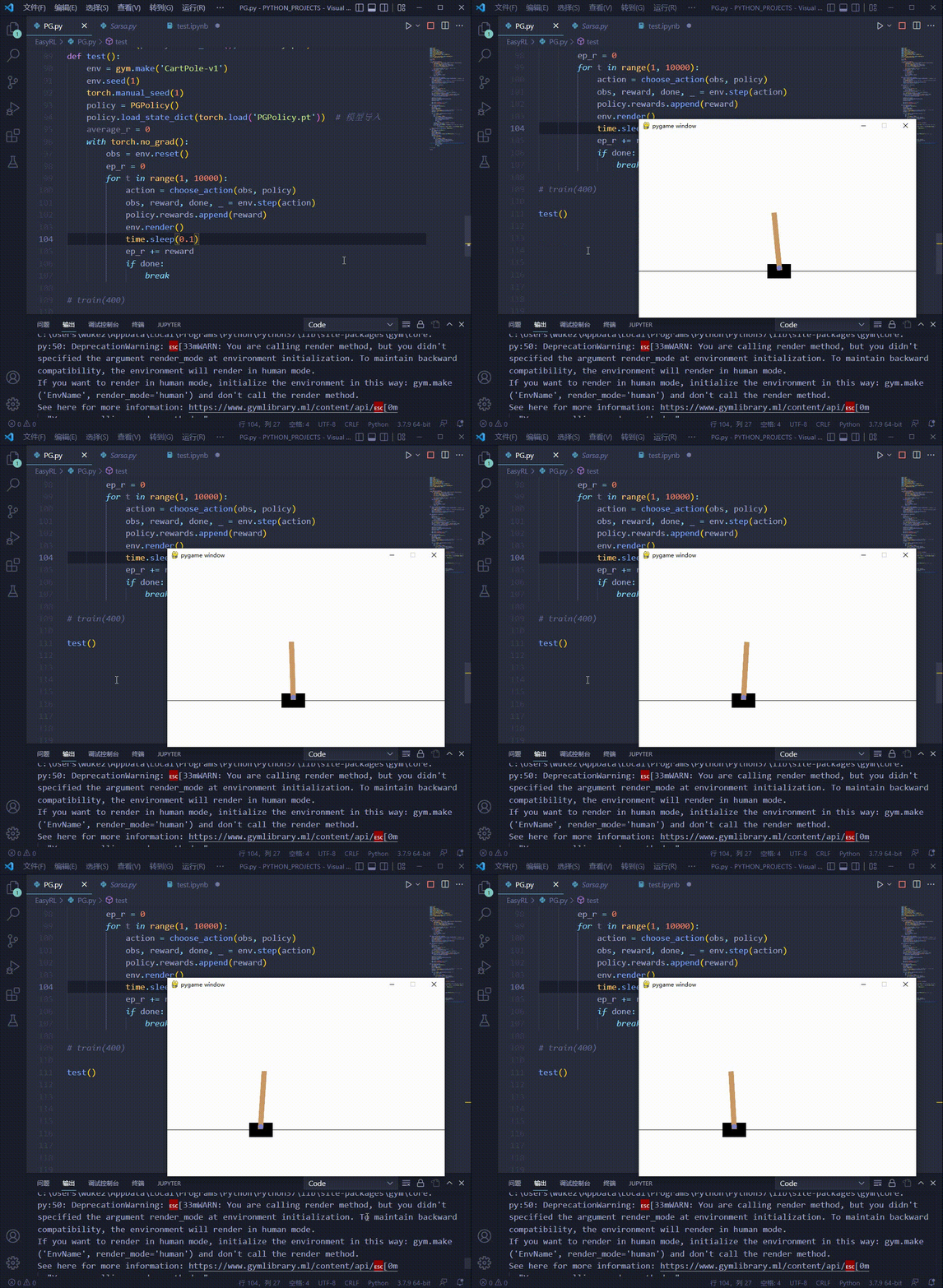
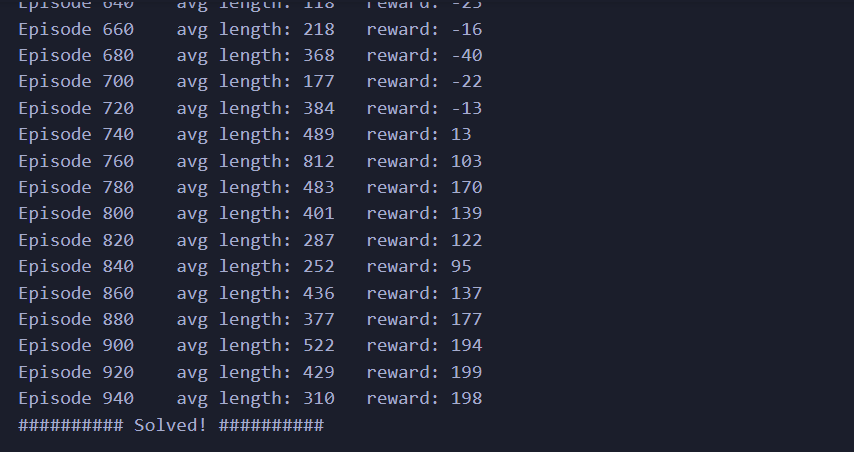
训练过程:
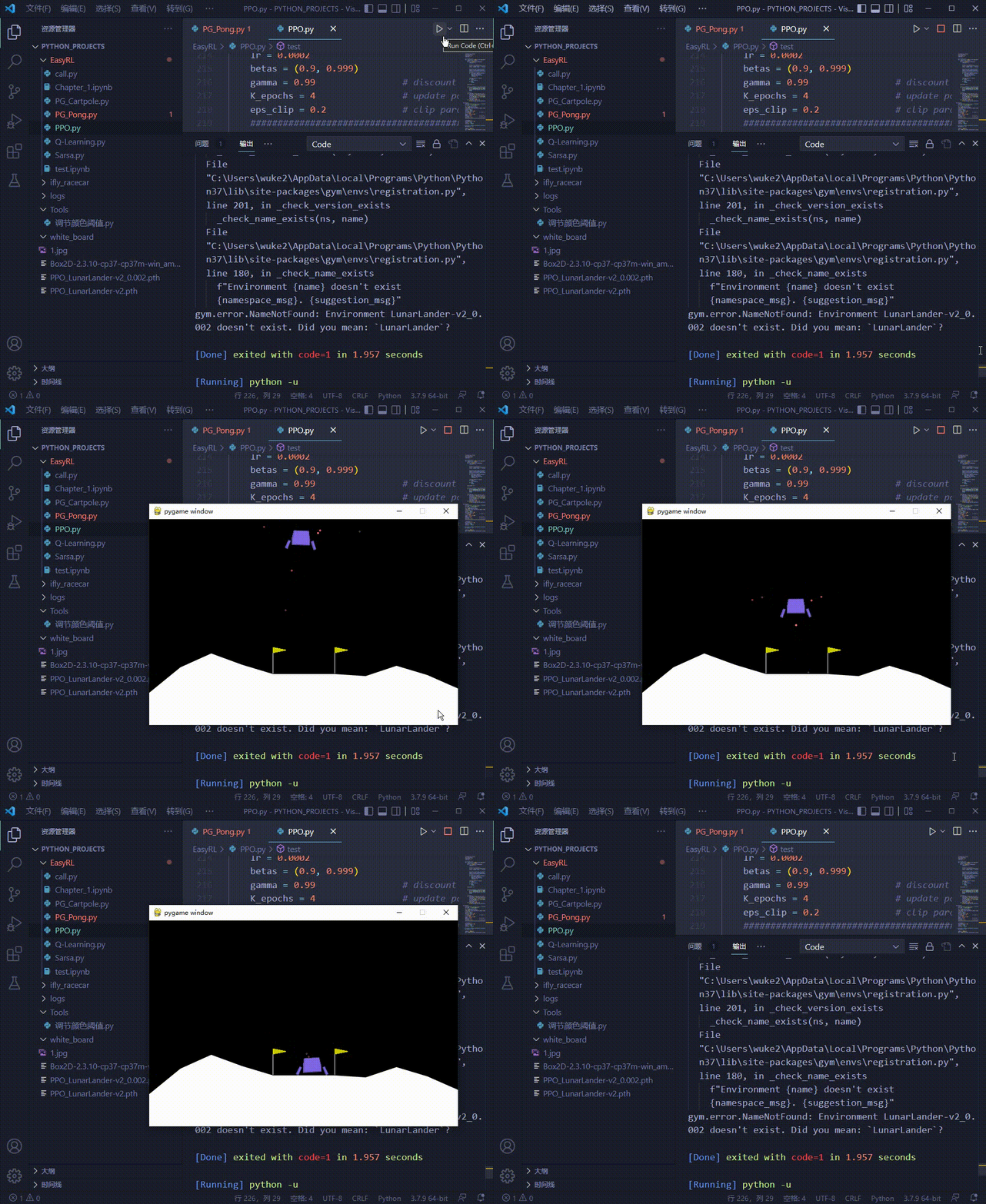
(该环境需要安装box2d)
https://www.gymlibrary.dev/environments/box2d/lunar_lander/?highlight=lunarlander
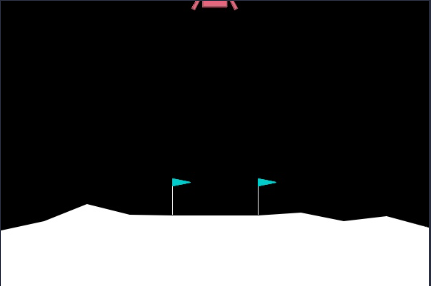
observation (1,8)
| Num | Observation |
|---|---|
| 0 | x |
| 1 | y |
| 2 | V x V_x Vx |
| 3 | V y V_y Vy |
| 4 | a n g l e angle angle |
| 5 | a n g u l a r v e l o c i t y angular \quad velocity angularvelocity |
| 6 | 左腿是否触地(bool) |
| 7 | 右腿是否触地(bool) |
action (1,4)
| Num | Action |
|---|---|
| 0 | 啥也不干 |
| 1 | 左侧点火 |
| 2 | 下面(主发动机)点火 |
| 3 | 右侧点火 |
reward
从屏幕顶部移动到着陆台的奖励约为100-140分。如果着陆器没降落到陆台,它将失去奖励。如果着陆器坠毁,它将获得额外的-100分。如果它成功降落,它将获得额外的+100分。接地的每个支腿为+10点。每架主机点火-0.3分。侧面发动机每帧点火-0.03分。解决的是200分。
终止条件
初始化策略函数的参数 θ 0 \theta_0 θ0, 初始化价值函数的参数 ϕ 0 \phi_0 ϕ0
for k = 0,1,2,…
基于 π ( θ k ) \pi(\theta_k) π(θk)来采集轨迹组 D k = τ k D_k={\tau_k} Dk=τk
计算 R t R_t Rt
计算 A t A_t At
更新策略: θ k + 1 = a r g m a x θ 1 ∣ D k ∣ T ∑ τ ∑ t m i n ( π θ ( a t ∣ s t ) π θ ′ ( a t ∣ s t ) A ( s t , a t ) , g ( ϵ , A ( s t , a t ) ) ) \theta_{k+1}=\underset{\theta}{argmax}\frac{1}{|D_k|T}\underset{\tau }{\sum}\underset{t }{\sum} min(\frac{\pi_\theta(a_t|s_t)}{\pi_{\theta^{'}}(a_t|s_t)}A(s_t,a_t),\quad g(\epsilon,A(s_t,a_t))) θk+1=θargmax∣Dk∣T1τ∑t∑min(πθ′(at∣st)πθ(at∣st)A(st,at),g(ϵ,A(st,at)))
更新价值函数: ϕ k + 1 = a r g m i n ϕ 1 ∣ D k ∣ T ∑ τ ∑ t ( V ( s t ) − R ) 2 \phi_{k+1}=\underset{\phi}{argmin}\frac{1}{|D_k|T}\underset{\tau }{\sum}\underset{t }{\sum} (V(s_t)-R)^2 ϕk+1=ϕargmin∣Dk∣T1τ∑t∑(V(st)−R)2
import torch
import torch.nn as nn
from torch.distributions import Categorical
import gym

device = 'cpu'

class Memory:
    def __init__(self):
        self.actions = []
        self.states = []
        self.logprobs = []
        self.rewards = []
        self.is_terminals = []
    def clear_memory(self):
        del self.actions[:]
        del self.states[:]
        del self.logprobs[:]
        del self.rewards[:]
        del self.is_terminals[:]

class ActorCritic(nn.Module):
    def __init__(self, state_dim, action_dim, n_latent_var):
        super(ActorCritic, self).__init__()
        # actor
        self.action_layer = nn.Sequential(
                                nn.Linear(state_dim, n_latent_var),
                                nn.Tanh(),
                                nn.Linear(n_latent_var, n_latent_var),
                                nn.Tanh(),
                                nn.Linear(n_latent_var, action_dim),
                                nn.Softmax(dim=-1)
                                )
        # critic
        self.value_layer = nn.Sequential(
                nn.Linear(state_dim, n_latent_var),
                nn.Tanh(),
                nn.Linear(n_latent_var, n_latent_var),
                nn.Tanh(),
                nn.Linear(n_latent_var, 1)
                )

    def forward(self):
        # 如果这个方法没有被子类重写,但是调用了,就会报错
        raise NotImplementedError
    def act(self, state, memory):
        state = torch.from_numpy(state).float().to(device)
        action_probs = self.action_layer(state)
        dist = Categorical(action_probs)
        action = dist.sample()

        memory.states.append(state)
        memory.actions.append(action)
        memory.logprobs.append(dist.log_prob(action))

        return action.item()

    def evaluate(self, state, action):
        action_probs = self.action_layer(state)
        dist = Categorical(action_probs)

        action_logprobs = dist.log_prob(action)
        dist_entropy = dist.entropy()

        state_value = self.value_layer(state)

        return action_logprobs, torch.squeeze(state_value), dist_entropy

class PPO:
    def __init__(self, state_dim, action_dim, n_latent_var, lr, betas, gamma, K_epochs, eps_clip):
        self.lr = lr
        self.betas = betas
        self.gamma = gamma
        self.eps_clip = eps_clip
        self.K_epochs = K_epochs

        self.policy = ActorCritic(state_dim, action_dim, n_latent_var).to(device)
        self.optimizer = torch.optim.Adam(self.policy.parameters(), lr=lr, betas=betas)
        self.policy_old = ActorCritic(state_dim, action_dim, n_latent_var).to(device)
        self.policy_old.load_state_dict(self.policy.state_dict())

        self.MseLoss = nn.MSELoss()

    def update(self, memory):
        # Monte Carlo estimate of state rewards:
        rewards = []
        discounted_reward = 0
        for reward, is_terminal in zip(reversed(memory.rewards), reversed(memory.is_terminals)):
            if is_terminal:
                discounted_reward = 0
            discounted_reward = reward + (self.gamma * discounted_reward)
            rewards.insert(0, discounted_reward)

        # Normalizing the rewards:
        rewards = torch.tensor(rewards).to(device).to(torch.float32)
        rewards = (rewards - rewards.mean()) / (rewards.std() + 1e-5)

        # convert list to tensor
        old_states = torch.stack(memory.states).to(device).detach().to(torch.float32)
        old_actions = torch.stack(memory.actions).to(device).detach().to(torch.float32)
        old_logprobs = torch.stack(memory.logprobs).to(device).detach().to(torch.float32)

        # Optimize policy for K epochs:
        for _ in range(self.K_epochs):
            # Evaluating old actions and values :
            logprobs, state_values, dist_entropy = self.policy.evaluate(old_states, old_actions)
            # Finding the ratio (pi_theta / pi_theta__old):
            ratios = torch.exp(logprobs - old_logprobs.detach())

            # Finding Surrogate Loss:
            advantages = rewards - state_values.detach()
            surr1 = ratios * advantages
            surr2 = torch.clamp(ratios, 1-self.eps_clip, 1+self.eps_clip) * advantages
            loss = -torch.min(surr1, surr2) + 0.5*self.MseLoss(state_values, rewards) - 0.01*dist_entropy
            loss =loss.to(torch.float32)
            # take gradient step
            self.optimizer.zero_grad()
            loss.mean().backward()
            self.optimizer.step()

        # Copy new weights into old policy:
        self.policy_old.load_state_dict(self.policy.state_dict())

def main():
    ############## Hyperparameters ##############
    env_name = 'LunarLander-v2'# "LunarLander-v2"
    # creating environment
    env = gym.make(env_name)
    env = env.unwrapped
    state_dim = env.observation_space.shape[0]
    action_dim =  4
    render = False
    solved_reward = 200         # stop training if avg_reward > solved_reward
    log_interval = 20           # print avg reward in the interval
    max_episodes = 5000        # max training episodes
    max_timesteps = 1000         # max timesteps in one episode
    n_latent_var = 64           # number of variables in hidden layer
    update_timestep = 2000      # update policy every n timesteps
    lr = 0.002
    betas = (0.9, 0.999)
    gamma = 0.99                # discount factor
    K_epochs = 4                # update policy using 1 trajectory for K epochs
    eps_clip = 0.2              # clip parameter for PPO
    random_seed = 123
    #############################################

    if random_seed:
        torch.manual_seed(random_seed)
        env.seed(random_seed)

    memory = Memory()
    ppo = PPO(state_dim, action_dim, n_latent_var, lr, betas, gamma, K_epochs, eps_clip)

    print(lr,betas)

    # logging variables
    running_reward = 0
    avg_length = 0
    timestep = 0

    # training loop
    for i_episode in range(1, max_episodes+1):
        state = env.reset()
        for t in range(max_timesteps):
            timestep += 1

            # Running policy_old:
            action = ppo.policy_old.act(state, memory)
            state, reward, done, _ = env.step(action)

            # Saving reward and is_terminal:
            memory.rewards.append(reward)
            memory.is_terminals.append(done)
            # update if its time
            if timestep % update_timestep == 0:
                ppo.update(memory)
                memory.clear_memory()
                timestep = 0

            running_reward += reward
            if render:
                env.render()
            if done:
                break

        avg_length += t

        # stop training if avg_reward > solved_reward
        if running_reward > (log_interval*solved_reward):
            print("########## Solved! ##########")
            torch.save(ppo.policy.state_dict(), './PPO_{}_{}.pth'.format(env_name,lr))
            break

        # logging
        if i_episode % log_interval == 0:
            avg_length = int(avg_length/log_interval)
            running_reward = int((running_reward/log_interval))
            print('Episode {} \t avg length: {} \t reward: {}'.format(i_episode, avg_length, running_reward))
            running_reward = 0
            avg_length = 0
        if i_episode % 2000 == 0:
            torch.save(ppo.policy.state_dict(), './PPO_{}_{}.pth'.format(env_name,lr))

def test():
    ############## Hyperparameters ##############
    env_name = "LunarLander-v2"
    # creating environment
    env = gym.make(env_name)
    state_dim = env.observation_space.shape[0]
    action_dim = 4
    render = False
    max_timesteps = 500
    n_latent_var = 64           # number of variables in hidden layer
    lr = 0.0002
    betas = (0.9, 0.999)
    gamma = 0.99                # discount factor
    K_epochs = 4                # update policy for K epochs
    eps_clip = 0.2              # clip parameter for PPO
    #############################################

    n_episodes = 3
    max_timesteps = 300
    render = True
    save_gif = False

    filename = "PPO_{}_0.002.pth".format(env_name)
    directory = "./"

    memory = Memory()
    ppo = PPO(state_dim, action_dim, n_latent_var, lr, betas, gamma, K_epochs, eps_clip)

    ppo.policy_old.load_state_dict(torch.load(directory+filename))

    for ep in range(1, n_episodes+1):
        ep_reward = 0
        state = env.reset()
        for t in range(max_timesteps):
            action = ppo.policy_old.act(state, memory)
            state, reward, done, _ = env.step(action)
            ep_reward += reward
            if render:
                env.render()
            if done:
                break

        print('Episode: {}\tReward: {}'.format(ep, int(ep_reward)))
        ep_reward = 0
        env.close()

if __name__ == '__main__':
    main()
    # test()
Breakout - Gym Documentation (gymlibrary.dev)
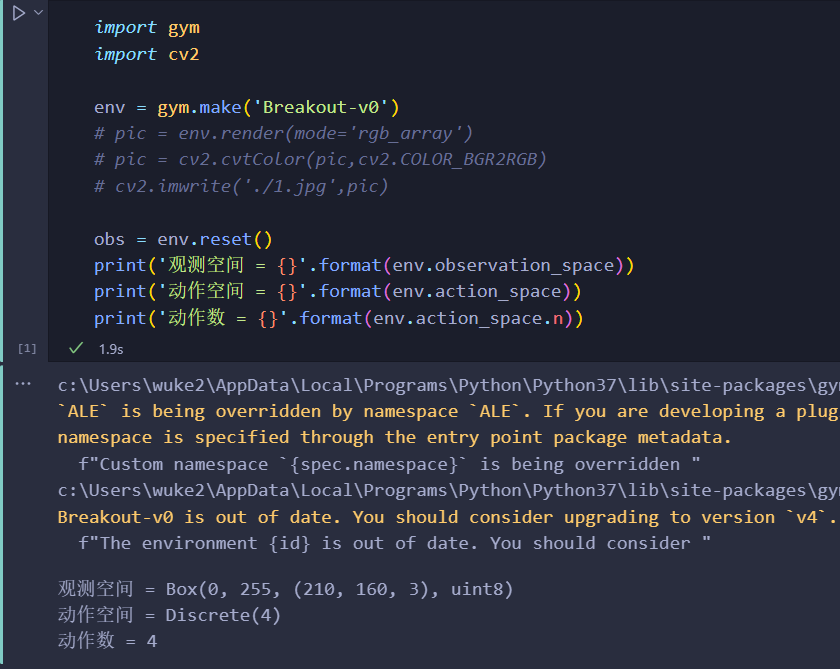
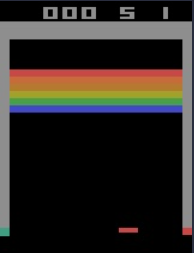
action (1,4)
| Num | Action |
|---|---|
| 0 | NOOP |
| 1 | FIRE |
| 2 | RIGHT |
| 3 | LEFT |
reward

(带有经验回放池的DQN)
初始化经验回放池 D D D(容量为 N N N)
随机初始化 动作-价值 函数 Q Q Q
for (each episode)
初始化序列 s 1 = [ x 1 ] s_1=[x_1] s1=[x1],预处理 ϕ 1 = ϕ ( s 1 ) \phi_1=\phi(s_1) ϕ1=ϕ(s1)
for (each step)
a t = m a x a Q ∗ ( ϕ ( s t ) , a : θ ) a_t=\underset{a}{max}Q^*(\phi(s_t),a:\theta) at=amaxQ∗(ϕ(st),a:θ) (概率=1- ϵ \epsilon ϵ)
执行 a t a_t at,得到 r t r_t rt和图片 x t + 1 x_{t+1} xt+1
s t + 1 = s t , ϕ t + 1 = ϕ ( s t + 1 ) s_{t+1}=s_t,\phi_{t+1}=\phi(s_{t+1}) st+1=st,ϕt+1=ϕ(st+1)
将 ( ϕ t , a t , r t , ϕ t + 1 ) (\phi_t,a_t,r_t,\phi_{t+1}) (ϕt,at,rt,ϕt+1)存储进 D D D
在 D D D中采样
y i = { r j ( t e r m i n a l ϕ j + 1 ) r j + γ m a x Q ( ϕ j + 1 , a ′ ; θ ) ( n o n − t e r m i n a l ϕ j + 1 ) y_i = \left\{\begin{matrix} r_j & (terminal\quad \phi_{j+1})\\ r_j +\gamma max Q( \phi_{j+1},a^{'}; \theta) & (non-terminal\quad \phi_{j+1}) \end{matrix}\right. yi={rjrj+γmaxQ(ϕj+1,a′;θ)(terminalϕj+1)(non−terminalϕj+1)
根据 ( y i − Q ( ϕ j , a j : θ ) ) 2 (y_i-Q(\phi_j,a_j:\theta))^2 (yi−Q(ϕj,aj:θ))2进行梯度下降
import gym
import cv2
import torch
import numpy as np
import torch.nn as nn
import pandas as pd
from torch.nn import Linear, Conv2d, ReLU
import PIL.Image as Image

device=torch.device("cuda:0" if torch.cuda.is_available() else"cpu")

# 经验池
class DQBReplayer:
    def __init__(self, capacity):
        # (S,A,R,S)
        self.memory = pd.DataFrame(index=range(capacity), columns=['observation', 'action', 'reward', 'next_observation', 'done'])
        self.i = 0
        self.count = 0
        self.capacity = capacity
    def store(self,*args):
        self.memory.loc[self.i] = args
        self.i = (self.i + 1)%self.capacity
        self.count = min(self.count+1, self.capacity)
    def sample(self, size):
        indics = np.random.choice(self.count, size=size)
        return (np.stack(self.memory.loc[indics,field]) for field in self.memory.columns)

# Q-Network
class DQN_net(nn.Module):
    def __init__(self):
        super(DQN_net, self).__init__()
        self.conv = nn.Sequential(
            Conv2d(in_channels=4, out_channels=32, kernel_size=8, stride=4),
            ReLU(),
            Conv2d(in_channels=32, out_channels=64, kernel_size=4, stride=2),
            ReLU(),
            Conv2d(in_channels=64, out_channels=64, kernel_size=3, stride=1),
            ReLU()
        )
        self.classifier = nn.Sequential(
            Linear(3136, 512),
            ReLU(),
            Linear(512, 4)
        )
    def forward(self, x):
        x = self.conv(x)
        x = x.view(x.size(0),-1)
        output = self.classifier(x)
        return output

class DQN(nn.Module):
    def __init__(self, input_shape, env):
        super(DQN, self).__init__()
        self.replayer_start_size = 100000
        self.upon_times = 20
        self.replayer = DQBReplayer(capacity=self.replayer_start_size)
        self.action_n = env.action_space.n
        self.image_stack = input_shape[2]
        self.gamma = 0.99
        self.image_shape = (input_shape[0], input_shape[1])
        self.e_net = DQN_net()
        self.t_net = DQN_net()

        self.learn_step = 0
        self.max_learn_step = 650000
        self.epsilon = 1.
        self.start_learn = False
    def get_next_state(self,state=None,observation=None):
        img=Image.fromarray(observation,"RGB")
        img=img.resize(self.image_shape).convert('L')
        img=np.asarray(img.getdata(),dtype=np.uint8,).reshape(img.size[1],img.size[0])
        if state is None:
            next_state = np.array([img,]*self.image_stack)
        else:
            next_state = np.append(state[1:],[img,],axis=0)
        return next_state
    def decide(self,state,step):
        if self.start_learn == False: #前50000步随机选择
            action = np.random.randint(0, 4)
            return action
        else:
            self.epsilon -= 0.0000053
        if step < 30:
            #每局前三十步随机选择,中间30万,
            #以一定概率(1-epsilon)通过神经网络选择,
            # 最后30万次以0.99概率通过神经网络选择
            action = np.random.randint(0, 4)
        elif np.random.random() < max(self.epsilon, 0.0005):
            action = np.random.randint(0,4)
        else:
            state = state/128 - 1
            y = torch.Tensor(state).float().unsqueeze(0)
            y = y.to(device)
            x = self.e_net(y).detach()
            if self.learn_step%2000==0:
                print("q value{}".format(x))
            action = torch.argmax(x).data.item()
        return action

def main():
    sum_reward = 0
    store_count = 0
    env = gym.make('Breakout-v0')
    net = DQN([84,84,4], env).cuda()

    Load_Net = 0
    if Load_Net==1:
        load_net_path = './epsiode_2575_reward_10.0.pkl'
        print("Load old net and the path is:",load_net_path)
        net.e_net = torch.load(load_net_path)
        net.t_net = torch.load(load_net_path)
    max_score = 0
    mse = nn.MSELoss()
    mse = mse.cuda()
    opt = torch.optim.RMSprop(net.e_net.parameters(), lr=0.0015)
    for i in range(20000):
        lives = 5
        obs = env.reset()
        state = net.get_next_state(None,obs)
        epoch_reward = 0
        if i%100==0:
            print("{} times_game".format(i),end=':')
            print('epoch_reward:{}'.format(epoch_reward))
        for step in range(500000):
            action = net.decide(state,step=step)
            obs, reward, done, _ = env.step(action)
            next_state = net.get_next_state(state, obs)
            epoch_reward += reward
            net.replayer.store(state, action, reward, next_state, done)
            net.learn_step += 1
            if net.learn_step >= net.replayer_start_size // 2 and net.learn_step % 4 == 0:
                if net.start_learn == False:
                    net.start_learn = True
                    print('Start Learn!')
                sample_n = 32
                states, actions, rewards, next_states, dones = net.replayer.sample(sample_n)
                states, next_states = states / 128 -1, next_states / 128 -1
                rewards = torch.Tensor(np.clip(rewards,-1,1)).unsqueeze(1).cuda()
                states, next_states = torch.Tensor(states).cuda(), torch.Tensor(next_states).cuda()
                actions = torch.Tensor(actions).long().unsqueeze(1).cuda()
                dones = torch.Tensor(dones).unsqueeze(1).cuda()
                q = net.e_net(states).gather(1, actions)
                q_next = net.t_net(next_states).detach().max(1)[0].reshape(sample_n, 1)
                tq = rewards + net.gamma * (1-done) * q_next
                loss = mse(q, tq)
                opt.zero_grad()
                loss.backward()
                opt.step()
                if net.learn_step % (net.upon_times * 5) == 0:
                    net.t_net.load_state_dict(net.e_net.state_dict())
                if net.learn_step % 100 == 0:
                    loss_record = loss.item()
                    a_r = torch.mean(rewards, 0).item()

            state = next_state

            if done:
                save_net_path = './'
                sum_reward+=epoch_reward
                if epoch_reward > max_score:
                    name = "epsiode_" + str(net.learn_step) + "_reward_" + str(epoch_reward) + ".pkl"
                    torch.save(net.e_net, save_net_path+name)
                    max_score = epoch_reward
                elif i % 1000 == 0:
                    name ="No."+str(i)+".pkl"
                    torch.save(net.e_net, save_net_path + name)
                if i%10==0:
                    sum_reward=0
                break

import cv2

def PictureArray2Video(pic_list, path='./test.mp4'):
    h,w,_ = pic_list[0].shape[0], pic_list[0].shape[1], pic_list[0].shape[2]
    print(h,w)
    writer = cv2.VideoWriter(path, cv2.VideoWriter_fourcc('m', 'p', '4', 'v'), 10, (w, h), True)
    total_frame = len(pic_list)
    for i in range(total_frame):
        writer.write(pic_list[i])
    writer.release()

def test():
    pics = []
    sum_reward = 0
    store_count = 0
    env = gym.make('Breakout-v0')
    net = DQN([84,84,4], env).cuda()

    Load_Net = 1
    if Load_Net==1:
        load_net_path = './epsiode_10219_reward_9.0.pkl'
        print("Load old net and the path is:",load_net_path)
        net.e_net = torch.load(load_net_path)
        net.t_net = torch.load(load_net_path)
    max_score = 0
    mse = nn.MSELoss()
    mse = mse.cuda()


    obs = env.reset()
    state = net.get_next_state(None,obs)
    epoch_reward = 0

    for step in range(500000):
        action = net.decide(state,step=step)
        obs, reward, done, _ = env.step(action)
        pic = env.render(mode='rgb_array')
        pic = cv2.cvtColor(pic,cv2.COLOR_BGR2RGB)
        next_state = net.get_next_state(state, obs)
        pics.append(pic)
        if done:
            PictureArray2Video(pics)
            break
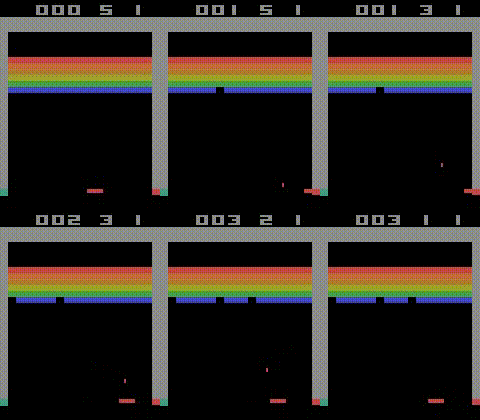
这个我感觉要训练好久,我训练了两个小时,reward=11,然后停下了。
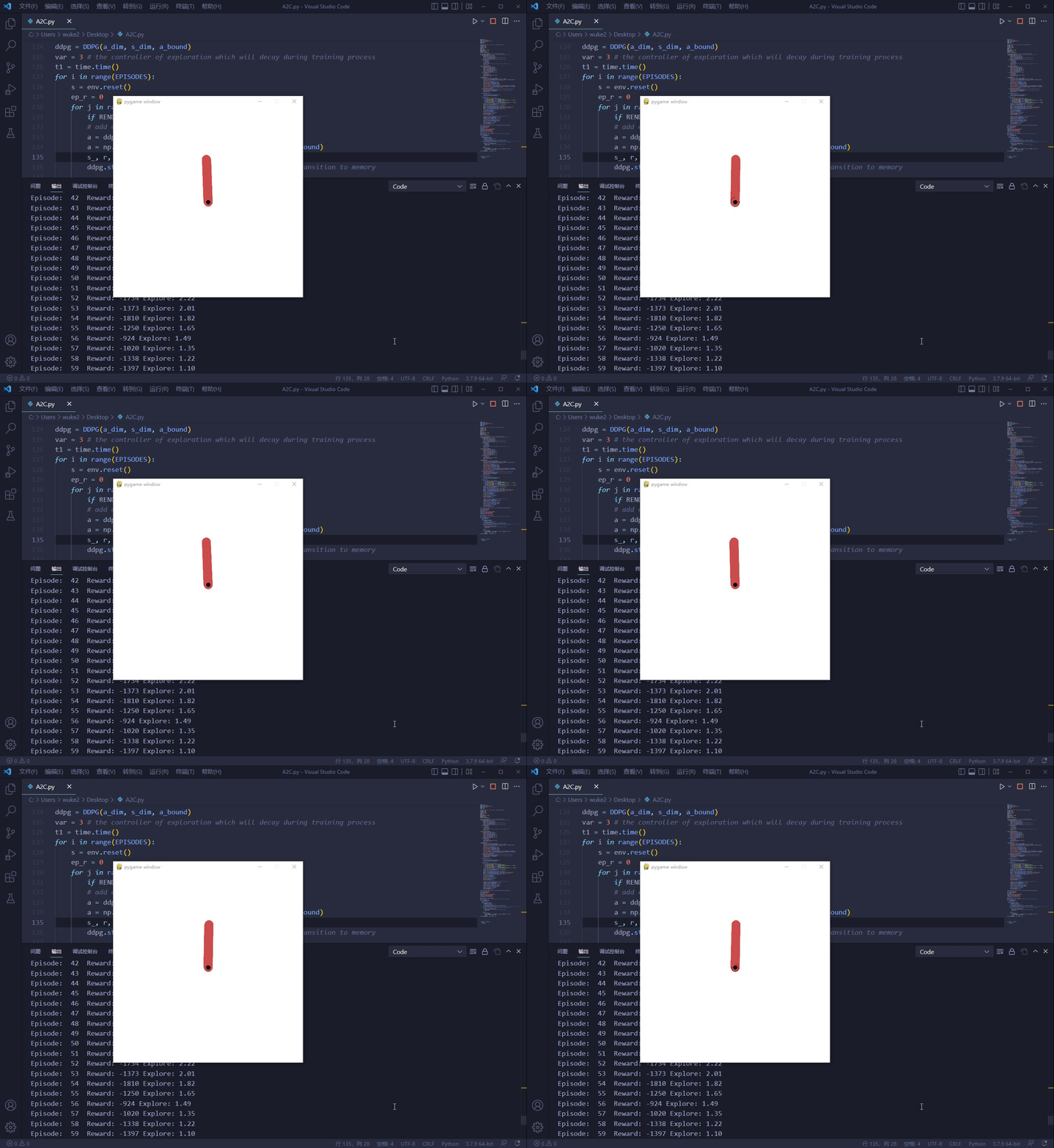
https://www.gymlibrary.dev/environments/classic_control/pendulum/?highlight=pendulum+v1
observation (1,3)
| Num | Observation | Min | Max |
|---|---|---|---|
| 0 | cos(theta) | -1 | 1 |
| 1 | sin(angle) | -1 | 1 |
| 2 | 角速度 | -8.0 | 8.0 |
action (1,)
力矩,大小在(-2,2)之前的值
奖励
r = − ( θ 2 + 0.1 × ω 2 + 0.001 × 力 矩 2 ) r = -(\theta^2 + 0.1×\omega^2 + 0.001×力矩^2) r=−(θ2+0.1×ω2+0.001×力矩2)
随机初始化 评论员 Q ( s , a ∣ θ Q ) Q(s,a|\theta^Q) Q(s,a∣θQ)和 演员 μ ( s ∣ θ μ ) \mu(s|\theta^\mu) μ(s∣θμ)
初始化目标策略价值网络 Q ′ Q{'} Q′和 θ ′ \theta^{'} θ′,
θ Q ′ = θ Q , θ μ ′ = θ μ \theta^{Q^{'}}=\theta^Q,\theta^{\mu^{'}}=\theta^\mu θQ′=θQ,θμ′=θμ
初始化经验回放池Rfor (each episode)
for (each step)
a t = μ ( s t ∣ θ μ ) a_t=\mu(s_t|\theta^{\mu}) at=μ(st∣θμ)
s t + 1 , r t , d o n e , = e n v . s t e p ( a t ) s_{t+1},r_t,done,_ = env.step(a_t) st+1,rt,done,=env.step(at)
将 ( s t , a t , r t , s t + 1 ) (s_t,a_t,r_t,s_{t+1}) (st,at,rt,st+1)存储进R
从R中采样N条轨迹 ( s i , a i , r i , s i + 1 ) (s_i,a_i,r_i,s_{i+1}) (si,ai,ri,si+1)
y i = r i + γ Q ′ ( s i + 1 , μ ′ ( s i + 1 ∣ θ Q ′ ) ∣ θ Q ′ ) y_i = r_i + \gamma Q^{'}(s_{i+1},\mu^{'}(s_{i+1}|\theta^{Q^{'}})|\theta^{Q^{'}}) yi=ri+γQ′(si+1,μ′(si+1∣θQ′)∣θQ′)
L o s s = 1 N Σ ( y i − Q ( s i , a i ∣ θ Q ) ) 2 Loss = \frac{1}{N}\Sigma(y_i-Q(s_i,a_i|\theta^{Q}))^2 Loss=N1Σ(yi−Q(si,ai∣θQ))2, 更新评论员网络
▽ θ μ J = 1 N Σ ▽ a Q ( s , a ∣ θ Q ) ∣ s = s i , a = μ ( s i ) ▽ θ μ μ ( s ∣ θ μ ) ∣ ) s i \bigtriangledown _{\theta^\mu}J = \frac{1}{N}\Sigma \bigtriangledown_a Q(s,a|\theta^Q)|_{s=s_i,a=\mu(s_i)}\bigtriangledown_{\theta^\mu} \mu(s|\theta^\mu)|)_{s_i} ▽θμJ=N1Σ▽aQ(s,a∣θQ)∣s=si,a=μ(si)▽θμμ(s∣θμ)∣)si
更新目标网络:
θ Q ′ = τ θ Q + ( 1 − τ ) θ Q ′ \theta^{Q^{'}} = \tau \theta^Q + (1-\tau)\theta^{Q^{'}} θQ′=τθQ+(1−τ)θQ′
θ μ ′ = τ θ μ + ( 1 − τ ) θ μ ′ \theta^{\mu^{'}} = \tau \theta^\mu + (1-\tau)\theta^{\mu^{'}} θμ′=τθμ+(1−τ)θμ′
import torch
import torch.nn as nn
import torch.nn.functional as F
import numpy as np
import gym
import time

#####################  hyper parameters  ####################
EPISODES = 200
EP_STEPS = 200
LR_ACTOR = 0.001
LR_CRITIC = 0.002
GAMMA = 0.9
TAU = 0.01
MEMORY_CAPACITY = 10000
BATCH_SIZE = 32
RENDER = False
ENV_NAME = 'Pendulum-v1'

########################## DDPG Framework ######################
class ActorNet(nn.Module): # define the network structure for actor and critic
    def __init__(self, s_dim, a_dim):
        super(ActorNet, self).__init__()
        self.fc1 = nn.Linear(s_dim, 30)
        self.fc1.weight.data.normal_(0, 0.1) # initialization of FC1
        self.out = nn.Linear(30, a_dim)
        self.out.weight.data.normal_(0, 0.1) # initilizaiton of OUT
    def forward(self, x):
        x = self.fc1(x)
        x = F.relu(x)
        x = self.out(x)
        x = torch.tanh(x)
        actions = x * 2 # for the game "Pendulum-v0", action range is [-2, 2]
        return actions

class CriticNet(nn.Module):
    def __init__(self, s_dim, a_dim):
        super(CriticNet, self).__init__()
        self.fcs = nn.Linear(s_dim, 30)
        self.fcs.weight.data.normal_(0, 0.1)
        self.fca = nn.Linear(a_dim, 30)
        self.fca.weight.data.normal_(0, 0.1)
        self.out = nn.Linear(30, 1)
        self.out.weight.data.normal_(0, 0.1)
    def forward(self, s, a):
        x = self.fcs(s)
        y = self.fca(a)
        actions_value = self.out(F.relu(x+y))
        return actions_value

class DDPG(object):
    def __init__(self, a_dim, s_dim, a_bound):
        self.a_dim, self.s_dim, self.a_bound = a_dim, s_dim, a_bound
        self.memory = np.zeros((MEMORY_CAPACITY, s_dim * 2 + a_dim + 1), dtype=np.float32)
        self.pointer = 0 # serves as updating the memory data
        # Create the 4 network objects
        self.actor_eval = ActorNet(s_dim, a_dim)
        self.actor_target = ActorNet(s_dim, a_dim)
        self.critic_eval = CriticNet(s_dim, a_dim)
        self.critic_target = CriticNet(s_dim, a_dim)
        # create 2 optimizers for actor and critic
        self.actor_optimizer = torch.optim.Adam(self.actor_eval.parameters(), lr=LR_ACTOR)
        self.critic_optimizer = torch.optim.Adam(self.critic_eval.parameters(), lr=LR_CRITIC)
        # Define the loss function for critic network update
        self.loss_func = nn.MSELoss()
    def store_transition(self, s, a, r, s_): # how to store the episodic data to buffer
        transition = np.hstack((s, a, [r], s_))
        index = self.pointer % MEMORY_CAPACITY # replace the old data with new data
        self.memory[index, :] = transition
        self.pointer += 1

    def choose_action(self, s):
        # print(s)
        s = torch.unsqueeze(torch.FloatTensor(s), 0)
        return self.actor_eval(s)[0].detach()

    def learn(self):
        # softly update the target networks
        for x in self.actor_target.state_dict().keys():
            eval('self.actor_target.' + x + '.data.mul_((1-TAU))')
            eval('self.actor_target.' + x + '.data.add_(TAU*self.actor_eval.' + x + '.data)')
        for x in self.critic_target.state_dict().keys():
            eval('self.critic_target.' + x + '.data.mul_((1-TAU))')
            eval('self.critic_target.' + x + '.data.add_(TAU*self.critic_eval.' + x + '.data)')
        # sample from buffer a mini-batch data
        indices = np.random.choice(MEMORY_CAPACITY, size=BATCH_SIZE)
        batch_trans = self.memory[indices, :]
        # extract data from mini-batch of transitions including s, a, r, s_
        batch_s = torch.FloatTensor(batch_trans[:, :self.s_dim])
        batch_a = torch.FloatTensor(batch_trans[:, self.s_dim:self.s_dim + self.a_dim])
        batch_r = torch.FloatTensor(batch_trans[:, -self.s_dim - 1: -self.s_dim])
        batch_s_ = torch.FloatTensor(batch_trans[:, -self.s_dim:])
        # make action and evaluate its action values
        a = self.actor_eval(batch_s)
        q = self.critic_eval(batch_s, a)
        actor_loss = -torch.mean(q)
        # optimize the loss of actor network
        self.actor_optimizer.zero_grad()
        actor_loss.backward()
        self.actor_optimizer.step()

        # compute the target Q value using the information of next state
        a_target = self.actor_target(batch_s_)
        q_tmp = self.critic_target(batch_s_, a_target)
        q_target = batch_r + GAMMA * q_tmp
        # compute the current q value and the loss
        q_eval = self.critic_eval(batch_s, batch_a)
        td_error = self.loss_func(q_target, q_eval)
        # optimize the loss of critic network
        self.critic_optimizer.zero_grad()
        td_error.backward()
        self.critic_optimizer.step()

############################### Training ######################################
# Define the env in gym
env = gym.make(ENV_NAME)
env = env.unwrapped
env.seed(1)
s_dim = env.observation_space.shape[0]
a_dim = env.action_space.shape[0]
a_bound = env.action_space.high
a_low_bound = env.action_space.low

ddpg = DDPG(a_dim, s_dim, a_bound)
var = 3 # the controller of exploration which will decay during training process
t1 = time.time()
for i in range(EPISODES):
    s = env.reset()
    ep_r = 0
    for j in range(EP_STEPS):
        if RENDER: env.render()
        # add explorative noise to action
        a = ddpg.choose_action(s)
        a = np.clip(np.random.normal(a, var), a_low_bound, a_bound)
        s_, r, done, info, _ = env.step(a)
        ddpg.store_transition(s, a, r / 10, s_) # store the transition to memory

        if ddpg.pointer > MEMORY_CAPACITY:
            var *= 0.9995 # decay the exploration controller factor
            ddpg.learn()

        s = s_
        ep_r += r
        if j == EP_STEPS - 1:
            print('Episode: ', i, ' Reward: %i' % (ep_r), 'Explore: %.2f' % var)
            if ep_r > -300 : RENDER = True
            break
print('Running time: ', time.time() - t1)


if __name__ == "__main__":
    learn()
    env.close()
如何在buildr项目中使用Ruby?我在很多不同的项目中使用过Ruby、JRuby、Java和Clojure。我目前正在使用我的标准Ruby开发一个模拟应用程序,我想尝试使用Clojure后端(我确实喜欢功能代码)以及JRubygui和测试套件。我还可以看到在未来的不同项目中使用Scala作为后端。我想我要为我的项目尝试一下buildr(http://buildr.apache.org/),但我注意到buildr似乎没有设置为在项目中使用JRuby代码本身!这看起来有点傻,因为该工具旨在统一通用的JVM语言并且是在ruby中构建的。除了将输出的jar包含在一个独特的、仅限ruby
在rails源中:https://github.com/rails/rails/blob/master/activesupport/lib/active_support/lazy_load_hooks.rb可以看到以下内容@load_hooks=Hash.new{|h,k|h[k]=[]}在IRB中,它只是初始化一个空哈希。和做有什么区别@load_hooks=Hash.new 最佳答案 查看rubydocumentationforHashnew→new_hashclicktotogglesourcenew(obj)→new_has
我的主要目标是能够完全理解我正在使用的库/gem。我尝试在Github上从头到尾阅读源代码,但这真的很难。我认为更有趣、更温和的踏脚石就是在使用时阅读每个库/gem方法的源代码。例如,我想知道RubyonRails中的redirect_to方法是如何工作的:如何查找redirect_to方法的源代码?我知道在pry中我可以执行类似show-methodmethod的操作,但我如何才能对Rails框架中的方法执行此操作?您对我如何更好地理解Gem及其API有什么建议吗?仅仅阅读源代码似乎真的很难,尤其是对于框架。谢谢! 最佳答案 Ru
我的假设是moduleAmoduleBendend和moduleA::Bend是一样的。我能够从thisblog找到解决方案,thisSOthread和andthisSOthread.为什么以及什么时候应该更喜欢紧凑语法A::B而不是另一个,因为它显然有一个缺点?我有一种直觉,它可能与性能有关,因为在更多命名空间中查找常量需要更多计算。但是我无法通过对普通类进行基准测试来验证这一点。 最佳答案 这两种写作方法经常被混淆。首先要说的是,据我所知,没有可衡量的性能差异。(在下面的书面示例中不断查找)最明显的区别,可能也是最著名的,是你的
几个月前,我读了一篇关于rubygem的博客文章,它可以通过阅读代码本身来确定编程语言。对于我的生活,我不记得博客或gem的名称。谷歌搜索“ruby编程语言猜测”及其变体也无济于事。有人碰巧知道相关gem的名称吗? 最佳答案 是这个吗:http://github.com/chrislo/sourceclassifier/tree/master 关于ruby-寻找通过阅读代码确定编程语言的rubygem?,我们在StackOverflow上找到一个类似的问题:
我目前正在使用以下方法获取页面的源代码:Net::HTTP.get(URI.parse(page.url))我还想获取HTTP状态,而无需发出第二个请求。有没有办法用另一种方法做到这一点?我一直在查看文档,但似乎找不到我要找的东西。 最佳答案 在我看来,除非您需要一些真正的低级访问或控制,否则最好使用Ruby的内置Open::URI模块:require'open-uri'io=open('http://www.example.org/')#=>#body=io.read[0,50]#=>"["200","OK"]io.base_ur
前言作为一名程序员,自己的本质工作就是做程序开发,那么程序开发的时候最直接的体现就是代码,检验一个程序员技术水平的一个核心环节就是开发时候的代码能力。众所周知,程序开发的水平提升是一个循序渐进的过程,每一位程序员都是从“菜鸟”变成“大神”的,所以程序员在程序开发过程中的代码能力也是根据平时开发中的业务实践来积累和提升的。提高代码能力核心要素程序员要想提高自身代码能力,尤其是新晋程序员的代码能力有很大的提升空间的时候,需要针对性的去提高自己的代码能力。提高代码能力其实有几个比较关键的点,只要把握住这些方面,就能很好的、快速的提高自己的一部分代码能力。1、多去阅读开源项目,如有机会可以亲自参与开源
目录一.加解密算法数字签名对称加密DES(DataEncryptionStandard)3DES(TripleDES)AES(AdvancedEncryptionStandard)RSA加密法DSA(DigitalSignatureAlgorithm)ECC(EllipticCurvesCryptography)非对称加密签名与加密过程非对称加密的应用对称加密与非对称加密的结合二.数字证书图解一.加解密算法加密简单而言就是通过一种算法将明文信息转换成密文信息,信息的的接收方能够通过密钥对密文信息进行解密获得明文信息的过程。根据加解密的密钥是否相同,算法可以分为对称加密、非对称加密、对称加密和非
嗨~大家好,这里是可莉!今天给大家带来的是7个C语言的经典基础代码~那一起往下看下去把【程序一】打印100到200之间的素数#includeintmain(){ inti; for(i=100;i 【程序二】输出乘法口诀表#includeintmain(){inti;for(i=1;i 【程序三】判断1000年---2000年之间的闰年#includeintmain(){intyear;for(year=1000;year 【程序四】给定两个整形变量的值,将两个值的内容进行交换。这里提供两种方法来进行交换,第一种为创建临时变量来进行交换,第二种是不创建临时变量而直接进行交换。1.创建临时变量来
1.postman介绍Postman一款非常流行的API调试工具。其实,开发人员用的更多。因为测试人员做接口测试会有更多选择,例如Jmeter、soapUI等。不过,对于开发过程中去调试接口,Postman确实足够的简单方便,而且功能强大。2.下载安装官网地址:https://www.postman.com/下载完成后双击安装吧,安装过程极其简单,无需任何操作3.使用教程这里以百度为例,工具使用简单,填写URL地址即可发送请求,在下方查看响应结果和响应状态码常用方法都有支持请求方法:getpostputdeleteGet、Post、Put与Delete的作用get:请求方法一般是用于数据查询,
