课程:学堂在线的清华训练营《驭风计划:培养人工智能青年人才》(满分作业)
paper:《Show, Attend and Tell Neural Image Caption Generation with Visual Attention》
需要的理论知识:LSTM BLEU Resnet-101 COCO数据集 Attention beam算法
理论知识也可以参考博客:
Monte Carlo
《Show, Attend and Tell: Neural Image Caption Generation with Visual Attention》论文阅读(详细
《Show and Tell: A Neural Image Caption Generator》论文解读
conda create --prefix=/home/aistudio/external-libraries/caption python=3.6 -y

conda init bash

conda activate /home/aistudio/external-libraries/caption

conda install pytorch=0.4.1 cuda92 -c https://mirrors.tuna.tsinghua.edu.cn/anaconda/cloud/pytorch/linux-64/ -y


pip install torchvision==0.2.2 numpy nltk tqdm h5py pillow matplotlib scikit-image scipy==1.1.0 -i https://pypi.tuna.tsinghua.edu.cn/simple

python train.py > train_att.log

python caption.py --img '/home/aistudio/data/data124850/test2014/COCO_test2014_000000090228.jpg' --model '../code/BEST_checkpoint_coco_5_cap_per_img_5_min_word_freq.pth.tar' --word_map '/home/aistudio/data/data124851/WORDMAP_coco_5_cap_per_img_5_min_word_freq.json'
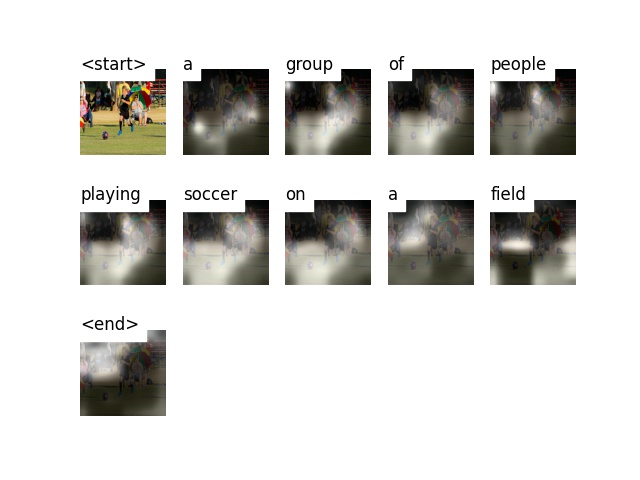
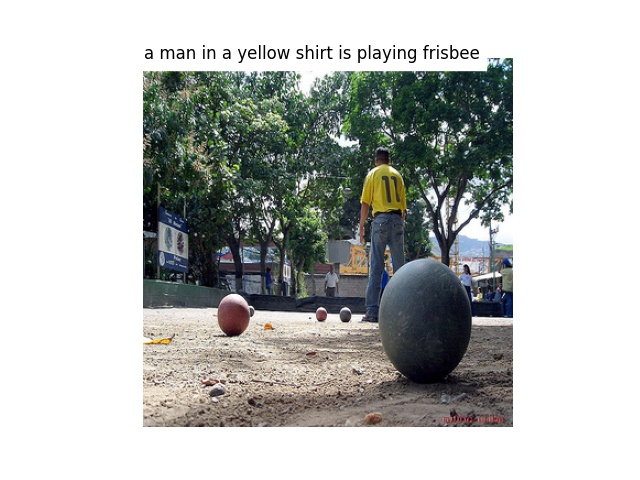
图中的白色亮光是指注意力,很明显,可以看到对于清晰和明显的图片这个模型还是有较好的效果,注意力也能关注到图片中的重要部分,而且注意力是随着词的变化而改变位置的,例如第2张图,当词是a laptop的时候,注意力正好关注电脑;当词是wooden desk的时候,注意力正好关注着桌子。


import torch
from torch import nn
import torchvision

device = torch.device("cuda" if torch.cuda.is_available() else "cpu")


class Encoder(nn.Module):
    """
    Encoder
    """

    def __init__(self, encoded_image_size=14):
        super(Encoder, self).__init__()
        self.enc_image_size = encoded_image_size

        # Pretrained ImageNet ResNet-101
        # Remove linear and pool layers
        resnet = torchvision.models.resnet101(pretrained=True)
        modules = list(resnet.children())[:-2]
        self.resnet = nn.Sequential(*modules)

        # Resize image to fixed size to allow input images of variable size
        self.adaptive_pool = nn.AdaptiveAvgPool2d((encoded_image_size, encoded_image_size))

        self.fine_tune(fine_tune=True)

    def forward(self, images):
        """
        Forward propagation.
        :param images: images, a tensor of dimensions (batch_size, 3, image_size, image_size)
        :return: encoded images
        """
        out = self.resnet(images)  # (batch_size, 2048, image_size/32, image_size/32)
        out = self.adaptive_pool(out)  # (batch_size, 2048, encoded_image_size, encoded_image_size)
        out = out.permute(0, 2, 3, 1)  # (batch_size, encoded_image_size, encoded_image_size, 2048)
        return out

    def fine_tune(self, fine_tune=True):
        """
        Allow or prevent the computation of gradients for convolutional blocks 2 through 4 of the encoder.
        :param fine_tune: boolean
        """
        for p in self.resnet.parameters():
            p.requires_grad = False
        # If fine-tuning, only fine-tune convolutional blocks 2 through 4
        for c in list(self.resnet.children())[5:]:
            for p in c.parameters():
                p.requires_grad = fine_tune

class Attention(nn.Module):
    """
    Attention Network.
    """

    def __init__(self, encoder_dim, decoder_dim, attention_dim):
        """
        :param encoder_dim: feature size of encoded images
        :param decoder_dim: size of decoder's RNN
        :param attention_dim: size of the attention network
        """
        super(Attention, self).__init__()
        self.encoder_att = nn.Linear(encoder_dim, attention_dim)  # linear layer to transform encoded image
        self.decoder_att = nn.Linear(decoder_dim, attention_dim)  # linear layer to transform decoder's output
        self.full_att = nn.Linear(attention_dim, 1)  # linear layer to calculate values to be softmax-ed
        self.relu = nn.ReLU()
        self.softmax = nn.Softmax(dim=1)  # softmax layer to calculate weights
    def forward(self, encoder_out, decoder_hidden):
        """
        Forward pass.
        :param encoder_out: encoded images, a tensor of dimension (batch_size, num_pixels, encoder_dim)
        :param decoder_hidden: previous decoder output, a tensor of dimension (batch_size, decoder_dim)
        :return: attention weighted encoding, weights
        """

        att1 = self.encoder_att(encoder_out)  # (batch_size, num_pixels, attention_dim)
        att2 = self.decoder_att(decoder_hidden)  # (batch_size, attention_dim)
        att = self.full_att(self.relu(att1 + att2.unsqueeze(1))).squeeze(2)  # (batch_size, num_pixels)
        alpha = self.softmax(att)  # (batch_size, num_pixels)
        z = (encoder_out * alpha.unsqueeze(2)).sum(dim=1)  # (batch_size, encoder_dim)
        return z, alpha


class DecoderWithAttention(nn.Module):
    """
    Decoder.
    """

    def __init__(self, cfg, encoder_dim=2048):
        """
        :param attention_dim: size of attention network
        :param embed_dim: embedding size
        :param decoder_dim: size of decoder's RNN
        :param vocab_size: size of vocabulary
        :param encoder_dim: feature size of encoded images
        :param dropout: dropout
        """
        super(DecoderWithAttention, self).__init__()

        self.encoder_dim = encoder_dim
        self.decoder_dim = cfg['decoder_dim']
        self.attention_dim = cfg['attention_dim']
        self.embed_dim = cfg['embed_dim']
        self.vocab_size = cfg['vocab_size']
        self.dropout = cfg['dropout']
        self.device = cfg['device']

        self.attention = Attention(encoder_dim, self.decoder_dim, self.attention_dim)  # attention network

        self.embedding = nn.Embedding(self.vocab_size, self.embed_dim)  # embedding layer
        self.dropout = nn.Dropout(0.1)
        self.decode_step = nn.LSTMCell(self.embed_dim + encoder_dim, self.decoder_dim, bias=True)  # decoding LSTMCell
        self.init_h = nn.Linear(encoder_dim, self.decoder_dim)  # linear layer to find initial hidden state of LSTMCell
        self.init_c = nn.Linear(encoder_dim, self.decoder_dim)  # linear layer to find initial cell state of LSTMCell
        self.f_beta = nn.Linear(self.decoder_dim, encoder_dim)  # linear layer to create a sigmoid-activated gate
        self.sigmoid = nn.Sigmoid()
        self.fc = nn.Linear(self.decoder_dim, self.vocab_size)  # linear layer to find scores over vocabulary
        self.init_weights()  # initialize some layers with the uniform distribution

        # initialize some layers with the uniform distribution
        self.embedding.weight.data.uniform_(-0.1, 0.1)
        self.fc.bias.data.fill_(0)
        self.fc.weight.data.uniform_(-0.1, 0.1)

    def load_pretrained_embeddings(self, embeddings):
        """
        Loads embedding layer with pre-trained embeddings.
        :param embeddings: pre-trained embeddings
        """
        self.embedding.weight = nn.Parameter(embeddings)

    def fine_tune_embeddings(self, fine_tune=True):
        """
        Allow fine-tuning of embedding layer? (Only makes sense to not-allow if using pre-trained embeddings).
        :param fine_tune: Allow?
        """
        for p in self.embedding.parameters():
            p.requires_grad = fine_tune

    def init_weights(self):
        """
        Initializes some parameters with values from the uniform distribution, for easier convergence.
        """
        self.embedding.weight.data.uniform_(-0.1, 0.1)
        self.fc.bias.data.fill_(0)
        self.fc.weight.data.uniform_(-0.1, 0.1)

    def forward(self, encoder_out, encoded_captions, caption_lengths):
        """
        Forward propagation.

        :param encoder_out: encoded images, a tensor of dimension (batch_size, enc_image_size, enc_image_size, encoder_dim)
        :param encoded_captions: encoded captions, a tensor of dimension (batch_size, max_caption_length)
        :param caption_lengths: caption lengths, a tensor of dimension (batch_size, 1)
        :return: scores for vocabulary, sorted encoded captions, decode lengths, weights, sort indices
        """

        batch_size = encoder_out.size(0)
        encoder_dim = encoder_out.size(-1)
        vocab_size = self.vocab_size

        # Flatten image
        encoder_out = encoder_out.view(batch_size, -1, encoder_dim)  # (batch_size, num_pixels, encoder_dim)
        num_pixels = encoder_out.size(1)

        # Sort input data by decreasing lengths;
        caption_lengths, sort_ind = caption_lengths.squeeze(1).sort(dim=0, descending=True)
        encoder_out = encoder_out[sort_ind]
        encoded_captions = encoded_captions[sort_ind]

        # Embedding
        embeddings = self.embedding(encoded_captions)  # (batch_size, max_caption_length, embed_dim)

        # We won't decode at the <end> position, since we've finished generating as soon as we generate <end>
        # So, decoding lengths are actual lengths - 1
        decode_lengths = (caption_lengths - 1).tolist()

        # Create tensors to hold word predicion scores and alphas
        predictions = torch.zeros(batch_size, max(decode_lengths), vocab_size).to(self.device)
        alphas = torch.zeros(batch_size, max(decode_lengths), num_pixels).to(self.device)

        # Initialize LSTM state
        mean_encoder_out = encoder_out.mean(dim=1)
        h = self.init_h(mean_encoder_out)  # (batch_size, decoder_dim)
        c = self.init_c(mean_encoder_out)

        for t in range(max(decode_lengths)):
            batch_size_t = sum([l > t for l in decode_lengths])
            preds, alpha, h, c = self.one_step(t, batch_size_t, embeddings, encoder_out, h, c)
            predictions[:batch_size_t, t, :] = preds
            alphas[:batch_size_t, t, :] = alpha

        return predictions, encoded_captions, decode_lengths, alphas, sort_ind

    def one_step(self, t, batch_size_t, embeddings, encoder_out, h, c):
        """

        :param t:
        :param batch_size_t:
        :param embeddings:
        :param encoder_out:
        :param h:
        :param c:
        :return:
        """

        attention_weighted_encoding, alpha = self.attention(encoder_out[:batch_size_t],
                                                            h[:batch_size_t])
        gate = self.sigmoid(self.f_beta(h[:batch_size_t]))  # gating scalar, (batch_size_t, encoder_dim)
        attention_weighted_encoding = gate * attention_weighted_encoding
        h, c = self.decode_step(
            torch.cat([embeddings[:batch_size_t, t, :], attention_weighted_encoding], dim=1),
            (h[:batch_size_t], c[:batch_size_t]))  # (batch_size_t, decoder_dim)
        preds = self.fc(self.dropout(h))  # (batch_size_t, vocab_size)
        return preds, alpha, h, c
我有一个Ruby程序,它使用rubyzip压缩XML文件的目录树。gem。我的问题是文件开始变得很重,我想提高压缩级别,因为压缩时间不是问题。我在rubyzipdocumentation中找不到一种为创建的ZIP文件指定压缩级别的方法。有人知道如何更改此设置吗?是否有另一个允许指定压缩级别的Ruby库? 最佳答案 这是我通过查看rubyzip内部创建的代码。level=Zlib::BEST_COMPRESSIONZip::ZipOutputStream.open(zip_file)do|zip|Dir.glob("**/*")d
我在开发的Rails3网站的一些搜索功能上遇到了一个小问题。我有一个简单的Post模型,如下所示:classPost我正在使用acts_as_taggable_on来更轻松地向我的帖子添加标签。当我有一个标记为“rails”的帖子并执行以下操作时,一切正常:@posts=Post.tagged_with("rails")问题是,我还想搜索帖子的标题。当我有一篇标题为“Helloworld”并标记为“rails”的帖子时,我希望能够通过搜索“hello”或“rails”来找到这篇帖子。因此,我希望标题列的LIKE语句与acts_as_taggable_on提供的tagged_with方法
如何在buildr项目中使用Ruby?我在很多不同的项目中使用过Ruby、JRuby、Java和Clojure。我目前正在使用我的标准Ruby开发一个模拟应用程序,我想尝试使用Clojure后端(我确实喜欢功能代码)以及JRubygui和测试套件。我还可以看到在未来的不同项目中使用Scala作为后端。我想我要为我的项目尝试一下buildr(http://buildr.apache.org/),但我注意到buildr似乎没有设置为在项目中使用JRuby代码本身!这看起来有点傻,因为该工具旨在统一通用的JVM语言并且是在ruby中构建的。除了将输出的jar包含在一个独特的、仅限ruby
在MRIRuby中我可以这样做:deftransferinternal_server=self.init_serverpid=forkdointernal_server.runend#Maketheserverprocessrunindependently.Process.detach(pid)internal_client=self.init_client#Dootherstuffwithconnectingtointernal_server...internal_client.post('somedata')ensure#KillserverProcess.kill('KILL',
我正在编写一个小脚本来定位aws存储桶中的特定文件,并创建一个临时验证的url以发送给同事。(理想情况下,这将创建类似于在控制台上右键单击存储桶中的文件并复制链接地址的结果)。我研究过回形针,它似乎不符合这个标准,但我可能只是不知道它的全部功能。我尝试了以下方法:defauthenticated_url(file_name,bucket)AWS::S3::S3Object.url_for(file_name,bucket,:secure=>true,:expires=>20*60)end产生这种类型的结果:...-1.amazonaws.com/file_path/file.zip.A
我在我的Rails项目中使用Pow和powifygem。现在我尝试升级我的ruby版本(从1.9.3到2.0.0,我使用RVM)当我切换ruby版本、安装所有gem依赖项时,我通过运行railss并访问localhost:3000确保该应用程序正常运行以前,我通过使用pow访问http://my_app.dev来浏览我的应用程序。升级后,由于错误Bundler::RubyVersionMismatch:YourRubyversionis1.9.3,butyourGemfilespecified2.0.0,此url不起作用我尝试过的:重新创建pow应用程序重启pow服务器更新战俘
我已经像这样安装了一个新的Rails项目:$railsnewsite它执行并到达:bundleinstall但是当它似乎尝试安装依赖项时我得到了这个错误Gem::Ext::BuildError:ERROR:Failedtobuildgemnativeextension./System/Library/Frameworks/Ruby.framework/Versions/2.0/usr/bin/rubyextconf.rbcheckingforlibkern/OSAtomic.h...yescreatingMakefilemake"DESTDIR="cleanmake"DESTDIR="
我有一个用户工厂。我希望默认情况下确认用户。但是鉴于unconfirmed特征,我不希望它们被确认。虽然我有一个基于实现细节而不是抽象的工作实现,但我想知道如何正确地做到这一点。factory:userdoafter(:create)do|user,evaluator|#unwantedimplementationdetailshereunlessFactoryGirl.factories[:user].defined_traits.map(&:name).include?(:unconfirmed)user.confirm!endendtrait:unconfirmeddoenden
我是Rails的新手,所以请原谅简单的问题。我正在为一家公司创建一个网站。那家公司想在网站上展示它的客户。我想让客户自己管理这个。我正在为“客户”生成一个表格,我想要的三列是:公司名称、公司描述和Logo。对于名称,我使用的是name:string但不确定如何在脚本/生成脚手架终端命令中最好地创建描述列(因为我打算将其设置为文本区域)和图片。我怀疑描述(我想成为一个文本区域)应该仍然是描述:字符串,然后以实际形式进行调整。不确定如何处理图片字段。那么……说来话长:我在脚手架命令中输入什么来生成描述和图片列? 最佳答案 对于“文本”数
假设我有这个范围:("aaaaa".."zzzzz")如何在不事先/每次生成整个项目的情况下从范围中获取第N个项目? 最佳答案 一种快速简便的方法:("aaaaa".."zzzzz").first(42).last#==>"aaabp"如果出于某种原因你不得不一遍又一遍地这样做,或者如果你需要避免为前N个元素构建中间数组,你可以这样写:moduleEnumerabledefskip(n)returnto_enum:skip,nunlessblock_given?each_with_indexdo|item,index|yieldit
