在设置了 InvariantGlobalization 为 true 之后,将会发现原本能正常工作的 XAML 可能就会抛出异常。本文将告诉大家此问题的原因
这是有开发者在 WPF 仓库上给我报告的 bug 我才找到的问题。问题的现象是 XAML 抛出异常,步骤有些复杂:
这是 MainWindow.xaml.cs 的代码:
using System.Windows;

namespace repro
{
    /// <summary>
    /// Interaction logic for MainWindow.xaml
    /// </summary>
    public partial class MainWindow : Window
    {
        public MainWindow()
        {
            InitializeComponent();
        }
        public static string IWillNotCauseException { get; set; }
        public static int IWillCauseException { get; set; }
    }
}
这是在 XAML 的代码
<Window x:Class="repro.MainWindow"
        xmlns="http://schemas.microsoft.com/winfx/2006/xaml/presentation"
        xmlns:x="http://schemas.microsoft.com/winfx/2006/xaml"
        xmlns:d="http://schemas.microsoft.com/expression/blend/2008"
        xmlns:mc="http://schemas.openxmlformats.org/markup-compatibility/2006"
        xmlns:local="clr-namespace:repro"
        mc:Ignorable="d"
        Title="MainWindow" Height="450" Width="800">
    <Grid>
        <TextBlock Text="{Binding Source={x:Static local:MainWindow.IWillNotCauseException}}" />
        <TextBlock Text="{Binding Source={x:Static local:MainWindow.IWillCauseException}}" />
    </Grid>
</Window>
运行之后,将会看到 XAML 抛出异常。详细请看 https://github.com/dotnet/wpf/issues/6477
抛出的异常包含以下信息
System.Globalization.CultureNotFoundException: 'Only the invariant culture is supported in globalization-invariant mode. See https://aka.ms/GlobalizationInvariantMode for more information. (Parameter 'name')
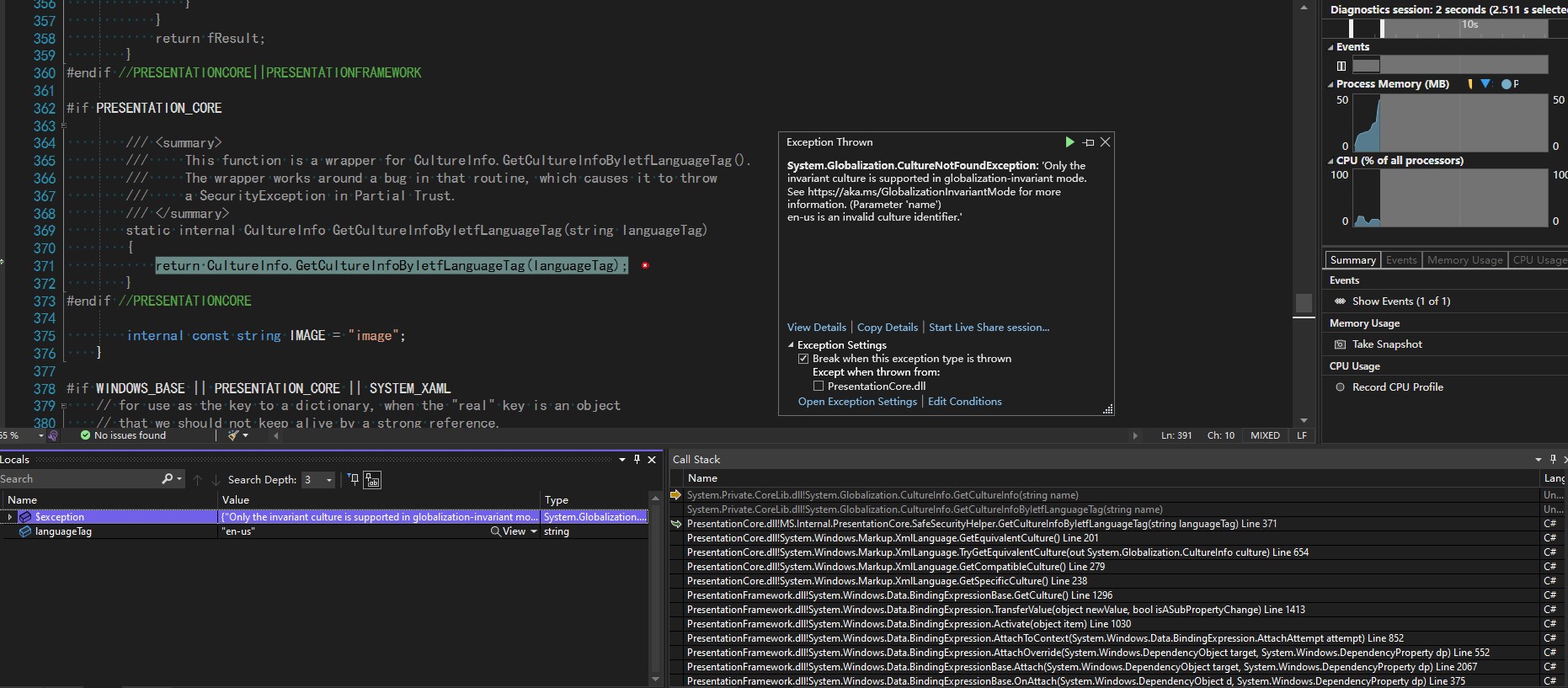
原因是在 dotnet 6 设置了 InvariantGlobalization 为 true 之后,在调用 CultureInfo.GetCultureInfoByIetfLanguageTag 方法时,将抛出异常,如下图
这是符合 官方文档 描述的
如 Breaking change: Culture creation and case mapping in globalization-invariant mode 文档所述:
Starting in .NET 6 when globalization-invariant mode is enabled:

    If an app attempts to create a culture that's not the invariant culture, a CultureNotFoundException exception is thrown.
因此这个问题其实是 dotnet 6 的符合预期的行为,也不是 WPF 的问题
附设置 InvariantGlobalization 为 true 的方法如下
编辑 csproj 项目文件,添加 <InvariantGlobalization>true</InvariantGlobalization> 到 PropertyGroup 里面,如以下代码
<PropertyGroup>
    <InvariantGlobalization>true</InvariantGlobalization>
</PropertyGroup>
或者是编辑 runtimeconfig.json 文件,添加如下代码
{
    "runtimeOptions":
    {
        "configProperties":
        {
            "System.Globalization.Invariant": true
        }
    }
}
参考文档:
Breaking change: Culture creation and case mapping in globalization-invariant mode
runtime/globalization-invariant-mode.md at main · dotnet/runtime · GitHub
我的目标是转换表单输入,例如“100兆字节”或“1GB”,并将其转换为我可以存储在数据库中的文件大小(以千字节为单位)。目前,我有这个:defquota_convert@regex=/([0-9]+)(.*)s/@sizes=%w{kilobytemegabytegigabyte}m=self.quota.match(@regex)if@sizes.include?m[2]eval("self.quota=#{m[1]}.#{m[2]}")endend这有效,但前提是输入是倍数(“gigabytes”,而不是“gigabyte”)并且由于使用了eval看起来疯狂不安全。所以,功能正常,
我想将html转换为纯文本。不过,我不想只删除标签,我想智能地保留尽可能多的格式。为插入换行符标签,检测段落并格式化它们等。输入非常简单,通常是格式良好的html(不是整个文档,只是一堆内容,通常没有anchor或图像)。我可以将几个正则表达式放在一起,让我达到80%,但我认为可能有一些现有的解决方案更智能。 最佳答案 首先,不要尝试为此使用正则表达式。很有可能你会想出一个脆弱/脆弱的解决方案,它会随着HTML的变化而崩溃,或者很难管理和维护。您可以使用Nokogiri快速解析HTML并提取文本:require'nokogiri'h
我需要读入一个包含数字列表的文件。此代码读取文件并将其放入二维数组中。现在我需要获取数组中所有数字的平均值,但我需要将数组的内容更改为int。有什么想法可以将to_i方法放在哪里吗?ClassTerraindefinitializefile_name@input=IO.readlines(file_name)#readinfile@size=@input[0].to_i@land=[@size]x=1whilex 最佳答案 只需将数组映射为整数:@land边注如果你想得到一条线的平均值,你可以这样做:values=@input[x]
这道题是thisquestion的逆题.给定一个散列,每个键都有一个数组,例如{[:a,:b,:c]=>1,[:a,:b,:d]=>2,[:a,:e]=>3,[:f]=>4,}将其转换为嵌套哈希的最佳方法是什么{:a=>{:b=>{:c=>1,:d=>2},:e=>3,},:f=>4,} 最佳答案 这是一个迭代的解决方案,递归的解决方案留给读者作为练习:defconvert(h={})ret={}h.eachdo|k,v|node=retk[0..-2].each{|x|node[x]||={};node=node[x]}node[
这是在Ruby中设置默认值的常用方法:classQuietByDefaultdefinitialize(opts={})@verbose=opts[:verbose]endend这是一个容易落入的陷阱:classVerboseNoMatterWhatdefinitialize(opts={})@verbose=opts[:verbose]||trueendend正确的做法是:classVerboseByDefaultdefinitialize(opts={})@verbose=opts.include?(:verbose)?opts[:verbose]:trueendend编写Verb
我想设置一个默认日期,例如实际日期,我该如何设置?还有如何在组合框中设置默认值顺便问一下,date_field_tag和date_field之间有什么区别? 最佳答案 试试这个:将默认日期作为第二个参数传递。youcorrectlysetthedefaultvalueofcomboboxasshowninyourquestion. 关于ruby-on-rails-date_field_tag,如何设置默认日期?[rails上的ruby],我们在StackOverflow上找到一个类似的问
两者都可以defsetup(options={})options.reverse_merge:size=>25,:velocity=>10end和defsetup(options={}){:size=>25,:velocity=>10}.merge(options)end在方法的参数中分配默认值。问题是:哪个更好?您更愿意使用哪一个?在性能、代码可读性或其他方面有什么不同吗?编辑:我无意中添加了bang(!)...并不是要询问nobang方法与bang方法之间的区别 最佳答案 我倾向于使用reverse_merge方法:option
我正在使用Rails构建一个简单的聊天应用程序。当用户输入url时,我希望将其输出为html链接(即“url”)。我想知道在Ruby中是否有任何库或众所周知的方法可以做到这一点。如果没有,我有一些不错的正则表达式示例代码可以使用... 最佳答案 查看auto_linkRails提供的辅助方法。这会将所有URL和电子邮件地址变成可点击的链接(htmlanchor标记)。这是文档中的代码示例。auto_link("Gotohttp://www.rubyonrails.organdsayhellotodavid@loudthinking.
我收到格式为的回复#我需要将其转换为哈希值(针对活跃商家)。目前我正在遍历变量并执行此操作:response.instance_variables.eachdo|r|my_hash.merge!(r.to_s.delete("@").intern=>response.instance_eval(r.to_s.delete("@")))end这有效,它将生成{:first="charlie",:last=>"kelly"},但它似乎有点hacky和不稳定。有更好的方法吗?编辑:我刚刚意识到我可以使用instance_variable_get作为该等式的第二部分,但这仍然是主要问题。
2022/8/4更新支持加入水印水印必须包含透明图像,并且水印图像大小要等于原图像的大小pythonconvert_image_to_video.py-f30-mwatermark.pngim_dirout.mkv2022/6/21更新让命令行参数更加易用新的命令行使用方法pythonconvert_image_to_video.py-f30im_dirout.mkvFFMPEG命令行转换一组JPG图像到视频时,是将这组图像视为MJPG流。我需要转换一组PNG图像到视频,FFMPEG就不认了。pyav内置了ffmpeg库,不需要系统带有ffmpeg工具因此我使用ffmpeg的python包装p
