我的版本是YOLOV5 7.0
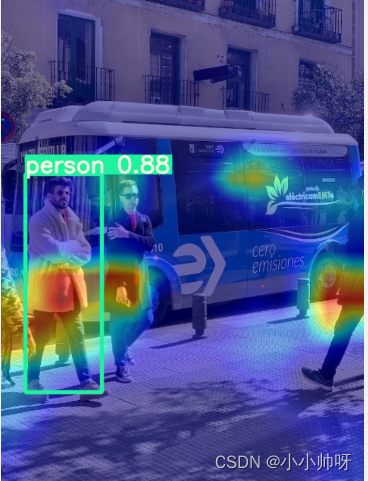
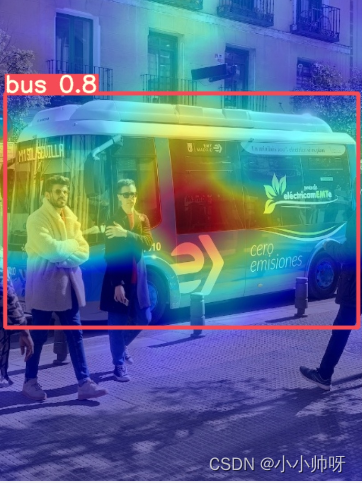
结果仅供参考
首先配置好YOLO V5环境
这个采用pip install requirements即可
具体配置环境可以看我其他的博客有详细介绍
GPU环境自己配置
运行YOLO 没问题,输出结果:
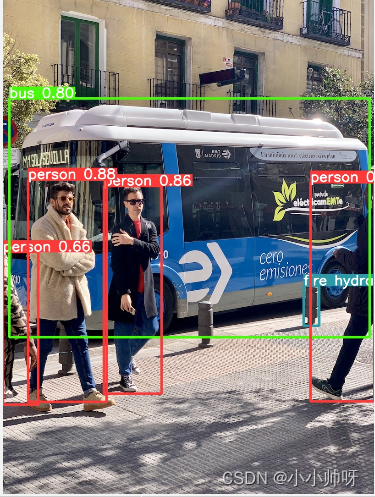
在项目文件夹下添加main_gradcam.py文件
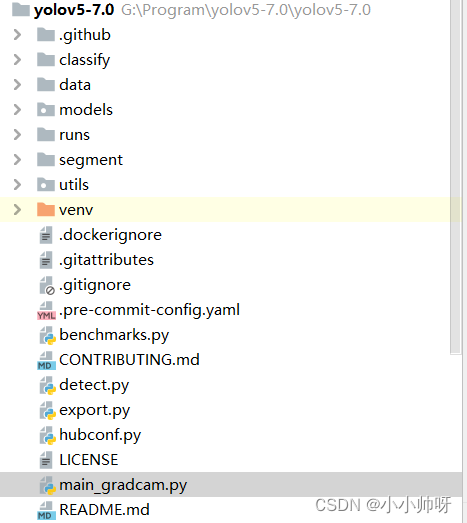
main_gradcam.py
import os
import random
import time
import argparse
import numpy as np
from models.gradcam import YOLOV5GradCAM, YOLOV5GradCAMPP
from models.yolov5_object_detector import YOLOV5TorchObjectDetector
import cv2
# 数据集类别名
names = ['person', 'bicycle', 'car', 'motorcycle', 'airplane', 'bus', 'train', 'truck', 'boat', 'traffic light',
         'fire hydrant', 'stop sign', 'parking meter', 'bench', 'bird', 'cat', 'dog', 'horse', 'sheep', 'cow',
         'elephant', 'bear', 'zebra', 'giraffe', 'backpack', 'umbrella', 'handbag', 'tie', 'suitcase', 'frisbee',
         'skis', 'snowboard', 'sports ball', 'kite', 'baseball bat', 'baseball glove', 'skateboard', 'surfboard',
         'tennis racket', 'bottle', 'wine glass', 'cup', 'fork', 'knife', 'spoon', 'bowl', 'banana', 'apple',
         'sandwich', 'orange', 'broccoli', 'carrot', 'hot dog', 'pizza', 'donut', 'cake', 'chair', 'couch',
         'potted plant', 'bed', 'dining table', 'toilet', 'tv', 'laptop', 'mouse', 'remote', 'keyboard', 'cell phone',
         'microwave', 'oven', 'toaster', 'sink', 'refrigerator', 'book', 'clock', 'vase', 'scissors', 'teddy bear',
         'hair drier', 'toothbrush']  # class names
# yolov5s网络中的三个detect层
target_layers = ['model_17_cv3_act', 'model_20_cv3_act', 'model_23_cv3_act']

# Arguments
parser = argparse.ArgumentParser()
parser.add_argument('--model-path', type=str, default="yolov5s.pt", help='Path to the model')
parser.add_argument('--img-path', type=str, default='data/images/bus.jpg', help='input image path')
parser.add_argument('--output-dir', type=str, default='runs/result17', help='output dir')
parser.add_argument('--img-size', type=int, default=640, help="input image size")
parser.add_argument('--target-layer', type=str, default='model_17_cv3_act',
                    help='The layer hierarchical address to which gradcam will applied,'
                         ' the names should be separated by underline')
parser.add_argument('--method', type=str, default='gradcam', help='gradcam method')
parser.add_argument('--device', type=str, default='cuda', help='cuda or cpu')
parser.add_argument('--no_text_box', action='store_true',
                    help='do not show label and box on the heatmap')
args = parser.parse_args()


def get_res_img(bbox, mask, res_img):
    mask = mask.squeeze(0).mul(255).add_(0.5).clamp_(0, 255).permute(1, 2, 0).detach().cpu().numpy().astype(
        np.uint8)
    heatmap = cv2.applyColorMap(mask, cv2.COLORMAP_JET)
    # n_heatmat = (Box.fill_outer_box(heatmap, bbox) / 255).astype(np.float32)
    n_heatmat = (heatmap / 255).astype(np.float32)
    res_img = res_img / 255
    res_img = cv2.add(res_img, n_heatmat)
    res_img = (res_img / res_img.max())
    return res_img, n_heatmat


def plot_one_box(x, img, color=None, label=None, line_thickness=3):
    # this is a bug in cv2. It does not put box on a converted image from torch unless it's buffered and read again!
    cv2.imwrite('temp.jpg', (img * 255).astype(np.uint8))
    img = cv2.imread('temp.jpg')

    # Plots one bounding box on image img
    tl = line_thickness or round(0.002 * (img.shape[0] + img.shape[1]) / 2) + 1  # line/font thickness
    color = color or [random.randint(0, 255) for _ in range(3)]
    c1, c2 = (int(x[0]), int(x[1])), (int(x[2]), int(x[3]))
    cv2.rectangle(img, c1, c2, color, thickness=tl, lineType=cv2.LINE_AA)
    if label:
        tf = max(tl - 1, 1)  # font thickness
        t_size = cv2.getTextSize(label, 0, fontScale=tl / 3, thickness=tf)[0]
        outside = c1[1] - t_size[1] - 3 >= 0  # label fits outside box up
        c2 = c1[0] + t_size[0], c1[1] - t_size[1] - 3 if outside else c1[1] + t_size[1] + 3
        outsize_right = c2[0] - img.shape[:2][1] > 0  # label fits outside box right
        c1 = c1[0] - (c2[0] - img.shape[:2][1]) if outsize_right else c1[0], c1[1]
        c2 = c2[0] - (c2[0] - img.shape[:2][1]) if outsize_right else c2[0], c2[1]
        cv2.rectangle(img, c1, c2, color, -1, cv2.LINE_AA)  # filled
        cv2.putText(img, label, (c1[0], c1[1] - 2 if outside else c2[1] - 2), 0, tl / 3, [225, 255, 255], thickness=tf,
                    lineType=cv2.LINE_AA)
    return img


# 检测单个图片
def main(img_path):
    colors = [[random.randint(0, 255) for _ in range(3)] for _ in names]
    device = args.device
    input_size = (args.img_size, args.img_size)
    # 读入图片
    img = cv2.imread(img_path)  # 读取图像格式:BGR
    print('[INFO] Loading the model')
    # 实例化YOLOv5模型,得到检测结果
    model = YOLOV5TorchObjectDetector(args.model_path, device, img_size=input_size, names=names)
    # img[..., ::-1]: BGR --> RGB
    # (480, 640, 3) --> (1, 3, 480, 640)
    torch_img = model.preprocessing(img[..., ::-1])
    tic = time.time()
    # 遍历三层检测层
    for target_layer in target_layers:
        # 获取grad-cam方法
        if args.method == 'gradcam':
            saliency_method = YOLOV5GradCAM(model=model, layer_name=target_layer, img_size=input_size)
        elif args.method == 'gradcampp':
            saliency_method = YOLOV5GradCAMPP(model=model, layer_name=target_layer, img_size=input_size)
        masks, logits, [boxes, _, class_names, conf] = saliency_method(torch_img)  # 得到预测结果
        result = torch_img.squeeze(0).mul(255).add_(0.5).clamp_(0, 255).permute(1, 2, 0).detach().cpu().numpy()
        result = result[..., ::-1]  # convert to bgr
        # 保存设置
        imgae_name = os.path.basename(img_path)  # 获取图片名
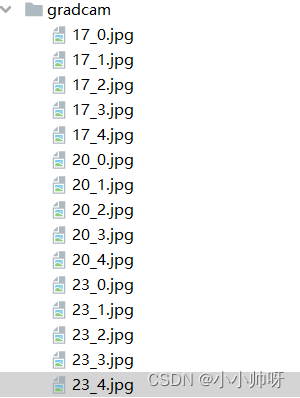
        save_path = f'{args.output_dir}{imgae_name[:-4]}/{args.method}'
        if not os.path.exists(save_path):
            os.makedirs(save_path)
        print(f'[INFO] Saving the final image at {save_path}')
        # 遍历每张图片中的每个目标
        for i, mask in enumerate(masks):
            # 遍历图片中的每个目标
            res_img = result.copy()
            # 获取目标的位置和类别信息
            bbox, cls_name = boxes[0][i], class_names[0][i]
            label = f'{cls_name} {conf[0][i]}'  # 类别+置信分数
            # 获取目标的热力图
            res_img, heat_map = get_res_img(bbox, mask, res_img)
            res_img = plot_one_box(bbox, res_img, label=label, color=colors[int(names.index(cls_name))],
                                   line_thickness=3)
            # 缩放到原图片大小
            res_img = cv2.resize(res_img, dsize=(img.shape[:-1][::-1]))
            output_path = f'{save_path}/{target_layer[6:8]}_{i}.jpg'
            cv2.imwrite(output_path, res_img)
            print(f'{target_layer[6:8]}_{i}.jpg done!!')
    print(f'Total time : {round(time.time() - tic, 4)} s')


if __name__ == '__main__':
    # 图片路径为文件夹
    if os.path.isdir(args.img_path):
        img_list = os.listdir(args.img_path)
        print(img_list)
        for item in img_list:
            # 依次获取文件夹中的图片名,组合成图片的路径
            main(os.path.join(args.img_path, item))
    # 单个图片
    else:
        main(args.img_path)
在model文件夹下添加如下两个py文件,分别是gradcam.py和yolov5_object_detector.py
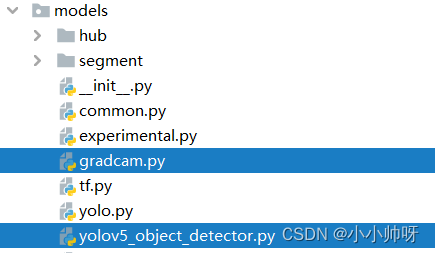
gradcam.py代码如下:
import time
import torch
import torch.nn.functional as F


def find_yolo_layer(model, layer_name):
    """Find yolov5 layer to calculate GradCAM and GradCAM++

    Args:
        model: yolov5 model.
        layer_name (str): the name of layer with its hierarchical information.

    Return:
        target_layer: found layer
    """
    hierarchy = layer_name.split('_')
    target_layer = model.model._modules[hierarchy[0]]

    for h in hierarchy[1:]:
        target_layer = target_layer._modules[h]
    return target_layer


class YOLOV5GradCAM:
    # 初始化,得到target_layer层
    def __init__(self, model, layer_name, img_size=(640, 640)):
        self.model = model
        self.gradients = dict()
        self.activations = dict()

        def backward_hook(module, grad_input, grad_output):
            self.gradients['value'] = grad_output[0]
            return None

        def forward_hook(module, input, output):
            self.activations['value'] = output
            return None

        target_layer = find_yolo_layer(self.model, layer_name)
        # 获取forward过程中每层的输入和输出,用于对比hook是不是正确记录
        target_layer.register_forward_hook(forward_hook)
        target_layer.register_full_backward_hook(backward_hook)
        device = 'cuda' if next(self.model.model.parameters()).is_cuda else 'cpu'
        self.model(torch.zeros(1, 3, *img_size, device=device))

    def forward(self, input_img, class_idx=True):
        """
        Args:
            input_img: input image with shape of (1, 3, H, W)
        Return:
            mask: saliency map of the same spatial dimension with input
            logit: model output
            preds: The object predictions
        """
        saliency_maps = []
        b, c, h, w = input_img.size()
        preds, logits = self.model(input_img)
        for logit, cls, cls_name in zip(logits[0], preds[1][0], preds[2][0]):
            if class_idx:
                score = logit[cls]
            else:
                score = logit.max()
            self.model.zero_grad()
            tic = time.time()
            # 获取梯度
            score.backward(retain_graph=True)
            print(f"[INFO] {cls_name}, model-backward took: ", round(time.time() - tic, 4), 'seconds')
            gradients = self.gradients['value']
            activations = self.activations['value']
            b, k, u, v = gradients.size()
            alpha = gradients.view(b, k, -1).mean(2)
            weights = alpha.view(b, k, 1, 1)
            saliency_map = (weights * activations).sum(1, keepdim=True)
            saliency_map = F.relu(saliency_map)
            saliency_map = F.interpolate(saliency_map, size=(h, w), mode='bilinear', align_corners=False)
            saliency_map_min, saliency_map_max = saliency_map.min(), saliency_map.max()
            saliency_map = (saliency_map - saliency_map_min).div(saliency_map_max - saliency_map_min).data
            saliency_maps.append(saliency_map)
        return saliency_maps, logits, preds

    def __call__(self, input_img):
        return self.forward(input_img)


class YOLOV5GradCAMPP(YOLOV5GradCAM):
    def __init__(self, model, layer_name, img_size=(640, 640)):
        super(YOLOV5GradCAMPP, self).__init__(model, layer_name, img_size)

    def forward(self, input_img, class_idx=True):
        saliency_maps = []
        b, c, h, w = input_img.size()
        tic = time.time()
        preds, logits = self.model(input_img)
        print("[INFO] model-forward took: ", round(time.time() - tic, 4), 'seconds')
        for logit, cls, cls_name in zip(logits[0], preds[1][0], preds[2][0]):
            if class_idx:
                score = logit[cls]
            else:
                score = logit.max()
            self.model.zero_grad()
            tic = time.time()
            # 获取梯度
            score.backward(retain_graph=True)
            print(f"[INFO] {cls_name}, model-backward took: ", round(time.time() - tic, 4), 'seconds')
            gradients = self.gradients['value']  # dS/dA
            activations = self.activations['value']  # A
            b, k, u, v = gradients.size()

            alpha_num = gradients.pow(2)
            alpha_denom = gradients.pow(2).mul(2) + \
                          activations.mul(gradients.pow(3)).view(b, k, u * v).sum(-1, keepdim=True).view(b, k, 1, 1)
            # torch.where(condition, x, y) condition是条件,满足条件就返回x,不满足就返回y
            alpha_denom = torch.where(alpha_denom != 0.0, alpha_denom, torch.ones_like(alpha_denom))
            alpha = alpha_num.div(alpha_denom + 1e-7)

            positive_gradients = F.relu(score.exp() * gradients)  # ReLU(dY/dA) == ReLU(exp(S)*dS/dA))
            weights = (alpha * positive_gradients).view(b, k, u * v).sum(-1).view(b, k, 1, 1)

            saliency_map = (weights * activations).sum(1, keepdim=True)
            saliency_map = F.relu(saliency_map)
            saliency_map = F.interpolate(saliency_map, size=(h, w), mode='bilinear', align_corners=False)
            saliency_map_min, saliency_map_max = saliency_map.min(), saliency_map.max()
            saliency_map = (saliency_map - saliency_map_min).div(saliency_map_max - saliency_map_min).data
            saliency_maps.append(saliency_map)
        return saliency_maps, logits, preds
yolov5_object_detector.py的代码如下:
import numpy as np
import torch
from models.experimental import attempt_load
from utils.general import xywh2xyxy
from utils.dataloaders import letterbox
import cv2
import time
import torchvision
import torch.nn as nn
from utils.metrics import box_iou


class YOLOV5TorchObjectDetector(nn.Module):
    def __init__(self,
                 model_weight,
                 device,
                 img_size,
                 names=None,
                 mode='eval',
                 confidence=0.45,
                 iou_thresh=0.45,
                 agnostic_nms=False):
        super(YOLOV5TorchObjectDetector, self).__init__()
        self.device = device
        self.model = None
        self.img_size = img_size
        self.mode = mode
        self.confidence = confidence
        self.iou_thresh = iou_thresh
        self.agnostic = agnostic_nms
        self.model = attempt_load(model_weight, inplace=False, fuse=False)
        self.model.requires_grad_(True)
        self.model.to(device)

        if self.mode == 'train':
            self.model.train()
        else:
            self.model.eval()
        # fetch the names
        if names is None:
            self.names = ['your dataset classname']
        else:
            self.names = names

        # preventing cold start
        img = torch.zeros((1, 3, *self.img_size), device=device)
        self.model(img)

    @staticmethod
    def non_max_suppression(prediction, logits, conf_thres=0.3, iou_thres=0.45, classes=None, agnostic=False,
                            multi_label=False, labels=(), max_det=300):
        """Runs Non-Maximum Suppression (NMS) on inference and logits results

        Returns:
             list of detections, on (n,6) tensor per image [xyxy, conf, cls] and pruned input logits (n, number-classes)
        """

        nc = prediction.shape[2] - 5  # number of classes
        xc = prediction[..., 4] > conf_thres  # candidates

        # Checks
        assert 0 <= conf_thres <= 1, f'Invalid Confidence threshold {conf_thres}, valid values are between 0.0 and 1.0'
        assert 0 <= iou_thres <= 1, f'Invalid IoU {iou_thres}, valid values are between 0.0 and 1.0'

        # Settings
        min_wh, max_wh = 2, 4096  # (pixels) minimum and maximum box width and height
        max_nms = 30000  # maximum number of boxes into torchvision.ops.nms()
        time_limit = 10.0  # seconds to quit after
        redundant = True  # require redundant detections
        multi_label &= nc > 1  # multiple labels per box (adds 0.5ms/img)
        merge = False  # use merge-NMS

        t = time.time()
        output = [torch.zeros((0, 6), device=prediction.device)] * prediction.shape[0]
        logits_output = [torch.zeros((0, nc), device=logits.device)] * logits.shape[0]
        # logits_output = [torch.zeros((0, 80), device=logits.device)] * logits.shape[0]
        for xi, (x, log_) in enumerate(zip(prediction, logits)):  # image index, image inference
            # Apply constraints
            # x[((x[..., 2:4] < min_wh) | (x[..., 2:4] > max_wh)).any(1), 4] = 0  # width-height
            x = x[xc[xi]]  # confidence
            log_ = log_[xc[xi]]
            # Cat apriori labels if autolabelling
            if labels and len(labels[xi]):
                l = labels[xi]
                v = torch.zeros((len(l), nc + 5), device=x.device)
                v[:, :4] = l[:, 1:5]  # box
                v[:, 4] = 1.0  # conf
                v[range(len(l)), l[:, 0].long() + 5] = 1.0  # cls
                x = torch.cat((x, v), 0)

            # If none remain process next image
            if not x.shape[0]:
                continue

            # Compute conf
            x[:, 5:] *= x[:, 4:5]  # conf = obj_conf * cls_conf
            # Box (center x, center y, width, height) to (x1, y1, x2, y2)
            box = xywh2xyxy(x[:, :4])

            # Detections matrix nx6 (xyxy, conf, cls)
            if multi_label:
                i, j = (x[:, 5:] > conf_thres).nonzero(as_tuple=False).T
                x = torch.cat((box[i], x[i, j + 5, None], j[:, None].float()), 1)
            else:  # best class only
                conf, j = x[:, 5:].max(1, keepdim=True)
                x = torch.cat((box, conf, j.float()), 1)[conf.view(-1) > conf_thres]
                log_ = log_[conf.view(-1) > conf_thres]
            # Filter by class
            if classes is not None:
                x = x[(x[:, 5:6] == torch.tensor(classes, device=x.device)).any(1)]

            # Check shape
            n = x.shape[0]  # number of boxes
            if not n:  # no boxes
                continue
            elif n > max_nms:  # excess boxes
                x = x[x[:, 4].argsort(descending=True)[:max_nms]]  # sort by confidence

            # Batched NMS
            c = x[:, 5:6] * (0 if agnostic else max_wh)  # classes
            boxes, scores = x[:, :4] + c, x[:, 4]  # boxes (offset by class), scores
            i = torchvision.ops.nms(boxes, scores, iou_thres)  # NMS
            if i.shape[0] > max_det:  # limit detections
                i = i[:max_det]
            if merge and (1 < n < 3E3):  # Merge NMS (boxes merged using weighted mean)
                # update boxes as boxes(i,4) = weights(i,n) * boxes(n,4)
                iou = box_iou(boxes[i], boxes) > iou_thres  # iou matrix
                weights = iou * scores[None]  # box weights
                x[i, :4] = torch.mm(weights, x[:, :4]).float() / weights.sum(1, keepdim=True)  # merged boxes
                if redundant:
                    i = i[iou.sum(1) > 1]  # require redundancy

            output[xi] = x[i]
            logits_output[xi] = log_[i]
            assert log_[i].shape[0] == x[i].shape[0]
            if (time.time() - t) > time_limit:
                print(f'WARNING: NMS time limit {time_limit}s exceeded')
                break  # time limit exceeded

        return output, logits_output

    @staticmethod
    def yolo_resize(img, new_shape=(640, 640), color=(114, 114, 114), auto=True, scaleFill=False, scaleup=True):

        return letterbox(img, new_shape=new_shape, color=color, auto=auto, scaleFill=scaleFill, scaleup=scaleup)

    def forward(self, img):
        prediction, logits, _ = self.model(img, augment=False)
        prediction, logits = self.non_max_suppression(prediction, logits, self.confidence, self.iou_thresh,
                                                      classes=None,
                                                      agnostic=self.agnostic)
        self.boxes, self.class_names, self.classes, self.confidences = [[[] for _ in range(img.shape[0])] for _ in
                                                                        range(4)]
        for i, det in enumerate(prediction):  # detections per image
            if len(det):
                for *xyxy, conf, cls in det:
                    # 返回整数
                    bbox = [int(b) for b in xyxy]
                    self.boxes[i].append(bbox)
                    self.confidences[i].append(round(conf.item(), 2))
                    cls = int(cls.item())
                    self.classes[i].append(cls)
                    if self.names is not None:
                        self.class_names[i].append(self.names[cls])
                    else:
                        self.class_names[i].append(cls)
        return [self.boxes, self.classes, self.class_names, self.confidences], logits

    def preprocessing(self, img):
        if len(img.shape) != 4:
            img = np.expand_dims(img, axis=0)
        im0 = img.astype(np.uint8)
        img = np.array([self.yolo_resize(im, new_shape=self.img_size)[0] for im in im0])
        img = img.transpose((0, 3, 1, 2))
        img = np.ascontiguousarray(img)
        img = torch.from_numpy(img).to(self.device)
        img = img / 255.0
        return img
更改model/yolo.py
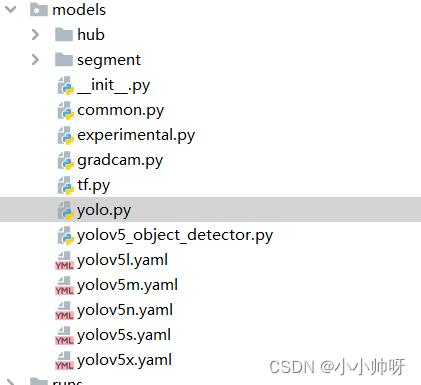
具体而言
Detect类中的forward函数
    def forward(self, x):
        z = []  # inference output

        logits_ = []               # 修改---1

        for i in range(self.nl):
            x[i] = self.m[i](x[i])  # conv
            bs, _, ny, nx = x[i].shape  # x(bs,255,20,20) to x(bs,3,20,20,85)
            x[i] = x[i].view(bs, self.na, self.no, ny, nx).permute(0, 1, 3, 4, 2).contiguous()

            if not self.training:  # inference
                if self.dynamic or self.grid[i].shape[2:4] != x[i].shape[2:4]:
                    self.grid[i], self.anchor_grid[i] = self._make_grid(nx, ny, i)

                logits = x[i][..., 5:]                 # 修改---2


                if isinstance(self, Segment):  # (boxes + masks)
                    xy, wh, conf, mask = x[i].split((2, 2, self.nc + 1, self.no - self.nc - 5), 4)
                    xy = (xy.sigmoid() * 2 + self.grid[i]) * self.stride[i]  # xy
                    wh = (wh.sigmoid() * 2) ** 2 * self.anchor_grid[i]  # wh
                    y = torch.cat((xy, wh, conf.sigmoid(), mask), 4)
                else:  # Detect (boxes only)
                    xy, wh, conf = x[i].sigmoid().split((2, 2, self.nc + 1), 4)
                    xy = (xy * 2 + self.grid[i]) * self.stride[i]  # xy
                    wh = (wh * 2) ** 2 * self.anchor_grid[i]  # wh
                    y = torch.cat((xy, wh, conf), 4)
                z.append(y.view(bs, self.na * nx * ny, self.no))

                logits_.append(logits.view(bs, -1, self.no - 5))     # 修改---3

        # return x if self.training else (torch.cat(z, 1),) if self.export else (torch.cat(z, 1), x)
        return x if self.training else (torch.cat(z, 1), torch.cat(logits_, 1), x)  # 修改---4
为了防止大家不知道怎么修改yolo.py文件,我将修改后的yolo.py文件放在下方
yolo.py
# YOLOv5 🚀 by Ultralytics, GPL-3.0 license
"""
YOLO-specific modules

Usage:
    $ python models/yolo.py --cfg yolov5s.yaml
"""

import argparse
import contextlib
import os
import platform
import sys
from copy import deepcopy
from pathlib import Path

FILE = Path(__file__).resolve()
ROOT = FILE.parents[1]  # YOLOv5 root directory
if str(ROOT) not in sys.path:
    sys.path.append(str(ROOT))  # add ROOT to PATH
if platform.system() != 'Windows':
    ROOT = Path(os.path.relpath(ROOT, Path.cwd()))  # relative

from models.common import *
from models.experimental import *
from utils.autoanchor import check_anchor_order
from utils.general import LOGGER, check_version, check_yaml, make_divisible, print_args
from utils.plots import feature_visualization
from utils.torch_utils import (fuse_conv_and_bn, initialize_weights, model_info, profile, scale_img, select_device,
                               time_sync)

try:
    import thop  # for FLOPs computation
except ImportError:
    thop = None


class Detect(nn.Module):
    # YOLOv5 Detect head for detection models
    stride = None  # strides computed during build
    dynamic = False  # force grid reconstruction
    export = False  # export mode

    def __init__(self, nc=80, anchors=(), ch=(), inplace=True):  # detection layer
        super().__init__()
        self.nc = nc  # number of classes
        self.no = nc + 5  # number of outputs per anchor
        self.nl = len(anchors)  # number of detection layers
        self.na = len(anchors[0]) // 2  # number of anchors
        self.grid = [torch.empty(0) for _ in range(self.nl)]  # init grid
        self.anchor_grid = [torch.empty(0) for _ in range(self.nl)]  # init anchor grid
        self.register_buffer('anchors', torch.tensor(anchors).float().view(self.nl, -1, 2))  # shape(nl,na,2)
        self.m = nn.ModuleList(nn.Conv2d(x, self.no * self.na, 1) for x in ch)  # output conv
        self.inplace = inplace  # use inplace ops (e.g. slice assignment)

    def forward(self, x):
        z = []  # inference output

        logits_ = []               # 修改---1

        for i in range(self.nl):
            x[i] = self.m[i](x[i])  # conv
            bs, _, ny, nx = x[i].shape  # x(bs,255,20,20) to x(bs,3,20,20,85)
            x[i] = x[i].view(bs, self.na, self.no, ny, nx).permute(0, 1, 3, 4, 2).contiguous()

            if not self.training:  # inference
                if self.dynamic or self.grid[i].shape[2:4] != x[i].shape[2:4]:
                    self.grid[i], self.anchor_grid[i] = self._make_grid(nx, ny, i)

                logits = x[i][..., 5:]                 # 修改---2


                if isinstance(self, Segment):  # (boxes + masks)
                    xy, wh, conf, mask = x[i].split((2, 2, self.nc + 1, self.no - self.nc - 5), 4)
                    xy = (xy.sigmoid() * 2 + self.grid[i]) * self.stride[i]  # xy
                    wh = (wh.sigmoid() * 2) ** 2 * self.anchor_grid[i]  # wh
                    y = torch.cat((xy, wh, conf.sigmoid(), mask), 4)
                else:  # Detect (boxes only)
                    xy, wh, conf = x[i].sigmoid().split((2, 2, self.nc + 1), 4)
                    xy = (xy * 2 + self.grid[i]) * self.stride[i]  # xy
                    wh = (wh * 2) ** 2 * self.anchor_grid[i]  # wh
                    y = torch.cat((xy, wh, conf), 4)
                z.append(y.view(bs, self.na * nx * ny, self.no))

                logits_.append(logits.view(bs, -1, self.no - 5))     # 修改---3

        # return x if self.training else (torch.cat(z, 1),) if self.export else (torch.cat(z, 1), x)
        return x if self.training else (torch.cat(z, 1), torch.cat(logits_, 1), x)  # 修改---4

    def _make_grid(self, nx=20, ny=20, i=0, torch_1_10=check_version(torch.__version__, '1.10.0')):
        d = self.anchors[i].device
        t = self.anchors[i].dtype
        shape = 1, self.na, ny, nx, 2  # grid shape
        y, x = torch.arange(ny, device=d, dtype=t), torch.arange(nx, device=d, dtype=t)
        yv, xv = torch.meshgrid(y, x, indexing='ij') if torch_1_10 else torch.meshgrid(y, x)  # torch>=0.7 compatibility
        grid = torch.stack((xv, yv), 2).expand(shape) - 0.5  # add grid offset, i.e. y = 2.0 * x - 0.5
        anchor_grid = (self.anchors[i] * self.stride[i]).view((1, self.na, 1, 1, 2)).expand(shape)
        return grid, anchor_grid


class Segment(Detect):
    # YOLOv5 Segment head for segmentation models
    def __init__(self, nc=80, anchors=(), nm=32, npr=256, ch=(), inplace=True):
        super().__init__(nc, anchors, ch, inplace)
        self.nm = nm  # number of masks
        self.npr = npr  # number of protos
        self.no = 5 + nc + self.nm  # number of outputs per anchor
        self.m = nn.ModuleList(nn.Conv2d(x, self.no * self.na, 1) for x in ch)  # output conv
        self.proto = Proto(ch[0], self.npr, self.nm)  # protos
        self.detect = Detect.forward

    def forward(self, x):
        p = self.proto(x[0])
        x = self.detect(self, x)
        return (x, p) if self.training else (x[0], p) if self.export else (x[0], p, x[1])


class BaseModel(nn.Module):
    # YOLOv5 base model
    def forward(self, x, profile=False, visualize=False):
        return self._forward_once(x, profile, visualize)  # single-scale inference, train

    def _forward_once(self, x, profile=False, visualize=False):
        y, dt = [], []  # outputs
        for m in self.model:
            if m.f != -1:  # if not from previous layer
                x = y[m.f] if isinstance(m.f, int) else [x if j == -1 else y[j] for j in m.f]  # from earlier layers
            if profile:
                self._profile_one_layer(m, x, dt)
            x = m(x)  # run
            y.append(x if m.i in self.save else None)  # save output
            if visualize:
                feature_visualization(x, m.type, m.i, save_dir=visualize)
        return x

    def _profile_one_layer(self, m, x, dt):
        c = m == self.model[-1]  # is final layer, copy input as inplace fix
        o = thop.profile(m, inputs=(x.copy() if c else x,), verbose=False)[0] / 1E9 * 2 if thop else 0  # FLOPs
        t = time_sync()
        for _ in range(10):
            m(x.copy() if c else x)
        dt.append((time_sync() - t) * 100)
        if m == self.model[0]:
            LOGGER.info(f"{'time (ms)':>10s} {'GFLOPs':>10s} {'params':>10s}  module")
        LOGGER.info(f'{dt[-1]:10.2f} {o:10.2f} {m.np:10.0f}  {m.type}')
        if c:
            LOGGER.info(f"{sum(dt):10.2f} {'-':>10s} {'-':>10s}  Total")

    def fuse(self):  # fuse model Conv2d() + BatchNorm2d() layers
        LOGGER.info('Fusing layers... ')
        for m in self.model.modules():
            if isinstance(m, (Conv, DWConv)) and hasattr(m, 'bn'):
                m.conv = fuse_conv_and_bn(m.conv, m.bn)  # update conv
                delattr(m, 'bn')  # remove batchnorm
                m.forward = m.forward_fuse  # update forward
        self.info()
        return self

    def info(self, verbose=False, img_size=640):  # print model information
        model_info(self, verbose, img_size)

    def _apply(self, fn):
        # Apply to(), cpu(), cuda(), half() to model tensors that are not parameters or registered buffers
        self = super()._apply(fn)
        m = self.model[-1]  # Detect()
        if isinstance(m, (Detect, Segment)):
            m.stride = fn(m.stride)
            m.grid = list(map(fn, m.grid))
            if isinstance(m.anchor_grid, list):
                m.anchor_grid = list(map(fn, m.anchor_grid))
        return self


class DetectionModel(BaseModel):
    # YOLOv5 detection model
    def __init__(self, cfg='yolov5s.yaml', ch=3, nc=None, anchors=None):  # model, input channels, number of classes
        super().__init__()
        if isinstance(cfg, dict):
            self.yaml = cfg  # model dict
        else:  # is *.yaml
            import yaml  # for torch hub
            self.yaml_file = Path(cfg).name
            with open(cfg, encoding='ascii', errors='ignore') as f:
                self.yaml = yaml.safe_load(f)  # model dict

        # Define model
        ch = self.yaml['ch'] = self.yaml.get('ch', ch)  # input channels
        if nc and nc != self.yaml['nc']:
            LOGGER.info(f"Overriding model.yaml nc={self.yaml['nc']} with nc={nc}")
            self.yaml['nc'] = nc  # override yaml value
        if anchors:
            LOGGER.info(f'Overriding model.yaml anchors with anchors={anchors}')
            self.yaml['anchors'] = round(anchors)  # override yaml value
        self.model, self.save = parse_model(deepcopy(self.yaml), ch=[ch])  # model, savelist
        self.names = [str(i) for i in range(self.yaml['nc'])]  # default names
        self.inplace = self.yaml.get('inplace', True)

        # Build strides, anchors
        m = self.model[-1]  # Detect()
        if isinstance(m, (Detect, Segment)):
            s = 256  # 2x min stride
            m.inplace = self.inplace
            forward = lambda x: self.forward(x)[0] if isinstance(m, Segment) else self.forward(x)
            m.stride = torch.tensor([s / x.shape[-2] for x in forward(torch.zeros(1, ch, s, s))])  # forward
            check_anchor_order(m)
            m.anchors /= m.stride.view(-1, 1, 1)
            self.stride = m.stride
            self._initialize_biases()  # only run once

        # Init weights, biases
        initialize_weights(self)
        self.info()
        LOGGER.info('')

    def forward(self, x, augment=False, profile=False, visualize=False):
        if augment:
            return self._forward_augment(x)  # augmented inference, None
        return self._forward_once(x, profile, visualize)  # single-scale inference, train

    def _forward_augment(self, x):
        img_size = x.shape[-2:]  # height, width
        s = [1, 0.83, 0.67]  # scales
        f = [None, 3, None]  # flips (2-ud, 3-lr)
        y = []  # outputs
        for si, fi in zip(s, f):
            xi = scale_img(x.flip(fi) if fi else x, si, gs=int(self.stride.max()))
            yi = self._forward_once(xi)[0]  # forward
            # cv2.imwrite(f'img_{si}.jpg', 255 * xi[0].cpu().numpy().transpose((1, 2, 0))[:, :, ::-1])  # save
            yi = self._descale_pred(yi, fi, si, img_size)
            y.append(yi)
        y = self._clip_augmented(y)  # clip augmented tails
        return torch.cat(y, 1), None  # augmented inference, train

    def _descale_pred(self, p, flips, scale, img_size):
        # de-scale predictions following augmented inference (inverse operation)
        if self.inplace:
            p[..., :4] /= scale  # de-scale
            if flips == 2:
                p[..., 1] = img_size[0] - p[..., 1]  # de-flip ud
            elif flips == 3:
                p[..., 0] = img_size[1] - p[..., 0]  # de-flip lr
        else:
            x, y, wh = p[..., 0:1] / scale, p[..., 1:2] / scale, p[..., 2:4] / scale  # de-scale
            if flips == 2:
                y = img_size[0] - y  # de-flip ud
            elif flips == 3:
                x = img_size[1] - x  # de-flip lr
            p = torch.cat((x, y, wh, p[..., 4:]), -1)
        return p

    def _clip_augmented(self, y):
        # Clip YOLOv5 augmented inference tails
        nl = self.model[-1].nl  # number of detection layers (P3-P5)
        g = sum(4 ** x for x in range(nl))  # grid points
        e = 1  # exclude layer count
        i = (y[0].shape[1] // g) * sum(4 ** x for x in range(e))  # indices
        y[0] = y[0][:, :-i]  # large
        i = (y[-1].shape[1] // g) * sum(4 ** (nl - 1 - x) for x in range(e))  # indices
        y[-1] = y[-1][:, i:]  # small
        return y

    def _initialize_biases(self, cf=None):  # initialize biases into Detect(), cf is class frequency
        # https://arxiv.org/abs/1708.02002 section 3.3
        # cf = torch.bincount(torch.tensor(np.concatenate(dataset.labels, 0)[:, 0]).long(), minlength=nc) + 1.
        m = self.model[-1]  # Detect() module
        for mi, s in zip(m.m, m.stride):  # from
            b = mi.bias.view(m.na, -1)  # conv.bias(255) to (3,85)
            b.data[:, 4] += math.log(8 / (640 / s) ** 2)  # obj (8 objects per 640 image)
            b.data[:, 5:5 + m.nc] += math.log(0.6 / (m.nc - 0.99999)) if cf is None else torch.log(cf / cf.sum())  # cls
            mi.bias = torch.nn.Parameter(b.view(-1), requires_grad=True)


Model = DetectionModel  # retain YOLOv5 'Model' class for backwards compatibility


class SegmentationModel(DetectionModel):
    # YOLOv5 segmentation model
    def __init__(self, cfg='yolov5s-seg.yaml', ch=3, nc=None, anchors=None):
        super().__init__(cfg, ch, nc, anchors)


class ClassificationModel(BaseModel):
    # YOLOv5 classification model
    def __init__(self, cfg=None, model=None, nc=1000, cutoff=10):  # yaml, model, number of classes, cutoff index
        super().__init__()
        self._from_detection_model(model, nc, cutoff) if model is not None else self._from_yaml(cfg)

    def _from_detection_model(self, model, nc=1000, cutoff=10):
        # Create a YOLOv5 classification model from a YOLOv5 detection model
        if isinstance(model, DetectMultiBackend):
            model = model.model  # unwrap DetectMultiBackend
        model.model = model.model[:cutoff]  # backbone
        m = model.model[-1]  # last layer
        ch = m.conv.in_channels if hasattr(m, 'conv') else m.cv1.conv.in_channels  # ch into module
        c = Classify(ch, nc)  # Classify()
        c.i, c.f, c.type = m.i, m.f, 'models.common.Classify'  # index, from, type
        model.model[-1] = c  # replace
        self.model = model.model
        self.stride = model.stride
        self.save = []
        self.nc = nc

    def _from_yaml(self, cfg):
        # Create a YOLOv5 classification model from a *.yaml file
        self.model = None


def parse_model(d, ch):  # model_dict, input_channels(3)
    # Parse a YOLOv5 model.yaml dictionary
    LOGGER.info(f"\n{'':>3}{'from':>18}{'n':>3}{'params':>10}  {'module':<40}{'arguments':<30}")
    anchors, nc, gd, gw, act = d['anchors'], d['nc'], d['depth_multiple'], d['width_multiple'], d.get('activation')
    if act:
        Conv.default_act = eval(act)  # redefine default activation, i.e. Conv.default_act = nn.SiLU()
        LOGGER.info(f"{colorstr('activation:')} {act}")  # print
    na = (len(anchors[0]) // 2) if isinstance(anchors, list) else anchors  # number of anchors
    no = na * (nc + 5)  # number of outputs = anchors * (classes + 5)

    layers, save, c2 = [], [], ch[-1]  # layers, savelist, ch out
    for i, (f, n, m, args) in enumerate(d['backbone'] + d['head']):  # from, number, module, args
        m = eval(m) if isinstance(m, str) else m  # eval strings
        for j, a in enumerate(args):
            with contextlib.suppress(NameError):
                args[j] = eval(a) if isinstance(a, str) else a  # eval strings

        n = n_ = max(round(n * gd), 1) if n > 1 else n  # depth gain
        if m in {
                Conv, GhostConv, Bottleneck, GhostBottleneck, SPP, SPPF, DWConv, MixConv2d, Focus, CrossConv,
                BottleneckCSP, C3, C3TR, C3SPP, C3Ghost, nn.ConvTranspose2d, DWConvTranspose2d, C3x}:
            c1, c2 = ch[f], args[0]
            if c2 != no:  # if not output
                c2 = make_divisible(c2 * gw, 8)

            args = [c1, c2, *args[1:]]
            if m in {BottleneckCSP, C3, C3TR, C3Ghost, C3x}:
                args.insert(2, n)  # number of repeats
                n = 1
        elif m is nn.BatchNorm2d:
            args = [ch[f]]
        elif m is Concat:
            c2 = sum(ch[x] for x in f)
        # TODO: channel, gw, gd
        elif m in {Detect, Segment}:
            args.append([ch[x] for x in f])
            if isinstance(args[1], int):  # number of anchors
                args[1] = [list(range(args[1] * 2))] * len(f)
            if m is Segment:
                args[3] = make_divisible(args[3] * gw, 8)
        elif m is Contract:
            c2 = ch[f] * args[0] ** 2
        elif m is Expand:
            c2 = ch[f] // args[0] ** 2
        else:
            c2 = ch[f]

        m_ = nn.Sequential(*(m(*args) for _ in range(n))) if n > 1 else m(*args)  # module
        t = str(m)[8:-2].replace('__main__.', '')  # module type
        np = sum(x.numel() for x in m_.parameters())  # number params
        m_.i, m_.f, m_.type, m_.np = i, f, t, np  # attach index, 'from' index, type, number params
        LOGGER.info(f'{i:>3}{str(f):>18}{n_:>3}{np:10.0f}  {t:<40}{str(args):<30}')  # print
        save.extend(x % i for x in ([f] if isinstance(f, int) else f) if x != -1)  # append to savelist
        layers.append(m_)
        if i == 0:
            ch = []
        ch.append(c2)
    return nn.Sequential(*layers), sorted(save)


if __name__ == '__main__':
    parser = argparse.ArgumentParser()
    parser.add_argument('--cfg', type=str, default='yolov5s.yaml', help='model.yaml')
    parser.add_argument('--batch-size', type=int, default=1, help='total batch size for all GPUs')
    parser.add_argument('--device', default='', help='cuda device, i.e. 0 or 0,1,2,3 or cpu')
    parser.add_argument('--profile', action='store_true', help='profile model speed')
    parser.add_argument('--line-profile', action='store_true', help='profile model speed layer by layer')
    parser.add_argument('--test', action='store_true', help='test all yolo*.yaml')
    opt = parser.parse_args()
    opt.cfg = check_yaml(opt.cfg)  # check YAML
    print_args(vars(opt))
    device = select_device(opt.device)

    # Create model
    im = torch.rand(opt.batch_size, 3, 640, 640).to(device)
    model = Model(opt.cfg).to(device)

    # Options
    if opt.line_profile:  # profile layer by layer
        model(im, profile=True)

    elif opt.profile:  # profile forward-backward
        results = profile(input=im, ops=[model], n=3)

    elif opt.test:  # test all models
        for cfg in Path(ROOT / 'models').rglob('yolo*.yaml'):
            try:
                _ = Model(cfg)
            except Exception as e:
                print(f'Error in {cfg}: {e}')

    else:  # report fused model summary
        model.fuse()
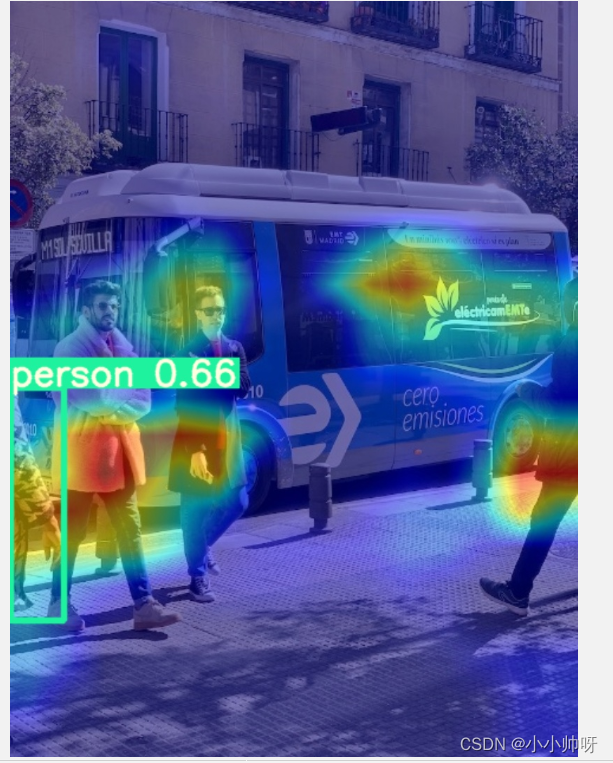
运行main_gradcam.py
参数列表可以自己进行修改。
# Arguments
parser = argparse.ArgumentParser()
parser.add_argument('--model-path', type=str, default="yolov5s.pt", help='Path to the model')
parser.add_argument('--img-path', type=str, default='data/images/bus.jpg', help='input image path')
parser.add_argument('--output-dir', type=str, default='runs/result17', help='output dir')
parser.add_argument('--img-size', type=int, default=640, help="input image size")
parser.add_argument('--target-layer', type=str, default='model_17_cv3_act',
                    help='The layer hierarchical address to which gradcam will applied,'
                         ' the names should be separated by underline')
parser.add_argument('--method', type=str, default='gradcam', help='gradcam method')
parser.add_argument('--device', type=str, default='cuda', help='cuda or cpu')
parser.add_argument('--no_text_box', action='store_true',
                    help='do not show label and box on the heatmap')
args = parser.parse_args()
为了将Cucumber用于命令行脚本,我按照提供的说明安装了arubagem。它在我的Gemfile中,我可以验证是否安装了正确的版本并且我已经包含了require'aruba/cucumber'在'features/env.rb'中为了确保它能正常工作,我写了以下场景:@announceScenario:Testingcucumber/arubaGivenablankslateThentheoutputfrom"ls-la"shouldcontain"drw"假设事情应该失败。它确实失败了,但失败的原因是错误的:@announceScenario:Testingcucumber/ar
我正在使用puppet为ruby程序提供一组常量。我需要提供一组主机名,我的程序将对其进行迭代。在我之前使用的bash脚本中,我只是将它作为一个puppet变量hosts=>"host1,host2"我将其提供给bash脚本作为HOSTS=显然这对ruby不太适用——我需要它的格式hosts=["host1","host2"]自从phosts和putsmy_array.inspect提供输出["host1","host2"]我希望使用其中之一。不幸的是,我终其一生都无法弄清楚如何让它发挥作用。我尝试了以下各项:我发现某处他们指出我需要在函数调用前放置“function_”……这
这是一道面试题,我没有答对,但还是很好奇怎么解。你有N个人的大家庭,分别是1,2,3,...,N岁。你想给你的大家庭拍张照片。所有的家庭成员都排成一排。“我是家里的friend,建议家庭成员安排如下:”1岁的家庭成员坐在这一排的最左边。每两个坐在一起的家庭成员的年龄相差不得超过2岁。输入:整数N,1≤N≤55。输出:摄影师可以拍摄的照片数量。示例->输入:4,输出:4符合条件的数组:[1,2,3,4][1,2,4,3][1,3,2,4][1,3,4,2]另一个例子:输入:5输出:6符合条件的数组:[1,2,3,4,5][1,2,3,5,4][1,2,4,3,5][1,2,4,5,3][
我想使用spawn(针对多个并发子进程)在Ruby中执行一个外部进程,并将标准输出或标准错误收集到一个字符串中,其方式类似于使用Python的子进程Popen.communicate()可以完成的操作。我尝试将:out/:err重定向到一个新的StringIO对象,但这会生成一个ArgumentError,并且临时重新定义$stdxxx会混淆子进程的输出。 最佳答案 如果你不喜欢popen,这是我的方法:r,w=IO.pipepid=Process.spawn(command,:out=>w,:err=>[:child,:out])
Unity自动旋转动画1.开门需要门把手先动,门再动2.关门需要门先动,门把手再动3.中途播放过程中不可以再次进行操作觉得太复杂?查看我的文章开关门简易进阶版效果:如果这个门可以直接打开的话,就不需要放置"门把手"如果门把手还有钥匙需要旋转,那就可以把钥匙放在门把手的"门把手",理论上是可以无限套娃的可调整参数有:角度,反向,轴向,速度运行时点击Test进行测试自己写的代码比较垃圾,命名与结构比较拉,高手轻点喷,新手有类似的需求可以拿去做参考上代码usingSystem.Collections;usingSystem.Collections.Generic;usingUnityEngine;u
我想知道Ruby用来在命令行打印这些东西的输出流:irb(main):001:0>a="test"=>"test"irb(main):002:0>putsatest=>nilirb(main):003:0>a=>"test"$stdout是否用于irb(main):002:0>和irb(main):003:0>?而且,在这两次调用之间,$stdout的值是否有任何变化?另外,有人能告诉我打印/写入这些内容的Ruby源代码吗? 最佳答案 是的。而且很容易向自己测试/证明。在命令行试试这个:ruby-e'puts"foo"'>test.
我在使用自定义RailsFormBuilder时遇到了问题,从昨天晚上开始我就发疯了。基本上我想对我的构建器方法之一有一个可选block,以便我可以在我的主要content_tag中显示其他内容。:defform_field(method,&block)content_tag(:div,class:'field')doconcatlabel(method,"Label#{method}")concattext_field(method)capture(&block)ifblock_given?endend当我在我的一个Slim模板中调用该方法时,如下所示:=f.form_field:e
考虑一下:现在这些情况:#output:http://domain.com/?foo=1&bar=2#output:http://domain.com/?foo=1&bar=2#output:http://domain.com/?foo=1&bar=2#output:http://domain.com/?foo=1&bar=2我需要用其他字符串输出URL。我如何保证&符号不会被转义?由于我无法控制的原因,我无法发送&。求助!把我的头发拉到这里:\编辑:为了澄清,我实际上有一个像这样的数组:@images=[{:id=>"fooid",:url=>"http://
我有一个像这样的ruby类:require'logger'classTdefdo_somethinglog=Logger.new(STDERR)log.info("Hereisaninfomessage")endend测试脚本行如下:#!/usr/bin/envrubygem"minitest"require'minitest/autorun'require_relative't'classTestMailProcessorClasses当我运行这个测试时,out和err都是空字符串。我看到消息打印在stderr上(在终端上)。有没有办法让Logger和capture_io一起玩得
在运行Cucumber测试时,我得到(除了测试结果)大量调试/日志相关的输出形式:D,[2013-03-06T12:21:38.911829#49031]DEBUG--:SOAPrequest:D,[2013-03-06T12:21:38.911919#49031]DEBUG--:Pragma:no-cache,SOAPAction:"",Content-Type:text/xml;charset=UTF-8,Content-Length:1592W,[2013-03-06T12:21:38.912360#49031]WARN--:HTTPIexecutesHTTPPOSTusingt
