文章目录
二叉搜索树又称二叉排序树,它或者是一棵空树,或者是具有以下性质的二叉树:
若它的左子树不为空,则左子树上所有节点的值都小于根节点的值
若它的右子树不为空,则右子树上所有节点的值都大于根节点的值
左<根<右
它的左右子树也分别为二叉搜索树
之所以又叫二叉排序树,是因为二叉搜索树中序遍历的结果是有序的
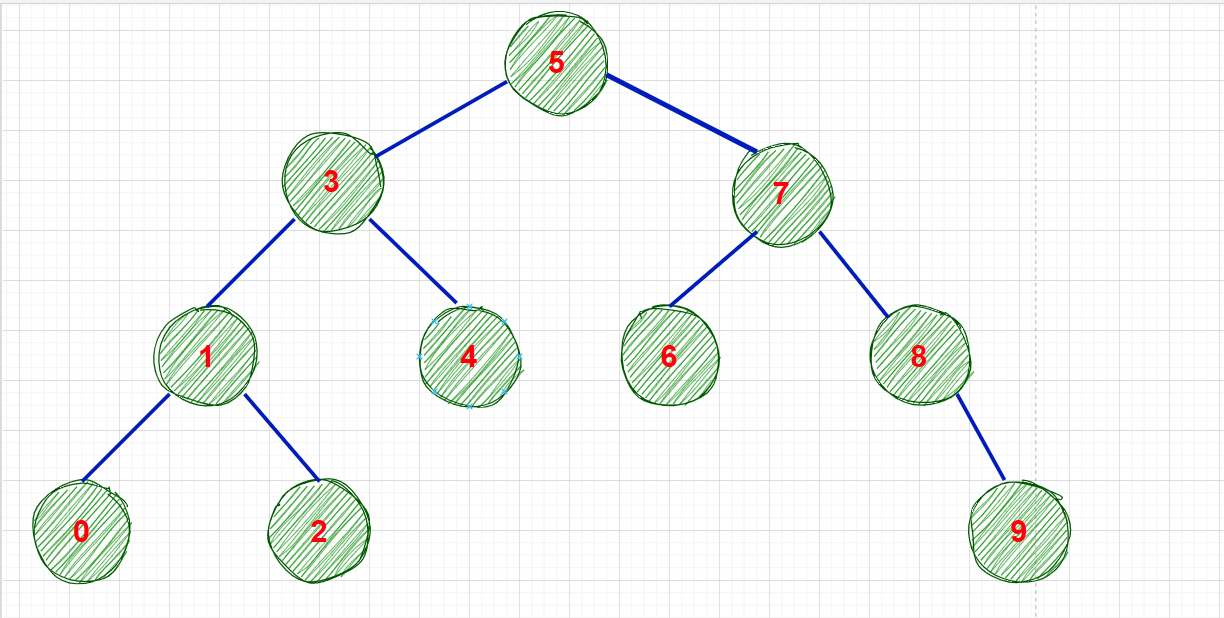
基于二叉搜索树的特点,查找一个数并不难,若根节点不为空的情况下:
若根节点key==查找key,直接返回true
若根节点key>查找key,那得找到更小的,则往左子树查找
若根节点key<查找key,那得找到更大的,则往右子树查找
最多查找高度次,走到空为止,如果还没找到,则说明这个值不存在,返回false
	bool find(const K& key)
	{
		Node* cur = _root;
		while (cur)
		{
			if (cur->_key < key)
			{
				cur = cur->_right;
			}
			else if (cur->_key > key)
			{
				cur = cur->_left;
			}
			else
			{
				return true;
			}
		}
		return false;
	}
1.树为空,则直接插入,新增节点,直接插入root指针即可
2.树不为空,按二叉搜索树性质查找插入位置,插入新节点。
(注意:不能插入重复的元素,并且每次插入都是要定位到空节点的位置;我们先定义一个 cur从root开始,比较元素的大小:若插入的元素比当前位置元素小就往左走,比当前位置元素大就往右走,直到为空,相等就不能插入了;同时定义一个parent去记录当前 cur的前一个位置,最后判断cur是parent的左子树还是右子树即可)
	bool Insert(const K& key)
	{
		if (_root == nullptr)
		{
			_root = new Node(key);
			return true;
		}
		Node* parent = nullptr;
		Node* cur = _root;
		while (cur)
		{
			if (cur->_key < key)
			{
				parent = cur;
				cur = cur->_right;
			}
			else if (cur->_key > key)
			{
				parent = cur;
				cur = cur->_left;
			}
			else
			{
				return false;
			}
		}
		cur = new Node(key);
		if (parent->_key < key)
		{
			parent->_right = cur;
		}
		else
		{
			parent->_left = cur;
		}
		return true;
	}
递归走起,同时由于_root是私有的,外部不能访问,我们可以在类内给中序提供一个方法即可,就不需要传参了
void InOrder()
	{
		_InOrder(_root);
		cout << endl;
	}

private:
	void _InOrder(Node* root)
	{
		if (root == nullptr)
		{
			return;
		}
		_InOrder(root->_left);
		cout << root->_key << " ";
		_InOrder(root->_right);
	}
	Node* _root = nullptr;
删除的情况比较多:
但是左右都为空可以纳入到左为空或右为空的情况
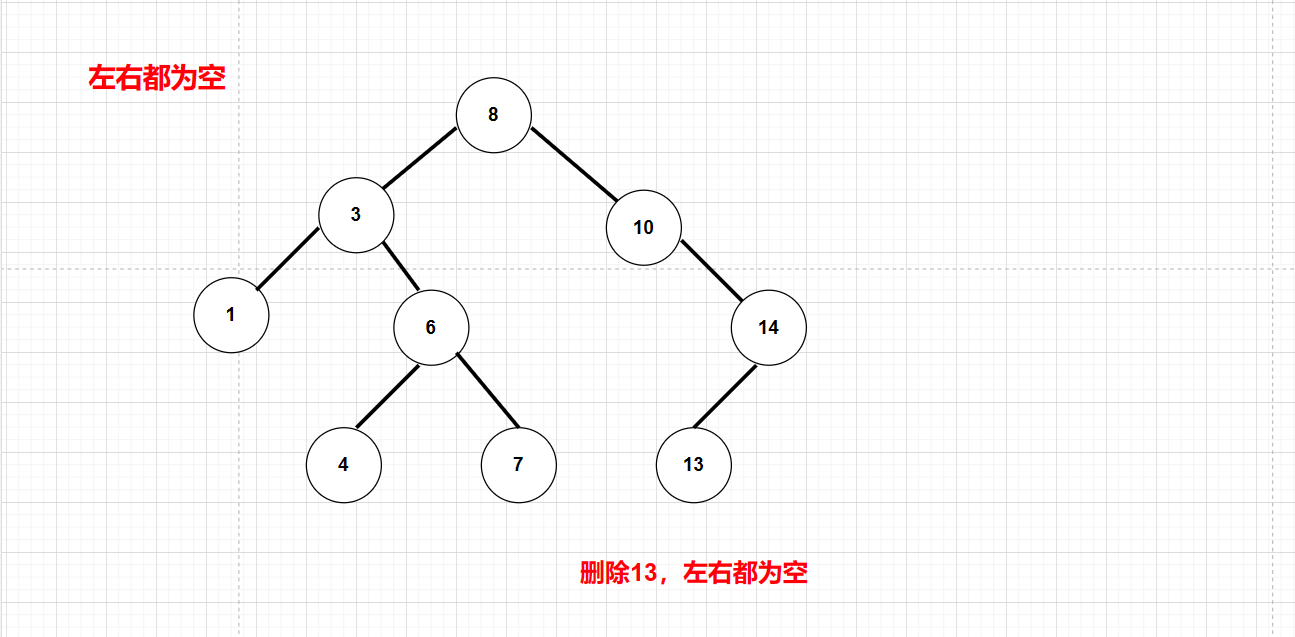
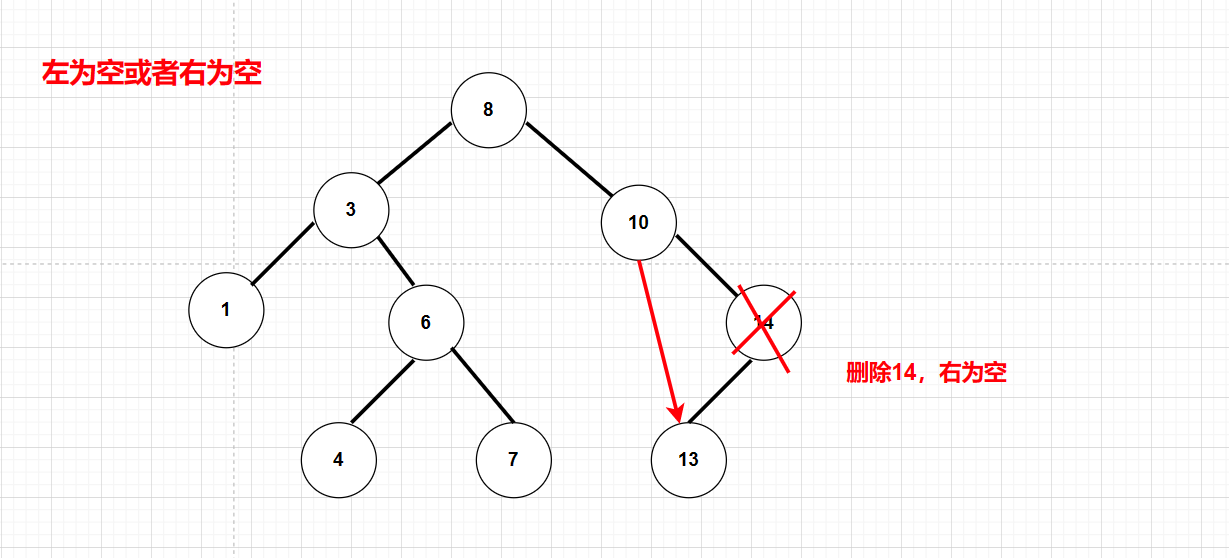
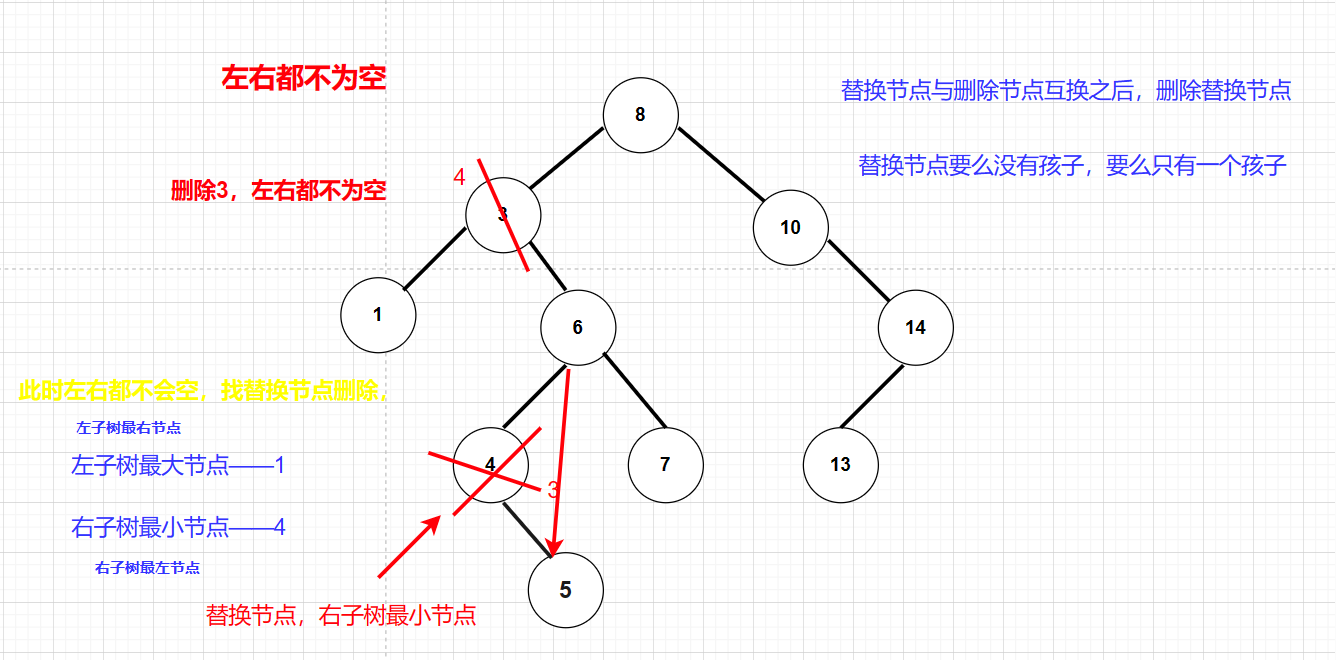
注意:
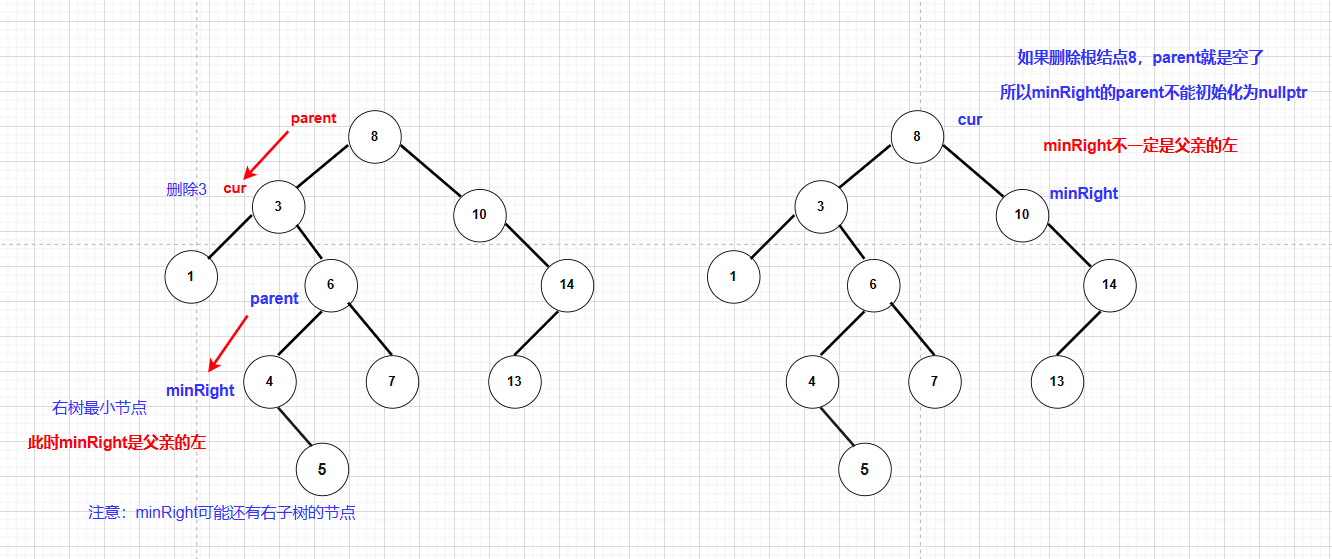
代码实现:
bool Erase(const K& key)
	{
		Node* parent = nullptr;
		Node* cur = _root;
		while (cur)
		{
			if (cur->_key < key)
			{
				parent = cur;
				cur = cur->_right;
			}
			else if (cur->_key > key)
			{
				parent = cur;
				cur = cur->_left;
			}
			else
			{
				//左为空
				if (cur->_left == nullptr)
				{
					//删除根结点
					//if(parent==nullptr)
					if (cur == _root)
					{
						_root = cur->_right;
					}
					else
					{
						if (parent->_left == cur)
						{
							parent->_left = cur->_right;
						}
						else
						{
							parent->_right = cur->_right;
						}
					}
					delete cur;
				}
				//右为空
				else if (cur->_right == nullptr)
				{
					if (cur == _root)
					{
						_root = cur->_left;
					}
					else
					{
						if (parent->_left == cur)
						{
							parent->_left = cur->_left;
						}
						else
						{
							parent->_right = cur->_left;
						}
					}
					delete cur;
				}
				//左右都不为空,找替换节点
				else
				{
					//不能初始化为nullptr
					Node* parent = cur;
					//右子树最小节点
					Node* minRight = cur->_right;
					while (minRight->_left)
					{
						parent = minRight;
						minRight = minRight->_left;
					}
					cur->_key = minRight->_key;
					//判断minRight是父亲的左还是右
					if (minRight == parent->_left)
					{
						parent->_left = minRight->_right;
					}
					else
					{
						parent->_right = minRight->_right;
					}
					delete minRight;
				}
				return true;
			}
		}
		return false;
	}
这个比较简单:苏醒把,递归时刻
bool _FindR(Node* root, const K& key)
	{
		if (root == nullptr) return false;
		else if (root->_key < key) return _FindR(root->_right, key);
		else if (root->_key > key) return _FindR(root->_left, key);
		else return true;
	}
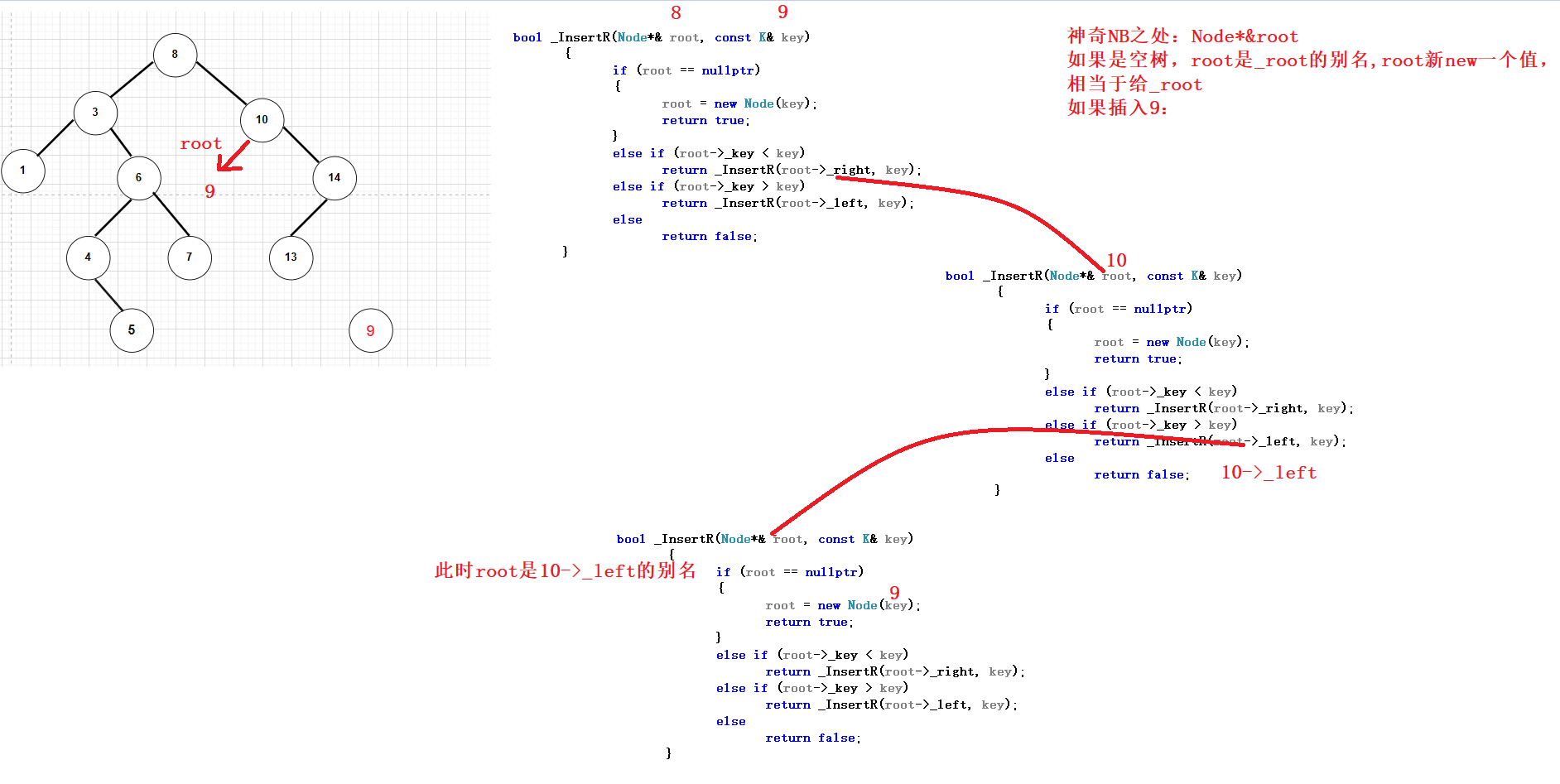
最大的问题是插入之后跟父亲进行链接,如果直接给root是不可以的,因为root是栈帧里面的参数,只是局部变量:加上引用
bool _InsertR(Node*& root, const K& key)
	{
		if (root == nullptr)
		{
			root = new Node(key);
			return true;
		}
		else if (root->_key < key)
			return _InsertR(root->_right, key);
		else if (root->_key > key)
			return _InsertR(root->_left, key);
		else
			return false;
	}
递归删除怎么找到父节点?root = root->_left/ root = root->_right;
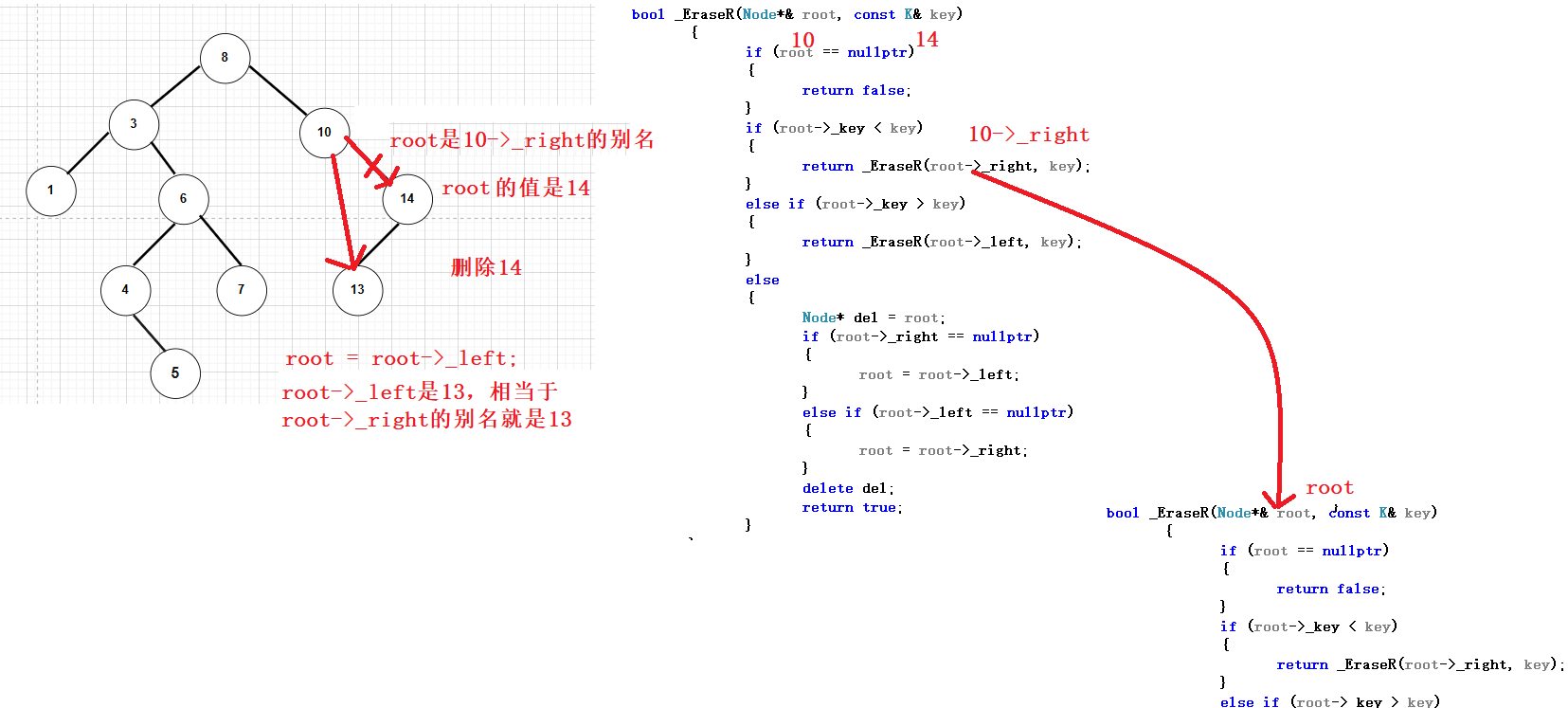
bool _EraseR(Node*& root, const K& key)
	{
		if (root == nullptr)
		{
			return false;
		}
		if (root->_key < key)
		{
			return _EraseR(root->_right, key);
		}
		else if (root->_key > key)
		{
			return _EraseR(root->_left, key);
		}
		else
		{
			Node* del = root;
			if (root->_right == nullptr)
			{
				root = root->_left;
			}
			else if (root->_left == nullptr)
			{
				root = root->_right;
			}
			else
			{
				Node* minRight = root->_right;
				while (minRight->_left)
				{
					minRight = minRight->_left;
				}
				swap(root->_key, minRight->_key);
				return _EraseR(root->_right, key);
			}
			delete del;
			return true;
		}
	}
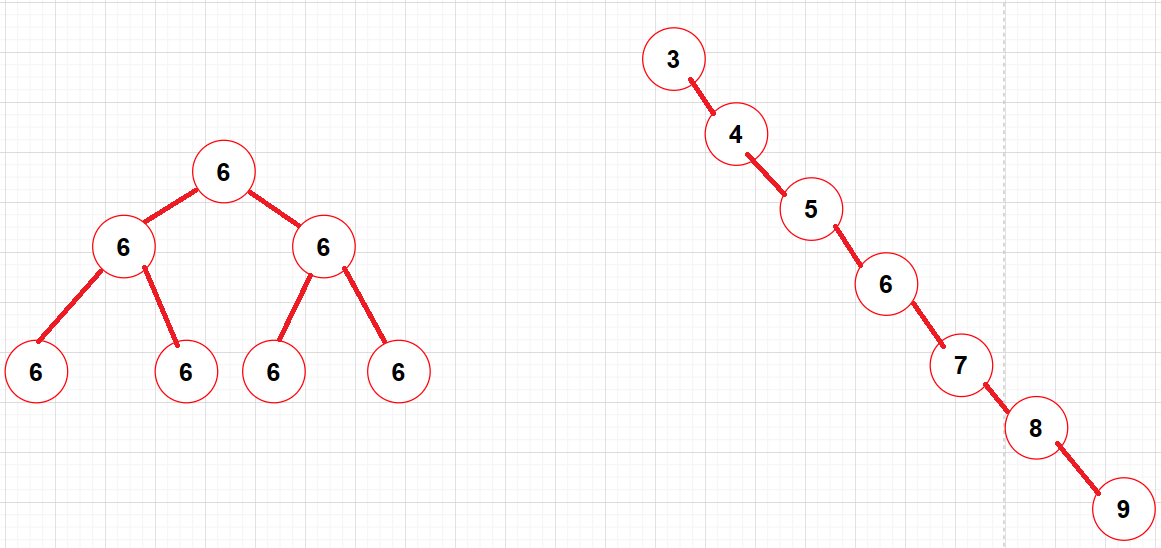
最优情况下,二叉搜索树为完全二叉树,其平均比较次数为:log2N
最差情况下,二叉搜索树退化为单支树,其平均比较次数为: N/2
1.K模型:K模型即只有key作为关键码,结构中只需要存储Key即可,关键码即为需要搜索到的值,判断关键字是否存在。
比如:给一个单词word,判断该单词是否拼写正确,具体方式如下:
以单词集合中的每个单词作为key,构建一棵二叉搜索树,在二叉搜索树中检索该单词是否存在,存在则拼写正确,不存在则拼写错误。
2.KV模型:每一个关键码key,都有与之对应的值Value,即**<Key, Value>**的键值对。
比如英汉词典就是英文与中文的对应关系,通过英文可以快速找到与其对应的中文,英文单词与其对应的中文<word, chinese>就构成一种键值对;再比如统计单词次数,统计成功后,给定单词就可快速找到其出现的次数,单词与其出现次数就是**<word, count>**就构成一种键值对。
namespace KV
{
	template <class K,class V>
	struct BSTreeNode
	{
		BSTreeNode<K,V>* _left;
		BSTreeNode<K,V>* _right;
		K _key;
		V _value;

		BSTreeNode(const K& key,const V&value)
			:_key(key),
			_value(value),
			_left(nullptr),
			_right(nullptr)
		{}
	};

	template <class K,class V>
	class BSTree
	{
        typedef BSTreeNode<K, V> Node;
	public:
		bool Insert(const K& key, const V& value)

		Node* find(const K& key)

		void InOrder()
	private:
		Node* _root = nullptr;
	};
}
void TestBSTree()
{
	//key/Value的搜索模型;通过key查找或修改Value
	KV::BSTree<string, string> dict;
	dict.Insert("sort", "排序");
	dict.Insert("string", "字符串");
	dict.Insert("left", "左");
	dict.Insert("right", "右");
	string str;
	while (cin >> str)
	{
		KV::BSTreeNode<string, string>* ret = dict.find(str);
		if (ret)
		{
			cout << ret->_value << endl;
		}
		else
		{
			cout << "找不到" << endl;
		}
	}

}
源代码:
BSTree.h
#include <iostream>
using namespace std;

namespace K
{
	template <class K>
	struct BSTreeNode
	{
		BSTreeNode<K>* _left;
		BSTreeNode<K>* _right;
		K _key;

		BSTreeNode(const K& key)
			:_key(key),
			_left(nullptr),
			_right(nullptr)
		{}
	};
	template <class K>
	class BSTree
	{
		typedef BSTreeNode<K> Node;
	public:
		BSTree()
			:_root(nullptr)
		{}

		BSTree(const BSTree<K>& t)
		{
			_root = Copy(t._root);
		}

		BSTree<K>& operator = (BSTree<K> t)
		{
			swap(_root, t._root);
			return *this;
		}
		~BSTree()
		{
			Destroy(_root);
			_root = nullptr;
		}


		bool Insert(const K& key)
		{
			if (_root == nullptr)
			{
				_root = new Node(key);
				return true;
			}
			Node* parent = nullptr;
			Node* cur = _root;
			while (cur)
			{
				if (cur->_key < key)
				{
					parent = cur;
					cur = cur->_right;
				}
				else if (cur->_key > key)
				{
					parent = cur;
					cur = cur->_left;
				}
				else
				{
					return false;
				}
			}
			cur = new Node(key);
			if (parent->_key < key)
			{
				parent->_right = cur;
			}
			else
			{
				parent->_left = cur;
			}
			return true;
		}

		bool find(const K& key)
		{
			Node* cur = _root;
			while (cur)
			{
				if (cur->_key < key)
				{
					cur = cur->_right;
				}
				else if (cur->_key > key)
				{
					cur = cur->_left;
				}
				else
				{
					return true;
				}
			}
			return false;
		}

		bool Erase(const K& key)
		{
			Node* parent = nullptr;
			Node* cur = _root;
			while (cur)
			{
				if (cur->_key < key)
				{
					parent = cur;
					cur = cur->_right;
				}
				else if (cur->_key > key)
				{
					parent = cur;
					cur = cur->_left;
				}
				else
				{
					//左为空
					if (cur->_left == nullptr)
					{
						//删除根结点
						//if(parent==nullptr)
						if (cur == _root)
						{
							_root = cur->_right;
						}
						else
						{
							if (parent->_left == cur)
							{
								parent->_left = cur->_right;
							}
							else
							{
								parent->_right = cur->_right;
							}
						}
						delete cur;
					}
					//右为空
					else if (cur->_right == nullptr)
					{
						if (cur == _root)
						{
							_root = cur->_left;
						}
						else
						{
							if (parent->_left == cur)
							{
								parent->_left = cur->_left;
							}
							else
							{
								parent->_right = cur->_left;
							}
						}
						delete cur;
					}
					//左右都不为空,找替换节点
					else
					{
						//不能初始化为nullptr
						Node* parent = cur;
						//右子树最小节点
						Node* minRight = cur->_right;
						while (minRight->_left)
						{
							parent = minRight;
							minRight = minRight->_left;
						}
						cur->_key = minRight->_key;
						//判断minRight是父亲的左还是右
						if (minRight == parent->_left)
						{
							parent->_left = minRight->_right;
						}
						else
						{
							parent->_right = minRight->_right;
						}
						delete minRight;
					}
					return true;
				}
			}
			return false;
		}


		void InOrder()
		{
			_InOrder(_root);
			cout << endl;
		}

        //递归
		bool InsertR(const K& key)
		{
			return _InsertR(_root, key);
		}

		bool FindR(const K& key)
		{
			return _FindR(_root, key);
		}

		bool EraseR(const K& key)
		{
			return _EraseR(_root, key);
		}

	private:
		void Destroy(Node* root)
		{
			if (root == nullptr)
			{
				return;
			}
			Destroy(root->_left);
			Destroy(root->_right);
			delete root;
		}

		Node* Copy(Node* root)
		{
			if (root == nullptr)
				return nullptr;
			Node* newRoot = new Node(root->_key);
			newRoot->_left = Copy(root->_left);
			newRoot->_right = Copy(root->_right);
			return newRoot;
		}

		bool _EraseR(Node*& root, const K& key)
		{
			if (root == nullptr)
			{
				return false;
			}
			if (root->_key < key)
			{
				return _EraseR(root->_right, key);
			}
			else if (root->_key > key)
			{
				return _EraseR(root->_left, key);
			}
			else
			{
				Node* del = root;
				if (root->_right == nullptr)
				{
					root = root->_left;
				}
				else if (root->_left == nullptr)
				{
					root = root->_right;
				}
				else
				{
					Node* minRight = root->_right;
					while (minRight->_left)
					{
						minRight = minRight->_left;
					}
					swap(root->_key, minRight->_key);
					return _EraseR(root->_right, key);
				}
				delete del;
				return true;
			}
		}

		bool _InsertR(Node*& root, const K& key)
		{
			if (root == nullptr)
			{
				root = new Node(key);
				return true;
			}
			else if (root->_key < key)
				return _InsertR(root->_right, key);
			else if (root->_key > key)
				return _InsertR(root->_left, key);
			else
				return false;
		}

		bool _FindR(Node* root, const K& key)
		{
			if (root == nullptr) return false;
			else if (root->_key < key) return _FindR(root->_right, key);
			else if (root->_key > key) return _FindR(root->_left, key);
			else return true;
		}

		void _InOrder(Node* root)
		{
			if (root == nullptr)
			{
				return;
			}
			_InOrder(root->_left);
			cout << root->_key << " ";
			_InOrder(root->_right);
		}
		Node* _root = nullptr;
	};
}

namespace KV
{
	template <class K,class V>
	struct BSTreeNode
	{
		BSTreeNode<K,V>* _left;
		BSTreeNode<K,V>* _right;
		K _key;
		V _value;

		BSTreeNode(const K& key,const V&value)
			:_key(key),
			_value(value),
			_left(nullptr),
			_right(nullptr)
		{}
	};

	template <class K,class V>
	class BSTree
	{
		typedef BSTreeNode<K, V> Node;
	public:
		bool Insert(const K& key, const V& value)
		{
			if (_root == nullptr)
			{
				_root = new Node(key, value);
				return true;
			}
			Node* parent = nullptr;
			Node* cur = _root;
			while (cur)
			{
				if (cur->_key < key)
				{
					parent = cur;
					cur = cur->_right;
				}
				else if (cur->_key > key)
				{
					parent = cur;
					cur = cur->_left;
				}
				else
				{
					return false;
				}
			}
			cur = new Node(key, value);
			if (parent->_key < key)
			{
				parent->_right = cur;
			}
			else
			{
				parent->_left = cur;
			}
			return true;
		}

		Node* find(const K& key)
		{
			Node* cur = _root;
			while (cur)
			{
				if (cur->_key < key)
				{
					cur = cur->_right;
				}
				else if (cur->_key > key)
				{
					cur = cur->_left;
				}
				else
				{
					return cur;
				}
			}
			return nullptr;
		}
		void InOrder()
		{
			_InOrder(_root);
		}
	private:
		void _InOrder(Node* root)
		{
			if (root == nullptr) return;
			_InOrder(root->_left);
			cout << root->_key << ":"<<root->_value<<endl;
			_InOrder(root->_right);
		}
		Node* _root = nullptr;
	};
}
void TestBSTree1()
{
	int a[] = { 8, 3, 1, 10, 6, 4, 7, 14, 13 };
	K::BSTree<int> t;
	for (auto e : a)
	{
		t.Insert(e);
	}
	t.InOrder();
	K::BSTree<int> copyt(t);
	copyt.InOrder();
	t.InsertR(9);
	t.InOrder();
	t.EraseR(9);
	t.InOrder();

	t.EraseR(3);
	t.InOrder();

	for (auto e : a)
	{
		t.EraseR(e);
	    t.InOrder();
	}
}
void TestBSTree2()
{
	KV::BSTree<string, string> dict;
	dict.Insert("sort", "排序");
	dict.Insert("string", "字符串");
	dict.Insert("left", "左");
	dict.Insert("right", "右");
	string str;
	while (cin >> str)
	{
		KV::BSTreeNode<string, string>* ret = dict.find(str);
		if (ret)
		{
			cout << ret->_value << endl;
		}
		else
		{
			cout << "找不到" << endl;
		}
	}

}
void TestBSTree3()
{
	string arr[] = { "苹果","西瓜","苹果" };
	KV::BSTree<string, int> countTree;
	for (auto e : arr)
	{
		auto* ret = countTree.find(e);
		if (ret == nullptr)
		{
			countTree.Insert(e, 1);
		}
		else
		{
			ret->_value++;
		}
	}
	countTree.InOrder();
}
#include "BSTree.h"
int main()
{
    //TestBSTree1();
	TestBSTree2();
    //TestBSTree3();
	return 0;
}
根据二叉树创建字符串
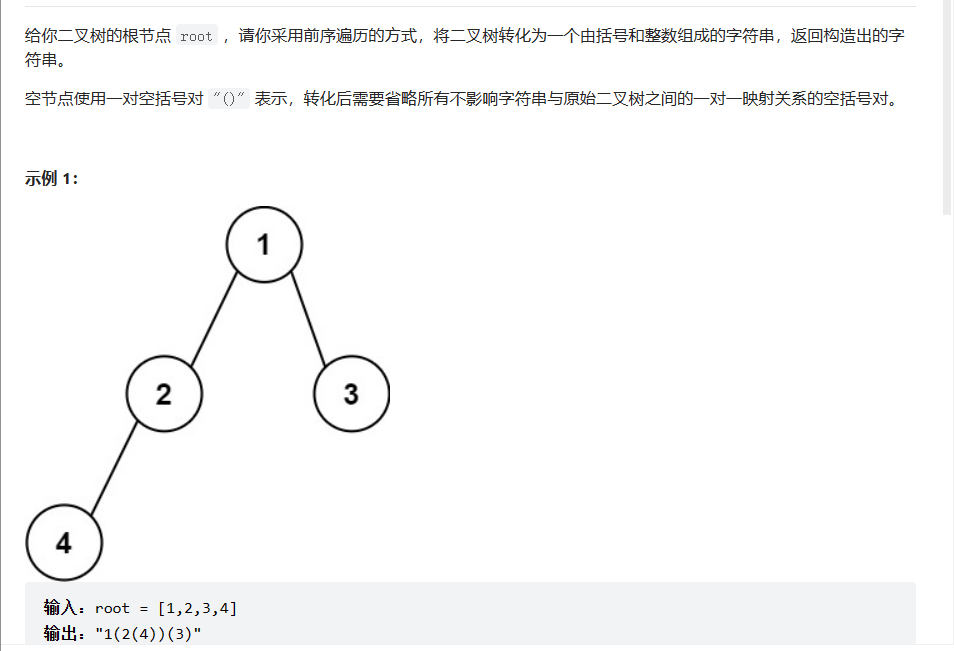
前序遍历,左为空,右不为空的括号不可以省略,右为空的括号可以省略
class Solution {
public:
    string tree2str(TreeNode* root) {
        if(root == nullptr) return string();
        string ret;
        ret += to_string(root->val);
        if(root->left)
        {
            ret+='(';
            ret+= tree2str(root->left);
            ret+=')';
        }
        else if(root->right)
        {
            ret+="()";
        }

        if(root->right)
        {
            ret+='(';
            ret+=tree2str(root->right);
            ret+=')';
        }
        return ret;

    }
};
二叉树的层序遍历
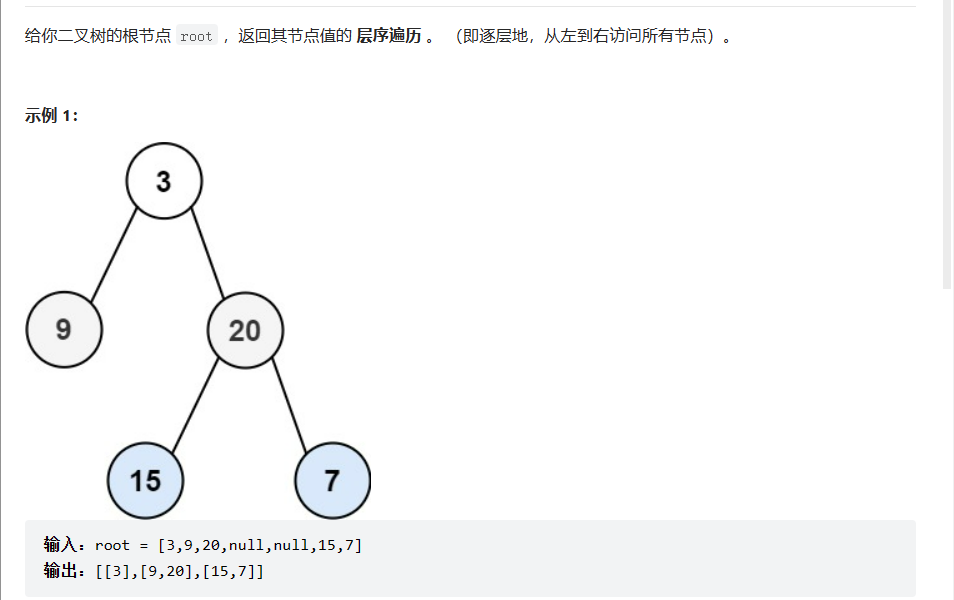
层序遍历,可以通过一个队列来实现,同时定义每次队列的大小
class Solution {
public:
    vector<vector<int>> levelOrder(TreeNode* root) {
        queue<TreeNode*> q;
        vector<vector<int>> vv;
        size_t levelSize = 0;
        if(root)
        {
            q.push(root);
            levelSize=1;
        }
        while(!q.empty())
        {
            vector<int> v;
            while(levelSize--)
            {
                TreeNode* front = q.front();
                q.pop();
                v.push_back(front->val);
                if(front->left)
                {
                    q.push(front->left);
                }
                if(front->right)
                {
                    q.push(front->right);
                }
            }
            vv.push_back(v);
            levelSize = q.size();
        }
        return vv;
    }
};
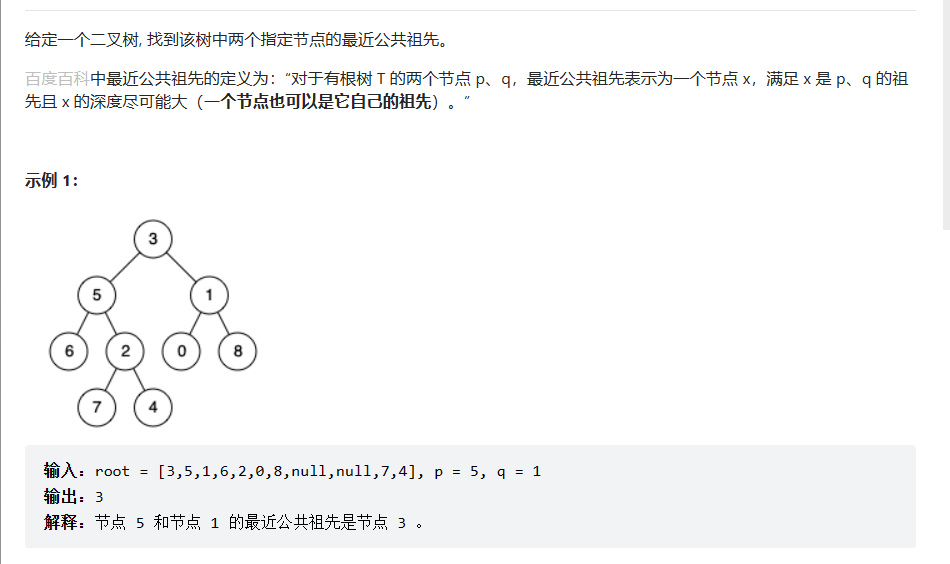
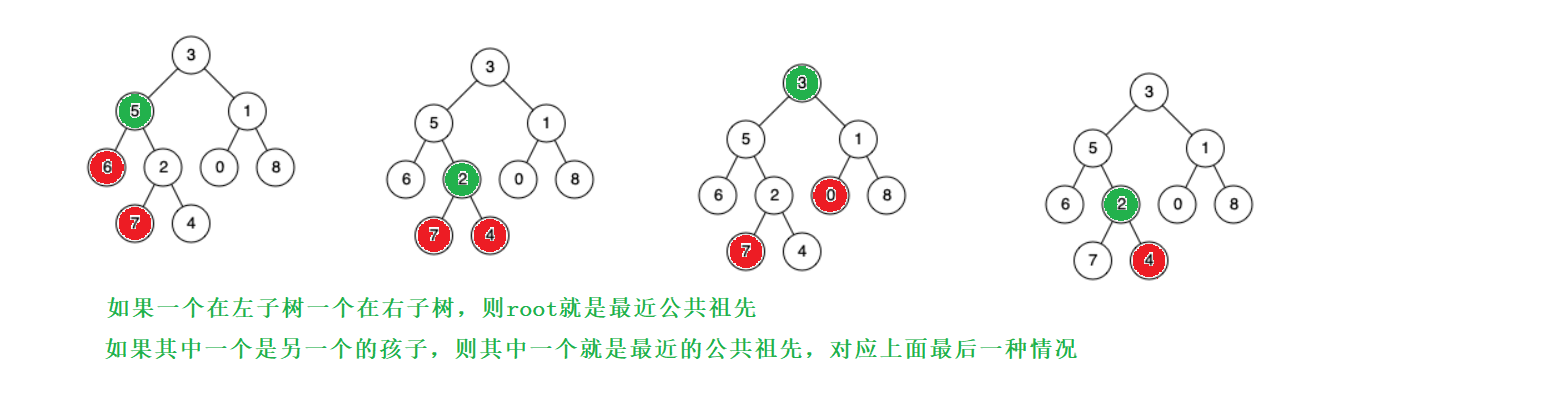
二叉树的最近公共祖先
class Solution {
    bool isInTree(TreeNode*root,TreeNode*x)
    {
        if(root == nullptr) return false;
        if(root == x) return true;
        else
            return isInTree(root->left,x)
                || isInTree(root->right,x);
    }
public:
    TreeNode* lowestCommonAncestor(TreeNode* root, TreeNode* p, TreeNode* q) {
        if(root==nullptr)
            return nullptr;
        if(root == p||root==q) return root;
        bool pLeft = isInTree(root->left,p);
        bool pRight = !pLeft;
        bool qLeft = isInTree(root->left,q);
        bool qRight = !qLeft;
        //一个在左一个在右
        if((pLeft&&qRight)||(pRight&&qLeft))
            return root;
        //同左
        if(pLeft&&qLeft)
            return lowestCommonAncestor(root->left,p,q);
        //同右
        else
            return lowestCommonAncestor(root->right,p,q);
    }
};
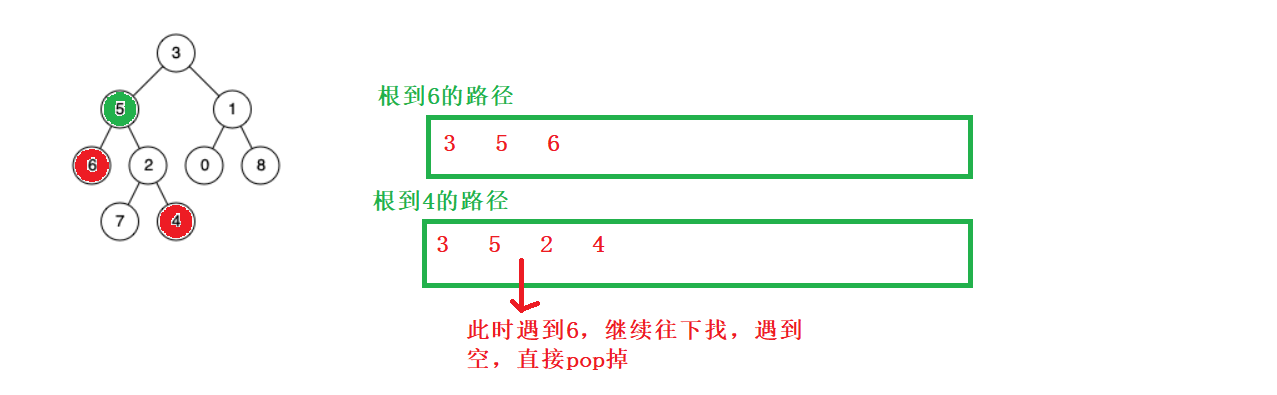
把根到对应节点的路径存储起来,在找出相交的结点即是最近的公共结点:
class Solution {
    bool GetPath(TreeNode*root,TreeNode*x,stack<TreeNode*>& stack)
    {
        if(root == nullptr) return false;
        stack.push(root);
        if(root == x)
        {
            return true;
        }
        if(GetPath(root->left,x,stack))
            return true;
        if(GetPath(root->right,x,stack))
            return true;
        stack.pop();
        return false;
    }
public:
    TreeNode* lowestCommonAncestor(TreeNode* root, TreeNode* p, TreeNode* q) {
        if(root==nullptr)
            return nullptr;
        stack<TreeNode*> pPath;
        stack<TreeNode*> qPath;
        GetPath(root,p,pPath);
        GetPath(root,q,qPath);
        //长的先pop
        while(pPath.size()!=qPath.size())
        {
            if(pPath.size()>qPath.size())
            {
                pPath.pop();
            }
            else
                qPath.pop();
        }
        //同时pop,找出交点
        while(pPath.top()!=qPath.top())
        {
            pPath.pop();
            qPath.pop();
        }
        return pPath.top();
    }
};
二叉搜索树与双向链表
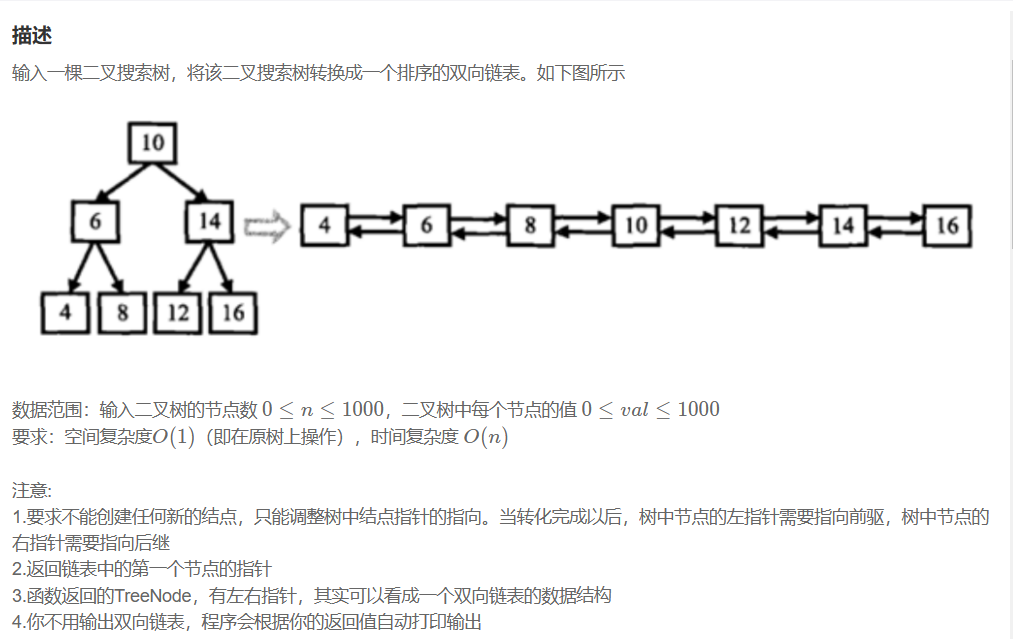
思路一:中序遍历,将节点放到一个vector中,在链接节点,但是空间复杂度不符合题目要求:
class Solution {
	void InOrder(TreeNode*root,vector<TreeNode*>& v)
	{
		if(root==nullptr) return;
		InOrder(root->left,v);
		v.push_back(root);
		InOrder(root->right,v);
	}
public:
    TreeNode* Convert(TreeNode* pRootOfTree) {
		if(pRootOfTree==nullptr) return nullptr;
		vector<TreeNode*> v;
		InOrder(pRootOfTree,v);
		if(v.size()<=1) return v[0];
		v[0]->left =nullptr;
		v[0]->right = v[1];
		for(int i =1;i<v.size()-1;i++)
		{
			v[i]->left = v[i-1];
			v[i]->right = v[i+1];
		}
		v[v.size()-1]->left = v[v.size()-2];
		v[v.size()-1]->right = nullptr;
		return v[0];
	}
};
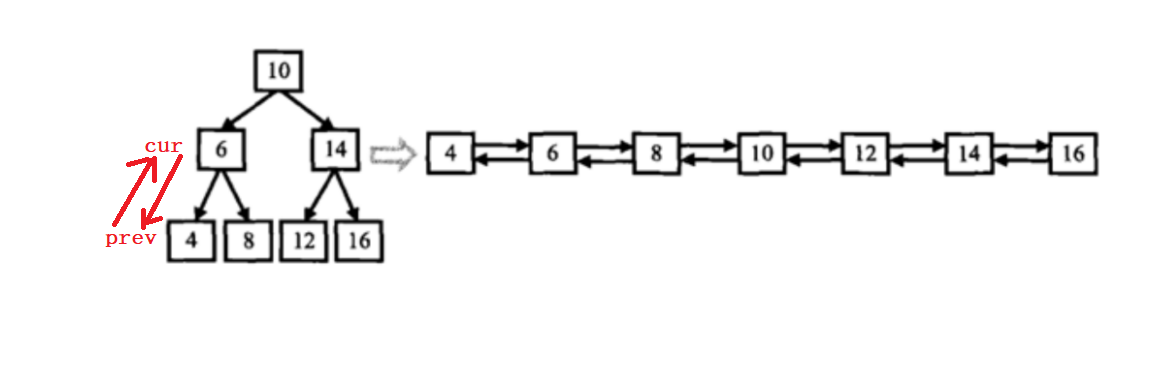
思路二:递归直接进行转换
class Solution {
	void InOrder(TreeNode*cur,TreeNode*&prev)
	{
		if(cur==nullptr)
		{
			return;
		}
		InOrder(cur->left,prev);
		cur->left = prev;
		if(prev)
		{
			prev->right = cur;
		}
		prev = cur;
		InOrder(cur->right,prev);
	}

public:
    TreeNode* Convert(TreeNode* pRootOfTree) {
		TreeNode*prev = nullptr;
		InOrder(pRootOfTree,prev);
		//找头
		TreeNode*head = pRootOfTree;
		while(head&&head->left)
		{
			head = head->left;
		}
		return head;
	}
};
从前序与中序遍历序列构造二叉树
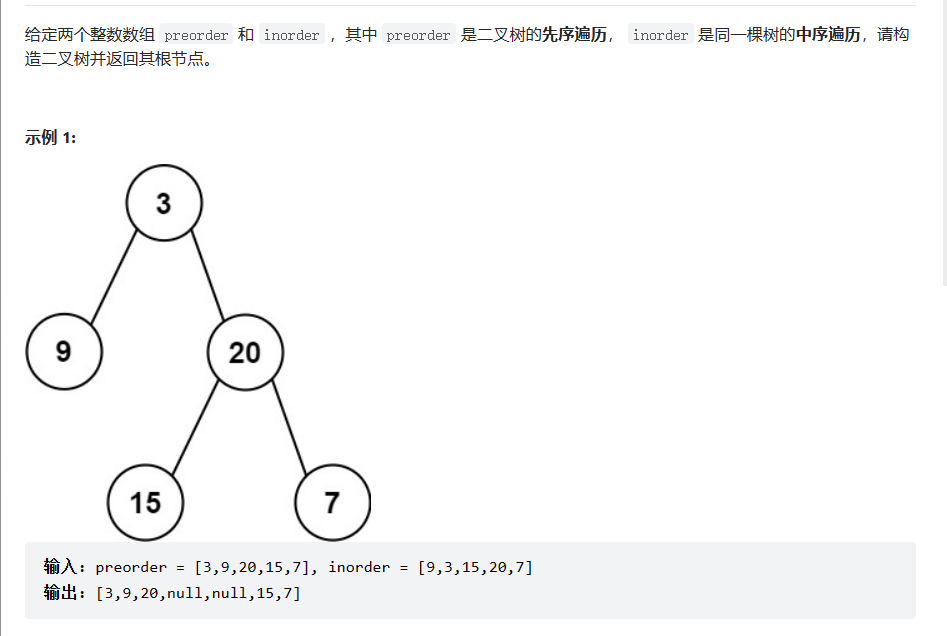
根据前序结果去创建树,前序是根左右,前序第一个元素就是根,在通过中序去进行分割左右子树。子树区间确认是否继续递归创建子树,区间不存在则是空树。所以根据前序先构造根,在通过中序构造左子树、在构造右子树即可。
class Solution {
    TreeNode* _buildTree(vector<int>& preorder, vector<int>& inorder,int&prei,int inbegin,int inend)
    {
        if(inbegin>inend)
        {
            return nullptr;
        }
        TreeNode*root = new TreeNode(preorder[prei]);
        int rooti = inbegin;
        while(inbegin<=inend)
        {
            if(preorder[prei] == inorder[rooti])
            {
                break;
            }
            else rooti++;
        }
        prei++;
        //[inbegin,rooti-1]rooti[rooti+1,inend]
        root->left= _buildTree(preorder,inorder,prei,inbegin,rooti-1);
        root->right = _buildTree(preorder,inorder,prei,rooti+1,inend);
        return root;
    }
public:
    TreeNode* buildTree(vector<int>& preorder, vector<int>& inorder) {
        int prei = 0;
       return _buildTree(preorder,inorder,prei,0,inorder.size()-1);
    }
};
传引用问题:因为prei是遍历前序数组开始的下标,整个递归遍历中都要使用,所以我们需要传引用。如果不是传引用而是传值的话,左子树构建好返回,如果此时prei不是传引用,只是形参,无法将上一次递归的结果保留下来,那么也就无构建右子树了。
从中序与后序遍历序列构造二叉树
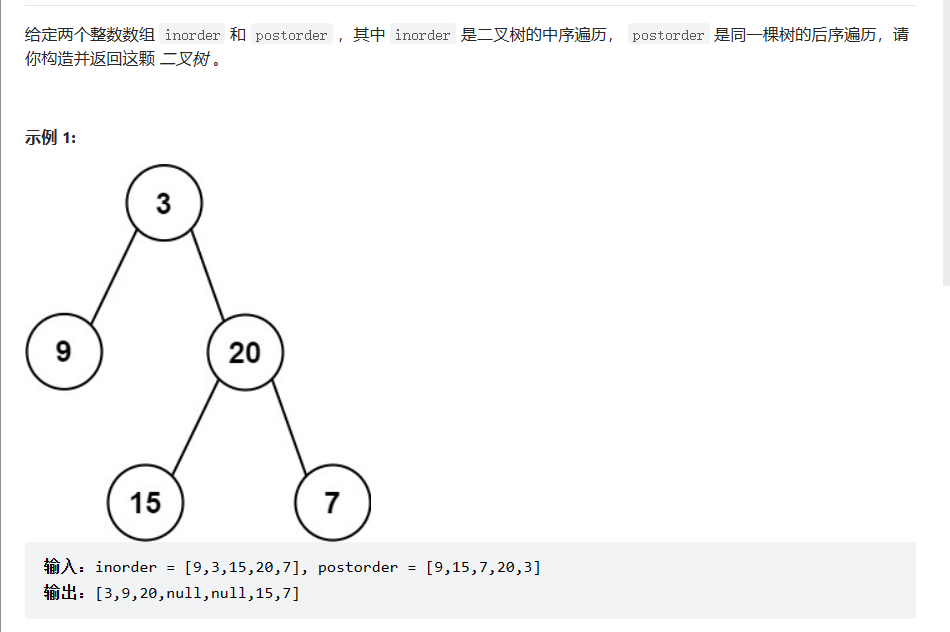
根据后序遍历的最后一个元素可以确定根结点,有了根结点做为切割点然后再去根据中序遍历划分左右区间,在继续下去,构造成二叉树,区间不存在就是空树了。同时,后序遍历是左右根,所以最后一个是根节点。所以当我们构造根结点后,由于前面是右子树,所以先构造右子树,在构造左子数。
class Solution {
    TreeNode* _buildTree(vector<int>& inorder, vector<int>& postorder,int &posi,int inbegin,int inend)
    {
        if(inbegin>inend)
        {
            return nullptr;
        }
        TreeNode* root = new TreeNode(postorder[posi]);
        int rooti = inbegin;
        while(inbegin<=inend)
        {
            if(postorder[posi] == inorder[rooti])
            {
                break;
            }
            else rooti++;
        }
        posi--;
        //[inbegin,rooti-1]rooti[rooti+1,inend];
        root->right = _buildTree(inorder,postorder,posi,rooti+1,inend);
        root->left = _buildTree(inorder,postorder,posi,inbegin,rooti-1);
        return root;
    }
public:
    TreeNode* buildTree(vector<int>& inorder, vector<int>& postorder) {
        int posi = postorder.size()-1;
        return _buildTree(inorder,postorder,posi,0,inorder.size()-1);
    }
};
我想将html转换为纯文本。不过,我不想只删除标签,我想智能地保留尽可能多的格式。为插入换行符标签,检测段落并格式化它们等。输入非常简单,通常是格式良好的html(不是整个文档,只是一堆内容,通常没有anchor或图像)。我可以将几个正则表达式放在一起,让我达到80%,但我认为可能有一些现有的解决方案更智能。 最佳答案 首先,不要尝试为此使用正则表达式。很有可能你会想出一个脆弱/脆弱的解决方案,它会随着HTML的变化而崩溃,或者很难管理和维护。您可以使用Nokogiri快速解析HTML并提取文本:require'nokogiri'h
我主要使用Ruby来执行此操作,但到目前为止我的攻击计划如下:使用gemsrdf、rdf-rdfa和rdf-microdata或mida来解析给定任何URI的数据。我认为最好映射到像schema.org这样的统一模式,例如使用这个yaml文件,它试图描述数据词汇表和opengraph到schema.org之间的转换:#SchemaXtoschema.orgconversion#data-vocabularyDV:name:namestreet-address:streetAddressregion:addressRegionlocality:addressLocalityphoto:i
有时我需要处理键/值数据。我不喜欢使用数组,因为它们在大小上没有限制(很容易不小心添加超过2个项目,而且您最终需要稍后验证大小)。此外,0和1的索引变成了魔数(MagicNumber),并且在传达含义方面做得很差(“当我说0时,我的意思是head...”)。散列也不合适,因为可能会不小心添加额外的条目。我写了下面的类来解决这个问题:classPairattr_accessor:head,:taildefinitialize(h,t)@head,@tail=h,tendend它工作得很好并且解决了问题,但我很想知道:Ruby标准库是否已经带有这样一个类? 最佳
我使用Nokogiri(Rubygem)css搜索寻找某些在我的html里面。看起来Nokogiri的css搜索不喜欢正则表达式。我想切换到Nokogiri的xpath搜索,因为这似乎支持搜索字符串中的正则表达式。如何在xpath搜索中实现下面提到的(伪)css搜索?require'rubygems'require'nokogiri'value=Nokogiri::HTML.parse(ABBlaCD3"HTML_END#my_blockisgivenmy_bl="1"#my_eqcorrespondstothisregexmy_eq="\/[0-9]+\/"#FIXMEThefoll
给定一个复杂的对象层次结构,幸运的是它不包含循环引用,我如何实现支持各种格式的序列化?我不是来讨论实际实现的。相反,我正在寻找可能会派上用场的设计模式提示。更准确地说:我正在使用Ruby,我想解析XML和JSON数据以构建复杂的对象层次结构。此外,应该可以将该层次结构序列化为JSON、XML和可能的HTML。我可以为此使用Builder模式吗?在任何提到的情况下,我都有某种结构化数据-无论是在内存中还是文本中-我想用它来构建其他东西。我认为将序列化逻辑与实际业务逻辑分开会很好,这样我以后就可以轻松支持多种XML格式。 最佳答案 我最
我正在尝试使用Curbgem执行以下POST以解析云curl-XPOST\-H"X-Parse-Application-Id:PARSE_APP_ID"\-H"X-Parse-REST-API-Key:PARSE_API_KEY"\-H"Content-Type:image/jpeg"\--data-binary'@myPicture.jpg'\https://api.parse.com/1/files/pic.jpg用这个:curl=Curl::Easy.new("https://api.parse.com/1/files/lion.jpg")curl.multipart_form_
无论您是想搭建桌面端、WEB端或者移动端APP应用,HOOPSPlatform组件都可以为您提供弹性的3D集成架构,同时,由工业领域3D技术专家组成的HOOPS技术团队也能为您提供技术支持服务。如果您的客户期望有一种在多个平台(桌面/WEB/APP,而且某些客户端是“瘦”客户端)快速、方便地将数据接入到3D应用系统的解决方案,并且当访问数据时,在各个平台上的性能和用户体验保持一致,HOOPSPlatform将帮助您完成。利用HOOPSPlatform,您可以开发在任何环境下的3D基础应用架构。HOOPSPlatform可以帮您打造3D创新型产品,HOOPSSDK包含的技术有:快速且准确的CAD
本教程将在Unity3D中混合Optitrack与数据手套的数据流,在人体运动的基础上,添加双手手指部分的运动。双手手背的角度仍由Optitrack提供,数据手套提供双手手指的角度。 01 客户端软件分别安装MotiveBody与MotionVenus并校准人体与数据手套。MotiveBodyMotionVenus数据手套使用、校准流程参照:https://gitee.com/foheart_1/foheart-h1-data-summary.git02 数据转发打开MotiveBody软件的Streaming,开始向Unity3D广播数据;MotionVenus中设置->选项选择Unit
文章目录一、概述简介原理模块二、配置Mysql使用版本环境要求1.操作系统2.mysql要求三、配置canal-server离线下载在线下载上传解压修改配置单机配置集群配置分库分表配置1.修改全局配置2.实例配置垂直分库水平分库3.修改group-instance.xml4.启动监听四、配置canal-adapter1修改启动配置2配置映射文件3启动ES数据同步查询所有订阅同步数据同步开关启动4.验证五、配置canal-admin一、概述简介canal是Alibaba旗下的一款开源项目,Java开发。基于数据库增量日志解析,提供增量数据订阅&消费。Git地址:https://github.co
我正在尝试在Rails上安装ruby,到目前为止一切都已安装,但是当我尝试使用rakedb:create创建数据库时,我收到一个奇怪的错误:dyld:lazysymbolbindingfailed:Symbolnotfound:_mysql_get_client_infoReferencedfrom:/Library/Ruby/Gems/1.8/gems/mysql2-0.3.11/lib/mysql2/mysql2.bundleExpectedin:flatnamespacedyld:Symbolnotfound:_mysql_get_client_infoReferencedf
