文章目录
前言:本章记录作者学习中,遇到的两个比较有趣的问题,一个简单和一个较复杂的迷宫问题。
让我们先来看简单的:迷宫问题
它的具体要求:
输入描述:
输入两个整数,分别表示二维数组的行数,列数。再输入相应的数组,其中的1表示墙壁,0表示可以走的路。数据保证有唯一解,不考虑有多解的情况,即迷宫只有一条通道。
如
5 5
0 1 0 0 0
0 1 1 1 0
0 0 0 0 0
0 1 1 1 0
0 0 0 1 0
要求输出 如:
(0,0)
(1,0)
(2,0)
(2,1)
(2,2)
(2,3)
(2,4)
(3,4)
(4,4)
这道题的重点有:只能上下左右走,不能斜着走;左上角为起点,右下角为终点;只有唯一解。
思路分析:
- 对于不支持变长数组的C版本来说,如果需要实现二维变长数组的话,就需要动态开辟二维数组。
- 每次需要对上下左右四个方向进行判断,才能到达下一个坐标,并且如果四个方向都不能走而且还没到达终点,那么就要往回走。
- 为了判断往回是否还有其它能走的方向,我们需要对走过的坐标进行标记,这样就不会出现走重复的路线。
- 在结束的时候,我们需要打印这条路径的每个坐标,那么我们就需要对我们走过的坐标进行储存,对到达不了终点的路上的坐标消除,所以似乎需要栈来帮我们储存这个坐标。
动态实现二维变长数组:
先创建一个二维指针,储存N个一维指针的地址,这些一维指针都分别指向一个开辟了M个数据的数组
#include<stdio.h>
void PrintMaze(int** maze, int N, int M)
{
	for (int i = 0; i < N; i++)
	{
		for (int j = 0; j < M; j++)
		{
			printf("%d ", maze[i][j]);
		}
		printf("\n");
	}
}

int main()
{
	int N = 0, M = 0;
	scanf("%d %d", &N, &M);

	//动态开辟二维数组
	int** maze = (int**)malloc(sizeof(int*) * N);
	for (int i = 0; i < N; i++)
	{
		maze[i] = (int*)malloc(sizeof(int) * M);
	}

	for (int i = 0; i < N; i++)
	{
		for (int j = 0; j < M; j++)
		{
			scanf("%d", &maze[i][j]);
		}
	}

	PrintMaze(maze, N, M);//测试是否能打印,看看有没有问题

	for (int i = 0; i < N; i++)
	{
		free(maze[i]);
	}
	free(maze);
	return 0;
}
四个方向判断的实现:
为了方便操作,我们建立一个结构体类型,方便定义坐标。
typedef struct position
{
	int row;
	int col;
}PT;
并且在测试页定义初始变量:
PT cur = { 0,0 };
- 从(0,0)坐标开始,假设先判断上下,再判断左右,如果能通过就移动坐标,并且进入下次判断,直到到达终点,或者不能移动,并且需要对每次到达的坐标进行标记,假设标记为2.
- 如果四个方向都不能走,并且没到达终点,那么将一直返回上一个位置,直到有其它方向能走。
- 如果到达终点,返回true,直到跳出所有递归。
//判断下一个坐标是否能通过
bool IsPass(int** maze, int N, int M, PT cur)
{
	if (cur.col >= 0 && cur.col < M && cur.row >= 0 && cur.row < N
		&& maze[cur.row][cur.col] == 0)
	{
		return true;
	}
	else
	{
		return false;
	}
}

bool GetPath(int** maze, int N, int M, PT cur)
{
	//到达终点
	if (cur.row == N - 1 && cur.col == M - 1)
	{
		return true;
	}


	//上下左右判断
	PT next;
	maze[cur.row][cur.col] = 2;//标记

	//上
	next = cur;
	next.row -= 1;
	if (IsPass(maze, N, M, next))
	{
		//上方向可以通过就移动到上方向的坐标,并且继续判断四个方向是否可以移动
		if (GetPath(maze, N, M, next))
		{
			//1.只有到达终点才会进入这次判断,并且一直返回true,直到退出所有递归。
			//2.因为这题只有唯一解,所以一旦找到终点就可以直接返回。
			return true;
		}
	}

	//下
	next = cur;
	next.row += 1;
	if (IsPass(maze, N, M, next))
	{
		if (GetPath(maze, N, M, next))
		{
			return true;
		}
	}

	//左
	next = cur;
	next.col -= 1;
	if (IsPass(maze, N, M, next))
	{
		if (GetPath(maze, N, M, next))
		{
			return true;
		}
	}

	//右
	next = cur;
	next.col += 1;
	if (IsPass(maze, N, M, next))
	{
		if (GetPath(maze, N, M, next))
		{
			return true;
		}
	}

	//四个方向都不能走,就返回false,跳到上一个坐标判断它剩下的其它方向是否可以走
	return false;
}
利用栈记录坐标的实现:
因为C语言没有自己的栈,所以我们还需要自己搭建一个栈。
栈的实现
- 每次判断坐标前,先将当前坐标存入栈中,如果四个方向都不能走的时候,再出栈。
- 当到达终点,返回完后,对栈中数据进行处理。
- 因为栈中数据打印后与题目要求的打印相反,所有需要再创建一个栈,将当前栈中的数据导入另一个栈中,从而实现相反的打印。
完整代码:
#include<stdio.h>;
#include<stdlib.h>;
#include<assert.h>;
#include<stdbool.h>;

typedef struct position
{
	int row;
	int col;
}PT;

typedef PT STDataType;
typedef struct stack {
	STDataType* a;
	int top;
	int capacity;
}ST;

void StackInit(ST*ps);
void StackDestroy(ST* ps);
void StackPush(ST* ps, STDataType x);
void StackPop(ST* ps);
STDataType StackTop(ST* ps);
int StackSize(ST* ps);
bool StackEmpty(ST* ps);

//

void StackInit(ST* ps) {
	ps->a = NULL;
	ps->capacity = 0;
	ps->top = 0;//或者-1

}

void StackPush(ST* ps, STDataType x) {

	if (ps->capacity == ps->top) {
		int newcapacity = ps->capacity == 0 ? 4 : ps->capacity * 2;
		STDataType* tmp = (STDataType*)realloc(ps->a, sizeof(STDataType) * newcapacity);
		if (tmp == NULL) {
			printf("realloc fail\n");
			exit(-1);
		}
		ps->a = tmp;
		ps->capacity = newcapacity;
	}
	ps->a[ps->top++] = x;
}

void StackDestroy(ST* ps) {
	assert(ps);
	free(ps->a);
	ps->a = NULL;
	ps->capacity = ps->top = 0;
}

void StackPop(ST* ps) {
	assert(ps);
	/*assert(ps->top > 0);*/
	assert(!StackEmpty(ps));
	ps->top--;
}

STDataType StackTop(ST* ps) {
	assert(ps);
	assert(!StackEmpty(ps));
	return ps->a[ps->top-1];
}

int StackSize(ST* ps) {
	assert(ps);
	return ps->top;
}

bool StackEmpty(ST* ps) {
	return ps->top==0;
}

//

ST path;//可以创局部变量,这里方便一下

bool IsPass(int** maze, int N, int M, PT cur)
{
	if (cur.col >= 0 && cur.col < M && cur.row >= 0 && cur.row < N
		&& maze[cur.row][cur.col] == 0)
	{
		return true;
	}
	else
	{
		return false;
	}
}

bool GetPath(int** maze, int N, int M, PT cur)
{
	//走过的坐标先入栈
	StackPush(&path, cur);

	//到达终点
	if (cur.row == N - 1 && cur.col == M - 1)
	{
		return true;
	}


	//上下左右判断
	PT next;
	maze[cur.row][cur.col] = 2;

	//上
	next = cur;
	next.row -= 1;
	if (IsPass(maze, N, M, next))
	{
		if (GetPath(maze, N, M, next))
		{
			return true;
		}
	}

	//下
	next = cur;
	next.row += 1;
	if (IsPass(maze, N, M, next))
	{
		if (GetPath(maze, N, M, next))
		{
			return true;
		}
	}

	//左
	next = cur;
	next.col -= 1;
	if (IsPass(maze, N, M, next))
	{
		if (GetPath(maze, N, M, next))
		{
			return true;
		}
	}

	//右
	next = cur;
	next.col += 1;
	if (IsPass(maze, N, M, next))
	{
		if (GetPath(maze, N, M, next))
		{
			return true;
		}
	}

	//四个方向都不能走,就出栈返回
	StackPop(&path);
	return false;
}

void PrintPath(ST* ps)
{
	ST rpath;//创建需要导数据的另一个栈
	StackInit(&rpath);

	while (!StackEmpty(ps))
	{
		StackPush(&rpath, StackTop(ps));
		StackPop(ps);
	}

	while (!StackEmpty(&rpath))
	{
		PT cur = StackTop(&rpath);
		printf("(%d,%d)\n", cur.row, cur.col);
		StackPop(&rpath);
	}

	StackDestroy(&rpath);
}

int main()
{
	int N = 0, M = 0;
	scanf("%d %d", &N, &M);

	PT cur = { 0,0 };

	StackInit(&path);
	//动态开辟二维数组
	int** maze = (int**)malloc(sizeof(int*) * N);
	for (int i = 0; i < N; i++)
	{
		maze[i] = (int*)malloc(sizeof(int) * M);
	}

	for (int i = 0; i < N; i++)
	{
		for (int j = 0; j < M; j++)
		{
			scanf("%d", &maze[i][j]);
		}
	}

	if (GetPath(maze, N, M, cur))
	{
		PrintPath(&path);
	}

	StackDestroy(&path);

	for (int i = 0; i < N; i++)
	{
		free(maze[i]);
	}
	free(maze);
	return 0;
}
看看这个问题:地下迷宫

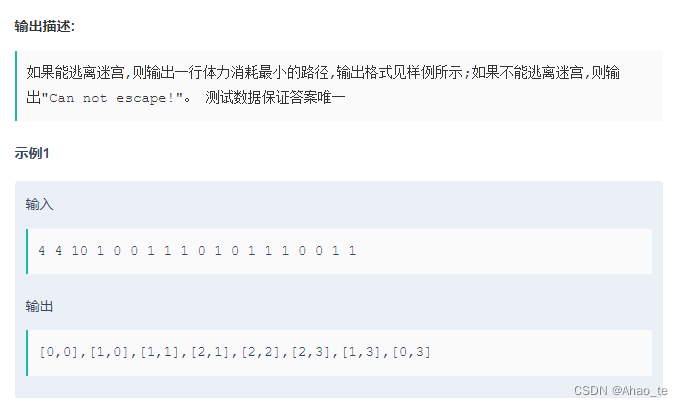
记录重点:
- 现在0代表障碍物,1代表通路,并且增加了体力值,左右移动减1,上移动减3,下移动不消耗,如果体力值为0还未到达出口,将无法逃离迷宫。
- (0,0)位置为起点,(0,m-1)位置为出口,并且现在要求最后打印的是最短路径。
- 体力值为0还未到达出口,结果需要打印:Can not escape!
- 坐标打印改变变成[0,0],
分析思路:
- 增加体力值P变量,并且当判断四个方向分别可以通过时,同时传入参数P,向上方向能通过传参数P-3,向左或者右方向能通过传P-1,向下传P;同时改变通路为1,出口为(0,m-1)
- 为了找到最短路径,直接通过建两个栈,一个记录当前路径的坐标,一个记录当前为止最短路径的坐标;利用递归列出所有可以走的路径,然后挑出最小的路径。(下面会重点介绍如何安全的转移栈以及如何用递归找到所有路径)
- 挑选的路径也要满足体力值条件;当所有的路径,体力都会耗尽且没有到达终点,记录最短路径坐标的栈为空,就可以通过这个情况打印Can not escape!。
先搭建一个基本的框架。
创建体力值,并且改变通路条件、出口、打印和函数参数调用
//

ST path;//可以创局部变量,这里方便一下

bool IsPass(int** maze, int N, int M, PT cur)
{
	if (cur.col >= 0 && cur.col < M && cur.row >= 0 && cur.row < N
		&& maze[cur.row][cur.col] == 1) //通路条件为1
	{
		return true;
	}
	else
	{
		return false;
	}
}

bool GetPath(int** maze, int N, int M, PT cur, int P)
{
	//走过的坐标先入栈
	StackPush(&path, cur);

	//到达终点
	if (cur.row == 0 && cur.col == M - 1) //终点为(0,m-1)
	{
		return true;
	}


	//上下左右判断
	PT next;
	maze[cur.row][cur.col] = 2;

	//上
	next = cur;
	next.row -= 1;
	if (IsPass(maze, N, M, next))
	{
		if (GetPath(maze, N, M, next, P-3))
		{
			return true;
		}
	}

	//下
	next = cur;
	next.row += 1;
	if (IsPass(maze, N, M, next))
	{
		if (GetPath(maze, N, M, next, P))
		{
			return true;
		}
	}

	//左
	next = cur;
	next.col -= 1;
	if (IsPass(maze, N, M, next))
	{
		if (GetPath(maze, N, M, next, P-1))
		{
			return true;
		}
	}

	//右
	next = cur;
	next.col += 1;
	if (IsPass(maze, N, M, next))
	{
		if (GetPath(maze, N, M, next, P-1))
		{
			return true;
		}
	}

	//四个方向都不能走,就出栈返回
	StackPop(&path);
	return false;
}

void PrintPath(ST* ps)
{
	ST rpath;
	StackInit(&rpath);

	while (!StackEmpty(ps))
	{
		StackPush(&rpath, StackTop(ps));
		StackPop(ps);
	}

	while (StackSize(&rpath) > 1)
	{
		PT cur = StackTop(&rpath);
		printf("[%d,%d],", cur.row, cur.col);
		StackPop(&rpath);
	}
	//前面打印带"," 最后一个不带
	PT cur = StackTop(&rpath);
	printf("[%d,%d]\n", cur.row, cur.col);
	StackPop(&rpath);

	StackDestroy(&rpath);
}

int main()
{
	int N = 0, M = 0, P = 0; //体力值P
	scanf("%d %d %d", &N, &M, &P);

	PT cur = { 0,0 };

	StackInit(&path);
	//动态开辟二维数组
	int** maze = (int**)malloc(sizeof(int*) * N);
	for (int i = 0; i < N; i++)
	{
		maze[i] = (int*)malloc(sizeof(int) * M);
	}

	for (int i = 0; i < N; i++)
	{
		for (int j = 0; j < M; j++)
		{
			scanf("%d", &maze[i][j]);
		}
	}

	if (GetPath(maze, N, M, cur, P))
	{
		PrintPath(&path);
	}

	StackDestroy(&path);

	for (int i = 0; i < N; i++)
	{
		free(maze[i]);
	}
	free(maze);
	return 0;
}
找到所有的路径和记录的实现:
主要难的是这里的递归思想。
- 如果有通路,就移动到下一个坐标进行四个方向的判断,直到体力值用完到达终点或者没有到达终点。
- 到达终点之后,第一次到达终点保存这条路径,之后比较两条路径,选最短的路径;之后回到上一个坐标点
- 到达终点之后,当前坐标继续进行四个方向的判断,当四个方向都不能通过的时候,为了让下次能访问这个坐标,将这个坐标恢复为1,并且返回上一个坐标。
- 每个可以通过的坐标都将进行4个方向的判断,当所有可通过坐标判断完成,递归函数结束。
为什么要创建两个栈?
因为有一个栈里面的数据是会变的,所有需要深拷贝一个栈记录原来不变的数据。
void StackCopy(ST* path, ST* minpath)
{

	minpath->a = (STDataType*)malloc(sizeof(STDataType*) * path->capacity);
	memcpy(minpath->a, path->a, sizeof(STDataType) * path->top);
	minpath->capacity = path->capacity;
	minpath->top = path->top;
}


void GetPath(int** maze, int N, int M, PT cur, int P)
{
	StackPush(&path, cur);


	//到达终点
	if (cur.row == 0 && cur.col == M - 1)
	{
		if (P >= 0 && StackEmpty(&minpath) || StackSize(&path) < StackSize(&minpath))
		{
			StackDestroy(&minpath);
			StackCopy(&path, &minpath);
		}
	}


	//上下左右判断
	PT next;
	maze[cur.row][cur.col] = 2;

	//上
	next = cur;
	next.row -= 1;
	if (IsPass(maze, N, M, next))
	{
		GetPath(maze, N, M, next, P - 3);
	}

	//下
	next = cur;
	next.row += 1;
	if (IsPass(maze, N, M, next))
	{
		GetPath(maze, N, M, next, P);
	}

	//左
	next = cur;
	next.col -= 1;
	if (IsPass(maze, N, M, next))
	{
		GetPath(maze, N, M, next, P - 1);
	}

	//右
	next = cur;
	next.col += 1;
	if (IsPass(maze, N, M, next))
	{
		GetPath(maze, N, M, next, P - 1);
	}

	//恢复
	maze[cur.row][cur.col] = 1;
	StackPop(&path);
}
完整代码:
#include<stdio.h>;
#include<stdlib.h>;
#include<assert.h>;
#include<stdbool.h>;
#include<string.h>;

typedef struct position
{
	int row;
	int col;
}PT;

typedef PT STDataType;
typedef struct stack {
	STDataType* a;
	int top;
	int capacity;
}ST;

void StackInit(ST* ps);
void StackDestroy(ST* ps);
void StackPush(ST* ps, STDataType x);
void StackPop(ST* ps);
STDataType StackTop(ST* ps);
int StackSize(ST* ps);
bool StackEmpty(ST* ps);


void StackInit(ST* ps) {
	ps->a = NULL;
	ps->capacity = 0;
	ps->top = 0;//或者-1

}

void StackPush(ST* ps, STDataType x) {

	if (ps->capacity == ps->top) {
		int newcapacity = ps->capacity == 0 ? 4 : ps->capacity * 2;
		STDataType* tmp = (STDataType*)realloc(ps->a, sizeof(STDataType) * newcapacity);
		if (tmp == NULL) {
			printf("realloc fail\n");
			exit(-1);
		}
		ps->a = tmp;
		ps->capacity = newcapacity;
	}
	ps->a[ps->top++] = x;
}

void StackDestroy(ST* ps) {
	assert(ps);
	free(ps->a);
	ps->a = NULL;
	ps->capacity = ps->top = 0;
}

void StackPop(ST* ps)
{
	assert(ps);
	/*assert(ps->top > 0);*/
	assert(!StackEmpty(ps));
	ps->top--;
}

STDataType StackTop(ST* ps)
{
	assert(ps);
	assert(!StackEmpty(ps));
	return ps->a[ps->top - 1];
}

int StackSize(ST* ps)
{
	assert(ps);
	return ps->top;
}

bool StackEmpty(ST* ps)
{
	return ps->top == 0;
}

void StackCopy(ST* path, ST* minpath)
{

	minpath->a = (STDataType*)malloc(sizeof(STDataType*) * path->capacity);
	memcpy(minpath->a, path->a, sizeof(STDataType) * path->top);
	minpath->capacity = path->capacity;
	minpath->top = path->top;
}


ST path;
ST minpath;

//判断通路
bool IsPass(int** maze, int N, int M, PT cur)
{
	if (cur.col >= 0 && cur.col < M && cur.row >= 0 && cur.row < N
		&& maze[cur.row][cur.col] == 1)
	{
		return true;
	}
	else
	{
		return false;
	}
}

//递归找到最小路径
void GetPath(int** maze, int N, int M, PT cur, int P)
{
	StackPush(&path, cur);


	//到达终点
	if (cur.row == 0 && cur.col == M - 1)
	{
		if (P >= 0 && StackEmpty(&minpath) || StackSize(&path) < StackSize(&minpath))
		{
			StackDestroy(&minpath);
			StackCopy(&path, &minpath);
		}
	}


	//上下左右判断
	PT next;
	maze[cur.row][cur.col] = 2;

	//上
	next = cur;
	next.row -= 1;
	if (IsPass(maze, N, M, next))
	{
		GetPath(maze, N, M, next, P - 3);
	}

	//下
	next = cur;
	next.row += 1;
	if (IsPass(maze, N, M, next))
	{
		GetPath(maze, N, M, next, P);
	}

	//左
	next = cur;
	next.col -= 1;
	if (IsPass(maze, N, M, next))
	{
		GetPath(maze, N, M, next, P - 1);
	}

	//右
	next = cur;
	next.col += 1;
	if (IsPass(maze, N, M, next))
	{
		GetPath(maze, N, M, next, P - 1);
	}

	maze[cur.row][cur.col] = 1;
	StackPop(&path);
}

//打印坐标
void PrintPath(ST* ps)
{
	ST rpath;
	StackInit(&rpath);

	while (!StackEmpty(ps))
	{
		StackPush(&rpath, StackTop(ps));
		StackPop(ps);
	}

	while (StackSize(&rpath) > 1)
	{
		PT cur = StackTop(&rpath);
		printf("[%d,%d],", cur.row, cur.col);
		StackPop(&rpath);
	}
	PT cur = StackTop(&rpath);
	printf("[%d,%d]\n", cur.row, cur.col);
	StackPop(&rpath);

	StackDestroy(&rpath);
}

int main()
{
	int N = 0, M = 0, P = 0;
	scanf("%d %d %d", &N, &M, &P);

	PT cur = { 0,0 };

	StackInit(&path);
	StackInit(&minpath);
	//动态开辟二维数组
	int** maze = (int**)malloc(sizeof(int*) * N);
	for (int i = 0; i < N; i++)
	{
		maze[i] = (int*)malloc(sizeof(int) * M);
	}

	for (int i = 0; i < N; i++)
	{
		for (int j = 0; j < M; j++)
		{
			scanf("%d", &maze[i][j]);
		}
	}

	//获得最小路径
	GetPath(maze, N, M, cur, P);

	if (!StackEmpty(&minpath))
	{
		PrintPath(&minpath);
	}
	else
	{
		printf("Can not escape!");
	}

	StackDestroy(&path);
	StackDestroy(&minpath);

	for (int i = 0; i < N; i++)
	{
		free(maze[i]);
	}
	free(maze);
	return 0;
}
总结:迷宫问题的难点主要是怎么找到路径,如何打印路径坐标。如果能解决这些问题,那么对递归的理解以及栈的应用有很大的提升。
我想将html转换为纯文本。不过,我不想只删除标签,我想智能地保留尽可能多的格式。为插入换行符标签,检测段落并格式化它们等。输入非常简单,通常是格式良好的html(不是整个文档,只是一堆内容,通常没有anchor或图像)。我可以将几个正则表达式放在一起,让我达到80%,但我认为可能有一些现有的解决方案更智能。 最佳答案 首先,不要尝试为此使用正则表达式。很有可能你会想出一个脆弱/脆弱的解决方案,它会随着HTML的变化而崩溃,或者很难管理和维护。您可以使用Nokogiri快速解析HTML并提取文本:require'nokogiri'h
我想为Heroku构建一个Rails3应用程序。他们使用Postgres作为他们的数据库,所以我通过MacPorts安装了postgres9.0。现在我需要一个postgresgem并且共识是出于性能原因你想要pggem。但是我对我得到的错误感到非常困惑当我尝试在rvm下通过geminstall安装pg时。我已经非常明确地指定了所有postgres目录的位置可以找到但仍然无法完成安装:$envARCHFLAGS='-archx86_64'geminstallpg--\--with-pg-config=/opt/local/var/db/postgresql90/defaultdb/po
我主要使用Ruby来执行此操作,但到目前为止我的攻击计划如下:使用gemsrdf、rdf-rdfa和rdf-microdata或mida来解析给定任何URI的数据。我认为最好映射到像schema.org这样的统一模式,例如使用这个yaml文件,它试图描述数据词汇表和opengraph到schema.org之间的转换:#SchemaXtoschema.orgconversion#data-vocabularyDV:name:namestreet-address:streetAddressregion:addressRegionlocality:addressLocalityphoto:i
尝试通过RVM将RubyGems升级到版本1.8.10并出现此错误:$rvmrubygemslatestRemovingoldRubygemsfiles...Installingrubygems-1.8.10forruby-1.9.2-p180...ERROR:Errorrunning'GEM_PATH="/Users/foo/.rvm/gems/ruby-1.9.2-p180:/Users/foo/.rvm/gems/ruby-1.9.2-p180@global:/Users/foo/.rvm/gems/ruby-1.9.2-p180:/Users/foo/.rvm/gems/rub
我的最终目标是安装当前版本的RubyonRails。我在OSXMountainLion上运行。到目前为止,这是我的过程:已安装的RVM$\curl-Lhttps://get.rvm.io|bash-sstable检查已知(我假设已批准)安装$rvmlistknown我看到当前的稳定版本可用[ruby-]2.0.0[-p247]输入命令安装$rvminstall2.0.0-p247注意:我也试过这些安装命令$rvminstallruby-2.0.0-p247$rvminstallruby=2.0.0-p247我很快就无处可去了。结果:$rvminstall2.0.0-p247Search
由于fast-stemmer的问题,我很难安装我想要的任何rubygem。我把我得到的错误放在下面。Buildingnativeextensions.Thiscouldtakeawhile...ERROR:Errorinstallingfast-stemmer:ERROR:Failedtobuildgemnativeextension./System/Library/Frameworks/Ruby.framework/Versions/2.0/usr/bin/rubyextconf.rbcreatingMakefilemake"DESTDIR="cleanmake"DESTDIR=
当我尝试安装Ruby时遇到此错误。我试过查看this和this但无济于事➜~brewinstallrubyWarning:YouareusingOSX10.12.Wedonotprovidesupportforthispre-releaseversion.Youmayencounterbuildfailuresorotherbreakages.Pleasecreatepull-requestsinsteadoffilingissues.==>Installingdependenciesforruby:readline,libyaml,makedepend==>Installingrub
有时我需要处理键/值数据。我不喜欢使用数组,因为它们在大小上没有限制(很容易不小心添加超过2个项目,而且您最终需要稍后验证大小)。此外,0和1的索引变成了魔数(MagicNumber),并且在传达含义方面做得很差(“当我说0时,我的意思是head...”)。散列也不合适,因为可能会不小心添加额外的条目。我写了下面的类来解决这个问题:classPairattr_accessor:head,:taildefinitialize(h,t)@head,@tail=h,tendend它工作得很好并且解决了问题,但我很想知道:Ruby标准库是否已经带有这样一个类? 最佳
我正在尝试使用boilerpipe来自JRuby。我看过guide从JRuby调用Java,并成功地将它与另一个Java包一起使用,但无法弄清楚为什么同样的东西不能用于boilerpipe。我正在尝试基本上从JRuby中执行与此Java等效的操作:URLurl=newURL("http://www.example.com/some-location/index.html");Stringtext=ArticleExtractor.INSTANCE.getText(url);在JRuby中试过这个:require'java'url=java.net.URL.new("http://www
我意识到这可能是一个非常基本的问题,但我现在已经花了几天时间回过头来解决这个问题,但出于某种原因,Google就是没有帮助我。(我认为部分问题在于我是一个初学者,我不知道该问什么......)我也看过O'Reilly的RubyCookbook和RailsAPI,但我仍然停留在这个问题上.我找到了一些关于多态关系的信息,但它似乎不是我需要的(尽管如果我错了请告诉我)。我正在尝试调整MichaelHartl'stutorial创建一个包含用户、文章和评论的博客应用程序(不使用脚手架)。我希望评论既属于用户又属于文章。我的主要问题是:我不知道如何将当前文章的ID放入评论Controller。

