前言:最近在学习 NIO 和netty 相关知识时,在bio的模式下,遇到了
java.net.SocketException: Software caused connection abort: recv failed 的问题,刚好解决了,记录一下
我是启动一个服务绑定8801端口,启动然 客户端使用 httpClient 进行发起一个get请求,如果成功请求后会输出 服务端的 "hello,nio1"的字样但时间情况报错了。
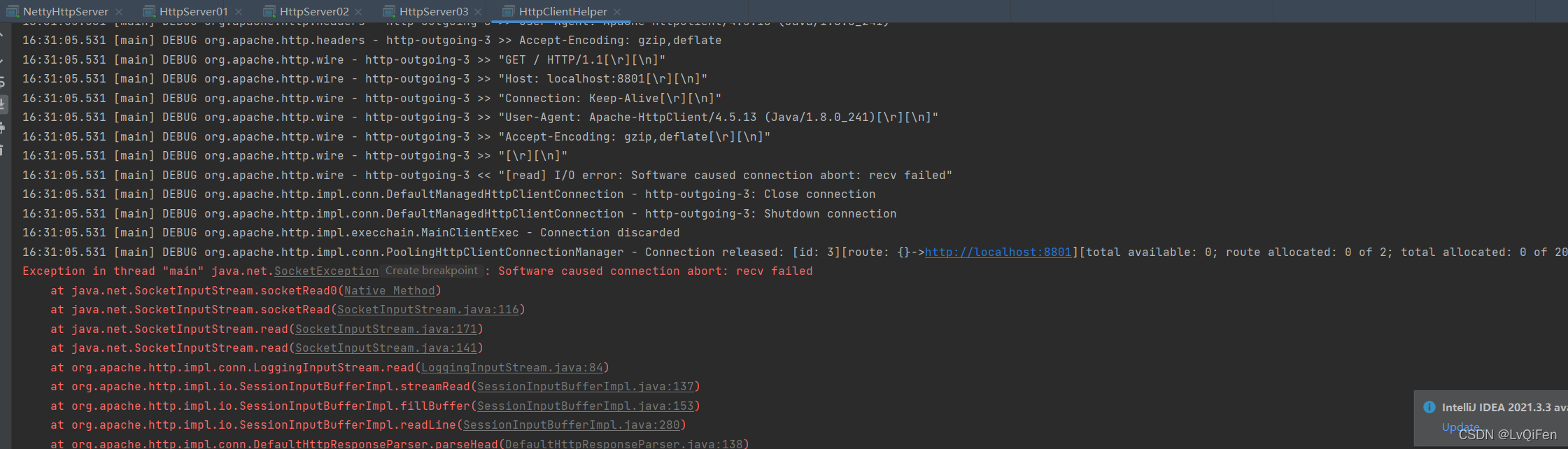
大概的意思就是 程序连接中止:接受失败,然后我就开始检查代码,用原生的
http请求也是能正常返回的,浏览器,和crul http://localhost:8801也是正常返回,那我就感觉很奇怪,为什么借助httpClient就会失败呢?
网上查了下这个报错大概意思就直接意思: 客户端和服务端建立tcp的短连接,每次客户端发送一次请求, 服务端响应后关闭与客户端的连接. 如果客户端在服务端关闭连接后,没有释放连接,继续试图发送请求和接收响应. 这个时候就会出错.
于是我开始想,会不会是服务端关闭太快导致客户端正在读的时候,服务端已经关闭了,导致报错。果断在关闭的时候阻塞线程一秒试试Thread.sleep(1000),就解决了。 所以这个问题报错的原因就是如上面红色字体描述的那样,在我这里就是服务端关闭太快了。
示例代码:
package org.geekbang.netty.server;

import java.io.IOException;
import java.io.PrintWriter;
import java.net.ServerSocket;
import java.net.Socket;

// 单线程的socket程序
public class HttpServer01 {
   public static void main(String[] args) throws IOException {
       // 开启8801端口
       ServerSocket serverSocket = new ServerSocket(8801);
       while (true) {
           try {
               Socket socket = serverSocket.accept();
               service(socket);
           } catch (IOException e) {
               e.printStackTrace();
           }
       }
   }

   private static void service(Socket socket) {
       try {
           PrintWriter printWriter = new PrintWriter(socket.getOutputStream(), true);
           printWriter.println("HTTP/1.1 200 OK");
           printWriter.println("Content-Type:text/html;charset=utf-8");
           printWriter.println("Connection: keep-alive");
           String body = "hello,nio1";
           // 一定要告诉他长度
           printWriter.println("Content-Length: " + body.getBytes().length);
           printWriter.println();
           printWriter.write(body);
           // 打开下面这行 Thread.sleep(1000) 代码,延迟主线程处理关闭流和soket 就解决了
           // Thread.sleep(1000);
           printWriter.close();
           socket.close();
       } catch (Exception e) {
           e.printStackTrace();
       }
   }
}
package org.geekbang.netty.util;

import lombok.extern.slf4j.Slf4j;
import org.apache.http.HttpEntity;
import org.apache.http.NameValuePair;
import org.apache.http.client.ClientProtocolException;
import org.apache.http.client.entity.UrlEncodedFormEntity;
import org.apache.http.client.methods.CloseableHttpResponse;
import org.apache.http.client.methods.HttpGet;
import org.apache.http.client.methods.HttpPost;
import org.apache.http.impl.client.CloseableHttpClient;
import org.apache.http.impl.client.HttpClients;
import org.apache.http.message.BasicNameValuePair;
import org.apache.http.util.EntityUtils;

import java.io.*;
import java.net.HttpURLConnection;
import java.net.URL;
import java.util.ArrayList;
import java.util.List;

/**
* @author lvzb31988
* @description: HttpClient 小试牛刀
* @date 2022/3/13
*/
@Slf4j
public class HttpClientHelper {
   public static CloseableHttpClient httpclient = HttpClients.createDefault();

   public static String getAsString(String url) throws IOException {
       HttpGet httpGet = new HttpGet(url);
       // jdk7增强try 这种写法是try-with-resources resources对象需要是 AutoCloseable接口的子类
       try (CloseableHttpResponse response = httpclient.execute(httpGet)) {
           System.out.println("see see what get this: " + response.getStatusLine());
           HttpEntity entity = response.getEntity();
           return EntityUtils.toString(entity, "UTF-8");
       }
   }

   public static String httpRequest(String requestUrl, String requestMethod, String outputStr) {
       StringBuffer buffer = null;
       try {
           URL url = new URL(requestUrl);
           HttpURLConnection conn = (HttpURLConnection) url.openConnection();
           conn.setDoOutput(true);
           conn.setDoInput(true);
           conn.setRequestMethod(requestMethod);
           conn.connect();
           //往服务器端写内容 也就是发起http请求需要带的参数
           if (null != outputStr) {
               OutputStream os = conn.getOutputStream();
               os.write(outputStr.getBytes("utf-8"));
               os.close();
           }

           //读取服务器端返回的内容
           InputStream is = conn.getInputStream();
           InputStreamReader isr = new InputStreamReader(is, "utf-8");
           BufferedReader br = new BufferedReader(isr);
           buffer = new StringBuffer();
           String line = null;
           while ((line = br.readLine()) != null) {
               buffer.append(line);
           }
       } catch (Exception e) {
           e.printStackTrace();
       }
       return buffer.toString();
   }


   public static void main(String[] args) throws IOException {

       String url = "http://www.baidu.com";
       String url1 = "http://localhost:8801";

       // 客户端请求 8801单线程服务:必定失败,然后会自动重新执行请求后面几次同样失败 : Software caused connection abort: recv failed
       String resultString1 = HttpClientHelper.getAsString(url1);
       log.info("get调用8801返回结果:{}", resultString1);

//        String httpResult = HttpClientHelper.httpRequest(url, "GET", null);
//        log.info("原生 http get调用返回结果:{}", httpResult);
   }
}
作为我的Rails应用程序的一部分,我编写了一个小导入程序,它从我们的LDAP系统中吸取数据并将其塞入一个用户表中。不幸的是,与LDAP相关的代码在遍历我们的32K用户时泄漏了大量内存,我一直无法弄清楚如何解决这个问题。这个问题似乎在某种程度上与LDAP库有关,因为当我删除对LDAP内容的调用时,内存使用情况会很好地稳定下来。此外,不断增加的对象是Net::BER::BerIdentifiedString和Net::BER::BerIdentifiedArray,它们都是LDAP库的一部分。当我运行导入时,内存使用量最终达到超过1GB的峰值。如果问题存在,我需要找到一些方法来更正我的代
是的,我知道最好使用webmock,但我想知道如何在RSpec中模拟此方法:defmethod_to_testurl=URI.parseurireq=Net::HTTP::Post.newurl.pathres=Net::HTTP.start(url.host,url.port)do|http|http.requestreq,foo:1endresend这是RSpec:let(:uri){'http://example.com'}specify'HTTPcall'dohttp=mock:httpNet::HTTP.stub!(:start).and_yieldhttphttp.shou
我真的很习惯使用Ruby编写以下代码:my_hash={}my_hash['test']=1Java中对应的数据结构是什么? 最佳答案 HashMapmap=newHashMap();map.put("test",1);我假设? 关于java-等价于Java中的RubyHash,我们在StackOverflow上找到一个类似的问题: https://stackoverflow.com/questions/22737685/
我正在尝试使用boilerpipe来自JRuby。我看过guide从JRuby调用Java,并成功地将它与另一个Java包一起使用,但无法弄清楚为什么同样的东西不能用于boilerpipe。我正在尝试基本上从JRuby中执行与此Java等效的操作:URLurl=newURL("http://www.example.com/some-location/index.html");Stringtext=ArticleExtractor.INSTANCE.getText(url);在JRuby中试过这个:require'java'url=java.net.URL.new("http://www
我目前正在使用以下方法获取页面的源代码:Net::HTTP.get(URI.parse(page.url))我还想获取HTTP状态,而无需发出第二个请求。有没有办法用另一种方法做到这一点?我一直在查看文档,但似乎找不到我要找的东西。 最佳答案 在我看来,除非您需要一些真正的低级访问或控制,否则最好使用Ruby的内置Open::URI模块:require'open-uri'io=open('http://www.example.org/')#=>#body=io.read[0,50]#=>"["200","OK"]io.base_ur
我只想对我一直在思考的这个问题有其他意见,例如我有classuser_controller和classuserclassUserattr_accessor:name,:usernameendclassUserController//dosomethingaboutanythingaboutusersend问题是我的User类中是否应该有逻辑user=User.newuser.do_something(user1)oritshouldbeuser_controller=UserController.newuser_controller.do_something(user1,user2)我
什么是ruby的rack或python的Java的wsgi?还有一个路由库。 最佳答案 来自Python标准PEP333:Bycontrast,althoughJavahasjustasmanywebapplicationframeworksavailable,Java's"servlet"APImakesitpossibleforapplicationswrittenwithanyJavawebapplicationframeworktoruninanywebserverthatsupportstheservletAPI.ht
相信很多人在录制视频的时候都会遇到各种各样的问题,比如录制的视频没有声音。屏幕录制为什么没声音?今天小编就和大家分享一下如何录制音画同步视频的具体操作方法。如果你有录制的视频没有声音,你可以试试这个方法。 一、检查是否打开电脑系统声音相信很多小伙伴在录制视频后会发现录制的视频没有声音,屏幕录制为什么没声音?如果当时没有打开音频录制,则录制好的视频是没有声音的。因此,建议在录制前进行检查。屏幕上没有声音,很可能是因为你的电脑系统的声音被禁止了。您只需打开电脑系统的声音,即可录制音频和图画同步视频。操作方法:步骤1:点击电脑屏幕右下侧的“小喇叭”图案,在上方的选项中,选择“声音”。 步骤2:在“声
首先回顾一下拉格朗日定理的内容:函数f(x)是在闭区间[a,b]上连续、开区间(a,b)上可导的函数,那么至少存在一个,使得:通过这个表达式我们可以知道,f(x)是函数的主体,a和b可以看作是主体函数f(x)中所取的两个值。那么可以有, 也就意味着我们可以用来替换 这种替换可以用在求某些多项式差的极限中。方法: 外层函数f(x)是一致的,并且h(x)和g(x)是等价无穷小。此时,利用拉格朗日定理,将原式替换为 ,再进行求解,往往会省去复合函数求极限的很多麻烦。使用要注意:1.要先找到主体函数f(x),即外层函数必须相同。2.f(x)找到后,复合部分是等价无穷小。3.要满足作差的形式。如果是加
这篇文章是继上一篇文章“Observability:从零开始创建Java微服务并监控它(一)”的续篇。在上一篇文章中,我们讲述了如何创建一个Javaweb应用,并使用Filebeat来收集应用所生成的日志。在今天的文章中,我来详述如何收集应用的指标,使用APM来监控应用并监督web服务的在线情况。源码可以在地址 https://github.com/liu-xiao-guo/java_observability 进行下载。摄入指标指标被视为可以随时更改的时间点值。当前请求的数量可以改变任何毫秒。你可能有1000个请求的峰值,然后一切都回到一个请求。这也意味着这些指标可能不准确,你还想提取最小/
