
文章目录
Thymeleaf是一个现代服务器端Java模板引擎,适用于Web和独立环境,能够处理HTML,XML,JavaScript,CSS甚至纯文本。
Thymeleaf的主要目标是提供一种优雅且高度可维护的模板创建方式。为实现这一目标,它以自然模板的概念为基础,将其逻辑注入模板文件,其方式不会影响模板被用作设计原型。这改善了设计沟通,缩小了设计和开发团队之间的差距。
Thymeleaf也从一开始就设计了Web标准 - 特别是HTML5 - 允许您创建完全验证的模板,如果您需要的话。
动静分离: Thymeleaf选用html作为模板页,这是任何一款其他模板引擎做不到的!Thymeleaf使用html通过一些特定标签语法代表其含义,但并未破坏html结构,即使无网络、不通过后端渲染也能在浏览器成功打开,大大方便界面的测试和修改。
开箱即用: Thymeleaf提供标准和Spring标准两种方言,可以直接套用模板实现JSTL、 OGNL表达式效果,避免每天套模板、改JSTL、改标签的困扰。同时开发人员也可以扩展和创建自定义的方言。
主要步骤:添加thymeleaf的依赖,创建一个控制类controller,在templates下创建一个html页面即可。
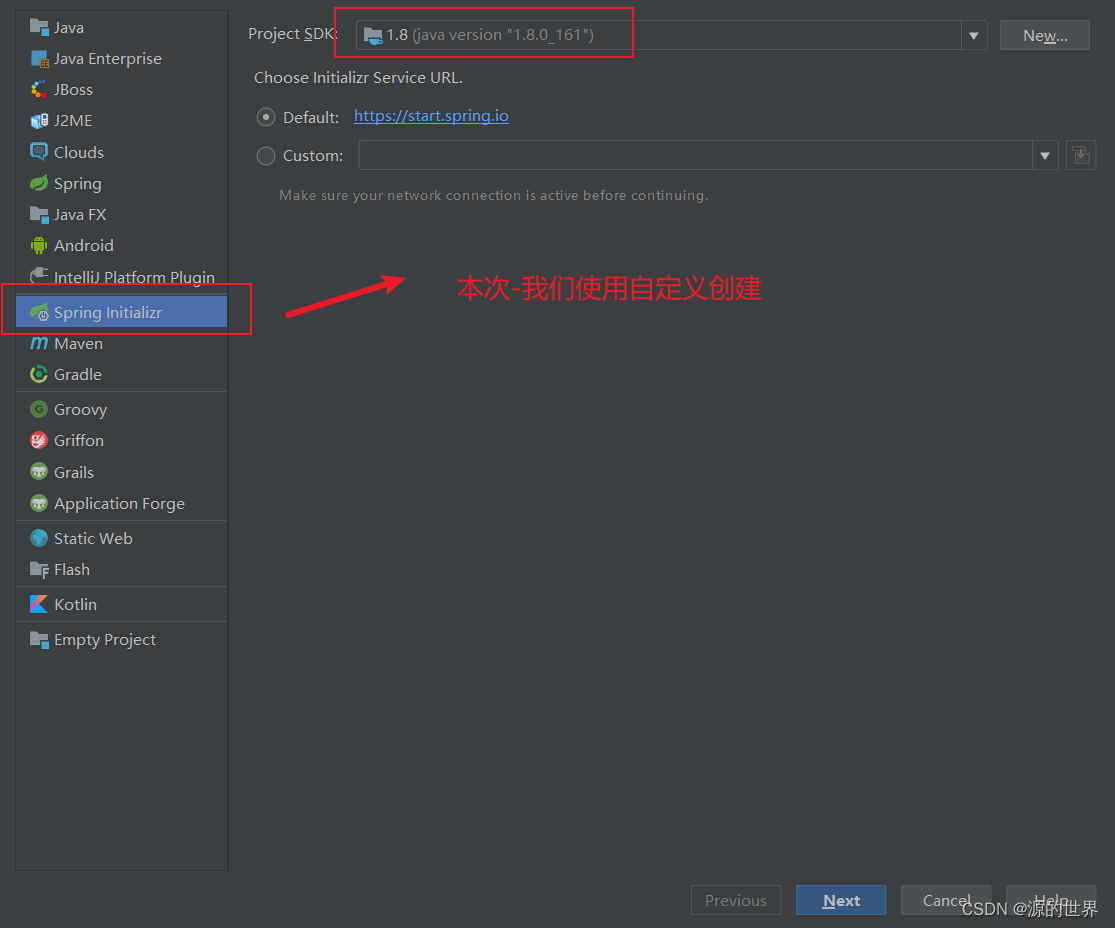
点击File->Project ->Srping Initializr点击下一步(Next)
完善信息后-点击下一步-点击完成即可
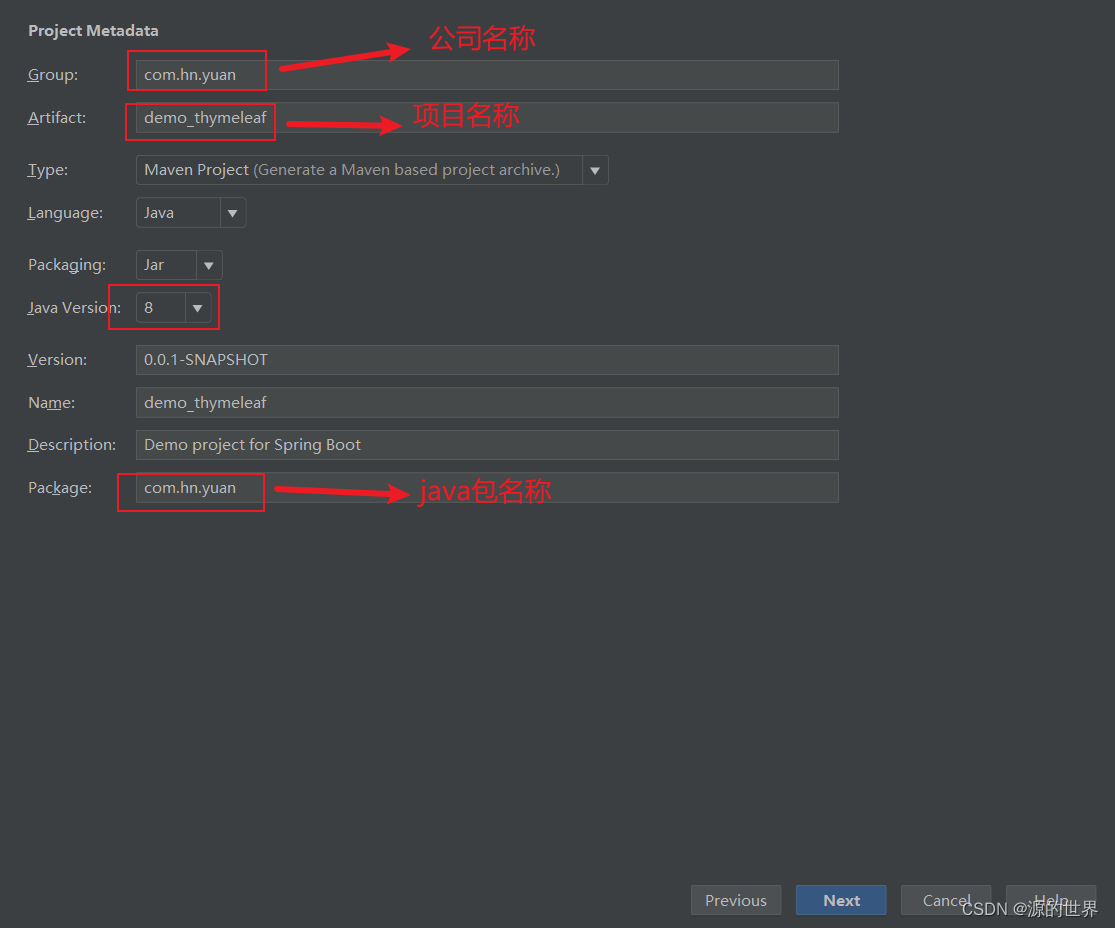
注意:需要配置下自己本地Maven地址
pom.xmll
<?xml version="1.0" encoding="UTF-8"?>
<project xmlns="http://maven.apache.org/POM/4.0.0" xmlns:xsi="http://www.w3.org/2001/XMLSchema-instance"
         xsi:schemaLocation="http://maven.apache.org/POM/4.0.0 https://maven.apache.org/xsd/maven-4.0.0.xsd">
    <modelVersion>4.0.0</modelVersion>
    <parent>
        <groupId>org.springframework.boot</groupId>
        <artifactId>spring-boot-starter-parent</artifactId>
        <version>2.7.5</version>
        <relativePath/> <!-- lookup parent from repository -->
    </parent>
    <groupId>com.hn.yuan</groupId>
    <artifactId>demo_thymeleaf</artifactId>
    <version>0.0.1-SNAPSHOT</version>
    <name>demo_thymeleaf</name>
    <description>Demo project for Spring Boot</description>
    <properties>
        <java.version>1.8</java.version>
    </properties>
    <dependencies>
        <!--添加thymeleaf的依赖-->
        <dependency>
            <groupId>org.springframework.boot</groupId>
            <artifactId>spring-boot-starter-thymeleaf</artifactId>
        </dependency>

        <!--spring项目启动器-->
        <dependency>
            <groupId>org.springframework.boot</groupId>
            <artifactId>spring-boot-starter-web</artifactId>
        </dependency>
        <!--通过注解消除实际开发中的样板式代码-->
        <dependency>
            <groupId>org.projectlombok</groupId>
            <artifactId>lombok</artifactId>
            <optional>true</optional>
        </dependency>
        <!--spring项目测试启动器-->
        <dependency>
            <groupId>org.springframework.boot</groupId>
            <artifactId>spring-boot-starter-test</artifactId>
        </dependency>
        <!--mybatis-plus启动器-->
        <dependency>
            <groupId>com.baomidou</groupId>
            <artifactId>mybatis-plus-boot-starter</artifactId>
            <version>3.5.1</version>
        </dependency>
        <!--mysql数据库驱动-->
        <dependency>
            <groupId>mysql</groupId>
            <artifactId>mysql-connector-java</artifactId>
            <version>5.1.35</version>
        </dependency>
        <!--代码生成器-->
        <dependency>
            <groupId>com.baomidou</groupId>
            <artifactId>mybatis-plus-generator</artifactId>
            <version>3.4.1</version>
        </dependency>
        <!--模板引擎-->
        <dependency>
            <groupId>org.apache.velocity</groupId>
            <artifactId>velocity-engine-core</artifactId>
            <version>2.1</version>
        </dependency>
    </dependencies>

    <build>
        <plugins>
            <plugin>
                <groupId>org.springframework.boot</groupId>
                <artifactId>spring-boot-maven-plugin</artifactId>
            </plugin>
        </plugins>
    </build>

</project>
application.properties层
#配置端口号;
server.port=8081
#配置数据源;
spring.datasource.driver-class-name=com.mysql.jdbc.Driver
spring.datasource.url=jdbc:mysql://localhost:3306/yuan_productlist?useUnicode=true&characterEncoding=UTF-8&useSSL=false
spring.datasource.username=root
spring.datasource.password=root

#关闭 springboot 中 thymeleaf 中的缓存, 默认为 true;
spring.thymeleaf.cache=false
controller层
package com.hn.yuan.controller;

import org.springframework.stereotype.Controller;
import org.springframework.ui.Model;
import org.springframework.web.bind.annotation.GetMapping;
import org.springframework.web.bind.annotation.RequestMapping;

@Controller
@RequestMapping("/roles")
public class ListController {

    @GetMapping("/list")
    public String getList(Model model){
        model.addAttribute("msg","Thymeleaf");
        return "list";
    }
}
templates文件夹下的 list.html页面
<!DOCTYPE html>
<html xmlns:th="http://www.thymeleaf.org">
<!--导入命名空间:namespace = ns-->
<head>
    <meta charset="UTF-8">
    <title>Thymeleaf模版集成完毕!</title>
    <!--引入bootstrap框架相关的样式; -->
    <link rel="stylesheet" href="/bootstrap/css/bootstrap.css"/>
    <script src="/bootstrap/js/bootstrap.min.js"></script>
</head>
<body>
<div class="container">
    <div class="panel panel-primary">
        <div class="panel-heading">
            <h1>Thymeleaf模版集成完毕!</h1>
        </div>
        <div class="panel-body">
            <table class="table table-striped table-bordered table-hover table-condensed text-center">
                <tr>
                    <td>角色编号</td>
                    <td>角色名称</td>
                    <td>操作</td>
                </tr>
                <tr>
                    <td th:text="1"></td>
                    <td th:text="admin"></td>
                    <td>
                        <a href="#" class="btn btn-success">修改</a>
                        <a href="#" class="btn btn-danger">删除</a>
                    </td>
                </tr>
            </table>
        </div>
        <div class="panel-footer text-right">
                Thymeleaf模版集成完毕!
        </div>
    </div>
</div>
</body>
</html>
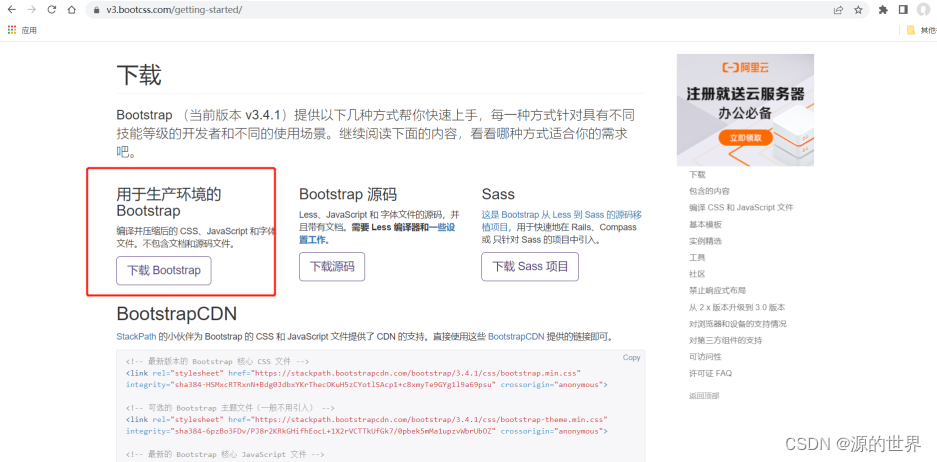
页面中我使用了 bootstrap样式,可自行下载,放入static文件夹下。官网下载地址分享
也可进入百度网盘分享地址:样式分享
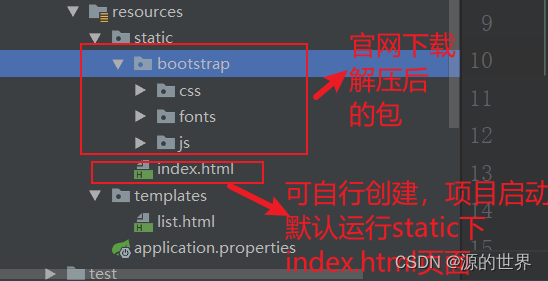
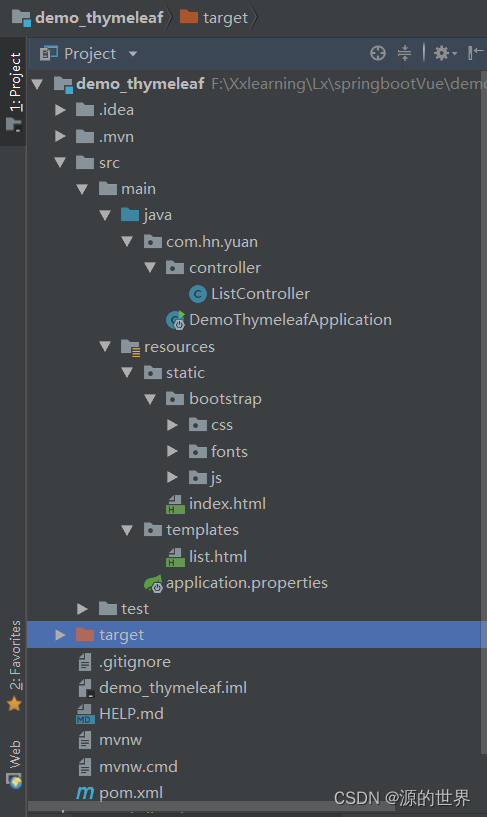
项目架构:
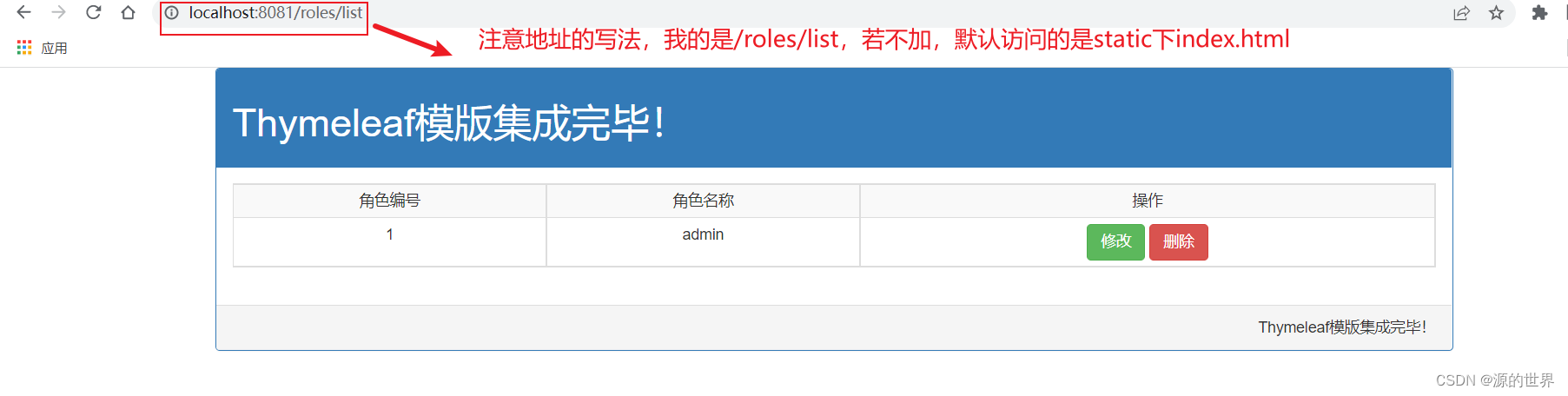
访问地址:http://localhost:8081/roles/list
创建一个 HTML 模板文件:
<!DOCTYPE HTML>
<html xmlns:th="http://www.thymeleaf.org">
<head>
    <title>Index Page</title>
    <meta http-equiv="Content-Type" content="text/html; charset=UTF-8" />
</head>
<body>
    <p th:text="${message}">Welcome to BeiJing!</p>
</body>
</html>
通过引入 Thymeleaf 命名空间。th:text用于处理p标签体的文本内容。该模板文件直接在任何浏览器中正确显示,浏览器会自动忽略它们不能理解的属性th:text。但这不是一个真正有效的 HTML5 文档,因为 HTML5 规范是不允许使用th:*这些非标准属性的。我们可以切换到 Thymeleaf 的data-th-*语法,以此来替换th:*语法:
<!DOCTYPE HTML>
<html xmlns:th="http://www.thymeleaf.org">
<head>
    <title>Index Page</title>
    <meta http-equiv="Content-Type" content="text/html; charset=UTF-8" />
</head>
<body>
    <p data-th-text="${message}">Welcome to BeiJing!</p>
</body>
</html>
HTML5 规范是允许data-*这样自定义的属性的。th:*和data-th-*这两个符号是完全等效且可以互换的。但为了简单直观和代码的紧凑性,本文采用th:*的表示形式。
首先介绍两个最基础的th:*属th:text和th:utext,它们都是用于处理文本消息内容。
th:text
在标签体中展示表达式评估结果的文本内容:
| 1 |
|---|
使用外部化的文本内容:
| 1 | Welcome to BeiJing! |
|---|
当它作为静态文件直接运行时,浏览器会自动忽略它不能识别的th:text属性,而显示
标签体的文本内容Welcome to BeiJing!
当它作为模板文件运行在服务器端时,th:text属性的具体值将会替换
标签体的文本内容。
th:utext
属性th:utext与th:text的区别在于:
假设:message = “Welcome to BeiJing!”。
使用th:text属性:
| 1 |
|---|
th:text效果:Welcome to BeiJing!
使用th:utext属性:
| 1 |
|---|
th:utext效果:Welcome to BeiJing!
Thymeleaf 提供了非常丰富的标准表达式语法,总共有 8 大类:
条件判断语句有三种,分别是:th:if、th:unless、th:swith。
请点击 转载链接

各位看官》创作不易,点个赞!!!
诸君共勉:万事开头难,只愿肯放弃。
免责声明:本文章仅用于学习参考
类classAprivatedeffooputs:fooendpublicdefbarputs:barendprivatedefzimputs:zimendprotecteddefdibputs:dibendendA的实例a=A.new测试a.foorescueputs:faila.barrescueputs:faila.zimrescueputs:faila.dibrescueputs:faila.gazrescueputs:fail测试输出failbarfailfailfail.发送测试[:foo,:bar,:zim,:dib,:gaz].each{|m|a.send(m)resc
我有一个模型:classItem项目有一个属性“商店”基于存储的值,我希望Item对象对特定方法具有不同的行为。Rails中是否有针对此的通用设计模式?如果方法中没有大的if-else语句,这是如何干净利落地完成的? 最佳答案 通常通过Single-TableInheritance. 关于ruby-on-rails-Rails-子类化模型的设计模式是什么?,我们在StackOverflow上找到一个类似的问题: https://stackoverflow.co
我正在使用的第三方API的文档状态:"[O]urAPIonlyacceptspaddedBase64encodedstrings."什么是“填充的Base64编码字符串”以及如何在Ruby中生成它们。下面的代码是我第一次尝试创建转换为Base64的JSON格式数据。xa=Base64.encode64(a.to_json) 最佳答案 他们说的padding其实就是Base64本身的一部分。它是末尾的“=”和“==”。Base64将3个字节的数据包编码为4个编码字符。所以如果你的输入数据有长度n和n%3=1=>"=="末尾用于填充n%
我主要使用Ruby来执行此操作,但到目前为止我的攻击计划如下:使用gemsrdf、rdf-rdfa和rdf-microdata或mida来解析给定任何URI的数据。我认为最好映射到像schema.org这样的统一模式,例如使用这个yaml文件,它试图描述数据词汇表和opengraph到schema.org之间的转换:#SchemaXtoschema.orgconversion#data-vocabularyDV:name:namestreet-address:streetAddressregion:addressRegionlocality:addressLocalityphoto:i
为什么4.1%2返回0.0999999999999996?但是4.2%2==0.2。 最佳答案 参见此处:WhatEveryProgrammerShouldKnowAboutFloating-PointArithmetic实数是无限的。计算机使用的位数有限(今天是32位、64位)。因此计算机进行的浮点运算不能代表所有的实数。0.1是这些数字之一。请注意,这不是与Ruby相关的问题,而是与所有编程语言相关的问题,因为它来自计算机表示实数的方式。 关于ruby-为什么4.1%2使用Ruby返
它不等于主线程的binding,这个toplevel作用域是什么?此作用域与主线程中的binding有何不同?>ruby-e'putsTOPLEVEL_BINDING===binding'false 最佳答案 事实是,TOPLEVEL_BINDING始终引用Binding的预定义全局实例,而Kernel#binding创建的新实例>Binding每次封装当前执行上下文。在顶层,它们都包含相同的绑定(bind),但它们不是同一个对象,您无法使用==或===测试它们的绑定(bind)相等性。putsTOPLEVEL_BINDINGput
我可以得到Infinity和NaNn=9.0/0#=>Infinityn.class#=>Floatm=0/0.0#=>NaNm.class#=>Float但是当我想直接访问Infinity或NaN时:Infinity#=>uninitializedconstantInfinity(NameError)NaN#=>uninitializedconstantNaN(NameError)什么是Infinity和NaN?它们是对象、关键字还是其他东西? 最佳答案 您看到打印为Infinity和NaN的只是Float类的两个特殊实例的字符串
如果您尝试在Ruby中的nil对象上调用方法,则会出现NoMethodError异常并显示消息:"undefinedmethod‘...’fornil:NilClass"然而,有一个tryRails中的方法,如果它被发送到一个nil对象,它只返回nil:require'rubygems'require'active_support/all'nil.try(:nonexisting_method)#noNoMethodErrorexceptionanymore那么try如何在内部工作以防止该异常? 最佳答案 像Ruby中的所有其他对象
关闭。这个问题需要detailsorclarity.它目前不接受答案。想改进这个问题吗?通过editingthispost添加细节并澄清问题.关闭8年前。Improvethisquestion为什么SecureRandom.uuid创建一个唯一的字符串?SecureRandom.uuid#=>"35cb4e30-54e1-49f9-b5ce-4134799eb2c0"SecureRandom.uuid方法创建的字符串从不重复?
我刚刚被困在这个问题上一段时间了。以这个基地为例:moduleTopclassTestendmoduleFooendend稍后,我可以通过这样做在Foo中定义扩展Test的类:moduleTopmoduleFooclassSomeTest但是,如果我尝试通过使用::指定模块来最小化缩进:moduleTop::FooclassFailure这失败了:NameError:uninitializedconstantTop::Foo::Test这是一个错误,还是仅仅是Ruby解析变量名的方式的逻辑结果? 最佳答案 Isthisabug,or
