目录
开发板:NodeMCU32s(v1.3)
SD卡读写模块:SDIO/SPI 二合一
SD卡:闪迪 32GB(TF卡,实际29.7GB)/ Kingston 32G (TF卡,实际29.1GB)
开发框架:Arduino
Esp32 可以通过 SDMMC 和 SPI 两种方式读取SD/TF卡数据。
- SDMMC 分为 1 位 SD 总线模式和 4 位 SD 总线模式
- Esp32 上有 4 组 SPI 外设,其中,控制器 SPI2 和 SPI3 分别使用带前缀 HSPI 和 VSPI 的信号总线。
注意:
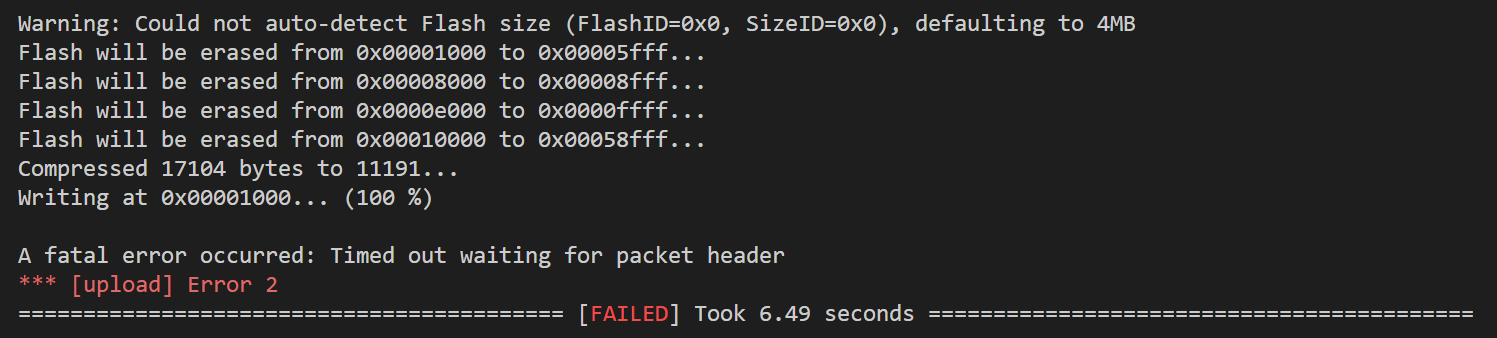
setup 函数后恢复供电(因此需要在 setup 函数中加入适当延时),否则 Esp32 会无限重启。 【4 位 SD 总线模式、HSPI 会发生】下载程序到 Esp32 时未断开 SD 卡供电,出现报错信息:
Timed out waiting for packet header
硬件连线方式:
-----------------------------------------------
|  NodeMCU32s            |   SD Card          |
|  --------------------------------------------
|  GPIO12                |   D02              |
|  GPIO4                 |   D01              |
|  GPIO15                |   CMD(MOSI)        |
|  GPIO2                 |   D00(MISO)        |
|  GPIO14                |   CLK(SCK)         |
|  GPIO13                |   D03(SS)          |
|  GND                   |   GND              |
|  VCC(3.3v)             |   VCC              |
-----------------------------------------------
#include "FS.h"
#include "SD.h"
#include "SD_MMC.h"

void WriteFile(fs::FS &fs, const char *path, uint8_t *buf, int len)
{
  //unsigned long start_time = millis();
  Serial.printf("write [%s]...\n", path);

  File file = fs.open(path, FILE_WRITE);
  if (!file) {
    Serial.println("Failed to open file for writing");
    return;
  }

  if (!file.write(buf, len)) {
      Serial.println("Write failed");
      return;
    }

  file.flush();
  file.close();

  Serial.printf("Write [%s] Complete", path);
}

void ReadFile(fs::FS &fs, const char *path, uint8_t *buf, int len)
{
  Serial.printf("read [%s]...\n", path);

  File file = fs.open(path);
  if (!file) {
    Serial.println("Failed to open file for reading");
    return;
  }

  if (!file.read(buf, len)) {
      Serial.println("Read failed");
      return;
  }

  file.close();

  Serial.printf("Read [%s] Complete: %s", path, buf);
}

void testIO(fs::FS &fs)
{
  char buf[] = "hello world";

  WriteFile(fs, "/test.txt", (uint8_t *)buf, strlen(buf));
  ReadFile(fs, "/test.txt", (uint8_t *)buf, strlen(buf));
}

void setup() {
  // put your setup code here, to run once:
  Serial.begin(115200);

  Serial.println("请插入内存卡");
  delay(8000);

  /* SD_MMC 4-bit Mode */
  if (!SD_MMC.begin()) {
    Serial.println("Card Mount Failed");
    return;
  }
  testIO(SD_MMC);
  SD_MMC.end(); // 取消SD挂载

void loop() {
}
硬件连线方式:
-----------------------------------------------
|  NodeMCU32s            |   SD Card          |
|  --------------------------------------------
|  -                     |   D02              |
|  -                     |   D01              |
|  GPIO15                |   CMD(MOSI)        |
|  GPIO2                 |   D00(MISO)        |
|  GPIO14                |   CLK(SCK)         |
|  -                     |   D03(SS)          |
|  GND                   |   GND              |
|  VCC(3.3v)             |   VCC              |
-----------------------------------------------
#include "FS.h"
#include "SD.h"
#include "SD_MMC.h"

void WriteFile(fs::FS &fs, const char *path, uint8_t *buf, int len)
{
  //unsigned long start_time = millis();
  Serial.printf("write [%s]...\n", path);

  File file = fs.open(path, FILE_WRITE);
  if (!file) {
    Serial.println("Failed to open file for writing");
    return;
  }

  if (!file.write(buf, len)) {
      Serial.println("Write failed");
      return;
    }

  file.flush();
  file.close();

  Serial.printf("Write [%s] Complete", path);
}

void ReadFile(fs::FS &fs, const char *path, uint8_t *buf, int len)
{
  Serial.printf("read [%s]...\n", path);

  File file = fs.open(path);
  if (!file) {
    Serial.println("Failed to open file for reading");
    return;
  }

  if (!file.read(buf, len)) {
      Serial.println("Read failed");
      return;
  }

  file.close();

  Serial.printf("Read [%s] Complete: %s", path, buf);
}

void testIO(fs::FS &fs)
{
  char buf[] = "hello world";

  WriteFile(fs, "/test.txt", (uint8_t *)buf, strlen(buf));
  ReadFile(fs, "/test.txt", (uint8_t *)buf, strlen(buf));
}

void setup() {
  // put your setup code here, to run once:
  Serial.begin(115200);

  Serial.println("请插入内存卡");
  delay(8000);

  /* SD_MMC 1-bit Mode */
  if (!SD_MMC.begin("/cdcard", true)) {
    Serial.println("Card Mount Failed");
    return;
  }
  testIO(SD_MMC);
  SD_MMC.end(); // 取消SD挂载

void loop() {
}
硬件连线方式:
-----------------------------------------------
|  NodeMCU32s            |   SD Card          |
|  --------------------------------------------
|  -                     |   D02              |
|  -                     |   D01              |
|  GPIO13                |   CMD(MOSI)        |
|  GPIO12                |   D00(MISO)        |
|  GPIO14                |   CLK(SCK)         |
|  GPIO15                |   D03(SS)          |
|  GND                   |   GND              |
|  VCC(3.3v)             |   VCC              |
-----------------------------------------------
#include "FS.h"
#include "SD.h"
#include "SD_MMC.h"

void WriteFile(fs::FS &fs, const char *path, uint8_t *buf, int len)
{
  //unsigned long start_time = millis();
  Serial.printf("write [%s]...\n", path);

  File file = fs.open(path, FILE_WRITE);
  if (!file) {
    Serial.println("Failed to open file for writing");
    return;
  }

  if (!file.write(buf, len)) {
      Serial.println("Write failed");
      return;
    }

  file.flush();
  file.close();

  Serial.printf("Write [%s] Complete", path);
}

void ReadFile(fs::FS &fs, const char *path, uint8_t *buf, int len)
{
  Serial.printf("read [%s]...\n", path);

  File file = fs.open(path);
  if (!file) {
    Serial.println("Failed to open file for reading");
    return;
  }

  if (!file.read(buf, len)) {
      Serial.println("Read failed");
      return;
  }

  file.close();

  Serial.printf("Read [%s] Complete: %s", path, buf);
}

void testIO(fs::FS &fs)
{
  char buf[] = "hello world";

  WriteFile(fs, "/test.txt", (uint8_t *)buf, strlen(buf));
  ReadFile(fs, "/test.txt", (uint8_t *)buf, strlen(buf));
}

void setup() {
  // put your setup code here, to run once:
  Serial.begin(115200);

  Serial.println("请插入内存卡");
  delay(8000);

  /* SD SPI Mode at HSPI */
  SPIClass spi = SPIClass(HSPI);
  spi.begin(14 /* SCK */, 12 /* MISO */, 13 /* MOSI */, 15 /* SS */);
  if (!SD.begin(15 /* SS */, spi, 80000000)) {
    Serial.println("Card Mount Failed");
    return;
  }
  testIO(SD);
  SD_MMC.end(); // 取消SD挂载

void loop() {
}
采用 32GB 闪迪 TF卡出现以下问题:
换成 32GB Kingston TF 卡正常。如果还不正常可以尝试换容量小一点的 TF 卡。
硬件连线方式:
-----------------------------------------------
|  NodeMCU32s            |   SD Card          |
|  --------------------------------------------
|  -                     |   D02              |
|  -                     |   D01              |
|  GPIO23                |   CMD(MOSI)        |
|  GPIO19                |   D00(MISO)        |
|  GPIO18                |   CLK(SCK)         |
|  GPIO5                 |   D03(SS)          |
|  GND                   |   GND              |
|  VCC(3.3v)             |   VCC              |
-----------------------------------------------
#include "FS.h"
#include "SD.h"
#include "SD_MMC.h"

void WriteFile(fs::FS &fs, const char *path, uint8_t *buf, int len)
{
  //unsigned long start_time = millis();
  Serial.printf("write [%s]...\n", path);

  File file = fs.open(path, FILE_WRITE);
  if (!file) {
    Serial.println("Failed to open file for writing");
    return;
  }

  if (!file.write(buf, len)) {
      Serial.println("Write failed");
      return;
    }

  file.flush();
  file.close();

  Serial.printf("Write [%s] Complete", path);
}

void ReadFile(fs::FS &fs, const char *path, uint8_t *buf, int len)
{
  Serial.printf("read [%s]...\n", path);

  File file = fs.open(path);
  if (!file) {
    Serial.println("Failed to open file for reading");
    return;
  }

  if (!file.read(buf, len)) {
      Serial.println("Read failed");
      return;
  }

  file.close();

  Serial.printf("Read [%s] Complete: %s", path, buf);
}

void testIO(fs::FS &fs)
{
  char buf[] = "hello world";

  WriteFile(fs, "/test.txt", (uint8_t *)buf, strlen(buf));
  ReadFile(fs, "/test.txt", (uint8_t *)buf, strlen(buf));
}

void setup() {
  // put your setup code here, to run once:
  Serial.begin(115200);

  Serial.println("请插入内存卡");
  delay(8000);

  /* SD SPI Mode at VSPI */
  SPIClass spi = SPIClass(HSPI);
  spi.begin(18 /* SCK */, 19 /* MISO */, 23 /* MOSI */, 5 /* SS */);
  if (!SD.begin(5 /* SS */, spi, 80000000)) {
    Serial.println("Card Mount Failed");
    return;
  }
  testIO(SD);
  SD_MMC.end(); // 取消SD挂载

void loop() {
}
采用 32GB 闪迪 TF卡出现 VSPI 同样问题,换成 32GB Kingston TF 卡正常。
参考:
[1]: Arduino ESP32 读取SD卡接口选择参考 🚀
[2]: Arduino ESP32 使用HSPI和VSPI接口挂载SD卡区别 🚀
[3]: ESP32 使用HSPI 读写SD卡的方法 🚀
[4]: 玩转 ESP32 + Arduino (二十四) SD卡读写 🚀
SD(安全数码卡,Secure Digital Memory Card),由 MMC 基础发展而来。
SD card、miniSD、microSD(TF)。SDSC(<2GB)、SDHC(2~32GB)、SDXC(32GB~2TB)SD Bus、SPI Bus、UHS-Ⅱ Bus。C 字包裹一个数字的图形,是一个写入速度的标准,这个标准主要有Class 2、Class 4、Class 6、Class10。U 字包裹一个数字的图形,这个同 C 字图形一样,也是一个写入速度的标准,如果同时出现,只需要看速度最快的那个即可。V+ 数字表示视频速度等级,用来表示最低读写速度。V 下面一般有罗马数字 Ⅰ、Ⅱ、Ⅲ,表示最低读写速度。Ⅰ只有一排金属触点,而其它有两排金属触点,数字越大,速度越快。(以Ⅰ为例,代表着UHS-1,Ultra High SpeedClass 1)A1、A2(application performance class)标签,这种卡可用于手机扩容,因此划分等级用于说明程序打开速度,A2比A1快。我正在尝试测试是否存在表单。我是Rails新手。我的new.html.erb_spec.rb文件的内容是:require'spec_helper'describe"messages/new.html.erb"doit"shouldrendertheform"dorender'/messages/new.html.erb'reponse.shouldhave_form_putting_to(@message)with_submit_buttonendendView本身,new.html.erb,有代码:当我运行rspec时,它失败了:1)messages/new.html.erbshou
我在从html页面生成PDF时遇到问题。我正在使用PDFkit。在安装它的过程中,我注意到我需要wkhtmltopdf。所以我也安装了它。我做了PDFkit的文档所说的一切......现在我在尝试加载PDF时遇到了这个错误。这里是错误:commandfailed:"/usr/local/bin/wkhtmltopdf""--margin-right""0.75in""--page-size""Letter""--margin-top""0.75in""--margin-bottom""0.75in""--encoding""UTF-8""--margin-left""0.75in""-
我在我的项目目录中完成了compasscreate.和compassinitrails。几个问题:我已将我的.sass文件放在public/stylesheets中。这是放置它们的正确位置吗?当我运行compasswatch时,它不会自动编译这些.sass文件。我必须手动指定文件:compasswatchpublic/stylesheets/myfile.sass等。如何让它自动运行?文件ie.css、print.css和screen.css已放在stylesheets/compiled。如何在编译后不让它们重新出现的情况下删除它们?我自己编译的.sass文件编译成compiled/t
我有一个对象has_many应呈现为xml的子对象。这不是问题。我的问题是我创建了一个Hash包含此数据,就像解析器需要它一样。但是rails自动将整个文件包含在.........我需要摆脱type="array"和我该如何处理?我没有在文档中找到任何内容。 最佳答案 我遇到了同样的问题;这是我的XML:我在用这个:entries.to_xml将散列数据转换为XML,但这会将条目的数据包装到中所以我修改了:entries.to_xml(root:"Contacts")但这仍然将转换后的XML包装在“联系人”中,将我的XML代码修改为
为了将Cucumber用于命令行脚本,我按照提供的说明安装了arubagem。它在我的Gemfile中,我可以验证是否安装了正确的版本并且我已经包含了require'aruba/cucumber'在'features/env.rb'中为了确保它能正常工作,我写了以下场景:@announceScenario:Testingcucumber/arubaGivenablankslateThentheoutputfrom"ls-la"shouldcontain"drw"假设事情应该失败。它确实失败了,但失败的原因是错误的:@announceScenario:Testingcucumber/ar
我在我的项目中添加了一个系统来重置用户密码并通过电子邮件将密码发送给他,以防他忘记密码。昨天它运行良好(当我实现它时)。当我今天尝试启动服务器时,出现以下错误。=>BootingWEBrick=>Rails3.2.1applicationstartingindevelopmentonhttp://0.0.0.0:3000=>Callwith-dtodetach=>Ctrl-CtoshutdownserverExiting/Users/vinayshenoy/.rvm/gems/ruby-1.9.3-p0/gems/actionmailer-3.2.1/lib/action_mailer
我的瘦服务器配置了nginx,我的ROR应用程序正在它们上运行。在我发布代码更新时运行thinrestart会给我的应用程序带来一些停机时间。我试图弄清楚如何优雅地重启正在运行的Thin实例,但找不到好的解决方案。有没有人能做到这一点? 最佳答案 #Restartjustthethinserverdescribedbythatconfigsudothin-C/etc/thin/mysite.ymlrestartNginx将继续运行并代理请求。如果您将Nginx设置为使用多个上游服务器,例如server{listen80;server
在MRIRuby中我可以这样做:deftransferinternal_server=self.init_serverpid=forkdointernal_server.runend#Maketheserverprocessrunindependently.Process.detach(pid)internal_client=self.init_client#Dootherstuffwithconnectingtointernal_server...internal_client.post('somedata')ensure#KillserverProcess.kill('KILL',
我已经从我的命令行中获得了一切,所以我可以运行rubymyfile并且它可以正常工作。但是当我尝试从sublime中运行它时,我得到了undefinedmethod`require_relative'formain:Object有人知道我的sublime设置中缺少什么吗?我正在使用OSX并安装了rvm。 最佳答案 或者,您可以只使用“require”,它应该可以正常工作。我认为“require_relative”仅适用于ruby1.9+ 关于ruby-主要:Objectwhenrun
我花了三天的时间用头撞墙,试图弄清楚为什么简单的“rake”不能通过我的规范文件。如果您遇到这种情况:任何文件夹路径中都不要有空格!。严重地。事实上,从现在开始,您命名的任何内容都没有空格。这是我的控制台输出:(在/Users/*****/Desktop/LearningRuby/learn_ruby)$rake/Users/*******/Desktop/LearningRuby/learn_ruby/00_hello/hello_spec.rb:116:in`require':cannotloadsuchfile--hello(LoadError) 最佳