
configparser是python自带的配置参数解析器。可以用于解析.config文件中的配置参数。ini文件中由sections(节点)-key-value组成
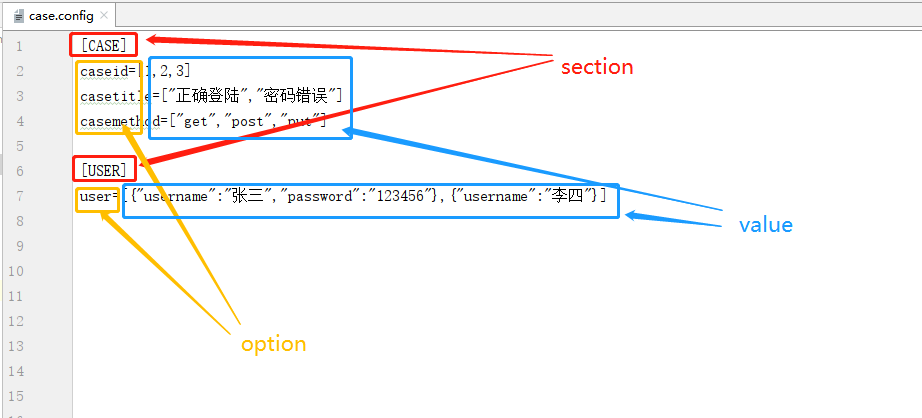
pip install configparseimport configparser
cf = configparser.ConfigParser()
cf.read("case.config",encoding="utf8")#读取config,有中文注意编码
#获取所有的section
sections = cf.sections()
print(sections)
#输出:['CASE', 'USER']import configparser
cf = configparser.ConfigParser()
cf.read("case.config",encoding="utf8")#读取config,有中文注意编码
#获取指定section下所有的option
options = cf.options("CASE")
print(options)
#输出:['caseid', 'casetitle', 'casemethod', 'caseexpect']import configparser
cf = configparser.ConfigParser()
cf.read("case.config",encoding="utf8")#读取config,有中文注意编码#获取指定section下的option和value,每一个option作为一个元祖[(),(),()]
alls = cf.items("CASE")
print(alls)
#输出:[('caseid', '[1,2,3]'), ('casetitle', '["正确登陆","密码错误"]'), ('casemethod', '["get","post","put"]'), ('caseexpect', '0000')]import configparser
cf = configparser.ConfigParser()
cf.read("case.config",encoding="utf8")#读取config,有中文注意编码
#获取指定section下指定option的value
caseid = cf.get("CASE","caseid")
print(caseid)import configparser
cf = configparser.ConfigParser()
cf.read("case.config",encoding="utf8")#读取config,有中文注意编码
#获取指定section下指定option的value
caseid = cf["CASE"]["caseid"]
print(caseid)
#输出:[1,2,3]import configparser
cf = configparser.ConfigParser()
cf.read("case.config",encoding="utf8")#读取config,有中文注意编码
#value数据类型
user = cf["USER"]["user"]
print(type(user))
#输出:<class 'str'>import configparser
cf = configparser.ConfigParser()
cf.read("case.config",encoding="utf8")#读取config,有中文注意编码
#value数据类型还原
user = cf["USER"]["user"]
print(type(user))#输出:<class 'str'>
user = eval(user)
print(type(user))#输出:<class 'list'>import configparser
class GetConfig():
def get_config_data(self,file,section,option):
cf = configparser.ConfigParser()
cf.read(file, encoding="utf8") # 读取config,有中文注意编码
# 返回value
return cf[section][option]
if __name__ == '__main__':
values = GetConfig().get_config_data("case.config","USER","user")
print(values)
#输出:[{"username":"张三","password":"123456"},{"username":"李四"}]
我有一个字符串input="maybe(thisis|thatwas)some((nice|ugly)(day|night)|(strange(weather|time)))"Ruby中解析该字符串的最佳方法是什么?我的意思是脚本应该能够像这样构建句子:maybethisissomeuglynightmaybethatwassomenicenightmaybethiswassomestrangetime等等,你明白了......我应该一个字符一个字符地读取字符串并构建一个带有堆栈的状态机来存储括号值以供以后计算,还是有更好的方法?也许为此目的准备了一个开箱即用的库?
关闭。这个问题是opinion-based.它目前不接受答案。想要改进这个问题?更新问题,以便editingthispost可以用事实和引用来回答它.关闭4年前。Improvethisquestion我想在固定时间创建一系列低音和高音调的哔哔声。例如:在150毫秒时发出高音调的蜂鸣声在151毫秒时发出低音调的蜂鸣声200毫秒时发出低音调的蜂鸣声250毫秒的高音调蜂鸣声有没有办法在Ruby或Python中做到这一点?我真的不在乎输出编码是什么(.wav、.mp3、.ogg等等),但我确实想创建一个输出文件。
我主要使用Ruby来执行此操作,但到目前为止我的攻击计划如下:使用gemsrdf、rdf-rdfa和rdf-microdata或mida来解析给定任何URI的数据。我认为最好映射到像schema.org这样的统一模式,例如使用这个yaml文件,它试图描述数据词汇表和opengraph到schema.org之间的转换:#SchemaXtoschema.orgconversion#data-vocabularyDV:name:namestreet-address:streetAddressregion:addressRegionlocality:addressLocalityphoto:i
我正在使用ruby1.9解析以下带有MacRoman字符的csv文件#encoding:ISO-8859-1#csv_parse.csvName,main-dialogue"Marceu","Giveittohimóhe,hiswife."我做了以下解析。require'csv'input_string=File.read("../csv_parse.rb").force_encoding("ISO-8859-1").encode("UTF-8")#=>"Name,main-dialogue\r\n\"Marceu\",\"Giveittohim\x97he,hiswife.\"\
exe应该在我打开页面时运行。异步进程需要运行。有什么方法可以在ruby中使用两个参数异步运行exe吗?我已经尝试过ruby命令-system()、exec()但它正在等待过程完成。我需要用参数启动exe,无需等待进程完成是否有任何rubygems会支持我的问题? 最佳答案 您可以使用Process.spawn和Process.wait2:pid=Process.spawn'your.exe','--option'#Later...pid,status=Process.wait2pid您的程序将作为解释器的子进程执行。除
我有一些Ruby代码,如下所示:Something.createdo|x|x.foo=barend我想编写一个测试,它使用double代替block参数x,这样我就可以调用:x_double.should_receive(:foo).with("whatever").这可能吗? 最佳答案 specify'something'dox=doublex.should_receive(:foo=).with("whatever")Something.should_receive(:create).and_yield(x)#callthere
我正在为一个项目制作一个简单的shell,我希望像在Bash中一样解析参数字符串。foobar"helloworld"fooz应该变成:["foo","bar","helloworld","fooz"]等等。到目前为止,我一直在使用CSV::parse_line,将列分隔符设置为""和.compact输出。问题是我现在必须选择是要支持单引号还是双引号。CSV不支持超过一个分隔符。Python有一个名为shlex的模块:>>>shlex.split("Test'helloworld'foo")['Test','helloworld','foo']>>>shlex.split('Test"
我不确定传递给方法的对象的类型是否正确。我可能会将一个字符串传递给一个只能处理整数的函数。某种运行时保证怎么样?我看不到比以下更好的选择:defsomeFixNumMangler(input)raise"wrongtype:integerrequired"unlessinput.class==FixNumother_stuffend有更好的选择吗? 最佳答案 使用Kernel#Integer在使用之前转换输入的方法。当无法以任何合理的方式将输入转换为整数时,它将引发ArgumentError。defmy_method(number)
两者都可以defsetup(options={})options.reverse_merge:size=>25,:velocity=>10end和defsetup(options={}){:size=>25,:velocity=>10}.merge(options)end在方法的参数中分配默认值。问题是:哪个更好?您更愿意使用哪一个?在性能、代码可读性或其他方面有什么不同吗?编辑:我无意中添加了bang(!)...并不是要询问nobang方法与bang方法之间的区别 最佳答案 我倾向于使用reverse_merge方法:option
我有一个只接受一个参数的方法:defmy_method(number)end如果使用number调用方法,我该如何引发错误??通常,我如何定义方法参数的条件?比如我想在调用的时候报错:my_method(1) 最佳答案 您可以添加guard在函数的开头,如果参数无效则引发异常。例如:defmy_method(number)failArgumentError,"Inputshouldbegreaterthanorequalto2"ifnumbereputse.messageend#=>Inputshouldbegreaterthano
