文章目录
本文使用的YOLOv5版本为v6.1,对YOLOv5-6.x网络结构还不熟悉的同学,可以移步至:【YOLOv5-6.x】网络模型&源码解析
想要尝试改进YOLOv5-6.1的同学,可以参考以下几篇博客:
【魔改YOLOv5-6.x(上)】结合轻量化网络Shufflenetv2、Mobilenetv3和Ghostnet
【魔改YOLOv5-6.x(中)】加入ACON激活函数、CBAM和CA注意力机制、加权双向特征金字塔BiFPN
【魔改YOLOv5-6.x(下)】YOLOv5s+Ghostconv+BiFPN+CA
Zhang, Yi-Fan, et al. “Focal and efficient IOU loss for accurate bounding box regression.” arXiv preprint arXiv:2101.08158 (2021).
我们知道,CIoU损失是在DIoU损失的基础上添加了衡量预测框和GT框纵横比 v v v,在一定程度上可以加快预测框的回归速度,但是仍然存在着很大的问题:
为了解决这个问题,EIoU提出了直接对w和h的预测结果进行惩罚的损失函数:
L
E
I
o
U
=
L
I
o
U
+
L
dis
+
L
asp
=
1
−
I
o
U
+
ρ
2
(
b
,
b
g
t
)
c
2
+
ρ
2
(
w
,
w
g
t
)
C
w
2
+
ρ
2
(
h
,
h
g
t
)
C
h
2
\begin{aligned} \mathcal{L}_\mathrm{E I o U} &=\mathcal{L}_\mathrm{I o U}+\mathcal{L}_{\text {dis }}+\mathcal{L}_{\text {asp }} \\ &=1-I o U+\frac{\rho^{2}\left(\mathbf{b}, \mathbf{b}^\mathrm{g t}\right)}{c^{2}}+\frac{\rho^{2}\left(w, w^\mathrm{g t}\right)}{C_\mathrm{w}^{2}}+\frac{\rho^{2}\left(h, h^\mathrm{g t}\right)}{C_\mathrm{h}^{2}} \end{aligned}
LEIoU=LIoU+Ldis +Lasp =1−IoU+c2ρ2(b,bgt)+Cw2ρ2(w,wgt)+Ch2ρ2(h,hgt)
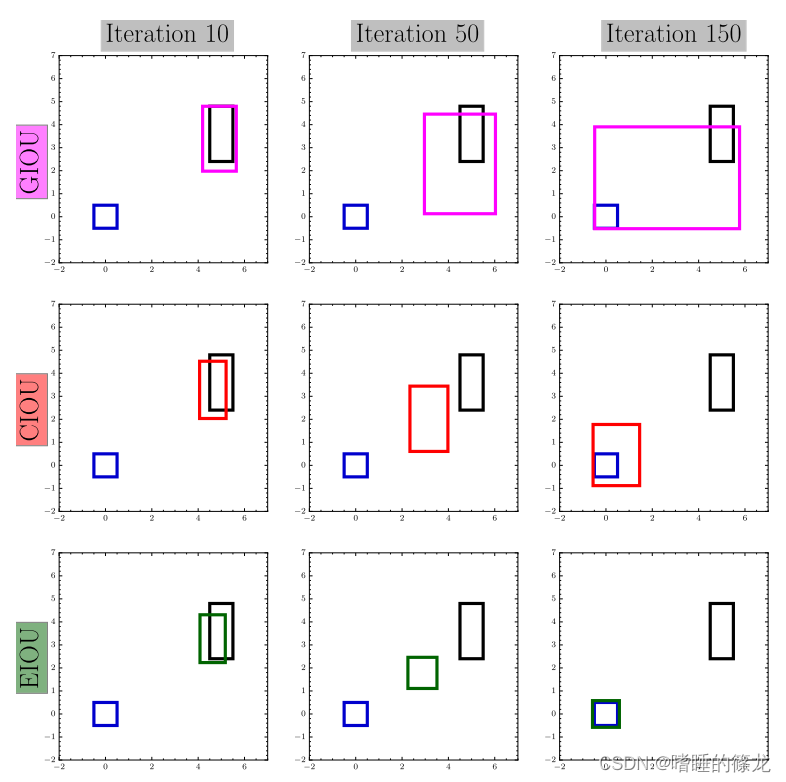
下图是GIoU、CIoU和EIoU损失预测框的迭代过程对比图,红色框和绿色框就是预测框的回归过程,蓝色框是真实框,黑色框是预先设定的锚框:
除此之外,论文中还提到了利用Focal Loss对EIOU进行加权处理:
L
F
o
c
a
l
−
E
I
o
U
=
I
o
U
γ
∗
L
E
I
o
U
L_\mathrm{Focal-EIoU}=IoU^{\gamma}*L_\mathrm{EIoU}
LFocal−EIoU=IoUγ∗LEIoU
utils/metrics.py中,找到bbox_iou函数,可以把原有的注释掉,换成下面的代码:# 计算两个框的特定IOU
def bbox_iou(box1, box2, x1y1x2y2=True, GIoU=False, DIoU=False, CIoU=False, EIoU=False, eps=1e-7):
# Returns the IoU of box1 to box2. box1 is 4, box2 is nx4
# 这里取转置,为了后续方便每个维度(坐标)之间的计算
box2 = box2.T
# Get the coordinates of bounding boxes
if x1y1x2y2: # x1, y1, x2, y2 = box1
b1_x1, b1_y1, b1_x2, b1_y2 = box1[0], box1[1], box1[2], box1[3]
b2_x1, b2_y1, b2_x2, b2_y2 = box2[0], box2[1], box2[2], box2[3]
else: # transform from xywh to xyxy 默认执行这里
b1_x1, b1_x2 = box1[0] - box1[2] / 2, box1[0] + box1[2] / 2
b1_y1, b1_y2 = box1[1] - box1[3] / 2, box1[1] + box1[3] / 2
b2_x1, b2_x2 = box2[0] - box2[2] / 2, box2[0] + box2[2] / 2
b2_y1, b2_y2 = box2[1] - box2[3] / 2, box2[1] + box2[3] / 2
# Intersection area
inter = (torch.min(b1_x2, b2_x2) - torch.max(b1_x1, b2_x1)).clamp(0) * \
(torch.min(b1_y2, b2_y2) - torch.max(b1_y1, b2_y1)).clamp(0)
# Union Area
w1, h1 = b1_x2 - b1_x1, b1_y2 - b1_y1 + eps
w2, h2 = b2_x2 - b2_x1, b2_y2 - b2_y1 + eps
union = w1 * h1 + w2 * h2 - inter + eps
iou = inter / union
# 目标框IOU损失函数的计算
if CIoU or DIoU or GIoU or EIoU:
# 两个框的最小闭包区域的width
cw = torch.max(b1_x2, b2_x2) - torch.min(b1_x1, b2_x1) # convex (smallest enclosing box) width
# 两个框的最小闭包区域的height
ch = torch.max(b1_y2, b2_y2) - torch.min(b1_y1, b2_y1) # convex height
if CIoU or DIoU or EIoU: # Distance or Complete IoU https://arxiv.org/abs/1911.08287v1
# 最小外接矩形 对角线的长度平方
c2 = cw ** 2 + ch ** 2 + eps # convex diagonal squared
# 两个框中心点之间距离的平方
rho2 = ((b2_x1 + b2_x2 - b1_x1 - b1_x2) ** 2 +
(b2_y1 + b2_y2 - b1_y1 - b1_y2) ** 2) / 4 # center distance squared
if DIoU:
return iou - rho2 / c2 # DIoU
# CIoU 比DIoU多了限制长宽比的因素:v * alpha
elif CIoU: # https://github.com/Zzh-tju/DIoU-SSD-pytorch/blob/master/utils/box/box_utils.py#L47
v = (4 / math.pi ** 2) * torch.pow(torch.atan(w2 / h2) - torch.atan(w1 / h1), 2)
with torch.no_grad():
alpha = v / (v - iou + (1 + eps))
return iou - (rho2 / c2 + v * alpha)
# EIoU 在CIoU的基础上将纵横比的损失项拆分成预测的宽高分别与最小外接框宽高的差值 加速了收敛提高了回归精度
elif EIoU:
rho_w2 = ((b2_x2 - b2_x1) - (b1_x2 - b1_x1)) ** 2
rho_h2 = ((b2_y2 - b2_y1) - (b1_y2 - b1_y1)) ** 2
cw2 = cw ** 2 + eps
ch2 = ch ** 2 + eps
return iou - (rho2 / c2 + rho_w2 / cw2 + rho_h2 / ch2)
# GIoU https://arxiv.org/pdf/1902.09630.pdf
c_area = cw * ch + eps # convex area
return iou - (c_area - union) / c_area
return iou # IoU
utils/loss.py中,找到ComputeLoss类中的__call__()函数,把Regression loss中计算iou的代码,换成下面这句:iou = bbox_iou(pbox.T, tbox[i], x1y1x2y2=False, CIoU=False, EIoU=True) # iou(prediction, target)
He, Jiabo, et al. “$\alpha $-IoU: A Family of Power Intersection over Union Losses for Bounding Box Regression.” Advances in Neural Information Processing Systems 34 (2021).
由于IoU Loss对于bbox尺度不变,可以训练出更好的检测器,因此在目标检测中常采用IOU Loss对预测框计算定位回归损失(在YOLOv5中采用CIoU Loss)
而本文提出的Alpha-IoU Loss是基于现有IoU Loss的统一幂化,即对所有的IoU Loss,增加
α
\alpha
α幂,当
α
\alpha
α等于1时,则回归到原始各个Loss中:
L
I
o
U
=
1
−
I
o
U
⟹
L
α
−
I
o
U
=
1
−
I
o
U
α
L
G
I
o
U
=
1
−
I
o
U
+
∣
C
−
(
B
∪
B
g
t
)
∣
∣
C
∣
⟹
L
α
−
G
I
o
U
=
1
−
I
o
U
α
+
(
∣
C
−
(
B
∪
B
g
t
)
∣
∣
C
∣
)
α
L
D
I
o
U
=
1
−
I
o
U
+
ρ
2
(
b
,
b
g
t
)
c
2
⟹
L
α
−
D
I
o
U
=
1
−
I
o
U
α
+
ρ
2
α
(
b
,
b
g
t
)
c
2
α
L
C
I
o
U
=
1
−
I
o
U
+
ρ
2
(
b
,
b
g
t
)
c
2
+
β
v
⟹
L
α
−
C
I
o
U
=
1
−
I
o
U
α
+
ρ
2
α
(
b
,
b
g
t
)
c
2
α
+
(
β
v
)
α
\begin{aligned} \mathcal{L}_{\mathrm{IoU}}=1-I o U & \Longrightarrow \mathcal{L}_{\alpha-\mathrm{IoU}}=1-I o U^{\alpha} \\ \mathcal{L}_{\mathrm{GIoU}}=1-I o U+\frac{\left|C-\left(B \cup B^\mathrm{g t}\right)\right|}{|C|} & \Longrightarrow \mathcal{L}_{\alpha-\mathrm{GIoU}}=1-I o U^{\alpha}+\left(\frac{\left|C-\left(B \cup B^\mathrm{g t}\right)\right|}{|C|}\right)^{\alpha} \\ \mathcal{L}_{\mathrm{DIoU}}=1-I o U+\frac{\rho^{2}\left(\boldsymbol{b}, \boldsymbol{b}^\mathrm{g t}\right)}{c^{2}} & \Longrightarrow \mathcal{L}_{\alpha-\mathrm{DIoU}}=1-I o U^{\alpha}+\frac{\rho^{2 \alpha}\left(\boldsymbol{b}, \boldsymbol{b}^\mathrm{g t}\right)}{c^{2 \alpha}} \\ \mathcal{L}_{\mathrm{CIoU}}=1-I o U+\frac{\rho^{2}\left(\boldsymbol{b}, \boldsymbol{b}^\mathrm{g t}\right)}{c^{2}}+\beta v & \Longrightarrow \mathcal{L}_{\alpha-\mathrm{CIoU}}=1-I o U^{\alpha}+\frac{\rho^{2 \alpha}\left(\boldsymbol{b}, \boldsymbol{b}^\mathrm{g t}\right)}{c^{2 \alpha}}+(\beta v)^{\alpha} \end{aligned}
LIoU=1−IoULGIoU=1−IoU+∣C∣∣C−(B∪Bgt)∣LDIoU=1−IoU+c2ρ2(b,bgt)LCIoU=1−IoU+c2ρ2(b,bgt)+βv⟹Lα−IoU=1−IoUα⟹Lα−GIoU=1−IoUα+(∣C∣∣C−(B∪Bgt)∣)α⟹Lα−DIoU=1−IoUα+c2αρ2α(b,bgt)⟹Lα−CIoU=1−IoUα+c2αρ2α(b,bgt)+(βv)α
# Alpha-IOU:https://arxiv.org/abs/2110.13675
# 参考:https://mp.weixin.qq.com/s/l22GJtA7Vd11dpY9QG4k2A
def bbox_alpha_iou(box1, box2, x1y1x2y2=False, GIoU=False, DIoU=False, CIoU=False, EIoU=False, alpha=3, eps=1e-9):
    # Returns tsqrt_he IoU of box1 to box2. box1 is 4, box2 is nx4
    box2 = box2.T

    # Get the coordinates of bounding boxes
    if x1y1x2y2:  # x1, y1, x2, y2 = box1
        b1_x1, b1_y1, b1_x2, b1_y2 = box1[0], box1[1], box1[2], box1[3]
        b2_x1, b2_y1, b2_x2, b2_y2 = box2[0], box2[1], box2[2], box2[3]
    else:  # transform from xywh to xyxy
        b1_x1, b1_x2 = box1[0] - box1[2] / 2, box1[0] + box1[2] / 2
        b1_y1, b1_y2 = box1[1] - box1[3] / 2, box1[1] + box1[3] / 2
        b2_x1, b2_x2 = box2[0] - box2[2] / 2, box2[0] + box2[2] / 2
        b2_y1, b2_y2 = box2[1] - box2[3] / 2, box2[1] + box2[3] / 2

    # Intersection area
    inter = (torch.min(b1_x2, b2_x2) - torch.max(b1_x1, b2_x1)).clamp(0) * \
            (torch.min(b1_y2, b2_y2) - torch.max(b1_y1, b2_y1)).clamp(0)

    # Union Area
    w1, h1 = b1_x2 - b1_x1, b1_y2 - b1_y1 + eps
    w2, h2 = b2_x2 - b2_x1, b2_y2 - b2_y1 + eps
    union = w1 * h1 + w2 * h2 - inter + eps

    # change iou into pow(iou+eps) 加入α次幂
    # alpha iou
    iou = torch.pow(inter / union + eps, alpha)
    beta = 2 * alpha
    if GIoU or DIoU or CIoU or EIoU:
        # 两个框的最小闭包区域的width和height
        cw = torch.max(b1_x2, b2_x2) - torch.min(b1_x1, b2_x1)  # convex (smallest enclosing box) width
        ch = torch.max(b1_y2, b2_y2) - torch.min(b1_y1, b2_y1)  # convex height

        if CIoU or DIoU or EIoU:  # Distance or Complete IoU https://arxiv.org/abs/1911.08287v1
            # 最小外接矩形 对角线的长度平方
            c2 = cw ** beta + ch ** beta + eps  # convex diagonal
            rho_x = torch.abs(b2_x1 + b2_x2 - b1_x1 - b1_x2)
            rho_y = torch.abs(b2_y1 + b2_y2 - b1_y1 - b1_y2)
            # 两个框中心点之间距离的平方
            rho2 = (rho_x ** beta + rho_y ** beta) / (2 ** beta)  # center distance
            if DIoU:
                return iou - rho2 / c2  # DIoU

            elif CIoU:  # https://github.com/Zzh-tju/DIoU-SSD-pytorch/blob/master/utils/box/box_utils.py#L47
                v = (4 / math.pi ** 2) * torch.pow(torch.atan(w2 / h2) - torch.atan(w1 / h1), 2)
                with torch.no_grad():
                    alpha_ciou = v / ((1 + eps) - inter / union + v)
                # return iou - (rho2 / c2 + v * alpha_ciou)  # CIoU
                return iou - (rho2 / c2 + torch.pow(v * alpha_ciou + eps, alpha))  # CIoU

            # EIoU 在CIoU的基础上
            # 将预测框宽高的纵横比损失项 拆分成预测框的宽高分别与最小外接框宽高的差值
            # 加速了收敛提高了回归精度
            elif EIoU:
                rho_w2 = ((b2_x2 - b2_x1) - (b1_x2 - b1_x1)) ** beta
                rho_h2 = ((b2_y2 - b2_y1) - (b1_y2 - b1_y1)) ** beta
                cw2 = cw ** beta + eps
                ch2 = ch ** beta + eps
                return iou - (rho2 / c2 + rho_w2 / cw2 + rho_h2 / ch2)

            # GIoU https://arxiv.org/pdf/1902.09630.pdf
            c_area = torch.max(cw * ch + eps, union)  # convex area
            return iou - torch.pow((c_area - union) / c_area + eps, alpha)  # GIoU
    else:
        return iou  # torch.log(iou+eps) or iou
即插即用| Alpha_IOU loss助力yolov5优化
目标检测中的预测框回归优化之IOU、GIOU、DIOU、CIOU和EIOU
深度学习笔记(十三):IOU、GIOU、DIOU、CIOU、EIOU、Focal EIOU、alpha IOU损失函数分析及Pytorch实现
我在开发的Rails3网站的一些搜索功能上遇到了一个小问题。我有一个简单的Post模型,如下所示:classPost我正在使用acts_as_taggable_on来更轻松地向我的帖子添加标签。当我有一个标记为“rails”的帖子并执行以下操作时,一切正常:@posts=Post.tagged_with("rails")问题是,我还想搜索帖子的标题。当我有一篇标题为“Helloworld”并标记为“rails”的帖子时,我希望能够通过搜索“hello”或“rails”来找到这篇帖子。因此,我希望标题列的LIKE语句与acts_as_taggable_on提供的tagged_with方法
很难说出这里要问什么。这个问题模棱两可、含糊不清、不完整、过于宽泛或夸夸其谈,无法以目前的形式得到合理的回答。如需帮助澄清此问题以便重新打开,visitthehelpcenter.关闭9年前。我需要从基于ruby的应用程序使用AmazonSimpleNotificationService,但不知道从哪里开始。您对从哪里开始有什么建议吗?
我有一个基本的Rails应用程序测试,其中包含一个用回形针处理的照片字段的用户模型。我创建了能够创建/编辑用户的View,并且照片上传工作正常。Editinguseruser_path(@user),:html=>{:method=>"put",:multipart=>true}do|f|%>|然后,我想将SWFUpload集成到我的应用程序中。我试着按照这个tutorial并运行testproject没有任何成功:浏览按钮不会打开文件对话框,并抛出错误#2176,这是关于selectFiles()方法的。首先,问题是Flashv.10与项目中包含的旧版本SWFUpload(2.1.0
我正在尝试使Authlogic和FacebookConnect(使用Facebook)发挥良好的作用,以便您可以通过正常注册方式或使用Facebookconnect创建帐户。我已经能够让连接以一种方式工作,但注销只会在facebook而不是我的网站上注销,我必须删除cookie才能使其正常工作。任何帮助都会很棒,谢谢! 最佳答案 这是我使用FacebookConnect扩展、authlogic和OpenID制作的示例应用程序。它仍然需要一些工作,但它确实起作用了。http://big-glow-mama.heroku.com/htt
关于yolov5训练时参数workers和batch-size的理解yolov5训练命令workers和batch-size参数的理解两个参数的调优总结yolov5训练命令python.\train.py--datamy.yaml--workers8--batch-size32--epochs100yolov5的训练很简单,下载好仓库,装好依赖后,只需自定义一下data目录中的yaml文件就可以了。这里我使用自定义的my.yaml文件,里面就是定义数据集位置和训练种类数和名字。workers和batch-size参数的理解一般训练主要需要调整的参数是这两个:workers指数据装载时cpu所使
亚马逊的documentation提供有关如何使用DynamoDBLocal的Java、.NET和PHP示例。你如何用AWSRubySDK做同样的事情??我的猜测是你在初始化时传入了一些参数,但我不知道它们是什么。dynamo_db=AWS::DynamoDB.new(:access_key_id=>'...',:secret_access_key=>'...') 最佳答案 您使用的是SDK的v1还是v2?您需要找出答案;从上面的简短片段来看,它看起来像v2。为了以防万一,我已经包含了这两个答案。v1答案:AWS.config(us
我想知道这个问题已经有一段时间了,但还没有真正找到答案。为什么要在Rails应用程序中使用Backbone.jsexaclty?是为了扩展功能、为您的JS提供更多MVC模式、构建更好的API......?目前我看不出你为什么要用它来做什么,因为我不认为我理解Backbone.js的概念 最佳答案 Rails的一大优势在于您拥有一个平台和一种语言,可以处理服务器代码并生成客户端代码(使用View)。毫无疑问,一旦您想使用javascript和jquery改善用户体验,这种理论上的优势就会迅速消失。所以实际上你还是要学习两种语言。但仍然
我正在尝试在数组中查找唯一元素并从中删除nil值。我的解决方案如下所示:@array=[1,2,1,1,2,3,4,nil,5,nil,5]@array.uniq.compact#=>[1,2,3,4,5]有没有一种方法可以同时完成这两种操作?如果不是,@array.uniq.compact或@array.compact.uniq哪个高效? 最佳答案 不,但是您可以按照您喜欢的任何顺序附加它们,即array.uniq.compactarray.compact.uniq正如phts所指出的,您可以将一个block传递给uniq,但我认
我正在考虑使用Sequel对于我发现在ActiveRecord中很难制作的一些较复杂的SQL。在同一个项目中使用Sequel和ActiveRecord有什么需要注意的吗?(除了明显的,比如续集中没有AR验证等......) 最佳答案 免责声明:我是Sequel的维护者。在使用Rails时,Sequel很容易与ActiveRecord一起使用或代替ActiveRecord。您必须手动设置数据库连接,但除此之外,用法类似。您的Sequel模型文件位于app/models中,其工作方式类似于ActiveRecord模型。设置数据库连接并不
我是那些没有在他的任何Ruby/RubyonRails工作中使用TextMate的开发人员之一。我在这个领域的特别忠诚在于vim。您最喜欢将vim与Ruby和/或RubyonRails结合使用以尽可能提高工作效率的提示/技巧是什么? 最佳答案 最重要获取rails.vim的副本它在数百万级别上很棒。Readthedoc.提示太多了,:Rviewcustomer,:RSmodelfoo,:Rinvert,gf,:Rextract,:Rake等等。您可能需要NERDTree以及轻松导航(您可以使用:Rtree访问)第二重要在推特上关注t
