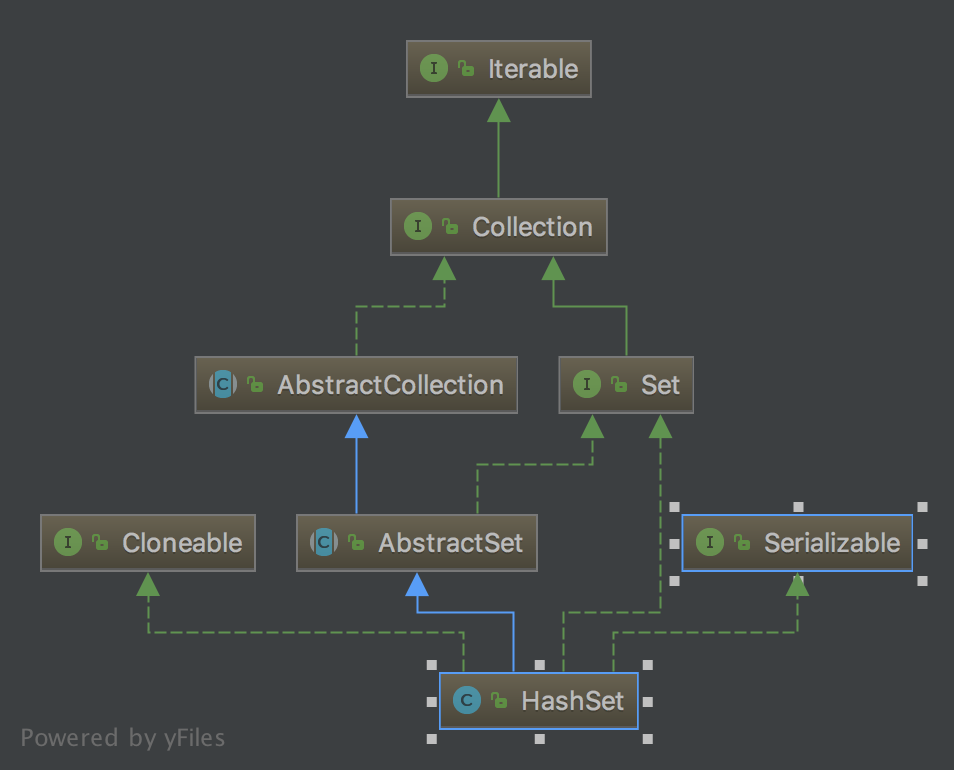
HashSet实现了Set接口
HashSet底层实际上是由HashMap实现的
public HashSet() {
        map = new HashMap<>();
}
- 可以存放
null,但是只能有一个null
HashSet不保证元素是有序的(即不保证存放元素的顺序和取出元素的顺序一致),取决于hash后,再确定索引的结果
- 不能有重复的元素
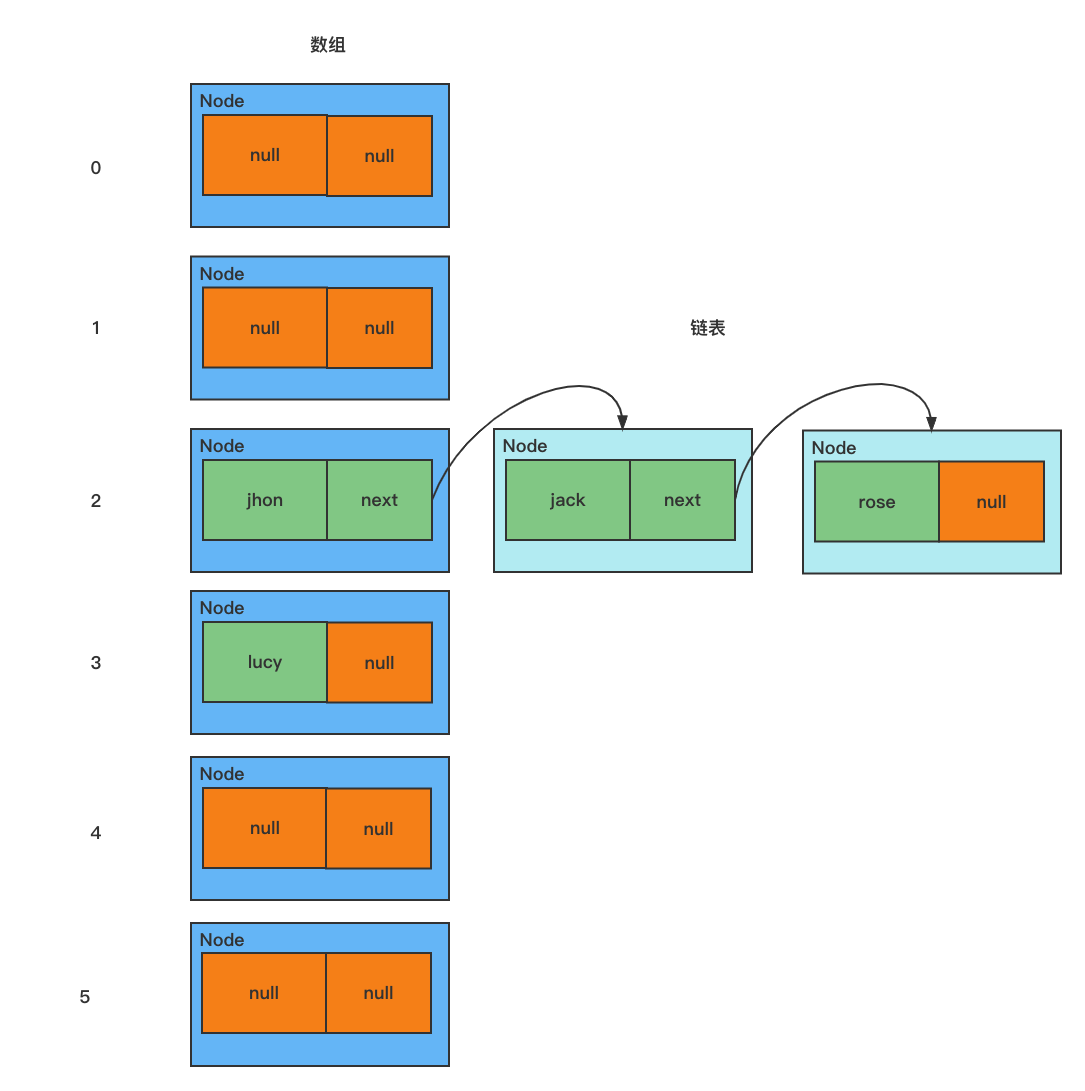
HashSet底层是HashMap,HashMap底层是 数组 + 链表 + 红黑树
/**
 * 模拟 HashSet 数组+链表的结构
 */
public class HashSetStructureMain {
    public static void main(String[] args) {
        // 模拟一个 HashSet(HashMap) 的底层结构
        // 1. 创建一个数组,数组的类型为 Node[]
        // 2. 有些地方直接把 Node[] 数组称为 表
        Node[] table = new Node[16];
        System.out.println(table);
        // 3. 创建节点
        Node john = new Node("john", null);
        table[2] = jhon; // 把节点 john 放在数组索引为 2 的位置
        Node jack = new Node("jack", null);
        jhon.next = jack; // 将 jack 挂载到 jhon 的后面
        Node rose = new Node("rose", null);
        jack.next = rose; // 将 rose 挂载到 jack 的后面
        Node lucy = new Node("lucy", null);
        table[3] = lucy; // 将 lucy 放在数组索引为 3 的位置
        System.out.println(table);

    }
}

// 节点类 存储数据,可以指向下一个节点,从而形成链表
class Node{
    Object item; // 存放数据
    Node next; // 指向下一个节点
    public Node(Object item, Node next){
        this.item = item;
        this.next = next;
    }
}
HashSet底层是HashMap
- 当添加一个元素时,会先得到 待添加元素的
hash值,然后将其转换成一个 索引值
- 查询存储数据表(Node 数组)
table,看当前 待添加元素 所对应的 索引值 的位置是否已经存放了 其它元素
- 如果当前 索引值 所对应的的位置不存在 其它元素,就将当前 待添加元素 放到这个 索引值 所对应的的位置
- 如果当前 索引值 所对应的位置存在 其它元素,就调用
待添加元素.equals(已存在元素)比较,结果为true,则放弃添加;结果为false,则将 待添加元素 放到 已存在元素 的后面(已存在元素.next = 待添加元素)
HashSet的底层是HashMap,第一次添加元素时,table数组扩容到cap = 16,threshold(临界值) = cap * loadFactor(加载因子 0.75) = 12
- 如果
table数组使用到了临界值 12,就会扩容到cap * 2 = 32,新的临界值就是32 * 0.75 = 24,以此类推
- 在 Java8 中,如果一条链表上的元素个数 到达
TREEIFY_THRESHOLD(默认是 8),并且table的大小 >=MIN_TREEIFY_CAPACITY(默认是 64),就会进行 树化(红黑树)
- 判断是否扩容是根据
++size > threshold,即是否扩容,是根据HashMap所存的元素个数(size)是否超过临界值,而不是根据table.length()是否超过临界值
/**
 * HashSet 源码分析
 */
public class HashSetSourceMain {
    public static void main(String[] args) {
        HashSet hashSet = new HashSet();
        hashSet.add("java");
        hashSet.add("php");
        hashSet.add("java");
        System.out.println("set = " + hashSet);

        // 源码分析
        // 1. 执行 HashSet()
        /**
         * public HashSet() { // HashSet 底层是 HashMap
         *         map = new HashMap<>();
         *     }
         */

        // 2. 执行 add()
        /**
         * public boolean add(E e) { // e == "java"
         *         // HashSet 的 add() 方法其实是调用 HashMap 的 put()方法
         *         return map.put(e, PRESENT)==null; // (static) PRESENT = new Object(); 用于占位
         *     }
         */

        // 3. 执行 put()
        // hash(key) 得到 key(待存元素) 对应的hash值,并不等于 hashcode()
        // 算法是 h = key.hashCode()) ^ (h >>> 16
        /**
         * public V put(K key, V value) {
         *         return putVal(hash(key), key, value, false, true);
         *     }
         */

        // 4. 执行 putVal()
        // 定义的辅助变量:Node<K,V>[] tab; Node<K,V> p; int n, i;
        // table 是 HashMap 的一个属性,初始化为 null;transient Node<K,V>[] table;
        // resize() 方法,为 table 数组指定容量
        // p = tab[i = (n - 1) & hash] 计算 key的hash值所对应的 table 中的索引位置,将索引位置对应的 Node 赋给 p
        /**
         * final V putVal(int hash, K key, V value, boolean onlyIfAbsent,
         *                    boolean evict) {
         *         Node<K,V>[] tab; Node<K,V> p; int n, i; // 辅助变量
         *         // table 就是 HashMap 的一个属性,类型是 Node[]
         *         // if 语句表示如果当前 table 是 null,或者 table.length == 0
         *         // 就是 table 第一次扩容,容量为 16
         *         if ((tab = table) == null || (n = tab.length) == 0)
         *             n = (tab = resize()).length;
         *         // 1. 根据 key,得到 hash 去计算key应该存放到 table 的哪个索引位置
         *         // 2. 并且把这个位置的索引值赋给 i;索引值对应的元素,赋给 p
         *         // 3. 判断 p 是否为 null
         *         // 3.1 如果 p 为 null,表示还没有存放过元素,就创建一个Node(key="java",value=PRESENT),并把这个元素放到 i 的索引位置
         *         // tab[i] = newNode(hash, key, value, null);
         *         if ((p = tab[i = (n - 1) & hash]) == null)
         *             tab[i] = newNode(hash, key, value, null);
         *         else {
         *             Node<K,V> e; K k; // 辅助变量
         *             // 如果当前索引位置对应的链表的第一个元素和待添加的元素的 hash值一样
         *             // 并且满足下面两个条件之一:
         *             // 1. 待添加的 key 与 p 所指向的 Node 节点的key 是同一个对象
         *             // 2. 待添加的 key.equals(p 指向的 Node 节点的 key) == true
         *             // 就认为当前待添加的元素是重复元素,添加失败
         *             if (p.hash == hash &&
         *                 ((k = p.key) == key || (key != null && key.equals(k))))
         *                 e = p;
         *             // 判断 当前 p 是不是一颗红黑树
         *             // 如果是一颗红黑树,就调用 putTreeVal,来进行添加
         *             else if (p instanceof TreeNode)
         *                 e = ((TreeNode<K,V>)p).putTreeVal(this, tab, hash, key, value);
         *             else {
         *                  // 如果 当前索引位置已经形成一个 链表,就使用 for 循环比较
         *                  // 将待添加元素依次和链表上的每个元素进行比较
         *                  // 1. 比较过程中如果出现待添加元素和链表中的元素有相同的,比较结束,出现重复元素,添加失败
         *                  // 2. 如果比较到链表最后一个元素,链表中都没出现与待添加元素相同的,就把当前待添加元素放到该链表最后的位置
         *                  // 注意:在把待添加元素添加到链表后,立即判断 该链表是否已经到达 8 个节点
         *                  // 如果到达,就调用 treeifyBin() 对当前这个链表进行数化(转成红黑树)
         *                  // 注意:在转成红黑树前,还要进行判断
         *                  // if (tab == null || (n = tab.length) < MIN_TREEIFY_CAPACITY)
         *                  //        resize();
         *                  // 如果上面条件成立,先对 table 进行扩容
         *                  // 如果上面条件不成立,才转成红黑树
         *                 for (int binCount = 0; ; ++binCount) {
         *                     if ((e = p.next) == null) {
         *                         p.next = newNode(hash, key, value, null);
         *                         if (binCount >= TREEIFY_THRESHOLD - 1) // -1 for 1st
         *                             treeifyBin(tab, hash);
         *                         break;
         *                     }
         *                     if (e.hash == hash &&
         *                         ((k = e.key) == key || (key != null && key.equals(k))))
         *                         break;
         *                     p = e;
         *                 }
         *             }
         *             // e 不为 null ,说明添加失败
         *             if (e != null) { // existing mapping for key
         *                 V oldValue = e.value;
         *                 if (!onlyIfAbsent || oldValue == null)
         *                     e.value = value;
         *                 afterNodeAccess(e);
         *                 return oldValue;
         *             }
         *         }
         *         ++modCount;
         *         // 扩容:说明判断 table 是否扩容不是看 table 的length
         *         // 而是看 整个 HashMap 的 size(即已存元素个数)
         *         if (++size > threshold)
         *             resize();
         *         afterNodeInsertion(evict);
         *         return null;
         *     }
         */
    }
}
HashSet 的底层是 HashMap,HashSet 的迭代器也是借由 HashMap 来实现的
HashSet.iterator() 实际上是去调用 HashMap 的 KeySet().iterator()
public Iterator<E> iterator() {
    return map.keySet().iterator();
}
KeySet() 方法返回一个 KeySet 对象,而 KeySet 是 HashMap 的一个内部类public Set<K> keySet() {
Set<K> ks = keySet;
if (ks == null) {
ks = new KeySet();
keySet = ks;
}
return ks;
}
KeySet().iterator() 方法返回一个 KeyIterator 对象,KeyIterator 是 HashMap 的一个内部类public final Iterator<K> iterator() { return new KeyIterator(); }
KeyIterator 继承了 HashIterator(HashMap的内部类) 类,并实现了 Iterator 接口,即 KeyIterator、HashIterator 才是真正实现 迭代器 的类final class KeyIterator extends HashIterator
implements Iterator<K> {
public final K next() { return nextNode().key; }
}
当执行完 Iterator iterator = HashSet.iterator; 之后,此时的 iterator 对象中已经存储了一个元素节点
怎么做到的?
回到第 4 步,KeySet().iterator() 方法返回一个 KeyIterator 对象
new KeyIterator() 调用 KeyIterator 的无参构造器
在这之前,会先调用其父类 HashIterator 的无参构造器
因此,分析 HashIterator 的无参构造器就知道发生了什么
/**
*         Node<K,V> next;        // next entry to return
*         Node<K,V> current;     // current entry
*         int expectedModCount;  // for fast-fail
*         int index;             // current slot
* HashIterator() {
*             expectedModCount = modCount;
*             Node<K,V>[] t = table;
*             current = next = null;
*             index = 0;
*             if (t != null && size > 0) { // advance to first entry
*                 do {} while (index < t.length && (next = t[index++]) == null);
*             }
*         }
*/
next、current、index 都是 HashIterator 的属性
Node<K,V>[] t = table; 先把 Node 数组 talbe 赋给 t
current = next = null; current、next 都置为 null
index = 0; index 置为 0
do {} while (index < t.length && (next = t[index++]) == null); 这个 do-while 会在 table 中遍历 Node 结点
一旦 (next = t[index++]) == null 不成立 时,就说明找到了一个 table 中的 Node 结点
将这个节点赋给 next,并退出当前 do-while 循环
此时 Iterator iterator = HashSet.iterator; 就执行完了
当前 iterator 的运行类型其实是 HashIterator,而 HashIterator 的 next 中存储着从 table 中遍历出来的一个 Node 结点
执行 iterator.hasNext
此时的 next 存储着一个 Node,所以并不为 null,返回 true
public final boolean hasNext() {
    return next != null;
}
执行 iterator.next()
Node<K,V> e = next; 把当前存储着 Node 结点的 next 赋值给了 e(next = (current = e).next) == null 判断当前结点的下一个结点是否为 null
null,就执行 do {} while (index < t.length && (next = t[index++]) == null);,在 table 数组中遍历,寻找 table 数组中的下一个 Node 并赋值给 nextnull,就将当前结点的下一个结点赋值给 next,并且此刻不会去 table 数组中遍历下一个 Node 结点e 返回iterator.next() 都像 (a)、(b) 那样去判断遍历,直到遍历完成/**
* HashSet 源码分析
*/
public class HashSetSourceMain {
public static void main(String[] args) {
HashSet hashSet = new HashSet();
hashSet.add("java");
hashSet.add("php");
hashSet.add("java");
System.out.println("set = " + hashSet);
// HashSet 迭代器实现原理
// HashSet 底层是 HashMap,HashMap 底层是 数组 + 链表 + 红黑树
// HashSet 本身没有实现迭代器,而是借由 HashMap 来实现的
// 1. hashSet.iterator() 实际上是去调用 HashMap 的 keySet().iterator()
/**
* public Iterator<E> iterator() {
* return map.keySet().iterator();
* }
*/
// 2. KeySet() 方法返回一个 KeySet 对象,而 KeySet 是 HashMap 的一个内部类
/**
* public Set<K> keySet() {
* Set<K> ks = keySet;
* if (ks == null) {
* ks = new KeySet();
* keySet = ks;
* }
* return ks;
* }
*/
// 3. KeySet().iterator() 方法返回一个 KeyIterator 对象,KeyIterator 是 HashMap的一个内部类
/**
* public final Iterator<K> iterator() { return new KeyIterator(); }
*/
// 4. KeyIterator 继承了 HashIterator(HashMap的内部类) 类,并实现了 Iterator 接口
// 即 KeyIterator、HashIterator 才是真正实现 迭代器的类
/**
* final class KeyIterator extends HashIterator
* implements Iterator<K> {
* public final K next() { return nextNode().key; }
* }
*/
// 5. 当执行完 Iterator iterator = hashSet.iterator(); 后
// 此时的 iterator 对象中已经存储了一个元素节点
// 怎么做到的?
// 回到第 3 步,KeySet().iterator() 方法返回一个 KeyIterator 对象
// new KeyIterator() 调用 KeyIterator 的无参构造器
// 在这之前,会先调用 KeyIterator 父类 HashIterator 的无参构造器
// 因此分析 HashIterator 的无参构造器就知道发生了什么
/**
* Node<K,V> next; // next entry to return
* Node<K,V> current; // current entry
* int expectedModCount; // for fast-fail
* int index; // current slot
* HashIterator() {
* expectedModCount = modCount;
* Node<K,V>[] t = table;
* current = next = null;
* index = 0;
* if (t != null && size > 0) { // advance to first entry
* do {} while (index < t.length && (next = t[index++]) == null);
* }
* }
*/
// 5.0 next, current, index 都是 HashIterator 的属性
// 5.1 Node<K,V>[] t = table; 先把 Node 数组 table 赋给 t
// 5.2 current = next = null; 把 current 和 next 都置为 null
// 5.3 index = 0; index 置为 0
// 5.4 do {} while (index < t.length && (next = t[index++]) == null);
// 这个 do{} while 循环会在 table 中 遍历 Node节点
// 一旦 (next = t[index++]) == null 不成立时,就说明找到了一个 table 中的节点
// 将这个节点赋给 next,并退出当前 do while循环
// 此时 Iterator iterator = hashSet.iterator(); 就执行完了
// 当前 iterator 的运行类型其实是 HashIterator,而 HashIterator 的 next 中存储着从 table 中遍历出来的一个 Node节点
// 6. 执行 iterator.hasNext()
/**
* public final boolean hasNext() {
* return next != null;
* }
*/
// 6.1 此时的 next 存储着一个 Node,所以并不为 null,返回 true
// 7. 执行 iterator.next(),其实是去执行 HashIterator 的 nextNode()
/**
* final Node<K,V> nextNode() {
* Node<K,V>[] t;
* Node<K,V> e = next;
* if (modCount != expectedModCount)
* throw new ConcurrentModificationException();
* if (e == null)
* throw new NoSuchElementException();
* if ((next = (current = e).next) == null && (t = table) != null) {
* do {} while (index < t.length && (next = t[index++]) == null);
* }
* return e;
* }
*/
// 7.1 Node<K,V> e = next; 把当前存储着 Node 节点的 next 赋值给了 e
// 7.2 (next = (current = e).next) == null
// 判断当前节点的下一个节点是否为 null
// a. 如果当前节点的下一个节点为 null
// 就执行 do {} while (index < t.length && (next = t[index++]) == null);
// 再 table 数组中 遍历,寻找 table 数组中的下一个 Node 并赋值给 next
// b. 如果当前节点的下一个节点不为 null
// 就将当前节点的下一个节点赋值给 next,并且此刻不会去 table 数组中遍历下一个 Node 节点
// 7.3 将找到的节点 e 返回
// 7.4 之后每次执行 iterator.next(),都像 a、b 那样去判断遍历,直到遍历完成
Iterator iterator = hashSet.iterator();
while (iterator.hasNext()) {
Object next = iterator.next();
System.out.println(next);
}
}
}
当我使用Bundler时,是否需要在我的Gemfile中将其列为依赖项?毕竟,我的代码中有些地方需要它。例如,当我进行Bundler设置时:require"bundler/setup" 最佳答案 没有。您可以尝试,但首先您必须用鞋带将自己抬离地面。 关于ruby-我需要将Bundler本身添加到Gemfile中吗?,我们在StackOverflow上找到一个类似的问题: https://stackoverflow.com/questions/4758609/
我有多个ActiveRecord子类Item的实例数组,我需要根据最早的事件循环打印。在这种情况下,我需要打印付款和维护日期,如下所示:ItemAmaintenancerequiredin5daysItemBpaymentrequiredin6daysItemApaymentrequiredin7daysItemBmaintenancerequiredin8days我目前有两个查询,用于查找maintenance和payment项目(非排他性查询),并输出如下内容:paymentrequiredin...maintenancerequiredin...有什么方法可以改善上述(丑陋的)代
我有一个ModularSinatra应用程序,我正在尝试将Bootstrap添加到应用程序中。get'/bootstrap/application.css'doless:"bootstrap/bootstrap"end我在views/bootstrap中有所有less文件,包括bootstrap.less。我收到这个错误:Less::ParseErrorat/bootstrap/application.css'reset.less'wasn'tfound.Bootstrap.less的第一行是://CSSReset@import"reset.less";我尝试了所有不同的路径格式,但它
我正在使用Sequel构建一个愿望list系统。我有一个wishlists和itemstable和一个items_wishlists连接表(该名称是续集选择的名称)。items_wishlists表还有一个用于facebookid的额外列(因此我可以存储opengraph操作),这是一个NOTNULL列。我还有Wishlist和Item具有续集many_to_many关联的模型已建立。Wishlist类也有:selectmany_to_many关联的选项设置为select:[:items.*,:items_wishlists__facebook_action_id].有没有一种方法可以
当谈到运行时自省(introspection)和动态代码生成时,我认为ruby没有任何竞争对手,可能除了一些lisp方言。前几天,我正在做一些代码练习来探索ruby的动态功能,我开始想知道如何向现有对象添加方法。以下是我能想到的3种方法:obj=Object.new#addamethoddirectlydefobj.new_method...end#addamethodindirectlywiththesingletonclassclass这只是冰山一角,因为我还没有探索instance_eval、module_eval和define_method的各种组合。是否有在线/离线资
我注意到类定义,如果我打开classMyClass,并在不覆盖的情况下添加一些东西我仍然得到了之前定义的原始方法。添加的新语句扩充了现有语句。但是对于方法定义,我仍然想要与类定义相同的行为,但是当我打开defmy_method时似乎,def中的现有语句和end被覆盖了,我需要重写一遍。那么有什么方法可以使方法定义的行为与定义相同,类似于super,但不一定是子类? 最佳答案 我想您正在寻找alias_method:classAalias_method:old_func,:funcdeffuncold_func#similartoca
我有带有Logo图像的公司模型has_attached_file:logo我用他们的Logo创建了许多公司。现在,我需要添加新样式has_attached_file:logo,:styles=>{:small=>"30x15>",:medium=>"155x85>"}我是否应该重新上传所有旧数据以重新生成新样式?我不这么认为……或者有什么rake任务可以重新生成样式吗? 最佳答案 参见Thumbnail-Generation.如果rake任务不适合你,你应该能够在控制台中使用一个片段来调用重新处理!关于相关公司
查看我的Ruby代码:h=Hash.new([])h[0]=:word1h[1]=h[1]输出是:Hash={0=>:word1,1=>[:word2,:word3],2=>[:word2,:word3]}我希望有Hash={0=>:word1,1=>[:word2],2=>[:word3]}为什么要附加第二个哈希元素(数组)?如何将新数组元素附加到第三个哈希元素? 最佳答案 如果您提供单个值作为Hash.new的参数(例如Hash.new([]),完全相同的对象将用作每个缺失键的默认值。这就是您所拥有的,那是你不想要的。您可以改用
我正在尝试使用Curbgem执行以下POST以解析云curl-XPOST\-H"X-Parse-Application-Id:PARSE_APP_ID"\-H"X-Parse-REST-API-Key:PARSE_API_KEY"\-H"Content-Type:image/jpeg"\--data-binary'@myPicture.jpg'\https://api.parse.com/1/files/pic.jpg用这个:curl=Curl::Easy.new("https://api.parse.com/1/files/lion.jpg")curl.multipart_form_
一、引擎主循环UE版本:4.27一、引擎主循环的位置:Launch.cpp:GuardedMain函数二、、GuardedMain函数执行逻辑:1、EnginePreInit:加载大多数模块int32ErrorLevel=EnginePreInit(CmdLine);PreInit模块加载顺序:模块加载过程:(1)注册模块中定义的UObject,同时为每个类构造一个类默认对象(CDO,记录类的默认状态,作为模板用于子类实例创建)(2)调用模块的StartUpModule方法2、FEngineLoop::Init()1、检查Engine的配置文件找出使用了哪一个GameEngine类(UGame
