文章目录
这是由原生线程库提供的,遵守POSIX标准。这个标准就像前面学过的system V标准。
有以下特点:
1️⃣ 与线程有关的函数构成了一个完整的系列,绝大多数函数的名字都是以
pthread_打头的。
2️⃣ 要使用这些函数库,要通过引入头文<pthread.h>。
3️⃣ 链接这些线程函数库时要使用编译器命令的-lpthread选项。
#include <pthread.h>

int pthread_create(pthread_t *thread, const pthread_attr_t *attr,
                   void *(*start_routine) (void *), void *arg);
Compile and link with -pthread.// 链接的时候必须加上-lpthread

RETURN VALUE
On success, pthread_create() returns 0;
on error, it returns an error number, and the contents of *thread are undefined.
参数说明:
thread:线程id
attr:线程属性,直接设为null
start_routine:函数指针
arg:这个参数会传递进start_routine的void*参数中。
这里在链接的时候要注意link到系统给的原生线程库-lpthread。
对于错误的检查:
像我们以前的函数基本都是设置进全局变量errno来指示错误,而pthreads函数出错时不会设置全局变量errno,因为全部变量会被多个线程共享。它会将错误代码通过返回值返回。
这里要注意pthread_create函数把tid传址进去就是为了修改tid。
#include <iostream>
#include <string>
#include <pthread.h>
#include <vector>
#include <unistd.h>

using std::cout;
using std::endl;

void* start_stream(void* str)
{
    std::string name = static_cast<const char*>(str);
    while(true)
    {
        cout << "i am new thread: " << name << endl;
        sleep(1);
    }
}

#define NUM 10

int main()
{
    // 创建一批线程
    for(int i = 0; i < NUM; i++)
    {
        pthread_t tid;
        pthread_create(&tid, nullptr, start_stream, (void*)"new thread");
    }

    // 创建完毕
    while(true)
    {
        cout << "-----------create success-----------" << endl;
        sleep(1);
    }
    return 0;
}
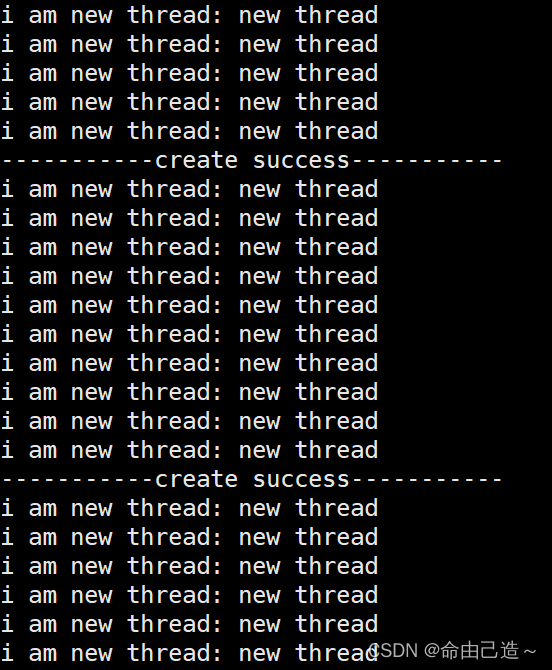
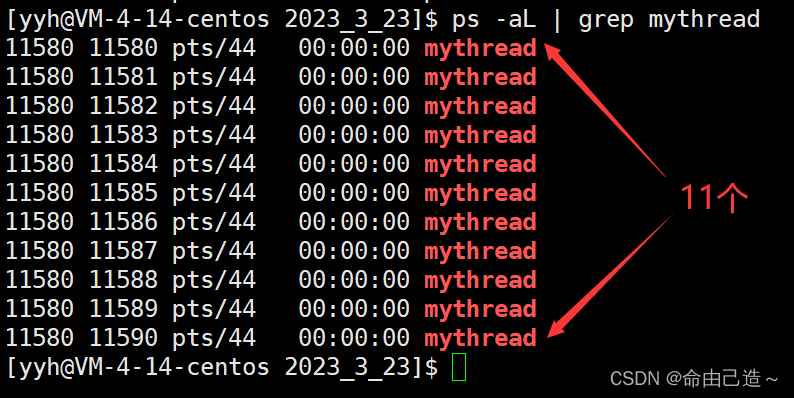
现在我们给每个线程传递进去的时候加上一个编号:
for(int i = 1; i <= NUM; i++)
{
    pthread_t tid;
    char buf[64];
    snprintf(buf, sizeof(buf), "%s:%d", "thread", i);
    pthread_create(&tid, nullptr, start_stream, (void*)buf);
}
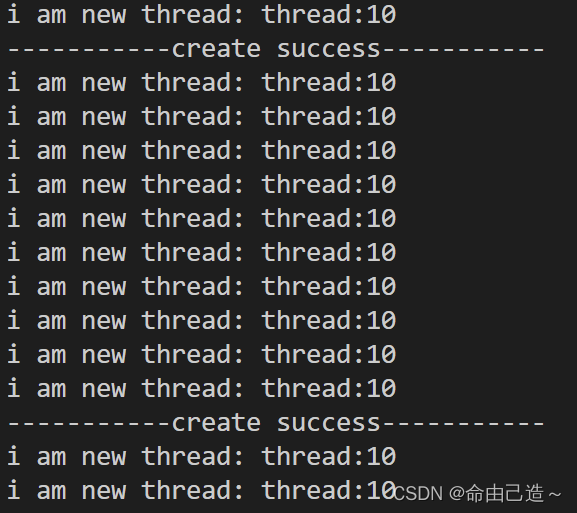
为什么会出现这个现象呢?
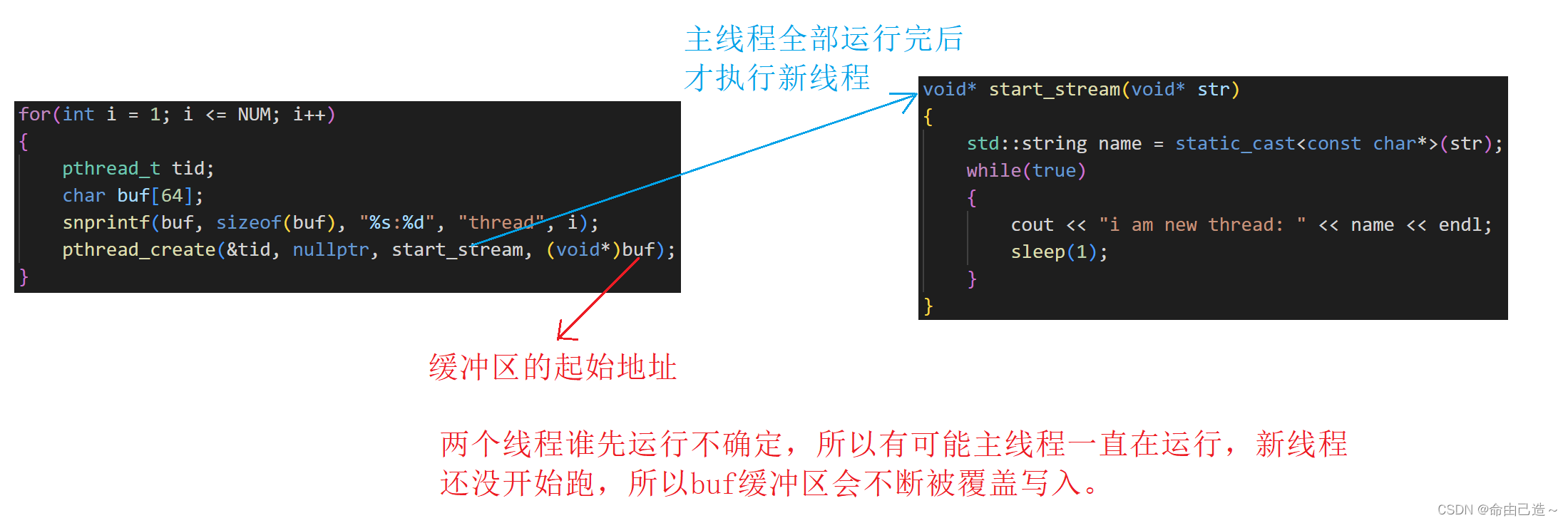
那么真正的写法应该是什么呢?
我们主要目的是让每个线程都不会共享buf。
class ThreadData
{
public:
    pthread_t _tid;
    char _buf[64];
};

void* start_stream(void* args)
{
    ThreadData *ptd = static_cast<ThreadData *>(args);
    while(true)
    {
        cout << "i am new thread: " << ptd->_buf << endl;
        sleep(1);
    }
}

#define NUM 10

int main()
{
    // 创建一批线程
    for(int i = 1; i <= NUM; i++)
    {
        ThreadData *ptd = new ThreadData();
        snprintf(ptd->_buf, sizeof(ptd->_buf), "%s:%d", "thread", i);
        pthread_create(&ptd->_tid, nullptr, start_stream, (void*)ptd);
    }

    // 创建完毕
    while(true)
    {
        cout << "-----------create success-----------" << endl;
        sleep(1);
    }
    return 0;
}
这样每个线程所获得的buf都是不同的。
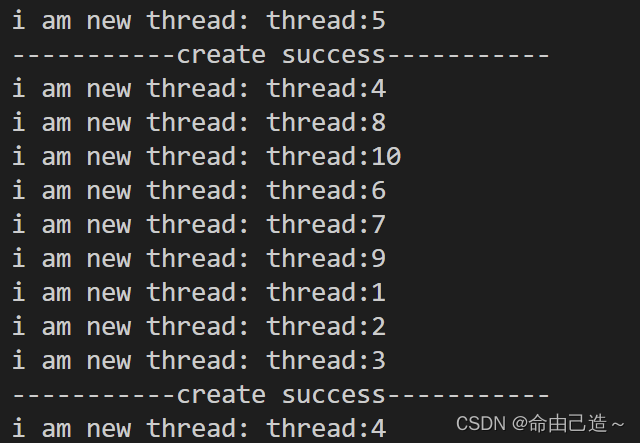
再加上一个计数器:
void* start_stream(void* args)
{
    ThreadData *ptd = static_cast<ThreadData *>(args);
    int cnt = 10;
    while(cnt)
    {
        // cout << "i am new thread: " << ptd->_buf << " cnt: " << cnt << endl;
        printf("i am new thread: %s cnt: %d &cnt: 0x%x\n", ptd->_buf, cnt, &cnt);
        cnt--;
        sleep(1);
    }
    delete ptd;
    return nullptr;
}
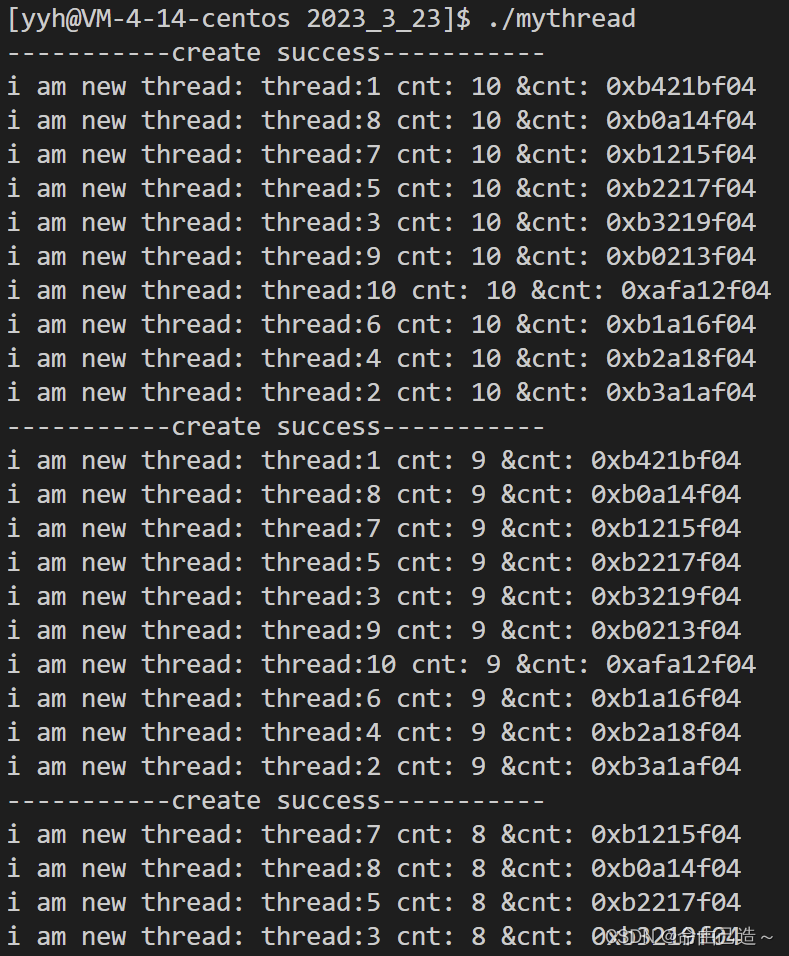
这里可以看到每个线程cnt的地址都不一样,所以每个线程都有不同的cnt,不会相互影响。
这就证明了每一个线程都有自己独立的栈结构。
这个调用方法函数就是一个可重入函数,每个线程都会形成独立的栈帧。
首先要知道最基本的终止方法:
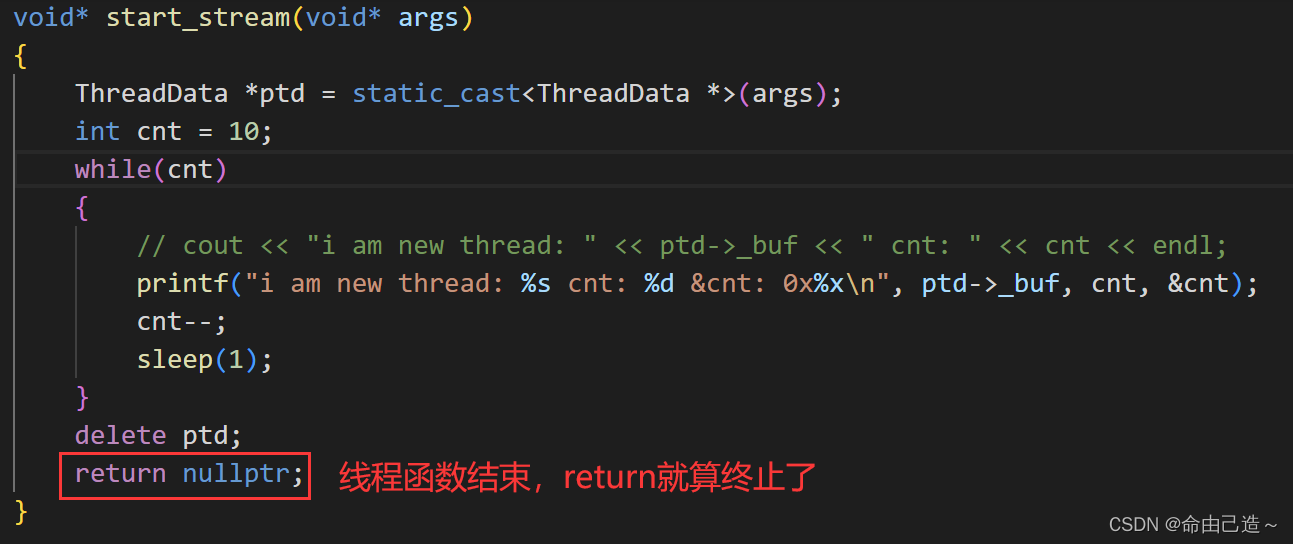
这里要注意exit不能用来终止线程,使用exit整个进程都会退出,所以exit是用来终止进程的。
POSIX线程库专门给了一个接口用来结束终止线程。
#include <pthread.h>

void pthread_exit(void *retval);

Compile and link with -pthread.
参数可以默认设置为nullptr。
void* start_stream(void* args)
{
    ThreadData *ptd = static_cast<ThreadData *>(args);
    int cnt = 10;
    while(cnt)
    {
        printf("i am new thread: %s cnt: %d &cnt: 0x%x\n", ptd->_buf, cnt, &cnt);
        cnt--;
        sleep(1);
    }
    delete ptd;
    //return nullptr;
    pthread_exit(nullptr);// 结束线程
}
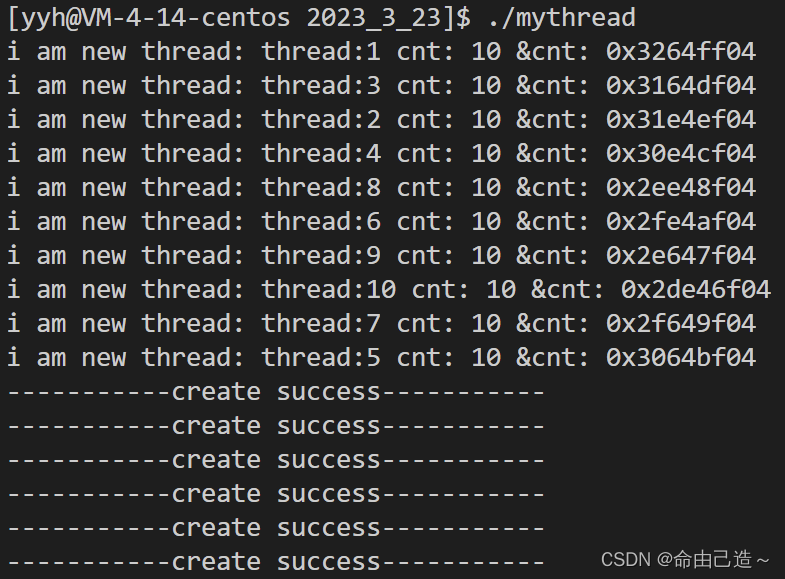
可以看到把新建线程结束后,主线程还在继续运行。
当然也可以使用return来终止。
跟进程一样线程也是要等待的,如果不等待,就会造成内存泄漏(类似僵尸进程)。
而等待主要是要做:
#include <pthread.h>

int pthread_join(pthread_t thread, void **retval);

Compile and link with -pthread.

RETURN VALUE
On success, pthread_join() returns 0;
on error, it returns an error number.
参数说明:
thread:要等待的线程。
retval:后面1.4.1线程的返回值详细说明。
class ThreadData
{
public:
    pthread_t _tid;
    char _buf[64];
};

void* start_stream(void* args)
{
    ThreadData *ptd = static_cast<ThreadData *>(args);
    int cnt = 10;
    while(cnt)
    {
        printf("i am new thread: %s cnt: %d &cnt: 0x%x\n", ptd->_buf, cnt, &cnt);
        cnt--;
        sleep(1);
    }
    delete ptd;
    // return nullptr;
    pthread_exit(nullptr);// 结束线程
}

#define NUM 10

int main()
{
    // 创建一批线程
    std::vector<ThreadData*> tids;
    for(int i = 1; i <= NUM; i++)
    {
        ThreadData *ptd = new ThreadData();
        snprintf(ptd->_buf, sizeof(ptd->_buf), "%s:%d", "thread", i);
        pthread_create(&ptd->_tid, nullptr, start_stream, (void*)ptd);
        tids.push_back(ptd);
    }
    for(auto& e : tids)
    {
        printf("creat thread: %s : 0x%x success\n", e->_buf, e->_tid);
    }
    return 0;
}
这是没有等待线程的代码
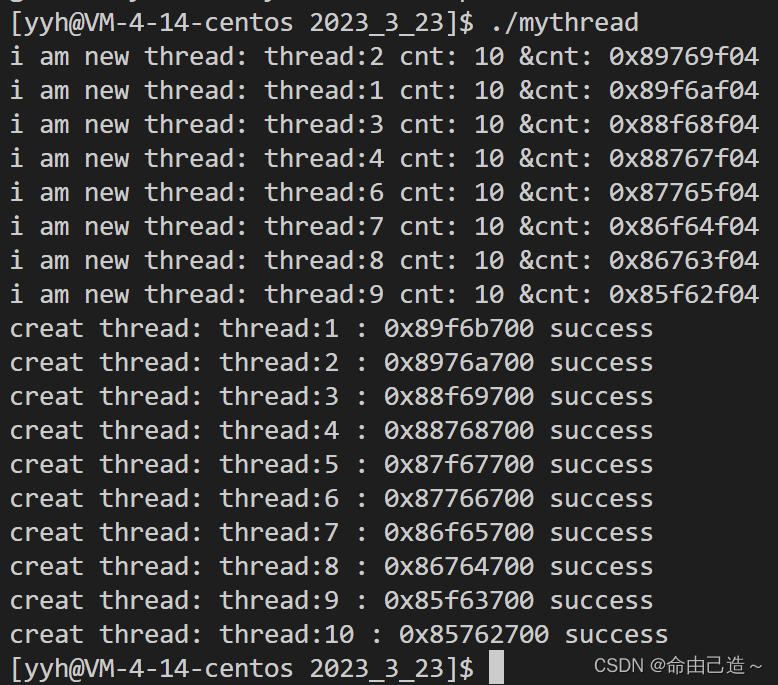
可以看到主线程运行完就直接结束了进程,所有新线程也全部结束。
进行线程等待的代码:
class ThreadData
{
public:
    pthread_t _tid;
    char _buf[64];
};

void* start_stream(void* args)
{
    ThreadData *ptd = static_cast<ThreadData *>(args);
    int cnt = 5;
    while(cnt)
    {
        printf("i am new thread: %s cnt: %d &cnt: 0x%x\n", ptd->_buf, cnt, &cnt);
        cnt--;
        sleep(1);
    }
    // return nullptr;
    pthread_exit(nullptr);// 结束线程
}

#define NUM 10

int main()
{
    // 创建一批线程
    std::vector<ThreadData*> tids;
    for(int i = 1; i <= NUM; i++)
    {
        ThreadData *ptd = new ThreadData();
        snprintf(ptd->_buf, sizeof(ptd->_buf), "%s:%d", "thread", i);
        pthread_create(&ptd->_tid, nullptr, start_stream, (void*)ptd);
        tids.push_back(ptd);
    }
    for(auto& e : tids)
    {
        printf("creat thread: %s : 0x%x success\n", e->_buf, e->_tid);
    }
    // 线程等待
    for(auto& e : tids)
    {
        int n = pthread_join(e->_tid, nullptr);
        assert(n == 0);
        delete e;
    }
    cout << "main thread quit" << endl;
    return 0;
}
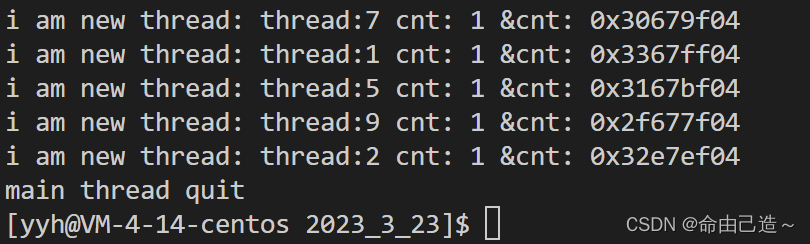
可以看到新线程也都执行到了结尾。

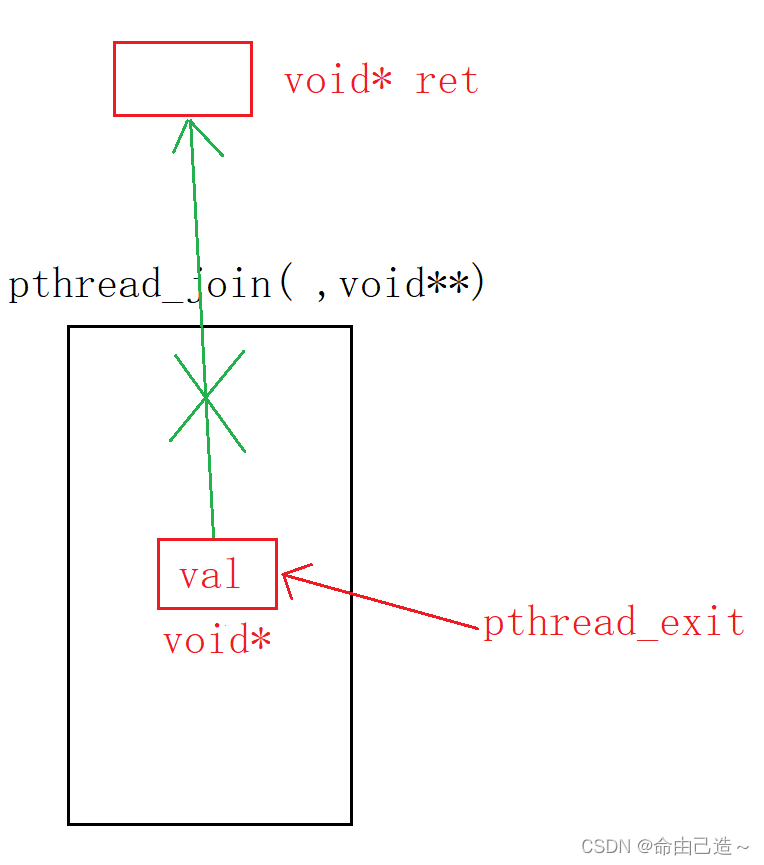
这里的返回值究竟是干什么的呢?
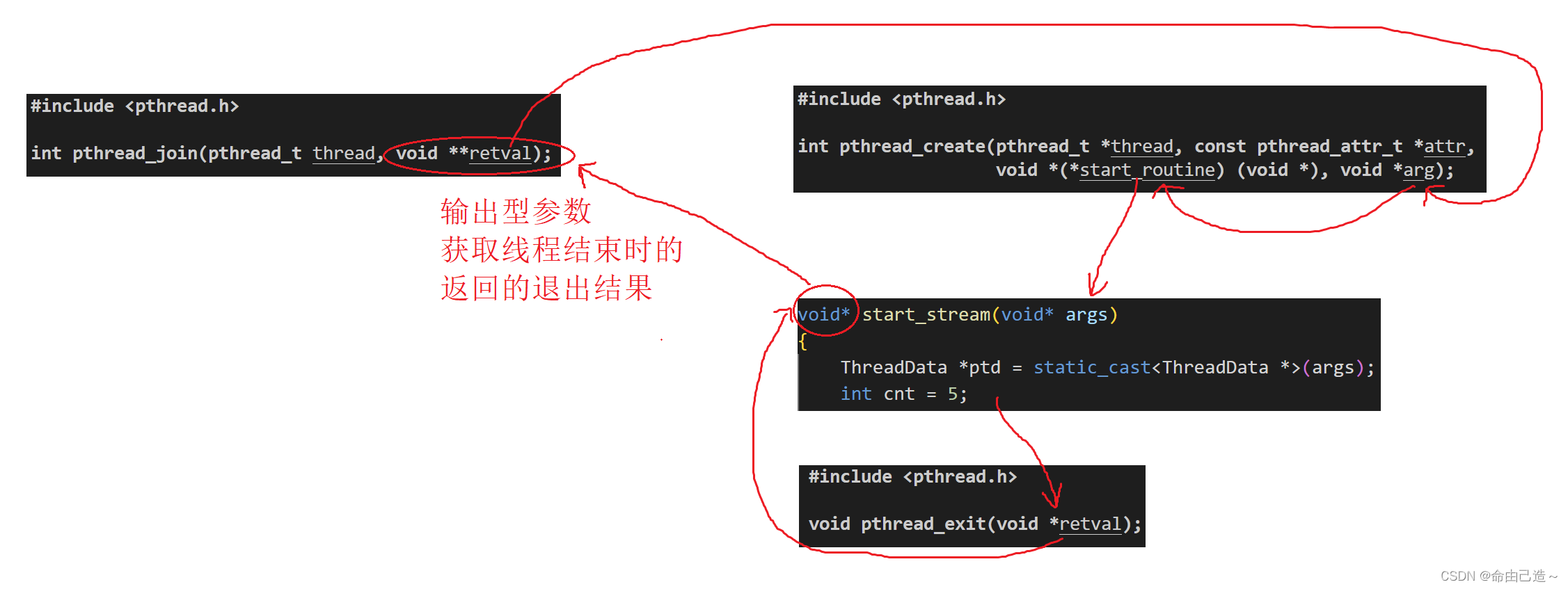
这样我们就可以在pthread_jion的时候来获取线程结束的返回值。
class ThreadData
{
public:
    int _number;
    pthread_t _tid;
    char _buf[64];
};

void* start_stream(void* args)
{
    ThreadData *ptd = static_cast<ThreadData *>(args);
    int cnt = 5;
    while(cnt)
    {
        printf("i am new thread: %s cnt: %d &cnt: 0x%x\n", ptd->_buf, cnt, &cnt);
        cnt--;
        sleep(1);
    }
    // return nullptr;
     pthread_exit((void*)ptd->_number);// 结束线程
}

#define NUM 10

int main()
{
    // 创建一批线程
    std::vector<ThreadData*> tids;
    for(int i = 1; i <= NUM; i++)
    {
        ThreadData *ptd = new ThreadData();
        ptd->_number = i;
        snprintf(ptd->_buf, sizeof(ptd->_buf), "%s:%d", "thread", i);
        pthread_create(&ptd->_tid, nullptr, start_stream, (void*)ptd);
        tids.push_back(ptd);
    }
    for(auto& e : tids)
    {
        printf("creat thread: %s : 0x%x success\n", e->_buf, e->_tid);
    }
    // 线程等待
    for(auto& e : tids)
    {
        void* ret = nullptr;
        int n = pthread_join(e->_tid, &ret);
        assert(n == 0);
        printf("join success: %d\n", (long long)(ret));
        delete e;
    }
    cout << "main thread quit" << endl;
    return 0;
}
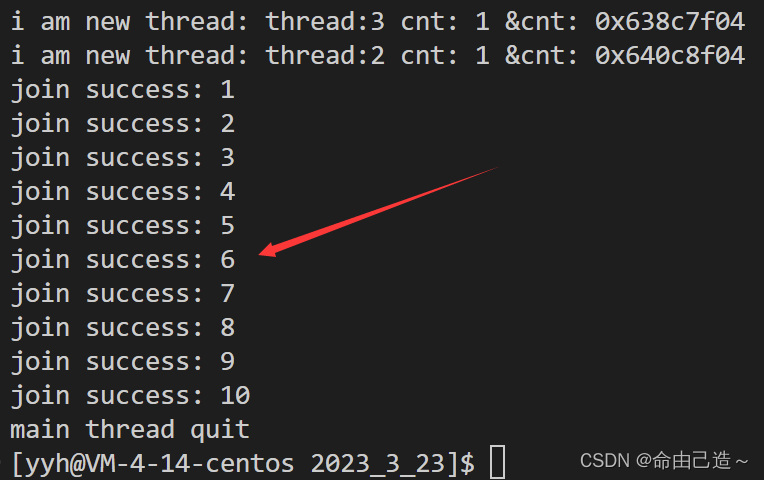
可以看到拿到了返回值(退出码)。
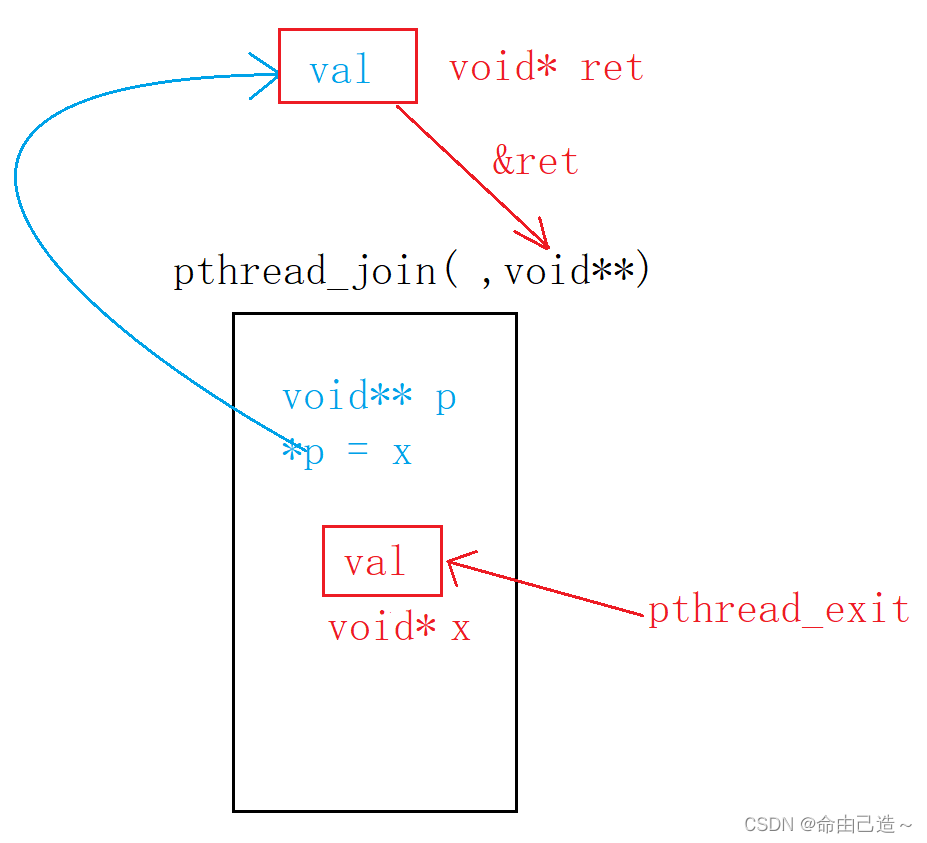
那么这个ret是怎么拿到数据的呢?
线程结束时会把返回值写入pthread库暂时保存,这时候其实我们设置的ret变量类型和库中临时保存的类型相同,但是由于这是个函数调用,我们没办法直接赋值。
所以我们吧ret的地址传进去,函数内部自己帮我们实现(蓝色)
这里我们思考一个问题:线程退出的时候为什么没有跟进程退出那样有退出信号?
因为信号是发给进程的,整个进程都会被退出,要退出信号也没有意义了。
所以pthread_jion默认认为能够调用成功,不考虑异常问题,异常应该是进程考虑的问题。
想要取消线程的前提是线程得先跑起来。
#include <pthread.h>

int pthread_cancel(pthread_t thread);

Compile and link with -pthread.

RETURN VALUE
On success, pthread_cancel() returns 0;
on error, it returns a nonzero error number.
我们可以取消一半的线程,观察这一半和剩余一半的区别:
class ThreadData
{
public:
    int _number;
    pthread_t _tid;
    char _buf[64];
};

void* start_stream(void* args)
{
    ThreadData *ptd = static_cast<ThreadData *>(args);
    int cnt = 5;
    while(cnt)
    {
        printf("i am new thread: %s cnt: %d &cnt: 0x%x\n", ptd->_buf, cnt, &cnt);
        cnt--;
        sleep(1);
    }
    // return nullptr;
     pthread_exit((void*)100);// 结束线程
}

#define NUM 10

int main()
{
    // 创建一批线程
    std::vector<ThreadData*> tids;
    for(int i = 1; i <= NUM; i++)
    {
        ThreadData *ptd = new ThreadData();
        ptd->_number = i;
        snprintf(ptd->_buf, sizeof(ptd->_buf), "%s:%d", "thread", i);
        pthread_create(&ptd->_tid, nullptr, start_stream, (void*)ptd);
        tids.push_back(ptd);
    }
    for(auto& e : tids)
    {
        printf("creat thread: %s : 0x%x success\n", e->_buf, e->_tid);
    }

    // 取消一半的线程
    for(int i = 0; i < tids.size() / 2; i++)
    {
        pthread_cancel(tids[i]->_tid);
    }
    // 线程等待
    for(auto& e : tids)
    {
        void* ret = nullptr;
        int n = pthread_join(e->_tid, &ret);
        assert(n == 0);
        printf("join success: %d\n", (long long)(ret));
        delete e;
    }
    cout << "main thread quit" << endl;
    return 0;
}
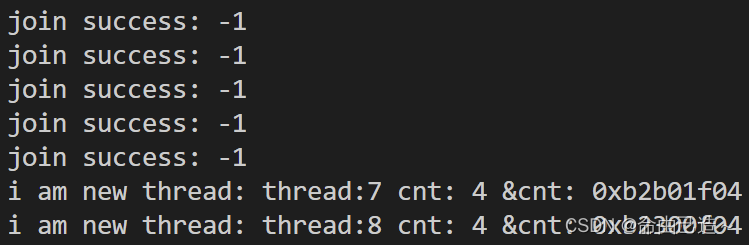
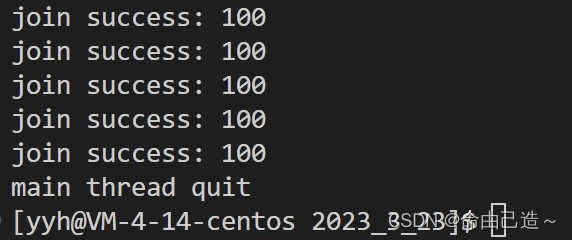
所以线程如果是被取消的,那么它的退出码是-1。它其实是一个宏:PTHREAD_CANCELED。
我们可以用C++给我们提供的线程库:
#include <iostream>
#include <thread>
#include <unistd.h>

using std::cout;
using std::endl;


int main()
{
    std::thread t([](){
        while(true)
        {
            cout << "i am new thread" << endl;
            sleep(1);
        };
    });

    while(true)
    {
        cout << "i am main thread" << endl;
        sleep(1);
    }

    t.join();
    return 0;
}
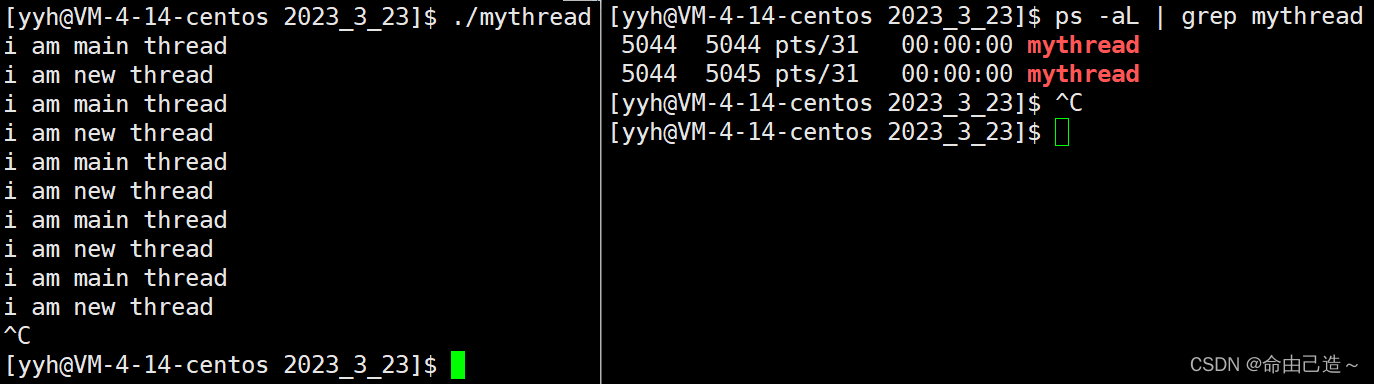
注意编译的时候得链接-lpthread。
因为任何语言想要在linux中实现多线程,必须要使用pthread库。而我们现在写的C++11中的多线程,本质上就是对pthread库的封装。
在后边会模拟线程库的实现。
默认情况下,新创建的线程是joinable的,线程退出后,需要对其进行pthread_join操作,否则无法释放资源,从而造成系统泄漏。
如果不关心线程的返回值,join是一种负担,这个时候,我们可以告诉系统,当线程退出时,自动释放线程资源。
先写一个正常的创建线程:
#include <iostream>
#include <string>
#include <cstdio>
#include <pthread.h>
#include <unistd.h>

using std::cout;
using std::endl;

std::string GetId(const pthread_t& _id)
{
    char buf[64];
    snprintf(buf, sizeof(buf), " 0x%x", _id);
    return buf;
}

void* start_stream(void* args)
{
    std::string name = static_cast<const char*>(args);
    while(true)
    {
        cout << "i am new thread name: " << name << GetId(pthread_self()) << endl;
        sleep(1);
    }
    pthread_exit(nullptr);
}

int main()
{
    pthread_t tid;
    pthread_create(&tid, nullptr, start_stream, (void*)"thread one");
    cout << "i am main thread, new id: " << GetId(tid) << endl;
    pthread_join(tid, nullptr);
    return 0;
}
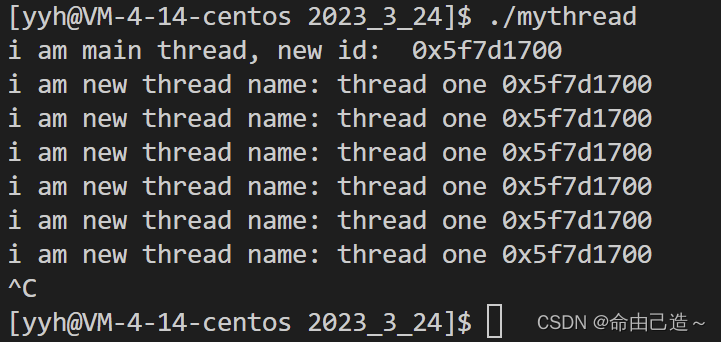
解释一下这里的pthread_self(),哪个线程调用这个函数,就可以获得该线程的id。
#include <pthread.h>

pthread_t pthread_self(void);

Compile and link with -pthread.

RETURN VALUE
This function always succeeds, returning the calling thread's ID.
而上面我们进过验证看到获取的确实是新线程的id。
有了获取线程id的方法接下来就可以进行线程的分离。
#include <pthread.h>

int pthread_detach(pthread_t thread);

Compile and link with -pthread.

RETURN VALUE
On success, pthread_detach() returns 0;
on error, it returns an error number.
因为如果一个线程设置了分离,那么这个线程就不能被等待,而如果等待失败,就会返回错误码:
std::string GetId(const pthread_t& _id)
{
    char buf[64];
    snprintf(buf, sizeof(buf), " 0x%x", _id);
    return buf;
}

void* start_stream(void* args)
{
    std::string name = static_cast<const char*>(args);
    pthread_detach(pthread_self());// 线程分离
    int cnt = 5;
    while(cnt--)
    {
        cout << "i am new thread name: " << name << GetId(pthread_self()) << endl;
        sleep(1);
    }
    pthread_exit(nullptr);
}

int main()
{
    pthread_t tid;
    pthread_create(&tid, nullptr, start_stream, (void*)"thread one");
    cout << "i am main thread, new id: " << GetId(tid) << endl;
    // 一个线程设置分离状态就不能被等待了
    int n = pthread_join(tid, nullptr);
    cout << "error: " << n << "->" << strerror(n) << endl;
    return 0;
}
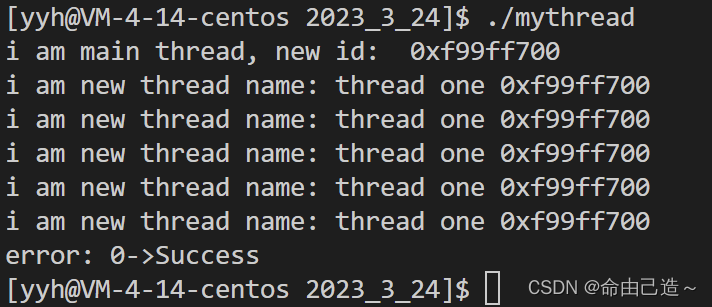
但是这里的结果显示是正确的。是什么原因呢?
因为主线程和新线程执行顺序不确定,新线程还没来得及分离,主线程就执行到jion了,主线程就开始阻塞等待了,后续新线程分离了也不知道。
所以我们让主线程慢一点执行或者让主线程进行分离:
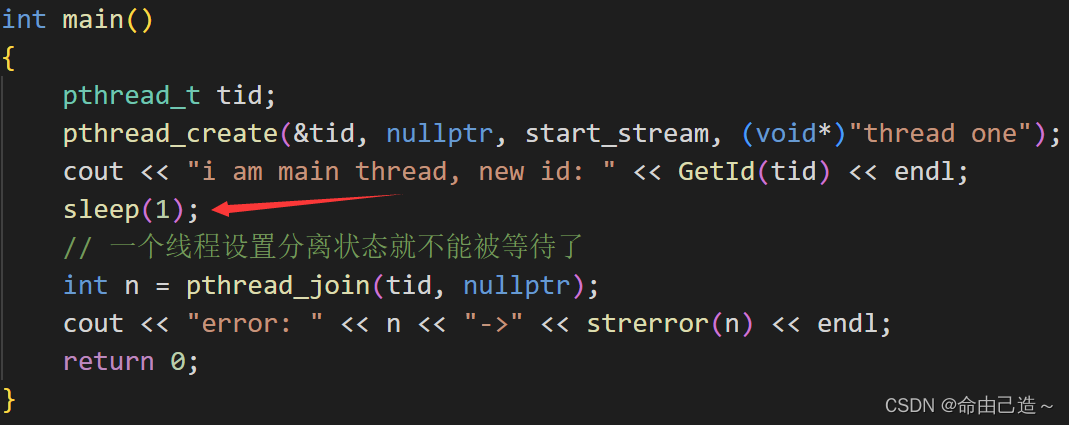
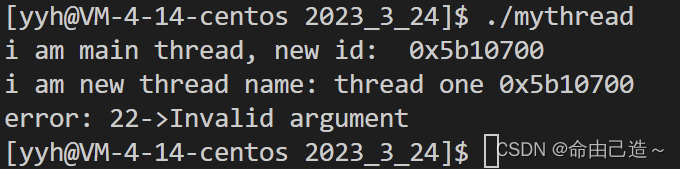
所以一旦有一个线程被分离,那么我们就可以不用管这个线程了,做自己的事情即可。
我们可以看到我们打印出来的线程ID:
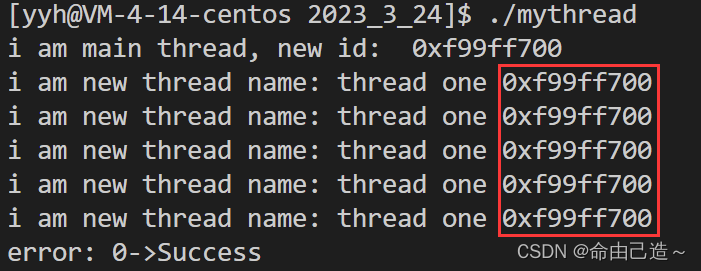
那么它究竟是什么呢?
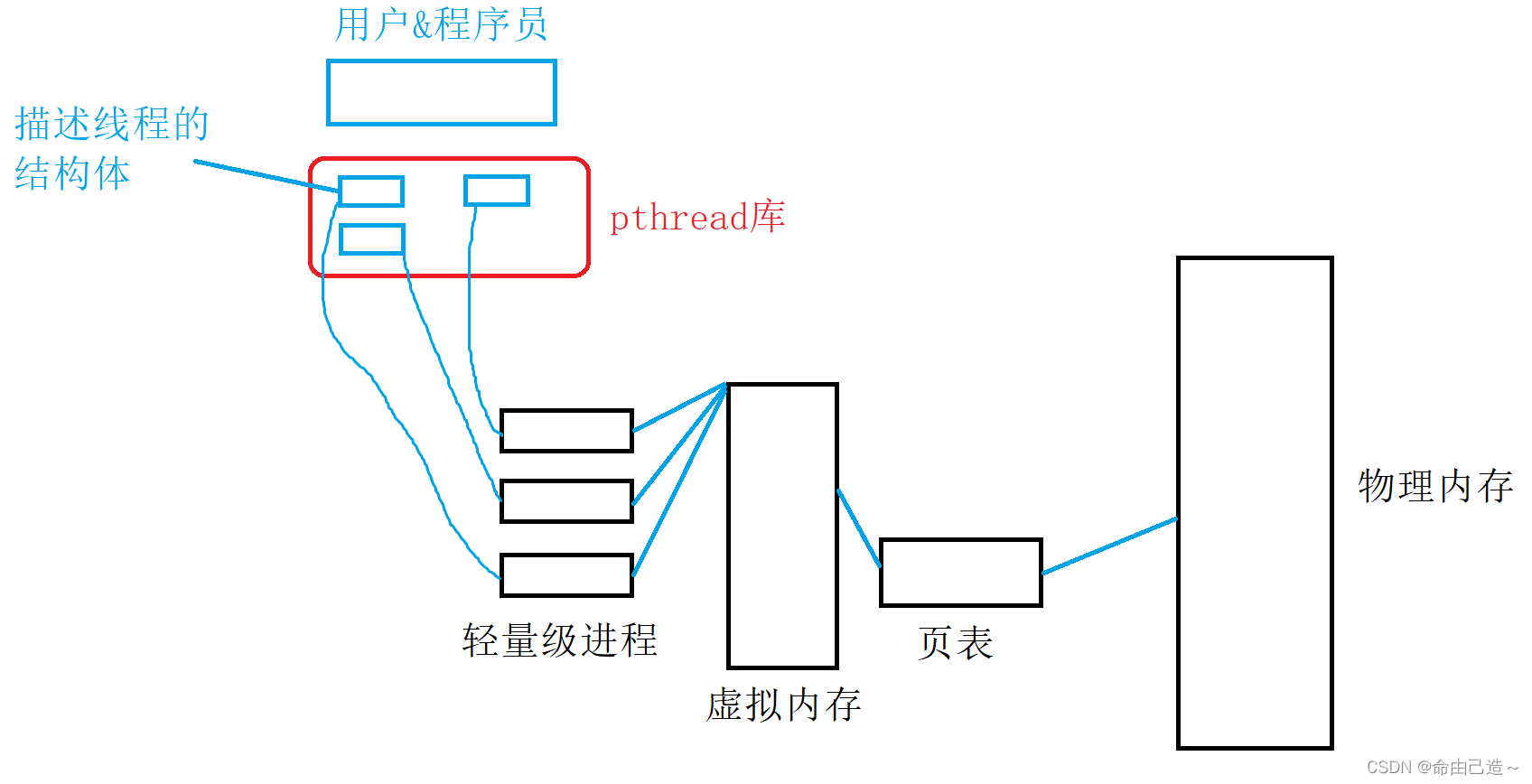
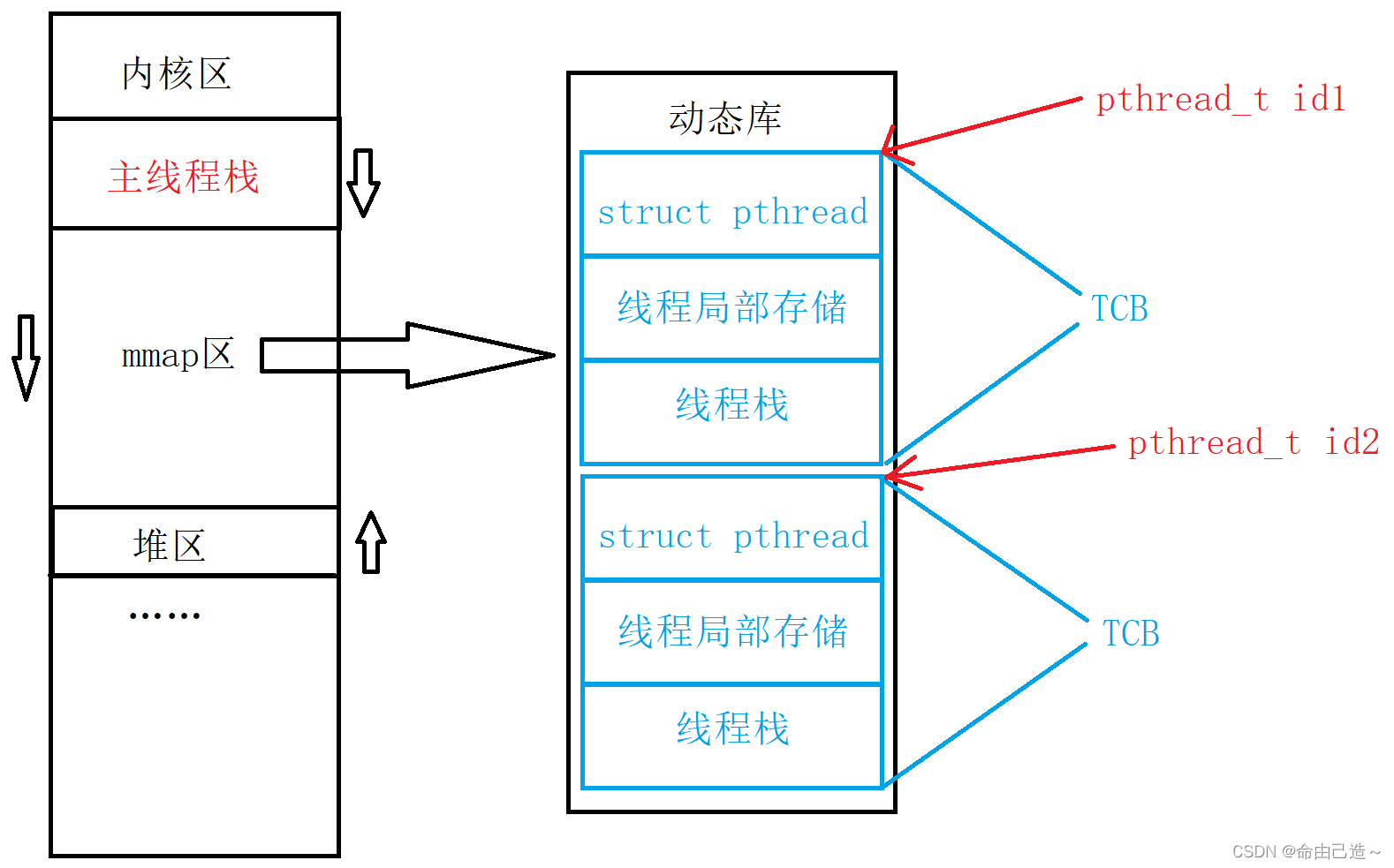
我们知道linux创建进程要通过pthread库提供的接口。所以原生库中可能存在多个线程,那么我们就必须要把这些线程管理起来。而描述这些线程的结构体是由原生线程库实现的,每一个结构体对应一个轻量级进程,所以线程是由库和OS共同实现的。
而库中描述线程的结构体到底是什么样子的呢?
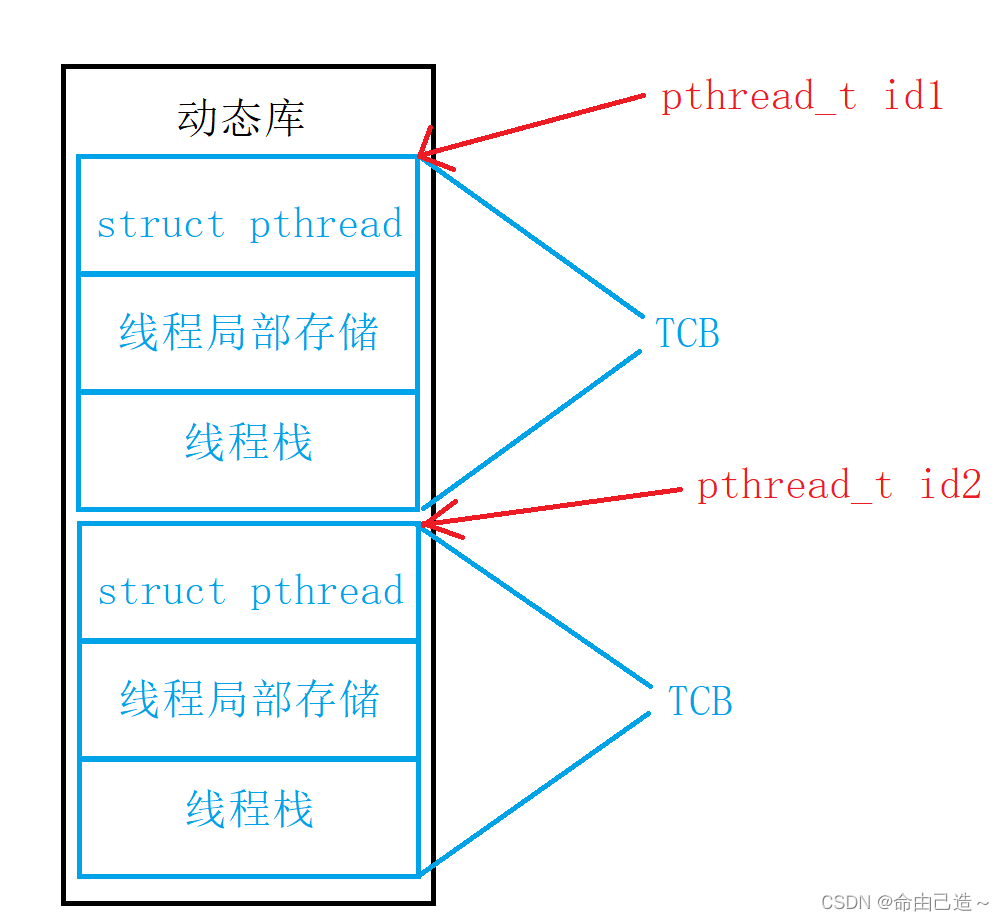
每个结构体在库中就像一个数组一样被存储起来。而每个结构体的起始位置的地址就是线程的ID值。
这里也可以看到每个线程都有自己独立的栈结构,由库来维护。
主线程也有自己独立的栈:
int g_val = 0;

void* start_stream(void* args)
{
    std::string name = static_cast<const char *>(args);
    while(true)
    {
        cout << name;
        printf(" g_val: %d &g_val 0x%x\n", g_val, &g_val);
        sleep(1);
        ++g_val;
    }
}

int main()
{
    pthread_t tid;
    pthread_create(&tid, nullptr, start_stream, (void*)"thread one");
    while(true)
    {
        printf("main g_val: %d &g_val 0x%x\n", g_val, &g_val);
        sleep(1);
    }
    pthread_join(tid, nullptr);
    return 0;
}
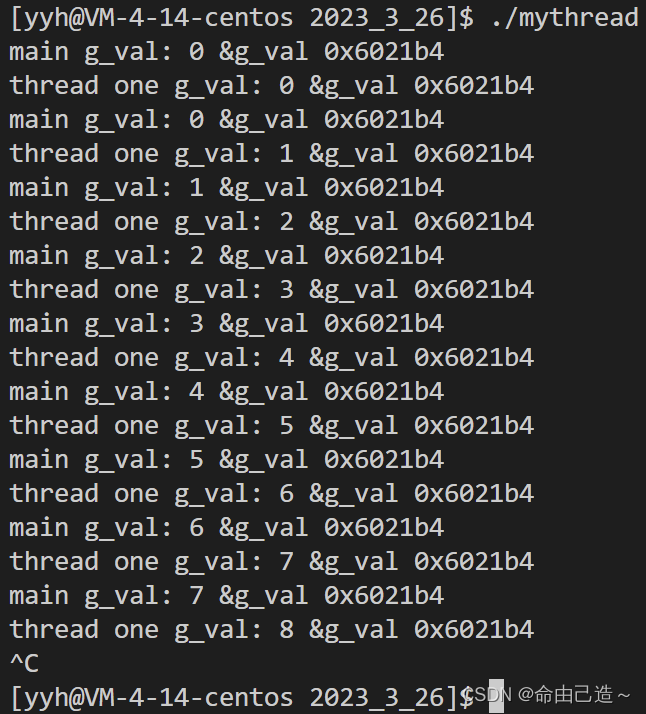
可以看到不同的线程共享一个全局变量。
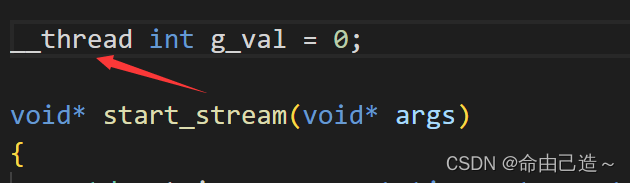
但是当我们给g_val添加__thread属性后:
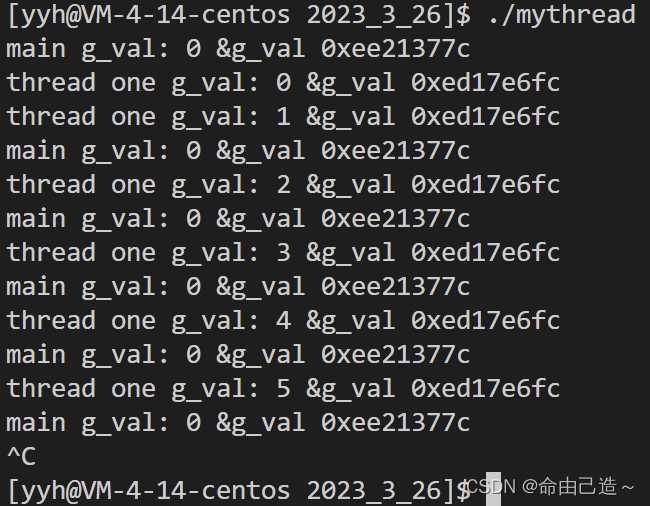
从结果看g_val不是共享的了,而是每个线程独有一个。
添加__thread,可以将一个内置类型设置为线程局部存储。给每个线程都来一份。
是介于全局变量和局部变量之间线程特有的属性。
我们想像1.6C++多线程那样来使用多线程该怎么办呢?
当然是对原生线程库进行封装。
// mythread.hpp
#pragma once

#include <iostream>
#include <pthread.h>
#include <cstring>
#include <string>
#include <cassert>
#include <functional>

class Thread;

class Context
{
public:
    Thread *_this;
    void *_args;

    Context()
        : _this(nullptr)
        , _args(nullptr)
    {}
};

class Thread
{
public:
    typedef std::function<void*(void*)> func_t;

    Thread(func_t fun, void* args, int number)
        : _func(fun)
        , _args(args)
    {
        char buf[64];
        snprintf(buf, sizeof buf, "thread-%d", number);
        _name = buf;
    }

    // 不加static就会有this指针
    static void* start_routine(void* args)
    {
        //return _func(args);
        // 无this指针,无法调用
        Context* pct = static_cast<Context*>(args);
        pct->_this->_func(pct->_args);
        delete pct;
        return nullptr;
    }

    void start()
    {
        // int n = pthread_create(&_tid, nullptr, _func, _args);
        // _func是C++函数,pthread_create是C接口,不能混编
        Context* pct = new Context();
        pct->_this = this;
        pct->_args = _args;
        int n = pthread_create(&_tid, nullptr, start_routine, pct);
        assert(n == 0);
        (void)n;
    }

    void join()
    {
        int n = pthread_join(_tid, nullptr);
        assert(n == 0);
        (void)n;
    }
private:
    std::string _name;// 线程名
    pthread_t _tid;// 线程id
    func_t _func;// 调用方法
    void *_args;// 参数
};

// mythread.cc
#include <iostream>
#include <string>
#include <cstdio>
#include <cstring>
#include <pthread.h>
#include <unistd.h>
#include "mythread.hpp"

using std::cout;
using std::endl;

void* start_handler(void* args)
{
    std::string name = static_cast<const char *>(args);
    while(true)
    {
        cout << name << endl;
        sleep(1);
    }
}

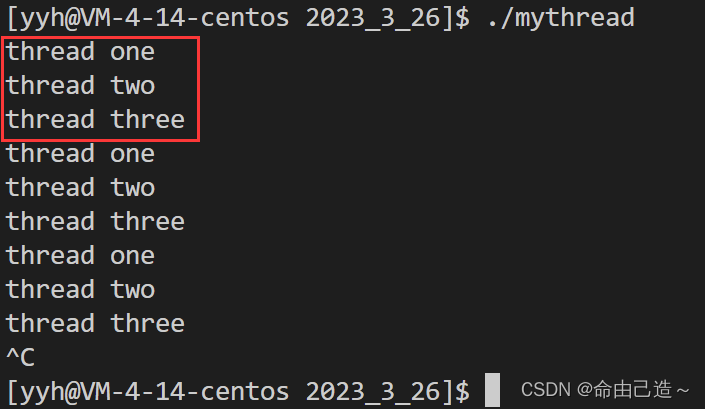
int main()
{
    Thread* thread1 = new Thread(start_handler, (void*)"thread one", 1);
    Thread* thread2 = new Thread(start_handler, (void*)"thread two", 2);
    Thread* thread3 = new Thread(start_handler, (void*)"thread three", 3);
    thread1->start();
    thread2->start();
    thread3->start();
    thread1->join();
    thread2->join();
    thread3->join();
    return 0;
}
当我在Rails控制台中按向上或向左箭头时,出现此错误:irb(main):001:0>/Users/me/.rvm/gems/ruby-2.0.0-p247/gems/rb-readline-0.4.2/lib/rbreadline.rb:4269:in`blockin_rl_dispatch_subseq':invalidbytesequenceinUTF-8(ArgumentError)我使用rvm来管理我的ruby安装。我正在使用=>ruby-2.0.0-p247[x86_64]我使用bundle来管理我的gem,并且我有rb-readline(0.4.2)(人们推荐的最少
我正在使用Ruby2.1.1和Rails4.1.0.rc1。当执行railsc时,它被锁定了。使用Ctrl-C停止,我得到以下错误日志:~/.rvm/gems/ruby-2.1.1/gems/spring-1.1.2/lib/spring/client/run.rb:47:in`gets':Interruptfrom~/.rvm/gems/ruby-2.1.1/gems/spring-1.1.2/lib/spring/client/run.rb:47:in`verify_server_version'from~/.rvm/gems/ruby-2.1.1/gems/spring-1.1.
我将我的Rails应用程序部署到OpenShift,它运行良好,但我无法在生产服务器上运行“Rails控制台”。它给了我这个错误。我该如何解决这个问题?我尝试更新rubygems,但它也给出了权限被拒绝的错误,我也无法做到。railsc错误:Warning:You'reusingRubygems1.8.24withSpring.UpgradetoatleastRubygems2.1.0andrun`gempristine--all`forbetterstartupperformance./opt/rh/ruby193/root/usr/share/rubygems/rubygems
我收到这个错误:RuntimeError(自动加载常量Apps时检测到循环依赖当我使用多线程时。下面是我的代码。为什么会这样?我尝试多线程的原因是因为我正在编写一个HTML抓取应用程序。对Nokogiri::HTML(open())的调用是一个同步阻塞调用,需要1秒才能返回,我有100,000多个页面要访问,所以我试图运行多个线程来解决这个问题。有更好的方法吗?classToolsController0)app.website=array.join(',')putsapp.websiteelseapp.website="NONE"endapp.saveapps=Apps.order("
说在前面这部分我本来是合为一篇来写的,因为目的是一样的,都是通过独立按键来控制LED闪灭本质上是起到开关的作用,即调用函数和中断函数。但是写一篇太累了,我还是决定分为两篇写,这篇是调用函数篇。在本篇中你主要看到这些东西!!!1.调用函数的方法(主要讲语法和格式)2.独立按键如何控制LED亮灭3.程序中的一些细节(软件消抖等)1.调用函数的方法思路还是比较清晰地,就是通过按下按键来控制LED闪灭,即每按下一次,LED取反一次。重要的是,把按键与LED联系在一起。我打算用K1来作为开关,看了一下开发板原理图,K1连接的是单片机的P31口,当按下K1时,P31是与GND相连的,也就是说,当我按下去时
我正在尝试使用ruby编写一个双线程客户端,一个线程从套接字读取数据并将其打印出来,另一个线程读取本地数据并将其发送到远程服务器。我发现的问题是Ruby似乎无法捕获线程内的错误,这是一个示例:#!/usr/bin/rubyThread.new{loop{$stdout.puts"hi"abc.putsefsleep1}}loop{sleep1}显然,如果我在线程外键入abc.putsef,代码将永远不会运行,因为Ruby将报告“undefinedvariableabc”。但是,如果它在一个线程内,则没有错误报告。我的问题是,如何让Ruby捕获这样的错误?或者至少,报告线程中的错误?
我是ruby的新手,我认为重新构建一个我用C#编写的简单聊天程序是个好主意。我正在使用Ruby2.0.0MRI(Matz的Ruby实现)。问题是我想在服务器运行时为简单的服务器命令提供I/O。这是从示例中获取的服务器。我添加了使用gets()获取输入的命令方法。我希望此方法在后台作为线程运行,但该线程正在阻塞另一个线程。require'socket'#Getsocketsfromstdlibserver=TCPServer.open(2000)#Sockettolistenonport2000defcommandsx=1whilex==1exitProgram=gets.chomp
在我的Character模型中,我添加了:字符.rbbefore_savedoself.profile_picture_url=asset_path('icon.png')end但是,对于数据库中已存在的所有角色,它们的profile_picture_url为nil。因此,我想进入控制台并遍历所有这些并进行设置。在我试过的控制台中:Character.find_eachdo|c|c.profile_picture_url=asset_path('icon.png')end但这给出了错误:NoMethodError:undefinedmethod`asset_path'formain:O
当我进入Rails控制台时,我已将pry设置为加载代替irb。我找不到该页面或不记得如何将其恢复为默认行为,因为它似乎干扰了我的Rubymine调试器。有什么建议吗? 最佳答案 我刚发现问题,pry-railsgem。忘记了它的目的是让“railsconsole”打开pry。 关于ruby-on-rails-带有Pry的Rails控制台,我们在StackOverflow上找到一个类似的问题: https://stackoverflow.com/question
我正在尝试将$stdout设置为临时写入一个文件,然后返回到一个文件。test.rb:old_stdout=$stdout$stdout.reopen("mytestfile.out",'w+')puts"thisgoesinmytestfile"$stdout=old_stdoutputs"thisshouldbeontheconsole"$stdout.reopen("mytestfile1.out",'w+')puts"thisgoesinmytestfile1:"$stdout=old_stdoutputs"thisshouldbebackontheconsole"这是输出。r