本篇幅是继 MyBatis详解(一)的下半部分。
【1】基于前面已经将XML文件进行build解析了并且返回了SqlSessionFactory
【1.1】那么分析SqlSessionFactory.openSession()方法是怎么返回SqlSession的,且SqlSession又是什么东西:
@Override
public SqlSession openSession() {
    return openSessionFromDataSource(configuration.getDefaultExecutorType(), null, false);
}

/**
* 方法实现说明:从session中开启一个数据源
* @param execType:执行器类型
* @param level:隔离级别
*/
private SqlSession openSessionFromDataSource(ExecutorType execType, TransactionIsolationLevel level, boolean autoCommit) {
    Transaction tx = null;
    try {
      // 获取环境变量
      final Environment environment = configuration.getEnvironment();
      // 获取事务工厂
      final TransactionFactory transactionFactory = getTransactionFactoryFromEnvironment(environment);
      tx = transactionFactory.newTransaction(environment.getDataSource(), level, autoCommit);
      // 创建一个sql执行器对象
      // 一般情况下 若我们的mybaits的全局配置文件的cacheEnabled默认为ture就返回一个cacheExecutor,若关闭的话返回的就是一个SimpleExecutor
      final Executor executor = configuration.newExecutor(tx, execType);
      // 创建返回一个DeaultSqlSessoin对象返回
      return new DefaultSqlSession(configuration, executor, autoCommit);
    } catch (Exception e) {
      closeTransaction(tx); // may have fetched a connection so lets call close()
      throw ExceptionFactory.wrapException("Error opening session.  Cause: " + e, e);
    } finally {
      ErrorContext.instance().reset();
    }
}
【1.1.1】分析newExecutor方法中执行器的产生:
/**
* 方法实现说明:创建一个sql语句执行器对象
* @param transaction:事务
* @param executorType:执行器类型
* @return:Executor执行器对象
*/
public Executor newExecutor(Transaction transaction, ExecutorType executorType) {
    executorType = executorType == null ? defaultExecutorType : executorType;
    executorType = executorType == null ? ExecutorType.SIMPLE : executorType;
    Executor executor;
    //判断执行器的类型
    // 批量的执行器
    if (ExecutorType.BATCH == executorType) {
      executor = new BatchExecutor(this, transaction);
    } else if (ExecutorType.REUSE == executorType) {
      //可重复使用的执行器
      executor = new ReuseExecutor(this, transaction);
    } else {
      //简单的sql执行器对象
      executor = new SimpleExecutor(this, transaction);
    }
    //判断mybatis的全局配置文件是否开启缓存
    if (cacheEnabled) {
      //把当前的简单的执行器包装成一个CachingExecutor
      executor = new CachingExecutor(executor);
    }
    //调用所有的拦截器对象plugin方法,也就是生成代理对象
    executor = (Executor) interceptorChain.pluginAll(executor);
    return executor;
}
【1.1.1.1】图示:
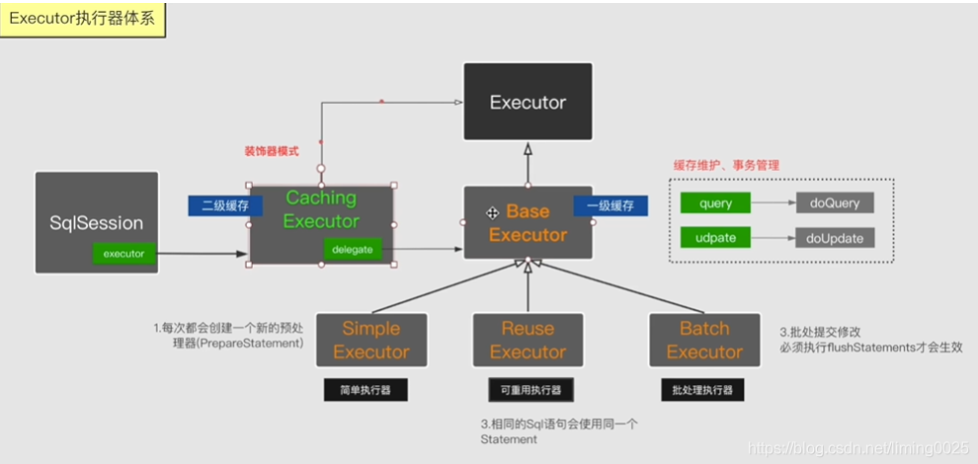
【1.1.2】分析底层如何执行JDBC【User user = (User)session.selectOne("com.mapper.UserMapper.selectById", 1);】
/**
* 方法实现说明:查询我们当个对象
* @param statement:SQL语句
* @param parameter:调用时候的参数
* @return: T 返回结果
*/
@Override
public <T> T selectOne(String statement, Object parameter) {
    // 这里selectOne调用也是调用selectList方法
    List<T> list = this.selectList(statement, parameter);
    //若查询出来有且有一个一个对象,直接返回要给
    if (list.size() == 1) {
      return list.get(0);
    } else if (list.size() > 1) {
      //查询的有多个,那么就抛出异常
      throw new TooManyResultsException("Expected one result (or null) to be returned by selectOne(), but found: " + list.size());
    } else {
      return null;
    }
}

@Override
public <E> List<E> selectList(String statement, Object parameter) {
    return this.selectList(statement, parameter, RowBounds.DEFAULT);
}

/**
* @param statement: statementId
* @param parameter:参数对象
* @param rowBounds :mybiats的逻辑分页对象
*/
@Override
public <E> List<E> selectList(String statement, Object parameter, RowBounds rowBounds) {
    try {
      //第一步:通过我们的statement去我们的全局配置类中获取MappedStatement
      MappedStatement ms = configuration.getMappedStatement(statement);
      //通过执行器去执行我们的sql对象
      //第一步:包装我们的集合类参数
      //第二步:一般情况下是executor为cacheExetory对象
      return executor.query(ms, wrapCollection(parameter), rowBounds, Executor.NO_RESULT_HANDLER);
    } catch (Exception e) {
      throw ExceptionFactory.wrapException("Error querying database.  Cause: " + e, e);
    } finally {
      ErrorContext.instance().reset();
    }
}【1.1.2.0】分析两种方法的本质:
方法一:User user = (User)session.selectOne("com.mapper.UserMapper.selectById", 1);

源码流程:
//通过statement去我们的全局配置类中获取MappedStatement
MappedStatement ms = configuration.getMappedStatement(statement);

public MappedStatement getMappedStatement(String id) {
    return this.getMappedStatement(id, true);
}

public MappedStatement getMappedStatement(String id, boolean validateIncompleteStatements) {
    if (validateIncompleteStatements) {
      buildAllStatements();
    }
    // 这个mappedStatements便是在SqlSessionFactory进行build过程中parse解析出来的
    return mappedStatements.get(id);
}

方法二:UserMapper mapper = session.getMapper(UserMapper.class); 与 User user = mapper.selectById(1L);

源码流程:
@Override
public <T> T getMapper(Class<T> type) {
    return configuration.getMapper(type, this);
}

public <T> T getMapper(Class<T> type, SqlSession sqlSession) {
    return mapperRegistry.getMapper(type, sqlSession);
}

/**
* 方法实现说明:通过class类型和sqlSessionTemplate获取Mapper(代理对象)
* @param type:Mapper的接口类型
* @param sqlSession:接口类型实际上是我们的sqlSessionTemplate类型
*/
@SuppressWarnings("unchecked")
public <T> T getMapper(Class<T> type, SqlSession sqlSession) {
    // 直接去缓存knownMappers中通过Mapper的class类型去找mapperProxyFactory
    final MapperProxyFactory<T> mapperProxyFactory = (MapperProxyFactory<T>) knownMappers.get(type);
    // 缓存中没有获取到 直接抛出异常
    if (mapperProxyFactory == null) {
      throw new BindingException("Type " + type + " is not known to the MapperRegistry.");
    }
    try {
      // 通过MapperProxyFactory来创建我们的实例
      return mapperProxyFactory.newInstance(sqlSession);
    } catch (Exception e) {
      throw new BindingException("Error getting mapper instance. Cause: " + e, e);
    }
}
【1.1.2.1】如果是定义了二级缓存,那么会走CachingExecutor逻辑:
/**
* 方法实现说明:通过我们的sql执行器对象执行sql
* @param ms 用于封装我们一个个的insert|delete|update|select 对象
* @param parameterObject:参数对象
* @param rowBounds :mybaits的逻辑分页对象
* @param resultHandler:结果处理器对象
*/
@Override
public <E> List<E> query(MappedStatement ms, Object parameterObject, RowBounds rowBounds, ResultHandler resultHandler) throws SQLException {
    // 通过参数对象解析sql详细信息1339025938:1570540512:com.project.mapper.selectById:0:2147483647:select id,user_name,create_time from t_user where id=?:1:development
    BoundSql boundSql = ms.getBoundSql(parameterObject);
    CacheKey key = createCacheKey(ms, parameterObject, rowBounds, boundSql);
    return query(ms, parameterObject, rowBounds, resultHandler, key, boundSql);
}

@Override
public <E> List<E> query(MappedStatement ms, Object parameterObject, RowBounds rowBounds, ResultHandler resultHandler, CacheKey key, BoundSql boundSql) throws SQLException {
    //判断mapper中是否开启了二级缓存<cache></cache>
    Cache cache = ms.getCache();
    // 判断是否配置了cache
    if (cache != null) {
      //判断是否需要刷新缓存
      flushCacheIfRequired(ms);
      if (ms.isUseCache() && resultHandler == null) {
        ensureNoOutParams(ms, boundSql);
        // 先去二级缓存中获取
        @SuppressWarnings("unchecked")
        List<E> list = (List<E>) tcm.getObject(cache, key);   //也就是去PerpetualCache里面寻找
        // 二级缓存中没有获取到
        if (list == null) {
          //通过查询数据库去查询
          list = delegate.query(ms, parameterObject, rowBounds, resultHandler, key, boundSql);
          //加入到二级缓存中
          tcm.putObject(cache, key, list); // issue #578 and #116
        }
        return list;
      }
    }
    //没有整合二级缓存,直接去查询
    return delegate.query(ms, parameterObject, rowBounds, resultHandler, key, boundSql);
}
【1.1.2.1.1】事务的TransactionalCacheManager:
【1.1.2.1.1.1】它存在的意义在于:避免事务不成功的sql语句填充到了Cache里面,淘汰掉一些已经执行过的语句,相当于包装了一层。
【1.1.2.1.1.2】存储的地方:本质上会先存在自身类的属性值private final Map<Cache, TransactionalCache> transactionalCaches = new HashMap<>();
【1.1.2.1.1.3】当成功后才会提交到PerpetualCache里面。
【1.1.2.1.2】分析语句的解析【ms.getBoundSql(parameterObject)】:
public BoundSql getBoundSql(Object parameterObject) {
    BoundSql boundSql = sqlSource.getBoundSql(parameterObject);
    List<ParameterMapping> parameterMappings = boundSql.getParameterMappings();
    if (parameterMappings == null || parameterMappings.isEmpty()) {
      boundSql = new BoundSql(configuration, boundSql.getSql(), parameterMap.getParameterMappings(), parameterObject);
    }

    // check for nested result maps in parameter mappings (issue #30)
    for (ParameterMapping pm : boundSql.getParameterMappings()) {
      String rmId = pm.getResultMapId();
      if (rmId != null) {
        ResultMap rm = configuration.getResultMap(rmId);
        if (rm != null) {
          hasNestedResultMaps |= rm.hasNestedResultMaps();
        }
      }
    }

    return boundSql;
}

//DynamicSqlSource类#getBoundSql方法
@Override
public BoundSql getBoundSql(Object parameterObject) {
    DynamicContext context = new DynamicContext(configuration, parameterObject);
    //责任链处理SqlNode,编译出完整的sql
    rootSqlNode.apply(context);
    SqlSourceBuilder sqlSourceParser = new SqlSourceBuilder(configuration);
    //处理sql中的#{..}
    Class<?> parameterType = parameterObject == null ? Object.class : parameterObject.getClass();
    //将#{..}中的内容封装为parameterMapping,替换为?
    SqlSource sqlSource = sqlSourceParser.parse(context.getSql(), parameterType, context.getBindings());
    BoundSql boundSql = sqlSource.getBoundSql(parameterObject);
    context.getBindings().forEach(boundSql::setAdditionalParameter);
    return boundSql;
}

//BoundSql类的结构
public class BoundSql {

  private final String sql;  //语句
  private final List<ParameterMapping> parameterMappings;
  private final Object parameterObject;  //参数处理
  private final Map<String, Object> additionalParameters;  //结果集处理
  private final MetaObject metaParameters;
}
【1.1.2.2】如果没有定义的话,则会选择BaseExecutor的三个子类中的一个【但其实还是会走BaseExecutor的逻辑】:
//BaseExecutor类#query方法,子类重写的是doQuery,如果是使用query方法本质上还是走BaseExecutor类的
@Override
public <E> List<E> query(MappedStatement ms, Object parameter, RowBounds rowBounds, ResultHandler resultHandler, CacheKey key, BoundSql boundSql) throws SQLException {
    ErrorContext.instance().resource(ms.getResource()).activity("executing a query").object(ms.getId());
    //已经关闭,则抛出 ExecutorException 异常
    if (closed) {
      throw new ExecutorException("Executor was closed.");
    }
    // 清空本地缓存,如果 queryStack 为零,并且要求清空本地缓存。
    if (queryStack == 0 && ms.isFlushCacheRequired()) {
      clearLocalCache();
    }
    List<E> list;
    try {
      // 从一级缓存中,获取查询结果
      queryStack++;

      //BaseExecutor类的属性值:protected PerpetualCache localCache;
      list = resultHandler == null ? (List<E>) localCache.getObject(key) : null;

      // 获取到,则进行处理
      if (list != null) {
        //处理存过的
        handleLocallyCachedOutputParameters(ms, key, parameter, boundSql);
      } else {
        // 获得不到,则从数据库中查询
        list = queryFromDatabase(ms, parameter, rowBounds, resultHandler, key, boundSql);
      }
    } finally {
      queryStack--;
    }
    if (queryStack == 0) {
      for (DeferredLoad deferredLoad : deferredLoads) {
        deferredLoad.load();
      }
      // issue #601
      deferredLoads.clear();
      if (configuration.getLocalCacheScope() == LocalCacheScope.STATEMENT) {
        // issue #482
        clearLocalCache();
      }
    }
    return list;
}


//至于为什么会说一级缓存是session级别的,因为一旦提交或者回滚之后都会被清空
@Override
public void commit(boolean required) throws SQLException {
    if (closed) {
      throw new ExecutorException("Cannot commit, transaction is already closed");
    }
    clearLocalCache();
    flushStatements();
    if (required) {
      transaction.commit();
    }
}

@Override
public void rollback(boolean required) throws SQLException {
    if (!closed) {
      try {
        clearLocalCache();
        flushStatements(true);
      } finally {
        if (required) {
          transaction.rollback();
        }
      }
    }
}

// 清楚本地一级缓存
@Override
public void clearLocalCache() {
    if (!closed) {
      localCache.clear();
      localOutputParameterCache.clear();
    }
}
【1.1.2.3】分析queryFromDatabase方法:
private <E> List<E> queryFromDatabase(MappedStatement ms, Object parameter, RowBounds rowBounds, ResultHandler resultHandler, CacheKey key, BoundSql boundSql) throws SQLException {
    List<E> list;
    //一级缓存中先占位
    localCache.putObject(key, EXECUTION_PLACEHOLDER);
    try {
      //调用子类的查询方法
      list = doQuery(ms, parameter, rowBounds, resultHandler, boundSql);
    } finally {
      localCache.removeObject(key);
    }
    localCache.putObject(key, list);
    if (ms.getStatementType() == StatementType.CALLABLE) {
      localOutputParameterCache.putObject(key, parameter);
    }
    return list;
}

//以默认的SimpleExecutor为例查看doQuery方法
@Override
public <E> List<E> doQuery(MappedStatement ms, Object parameter, RowBounds rowBounds, ResultHandler resultHandler, BoundSql boundSql) throws SQLException {
    Statement stmt = null;
    try {
      Configuration configuration = ms.getConfiguration();
      //创建StatementHandler,主要职责是拿到链接,拿到执行者
      StatementHandler handler = configuration.newStatementHandler(wrapper, ms, parameter, rowBounds, resultHandler, boundSql);
      stmt = prepareStatement(handler, ms.getStatementLog());
      return handler.query(stmt, resultHandler);
    } finally {
      closeStatement(stmt);
    }
}

//分析如何创建StatementHandler
public StatementHandler newStatementHandler(Executor executor, MappedStatement mappedStatement, Object parameterObject, RowBounds rowBounds, ResultHandler resultHandler, BoundSql boundSql) {
    StatementHandler statementHandler = new RoutingStatementHandler(executor, mappedStatement, parameterObject, rowBounds, resultHandler, boundSql);
    statementHandler = (StatementHandler) interceptorChain.pluginAll(statementHandler);
    return statementHandler;
}

//存在三种StatementHandler
public RoutingStatementHandler(Executor executor, MappedStatement ms, Object parameter, RowBounds rowBounds, ResultHandler resultHandler, BoundSql boundSql) {
    switch (ms.getStatementType()) {
      case STATEMENT:
        delegate = new SimpleStatementHandler(executor, ms, parameter, rowBounds, resultHandler, boundSql);
        break;
      case PREPARED:
        delegate = new PreparedStatementHandler(executor, ms, parameter, rowBounds, resultHandler, boundSql);
        break;
      case CALLABLE:
        delegate = new CallableStatementHandler(executor, ms, parameter, rowBounds, resultHandler, boundSql);
        break;
      default:
        throw new ExecutorException("Unknown statement type: " + ms.getStatementType());
    }
}

//但是这三种都是继承BaseStatementHandler,因为BaseStatementHandler里面才会有resultSetHandler和parameterHandler
protected BaseStatementHandler(Executor executor, MappedStatement mappedStatement, Object parameterObject, RowBounds rowBounds, ResultHandler resultHandler, BoundSql boundSql) {
    this.configuration = mappedStatement.getConfiguration();
    this.executor = executor;
    this.mappedStatement = mappedStatement;
    this.rowBounds = rowBounds;

    this.typeHandlerRegistry = configuration.getTypeHandlerRegistry();
    this.objectFactory = configuration.getObjectFactory();

    if (boundSql == null) { // issue #435, get the key before calculating the statement
      generateKeys(parameterObject);
      boundSql = mappedStatement.getBoundSql(parameterObject);
    }

    this.boundSql = boundSql;

    this.parameterHandler = configuration.newParameterHandler(mappedStatement, parameterObject, boundSql);
    this.resultSetHandler = configuration.newResultSetHandler(executor, mappedStatement, rowBounds, parameterHandler, resultHandler, boundSql);
}
【2.2】对于执行器Executor的分析,先分析接口的定义:
/**
* 类的描述:sql执行器接口,主要用于维护一级缓存和二级缓存,并且提供事务管理功能
*        Executor
*          --BaseExecutor(一级缓存)
*            --batchExecutor(批量执行器)
*            --ReUseExecutor(可重用的)
*            --SimpleExecutor简单的
*          --CacheExecutor(加入了二级缓存)
*/
public interface Executor {

  //ResultHandler 对象的枚举
  ResultHandler NO_RESULT_HANDLER = null;

  /**
   * 更新 or 插入 or 删除,由传入的 MappedStatement 的 SQL 所决定
   * @param ms 我们的执行sql包装对象(MappedStatement)
   * @param parameter 执行的参数
   */
  int update(MappedStatement ms, Object parameter) throws SQLException;

  /**
   * 查询带缓存key查询
   * @param ms 我们的执行sql包装对象(MappedStatement)
   * @param parameter:参数
   * @param rowBounds 逻辑分页参数
   * @param resultHandler:返回结果处理器
   * @param cacheKey:缓存key
   * @param boundSql:我们的sql对象
   * @return 查询结果集list
   * @throws SQLException
   */
  <E> List<E> query(MappedStatement ms, Object parameter, RowBounds rowBounds, ResultHandler resultHandler, CacheKey cacheKey, BoundSql boundSql) throws SQLException;

  /**
   * 不走缓存查询
   * @param ms 我们的执行sql包装对象(MappedStatement)
   * @param parameter:参数
   * @param rowBounds 逻辑分页参数
   * @param resultHandler:返回结果处理器
   * @return 结果集list
   * @throws SQLException
   */
  <E> List<E> query(MappedStatement ms, Object parameter, RowBounds rowBounds, ResultHandler resultHandler) throws SQLException;

  /**
   * 调用存过查询返回游标对象
   * @param ms 我们的执行sql包装对象(MappedStatement)
   * @param parameter:参数
   * @param rowBounds 逻辑分页参数
   * @return Cursor数据库游标
   * @throws SQLException
   */
  <E> Cursor<E> queryCursor(MappedStatement ms, Object parameter, RowBounds rowBounds) throws SQLException;

  // 刷入批处理语句
  List<BatchResult> flushStatements() throws SQLException;

  //提交事务
  void commit(boolean required) throws SQLException;

  //回滚事务
  void rollback(boolean required) throws SQLException;

  //创建缓存key
  CacheKey createCacheKey(MappedStatement ms, Object parameterObject, RowBounds rowBounds, BoundSql boundSql);

  // 判断是否缓存
  boolean isCached(MappedStatement ms, CacheKey key);
  // 清除本地缓存
  void clearLocalCache();

  // 延迟加载
  void deferLoad(MappedStatement ms, MetaObject resultObject, String property, CacheKey key, Class<?> targetType);

  //获取一个事务
  Transaction getTransaction();
  // 关闭事务
  void close(boolean forceRollback);

  //判断是否关闭
  boolean isClosed();

  // 设置包装的 Executor 对象
  void setExecutorWrapper(Executor executor);
}
一、什么是MQTT协议MessageQueuingTelemetryTransport:消息队列遥测传输协议。是一种基于客户端-服务端的发布/订阅模式。与HTTP一样,基于TCP/IP协议之上的通讯协议,提供有序、无损、双向连接,由IBM(蓝色巨人)发布。原理:(1)MQTT协议身份和消息格式有三种身份:发布者(Publish)、代理(Broker)(服务器)、订阅者(Subscribe)。其中,消息的发布者和订阅者都是客户端,消息代理是服务器,消息发布者可以同时是订阅者。MQTT传输的消息分为:主题(Topic)和负载(payload)两部分Topic,可以理解为消息的类型,订阅者订阅(Su
TCL脚本语言简介•TCL(ToolCommandLanguage)是一种解释执行的脚本语言(ScriptingLanguage),它提供了通用的编程能力:支持变量、过程和控制结构;同时TCL还拥有一个功能强大的固有的核心命令集。TCL经常被用于快速原型开发,脚本编程,GUI和测试等方面。•实际上包含了两个部分:一个语言和一个库。首先,Tcl是一种简单的脚本语言,主要使用于发布命令给一些互交程序如文本编辑器、调试器和shell。由于TCL的解释器是用C\C++语言的过程库实现的,因此在某种意义上我们又可以把TCL看作C库,这个库中有丰富的用于扩展TCL命令的C\C++过程和函数,所以,Tcl是
开门见山|拉取镜像dockerpullelasticsearch:7.16.1|配置存放的目录#存放配置文件的文件夹mkdir-p/opt/docker/elasticsearch/node-1/config#存放数据的文件夹mkdir-p/opt/docker/elasticsearch/node-1/data#存放运行日志的文件夹mkdir-p/opt/docker/elasticsearch/node-1/log#存放IK分词插件的文件夹mkdir-p/opt/docker/elasticsearch/node-1/plugins若你使用了moba,直接右键新建即可如上图所示依次类推创建
文章目录概念索引相关操作创建索引更新副本查看索引删除索引索引的打开与关闭收缩索引索引别名查询索引别名文档相关操作新建文档查询文档更新文档删除文档映射相关操作查询文档映射创建静态映射创建索引并添加映射概念es中有三个概念要清楚,分别为索引、映射和文档(不用死记硬背,大概有个印象就可以)索引可理解为MySQL数据库;映射可理解为MySQL的表结构;文档可理解为MySQL表中的每行数据静态映射和动态映射上面已经介绍了,映射可理解为MySQL的表结构,在MySQL中,向表中插入数据是需要先创建表结构的;但在es中不必这样,可以直接插入文档,es可以根据插入的文档(数据),动态的创建映射(表结构),这就
HTTP缓存是指浏览器或者代理服务器将已经请求过的资源保存到本地,以便下次请求时能够直接从缓存中获取资源,从而减少网络请求次数,提高网页的加载速度和用户体验。缓存分为强缓存和协商缓存两种模式。一.强缓存强缓存是指浏览器直接从本地缓存中获取资源,而不需要向web服务器发出网络请求。这是因为浏览器在第一次请求资源时,服务器会在响应头中添加相关缓存的响应头,以表明该资源的缓存策略。常见的强缓存响应头如下所述:Cache-ControlCache-Control响应头是用于控制强制缓存和协商缓存的缓存策略。该响应头中的指令如下:max-age:指定该资源在本地缓存的最长有效时间,以秒为单位。例如:Ca
如何用IDEA2022创建并初始化一个SpringBoot项目?目录如何用IDEA2022创建并初始化一个SpringBoot项目?0. 环境说明1. 创建SpringBoot项目 2.编写初始化代码0. 环境说明IDEA2022.3.1JDK1.8SpringBoot1. 创建SpringBoot项目 打开IDEA,选择NewProject创建项目。 填写项目名称、项目构建方式、jdk版本,按需要修改项目文件路径等信息。 选择springboot版本以及需要的包,此处只选择了springweb。 此处需特别注意,若你使用的是jdk1
前言上一篇我们简要讲述了粒子系统是什么,如何添加,以及基本模块的介绍,以及对于曲线和颜色编辑器的讲解。从本篇开始,我们将按照模块结构讲解下去,本篇主要讲粒子系统的主模块,该模块主要是控制粒子的初始状态和全局属性的,以下是关于该模块的介绍,请大家指正。目录前言本系列提要一、粒子系统主模块1.阅读前注意事项2.参考图3.参数讲解DurationLoopingPrewarmStartDelayStartLifetimeStartSpeed3DStartSizeStartSize3DStartRotationStartRotationFlipRotationStartColorGravityModif
VMware虚拟机与本地主机进行磁盘共享前提虚拟机版本为Windows10(专业版,不是可能有问题)本地主机为家庭版或学生版(此版本会有问题,但有替代方式)最好是专业版VMware操作1.关闭防火墙,全部关闭。2.打开电脑属性3.点击共享-》高级共享-》权限4.如果没有everyone,就添加权限选择完全控制,然后应用确定。5.打开cmd输入lusrmgr.msc(只有专业版可以打开)如果不是专业版,可以跳过这一步。点击用户-》administrator密码要复杂密码,否则不行。推荐admaiN@1234类型的密码。设置完密码,点击属性,将禁用解开。6.如果虚拟机的windows不是专业版,可
IK分词器本文分为简介、安装、使用三个角度进行讲解。简介倒排索引众所周知,ES是一个及其强大的搜索引擎,那么它为什么搜索效率极高呢,当然和他的存储方式脱离不了关系,ES采取的是倒排索引,就是反向索引;常见索引结构几乎都是通过key找value,例如Map;倒排索引的优势就是有效利用Value,将多个含有相同Value的值存储至同一位置。分词器为了配合倒排索引,分词器也就诞生了,只有合理的利用Value,才会让倒排索引更加高效,如果一整个Value不进行任何操作直接进行存储,那么Value和key毫无区别。分词器Analyzer通常会对Value进行操作:一、字符过滤,过滤掉html标签;二、分
题外话:抑郁场,开局一小时只出A,死活想不来B,最后因为D题出锅ura才保住可怜的分。但咱本来就写不到DB-LongLegs(数论)本题题解法一学自同样抑郁的知乎作者幽血魅影的题解,有讲解原理。法二来着知乎巨佬cup-pyy(大佬说《不难发现》呜呜)题意三种操作:向上走mmm步向右走mmm步给自己一次走的步数加111,即使得m=m+1m=m+1m=m+1问从(0,0)(0,0)(0,0)走到(a,b)(a,b)(a,b)的最小操作次数,值得注意的是操作三不可逆。解析假设我们最终一步的大小增长到mmm,那么在这个过程中我能以[1,m][1,m][1,m](当步数增长到该数时)之间的任何数字向上或
