FFmpeg在libavcodec模块,旧版本提供avcodec_decode_video2()作为视频解码函数,avcodec_decode_audio4()作为音频解码函数。在FFmpeg 3.1版本新增avcodec_send_packet()与avcodec_receive_frame()作为音视频解码函数。后来,在3.4版本把avcodec_decode_video2()和avcodec_decode_audio4()标记为过时API。版本变更描述如下:
FFmpeg 3.1

2016-04-21 - 7fc329e - lavc 57.37.100 - avcodec.h
Add a new audio/video encoding and decoding API with decoupled input
and output -- avcodec_send_packet(), avcodec_receive_frame(),
avcodec_send_frame() and avcodec_receive_packet().

FFmpeg 3.4

2017-09-26 - b1cf151c4d - lavc 57.106.102 - avcodec.h
Deprecate AVCodecContext.refcounted_frames. This was useful for deprecated
API only (avcodec_decode_video2/avcodec_decode_audio4). The new decode APIs
(avcodec_send_packet/avcodec_receive_frame) always work with reference
counted frames.
avcodec_send_packet()和avcodec_receive_frame()函数声明位于libavcodec/avcodec.h。我们来看看函数声明介绍:
/**
 * Supply raw packet data as input to a decoder.
 *
 * @param avctx codec context
 * @param[in] avpkt The input AVPacket. Usually, this will be a single video
 *                  frame, or several complete audio frames.
 *
 * @return 0 on success, otherwise negative error code:
 *      AVERROR(EAGAIN):   input is not accepted in the current state - user
 *                         must read output with avcodec_receive_frame()
 *      AVERROR_EOF:       the decoder has been flushed, and no new packets
 *      AVERROR(EINVAL):   codec not opened, it is an encoder, or requires flush
 *      AVERROR(ENOMEM):   failed to add packet to internal queue, or similar
 */
int avcodec_send_packet(AVCodecContext *avctx, const AVPacket *avpkt);


/**
 * Return decoded output data from a decoder.
 *
 * @param avctx codec context
 * @param frame This will be set to a reference-counted video or audio
 *              frame (depending on the decoder type) allocated by the
 *              decoder. Note that the function will always call
 *              av_frame_unref(frame) before doing anything else.
 *
 * @return
 *      0:                 success, a frame was returned
 *      AVERROR(EAGAIN):   output is not available in this state
 *      AVERROR_EOF:       the decoder has been fully flushed
 *      AVERROR(EINVAL):   codec not opened, or it is an encoder
 *      AVERROR_INPUT_CHANGED: current decoded frame has changed parameters
 */
int avcodec_receive_frame(AVCodecContext *avctx, AVFrame *frame);
由描述可知,avcodec_send_packet()负责把AVpacket数据包发送给解码器,avcodec_receive_frame()则从解码器取出一帧AVFrame数据。返回0,代表解码成功;返回EAGAIN,代表当前状态无可输出的数据;返回EOF,代表到达文件流结尾;返回INVAL,代表解码器未打开或者当前打开的是编码器;返回INPUT_CHANGED,代表输入参数发生变化,比如width和height改变。
avcodec_send_packet()和avcodec_receive_frame()的解码流程图如下:
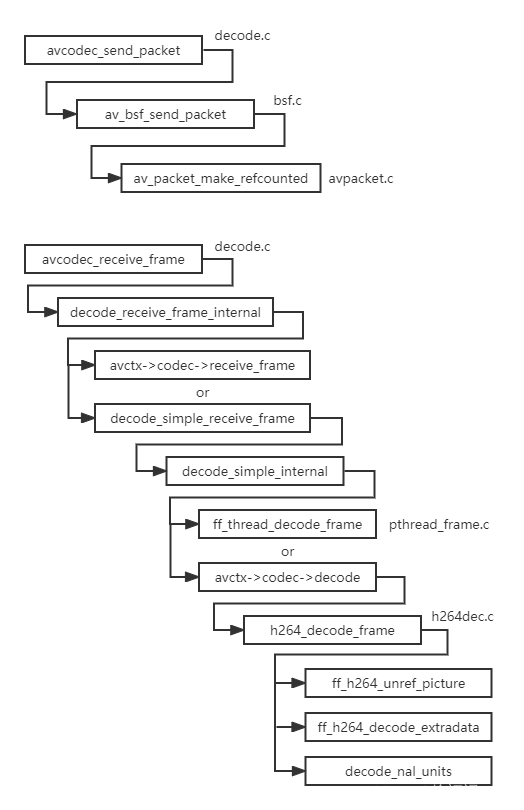
avcodec_send_packet()函数位于libavcodec/decode.c,具体如下:
int avcodec_send_packet(AVCodecContext *avctx, const AVPacket *avpkt)
{
    AVCodecInternal *avci = avctx->internal;
    int ret;
    // 判断解码器是否打开,是否为解码器
    if (!avcodec_is_open(avctx) || !av_codec_is_decoder(avctx->codec))
        return AVERROR(EINVAL);
    if (avctx->internal->draining)
        return AVERROR_EOF;
    if (avpkt && !avpkt->size && avpkt->data)
        return AVERROR(EINVAL);

    av_packet_unref(avci->buffer_pkt);
    if (avpkt && (avpkt->data || avpkt->side_data_elems)) {
        ret = av_packet_ref(avci->buffer_pkt, avpkt);
        if (ret < 0)
            return ret;
    }
    // 发送packet到bitstream滤波器
    ret = av_bsf_send_packet(avci->bsf, avci->buffer_pkt);
    if (ret < 0) {
        av_packet_unref(avci->buffer_pkt);
        return ret;
    }
    if (!avci->buffer_frame->buf[0]) {
        ret = decode_receive_frame_internal(avctx, avci->buffer_frame);
        if (ret < 0 && ret != AVERROR(EAGAIN) && ret != AVERROR_EOF)
            return ret;
    }

    return 0;
}由此可见,内部是调用av_bsf_send_packet()函数把packet发送给bitstream滤波器,代码位于libavcodec/bsf.c,具体如下:
int av_bsf_send_packet(AVBSFContext *ctx, AVPacket *pkt)
{
    AVBSFInternal *bsfi = ctx->internal;
    int ret;

    if (!pkt || IS_EMPTY(pkt)) {
        bsfi->eof = 1;
        return 0;
    }
    if (bsfi->eof) {
        return AVERROR(EINVAL);
    }
    if (!IS_EMPTY(bsfi->buffer_pkt))
        return AVERROR(EAGAIN);
    // 申请AVPacket内存,并拷贝数据
    ret = av_packet_make_refcounted(pkt);
    if (ret < 0)
        return ret;
	// 把pkt指针赋值给bsfi->buffer_pkt
    av_packet_move_ref(bsfi->buffer_pkt, pkt);

    return 0;
}
av_bsf_send_packet()函数内部调用av_packet_make_refcounted()来申请AVPacket内存,并拷贝数据。然后调用av_packet_move_ref()函数把pkt指针赋值给bsfi->buffer_pkt。
avcodec_receive_frame()函数同样位于libavcodec/decode.c,主要是调用内部函数decode_receive_frame_internal()实现解码,具体代码如下:
int avcodec_receive_frame(AVCodecContext *avctx, AVFrame *frame)
{
    AVCodecInternal *avci = avctx->internal;
    int ret, changed;

    av_frame_unref(frame);
    // 判断解码器是否打开,是否为解码器
    if (!avcodec_is_open(avctx) || !av_codec_is_decoder(avctx->codec))
        return AVERROR(EINVAL);
    if (avci->buffer_frame->buf[0]) {
        av_frame_move_ref(frame, avci->buffer_frame);
    } else {
        ret = decode_receive_frame_internal(avctx, frame);
        if (ret < 0)
            return ret;
    }
    if (avctx->codec_type == AVMEDIA_TYPE_VIDEO) {
        ret = apply_cropping(avctx, frame);
        if (ret < 0) {
            av_frame_unref(frame);
            return ret;
        }
    }

    ......

    return 0;
}decode_receive_frame_internal()函数判断是否支持avctx->codec->receive_frame,如果支持就调用avctx->codec->receive_frame()函数进行解码,否则调用decode_simple_receive_frame()函数进行解码。具体如下:
static int decode_receive_frame_internal(AVCodecContext *avctx, AVFrame *frame)
{
    AVCodecInternal *avci = avctx->internal;
    int ret;

    if (avctx->codec->receive_frame) {
        ret = avctx->codec->receive_frame(avctx, frame);
        if (ret != AVERROR(EAGAIN))
            av_packet_unref(avci->last_pkt_props);
    } else {
        ret = decode_simple_receive_frame(avctx, frame);
	}
    ......

    /* free the per-frame decode data */
    av_buffer_unref(&frame->private_ref);
    return ret;
}decode_simple_receive_frame()函数又调用decode_simple_internal()内部函数进行解码:
static int decode_simple_receive_frame(AVCodecContext *avctx, AVFrame *frame)
{
    int ret;
    int64_t discarded_samples = 0;

    while (!frame->buf[0]) {
        if (discarded_samples > avctx->max_samples)
            return AVERROR(EAGAIN);
        ret = decode_simple_internal(avctx, frame, &discarded_samples);
        if (ret < 0)
            return ret;
    }

    return 0;
}由描述可知,decode_simple_internal()函数是解码器的核心封装函数。我们应该循环调用avcodec_receive_frame()函数,直到返回EAGAIN。通过判断是否需要特定线程进行解码,如果需要就调用ff_thread_decode_frame()函数,否则调用avctx->codec->decode指向的解码函数。具体调用过程如下:
/*
 * The core of the receive_frame_wrapper for the decoders implementing
 * the simple API. Certain decoders might consume partial packets without
 * returning any output, so this function needs to be called in a loop until it
 * returns EAGAIN.
 **/
static inline int decode_simple_internal(AVCodecContext *avctx,
										 AVFrame *frame,
										 int64_t *discarded_samples)
{
    AVCodecInternal   *avci = avctx->internal;
    DecodeSimpleContext *ds = &avci->ds;
    AVPacket           *pkt = ds->in_pkt;
    int got_frame, actual_got_frame;
    int ret;

    if (!pkt->data && !avci->draining) {
        av_packet_unref(pkt);
        ret = ff_decode_get_packet(avctx, pkt);
        if (ret < 0 && ret != AVERROR_EOF)
            return ret;
    }
    if (avci->draining_done)
        return AVERROR_EOF;

    if (!pkt->data &&
        !(avctx->codec->capabilities & AV_CODEC_CAP_DELAY ||
          avctx->active_thread_type & FF_THREAD_FRAME))
        return AVERROR_EOF;

    got_frame = 0;

    if (HAVE_THREADS && avctx->active_thread_type & FF_THREAD_FRAME) {
        ret = ff_thread_decode_frame(avctx, frame, &got_frame, pkt);
    } else {
        ret = avctx->codec->decode(avctx, frame, &got_frame, pkt);

        ......
    }

	......

    return ret < 0 ? ret : 0;
}ff_thread_decode_frame()函数位于libavcodec/pthread_frame.c。首先是调用submit_packet()函数提交packet到下一个解码线程,然后调用数组中最前面线程进行解码。相关代码如下:
int ff_thread_decode_frame(AVCodecContext *avctx,
                           AVFrame *picture,
						   int *got_picture_ptr,
                           AVPacket *avpkt)
{
    FrameThreadContext *fctx = avctx->internal->thread_ctx;
    int finished = fctx->next_finished;
    PerThreadContext *p;
    int err;
    async_unlock(fctx);

    /*
     * Submit a packet to the next decoding thread.
     */
    p = &fctx->threads[fctx->next_decoding];
    err = submit_packet(p, avctx, avpkt);
    if (err)
        goto finish;

    ......

    /* Return the next available frame from the oldest thread.*/
    do {
        p = &fctx->threads[finished++];
        if (atomic_load(&p->state) != STATE_INPUT_READY) {
            pthread_mutex_lock(&p->progress_mutex);
            while (atomic_load_explicit(&p->state, memory_order_relaxed) != STATE_INPUT_READY)
                pthread_cond_wait(&p->output_cond, &p->progress_mutex);
            pthread_mutex_unlock(&p->progress_mutex);
        }
        av_frame_move_ref(picture, p->frame);
        *got_picture_ptr = p->got_frame;
        picture->pkt_dts = p->avpkt->dts;
        err = p->result;
        p->got_frame = 0;
        p->result = 0;

        if (finished >= avctx->thread_count) finished = 0;
    } while (!avpkt->size && !*got_picture_ptr && err >= 0 && finished != fctx->next_finished);

    update_context_from_thread(avctx, p->avctx, 1);
    if (fctx->next_decoding >= avctx->thread_count)
		fctx->next_decoding = 0;
    fctx->next_finished = finished;
    /* return the size of the consumed packet if no error occurred */
    if (err >= 0)
        err = avpkt->size;
finish:
    async_lock(fctx);
    return err;
}以h264解码器为例,位于libavcodec/h264dec.c,对应的AVCodec如下:
AVCodec ff_h264_decoder = {
    .name                  = "h264",
    .long_name             = NULL_IF_CONFIG_SMALL("H.264/AVC/MPEG-4 AVC/MPEG-4 part10"),
    .type                  = AVMEDIA_TYPE_VIDEO,
    .id                    = AV_CODEC_ID_H264,
    .priv_data_size        = sizeof(H264Context),
    .init                  = h264_decode_init,
    .close                 = h264_decode_end,
    .decode                = h264_decode_frame,
    .capabilities          = AV_CODEC_CAP_DR1 |
                             AV_CODEC_CAP_DELAY | AV_CODEC_CAP_SLICE_THREADS |
                             AV_CODEC_CAP_FRAME_THREADS,
    .flush                 = h264_decode_flush,
    .update_thread_context = ONLY_IF_THREADS_ENABLED(ff_h264_update_thread_context),
    .profiles              = NULL_IF_CONFIG_SMALL(ff_h264_profiles),
    .priv_class            = &h264_class,
};
此时, avctx->codec->decode函数指针指向的是h264_decode_frame。如果存在extradata就调用ff_h264_decode_extradata()函数解析,最关键是调用decode_nal_units()函数来解码NAL单元。相关代码如下:
static int h264_decode_frame(AVCodecContext *avctx, void *data,
                             int *got_frame, AVPacket *avpkt)
{
    ......

    ff_h264_unref_picture(h, &h->last_pic_for_ec);
    /* end of stream, output what is still in the buffers */
    if (buf_size == 0)
        return send_next_delayed_frame(h, pict, got_frame, 0);

    if (av_packet_get_side_data(avpkt, AV_PKT_DATA_NEW_EXTRADATA, NULL)) {
        buffer_size_t side_size;
        uint8_t *side = av_packet_get_side_data(avpkt, AV_PKT_DATA_NEW_EXTRADATA, &side_size);
        ff_h264_decode_extradata(side, side_size,
                                 &h->ps, &h->is_avc, &h->nal_length_size,
                                 avctx->err_recognition, avctx);
    }
    if (h->is_avc && buf_size >= 9 && buf[0]==1 && buf[2]==0 && (buf[4]&0xFC)==0xFC) {
		// 解析avcc对应的extradata
        if (is_avcc_extradata(buf, buf_size))
            return ff_h264_decode_extradata(buf, buf_size,
                                            &h->ps, &h->is_avc, &h->nal_length_size,
                                            avctx->err_recognition, avctx);
    }
	// 解码NAL单元
    buf_index = decode_nal_units(h, buf, buf_size);
    if (buf_index < 0)
        return AVERROR_INVALIDDATA;
    if (!h->cur_pic_ptr && h->nal_unit_type == H264_NAL_END_SEQUENCE) {
        av_assert0(buf_index <= buf_size);
        return send_next_delayed_frame(h, pict, got_frame, buf_index);
    }
    if (!(avctx->flags2 & AV_CODEC_FLAG2_CHUNKS) && (!h->cur_pic_ptr || !h->has_slice)) {
        if (avctx->skip_frame >= AVDISCARD_NONREF ||
            buf_size >= 4 && !memcmp("Q264", buf, 4))
            return buf_size;
        return AVERROR_INVALIDDATA;
    }
    if (!(avctx->flags2 & AV_CODEC_FLAG2_CHUNKS) ||
        (h->mb_y >= h->mb_height && h->mb_height)) {
        if ((ret = ff_h264_field_end(h, &h->slice_ctx[0], 0)) < 0)
            return ret;

        /* Wait for second field. */
        if (h->next_output_pic) {
            ret = finalize_frame(h, pict, h->next_output_pic, got_frame);
            if (ret < 0)
                return ret;
        }
    }

    ff_h264_unref_picture(h, &h->last_pic_for_ec);
    return get_consumed_bytes(buf_index, buf_size);
}由于avcodec_decode_video2()函数已经过时,所以内部提供compat_decode()来兼容旧版本,具体代码如下:
int avcodec_decode_video2(AVCodecContext *avctx, AVFrame *picture,
                                              int *got_picture_ptr,
                                              const AVPacket *avpkt)
{
    return compat_decode(avctx, picture, got_picture_ptr, avpkt);
}
我们来看看compat_decode()函数源码,其实内部也是调用avcodec_send_packet()和avcodec_receive_frame()进行解码,具体如下:
static int compat_decode(AVCodecContext *avctx, AVFrame *frame,
                         int *got_frame, const AVPacket *pkt)
{
    AVCodecInternal *avci = avctx->internal;
    int ret = 0;
    *got_frame = 0;

    if (avci->draining_done && pkt && pkt->size != 0) {
        avcodec_flush_buffers(avctx);
    }
    if (avci->compat_decode_partial_size > 0 &&
        avci->compat_decode_partial_size != pkt->size) {
        ret = AVERROR(EINVAL);
        goto finish;
    }
    if (!avci->compat_decode_partial_size) {
		// 调用avcodec_send_packet发送packet
        ret = avcodec_send_packet(avctx, pkt);
        if (ret == AVERROR_EOF)
            ret = 0;
        else if (ret == AVERROR(EAGAIN)) {
            /* we fully drain all the output in each decode call, so this should not
             * ever happen */
            ret = AVERROR_BUG;
            goto finish;
        } else if (ret < 0)
            goto finish;
    }

    while (ret >= 0) {
		// 循环调用avcodec_receive_frame接收frame
        ret = avcodec_receive_frame(avctx, frame);
        if (ret < 0) {
            if (ret == AVERROR(EAGAIN) || ret == AVERROR_EOF)
                ret = 0;
            goto finish;
        }

        if (frame != avci->compat_decode_frame) {
            if (!avctx->refcounted_frames) {
                ret = unrefcount_frame(avci, frame);
                if (ret < 0)
                    goto finish;
            }

            *got_frame = 1;
            frame = avci->compat_decode_frame;
        } else {
            if (!avci->compat_decode_warned) {
                avci->compat_decode_warned = 1;
            }
        }

        if (avci->draining || (!avctx->codec->bsfs
			&& avci->compat_decode_consumed < pkt->size)) {
            break;
		}
    }

finish:
    if (ret == 0) {
        /* if there are any bsfs then assume full packet is always consumed */
        if (avctx->codec->bsfs)
            ret = pkt->size;
        else
            ret = FFMIN(avci->compat_decode_consumed, pkt->size);
    }
    avci->compat_decode_consumed = 0;
    avci->compat_decode_partial_size = (ret >= 0) ? pkt->size - ret : 0;

    return ret;
}和avcodec_decode_video2()函数一样,avcodec_decode_audio4()函数已经过时,内部也是提供compat_decode()来兼容旧版本,具体代码如下:
int avcodec_decode_audio4(AVCodecContext *avctx,
                                              AVFrame *frame,
                                              int *got_frame_ptr,
                                              const AVPacket *avpkt)
{
    return compat_decode(avctx, frame, got_frame_ptr, avpkt);
}
至此,avcodec_send_packet()和avcodec_receive_frame()组成的解码函数已经分析完毕。
学习FFmpeg与代码实践,可参考:FFmpegAndroid
一、引擎主循环UE版本:4.27一、引擎主循环的位置:Launch.cpp:GuardedMain函数二、、GuardedMain函数执行逻辑:1、EnginePreInit:加载大多数模块int32ErrorLevel=EnginePreInit(CmdLine);PreInit模块加载顺序:模块加载过程:(1)注册模块中定义的UObject,同时为每个类构造一个类默认对象(CDO,记录类的默认状态,作为模板用于子类实例创建)(2)调用模块的StartUpModule方法2、FEngineLoop::Init()1、检查Engine的配置文件找出使用了哪一个GameEngine类(UGame
动漫制作技巧是很多新人想了解的问题,今天小编就来解答与大家分享一下动漫制作流程,为了帮助有兴趣的同学理解,大多数人会选择动漫培训机构,那么今天小编就带大家来看看动漫制作要掌握哪些技巧?一、动漫作品首先完成草图设计和原型制作。设计草图要有目的、有对象、有步骤、要形象、要简单、符合实际。设计图要一致性,以保证制作的顺利进行。二、原型制作是根据设计图纸和制作材料,可以是手绘也可以是3d软件创建。在此步骤中,要注意的问题是色彩和平面布局。三、动漫制作制作完成后,加工成型。完成不同的表现形式后,就要对设计稿进行加工处理,使加工的难易度降低,并得到一些基本准确的概念,以便于后续的大样、准确的尺寸制定。四、
2022/8/4更新支持加入水印水印必须包含透明图像,并且水印图像大小要等于原图像的大小pythonconvert_image_to_video.py-f30-mwatermark.pngim_dirout.mkv2022/6/21更新让命令行参数更加易用新的命令行使用方法pythonconvert_image_to_video.py-f30im_dirout.mkvFFMPEG命令行转换一组JPG图像到视频时,是将这组图像视为MJPG流。我需要转换一组PNG图像到视频,FFMPEG就不认了。pyav内置了ffmpeg库,不需要系统带有ffmpeg工具因此我使用ffmpeg的python包装p
Transformers开始在视频识别领域的“猪突猛进”,各种改进和魔改层出不穷。由此作者将开启VideoTransformer系列的讲解,本篇主要介绍了FBAI团队的TimeSformer,这也是第一篇使用纯Transformer结构在视频识别上的文章。如果觉得有用,就请点赞、收藏、关注!paper:https://arxiv.org/abs/2102.05095code(offical):https://github.com/facebookresearch/TimeSformeraccept:ICML2021author:FacebookAI一、前言Transformers(VIT)在图
我正在尝试使用以下代码通过将ffmpeg实用程序作为子进程运行并获取其输出并解析它来确定视频分辨率:IO.popen'ffmpeg-i'+path_to_filedo|ffmpegIO|#myparsegoeshereend...但是ffmpeg输出仍然连接到标准输出并且ffmepgIO.readlines是空的。ffmpeg实用程序是否需要一些特殊处理?或者还有其他方法可以获得ffmpeg输出吗?我在WinXP和FedoraLinux下测试了这段代码-结果是一样的。 最佳答案 要跟进mouviciel的评论,您需要使用类似pope
目前我正在使用这个正则表达式从YoutubeURL中提取视频ID:url.match(/v=([^&]*)/)[1]我怎样才能改变它,以便它也可以从这个没有v参数的YoutubeURL获取视频ID:http://www.youtube.com/user/SHAYTARDS#p/u/9/Xc81AajGUMU感谢阅读。编辑:我正在使用ruby1.8.7 最佳答案 对于Ruby1.8.7,这就可以了。url_1='http://www.youtube.com/watch?v=8WVTOUh53QY&feature=feedf'url
如果我说x.hello()在Java中,对象x正在“调用”它包含的方法。在Ruby中,对象x正在“接收”它包含的方法。这只是表达相同想法的不同术语,还是意识形态上的根本差异?来自Java,我发现Ruby的“接收器”想法非常令人困惑。也许有人可以解释这与Java的关系? 最佳答案 在您的示例中,x不调用hello()。包含该片段的任何对象都是“调用”(即,它是“调用者”)。在Java中,x可以称为接收者;它正在接收对hello()方法的调用。 关于java-Java中的"caller"和R
我已经安装了DeviseonRails4.2.0,一切似乎都在工作,我使用了以下指南:http://sourcey.com/rails-4-omniauth-using-devise-with-twitter-facebook-and-linkedin/我的设计模块是:devise:database_authenticatable,:registerable,:confirmable,:recoverable,:rememberable,:trackable,:validatable,:omniauthable唯一的问题是,如果我尝试通过转到注册页面创建一个新帐户,然后在输入我的电子邮
有人可以帮忙吗?我的堆栈是带有nginx/passenger和ruby2.2.2的ubuntu-server14.04。我无法使我的项目投入生产。在开发中一切运行正常。secret.ymlproduction:secret_key_base:secret_token:服务器server{listen80;server_namelogvs.local;passenger_enabledon;passenger_app_envdevelopment;root/var/www/logvs/public;}错误日志App2532stderr:[2015-06-0722:56:01.4724
这段代码来self发现的一个示例,计算数组中等于其索引的元素数。但是怎么办?[4,1,2,0].to_enum(:count).each_with_index{|elem,index|elem==index}我无法仅通过链接来完成,而且链中的求值顺序令人困惑。我的理解是我们正在使用Enumerable#count的重载,如果给定一个block,它会计算产生真值的元素的数量。我看到each_with_index具有判断项目是否等于其索引的逻辑。我不明白的是each_with_index如何成为count的block参数,或者为什么each_with_index像被调用一样工作直接在[4,
