目录
在深度学习快速发展的今天,对于不同深度学习模型的超参数优化(hyperparameter optimization),始终是一个比较头痛的问题。在超参较少的情况下,grid search是比较常见的方式,但是随着超参数量的不断增多,特别是对于神经网络而言,训练过程的超参和NN本身的超参组成的参数空间是巨大的,grid search方法会消耗巨大的资源,而且效果很差,因此寻找一个“机器炼丹”的框架十分必要。
optuna 是一个十分常用的超参数调优框架,具有操作简单,嵌入式强和动态调整参数空间等优点。另外还有其他框架也可以进行超参优化,如李沐老师提到的automl等。
首先需要在命令行 pip install optuna 载入这个第三方库,载入之后import即可。
optuna中需要注意几个关键的名词:
trail::一次实验
study::一次学习过程(包括多次实验)
import optuna
def obj(trail):
	x = trail.suggest_float('x',1,5)
	return (x-3)*(x-3)
stu = optuna.creat_study(study_name = 'test', direction = 'minimize')
stu.optimize(obj, n_trials = 50)
print(study.best_params)
print(study.best_trial)
print(study.best_trial.value)
该段实例代码中,函数obj定义一个含参数的需要优化的模块,带调整的超参数为 ‘x’ ,返回值为该模块的 objective value。超参x的类型为float,可调整空间为 [1,5] 左右都闭区间,常用的还有suggest_int表示整型,suggest_categorical表示字符串集合。
trail.suggest_int('name', 10, 50)
trail.suggest_categorical('active', ['relu', 'sigmoid', 'tanh'])
study表示一个学习过程,direction参数为“minimize”表示对函数obj 的返回值(同时也是每次trial的objective value)向最小的方向优化。
optuna.visualization中包含了丰富的可视化工具。比较推荐使用的是以下三个:
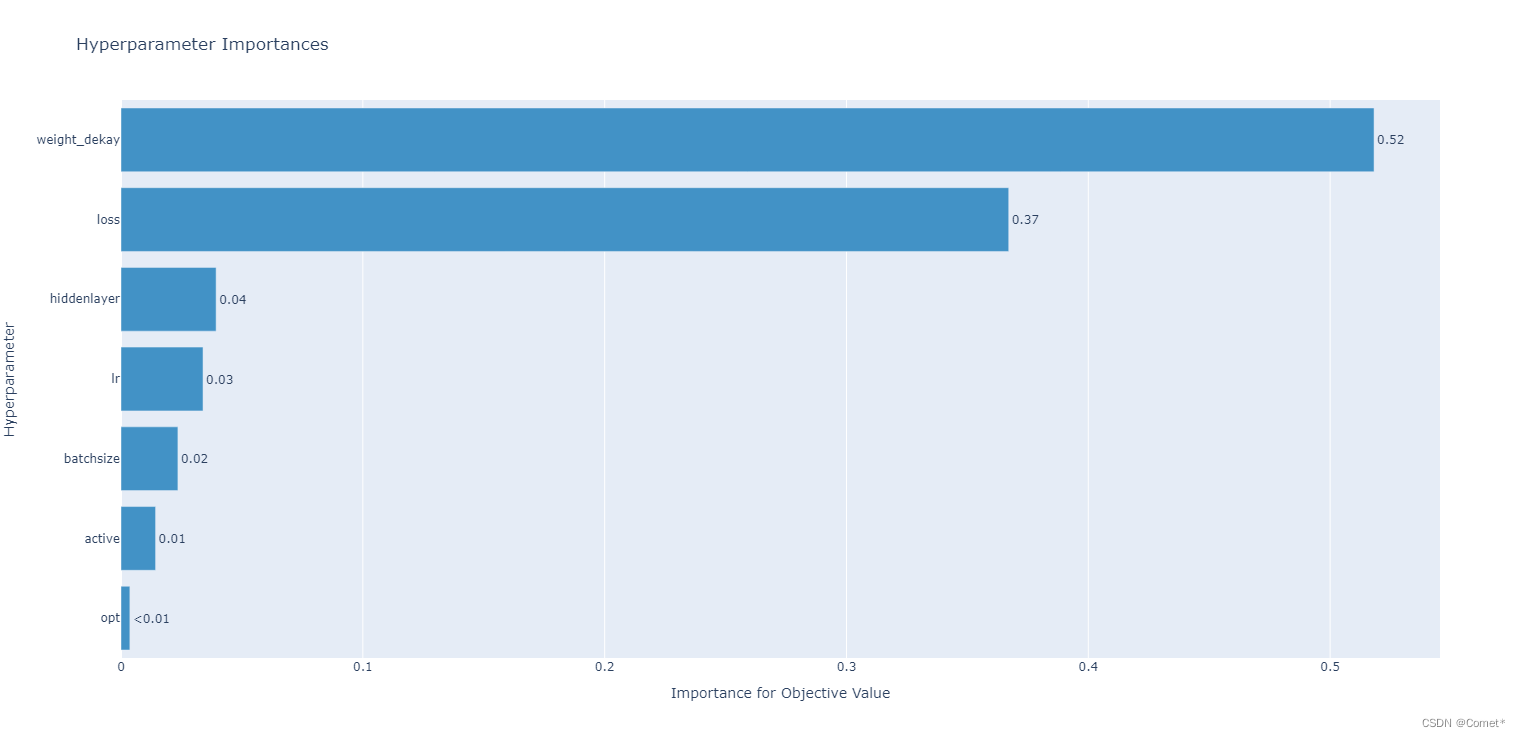
optuna.visualization.plot_param_importances(stu).show()
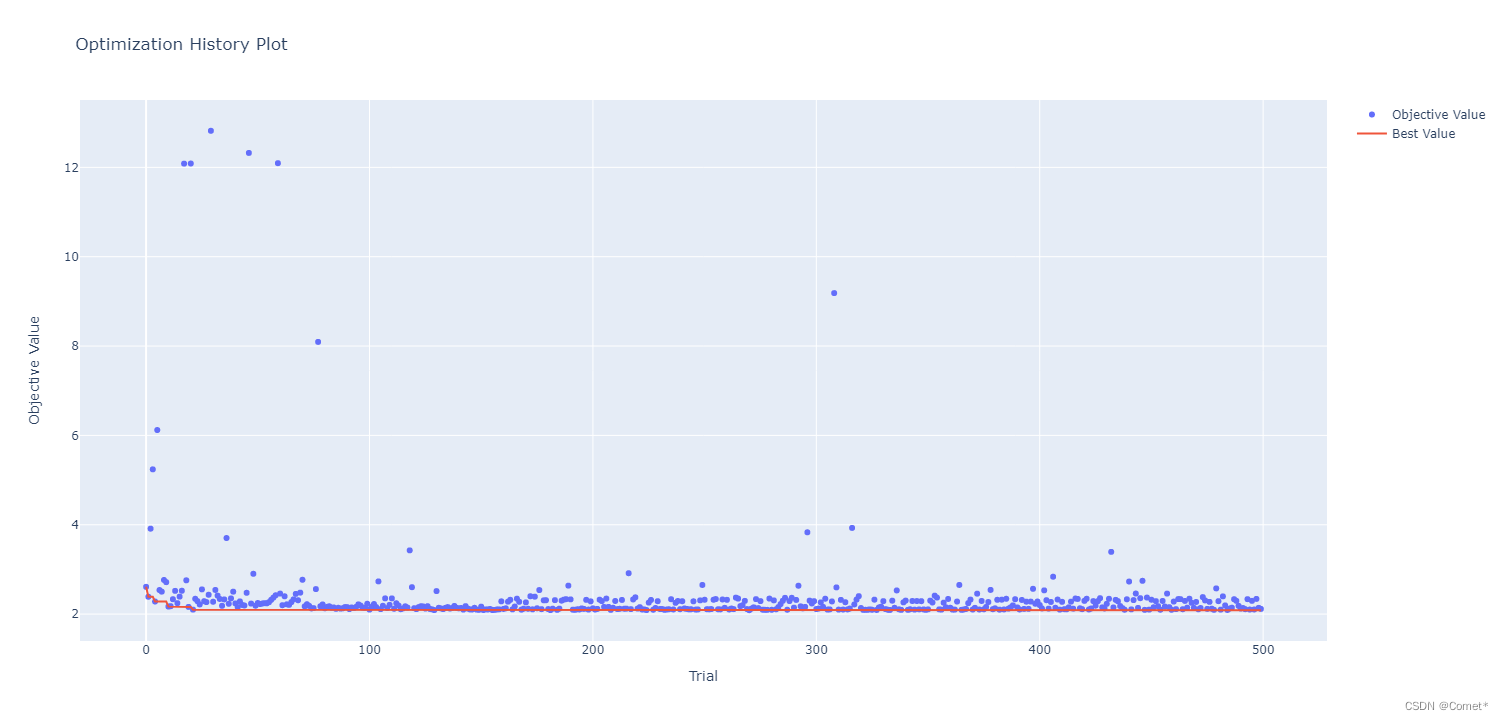
optuna.visualization.plot_optimization_history(stu).show()
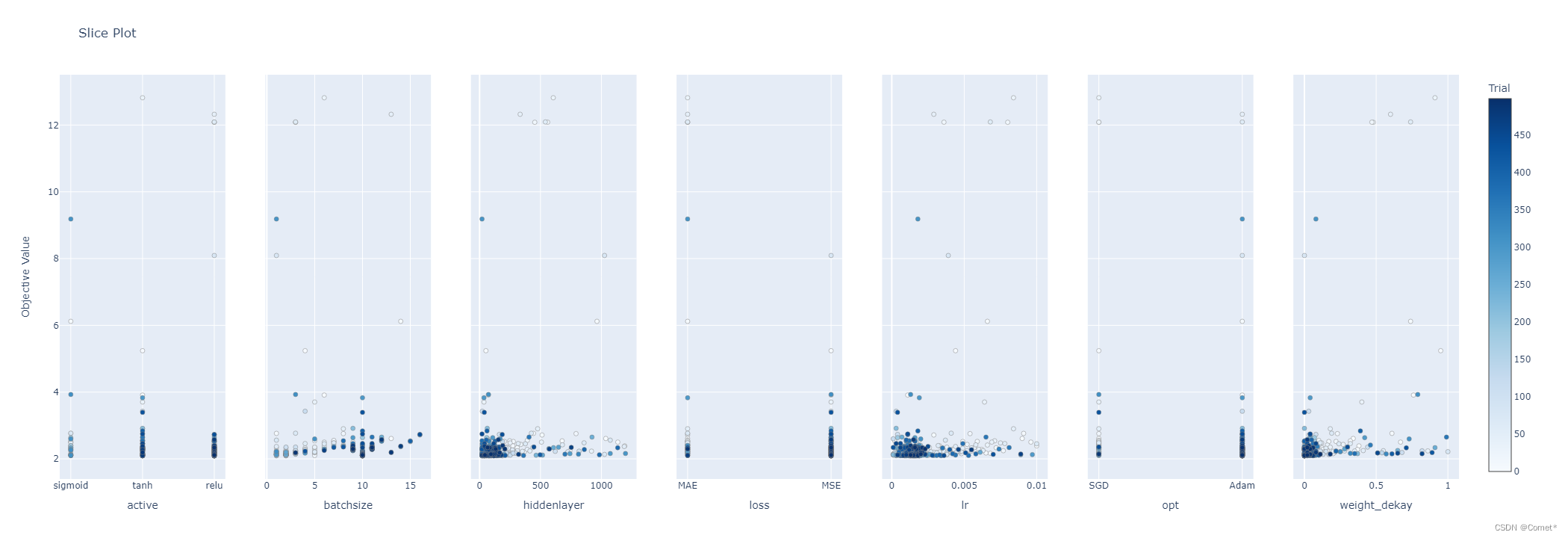
optuna.visualization.plot_slice(stu).show()
plot_param_importances 展示各个超参数对结果影响的重要性
plot_optimization_history 展示在n_trail 个trail中每次的objective value和当前的最优解
plot_slice 展示每个超参数在所有trail中取值的分布,以散点图的形式
在pytorch构建的MLP中进行使用,可以看到该调参框架是十分灵活的,可以设置训练参数,如batchsize,learning rate,也可也设置NN的参数,如隐藏层数目,激活函数类型等。
import torch
from torch import nn, optim
from torch.utils.data import DataLoader
from torch.autograd import Variable  # 获取变量

import optuna

def train(batch_size, learning_rate, lossfunc, opt, hidden_layer, activefunc, weightdk,momentum):  # 选出一些超参数
    trainset_num = 800
    testset_num = 50

    train_dataset = myDataset(trainset_num)
    test_dataset = myDataset(testset_num)
    train_loader = DataLoader(train_dataset, batch_size=batch_size, shuffle=True)
    test_loader = DataLoader(test_dataset, batch_size=batch_size, shuffle=True)


    # 创建CNN模型, 并设置损失函数及优化器
    model = MLP(hidden_layer, activefunc).cuda()
    # print(model)
    if lossfunc == 'MSE':
        criterion = nn.MSELoss().cuda()
    elif lossfunc == 'MAE':
        criterion = nn.L1Loss()

    # optimizer = optim.Adam(model.parameters(), lr=learning_rate, weight_decay=weightdk)
    optimizer =optim.RMSprop(model.parameters(),lr=learning_rate,weight_decay=weightdk, momentum=momentum)
    # 训练过程
    for epoch in range(num_epoches):
        # 训练模式
        model.train()
        for i, data in enumerate(train_loader):
            inputs, labels, _ = data
            inputs = Variable(inputs).float().cuda()
            labels = Variable(labels).float().cuda()
            # 前向传播
            out = model(inputs)
            # 可以考虑加正则项
            train_loss = criterion(out, labels)
            optimizer.zero_grad()
            train_loss.backward()
            optimizer.step()

    model.eval()

    testloss = test() #返回测试集合上的MAE
    print('Test MAE = ', resloss)
    return resloss


def objective(trail):
    batchsize = trail.suggest_int('batchsize', 1, 16)
    lr = trail.suggest_float('lr', 1e-4, 1e-2,step=0.0001)
    lossfunc = trail.suggest_categorical('loss', ['MSE', 'MAE'])
    opt = trail.suggest_categorical('opt', ['Adam', 'SGD'])
    hidden_layer = trail.suggest_int('hiddenlayer', 20, 1200)
    activefunc = trail.suggest_categorical('active', ['relu', 'sigmoid', 'tanh'])
    weightdekey = trail.suggest_float('weight_dekay', 0, 1,step=0.01)
    momentum= trail.suggest_float('momentum',0,1,step=0.01)
    loss = train(batchsize, lr, lossfunc, opt, hidden_layer, activefunc, weightdekey,momentum)
    return loss

if __name__ == '__main__':
    st=time.time()
    study = optuna.create_study(study_name='test', direction='minimize')
    study.optimize(objective, n_trials=500)
    print(study.best_params)
    print(study.best_trial)
    print(study.best_trial.value)
    print(time.time()-st)
    optuna.visualization.plot_param_importances(study).show()
    optuna.visualization.plot_optimization_history(study).show()
    optuna.visualization.plot_slice(study).show()
exe应该在我打开页面时运行。异步进程需要运行。有什么方法可以在ruby中使用两个参数异步运行exe吗?我已经尝试过ruby命令-system()、exec()但它正在等待过程完成。我需要用参数启动exe,无需等待进程完成是否有任何rubygems会支持我的问题? 最佳答案 您可以使用Process.spawn和Process.wait2:pid=Process.spawn'your.exe','--option'#Later...pid,status=Process.wait2pid您的程序将作为解释器的子进程执行。除
我有一些Ruby代码,如下所示:Something.createdo|x|x.foo=barend我想编写一个测试,它使用double代替block参数x,这样我就可以调用:x_double.should_receive(:foo).with("whatever").这可能吗? 最佳答案 specify'something'dox=doublex.should_receive(:foo=).with("whatever")Something.should_receive(:create).and_yield(x)#callthere
我正在为一个项目制作一个简单的shell,我希望像在Bash中一样解析参数字符串。foobar"helloworld"fooz应该变成:["foo","bar","helloworld","fooz"]等等。到目前为止,我一直在使用CSV::parse_line,将列分隔符设置为""和.compact输出。问题是我现在必须选择是要支持单引号还是双引号。CSV不支持超过一个分隔符。Python有一个名为shlex的模块:>>>shlex.split("Test'helloworld'foo")['Test','helloworld','foo']>>>shlex.split('Test"
我不确定传递给方法的对象的类型是否正确。我可能会将一个字符串传递给一个只能处理整数的函数。某种运行时保证怎么样?我看不到比以下更好的选择:defsomeFixNumMangler(input)raise"wrongtype:integerrequired"unlessinput.class==FixNumother_stuffend有更好的选择吗? 最佳答案 使用Kernel#Integer在使用之前转换输入的方法。当无法以任何合理的方式将输入转换为整数时,它将引发ArgumentError。defmy_method(number)
两者都可以defsetup(options={})options.reverse_merge:size=>25,:velocity=>10end和defsetup(options={}){:size=>25,:velocity=>10}.merge(options)end在方法的参数中分配默认值。问题是:哪个更好?您更愿意使用哪一个?在性能、代码可读性或其他方面有什么不同吗?编辑:我无意中添加了bang(!)...并不是要询问nobang方法与bang方法之间的区别 最佳答案 我倾向于使用reverse_merge方法:option
我有一个只接受一个参数的方法:defmy_method(number)end如果使用number调用方法,我该如何引发错误??通常,我如何定义方法参数的条件?比如我想在调用的时候报错:my_method(1) 最佳答案 您可以添加guard在函数的开头,如果参数无效则引发异常。例如:defmy_method(number)failArgumentError,"Inputshouldbegreaterthanorequalto2"ifnumbereputse.messageend#=>Inputshouldbegreaterthano
我没有找到太多关于如何执行此操作的信息,尽管有很多关于如何使用像这样的redirect_to将参数传递给重定向的建议:action=>'something',:controller=>'something'在我的应用程序中,我在路由文件中有以下内容match'profile'=>'User#show'我的表演Action是这样的defshow@user=User.find(params[:user])@title=@user.first_nameend重定向发生在同一个用户Controller中,就像这样defregister@title="Registration"@user=Use
对于作为String#tr参数的单引号字符串文字中反斜杠的转义状态,我觉得有些神秘。你能解释一下下面三个例子之间的对比吗?我特别不明白第二个。为了避免复杂化,我在这里使用了'd',在双引号中转义时不会改变含义("\d"="d")。'\\'.tr('\\','x')#=>"x"'\\'.tr('\\d','x')#=>"\\"'\\'.tr('\\\d','x')#=>"x" 最佳答案 在tr中转义tr的第一个参数非常类似于正则表达式中的括号字符分组。您可以在表达式的开头使用^来否定匹配(替换任何不匹配的内容)并使用例如a-f来匹配一
我正在使用RubyonRails3.0.9,我想生成一个传递一些自定义参数的link_toURL。也就是说,有一个articles_path(www.my_web_site_name.com/articles)我想生成如下内容:link_to'Samplelinktitle',...#HereIshouldimplementthecode#=>'http://www.my_web_site_name.com/articles?param1=value1¶m2=value2&...我如何编写link_to语句“alàRubyonRailsWay”以实现该目的?如果我想通过传递一些
Transformers开始在视频识别领域的“猪突猛进”,各种改进和魔改层出不穷。由此作者将开启VideoTransformer系列的讲解,本篇主要介绍了FBAI团队的TimeSformer,这也是第一篇使用纯Transformer结构在视频识别上的文章。如果觉得有用,就请点赞、收藏、关注!paper:https://arxiv.org/abs/2102.05095code(offical):https://github.com/facebookresearch/TimeSformeraccept:ICML2021author:FacebookAI一、前言Transformers(VIT)在图
