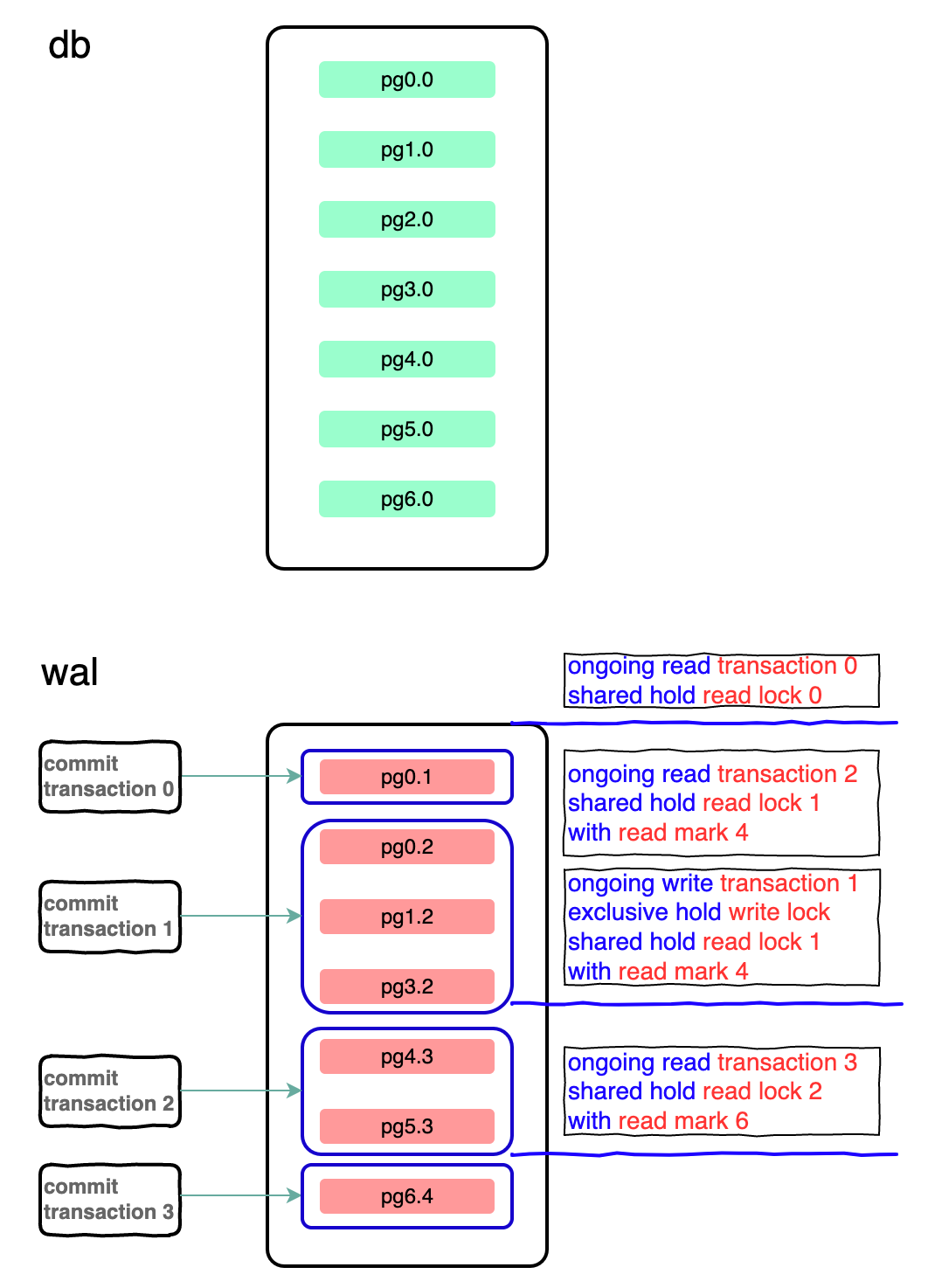
 sqlite 提供了一种 redo log 型事务实现,支持读写的并发,见 write-ahead log(https://sqlite.org/wal.html)。
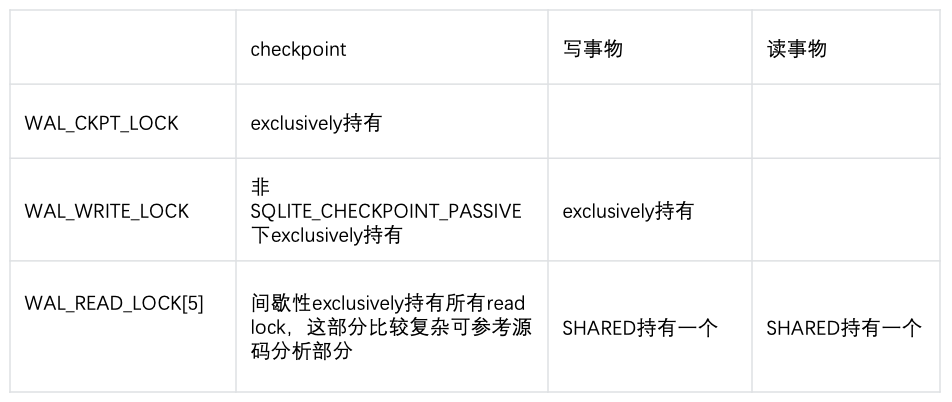
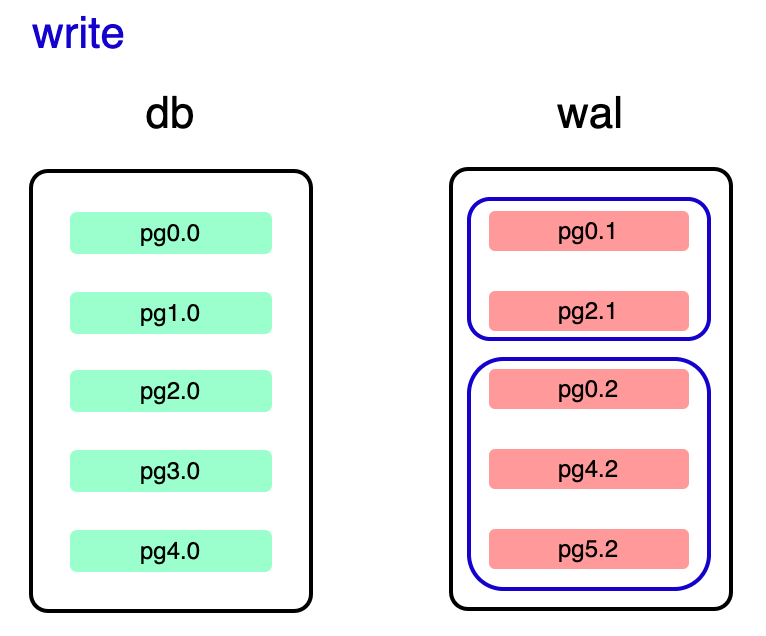 关于写
关于写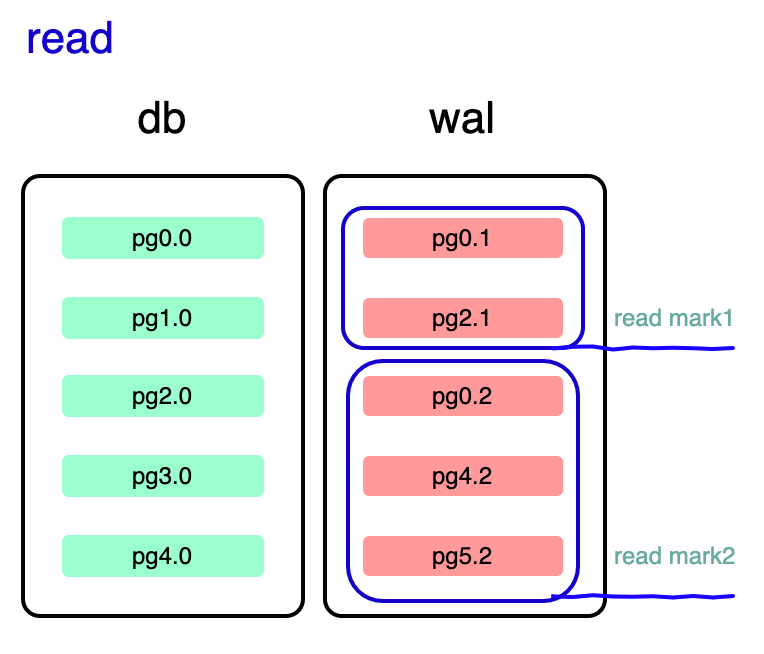 关于读
关于读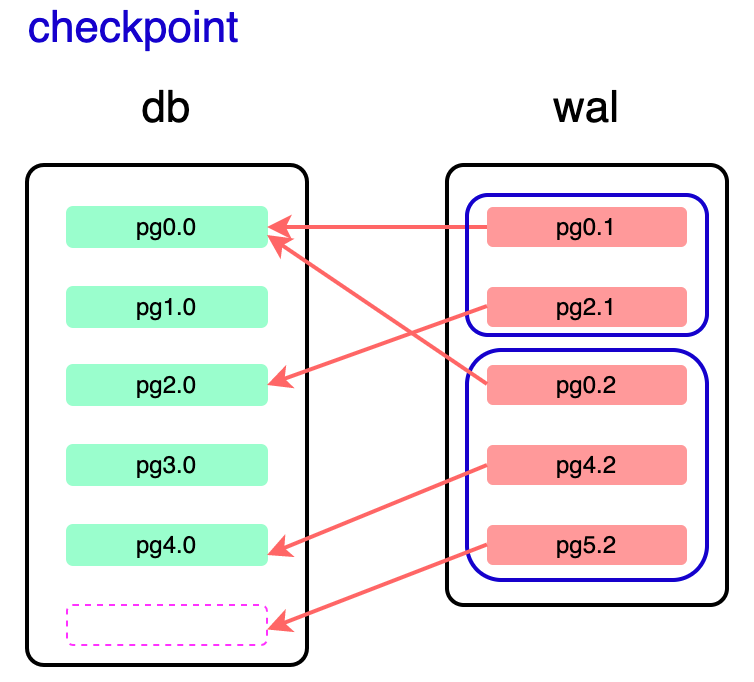 关于 checkpoint: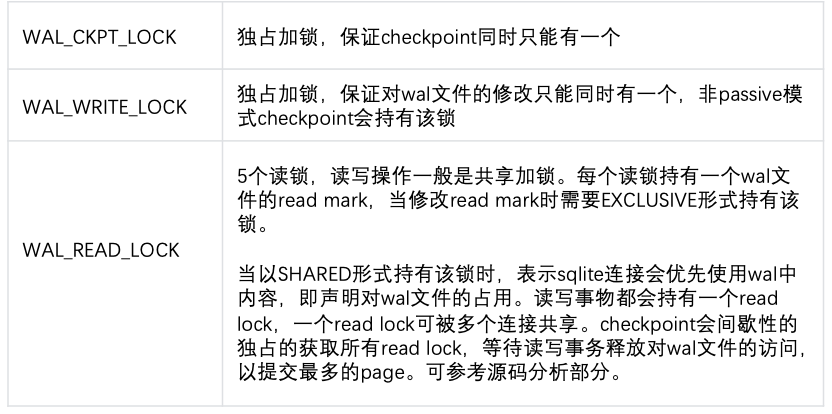
 /* 只在非SQLITE_CHECKPOINT_PASSIVE模式时设置xBusyHandler
  * 即SQLITE_CHECKPOINT_PASSIVE时如果获取不到锁,立即返回,不进行等待并retry
  */
 if( pPager->pWal ){
    rc = sqlite3WalCheckpoint(pPager->pWal, db, eMode,
        (eMode==SQLITE_CHECKPOINT_PASSIVE ? 0 : pPager->xBusyHandler),
        pPager->pBusyHandlerArg,
        pPager->walSyncFlags, pPager->pageSize, (u8 *)pPager->pTmpSpace,
        pnLog, pnCkpt
    );
}int sqlite3WalCheckpoint(
Wal *pWal, /* Wal connection */
int eMode, /* PASSIVE, FULL, RESTART, or TRUNCATE */
int (*xBusy)(void*), /* Function to call when busy */
void *pBusyArg, /* Context argument for xBusyHandler */
int sync_flags, /* Flags to sync db file with (or 0) */
int nBuf, /* Size of temporary buffer */
u8 *zBuf, /* Temporary buffer to use */
int *pnLog, /* OUT: Number of frames in WAL */
int *pnCkpt /* OUT: Number of backfilled frames in WAL */
){
int rc; /* Return code */
int isChanged = 0; /* True if a new wal-index header is loaded */
int eMode2 = eMode; /* Mode to pass to walCheckpoint() */
int (*xBusy2)(void*) = xBusy; /* Busy handler for eMode2 */
assert( pWal->ckptLock==0 );
assert( pWal->writeLock==0 );
/* EVIDENCE-OF: R-62920-47450 The busy-handler callback is never invoked
** in the SQLITE_CHECKPOINT_PASSIVE mode. */
assert( eMode!=SQLITE_CHECKPOINT_PASSIVE || xBusy==0 );
if( pWal->readOnly ) return SQLITE_READONLY;
WALTRACE(("WAL%p: checkpoint begins\n", pWal));
/* IMPLEMENTATION-OF: R-62028-47212 All calls obtain an exclusive
** "checkpoint" lock on the database file. */
// 独占获取WAL_CKPT_LOCK锁
rc = walLockExclusive(pWal, WAL_CKPT_LOCK, 1);
if( rc ){
/* EVIDENCE-OF: R-10421-19736 If any other process is running a
** checkpoint operation at the same time, the lock cannot be obtained and
** SQLITE_BUSY is returned.
** EVIDENCE-OF: R-53820-33897 Even if there is a busy-handler configured,
** it will not be invoked in this case.
*/
testcase( rc==SQLITE_BUSY );
testcase( xBusy!=0 );
return rc;
}
pWal->ckptLock = 1;
/* IMPLEMENTATION-OF: R-59782-36818 The SQLITE_CHECKPOINT_FULL, RESTART and
** TRUNCATE modes also obtain the exclusive "writer" lock on the database
** file.
**
** EVIDENCE-OF: R-60642-04082 If the writer lock cannot be obtained
** immediately, and a busy-handler is configured, it is invoked and the
** writer lock retried until either the busy-handler returns 0 or the
** lock is successfully obtained.
*/
// 非SQLITE_CHECKPOINT_PASSIVE时,独占获取WAL_WRITE_LOCK锁,并进行busy retry
if( eMode!=SQLITE_CHECKPOINT_PASSIVE ){
rc = walBusyLock(pWal, xBusy, pBusyArg, WAL_WRITE_LOCK, 1);
if( rc==SQLITE_OK ){
pWal->writeLock = 1;
}else if( rc==SQLITE_BUSY ){
eMode2 = SQLITE_CHECKPOINT_PASSIVE;
xBusy2 = 0;
rc = SQLITE_OK;
}
}
//如果wal-index显示db有变化,unfetch db文件,和主线逻辑关系不大
/* Read the wal-index header. */
if( rc==SQLITE_OK ){
rc = walIndexReadHdr(pWal, &isChanged);
if( isChanged && pWal->pDbFd->pMethods->iVersion>=3 ){
sqlite3OsUnfetch(pWal->pDbFd, 0, 0);
}
}
/* Copy data from the log to the database file. */
if( rc==SQLITE_OK ){
if( pWal->hdr.mxFrame && walPagesize(pWal)!=nBuf ){
rc = SQLITE_CORRUPT_BKPT;
}else{
// checkpoint
rc = walCheckpoint(pWal, eMode2, xBusy2, pBusyArg, sync_flags, zBuf);
}
/* If no error occurred, set the output variables. */
if( rc==SQLITE_OK || rc==SQLITE_BUSY ){
if( pnLog ) *pnLog = (int)pWal->hdr.mxFrame;
if( pnCkpt ) *pnCkpt = (int)(walCkptInfo(pWal)->nBackfill);
}
}
// release wal index,非主线逻辑
if( isChanged ){
/* If a new wal-index header was loaded before the checkpoint was
** performed, then the pager-cache associated with pWal is now
** out of date. So zero the cached wal-index header to ensure that
** next time the pager opens a snapshot on this database it knows that
** the cache needs to be reset.
*/
memset(&pWal->hdr, 0, sizeof(WalIndexHdr));
}
// 释放锁,返回
/* Release the locks. */
sqlite3WalEndWriteTransaction(pWal);
walUnlockExclusive(pWal, WAL_CKPT_LOCK, 1);
pWal->ckptLock = 0;
WALTRACE(("WAL%p: checkpoint %s\n", pWal, rc ? "failed" : "ok"));
return (rc==SQLITE_OK && eMode!=eMode2 ? SQLITE_BUSY : rc);
}static int walCheckpoint(
Wal *pWal, /* Wal connection */
int eMode, /* One of PASSIVE, FULL or RESTART */
int (*xBusy)(void*), /* Function to call when busy */
void *pBusyArg, /* Context argument for xBusyHandler */
int sync_flags, /* Flags for OsSync() (or 0) */
u8 *zBuf /* Temporary buffer to use */
){
int rc = SQLITE_OK; /* Return code */
int szPage; /* Database page-size */
WalIterator *pIter = 0; /* Wal iterator context */
u32 iDbpage = 0; /* Next database page to write */
u32 iFrame = 0; /* Wal frame containing data for iDbpage */
u32 mxSafeFrame; /* Max frame that can be backfilled */
u32 mxPage; /* Max database page to write */
int i; /* Loop counter */
volatile WalCkptInfo *pInfo; /* The checkpoint status information */
szPage = walPagesize(pWal);
testcase( szPage<=32768 );
testcase( szPage>=65536 );
pInfo = walCkptInfo(pWal);
if( pInfo->nBackfill<pWal->hdr.mxFrame ){
/* Allocate the iterator */
rc = walIteratorInit(pWal, &pIter);
if( rc!=SQLITE_OK ){
return rc;
}
assert( pIter );
/* EVIDENCE-OF: R-62920-47450 The busy-handler callback is never invoked
** in the SQLITE_CHECKPOINT_PASSIVE mode. */
assert( eMode!=SQLITE_CHECKPOINT_PASSIVE || xBusy==0 );
/* Compute in mxSafeFrame the index of the last frame of the WAL that is
** safe to write into the database. Frames beyond mxSafeFrame might
** overwrite database pages that are in use by active readers and thus
** cannot be backfilled from the WAL.
*/
mxSafeFrame = pWal->hdr.mxFrame;
mxPage = pWal->hdr.nPage;
/* 计算mxSafeFrame
* 会尝试独占的获取aReadMark锁,如果获取到,则代表原先持有对应aReadMark锁的事务已经结束。
* 会不断的用busy rerty逻辑等待对应的读锁释放。
* 如果对应事物一直没有释放aReadMark锁,最终的 mxSafeFrame = MIN(unfinished_aReadMarks)
*/
for(i=1; i<WAL_NREADER; i++){
/* Thread-sanitizer reports that the following is an unsafe read,
** as some other thread may be in the process of updating the value
** of the aReadMark[] slot. The assumption here is that if that is
** happening, the other client may only be increasing the value,
** not decreasing it. So assuming either that either the "old" or
** "new" version of the value is read, and not some arbitrary value
** that would never be written by a real client, things are still
** safe. */
u32 y = pInfo->aReadMark[i];
if( mxSafeFrame>y ){
assert( y<=pWal->hdr.mxFrame );
// 尝试获取 WAL_READ_LOCK(i)锁,并进行忙等待
rc = walBusyLock(pWal, xBusy, pBusyArg, WAL_READ_LOCK(i), 1);
if( rc==SQLITE_OK ){
// 成功获取 WAL_READ_LOCK(i)锁,设置为READMARK_NOT_USED;i==1,是个treak,不影响主流程
pInfo->aReadMark[i] = (i==1 ? mxSafeFrame : READMARK_NOT_USED);
walUnlockExclusive(pWal, WAL_READ_LOCK(i), 1);
}else if( rc==SQLITE_BUSY ){
// 一直没有获取对应WAL_READ_LOCK(i)锁,设置mxSafeFrame为y
mxSafeFrame = y;
xBusy = 0;
}else{
goto walcheckpoint_out;
}
}
}
// 开始从wal文件写回db文件,此时独占的持有WAL_READ_LOCK(0)
if( pInfo->nBackfill<mxSafeFrame
&& (rc = walBusyLock(pWal, xBusy, pBusyArg, WAL_READ_LOCK(0),1))==SQLITE_OK
){
i64 nSize; /* Current size of database file */
u32 nBackfill = pInfo->nBackfill;
pInfo->nBackfillAttempted = mxSafeFrame;
/* Sync the WAL to disk */
if( sync_flags ){
rc = sqlite3OsSync(pWal->pWalFd, sync_flags);
}
/* If the database may grow as a result of this checkpoint, hint
** about the eventual size of the db file to the VFS layer.
*/
if( rc==SQLITE_OK ){
i64 nReq = ((i64)mxPage * szPage);
rc = sqlite3OsFileSize(pWal->pDbFd, &nSize);
if( rc==SQLITE_OK && nSize<nReq ){
sqlite3OsFileControlHint(pWal->pDbFd, SQLITE_FCNTL_SIZE_HINT, &nReq);
}
}
// 逻辑比较简单,遍历并回写
/* Iterate through the contents of the WAL, copying data to the db file */
while( rc==SQLITE_OK && 0==walIteratorNext(pIter, &iDbpage, &iFrame) ){
i64 iOffset;
assert( walFramePgno(pWal, iFrame)==iDbpage );
if( iFrame<=nBackfill || iFrame>mxSafeFrame || iDbpage>mxPage ){
continue;
}
iOffset = walFrameOffset(iFrame, szPage) + WAL_FRAME_HDRSIZE;
/* testcase( IS_BIG_INT(iOffset) ); // requires a 4GiB WAL file */
rc = sqlite3OsRead(pWal->pWalFd, zBuf, szPage, iOffset);
if( rc!=SQLITE_OK ) break;
iOffset = (iDbpage-1)*(i64)szPage;
testcase( IS_BIG_INT(iOffset) );
rc = sqlite3OsWrite(pWal->pDbFd, zBuf, szPage, iOffset);
if( rc!=SQLITE_OK ) break;
}
/* If work was actually accomplished... */
if( rc==SQLITE_OK ){
if( mxSafeFrame==walIndexHdr(pWal)->mxFrame ){
i64 szDb = pWal->hdr.nPage*(i64)szPage;
testcase( IS_BIG_INT(szDb) );
rc = sqlite3OsTruncate(pWal->pDbFd, szDb);
if( rc==SQLITE_OK && sync_flags ){
rc = sqlite3OsSync(pWal->pDbFd, sync_flags);
}
}
if( rc==SQLITE_OK ){
/* 更新nBackfill为已经checkpoint的部分
* nBackfill记录当前已经checkpoint的部分
*/
pInfo->nBackfill = mxSafeFrame;
}
}
/* Release the reader lock held while backfilling */
// 释放 WAL_READ_LOCK(0)
walUnlockExclusive(pWal, WAL_READ_LOCK(0), 1);
}
if( rc==SQLITE_BUSY ){
/* Reset the return code so as not to report a checkpoint failure
** just because there are active readers. */
rc = SQLITE_OK;
}
}
/* If this is an SQLITE_CHECKPOINT_RESTART or TRUNCATE operation, and the
** entire wal file has been copied into the database file, then block
** until all readers have finished using the wal file. This ensures that
** the next process to write to the database restarts the wal file.
*/
// 非passive的checkpoint的区别都在这里
if( rc==SQLITE_OK && eMode!=SQLITE_CHECKPOINT_PASSIVE ){
assert( pWal->writeLock );
if( pInfo->nBackfill<pWal->hdr.mxFrame ){
// 没有全部checkpoint
rc = SQLITE_BUSY;
}else if( eMode>=SQLITE_CHECKPOINT_RESTART ){
// RESTART or TRUNCATE
u32 salt1;
sqlite3_randomness(4, &salt1);
assert( pInfo->nBackfill==pWal->hdr.mxFrame );
// 获取所有读锁, 保证下一个事物能够重新开始restart,即循环利用wal文件
rc = walBusyLock(pWal, xBusy, pBusyArg, WAL_READ_LOCK(1), WAL_NREADER-1);
if( rc==SQLITE_OK ){
if( eMode==SQLITE_CHECKPOINT_TRUNCATE ){
/* IMPLEMENTATION-OF: R-44699-57140 This mode works the same way as
** SQLITE_CHECKPOINT_RESTART with the addition that it also
** truncates the log file to zero bytes just prior to a
** successful return.
**
** In theory, it might be safe to do this without updating the
** wal-index header in shared memory, as all subsequent reader or
** writer clients should see that the entire log file has been
** checkpointed and behave accordingly. This seems unsafe though,
** as it would leave the system in a state where the contents of
** the wal-index header do not match the contents of the
** file-system. To avoid this, update the wal-index header to
** indicate that the log file contains zero valid frames. */
walRestartHdr(pWal, salt1);
// Truncate wal文件
rc = sqlite3OsTruncate(pWal->pWalFd, 0);
}
walUnlockExclusive(pWal, WAL_READ_LOCK(1), WAL_NREADER-1);
}
}
}
walcheckpoint_out:
walIteratorFree(pIter);
return rc;
}目录0专栏介绍1平面2R机器人概述2运动学建模2.1正运动学模型2.2逆运动学模型2.3机器人运动学仿真3动力学建模3.1计算动能3.2势能计算与动力学方程3.3动力学仿真0专栏介绍?附C++/Python/Matlab全套代码?课程设计、毕业设计、创新竞赛必备!详细介绍全局规划(图搜索、采样法、智能算法等);局部规划(DWA、APF等);曲线优化(贝塞尔曲线、B样条曲线等)。?详情:图解自动驾驶中的运动规划(MotionPlanning),附几十种规划算法1平面2R机器人概述如图1所示为本文的研究本体——平面2R机器人。对参数进行如下定义:机器人广义坐标
网站的日志分析,是seo优化不可忽视的一门功课,但网站越大,每天产生的日志就越大,大站一天都可以产生几个G的网站日志,如果光靠肉眼去分析,那可能看到猴年马月都看不完,因此借助网站日志分析工具去分析网站日志,那将会使网站日志分析工作变得更简单。下面推荐两款网站日志分析软件。第一款:逆火网站日志分析器逆火网站日志分析器是一款功能全面的网站服务器日志分析软件。通过分析网站的日志文件,不仅能够精准的知道网站的访问量、网站的访问来源,网站的广告点击,访客的地区统计,搜索引擎关键字查询等,还能够一次性分析多个网站的日志文件,让你轻松管理网站。逆火网站日志分析器下载地址:https://pan.baidu.
一、机器人介绍 此处是基于MATLABRVC工具箱,对ABB-IRB-1200型号的微型机械臂进行正逆向运动学分析,并利Simulink工具实现对机械臂进行具有动力学参数的末端轨迹规划仿真,最后根据机械模型设计Simulink-Adams联合仿真。 图1.ABBIRB 1200尺寸参数示意图ABBIRB 1200提供的两种型号广泛适用于各作业,且两者间零部件通用,两种型号的工作范围分别为700 mm 和 900 mm,大有效负载分别为 7 kg 和5 kg。 IRB 1200 能够在狭小空间内能发挥其工作范围与性能优势,具有全新的设计、小型化的体积、高效的性能、易于集成、便捷的接
目录一.大致如下常见问题:(1)找不到程序所依赖的Qt库version`Qt_5'notfound(requiredby(2)CouldnotLoadtheQtplatformplugin"xcb"in""eventhoughitwasfound(3)打包到在不同的linux系统下,或者打包到高版本的相同系统下,运行程序时,直接提示段错误即segmentationfault,或者Illegalinstruction(coredumped)非法指令(4)ldd应用程序或者库,查看运行所依赖的库时,直接报段错误二.问题逐个分析,得出解决方法:(1)找不到程序所依赖的Qt库version`Qt_5'
我想使用ruby-prof和JMeter分析Rails应用程序。我对分析特定Controller/操作/或模型方法的建议方法不感兴趣,我想分析完整堆栈,从上到下。所以我运行这样的东西:RAILS_ENV=productionruby-prof-fprof.outscript/server>/dev/null然后我在上面运行我的JMeter测试计划。然而,问题是使用CTRL+C或SIGKILL中断它也会在ruby-prof可以写入任何输出之前杀死它。如何在不中断ruby-prof的情况下停止mongrel服务器? 最佳答案
文章目录认识unity打包目录结构游戏逆向流程Unity游戏攻击面可被攻击原因mono的打包建议方案锁血飞天无限金币攻击力翻倍以上统称内存挂透视自瞄压枪瞬移内购破解Unity游戏防御开发时注意数据安全接入第三方反作弊系统外挂检测思路狠人自爆实战查看目录结构用il2cppdumper例子2-森林whoishe后记认识unity打包目录结构dll一般很大,因为里面是所有的游戏功能编译成的二进制码游戏逆向流程开发人员代码被编译打包到GameAssembly.dll中使用il2ppDumper工具,并借助游戏名_Data\il2cpp_data\Metadata\global-metadata.dat
在笔者前面有一篇文章《驱动开发:断链隐藏驱动程序自身》通过摘除驱动的链表实现了断链隐藏自身的目的,但此方法恢复时会触发PG会蓝屏,偶然间在网上找到了一个作者介绍的一种方法,觉得有必要详细分析一下他是如何实现的进程隐藏的,总体来说作者的思路是最终寻找到MiProcessLoaderEntry的入口地址,该函数的作用是将驱动信息加入链表和移除链表,运用这个函数即可动态处理驱动的添加和移除问题。MiProcessLoaderEntry(pDriverObject->DriverSection,1)添加MiProcessLoaderEntry(pDriverObject->DriverSection,
目录1. 研究范围定义2. 流程中台市场分析3. 厂商评估:微宏科技4. 入选证书 1. 研究范围定义近年来,随着外部市场环境快速变化、客户需求愈发多样,企业逐渐意识到,自身业务需要更加敏捷、高效,具备根据市场需求快速迭代的能力。业务流程的自动化能够帮助企业实现业务的敏捷高效,因此受到越来越多企业的关注。企业的“自动化武器库”品类丰富,包括低/零代码平台、RPA、BPM、AI等。企业可以使用多项自动化工具,但结果往往是各项自动化工具处于各自的“自动化烟囱”之中,仅能实现碎片式自动化。例如,某企业的IT团队可能在使用低代码平台、财务团队可能在使用RPA、呼叫中心则可能在使用聊天机器人。自动
我可以使用什么来分析1.9.2中的代码?我发现所有版本的ruby-prof都针对1.9.2存在段错误。例如,当我添加gem"ruby-prof"到我的Rails项目的Gemfile并运行bundlebundleexecruby-profconfig/environment.rb我遇到段错误。城里有新的分析gem吗?有没有办法让ruby-prof玩得很好? 最佳答案 不确定它是否有帮助,但我偶然发现了这一点,它可能会增加一点清晰度或引导您走上不同的道路:http://www.devheads.net/development/r
查看原文>>>基于”PLUS模型+“生态系统服务多情景模拟预测实践技术应用目录第一章、理论基础与软件讲解第二章、数据获取与制备第三章、土地利用格局模拟第四章、生态系统服务评估第五章、时空变化及驱动机制分析第六章、论文撰写技巧及案例分析基于ArcGISPro、Python、USLE、INVEST模型等多技术融合的生态系统服务构建生态安全格局基于生态系统服务(InVEST模型)的人类活动、重大工程生态成效评估、论文写作等具体应用基于ArcGISPro、R、INVEST等多技术融合下生态系统服务权衡与协同动态分析实践应用 本文从数据、方法、实践三方面对生态系统服务多情景预测进行讲解。内容涵盖多
