文章目录
数据绑定:是应用程序 UI 与业务逻辑之间建立连接的过程。 如果绑定正确设置并且数据提供正确通知,则当数据的值发生更改时,绑定到数据的视觉元素会自动反映更改。 数据绑定可能还意味着如果视觉元素中数据的外部表现形式发生更改,则基础数据可以自动更新以反映更改。
例如:如果用户编辑 TextBox 元素中的值,则基础数据值会自动更新以反映该更改。
一个是绑定源,一个是绑定目标。绑定源即控件绑定所使用的源数据,绑定目标即数据显示的控件。
CLR对象:可以绑定到CLR类的公开的属性、子属性、索引器上。
ADO.Net对象:例如DataTable、DataView等 。
XML文件:使用XPath进行解析 。
DependencyObject:绑定到其依赖项属性上,即控件绑定控件 。
对于绑定目标,必须是WPF中的DependencyObject,将数据绑定到其依赖项属性上。
注释:如果无需监视目标属性的更改,则使用 OneWay 绑定模式可避免 TwoWay 绑定模式的系统开销。
大多数属性都默认为 OneWay 绑定,但是一些依赖项属性,通常为用户可编辑的控件的属性,如 TextBox 的 Text 属性和 CheckBox 的 IsChecked 属性,默认为 TwoWay 绑定。
如果要知道依赖项属性绑定在默认情况下是单向还是双向的编程方法可使用 GetMetadata 获取属性的属性元数据,然后检查 BindsTwoWayByDefault 属性的布尔值。
代码如下(示例):
<Page x:Class="WpfDemo.Page1"
    xmlns="http://schemas.microsoft.com/winfx/2006/xaml/presentation"
    xmlns:x="http://schemas.microsoft.com/winfx/2006/xaml"
    Title="Page1" HorizontalAlignment="Center">
    <Grid Name="GridTable" Height="360" Background="Silver">
		<Grid.RowDefinitions>
            <RowDefinition></RowDefinition>
            <RowDefinition></RowDefinition>
            <RowDefinition></RowDefinition>
            <RowDefinition></RowDefinition>
        </Grid.RowDefinitions>
        <Grid.ColumnDefinitions>
	        <ColumnDefinition Width="130"></ColumnDefinition>
	        <ColumnDefinition Width="150"></ColumnDefinition>
	        <ColumnDefinition Width="20"></ColumnDefinition>
        </Grid.ColumnDefinitions>
        <Label Width="130" Height="25"  Grid.Row="0" Grid.Column="0"  Name="label1">TwoWay</Label>
        <TextBox Width="150" Height="25"  Grid.Row="0" Grid.Column="1"  Name="textBox4" Text="{Binding ElementName=scrollBar1,Path=Value,Mode=TwoWay}" />
        <Label Width="130" Height="25"  Grid.Row="1" Grid.Column="0"  Name="label2">OneWay</Label>
        <TextBox Width="150" Height="25"  Grid.Row="1" Grid.Column="1"   Name="textBox1" Text="{Binding ElementName=scrollBar1, Path=Value,Mode=OneWay}"/>
        <Label Width="130" Height="25"  Grid.Row="2" Grid.Column="0"  Name="label3">OneWayToSource</Label>
        <TextBox Width="150" Height="25"  Grid.Row="2" Grid.Column="1"   Name="textBox2" Text="{Binding ElementName=scrollBar1, Path=Value,Mode=OneWayToSource}" />
        <Label Width="130" Height="25"  Grid.Row="3" Grid.Column="0"  Name="label4">OneTime</Label>
        <TextBox Width="150" Height="25"  Grid.Row="3" Grid.Column="1"   Name="textBox3" Text="{Binding ElementName=scrollBar1, Path=Value,Mode=OneTime}"/>
         <ScrollBar Value="30" Minimum="0" Grid.RowSpan="4" Grid.Row="0" Grid.Column="2" Maximum="100" Name="scrollBar1" Width="18" Height="{Binding ElementName=GridTable,Path=Height}" />
   </Grid>
</Page>
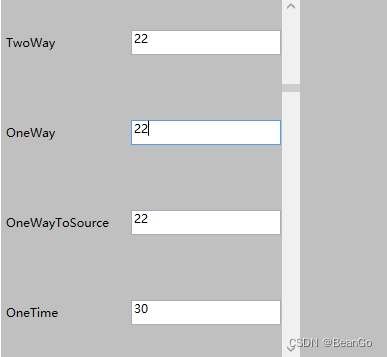
根据程序执行结果,我们可以得到以下结论:
问题:绑定源的值是在您编辑文本的同时进行更新,还是在您结束编辑文本并将鼠标指针从文本框移走后才进行更新呢?或者在您需要更新的情况下在手动的更新呢?
下图中右箭头的点演示 UpdateSourceTrigger 属性的角色:
TwoWay及OneWayToSource是由绑定目标到绑定源方向,若实现绑定目标的值更改影响绑定源的值方式,只需要设置相应控件绑定时的UpdateSourceTrigger的值,其值有三种:
PropertyChanged:当绑定目标属性更改时,立即更新绑定源。
LostFocus:当绑定目标元素失去焦点时,更新绑定源。
Explicit:仅在调用 UpdateSource 方法时更新绑定源。
注释:多数依赖项属性的UpdateSourceTrigger 值的默认值为 PropertyChanged,而 Text 属性的默认值为 LostFocus。
XAML:

<Page x:Class="WpfDemo.Changed"
    xmlns="http://schemas.microsoft.com/winfx/2006/xaml/presentation"
    xmlns:x="http://schemas.microsoft.com/winfx/2006/xaml"
    Title="Changed">
    <Grid Name="GridTable" Height="250" Background="Silver" Width="350">
        <Grid.RowDefinitions>
            <RowDefinition></RowDefinition>
            <RowDefinition></RowDefinition>
            <RowDefinition></RowDefinition>
            <RowDefinition></RowDefinition>
        </Grid.RowDefinitions>
        <Grid.ColumnDefinitions>
            <ColumnDefinition Width="100"></ColumnDefinition>
            <ColumnDefinition Width="150"></ColumnDefinition>
            <ColumnDefinition Width="100"></ColumnDefinition>
        </Grid.ColumnDefinitions>
        <TextBlock Grid.Row="0" Width="90" Height="25" Grid.Column="0" Name="label1" Text="PropertyChanged:"></TextBlock>
        <TextBlock Grid.Row="1"  Width="90" Height="25" Grid.Column="0" Name="label2" Text="LostFocus:"></TextBlock>
        <TextBlock Grid.Row="2"  Width="90" Height="25" Grid.Column="0" Name="label3" Text="Explicit:"></TextBlock>
        <TextBox Grid.Row="0" Width="150" Height="25" Text="{Binding Path=UserName,Mode=TwoWay,UpdateSourceTrigger=PropertyChanged}"  Grid.Column="1" Name="TextBox1" />
        <TextBox Grid.Row="1" Width="150" Height="25" Text="{Binding Path=UserName,Mode=TwoWay,UpdateSourceTrigger=LostFocus}"   Grid.Column="1"  Name="TextBox2" />
        <TextBox Grid.Row="2" Width="150" Height="25" Text="{Binding Path=UserName,Mode=TwoWay,UpdateSourceTrigger=Explicit}"   Grid.Column="1"  Name="txtExplicit" />
        <TextBlock Grid.Row="3" Width="90" Height="25"  Grid.Column="0" Name="lblResult" Text="结果:"></TextBlock>
        <TextBlock Grid.Row="3" Width="90" Height="25"  Grid.Column="1" Name="lblDisplay" Text="{Binding Path=UserName,Mode=OneWay}"></TextBlock>
        <Button Name="btnChanged" Width="90" Height="25" Grid.Row="3" Grid.Column="2">Explicit</Button>
    </Grid>
</Page>
C#:
namespace WpfDemo
{
    public partial class Changed : Page
    {

        #region properties

        public UserModel CurrentUser
        {
            get;set;
        }

        #endregion

        #region Constructor

        public Changed()
        {
            InitializeComponent();
            this.Loaded += new RoutedEventHandler(Changed_Loaded);
            this.btnChanged.Click += new RoutedEventHandler(btnChanged_Click);
        }

        #endregion

        #region Changed_Loaded

        void Changed_Loaded(object sender, RoutedEventArgs e)
        {
            this.CurrentUser = new UserModel() {UserName="swd"};
            this.DataContext = this.CurrentUser;
        }

        #endregion

        #region btnLogon_Click

        void btnChanged_Click(object sender, RoutedEventArgs e)
        {
          this.txtExplicit.GetBindingExpression(TextBox.TextProperty).UpdateSource();
        }

        #endregion
    }

    public class UserModel
    {
        public string UserName
        {
            get;set;}
    }
}
XmlDataProvider访问 XML 数据的方式有以下三种:
注释:当 XmlDocument.NodeChanged 事件发生时,XmlDataProvider 执行所有绑定的完全刷新。 特定节点不进行优化。
默认情况下,XmlDataProvider.IsAsynchronous 属性设置为 true,表示默认情况下 XmlDataProvider 检索数据并异步生成 XML 节点的集合。
以下将介绍使用上面所述的三种方式显示xml数据:
示例
Xaml:
<Page x:Class="WpfDemo.xmlBinding"
    xmlns="http://schemas.microsoft.com/winfx/2006/xaml/presentation"
    xmlns:x="http://schemas.microsoft.com/winfx/2006/xaml"
    Title="xmlBinding" xmlns:local="clr-namespace:WpfDemo">
    <Page.Resources>
        <XmlDataProvider x:Key="XmlFile" Source="Students.xml" XPath="/Students"></XmlDataProvider>
        <XmlDataProvider x:Key="InnerXmlStu" XPath="/Students">
            <x:XData>
                <Students xmlns="">
                    <Student><name>swd</name></Student>
                    <Student><name>awd</name></Student>
                    <Student><name>asd</name></Student>
                </Students>
            </x:XData>
        </XmlDataProvider>
    </Page.Resources>
    <Grid>
        <Grid.RowDefinitions>
            <RowDefinition></RowDefinition>
            <RowDefinition></RowDefinition>
            <RowDefinition></RowDefinition>
        </Grid.RowDefinitions>
        <Grid.ColumnDefinitions>
            <ColumnDefinition Width="100"></ColumnDefinition>
            <ColumnDefinition Width="150"></ColumnDefinition>
        </Grid.ColumnDefinitions>
        <TextBlock Grid.Row="0" Grid.Column="0"  Height="25" Width="100"  Text="引用XML文件"></TextBlock>
        <TextBlock Grid.Row="1" Grid.Column="0" Height="25" Width="100"   Text="内嵌XML"></TextBlock>
        <TextBlock Grid.Row="2" Grid.Column="0"  Height="25" Width="100"  Text="动态XML"></TextBlock>
        <ListBox Name="lisbXmlFile" Grid.Row="0" Grid.Column="1" Height="100" Width="150" ItemsSource="{Binding Source={StaticResource XmlFile},XPath=Student/name}">
        </ListBox>
        <ListBox Name="lisbInnerXml" Grid.Row="1" Grid.Column="1"  Height="100" Width="150" ItemsSource="{Binding Source={StaticResource InnerXmlStu},XPath=Student/name}">
        </ListBox>
        <ListBox Name="lisbXmlDoc" Grid.Row="2" Grid.Column="1"  Height="100"  Width="150" ItemsSource="{Binding XPath=Student/name}">
        </ListBox>
    </Grid>
</Page>
XML:
<?xml version="1.0" encoding="utf-8" ?>
<Students>
  <Student>
    <name>swd</name>
    <score>110</score>
  </Student>
  <Student>
    <name>asd</name>
    <score>120</score>
  </Student>
  <Student>
    <name>awd</name>
    <score>130</score>
  </Student>
</Students>
通过以上示例我想大家应该很容易理解与应用。
ObjectDataProvider 使您能够在 XAML 中创建可用作绑定源的对象,并为您提供以下属性,以对对象执行查询并绑定到结果。
使用 ConstructorParameters 属性将参数传递给对象的构造函数。
使用 MethodName 属性调用一个方法。
使用 MethodParameters 属性将参数传递给该方法。 然后,可以绑定到该方法的结果。
使用ObjectType 指定将提供数据绑定源的对象。
使用 ObjectInstance 属性来指定现有的对象实例作为源
注释:还可以使用 IsAsynchronous 属性指定是在辅助线程还是在活动上下文中执行对象创建。也就是是否异步检索数据。
示例:
XAML:
C#:
namespace WpfDemo
{
    #region CObjectDataProvider

    public partial class CObjectDataProvider : Page
    {
        public CObjectDataProvider()
        {InitializeComponent();}
    }

    #endregion

    #region Country

    public class Country
    {
        #region Name

        public string Name{get;set;}

        #endregion

        #region ProvinceList

        public List<Province> ProvinceList {get;set;}

        #endregion

        #region GetAllCity

        public static List<Country> GetAllCity()
        {
            return new List<Country>{
            new Country
            {
                Name = "中国",
                ProvinceList = new List<Province>
                {
                  new Province{ Name="福建省",CityList=new List<City>{new City{Name="福州市"},new City{Name="厦门市"},new City{Name="漳州市"},new City{Name="泉州市"}}},
                  new Province{Name="江苏省",CityList=new List<City>{new City{Name="苏州市"},new City{Name="南京市"},new City{Name="扬州市"},new City{Name="无锡市"}}},
               	  new Province{Name="江西省",CityList=new List<City>{new City{Name="南昌市"},new City{Name="九江市"}}}
               }
            };
        }

        #endregion

    }

    #endregion

	#region Province

    public class Province
    {
        #region Name

        public string Name{get;set;}

        #endregion

        #region CityList

        public List<City> CityList{get;set;}

        #endregion

    }

    #endregion

    #region City

    public class City
    {
        #region Name

        public string Name{get;set;}

        #endregion

    }

#endregion

}
提供一种将自定义逻辑应用于绑定的方式。
在Binding时,数据源对象到目标对象之间(或者目标对象到数据源对象)可能需要某种转换。这时只需实现IValueConverter接口自定义值转换器即可。
接口原型定义:
public interface IValueConverter
{
    object Convert(object value, Type targetType, object parameter, CultureInfo culture);
    object ConvertBack(object value, Type targetType, object parameter, CultureInfo culture);
}
参数value是要转换的值,typeTarget是转换后的值类型,parameter是Binding 类的 ConverterParameter传递过来的参数。
Convert方法:数据绑定引擎在将值从绑定源传播给绑定目标时,调用此方法。

ConvertBack方法:数据绑定引擎在将值从绑定目标传播给绑定源时,调用此方法。

ValueConversion属性作用是告诉自定义转换器类可以转换的源数据和目标数据的 类型(ValueConversion属性将在稍后的示例中看到)。
提供一种为检查用户输入的有效性而创建自定义规则的方法。
XAML:

<Page x:Class="WpfDemo.TypeConvertAndValidationRule"
    xmlns="http://schemas.microsoft.com/winfx/2006/xaml/presentation"
    xmlns:x="http://schemas.microsoft.com/winfx/2006/xaml"
    Title="TypeConvertAndValidationRule"
    xmlns:src="clr-namespace:WpfDemo">
    <Grid Height="250" Width="360" Background="Silver">
        <Grid.RowDefinitions>
		    <RowDefinition></RowDefinition>
		    <RowDefinition></RowDefinition>
		    <RowDefinition></RowDefinition>
       </Grid.RowDefinitions>
       <Grid.ColumnDefinitions>
            <ColumnDefinition></ColumnDefinition>
		    <ColumnDefinition></ColumnDefinition>
        </Grid.ColumnDefinitions>

        <TextBlock Height="25" Width="100" Text="生日"  Grid.Row="0" Grid.Column="0"></TextBlock>
        <TextBox Name="txtBirthday" Height="25" Width="150"  Grid.Row="0" Grid.Column="1">
            <TextBox.Text>
                <Binding Path="Birthday" UpdateSourceTrigger="LostFocus" Mode="TwoWay">
                   <Binding.ValidationRules><src:ValidationDateTimeRule/></Binding.ValidationRules>
                   <Binding.Converter><src:MyConverterOfBirthFormat/></Binding.Converter>
                </Binding>
           </TextBox.Text>
           <TextBox.ToolTip>
                <Binding RelativeSource="{RelativeSource Self}" Path="(Validation.Errors)        [0].ErrorContent"></Binding>
           </TextBox.ToolTip>
       </TextBox>
        <TextBlock Height="25" Width="150" Grid.Row="1" Text="{Binding Path=Birthday,Mode=OneWay}" Grid.Column="1"></TextBlock>
        <TextBlock Height="25" Width="100" Text="电子邮件格式检查" Grid.Row="2" Grid.Column="0"></TextBlock>
        <TextBox Height="25" Width="150" Grid.Row="2" Grid.Column="1">
            <TextBox.Text>
                <Binding Path="EMail">
                    <Binding.ValidationRules><ExceptionValidationRule /></Binding.ValidationRules>
                </Binding>
            </TextBox.Text>
            <TextBox.ToolTip>
                   <Binding RelativeSource="{RelativeSource Self}" Path="(Validation.Errors)[0].ErrorContent"></Binding>
            </TextBox.ToolTip>
       </TextBox>
    </Grid>
</Page>
C#:

namespace WpfDemo
{
    #region TypeConvertAndValidationRule

    public partial class TypeConvertAndValidationRule : Page
    {
        public TypeConvertAndValidationRule()
        {
            InitializeComponent();
            this.DataContext = new UserInfo { Name = "swd", Birthday =System.Convert.ToDateTime("1987/10/21"), EMail = "swd@126.com" };
        }
    }

    #endregion

    #region UserInfo

    public class UserInfo
    {
        #region Name

        public string Name{get;set;}

        #endregion

        #region Birthday

        public DateTime Birthday{get;set;}

        #endregion

        #region EMail

        private string email;

        public string EMail
        {
            get{return email;}
            set
            {
                this.email = value;
                Regex r = new Regex(@"^\w+([-+.]\w+)*@\w+([-.]\w+)*\.\w+([-.]\w+)*$");
                if (!r.IsMatch(value))
                {
                    throw new ApplicationException("电子邮件格式有误!");
                }
            }
        }

        #endregion

    }

    #endregion
允许集合具有当前记录管理、自定义排序、筛选和分组这些功能。比如排序,分组,筛选,导航以及其它自定义视图,并且这不会影响到你的后台数据的实际存储。
表示一个动态数据集合,在添加项、移除项或刷新整个列表时,此集合将提供通知。
MVVM(Model-View-ViewModel)是由MVC,MVP演变而来。MVVM分离了逻辑与界面,解放业务逻辑。
我主要使用Ruby来执行此操作,但到目前为止我的攻击计划如下:使用gemsrdf、rdf-rdfa和rdf-microdata或mida来解析给定任何URI的数据。我认为最好映射到像schema.org这样的统一模式,例如使用这个yaml文件,它试图描述数据词汇表和opengraph到schema.org之间的转换:#SchemaXtoschema.orgconversion#data-vocabularyDV:name:namestreet-address:streetAddressregion:addressRegionlocality:addressLocalityphoto:i
有时我需要处理键/值数据。我不喜欢使用数组,因为它们在大小上没有限制(很容易不小心添加超过2个项目,而且您最终需要稍后验证大小)。此外,0和1的索引变成了魔数(MagicNumber),并且在传达含义方面做得很差(“当我说0时,我的意思是head...”)。散列也不合适,因为可能会不小心添加额外的条目。我写了下面的类来解决这个问题:classPairattr_accessor:head,:taildefinitialize(h,t)@head,@tail=h,tendend它工作得很好并且解决了问题,但我很想知道:Ruby标准库是否已经带有这样一个类? 最佳
我正在尝试使用Curbgem执行以下POST以解析云curl-XPOST\-H"X-Parse-Application-Id:PARSE_APP_ID"\-H"X-Parse-REST-API-Key:PARSE_API_KEY"\-H"Content-Type:image/jpeg"\--data-binary'@myPicture.jpg'\https://api.parse.com/1/files/pic.jpg用这个:curl=Curl::Easy.new("https://api.parse.com/1/files/lion.jpg")curl.multipart_form_
无论您是想搭建桌面端、WEB端或者移动端APP应用,HOOPSPlatform组件都可以为您提供弹性的3D集成架构,同时,由工业领域3D技术专家组成的HOOPS技术团队也能为您提供技术支持服务。如果您的客户期望有一种在多个平台(桌面/WEB/APP,而且某些客户端是“瘦”客户端)快速、方便地将数据接入到3D应用系统的解决方案,并且当访问数据时,在各个平台上的性能和用户体验保持一致,HOOPSPlatform将帮助您完成。利用HOOPSPlatform,您可以开发在任何环境下的3D基础应用架构。HOOPSPlatform可以帮您打造3D创新型产品,HOOPSSDK包含的技术有:快速且准确的CAD
本教程将在Unity3D中混合Optitrack与数据手套的数据流,在人体运动的基础上,添加双手手指部分的运动。双手手背的角度仍由Optitrack提供,数据手套提供双手手指的角度。 01 客户端软件分别安装MotiveBody与MotionVenus并校准人体与数据手套。MotiveBodyMotionVenus数据手套使用、校准流程参照:https://gitee.com/foheart_1/foheart-h1-data-summary.git02 数据转发打开MotiveBody软件的Streaming,开始向Unity3D广播数据;MotionVenus中设置->选项选择Unit
文章目录一、概述简介原理模块二、配置Mysql使用版本环境要求1.操作系统2.mysql要求三、配置canal-server离线下载在线下载上传解压修改配置单机配置集群配置分库分表配置1.修改全局配置2.实例配置垂直分库水平分库3.修改group-instance.xml4.启动监听四、配置canal-adapter1修改启动配置2配置映射文件3启动ES数据同步查询所有订阅同步数据同步开关启动4.验证五、配置canal-admin一、概述简介canal是Alibaba旗下的一款开源项目,Java开发。基于数据库增量日志解析,提供增量数据订阅&消费。Git地址:https://github.co
我正在尝试在Rails上安装ruby,到目前为止一切都已安装,但是当我尝试使用rakedb:create创建数据库时,我收到一个奇怪的错误:dyld:lazysymbolbindingfailed:Symbolnotfound:_mysql_get_client_infoReferencedfrom:/Library/Ruby/Gems/1.8/gems/mysql2-0.3.11/lib/mysql2/mysql2.bundleExpectedin:flatnamespacedyld:Symbolnotfound:_mysql_get_client_infoReferencedf
文章目录1.开发板选择*用到的资源2.串口通信(个人理解)3.代码分析(注释比较详细)1.主函数2.串口1配置3.串口2配置以及中断函数4.注意问题5.源码链接1.开发板选择我用的是STM32F103RCT6的板子,不过代码大概在F103系列的板子上都可以运行,我试过在野火103的霸道板上也可以,主要看一下串口对应的引脚一不一样就行了,不一样的就更改一下。*用到的资源keil5软件这里用到了两个串口资源,采集数据一个,串口通信一个,板子对应引脚如下:串口1,TX:PA9,RX:PA10串口2,TX:PA2,RX:PA32.串口通信(个人理解)我就从串口采集传感器数据这个过程说一下我自己的理解,
SPI接收数据左移一位问题目录SPI接收数据左移一位问题一、问题描述二、问题分析三、探究原理四、经验总结最近在工作在学习调试SPI的过程中遇到一个问题——接收数据整体向左移了一位(1bit)。SPI数据收发是数据交换,因此接收数据时从第二个字节开始才是有效数据,也就是数据整体向右移一个字节(1byte)。请教前辈之后也没有得到解决,通过在网上查阅前人经验终于解决问题,所以写一个避坑经验总结。实际背景:MCU与一款芯片使用spi通信,MCU作为主机,芯片作为从机。这款芯片采用的是它规定的六线SPI,多了两根线:RDY和INT,这样从机就可以主动请求主机给主机发送数据了。一、问题描述根据从机芯片手
前言一般来说,前端根据后台返回code码展示对应内容只需要在前台判断code值展示对应的内容即可,但要是匹配的code码比较多或者多个页面用到时,为了便于后期维护,后台就会使用字典表让前端匹配,下面我将在微信小程序中通过wxs的方法实现这个操作。为什么要使用wxs?{{method(a,b)}}可以看到,上述代码是一个调用方法传值的操作,在vue中很常见,多用于数据之间的转换,但由于微信小程序诸多限制的原因,你并不能优雅的这样操作,可能有人会说,为什么不用if判断实现呢?但是if判断的局限性在于如果存在数据量过大时,大量重复性操作和if判断会让你的代码显得异常冗余。wxswxs相当于是一个独立
